Brookston Beer Bulletin

Jay R. Brooks on Beer

  • Home
  • About
  • Editorial
  • Birthdays
  • Art & Beer

Socialize

  • Dribbble
  • Email
  • Facebook
  • Flickr
  • GitHub
  • Instagram
  • LinkedIn
  • Pinterest
  • RSS
  • Twitter
  • YouTube

Powered by Genesis

Patent No. 141944A: Improvement In Apparatus For Preserving Beer On Draft

August 19, 2016 By Jay Brooks

patent-logo
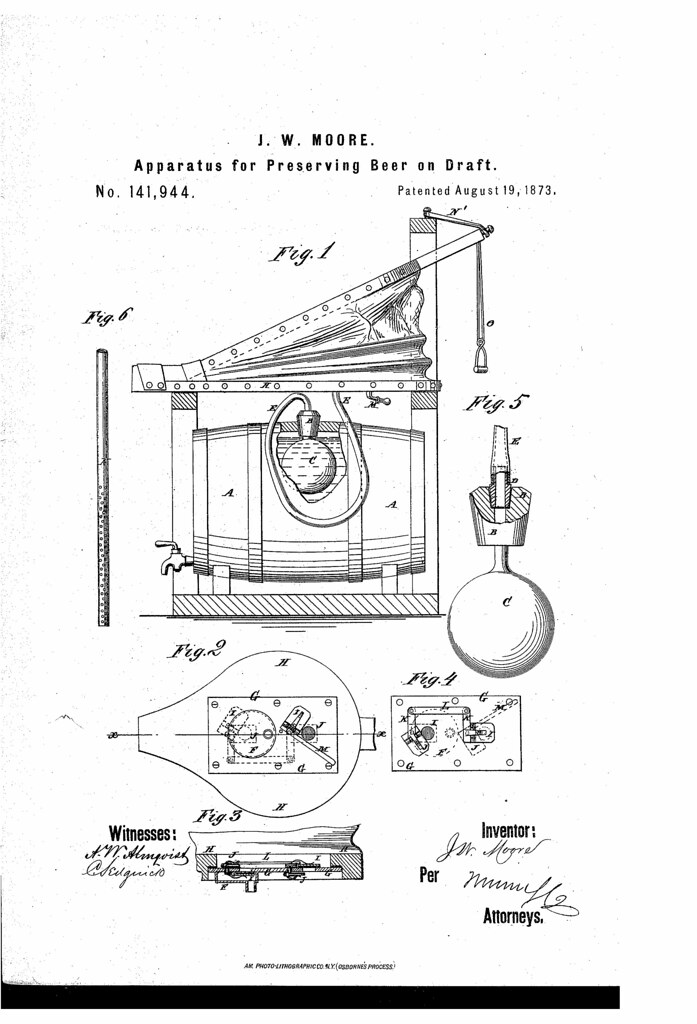
Today in 1873, US Patent 141944 A was issued, an invention of John W. Moose, for his “Improvement in Apparatus For Preserving Beer on Draft.” There’s no Abstract, although in the description it includes these claims:

This invention relates to means for introducing air into casks to take the place of the liquid drawn out; and it consists in the combination, with a flexible bag or air holder, of a valve and bellows mechanism of a novel construction, as will be hereinafter more fully described. It further consists in the employment of a perforated tube for withdrawing the air from the flexible bag.
US141944-0

Filed Under: Beers, Just For Fun, Politics & Law, Related Pleasures Tagged With: Barrels, History, Kegs, Law, Patent

Patent No. 3145106A: Addition Of Dry Clay To Beer

August 18, 2016 By Jay Brooks

patent-logo
Today in 1964, US Patent 3145106 A was issued, an invention of George F. Goerl, for his “Addition Of Dry Clay To Beer.” There’s no Abstract, although in the description it includes these claims:

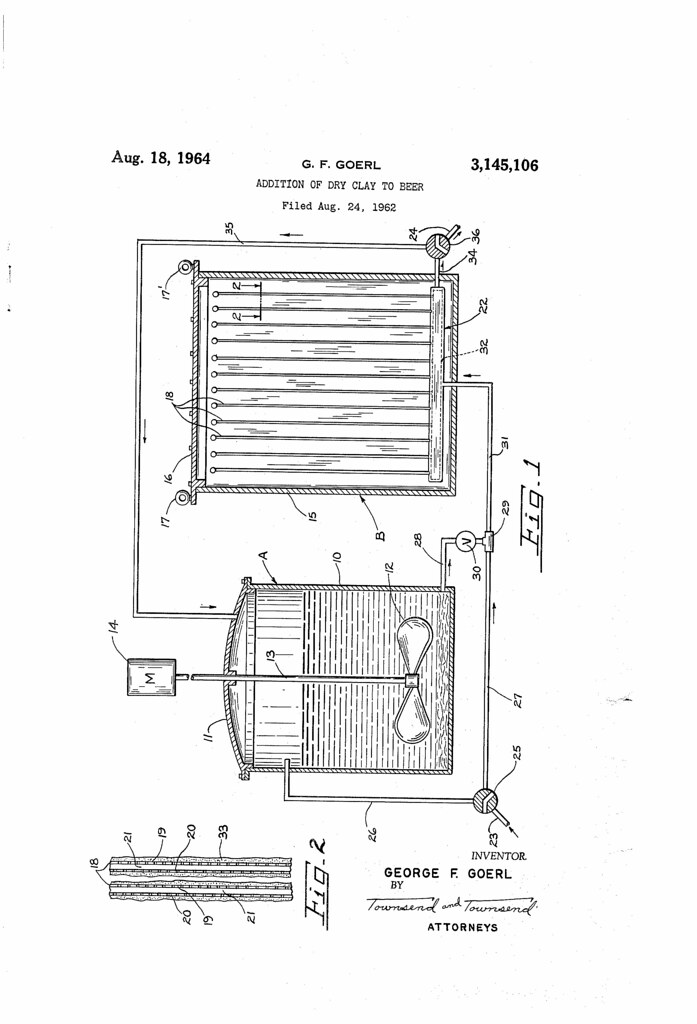
The gist of the present invention lies in the addition of chill-proofing clay to beer in dry form without first forming an aqueous slurry of the clay as in prior procedures. The dry clay is introduced into the beer by incorporating the clay in the conventional filter cake used to pre-filter beer after fermentation. The clay enters the beer as the beer passes through the filter cake. By adding the clay in dry form the sludge and beer loss attendant the use of hydrated clay is avoided. In addition, the chill-proofing effect of the clay appears to be enhanced by the present method.

Thus in the preferred embodiment there is provided an improved method for adding clay to beer in order to chill-proof the beer comprising slurrying diatomaceous earth and hectorite in a preselected volume of beer, forming an initial filter cake from said slurry of diatomaceous earth and hectorite, and flowing beer after fermentation through said filter cake to pre-filter the beer and to erode hectorite from the filter cake into the beer to chill-proof the beer. A beer slurry of diatomaceous earth and hectorite is continuously added in controlled quantities to beer prior to passage of the beer through the filter cake in order to continuously build up the filter cake and replace eroded hectorite. The initial cake and continuous addition are controlled to provide about 200 p.p.m. of hectorite with respect to the beer for erosion into the beer.

The present invention applies to malt beverages generally including beer, ale, stout, and the like. For ease of description, beer has been frequently used throughout the specification and claims. However, wherever the term beer appears it should be understood that the other related malt beverages could be readily substituted therefor.

Beer production follows a generally accepted sequence of steps. First, aqueous extract from suitable grain is fermented to produce beer. After fermentation has been completed, the temperature is dropped to approximately 30 F. and the beer is transferred from the fermentation equipment into a storage tank for a rest or aging period at about 30-32 F. The rest period may be as little as five days and in some cases as much as three months. Carbon dioxide may or may not be introduced into the beer during the rest period. The carbon dioxide is used to partially carbonate the beverage and purge the liquid of entrapped air.

After this first storage the beer is put through a preclarification or prefiltration operation. This is usually accomplished with some mechanical means such as a centrifuge or a filter. The present invention comes into play in this preclarification step. Most prevalently, the preclarification or first filtration (a second or polish filtration occurs at the termination of the processing of the beer) is accomplished by passing the beer through a filter cake formed by any suitable porous filtering substance. Most preferably and commonly, the substance employed is diatomaceous earth. However, other suitable substances such as perlite or cotton fibrous pads might be used as alternatives.

After pre-filtration the beer is then transferred into a finishing storage tank for another storage period of about one to five days during which time final carbonation is accomplished. Following the finishing period the beer is polish filtered. The beer is then in a form as found in the final product when purchased by the consumer.

During the course of the processing subsequent to fermentation, several treatments have become standard which serve to stabilize and make the final product more desirable in many respects. The beer may be treated with a clay for chill-proofing purposes in accordance with the method described in United States Patent No. 2,416,007, dated February 18, 1947. That patent teaches the addition of an aqueous suspension of suitable clays into the beer for removing foreign or partially soluble substances from beer such as undesirable proteins or proteinaceous complexes.

A number of improvements have been made upon said patent most of which include the preparation of an aqueous suspension of the clay prior to its addition to the beer. The present method is a further improvement upon said patent and prior techniques in that the aqueous suspension is avoided and the clay in dry form is added directly to the beer.

The most significant phenomenon that has been observed when dry clay is added to beer as opposed to aqueous suspensions of clay is that the clay does not swell as in aqueous addition techniques. This difference in the properties of the clay between the two types of addition is most important from an economic standpoint. In the aqueous addition of the clay the fully hydrated clay flocks and precipitates forming a sediment or sludge on the bottom of the treatment tank. When clay is added dry to beer it remains in the beer in particle size and no flocculation as such occurs.

Specifically, the practical advantage which follows from the use of dry clay includes the ease with which the beer may be finally filtered because of the simplicity of separating the non-flocculated clay after it has performed its function. Most important, the use of dry clay greatly reduces the volume of the trapped beer in the clay because of the non-flocculated, high density characteristics of the clay when added dry. This means a higher yield of beer per unit of beer-making ingredients.

In all respects the present method is similar to the prior methods of treating beer except that. the clay is added in dry form and at the point in the processing where the pro-filtration occurs. Aside from this difference all other prior techniques for treating the beer may e used as desired. Thus the various other treatments for stabilizing and clarifying beer may be used in addition to the clay treatment. These additional steps may include the use of reducing agents such as potassium metabisulfite, or preferably S0 gas itself, in accordance with United States Patent No. 2,916,377, dated December 8, 1959. It is also common to employ a proteolytic enzyme such as bromelin and/ or papain. The use of these other materials in the presently improved process is unchanged in any significant respect from prior techniques such as quantity of these other materials which may be employed or the point in the brewing process where they may be added. For example, when S0 gas is used, it may be introduced in the range of 5 to 30 ppm. and the enzyme dosage may be between 50015,000 activity units per barrels of beer processed, and they may be added at any point after fermentation, individually or simultaneously.

US3145106-0

Filed Under: Beers, Breweries, Just For Fun, Politics & Law, Related Pleasures Tagged With: History, Law, Patent, Science of Brewing

Patent No. 566173A: Hop Picking Machine

August 18, 2016 By Jay Brooks

patent-logo
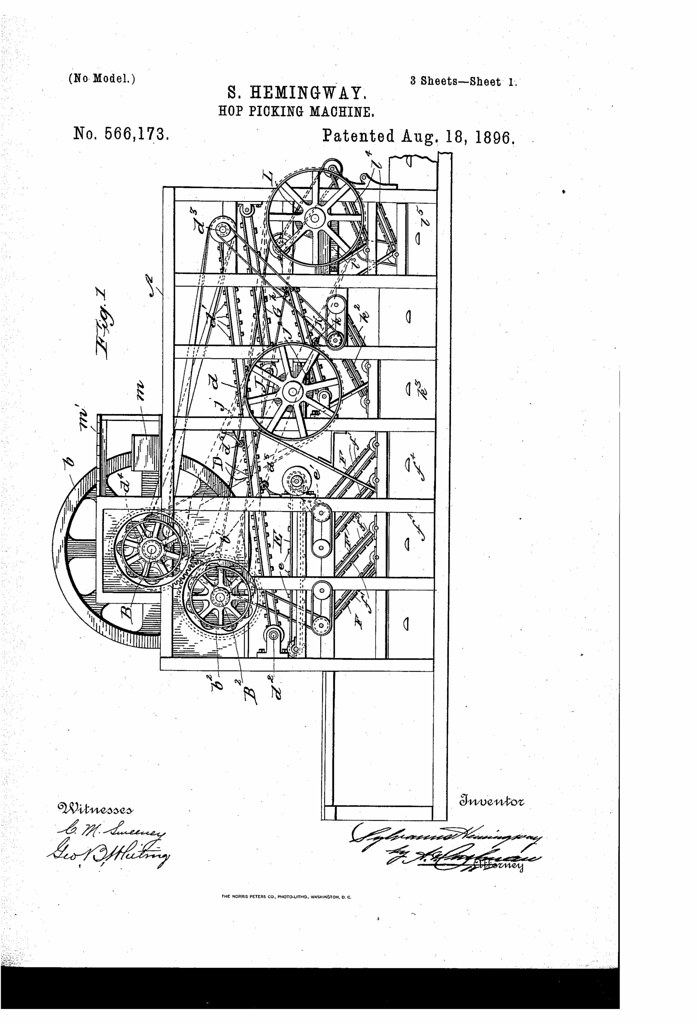
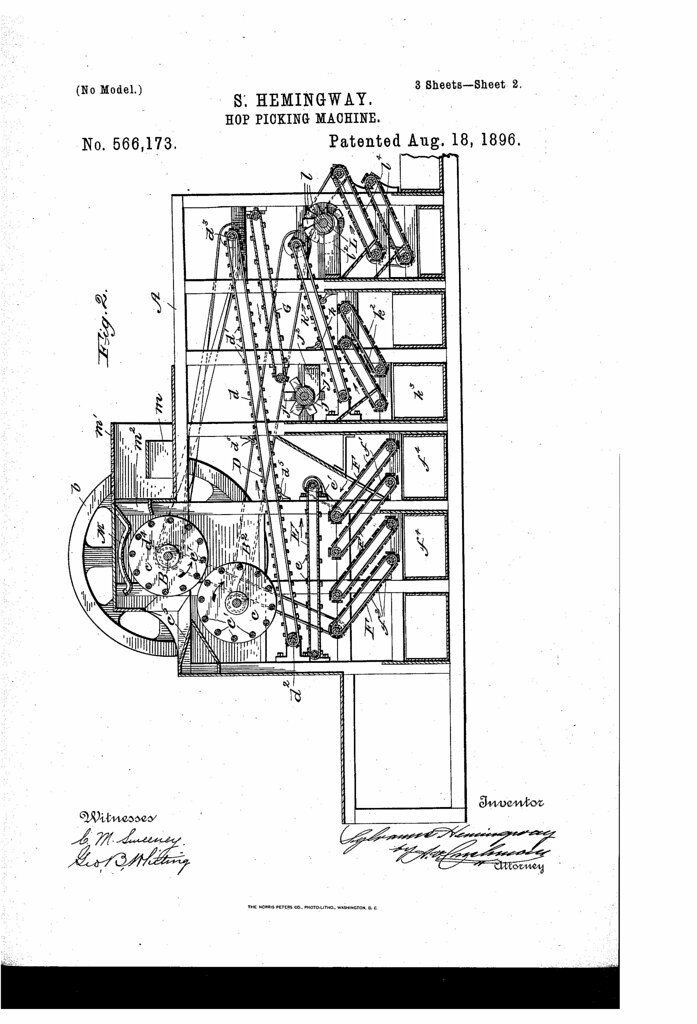
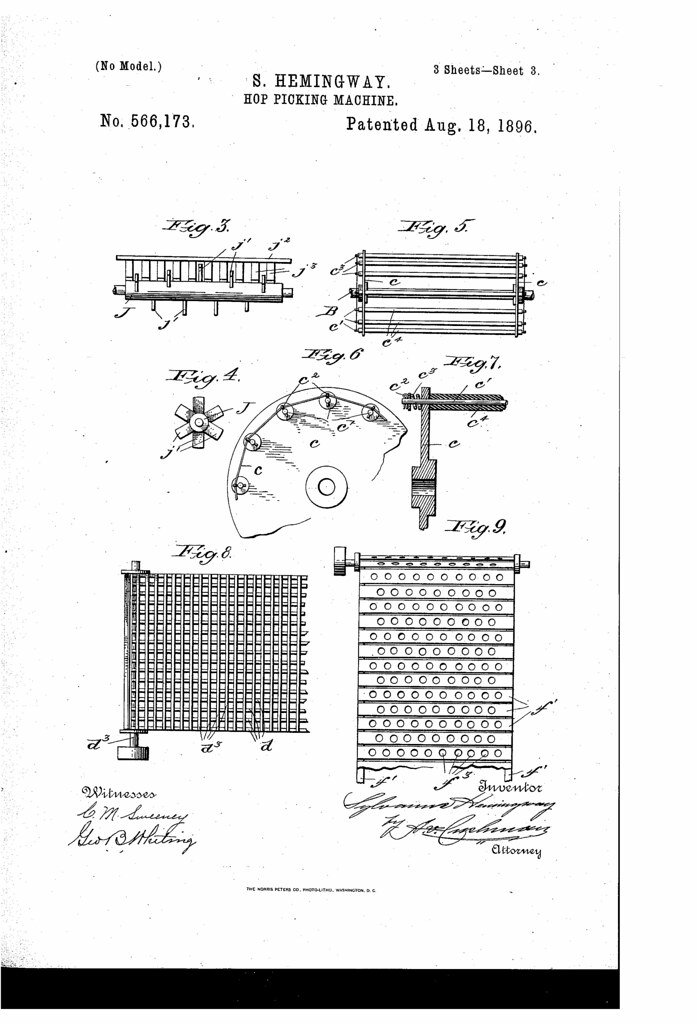
Today in 1896, US Patent 566173 A was issued, an invention of Sylvanus Hemingway, for his “Hop Picking Machine.” There’s no Abstract, although in the description it includes these claims:

My invention relates to hop-picking machines, and has for its object to provide a machine which will perform the work which has heretofore been done, to a large extent, by hand-picking.

My improved hop-picking machine has a capacity for work which makes it possible for a large harvest of hops to be picked and prepared for market in a comparatively short space of time, thereby Overcoming one of the difficulties experienced by hop-growers, who, on account of the comparatively short season for picking the hops and the scarcity of help, are frequently put to serious inconvenience in the preparation of the product for the market.

In carrying out my invention I have borne in mind the necessity of providing a machine which would strip the hops from the vines without’ crushing the flowers but which would It will be observed also that my invention as embodied in the machine presented in the present application will thoroughly clean the hops after they have beer stripped from the vines, separating the leaves which may have been torn from the vines from the hop-blossoms, which latter will be deposited in suitable receptacles, while the refuse will be deposited at either end of the machine.

US566173-0
US566173-1
US566173-2

Filed Under: Beers, Just For Fun, Politics & Law, Related Pleasures Tagged With: Brewing Equipment, History, Hops, Law, Patent

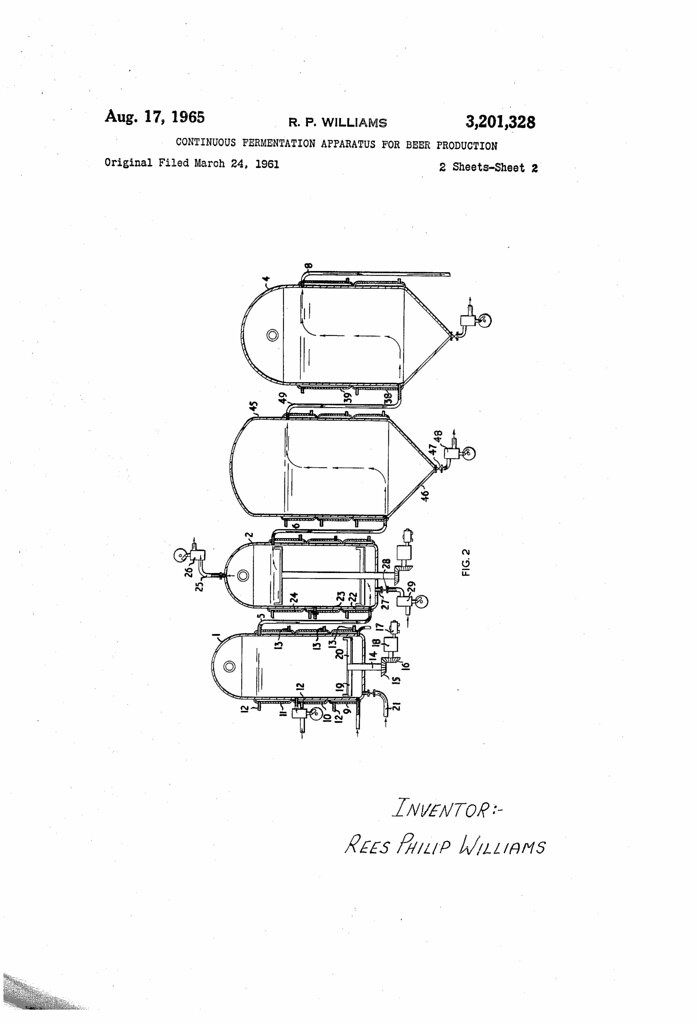
Patent No. 3201328A: Continuous Fermentation Apparatus For Beer Production

August 17, 2016 By Jay Brooks

patent-logo
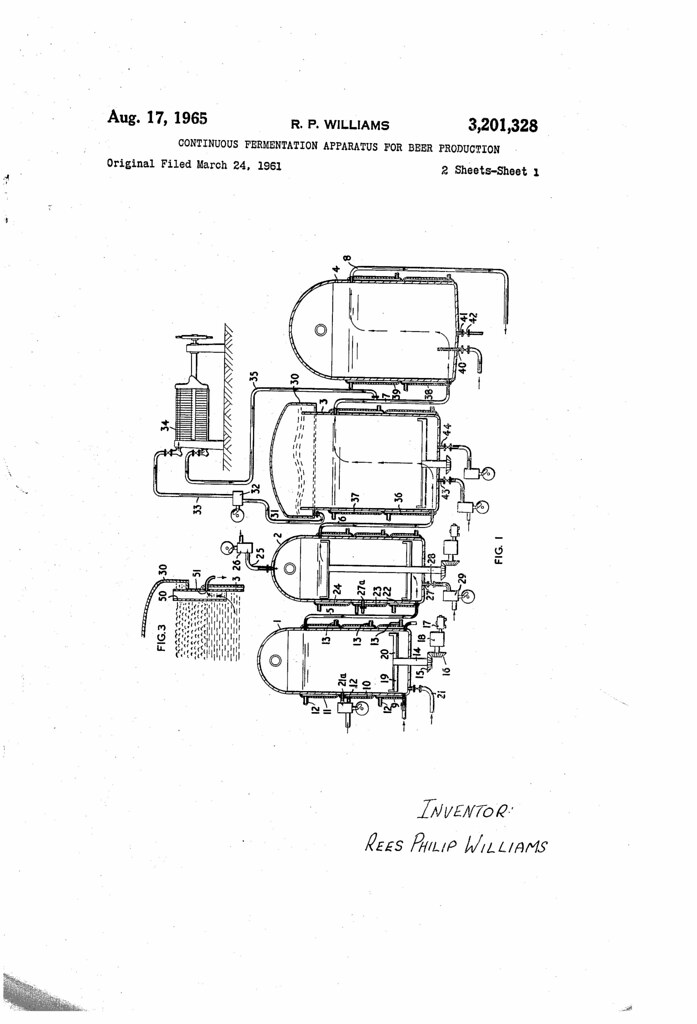
Today in 1965, US Patent 3201328 A was issued, an invention of Rees Philip Williams, for his “Continuous Fermentation Apparatus For Beer Production.” There’s no Abstract, although in the description it includes these claims:

This invention relates to the manufacture of beer, and more particularly to the fermentation of Brewers Wort, i.e. wort plus yeast as well known in the art, under steady rate conditions.

Hitherto, the fermentation process has been carried out, on a commercial scale, by batch processes which are relatively slow and involve the utilisation of relatively very bulky vessels for adequate production in quantity.

The object of the present invention is to provide apparatus suitable for use in carrying out such fermentation as a continuous process, with the advantages of relatively smaller vessels and higher production rate.

Fermentation of wort by yeast, in the production of beer, may be carried out by a continuous process including a first step of forming a mixture of sterile wort and yeast in first vessel means under temperature conditions selected to ensure multiplication of the yeast, a second step of continuously removing wort and yeast mixture which has dwelt in the first vessel means for a predetermined period of time and passing said removed mixture through second vessel means at a rate and under temperature conditions selected to ensure rapid fermentation by the yeast and production of a yeast crop, and a third step of continuously removing wort which has dwelt in the second vessel means for a predetermined period of time and passing said wort through third vessel means at a rate permitting settling.

According to the present invention, apparatus suitable for use in carrying out the above-described method, but not limited thereto, comprises a first vessel for making a ferment mixture such as sterile wort and yeast, means for controlling the temperature of the mixture in the first vessel, a second vessel having an inlet and an outlet, the inlet being connected to the outlet of the first vessel, means for controlling the temperture of mixture in the second vessel, a third vessel having an inlet and an outlet, the inlet being connected to the outlet of the second vessel, and means for controlling the temperature of fermented liquid in the third vessel.

The second vessel means could be simply a single vessel in which substantially the whole of the vigorous fermentation took place, but it is preferred to constitute the second vessel means by two vessels through which the mixture passes in succession, whereby the second method step referred to above itself includes two successive stages the first of which is a continuous passage of the mixture through a vessel at a rate and under conditions of temperature ensuring rapid fermentation, and the second of which is passage of the product through a further vessel at a rate and under conditions of temperature ensuring continuation of the rapid fermentation and a climax of the yeast crop production.

According to the type and characteristics of the beer to be produced, and of the wort and yeast to be used in the process, it is desirable to be able, at will, to both speed up and slow down the rate of fermentation. For

this purpose, gas or a mixture of gases may be introduced in the first and/or the second vessel means according to the effect sought. For example, air or pure oxygen may be introduced to boost the fermentation action, i.e. to rouse the yeast, and carbon dioxide or nitrogen may be introduced to slow down the fermentation process.

During the latter part of the active fermentation phase a yeast head is produced, e.g. in the second vessel means (and in the second of the two individual vessels where two in series are used). This head my be continuously removed together with a small content of wort, this wort being separated and recirculated, e.g. introduced back into the flow path for example immediately after the second vessel means.

It is preferred to arrange the apparatus so that the entire flow occurs by gravity through vessels arranged in series at progressively lower levels.

In a preferred embodiment, the second vessel is in two parts which are connected serially and are each provided with their individual means for controlling the temperature of the mixture therein. It is further preferred to have the temperature controlling means acting independently at separate levels, e.g. by two or more fluid jackets arranged along the vessels wall.

Preferably also, each vessel is provided with means, such as a simple conduit connected to a pump or pressure source, for the introduction of gas for quickening (e.g. rousing) and for slowing of the fermentation.

The first vessel, wherein multiplication of the yeast takes place, may be provided with agitator means adjacent the inlet end for assisting the flow and a stirrer adjacent the outlet end for ensuring mixing.

Where the process involves the production of a head on the fermented material, e.g. a yeast head, means are advantageously provided for continuous removal of such a head from the vessel in which it occurs, e.g. means for removal of the relatively copious head formed during the climax of fermentation in the third vessel. Means may also be included for continuously treating the removed head material by pressing it for removal of its wort content for recirculation.

In a preferred embodiment, for use in brewing of beer, the series of vessels are arranged successively at lower levels to give a flow of liquid through the apparatus by gravity, the inlet of each vessel being adjacent to the lower part of that vessel and the outlet of each vessel being adjacent the upper part of that vessel.

Where a gas or gases are given off during the process, one or more of the vessels may be provided with means for continuous removal of the gas, e.g. for continuous removal of carbon dioxide from the second vessel.

Where the process being carried out involves the formation of solid deposits, means may be provided for its continuous removal, e.g. for the removal of sludge from the bottom of the second of the two serially connected parts of the second vessel.

Carbon dioxide gas may also be injected in the third vessel for gasifying-of the liquor.

Where a relatively longer dwell time of the liquid in any vessel is desired, the cross-section of the vessel may be proportionately increased. Thus, by varying the size and cross-section of the vessels, the apparatus and process can be adjusted to suit the natural characteristics of the particular yeast which the brewer wishes to use.

US3201328-0
US3201328-1

Filed Under: Beers, Breweries, Just For Fun, Politics & Law, Related Pleasures Tagged With: Brewing Equipment, History, Law, Patent, Science of Brewing

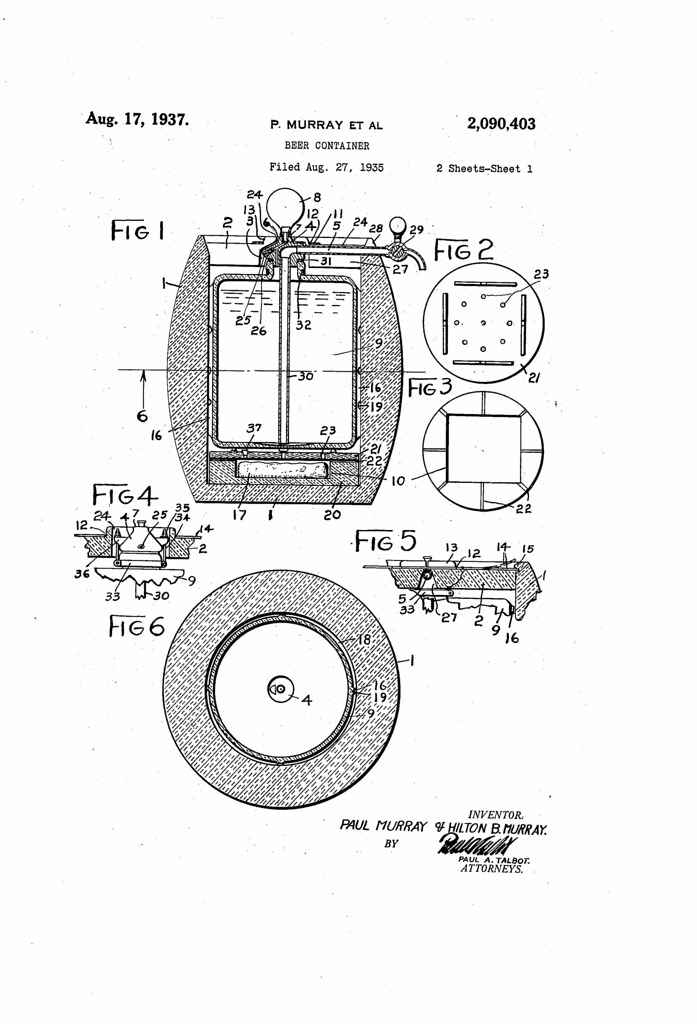
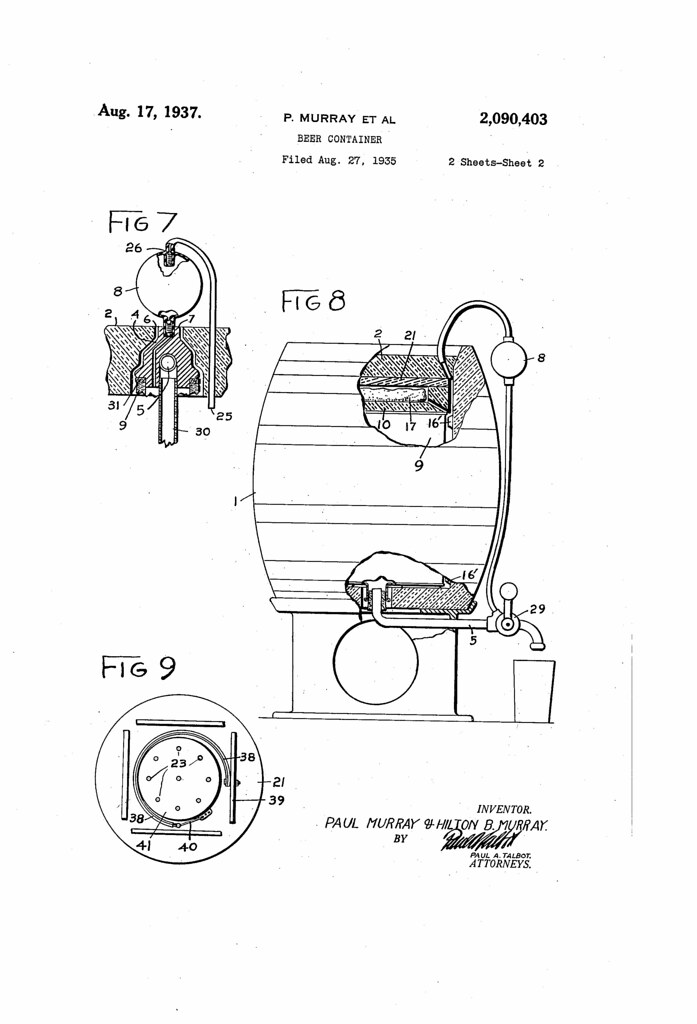
Patent No. 2090403A: Beer Container

August 17, 2016 By Jay Brooks

patent-logo
Today in 1937, US Patent 2090403 A was issued, an invention of Paul Murray and Hilton B. Murray, for their “Beer Container.” There’s no Abstract, although in the description it includes these claims:

Our invention relates to a container for maintaining the temperature, pressure and quality and to preserve draught beer and for such other liquids as require similar treatment. We are. aware that beer has been shipped in various types and sizes of barrels and bottles and kept cool and delicious both in unpasteurized draft form and in pasteurized form in bottles and our inventions and improvements are particularly applicable to the preserving and the convenience of making available real draught beer in the home and such other places as have proved difficult to supply by the use of the usual keg, cooler, pump, tap, etc. because of the quantity consumed and the bulk and care of the conventional equipment.

Beer at its best is by our simple device made available in a gallon or more for gradual home consumption as and when Wanted. Beer is thus delivered and maintained in its most delicious and convenient form.

Among the objects are:

To provide a receptacle for keeping draught beer in palatable condition.

To provide a means for regulating the cooling effect of dry ice.

To provide a simple means of retaining a uniform pressure on draught beer in a convenient container.

To provide an beer.

To provide a Ventilating system to distribute a uniform cooling effect to maintain a uniform temperature on draught beer in a convenient container.

To provide a simple and convenient container and means for disassembling and assembling the parts for filling and emptying draught beer.

US2090403-0
US2090403-1

Filed Under: Beers, Just For Fun, Politics & Law, Related Pleasures Tagged With: History, Kegs, Law, Patent

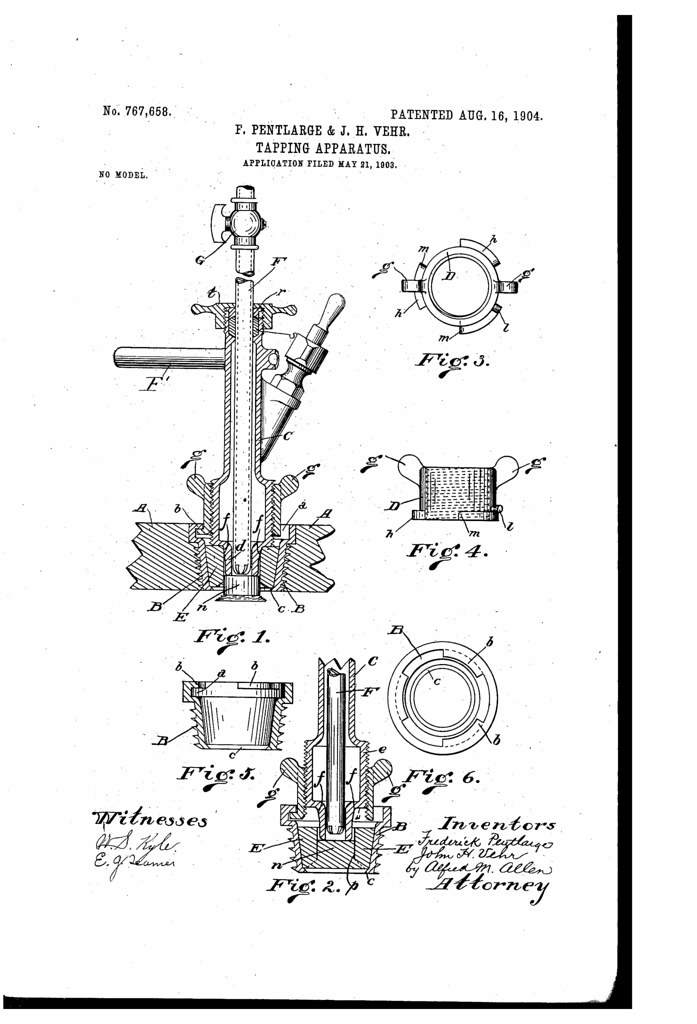
Patent No. 767658A: Tapping Apparatus

August 16, 2016 By Jay Brooks

patent-logo
Today in 1904, US Patent 767658 A was issued, an invention of Frederick Pentlarge and John H. Vehr, assigned to the US Bung Manufacturing Company, for their “Tapping Apparatus.” There’s no Abstract, although in the description it includes these claims:

Our improvements relate to apparatus for readily and easily tapping barrels, kegs, and other liquid-receptacles for the removal of the liquid contents, and the improvements have particular relation to apparatus for the tapping of beer kegs, barrels, and the like, to be applied at the faucet-hole, which is sealed by any of the ordinary and well-known faucet plugs or bungs.

US767658-0

Filed Under: Beers, Just For Fun, Politics & Law, Related Pleasures Tagged With: History, Kegs, Law, Patent

Patent Nos. 767960A & 767961A: Pasteurizer

August 16, 2016 By Jay Brooks

patent-logo
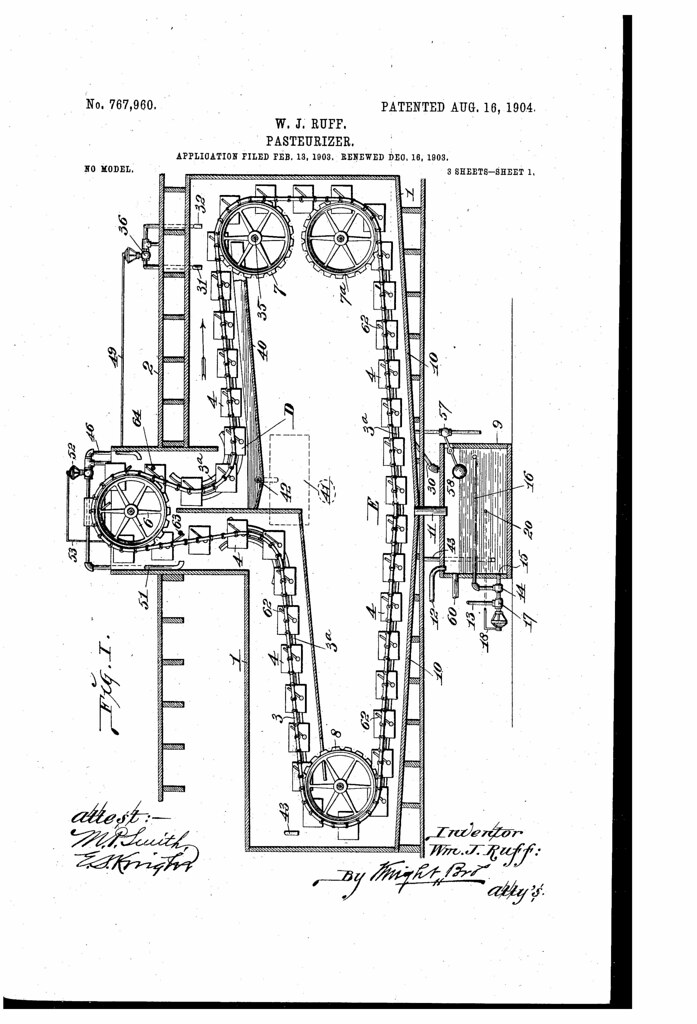
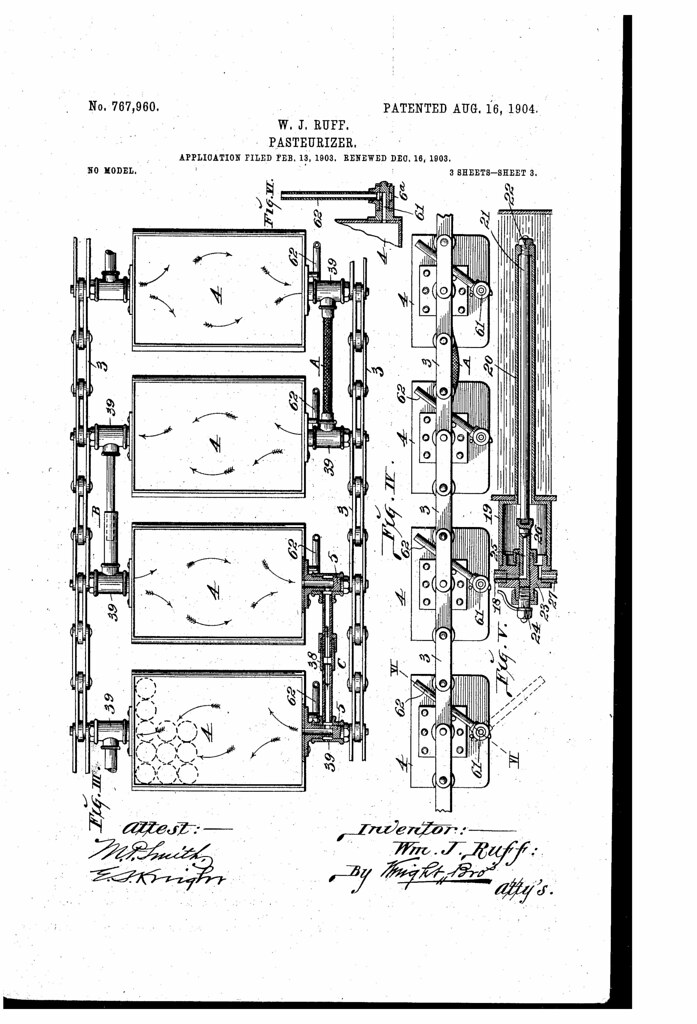
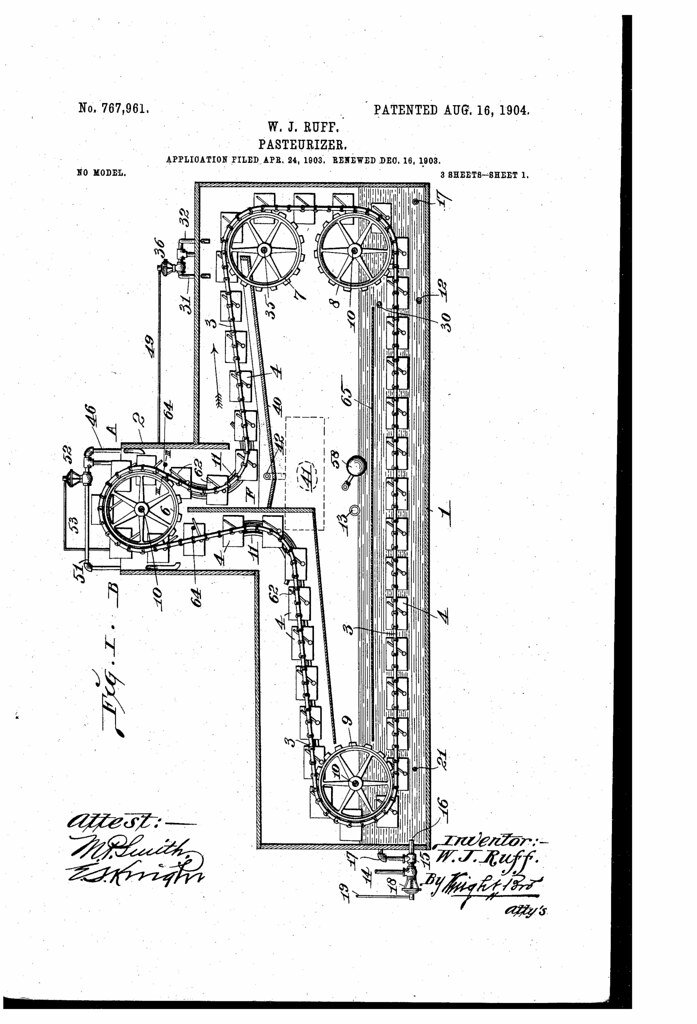
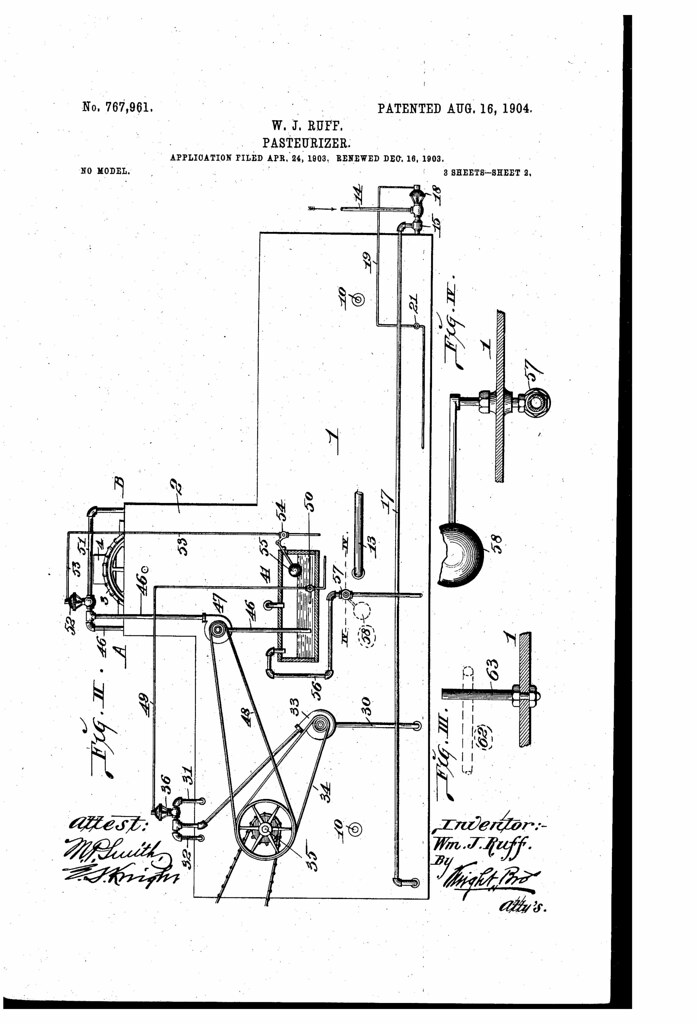
Today in 1904, both US Patent 767960 A and US Patent 767961 A were issued, and both are related inventions of William J. Ruff, under the same name: “Pasteurizer.” There’s no Abstract, although in the description it includes these claims for the first one:

My present invention relates to an apparatus for pasteurizing. beer, one of the principal objects of my invention being to simplify the construction and cheapen the cost of the apparatus, as well as improving its efficiency, by dispensing with a tank through which the bottles of beer are carried to expose them to the different temperatures to wit, in first at temperating the beer, then heating it to the maximum temperature, and finally cooling it to approximately atmospheric temperature.

US767960-0
US767960-1
US767960-2

And here’s a description of the claims for the second patent:

The object of my present invention .is to produce a pasteurizer wherein the bottles of beer are submerged in a water-bath during the time that they are subjected to the maximum temperature, while the preliminary heating and final cooling of the beer is effected without having the bottles submerged in the bath, the result being that a comparatively small amount of waterY is necessary to accomplish the work of pasteurization.

US767961-0
US767961-1
US767961-2

Filed Under: Beers, Breweries, Just For Fun, Politics & Law, Related Pleasures Tagged With: Brewing Equipment, History, Law, Patent, Science of Brewing

Patent No. 1000581A: Protector For Drinking Glasses

August 15, 2016 By Jay Brooks

patent-logo
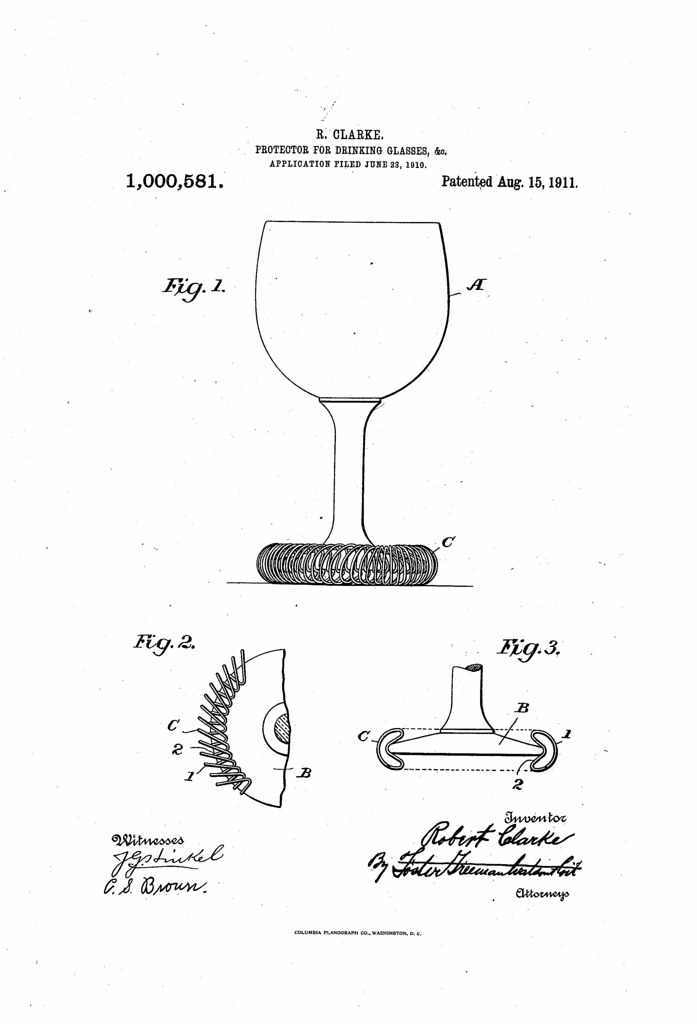
Today in 1911, US Patent 1000581 A was issued, an invention of Robert Clarke, for his “Protector For Drinking Glasses, Etc.” There’s no Abstract, although in the description it includes these claims:

The object of the present invention is to provide a simple, cheap and ornamental means for protecting the flanged bases of tumblers, medicine glasses and other articles of a frangible nature which are readily chipped or broken by contact with tables or other hard objects and to prevent drippings adhering to the bottoms of such vessels when raised. The invention is applicable, for instance, to beer glasses which are likely to be broken in setting them down on stone slabs or counters and which are liable to drip when raised from a wet counter.

My invention comprises an endless elastic coil which is adapted to surround the base of a receptacle and grip and sustain the same and hold it from contact with a table or other support upon which it may rest. My improved protector is also elastic and forms a cushion to prevent breakage of the base of the vessel when setting it down.

US1000581-0

Filed Under: Beers, Just For Fun, Politics & Law, Related Pleasures Tagged With: Glassware, History, Law, Patent

Patent No. 503190A: Hop Picking Machine

August 15, 2016 By Jay Brooks

patent-logo
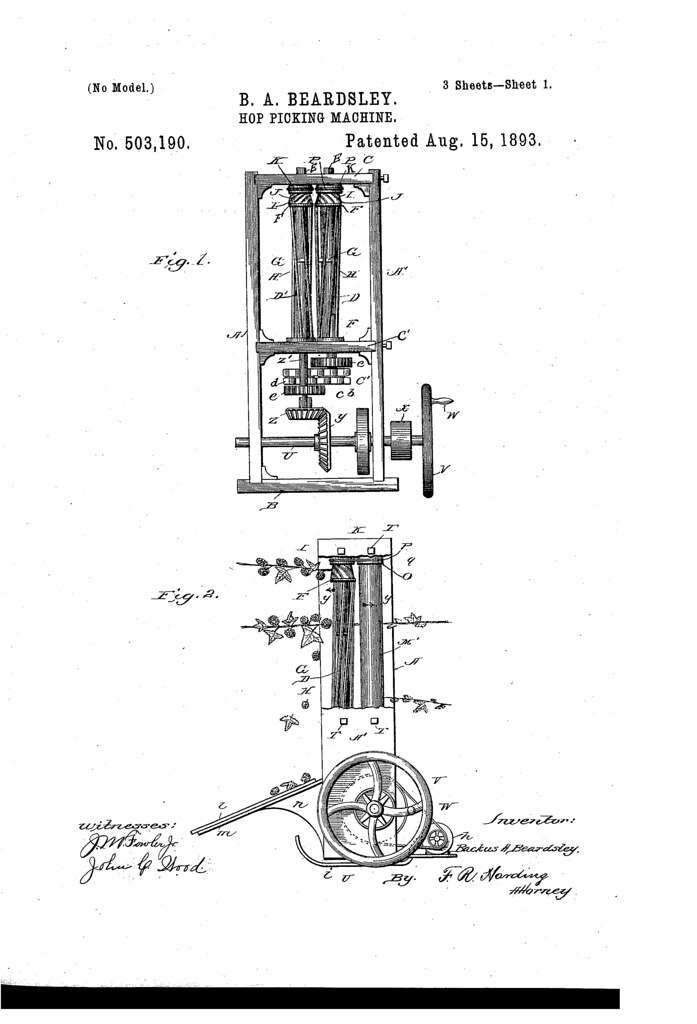
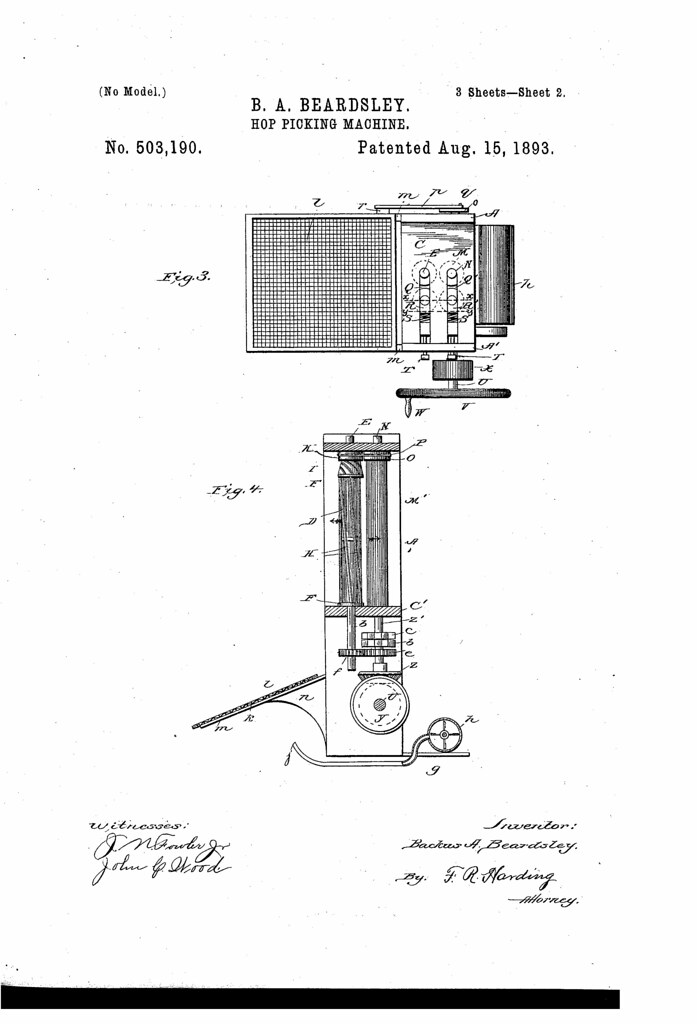
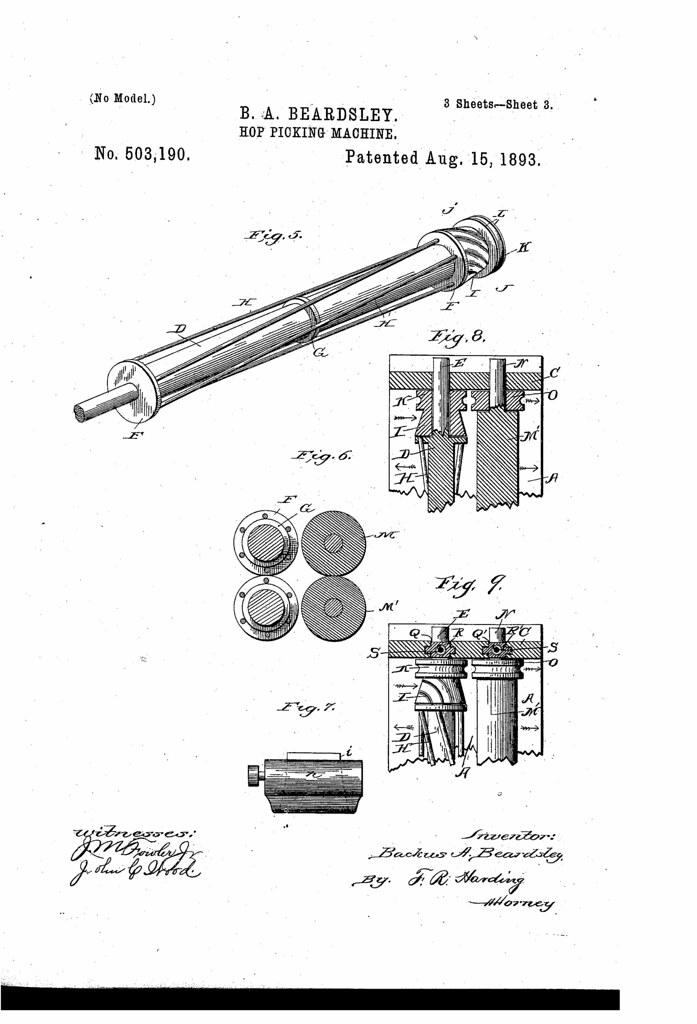
Today in 1893, US Patent 503190 A was issued, an invention of Backus A. Beardsley, for his “Hop Picking Machine.” There’s no Abstract, although in the description it includes these claims:

My invention relates tothat class known as hop-pickers; and more particularly refers to a new and useful improvement on machines designed for this purpose.

US503190-0
US503190-1
US503190-2

Filed Under: Beers, Just For Fun, Politics & Law, Related Pleasures Tagged With: Brewing Equipment, History, Hops, Law, Patent

Patent No. 2564163A: Receptacle With Elastic Bag Insert And System For Filling And Emptying The Same

August 14, 2016 By Jay Brooks

patent-logo
Today in 1951, US Patent 2564163 A was issued, an invention of Jean Emile Lucien Leperre, for his “Receptacle With Elastic Bag Insert and System For Filling and Emptying the Same.” There’s no Abstract, although in the description it includes these claims:

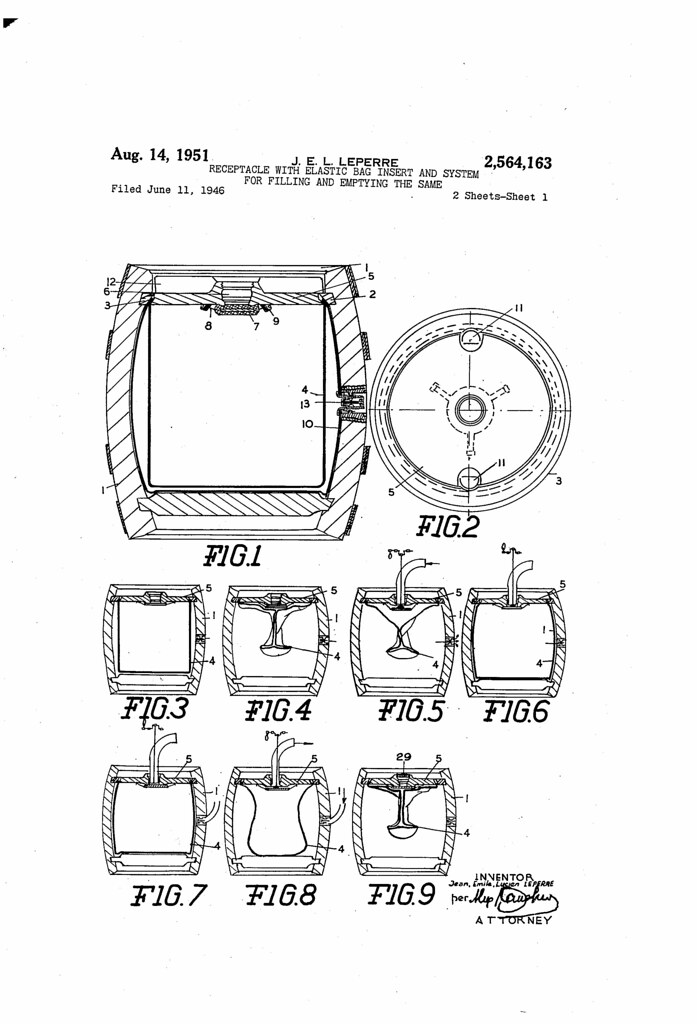
it is submitted between the brewery and the consumer. Numerous laboratory experiments have shown that beer samples removed with all the required care directly from the brewery tanks keep well. The case is no longer the same when the beer has passed through different casks and various drawing means.

The different causes of contamination are as follows:

In the case of wooden casks, these casks are always infected by the beer dregs remaining inside the casks emptied at the retailers. Once the cask is contaminated it is not possible to sterilize it again completely and the infection is continued by each new filling with beer.

Laboratory experiments of a very complete character have shown that when it is possible to superficially sterilize a cask, the infection begins again as soon as the cask has been put again under pressure.

It is a well-known fact that the dissolution of air in beer is also a cause of the lack of stability of said beer.

Moreover, the beer containers of the drawing 01! means where the beer has always a tendency to become hot. and to lose a part of its carbonic gas, the return into said containers of the froth and of the counter-pressure gases, as well as the presence of the plunging tubes of the drawing oil means, are several of the factors causing alteration of the beer.

As to the dealing out of the beer, it is a known fact that as long as a cask is not broken into, the beer retains generally its quality but once it has begun being dealt out the beer loses in a few hours most of its quality.

On the other hand for breaking into his cask. the retailer introduces into his beer a plunging tube which has generally been left about in the cellar and at the same time he drives into it the stopper of the cask which is unavoidably contaminated.

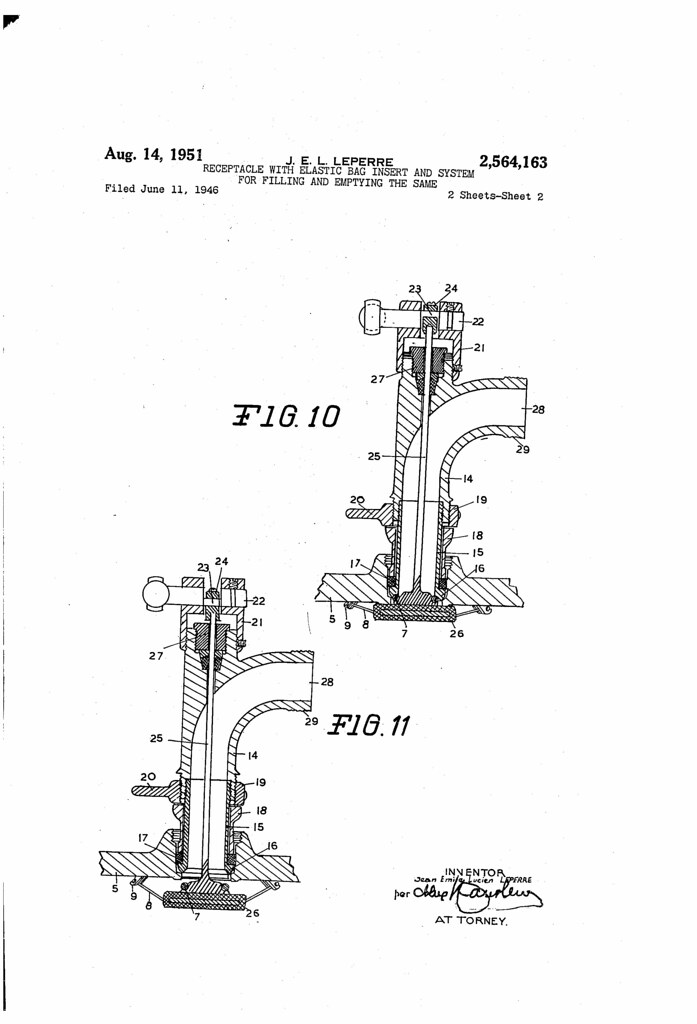
The present invention has for its object to remove these multiple drawbacks, and it comprises chiefly a special container having a yielding receiver mounted inside a rigid receiver with means being provided for allowing the liquid under pressure to enter inside the inner yielding receiver and also for allowing a counter-pressure fluid to be introduced between this inner yielding receiver and the outer rigid receiver.

A further characteristic feature of the invention consists in that the recess formed by the inner yielding receiver is reduced to zero for the filling of the cask with beer under pressure so that said recess is consequently completely emptied of its air, this being produced by a counter-pressure exerted between said receiver and the rigid outer receiver, the former increasing gradually in volume through the introduction of beer under pressure inside it while said counter-pressure gas progressively escapes from the outside of the yielding receiver.

According to a still further feature of the invention, there is provided a rigid receiver containing a yielding removable fluid-tight receiver, pouch or pocket into which the liquid under pressure is introduced while means are provided firstly for allowing the latter to communicate with the outside and secondly for adjusting the pressure of the fluid contained between the two receivers.

US2564163-0
US2564163-1

Filed Under: Beers, Just For Fun, Politics & Law, Related Pleasures Tagged With: Barrels, Cask, History, Kegs, Law, Patent

« Previous Page
Next Page »

Find Something

Northern California Breweries

Please consider purchasing my latest book, California Breweries North, available from Amazon, or ask for it at your local bookstore.

Recent Comments

  • Ernie Dewing on Historic Beer Birthday: Charles William Bergner 
  • Steve 'Pudgy' De Rose on Historic Beer Birthday: Jacob Schmidt
  • Jay Brooks on Beer Birthday: Bill Owens
  • Steve 'Pudgy' De Rose on Beer Birthday: Charles Finkel
  • Steve 'Pudgy' De Rose on Beer Birthday: Bill Owens

Recent Posts

  • Beer In Ads #5184: The “B”s Are Here, Bruton Bock Beer January 27, 2026
  • Beer Birthday: Logan Plant January 27, 2026
  • Historic Beer Birthday: William Tunis Ryerson January 27, 2026
  • Historic Beer Birthday: Henry Hubach January 27, 2026
  • Beer Birthday: Peter Kruger January 27, 2026

BBB Archives

Feedback

Head Quarter
This site is hosted and maintained by H25Q.dev. Any questions or comments for the webmaster can be directed here.