Brookston Beer Bulletin

Jay R. Brooks on Beer

  • Home
  • About
  • Editorial
  • Birthdays
  • Art & Beer

Socialize

  • Dribbble
  • Email
  • Facebook
  • Flickr
  • GitHub
  • Instagram
  • LinkedIn
  • Pinterest
  • RSS
  • Twitter
  • YouTube

Powered by Genesis

Patent No. 2085848A: Beer Dispensing Device

July 6, 2016 By Jay Brooks

patent-logo
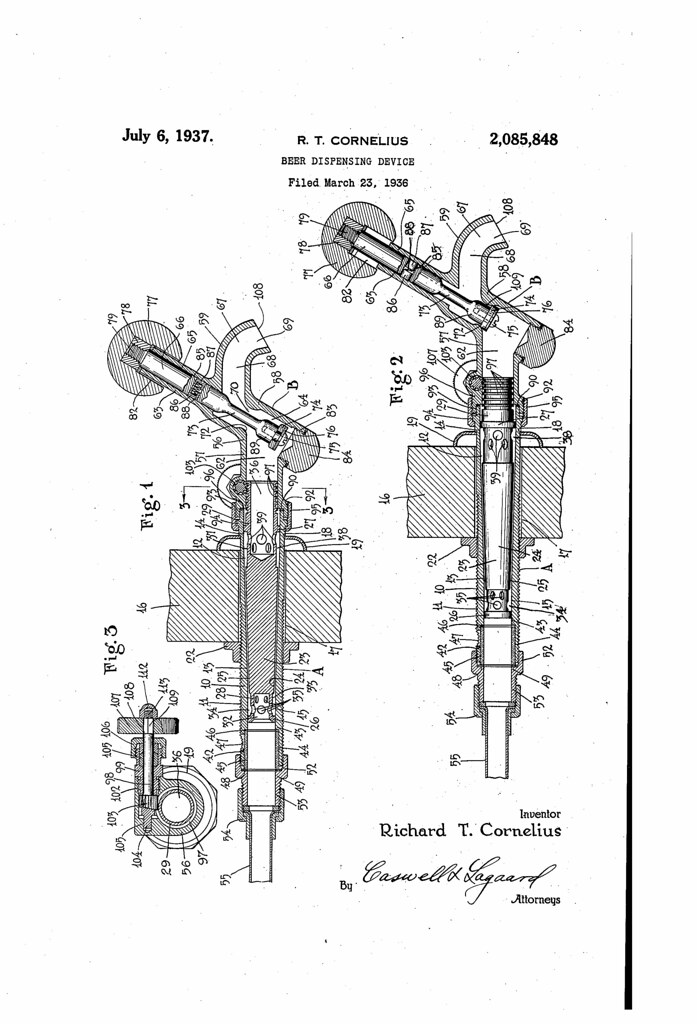
Today in 1937, US Patent 2085848 A was issued, an invention of Richard T. Cornelius, for his “Beer Dispensing Device.” There’s no Abstract, although in the description it includes this summary:

My invention relates to beer dispensing devices and has for an object to provide a device by means of which beer may be drawn in a manner to procure the desired amount of foam or collar on the beer when discharged into any type of drinking vessel.

Another object of the invention resides in providing a device in which the amount of foam produced can be varied.

An object of the invention resides in providing a dispensing device including a flow regulating device and a faucet and in which the rate of flow can be adjusted independently of the operation of the faucet.
US2085848-0

Filed Under: Beers, Just For Fun, Politics & Law, Related Pleasures Tagged With: History, Kegs, Law, Patent

Patent No. 3193395A: Concentration Of Beer By Crystallization

July 6, 2016 By Jay Brooks

patent-logo
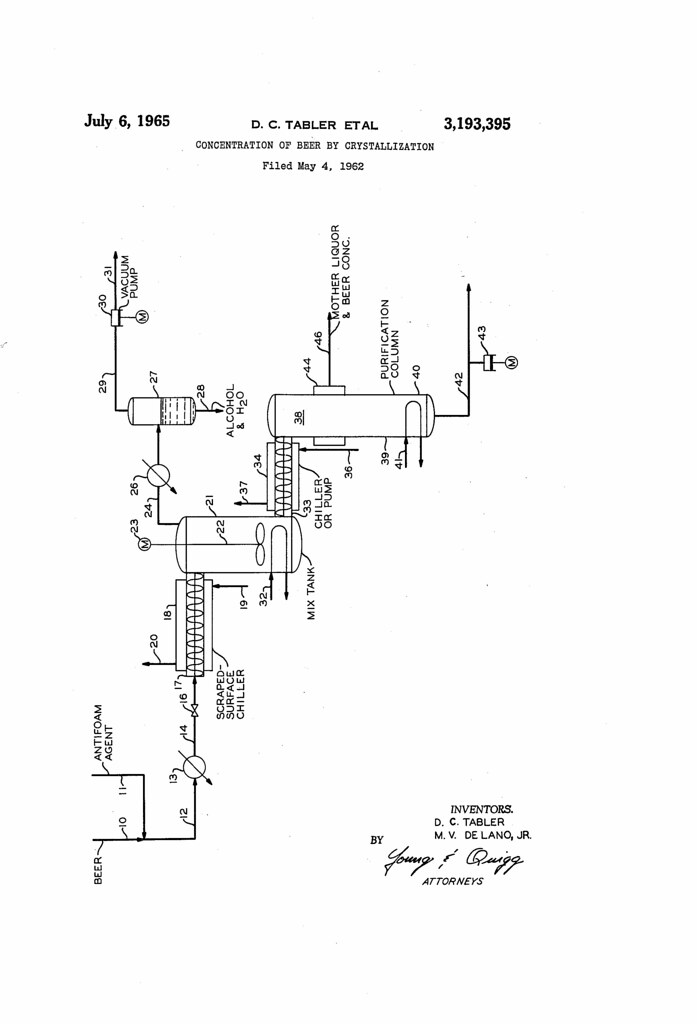
Today in 1965, US Patent 3193395 A was issued, an invention of Merritt V DeLano Jr. and Donald C. Tabler, assigned to the Phillips Petroleum Co., for their “Concentration of Beer by Crystallization.” There’s no Abstract, although in the description it includes this summary:

It is common to concentrate aqueous solutions by evaporation of water for the sake of economy in storage and shipping and to preserve the product. Removal of water by evaporation from a food product and particularly from a beverage results in the removal of essential components which affect the freshness and flavor of the beverage so that it cannot be restored to its original quality merely by the addition of water. This disadvantage can be overcome in the concentration of beverages by using a crystallization process whereby the water is separated from non-aqueous components by freezing. It is known that when water freezes the ice is in a pure form so that water can be removed from aqueous solutions by this method without the loss of volatile materials essential to the quality thereof.

There is considerable interest in the concentration of beer by freezing. The beer as received from the fermenters can be concentrated to approximately 1A its original volume by freezing out much of the water present therein. If the beer is shipped in the concentrated form, considerable savings can be realized in freight. Also, the storage facilities for the beer concentrate can be reduced and it has been found that beer in the concentrated form can be stored for substantially longer periods of time without deterioration of avor. Even if the beer is immediately reconstituted, there is substantial advantage to the concentration process in employing the crystallization method since the cold beer concentrate can be filtered to produce in effect an accelerated lagering process. This greatly reduces the requirements for large inventories and refrigerated storage tanks now necessary in breweries.

In the above-mentioned patent to Thomas, 2,854,494, there is disclosed a process and apparatus for purifying crystals which involves moving a mixture of crystals and mother liquor through a purification column in which the crystals are passed in a compact mass into a body of crystal melt which is displaced back into the crystal mass. The purification column includes an upstream liquid removal zone, a middle reflux zone, and a downstream melting zone. Mother liquor is removed from the crystals in the liquid removal zone and the ice crystals are melted in the melting zone. A portion of the crystal melt is Withdrawn from the melting zone and the remainder is forced back into the crystal mass in the reflux zone.

This apparatus can be used very effectively in the freeze concentration of beer. The beer is cooled to form a slurry of ice crystal in a mother liquor which is a beer concentrate and the resulting slurry is passed into the crystal purification column. Substantially pure water water which is the crystal melt can be removed from the melting zone and the beer concentrate is removed from the liquid removal zone of the purification column. We have found, however, that in the application of this purification method to beer, considerable difficulty is encountered as a result of carbon dioxide evolving from the mother liquor in the purification column. This evolvement of carbon dioxide causes channeling within the 3,193,395 Patented July 6, 1965 crystal mass with resultant loss of efficiency of the purification column. It becomes apparent, therefore, that the removal of carbon dioxide from the beer prior to its introduction into the crystal purification column should provide a solution to this problem. It can be appreciated, however, that with the removal of carbon dioxide from the beer prior to concentration there is also a substantial danger of removing alcohol and some of the essential flavor components which the crystal concentration method is used to preserve.

According to our invention, beer is concentrated by the crystallization method employing a purification column as described and the problem of channeling within the purification column as a result of evolvement of carbon dioxide is overcome by the prior removal of carbon dioxide without any substantial removal of the essential components from the beer itself. Since carbon dioxide is always added to beer in a carbonation step prior to packaging, this prior removal of carbon dioxide from the beer before concentration does not pose any particular problem or introduce an additional step in the over-all process of treating the beer concentrate on reconstitution. According to our invention, an antifoam agent is first added to the beer as it comes from the fermenters. The beer is then cooled in order to freeze a substantial amount of the water present therein and form a relatively thick slurry. This slurry is then subjected to a vacuum and the slurry is agitated with the result that carbon dioxide is removed from the remaining liquid. The solids content of the slurry can then be adjusted if necessary for the concentration process and the slurry is passed into the purification column where the ice and mother liquor are separated as described above. In a preferred aspect of the invention, in the carbon dioxide removal step the beer is cooled so that the slurry has a high solids content and subsequently the slurry is warmed slightly and thereby thinned so that trapped bubbles of carbon dioxide are released. The slurry is then recooled to the proper solids content for passage to the purification column. By lowering the temperature of the beer in order to remove carbon dioxide so that a substantial amount of water is frozen, the solubility of the carbon dioxide in the overall slurry is reduced even though the reduced temperature permits higher solubility in the remaining liquid. Reducing the pressure permits substantially all of the carbon dioxide to be removed from the slurry and since the alcohol has a very low vapor pressure at the low temperatures employed, very little of this material is vaporized with the carbon dioxide. We have also found that the addition of the antifoam agent to the beer prior to cooling to form a slurry enables substantially complete removal of the carbon dioxide from the slurry whereas complete removal is not attained without this antifoam agent, apparently because of the formation of extremely fine bubbles of the gas within the crystal mass.

It is an object of our invention to provide an improved method of concentrating beer by crystallization. Another object is to provide a method of concentrating beer by using a crystal purification column. Still another object of our invention is to provide a method of removing carbon dioxide from beer prior to concentration of the crystal slurry of the beer in the purification column without removing substantial amounts of alcohol. Still another object is to provide a method of improving the efficiency of a crystal purification column in the concentration of beer by substantially complete removal of the carbon dioxide present in the beer prior to passage of the crystal slurry through the purification column.

US3193395-0

Filed Under: Beers, Just For Fun, Politics & Law, Related Pleasures Tagged With: History, Law, Patent, Science, Science of Brewing

Patent No. 345059A: Apparatus For Cooling Beer

July 6, 2016 By Jay Brooks

patent-logo
Today in 1886, US Patent 345059 A was issued, an invention of Henry C. Johnson, for his “Apparatus For Cooling Beer.” There’s no Abstract, although in the description it includes this summary:

The object of the invention is to produce a beer-cooler that will operate upon a large body of liquid without the necessity of exposing it to evaporation in large shallow pans. To this end I employ a tub, covered to preserve the richness and flavor of the beer and prevent its contamination, and having one or preferably two or more coils of pipe or conduits of any preferred form connected with separate receivers or holders for the ammonia, which is allowed to expand in said pipes with any necessary rapidity of flow, regulated accurately by a valve, and is conducted to a receiving-tank common to all the coils, in which the ammonia is taken up by water for future use. When more convenient, carbonic acid, refrigerated brine, or other well-known cooling medium may be used in the conduit, instead of expanding the ammonia therein. The beer, after it is cooled, may be charged with carbonic-acid gas either in the same vessel orin separate storage-tuns to which it maybe transferred from the cooler, the carbonic acid gas serving to hasten the separation of the yeast and to rapidly bring the beer to a ripened condition, and the yeast being allowed to flow off to a separate vessel preferably without exposing the beer to the atmosphere.

US345059-0

Filed Under: Beers, Breweries, Just For Fun, Politics & Law, Related Pleasures Tagged With: Brewing Equipment, History, Law, Patent

Patent No. 963323A: Beer Tap

July 5, 2016 By Jay Brooks

patent-logo
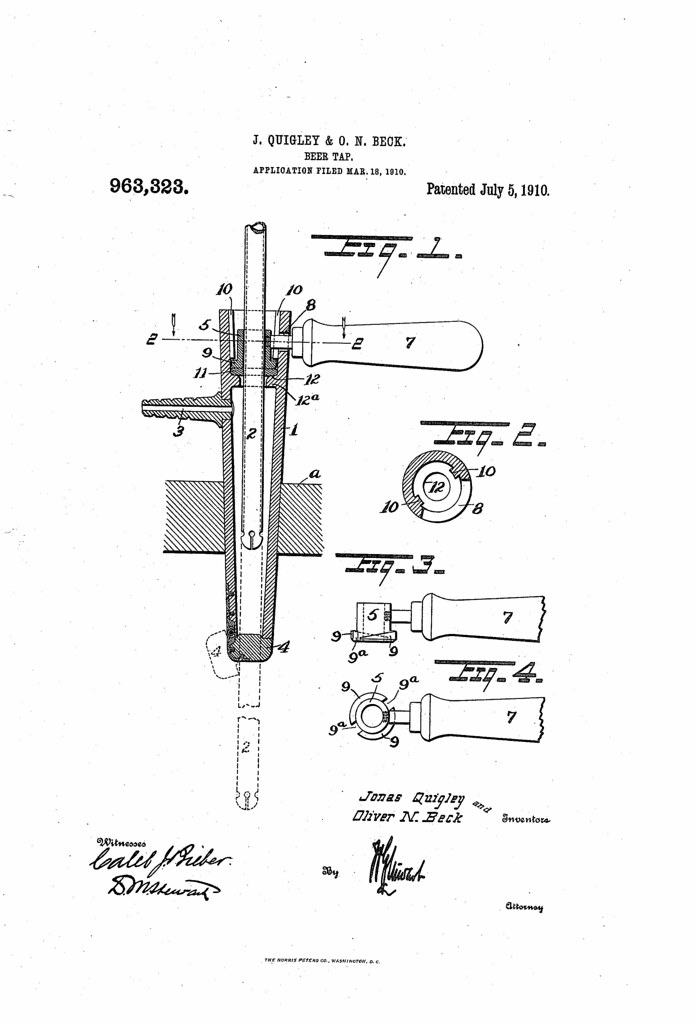
Today in 1911, US Patent 963323 A was issued, an invention of Jonas Quigley and Oliver N. Beck, for their “Beer Tap.” There’s no Abstract, although in the description it includes this summary:

Our invention relates particularly to beer tapping means in which a tap-tube is employed in connection with a casing therefor through which air-pressure is transmitted to the liquid; and our object is to provide an improved device of very simple construction and operation, as fully described in connection with the accompanying drawing, and the novelty of which is specifically pointed out in the claim.

US963323-0

Filed Under: Beers, Just For Fun, Politics & Law, Related Pleasures Tagged With: History, Kegs, Law, Patent

Patent No. 628084A: Beer Dispensing And Pipe Cleaning Apparatus

July 4, 2016 By Jay Brooks

patent-logo
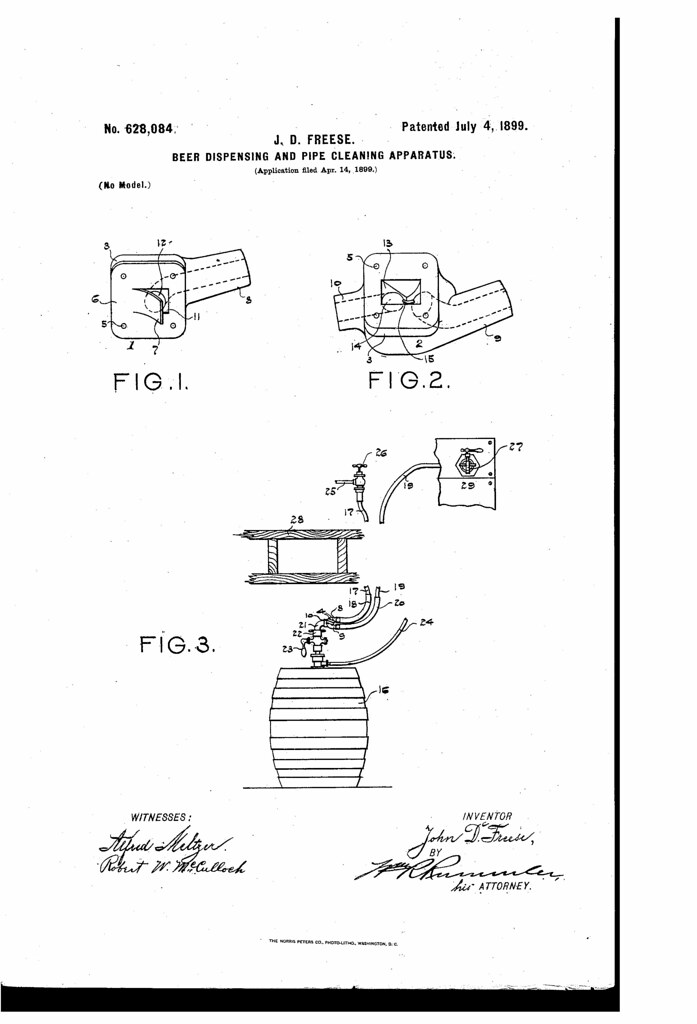
Today in 1899, US Patent 628084 A was issued, an invention of John D. Freese, for his “Beer Dispensing and Pipe Cleaning Apparatus.” There’s no Abstract, although in the description it includes this summary:

The main object of my invention is to provide convenient means for cleaning the pipes in a beer dispensing system so arranged that an operator may clean the pipes by turning on the water at the dispensing end, the water passing into the beer-pipe near the storage end and thence discharging through the beer faucet.

US628084-0

Filed Under: Beers, Just For Fun, Politics & Law, Related Pleasures Tagged With: History, Kegs, Law, Patent

Patent No. 996972A: Apparatus For Filling Bottles

July 4, 2016 By Jay Brooks

patent-logo
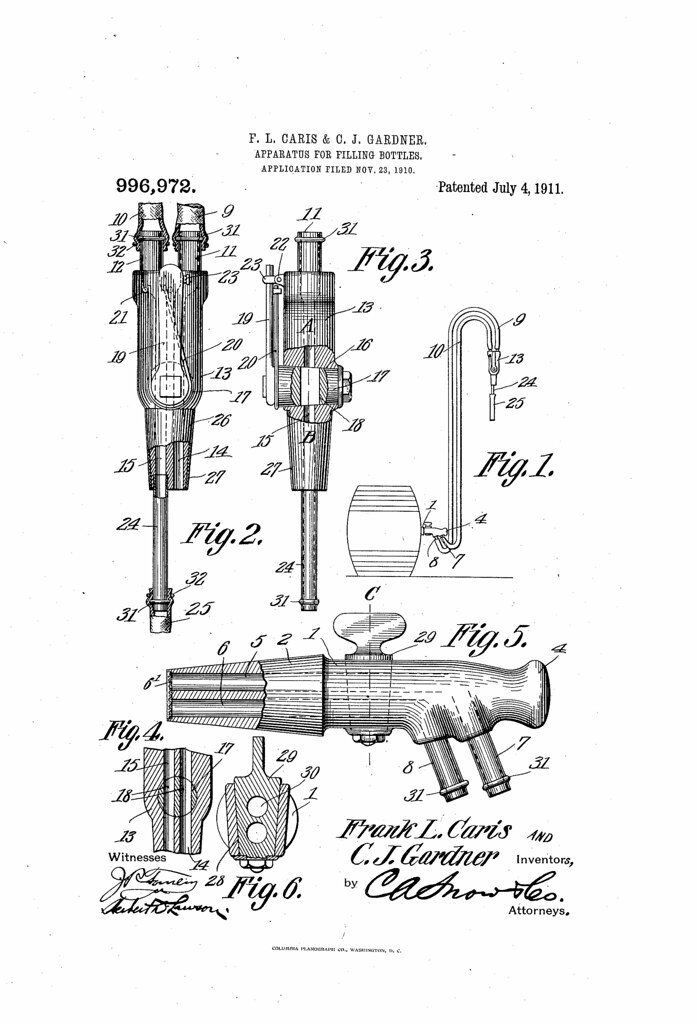
Today in 1911, US Patent 996972 A was issued, an invention of Frank L. Caris and Clarence J. Gardner, for their “Apparatus For Filling Bottles.” There’s no Abstract, although in the description it includes this summary:

This invention relates to apparatus for use in filling bottles from kegs or barrels, the same being particularly adapted for bottling beer and the like.

One of the objects of the invention is to provide an inexpensive device of this character which can be readily handled by one person, there being improved means for discharging the liquid into the bottle and for permitting the escape of foam back to the keg or other receptacle from which the liquid is drawn.

A further object is to provide apparatus of this type having a nozzle in which is mounted a valve normally maintained in closed position but which can be conveniently held open during the filling operation. With the foregoing and other objects in view, the invention consists in the combination and arrangement of parts and in the details of construction hereinafter described and claimed, it being understood that changes in the precise embodiment of invention herein disclosed can be made within the scope of what is claimed, without departing from the spirit of the invention.

US996972-0

Filed Under: Beers, Breweries, Just For Fun, Politics & Law, Related Pleasures Tagged With: Bottles, Brewing Equipment, History, Law, Packaging, Patent

Patent No. 1964836A: Faucet

July 3, 2016 By Jay Brooks

patent-logo
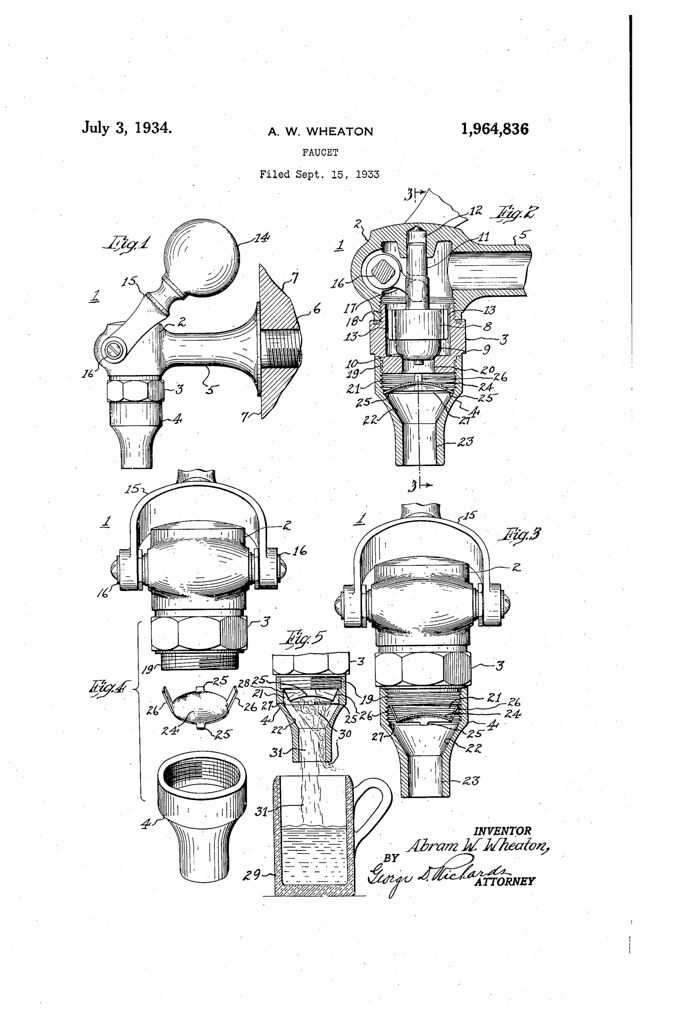
Today in 1934, US Patent 1964836 A was issued, an invention of Abram W. Wheaton, for his beer “Faucet.” There’s no Abstract, although in the description it includes this summary:

This invention relates, generally, to faucets and the invention has reference, more particularly, to an improved faucet, which while adapted for general purposes, is especially intended for use as a beer faucet.

The principal object of the present invention is to provide an improved faucet having a novel construction of gas separating bafile incorporated therein, said bafile serving to liberate a considerable portion of the carbon dioxide and other gas content of the beer as the same flows through the faucet, thereby greatly reducing the amount of foam ordinarily produced when drawing beer and preventing considerable waste which usually occurs when using ordinary beer faucets.

Another object of the present invention lies in the provision of an improved faucet having a novel sheet metal gas separating baffle of simple, rugged construction, the said baflle being so constructed as to enable the same to be readily inserted into or removed from the faucet and having means to insure its proper installation in the faucet.

US1964836-0

Filed Under: Beers, Just For Fun, Politics & Law, Related Pleasures Tagged With: History, Kegs, Law, Patent

Patent No. 280385A: Apparatus For And Process Of Cooling And Condensing The Foam Which Forms On The Surface Of Fermenting Liquor

July 3, 2016 By Jay Brooks

patent-logo
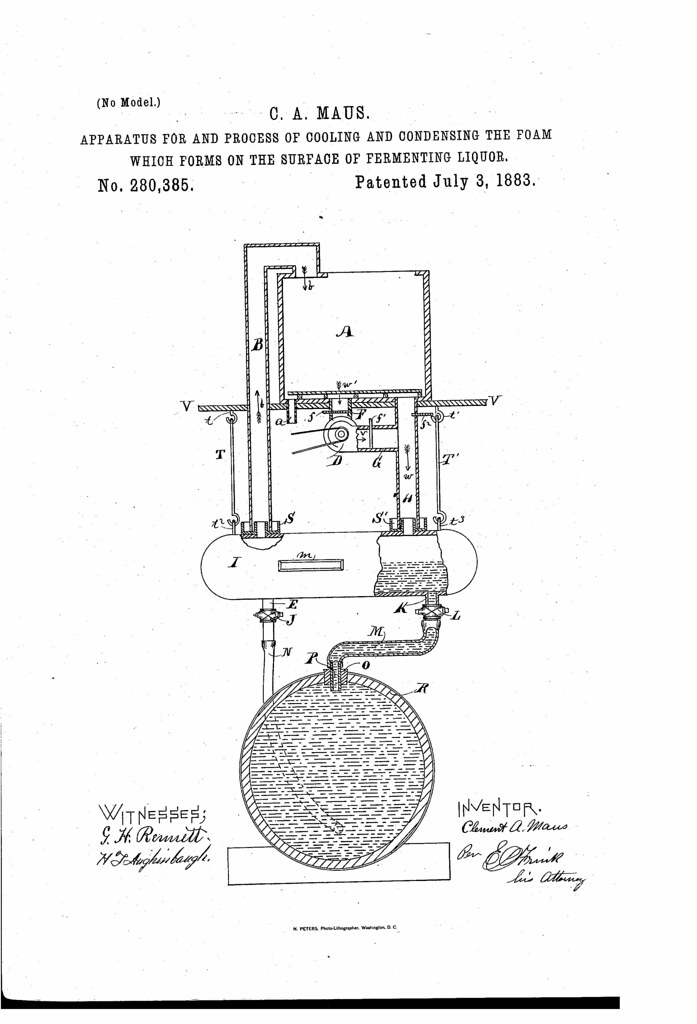
Today in 1883, US Patent 280385 A was issued, an invention of Clement A. Maus, for his “Apparatus For and Process of Cooling and Condensing the Foam Which Forms on the Surface of Fermenting Liquor.” There’s no Abstract, although in the description it includes this summary:

My invention relates to an apparatus for cooling and condensing the foam of fermenting liquors, wort, beer, ale, &c, in which a condensing-chamber operates in conjunction with suitable pipes, a current of cooled and purified air from an ice-reservoir, and a vessel containing the fermenting liquid; and the objects of my invention are, first, to provide a means for condensing the foam that is forming on the surface of fermenting wort, beer, ale, &c., by blowing on or beating it with a current of cooled air, thus converting the foam into a liquid state again and permitting it to run back into the fermenting body of liquid; second, to provide facilities for counteracting the volatilization of the flavor and fine hop aroma of the wort, beer, ale, &c., while undergoing several stages of fermentation; third, to provide a means for preventing the escape of the volatile portion of the hop aroma and flavor of the fermenting wort, beer, ale, 850., during the first and last stages of the fermenting body. These objects I accomplish by the mechanism illustrated by the accompanying drawing, in which the entire apparatus is illustrated by a single figure, which is partially in section to show the construction and arrangement of certain parts more fully.

US280385-0

Filed Under: Beers, Breweries, Just For Fun, Politics & Law, Related Pleasures Tagged With: Brewing Equipment, History, Law, Patent, Science of Brewing

Patent No. 2559107A: Drying Hops

July 3, 2016 By Jay Brooks

patent-logo
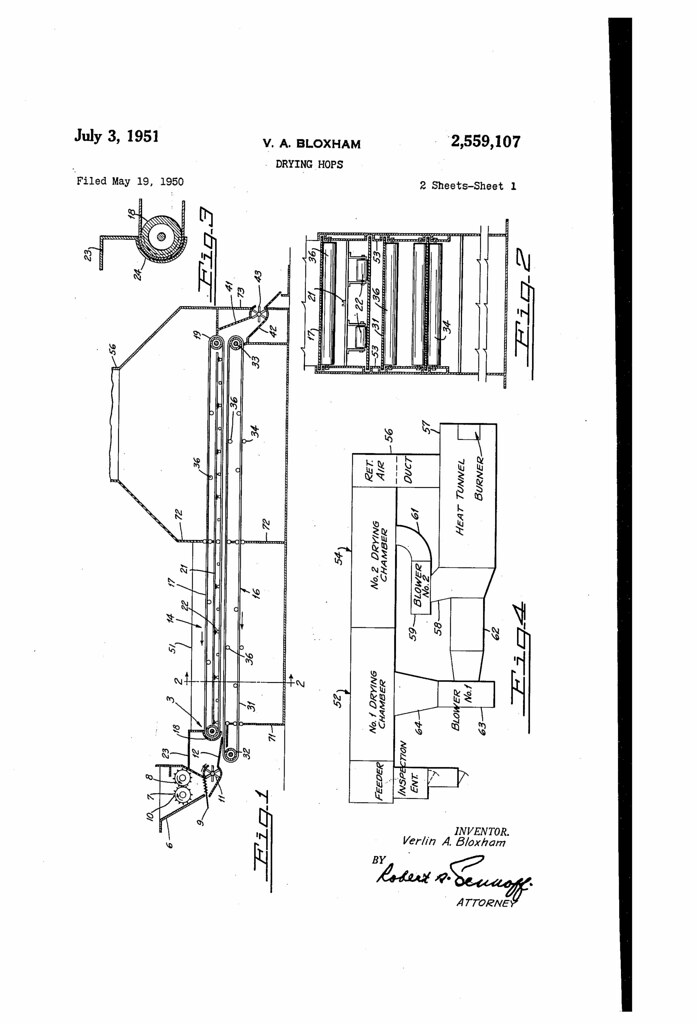
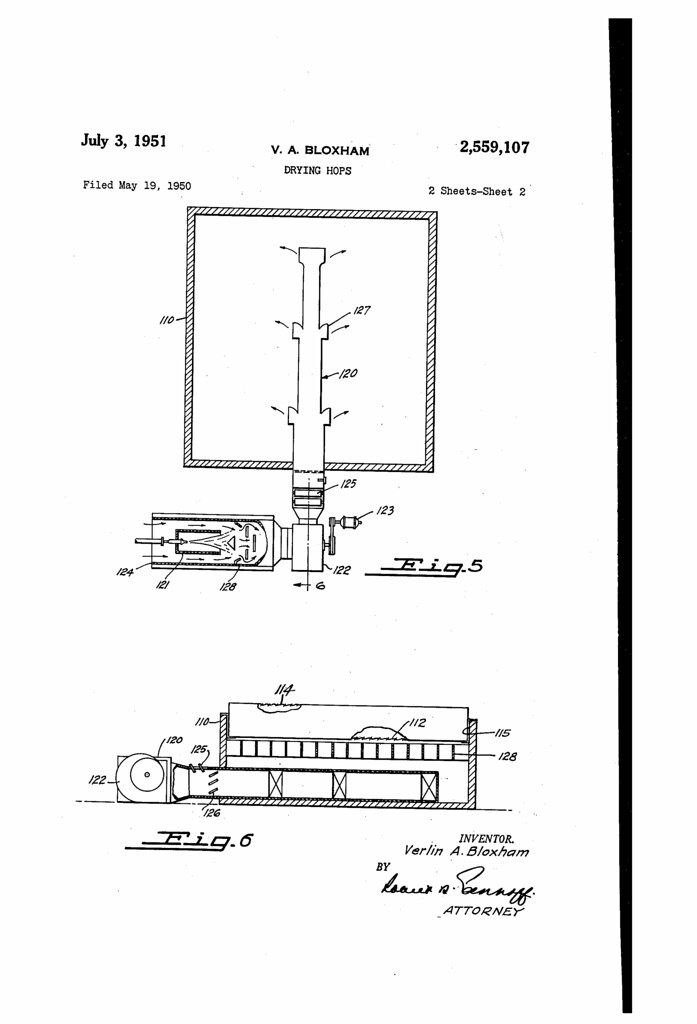
Today in 1951, US Patent 2559107 A was issued, an invention of Verlin A. Bloxham, for his “Drying Hops.” There’s no Abstract, although in the description it includes this summary:

This invention relates to an improved process for the drying of hops.

The common process employed, in lowering the moisture content of hops from 75% to 80% to 7 to 11%, involves the use of apparatus including a house-like structure having a reticulated floor upon which the hops are loaded. Beneath the floor there is disposed a heater, commonly direct fired, and the products of combustion from which usually pass through a zigzag or like arrangement of large pipes, located beneath the hop floor, on the way to the stack. Forced draft of air through the hops is not provided, the house being tall compared to its section so as to provide a stack effect, the hop-floor being some twenty feet above ground level. There are a great number of objections to this manner of drying, the major one probably .being the variable quality of the dried product. This variable quality is clue to several factors inherent in the process employed, one of the main ones of which is that the drying is more efficient in the lower portion of the bed, with the result that if the bed is not turned one or more times during the drying process, the drying will not -be uni,- form and hops in one portion of the bed will be of a different moisture content from those in another portion.

The turning of the hops, to ensure uniformity in drying, has its own drawbacks. After the hops dry, they become very fragile and brittle and easily broken, and when the bed is turned to reverse the position of the upper and lower layers, many of the cones which have reached the brittle state will be broken, and the product taken from the dryer will have an excessively high proportion of fines. The labor involved in this operation is, of course, objectionable in addition.

As will be apparent from the above description of the apparatus, the hops are subjected not only to heat by convection from the pipes, but also to radiant heat. For this reason, though ordinary dry bulb thermometers are customarily used in order to control the temperature Within the bed, the lower layers of hops to which heat is radiated will be at temperatures higher than that indicated by the thermometer. This consideration, of course, renders the control by thermometer inadequate and misleading and constitutes one of the reasons for lack of uniformity in the product, since the hop is extremely sensitive to excessive temperature. Further, action of this radiant heat is to raise the temperature to excessive levels of those portions of the enclosure which are seen by the pipes. This results in the successive drying, charring and perhaps final combustion of the combustible material, generally wood, employed in construction of the driers; the loss of the driers by fire is a common occurrence.

A still further serious objection is encountered due to the fact that fines fall from hops through the floor and onto the hot pipes where they become charred and give rise to vapors which in turn pass through the hops and may be condensed on or absorbed by them.

The driers are tall, as referred to above, which increases the difficulty and labor involved in loading, turning and unloading. Floor loading is limited to a depth of about twenty-four inches. The heating system is inefficient, wasting as much as 50% of the heat.

The present invention contemplates the continuous drying of hops, thus avoiding any delay between the harvesting of the hops and the drying operation. This facilitates the harvesting operation inasmuch as it is not necessary to assemble a kiln charge prior to the drying operation for loading into the kiln. Thus, the drying operation and the harvesting operation can be coordinated and carried on simultaneously and continuously.

US2559107-0
US2559107-1

Filed Under: Beers, Just For Fun, Politics & Law, Related Pleasures Tagged With: Brewing Equipment, History, Hops, Law, Patent

Patent No. 2006940A: Bung And A Method Of Making Bungs

July 2, 2016 By Jay Brooks

patent-logo
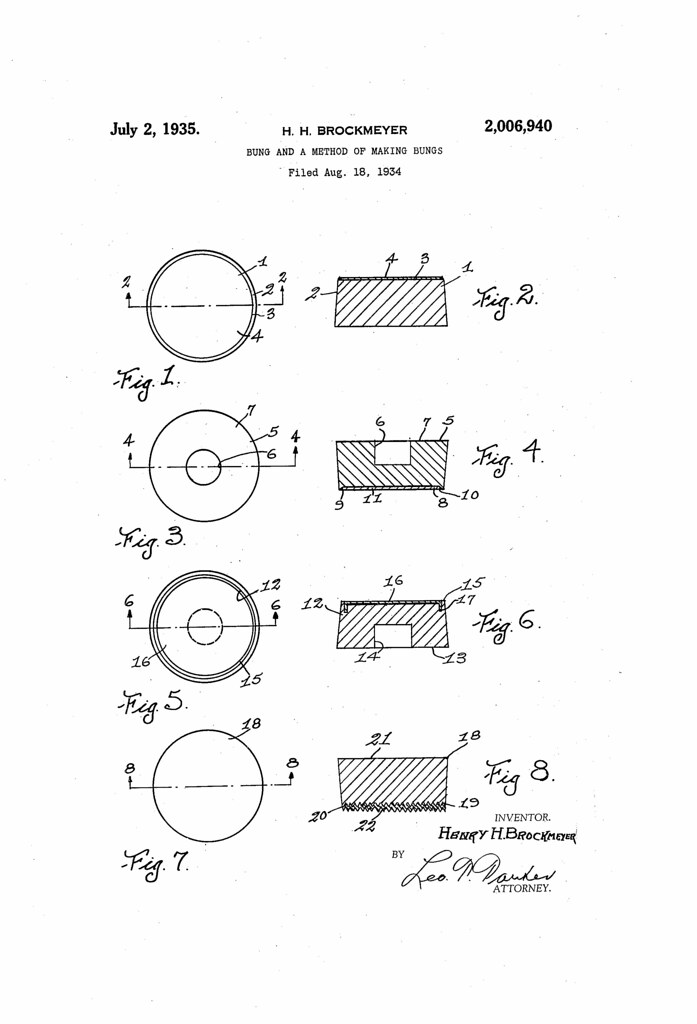
Today in 1935, US Patent 2006940 A was issued, an invention of Henry H. Brockmeyer, for his “Bung and a Method of Making Bungs.” There’s no Abstract, although in the description it includes this summary:

The invention relates to means particularly adapted to prevent seepage of liquids through bung and in many instances, especially for the reason that presently bungs usually are constructed from wood derived from relatively small trees, the grain does not extend parallel with the inner and outer surfaces of the bung but curves inwardly or outwardly whereby the liquid, particularly beer, which is under relatively heavy pressure within the container, is adapted to seep through the pores in the wood of the bung, or through the channels adjacent the grain. Moreover, the pressure of air or gases within the container is reduced as by escape of such air or gases through the pores or channels, in the bung, adjacent the grain, simultaneously when the liquid within the container seeps therethrough. Since it is advantageous to retain the air or gas pressure within the container, as well as prevent seepage of the liquid from within said container outwardly through the bung, any leakage of air or seepage of liquid is undesirable.

Therefore, an important object of the invention is to provide simple, efficient, practical and economical means to prevent passage of air or gases through a bung and to prevent seepage of liquid through said bung.

Other objects of the invention are to provide dependable means adapted to render the inner surface of a bung impervious to liquids, such as beer, whiskey, and the like; and to provide means which is unlikely to interfere or retard natural expansion of said bung, when contacted by said liquid, for the purpose of sealing the bung hole in which said bung is positioned.

US2006940-0

Filed Under: Beers, Just For Fun, Politics & Law, Related Pleasures Tagged With: History, Kegs, Law, Patent

« Previous Page
Next Page »

Find Something

Northern California Breweries

Please consider purchasing my latest book, California Breweries North, available from Amazon, or ask for it at your local bookstore.

Recent Comments

  • Ernie Dewing on Historic Beer Birthday: Charles William Bergner 
  • Steve 'Pudgy' De Rose on Historic Beer Birthday: Jacob Schmidt
  • Jay Brooks on Beer Birthday: Bill Owens
  • Steve 'Pudgy' De Rose on Beer Birthday: Charles Finkel
  • Steve 'Pudgy' De Rose on Beer Birthday: Bill Owens

Recent Posts

  • Historic Beer Birthday: John Goetz January 28, 2026
  • Beer Birthday: Jean-Marie Rock January 28, 2026
  • Beer In Ads #5184: The “B”s Are Here, Bruton Bock Beer January 27, 2026
  • Beer Birthday: Logan Plant January 27, 2026
  • Historic Beer Birthday: William Tunis Ryerson January 27, 2026

BBB Archives

Feedback

Head Quarter
This site is hosted and maintained by H25Q.dev. Any questions or comments for the webmaster can be directed here.