Brookston Beer Bulletin

Jay R. Brooks on Beer

  • Home
  • About
  • Editorial
  • Birthdays
  • Art & Beer

Socialize

  • Dribbble
  • Email
  • Facebook
  • Flickr
  • GitHub
  • Instagram
  • LinkedIn
  • Pinterest
  • RSS
  • Twitter
  • YouTube

Powered by Genesis

Patent No. 1029838A: Method Of Finishing And Preparing Beverages

June 18, 2016 By Jay Brooks

patent-logo
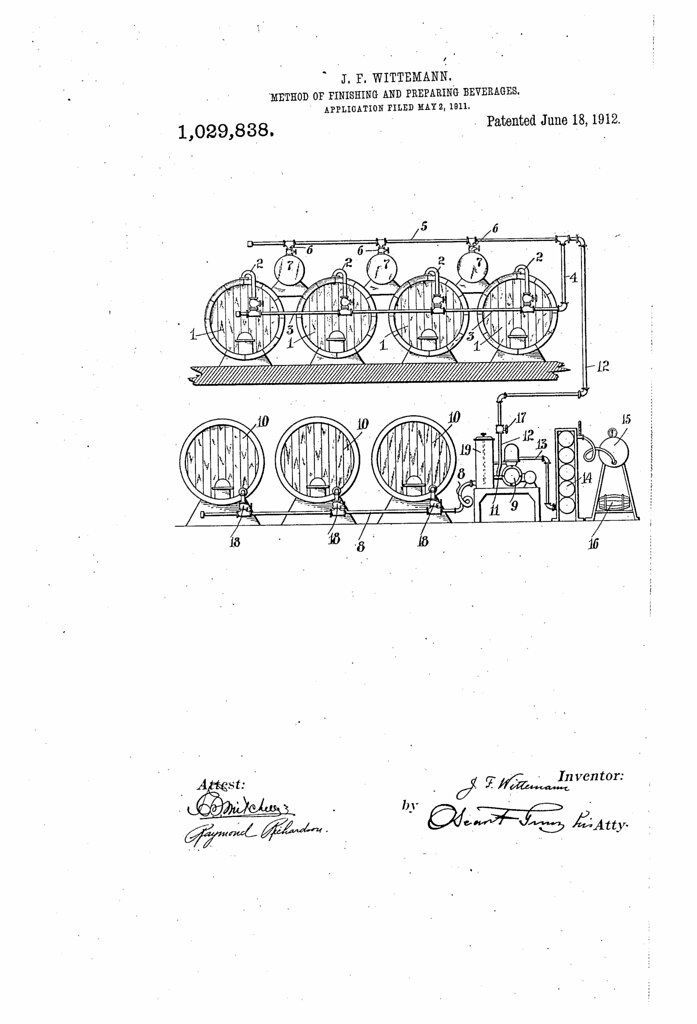
Today in 1912, US Patent 1029838 A was issued, an invention of Jacob Frederic Wittemann, for his “Method of Finishing and Preparing Beverages.” There’s no Abstract, though it’s described this way in the application:

The invention relates to a new and improved system or method of enhancing the value of fermented beverages such as beer, wine, cider, etc, by their treatment with the volatile products of the fermentation of such beverages.

The object. of my invention is to treat such beverages when they are matured, clarified or filtered, either or all,, to the required standard, but lacking sufficient incorporation of carbonic acid gas and fermentation ethers, generated during the fermentation of such liquids to impart to them the desired degree of effervescence, flavor and improved character by incorporating with such beverages such volatile fermentation products .while .the latter remain substantially in the same condition, as when generated by the fermentation of such beverages, but at such density or pressure and temperature that the stated object shall be attained, namely, that .the more or less quiescent state in which such beverages mature and clarify most readily, is transformed into a condition of effervescence or a foam-maintaining state at a temperature at which they attended by more or less disintegration, deterioration or other undesirable change in the character or composition of this complex gas, owing to improper treatment thereof, such as overheating during dry me chemical compression or compression in the presence of insufficient cooling medium, or its contact with a more or less impure cooling medium or with disintegrating metal surfaces, or owing to its degeneration or decomposition while kept in storage under high pressure. By my improved method all such undesirable changes or alterations in the composition, flavor and taste of the volatile products of fermentation are avoided when they are incorporated in the desired proportion with a matured, but-as yet more or less unmerchantable, beverage, owing to its lack of a sufficient proportion of such gas. The compression of the gas to the necessary density in which it capable of producing the desired effect in such beverages is preferably effected in part by its retention within the fermenting vessel, up to a pressure within a safety limit, dictated by the nature or construction of such vessel, and with the beverage into which it is to be incorporated by a liquid and gas-forcing mechanism such as a force pump.

As {this invention will find its principal use in the manufacture of beer, I shall hereafter use the term beer as a generic term for all similar beverages and in the accompanying drawing show an embodiment of ,one apparatus for carrying out my new and improved method or process as it would be used in a brewery; but I in no wise confine the use of my invention to beer only, as the process can as readily be applied to the manufacture of other similar beverages and by the use of other constructions of apparatus according to varying conditions or requirements, yet carrying out. the same method in principle.
US1029838-0

Filed Under: Beers, Breweries, Just For Fun, Politics & Law, Related Pleasures Tagged With: Barrels, History, Law, Patent, Science of Brewing

Patent Nos. 3094213A & 3094214A: Fill-Height Inspection Device For Fluid In Bottles/Automatic Container Fill-Height Inspection Machine

June 18, 2016 By Jay Brooks

patent-logo
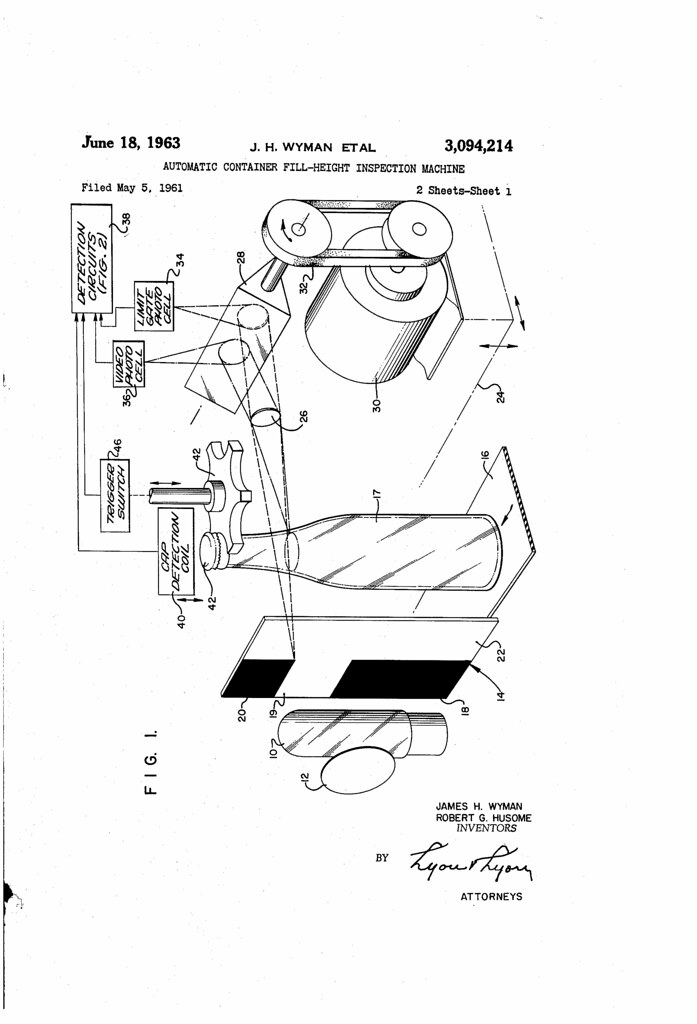
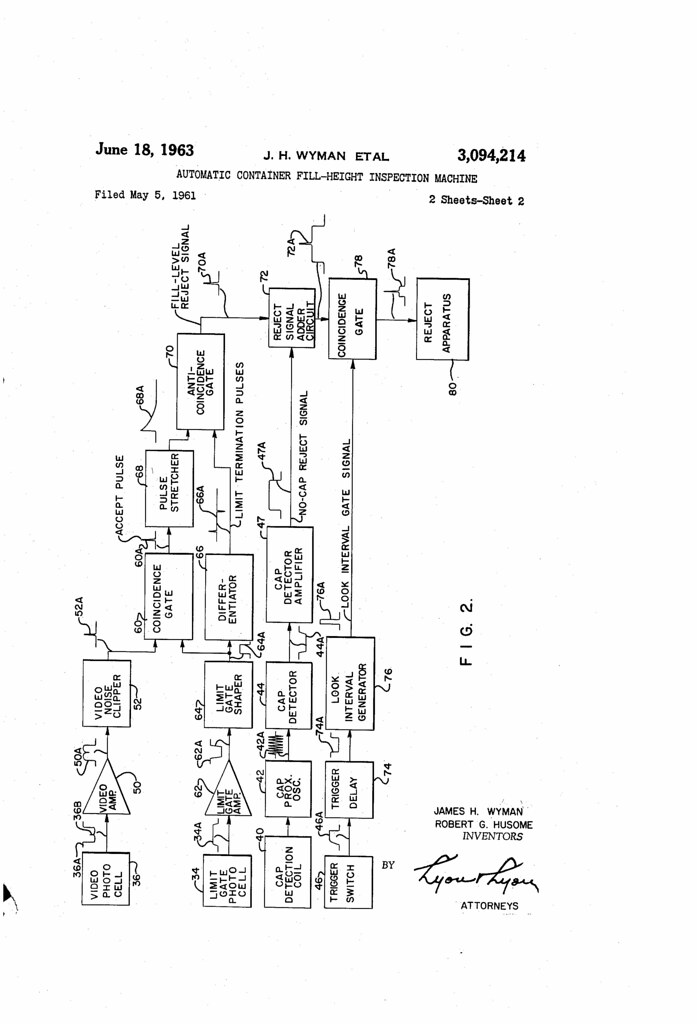
Today in 1895, US Patent 3094213 A and US Patent 3094214 A was issued, both inventions of James H. Wyman, with the second also by Robert G. Husome, for their “Fill-Height Inspection Device For Fluid In Bottles” and “Automatic Container Fill-Height Inspection Machine.” There’s no Abstract for either, though they’re described this way in the application:

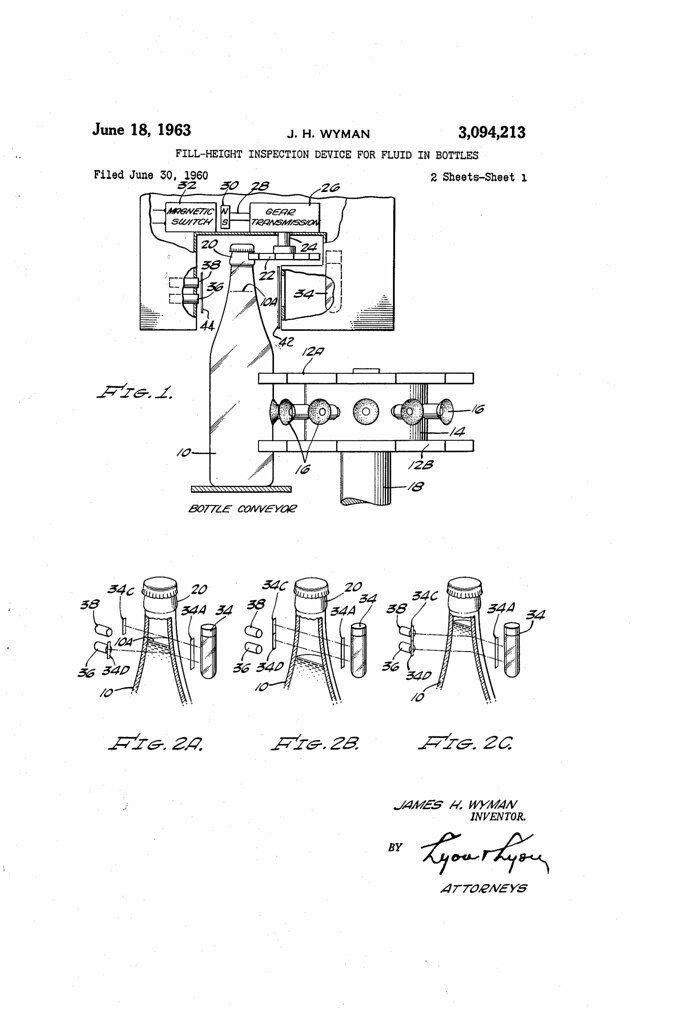
This invention relates to inspection apparatus of the type used to deter-mine whether a transparent container, such as a bottle, has been filled to the proper height with a liquid, and, more particularly, to improvements therein.

The requirement that the volume of beverage in a bottle correspond to the volume specified on the label on the bottle is a legal one. Good customer relations also provide more incentive to a bottler of liquids which require him to make sure that the contents of the bottle are as specified. On the other hand, should more than the specified amount of liquid be poured into the bottles, the bottler suffers an economic loss. Thus, a number of different systems have been proposed which inspect translucent containers, such as bottles, to determine whether the fill-height of the bottle is proper. These systems usually apply radiation on one side of the bottle and a detector on the other side of the bottle in the region of the bottle wherein desired fill-height occurs. However, due to various factors, such as the differences in bottle thickness, bottle color, variations in beverage color, as well as the presence of foam in many beverages, none of the heretofore-produced systems have proven consistently satisfactory.

An object of this invention is to provide a fill-height inspection system which is not adversely aifected by variations in bottle thickness or color.

Another object of this invention is the provision of a fill-height inspection system which is not adversely affected by differences in beverage color or the presence of foam.

Yet another object of the present invention is the provision of a novel and unique fill-height inspection system.

These and other objects of the invention are achieved by taking advantage of the fact that light is refracted or bent at ‘a unique angle by the liquid and its container. Thus, if a photocell is positioned on one side of a container so that no illumination from a light source can reach that photocell, unless it is refracted by the liquid in the container, a positive arrangement for detecting the fill-height of the liquid in the container may be obtained. The photocell is positioned adjacent the container at a level just below the minimum acceptable level. Similarly, to determine whether a container has been overfilled, a photocell may be positioned adjacent the container just above the maximum desired fill-height level, to be illuminated only by light which is refracted by the liquid in the bottle.

US3094213-0
US3094213-1

This invention relates to automatic fill-height inspection machines and, more particularly, to an improved arrangement for determining that a translucent container has been filled to the proper level.

Presently known automatic fill-height machines for photoelectrically inspecting a translucent container are not completely reliable, as a result of difficulties experienced with different colored bottles or bottles of varying opacity, thickness, or even in view of the fact that some liquids which are carbonated, such as beer, will have a foam at the top of the liquid which can provide a false signal as to the actual level to which the container is filled. Another difficulty which arises is that the prior systems are substantially limited to use with only one size of a container. If a production run of a different container size or even different fill-height requirements is desired, a considerable realignment of the fill height inspection apparatus parameters is required. A further limitation of prior systems is that they may be applicable only to translucent liquids.

An object of this invention is the provision of a reliable fill-height inspection apparatus.

Another object of this invention is the provision of a novel and useful fill-height inspection apparatus.

Yet another object of this invention is the provision of a fill height inspection apparatus which is easily adjustable for inspecting containers of different sizes.

Yet another object of this invention is to provide fill height inspection capability for opaque liquids, translucent liquids with foam on top, or solid (e.g., granular or powdered) materials in translucent containers.

US3094214-0
US3094214-1

Filed Under: Beers Tagged With: Bottles, Brewing Equipment, History, Law, Packaging, Patent

Patent No. 857461A: Hop Picker

June 18, 2016 By Jay Brooks

patent-logo
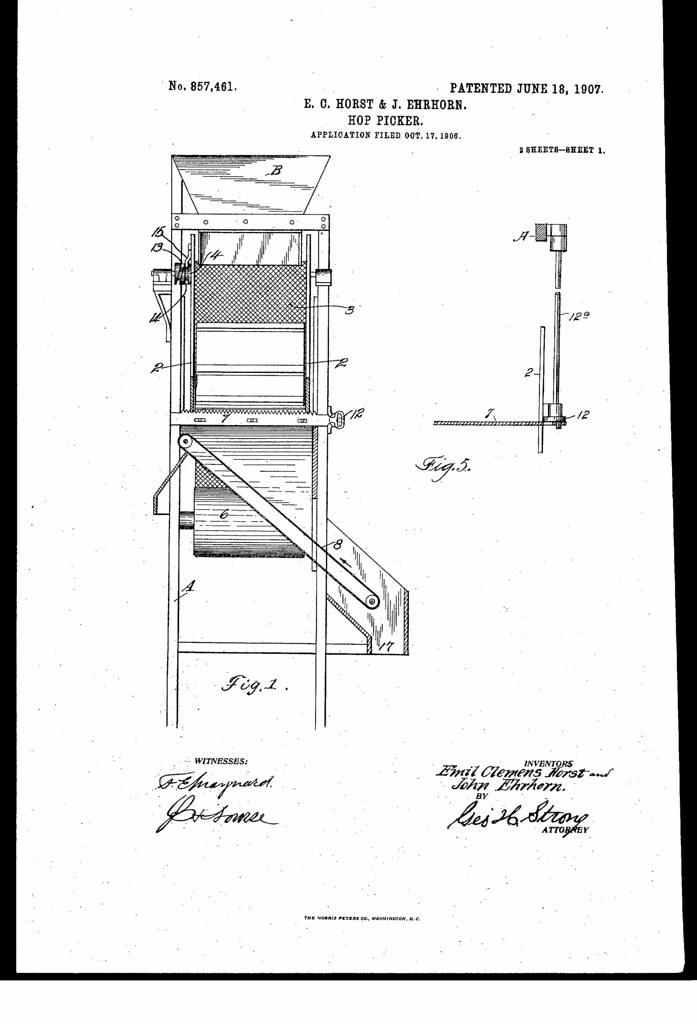
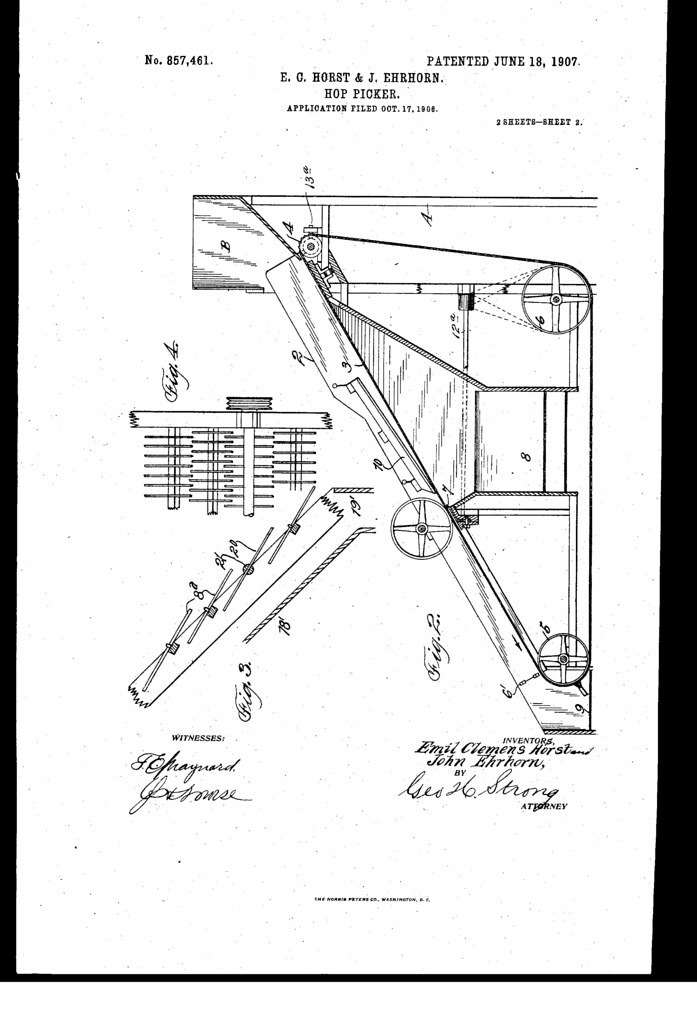
Today in 1907, US Patent 857461 A was issued, an invention of Emil Clemens Horst and John Ehrhorn, for their “Hop Picker.” There’s no Abstract, though it’s described this way in the application:

Our invention relates to a machine by which hops may be picked or separated from the vines upon which they grow. It consists of an endless traveling screen upon which the hop vines are thrown, and through which the hops upon their stems are caused to depend; a means for severing the hops from the stem.

US857461-0
US857461-1

Filed Under: Beers, Just For Fun, Politics & Law, Related Pleasures Tagged With: Brewing Equipment, History, Hops, Law, Patent

Patent No. 430526A: Bottle Filling Machine

June 17, 2016 By Jay Brooks

patent-logo
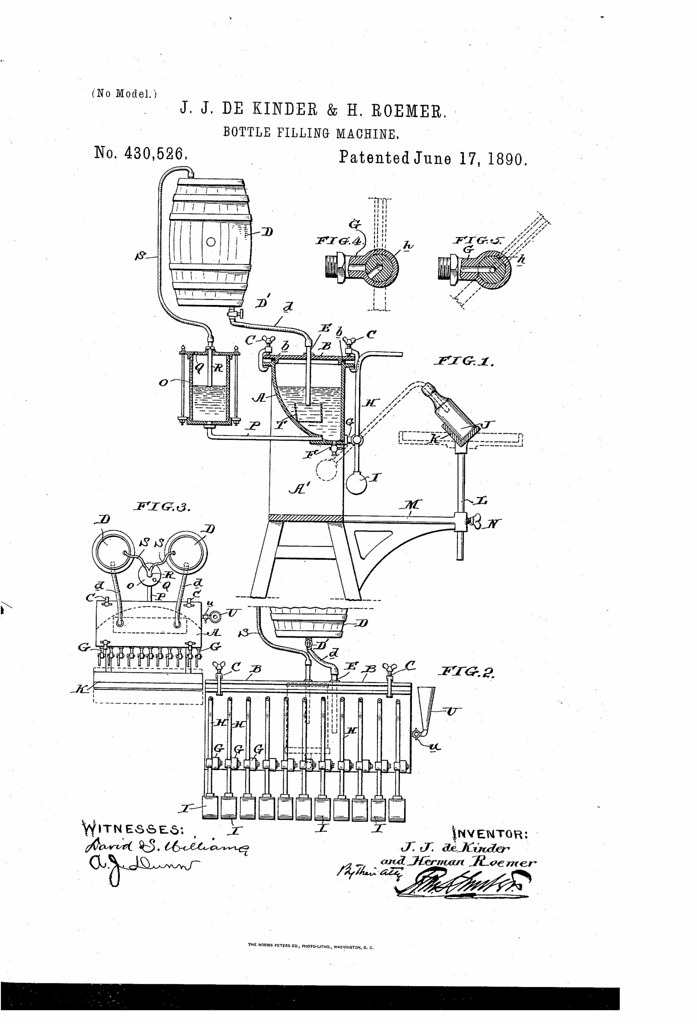
Today in 1890, US Patent 430526 A was issued, an invention of Joseph J. De Kinder and Hermann Roemer, for their “Bottle Filling Machine.” There’s no Abstract, though it’s described this way in the application:

Our invention relates to bottle-filling machines; and it consists of certain improvements, which are fully set forth in the following specification, and shown in the accompanying drawings, which form a part thereof.

While our invention relates to bottle-filling machines in general, it is especially adapted to beer-bottling, in which heretofore great difficulty has been experienced by reason of the great tendency of the beer to foam and of the difficulty of accomplishing the proper feeding of the beer from the barrel and of the loss of carbonic acid by exposure to the atmosphere. It is the object of our invention to overcome these difficulties and to accomplish a regular feeding of the liquid from the reservoir or supply without objectionable foaming in the bottles 0r Overflowing of the liquid.

In carrying out our invention we employ a convenient receptacle or vessel provided With delivery-tubes for delivering the liquid to the bottles, and connect this vessel with the barrel or supply-reservoir, and by means of certain devices, hereinafter more fully described, control the flow of the liquor from the barrel or reservoir by the level of the liquor in the delivery-vessel. By this means the supply of liquor in the delivery-vessel is replenished from the reservoir as the liquor is allowed to flow into the bottles Without the possibility of overflowing, for the moment the liquor in the delivery-vessel reaches a certain height the flowing of the liquor from the reservoir is automatically stopped and cannot begin again until the liquor-level has again fallen. This We accomplish by controlling the supply of air to the barrel or reservoir, as is hereinafter more fully described.

US430526-0

Filed Under: Beers, Breweries, Just For Fun, Politics & Law, Related Pleasures Tagged With: Bottles, Brewing Equipment, History, Law, Patent

Patent No. 139976A: Improvement In Apparatus For Pitching Barrels

June 17, 2016 By Jay Brooks

patent-logo
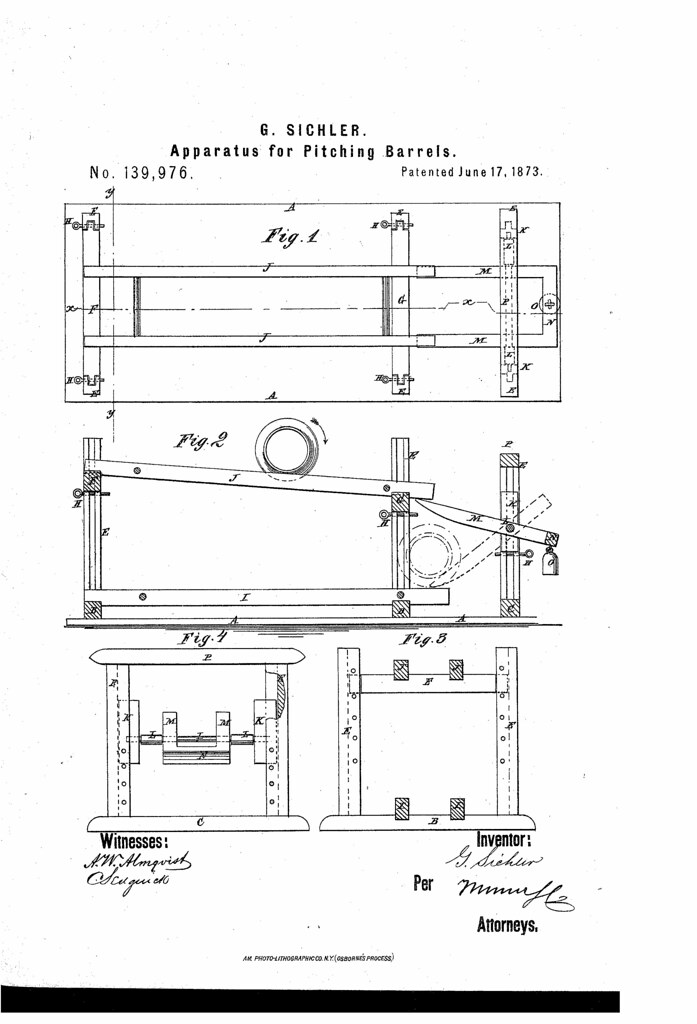
Today in 1873, US Patent 139976 A was issued, an invention of George Sichler, for his “Improvement in Apparatus For Pitching Barrels.” There’s no Abstract, though it’s described this way in the application:

My invention has for its object to furnish an improved apparatus for rolling beer-kegs after they have been pitched to keep the pitch spread over the inner surface of the kegs until they have become so cool that the pitch will not flow. The invention consists in the three cross-bars, the six-posts grooved upon their inner sides, the two adjustable crossbars, the two skids, the adjustable blocks, their connecting-round, and the tilting and weighted skid, constructed and operating in connection with each other as hereinafter fully described.

US139976-0

Filed Under: Beers, Just For Fun, Politics & Law, Related Pleasures Tagged With: Barrels, History, Kegs, Law, Patent

Patent No. 1764841A: Fermenting Vat

June 17, 2016 By Jay Brooks

patent-logo
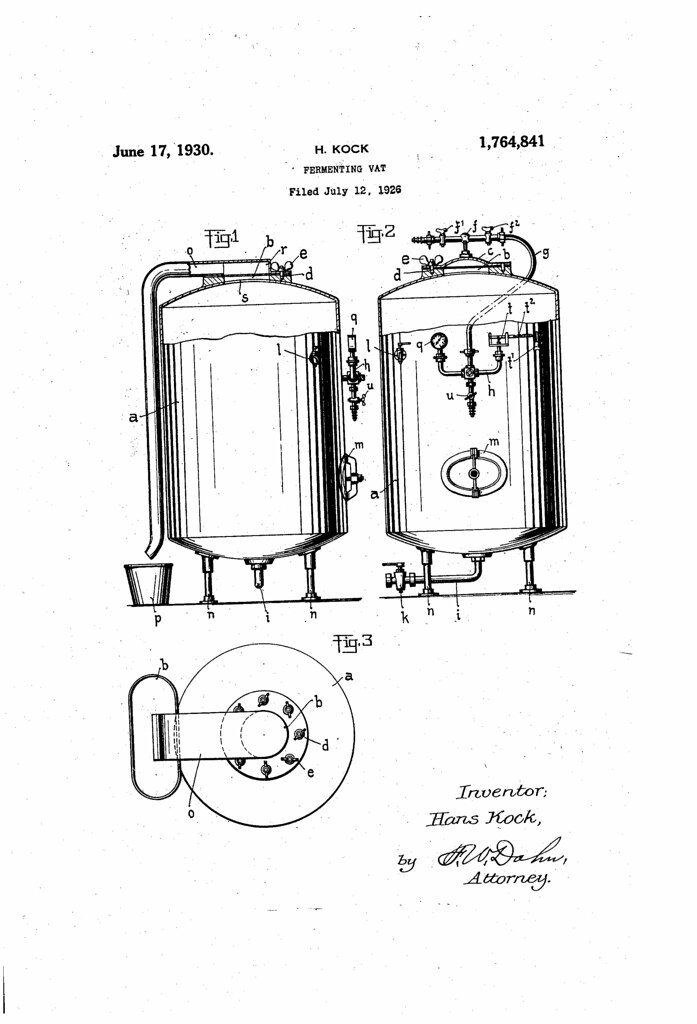
Today in 1930, US Patent 1764841 A was issued, an invention of Hans Kock, for his “Fermenting Vat.” There’s no Abstract, though it’s described this way in the application:

My. invention relates to improvements in fermenting vats, and the object of the improvements is to provide a vat which can be used for fermenting beer and other liquors, storing the beer and filling the same into hot ties. With this object in view my invention consists in forming the vat at its top with an opening adapted to have either one of the attachments necessary for fermenting the beer, storing the same and filling the same into bottles secured thereto, and constructing such attachments so that they can be readily mounted on and dismounted from the said vat.

US1764841-0

Filed Under: Beers, Breweries, Just For Fun, Politics & Law, Related Pleasures Tagged With: Brewing Equipment, History, Law, Patent, Science of Brewing

Patent No. RE22889E: Stationary Type Hop Picking Machine

June 17, 2016 By Jay Brooks

patent-logo
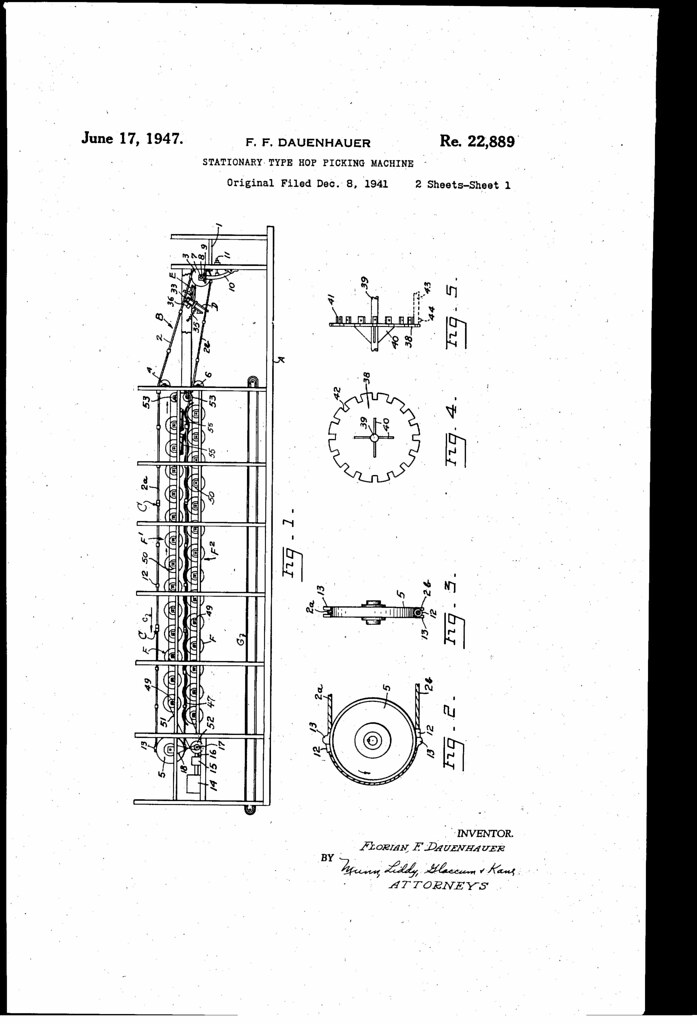
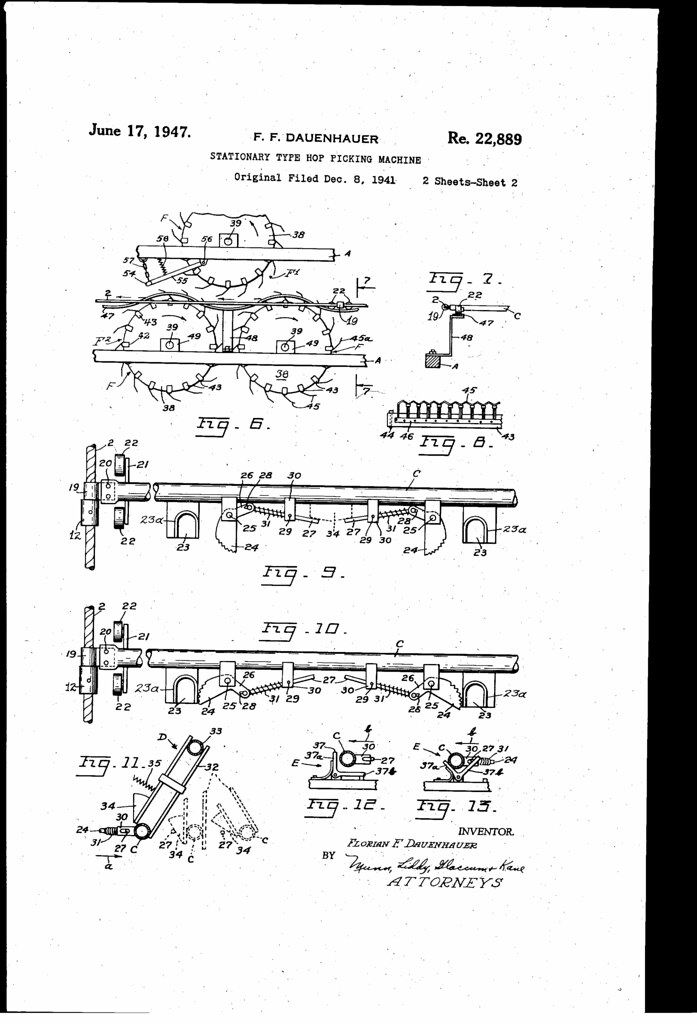
Today in 1947, US Patent RE22889 E was issued, an invention of Florian F. Dauenhauer, for his “Stationary Type Hop Picking Machine.” There’s no Abstract, although in the description it includes this summary:

Hops are raised on a trellis sixteen to eighteen feet in height. When ripe, the vines are out about four feet from the ground, the strings supporting their upper ends to the wire or trellis overhead being either broken by pulling on the vines or cut. Hand picking of hops, owing to the conditions surrounding the growing of hops, the shortness of the season, scarcity of labor and the like, is very expensive and the best hand picking leaves a large percentage of foreign material in the hops and the necessary sacking, boxing and delay in getting hand picked hops to the dry house often results in the discoloring, bruising and flattening of the hops themselves and entails many objectionable incidents.

My invention is an improvement over Patents Nos. 1,054,119 and 1,054,551 covering an apparatus and method for picking hops. In the patents, the picker drums are arranged in two horizontal rows with the drums in the upper row being disposed vertically above the drums in the lower row. The passage between the two rows of drums in the patented devices is therefore restricted in depth between each pair of drums and is of greater depth between adjacent sets of drums. This results in a passage having varying depths and the vines will be unnecessarily compressed each time they are moved through the restricted portions of the passage. The breakage of parts of the vines takes place more readily because of this. Moreover, the arrangement of the drums in vertical pairs leads to another disadvantageous feature of the machine. The hops are picked only where the vertical pairs of drums occur and no picking takes place between adjacent pairs of drums. The picking operation is therefore not continuous throughout the length of the passage.

One of the objects of my invention is to provide a hop picker in which the picking of the hops is continuous throughout the length of the passage through which the vines are moved. A further object of my invention is to provide a passage of uniform depth throughout. A more complete picking of the hops results and there is less breakage of the vines since the vines are carried through a passage of uniform depth rather than through one where the depth varies between each pair of successive drums.

A further object of my invention is to provide a novel vine carrier made of endless cables and carrying vine grasper bars, the bars in turn having vine gripping jaws that are automatically closed on the vines at the feeding end of the machine and are automatically opened so as to free the vines at the exit end of the machine.

USRE22889-0
USRE22889-1

Filed Under: Beers, Just For Fun, Politics & Law, Related Pleasures Tagged With: Brewing Equipment, History, Hops, Law, Patent

Patent No. 320361A: Method Of Preparing And Treating Starch

June 16, 2016 By Jay Brooks

patent-logo
Today in 1885, US Patent 320361 A was issued, an invention of William T. Jebb, for his “Method of Preparing and Treating Starch.” There’s no Abstract, though it’s described this way in the application:

This invention relates to an improvement in the manufacture of beer and ale from barley malt and the starch extracted from Indian corn or maize.

The object of this invention is to utilize the starch contained in the Indian corn for producing a heavy, light-colored wort, without imparting to the malt-liquor an objectionable taste or flavor or impairing its keeping qualities, by extracting from the corn in a simple and inexpensive manner a crude starch which is substantially free from impurities, and then producing a wort from this starch in connection with barley-malt.

Multi-colored Indian corn at a farm in Marion County, Oregon

Filed Under: Beers, Just For Fun, Politics & Law, Related Pleasures Tagged With: barley, History, Law, Malt, Patent

Patent No. 2443550A: Beer Control And Pipe-Cleaning Apparatus

June 15, 2016 By Jay Brooks

patent-logo
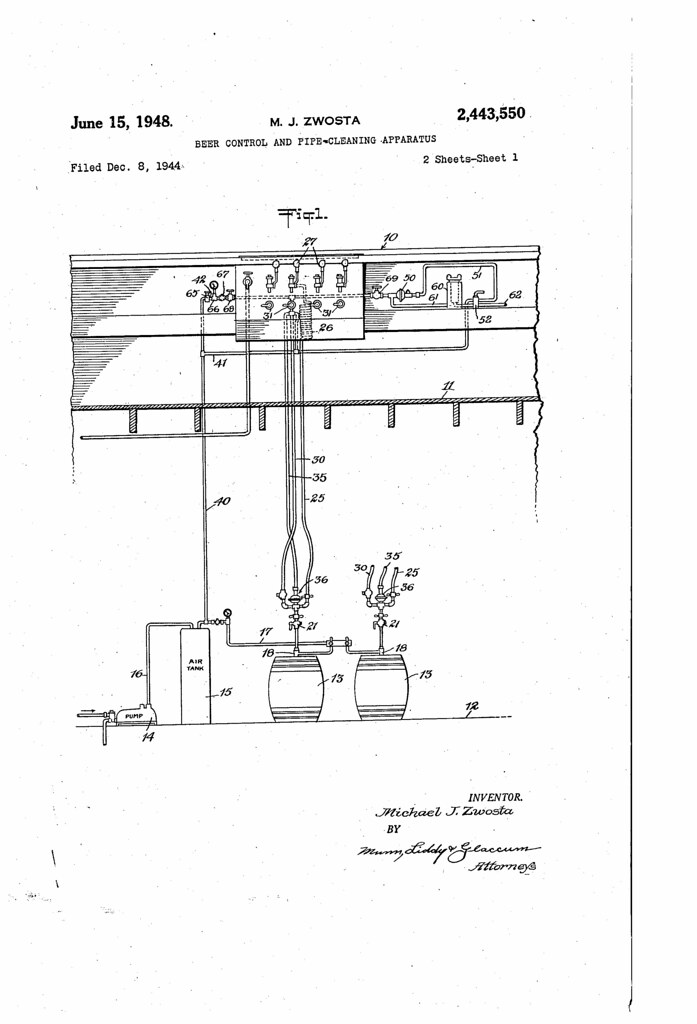
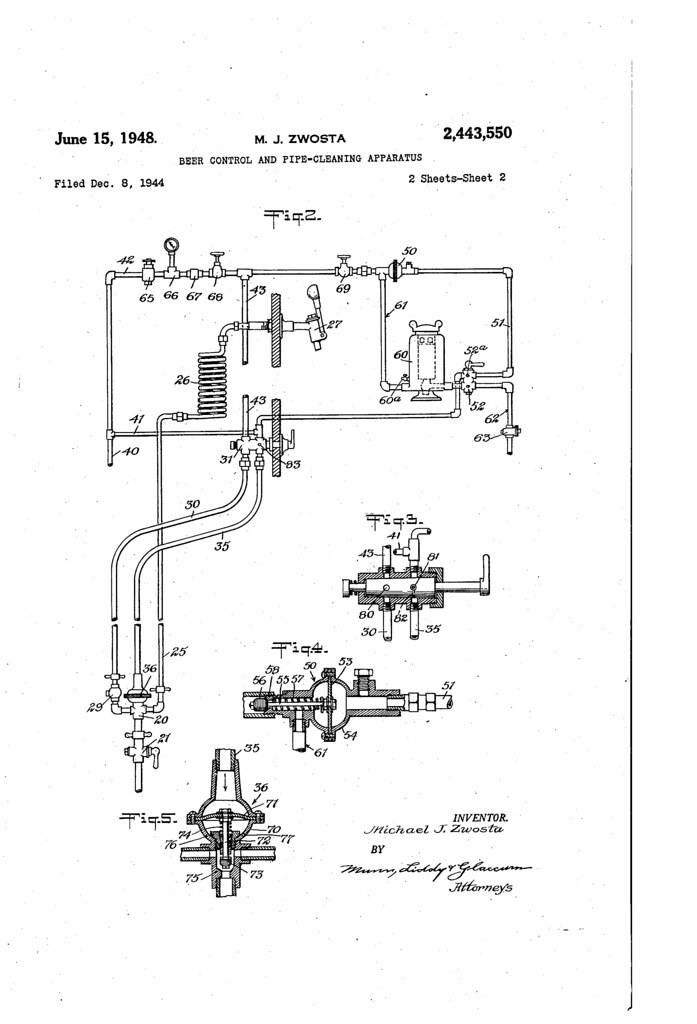
Today in 1948, US Patent 2443550 A was issued, an invention of Michael J. Zwosta, for his “Beer Control and Pipe-Cleaning Apparatus.” There’s no Abstract, though it’s described this way in the application:

This invention relates to beverage dispensing apparatus in which pipe connections extend from the beverage containers to the dispensing faucets and :air or carbonic gas pipes extend from a pump or tank to the beverage containers for supplying the pressure needed to raise the beverage from the containers to the dispensing faucets. More especially, this invention relates to arrangements for cleaning the beverage piping.

The pipe cleaning operation in such dispensing apparatus in general use today, is performed with special portable apparatus which necessitates disconnecting the pipe system from the beverage containers for cleaning and flushing. The operation is usually performed when the beverage dispensing apparatus is not in use and when it is performed during service hours service is necessarily discontinued during the pendency of the operation. This method is poor at best; it does not encourage or permit of sufficiently frequent and sufficiently thorough cleaning operations to insure at all times the best sanitary and palatable conditions. It also causes a serious loss of beverage contained in the pipe lines extending from the containers to the dispensing faucets. In addition to these serious shortcomings, this method is inconvenient and costly.

To overcome these objections, methods and apparatus have been invented for cleaning the pipe lines without causing loss of beverage and without disconnecting the pipe lines from the beverage containers. Invariably, however, these new methods and apparatus are complicated and impractical. In most cases the beverage in the pipe lines is saved by driving it back into the containers before the cleaning operation is started. This is an undesirable practice for the reason, among others, that the beverage from the unclean pipes would have a deleterious effect upon the beverage in the containers. Thus, despite the great shortcomings of the first mentioned method, the last mentioned methods and apparatus have not been generally accepted.

The principal object of the present invention is to provide a practical method and means for encouraging and permitting the frequent cleaning of the pipe system at any time during as well as outside of service hours, without loss of beverage, without the necessity for returning the containers, without the necessity for disconnecting the pipe lines from the beverage containers and without the employment of special portable apparatus.

Another object is to provide apparatus of the character described, having easily accessible controls located in the immediate vicinity of the dispensing faucets.

A further object is the provision of safety control means which function automatically to prevent accidental fouling of the cleaning and flushing system, as for example, the passage of cleaning fluid into the beverage containers.

US2443550-0
US2443550-1

Filed Under: Beers, Just For Fun, Politics & Law, Related Pleasures Tagged With: History, Kegs, Law, Patent

Patent No. 2321631A: Fluid Pressure Controlling Apparatus

June 15, 2016 By Jay Brooks

patent-logo
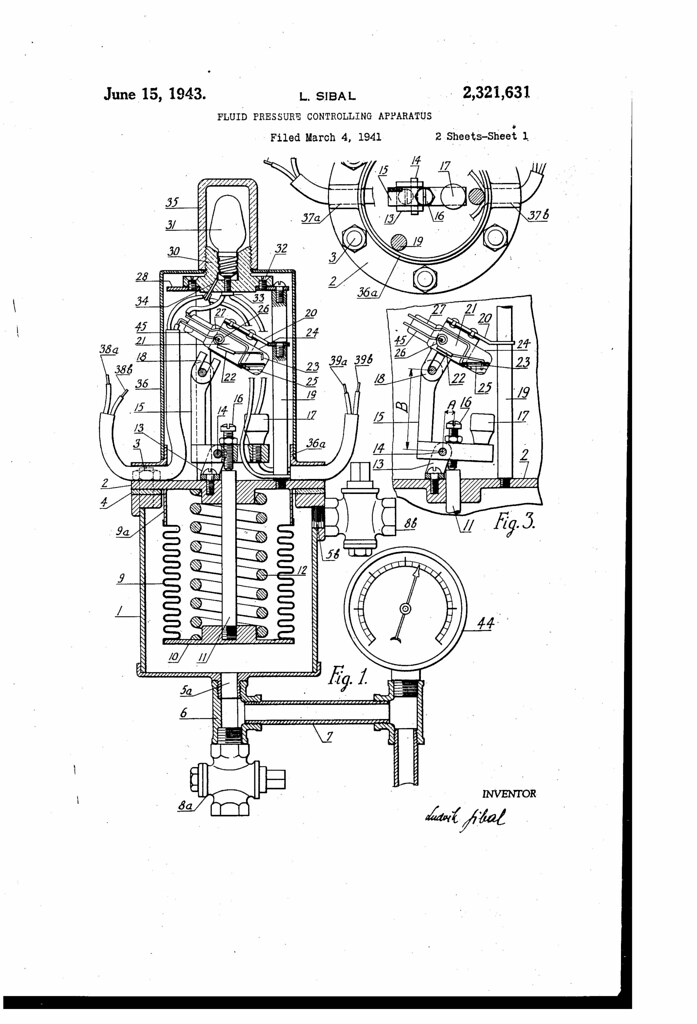
Today in 1943, US Patent 2321631 A was issued, an invention of Ludvik Sibal, for his “Fluid Pressure Controlling Apparatus.” There’s no Abstract, though it’s described this way in the application:

This invention relates to improvements of fluid pressure controlling apparatuses (gases, liquids,
etc.) and it is the principal object of the invention to provide means for adding gas or liquid pressure to containers from which their contents are being discharged at such a rate that the total pressure head at the point where the fluid flows out of said containers remains practically constant even during the discharge period.

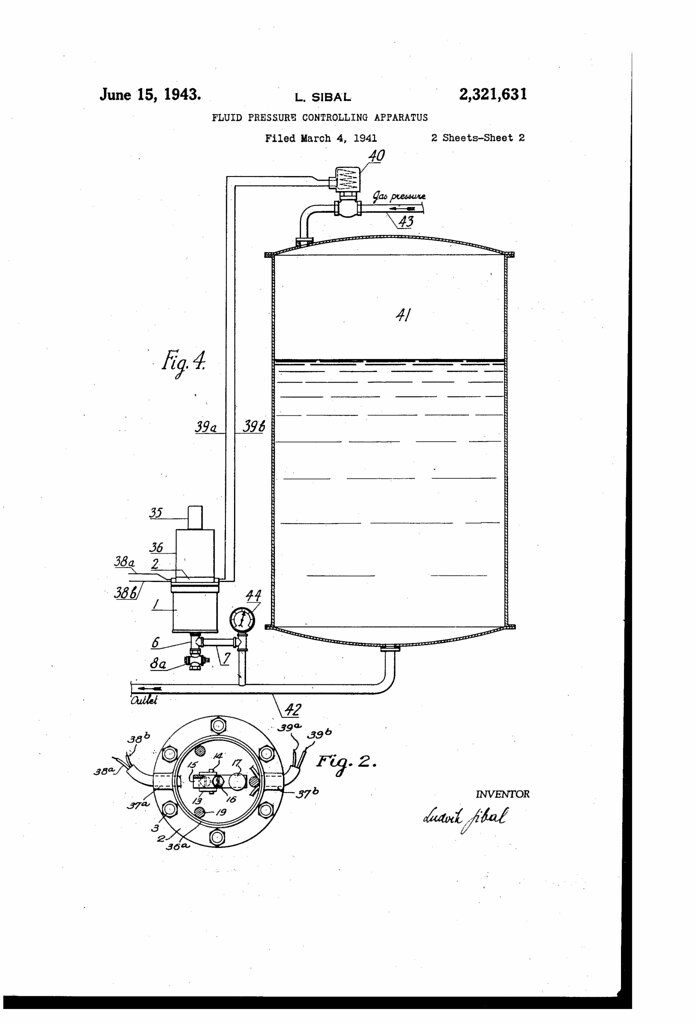
This apparatus is constructed with the special object in view of making it applicable to the so called government tanks in the breweries, from which beer is being drawn to the bottle or can filling machines. In these tanks the beer stands under a gaseous pressure (air or otherwise) the level of which is so chosen as to insure a smooth filling process by the filling machine to which the beer is discharged from the government; tanks. The pressure at the filling machine must be kept constant during the filling process and therefore it is necessary and important that the pressure at the point of flow out of the government tanks likewise be kept constant. The total pressure at the point of discharge from the government tanks is composed of two components: (1) the weight of the beer and (2) the gas pressure within said tanks. As the beer is being drawn from the tanks, the total pressure head causing flow at the point of discharge from the tanks is being decreased due to the decreasing weight of the beer. To make up for this loss in pressure head, gas pressure must be supplied to the tanks until the original desired total pressure head is again reached at the point of discharge. This is usually accomplished by a control man whose duty it is to sight the pressure gauge reading or beer level and to adjust the gas valve accordingly.

The main purpose of this apparatus is to eliminate the human factor of such pressure regulation thus making the regulation as nearly free from all human errors and neglects as is humanly possible. Also my design is such that it is best applicable to breweries and other enterprises where apparatus of this kind must withstand severe mistreatment and where it is necessary to thoroughly wash its interior as well as exterior.

This invention provides an apparatus which, when connected by means of a conduit such as .a pipe or a hose to the point at which the discharge occurs from a tank, throws on or oil? a sensitive snap-action electric (magnetic) mercury switch whenever the pressure head changes slightly in the tank at the point of discharge. This snap action switch is connected by means of electric conduits to a solenoid valve in the gas line leading to the tank, and when contact is made, the solenoid valve is actuated by the electric current so that it opens and admits the gas to flow into the tank thus increasing the total pressure head to the original desired level. As soon as this desired total pressure head is reached, the snap action switch automatically turns off and the gas valve closes.

US2321631-0
US2321631-1

Filed Under: Beers, Breweries, Just For Fun, Politics & Law, Related Pleasures Tagged With: Brewing Equipment, History, Law, Patent

« Previous Page
Next Page »

Find Something

Northern California Breweries

Please consider purchasing my latest book, California Breweries North, available from Amazon, or ask for it at your local bookstore.

Recent Comments

  • Ernie Dewing on Historic Beer Birthday: Charles William Bergner 
  • Steve 'Pudgy' De Rose on Historic Beer Birthday: Jacob Schmidt
  • Jay Brooks on Beer Birthday: Bill Owens
  • Steve 'Pudgy' De Rose on Beer Birthday: Charles Finkel
  • Steve 'Pudgy' De Rose on Beer Birthday: Bill Owens

Recent Posts

  • Beer In Ads #5185: It’s Bock Time January 28, 2026
  • Beer Birthday: Shane McNamara January 28, 2026
  • Historic Beer Birthday: John Goetz January 28, 2026
  • Beer Birthday: Jean-Marie Rock January 28, 2026
  • Beer In Ads #5184: The “B”s Are Here, Bruton Bock Beer January 27, 2026

BBB Archives

Feedback

Head Quarter
This site is hosted and maintained by H25Q.dev. Any questions or comments for the webmaster can be directed here.