Brookston Beer Bulletin

Jay R. Brooks on Beer

  • Home
  • About
  • Editorial
  • Birthdays
  • Art & Beer

Socialize

  • Dribbble
  • Email
  • Facebook
  • Flickr
  • GitHub
  • Instagram
  • LinkedIn
  • Pinterest
  • RSS
  • Twitter
  • YouTube

Powered by Genesis

One Nation, Under Hops

January 8, 2013 By Jay Brooks

hops-and-beer
The Geeks of the Industry blog, under his “Creative Strategist” tag, lists Craft Beer and the Thank You Economy as number 16. Here’s what the University of Oregon advertising student blogger had to say, presumably interpreted through his burgeoning education.

The craft brew industry is a prime example of a 21st century customer-brand dynamic. As you may know if you’ve been reading my blog, I am a bit obsessed with the philosophy of Gary Vaynerchuk and his views on what social media means to the present and future of branding. Microbrews and their cult-like support from many walks of life is a perfect example of the power of word of mouth in the 21st century. The village ecosystem of commerce is returning with the powerful viral capability of the passionate few.

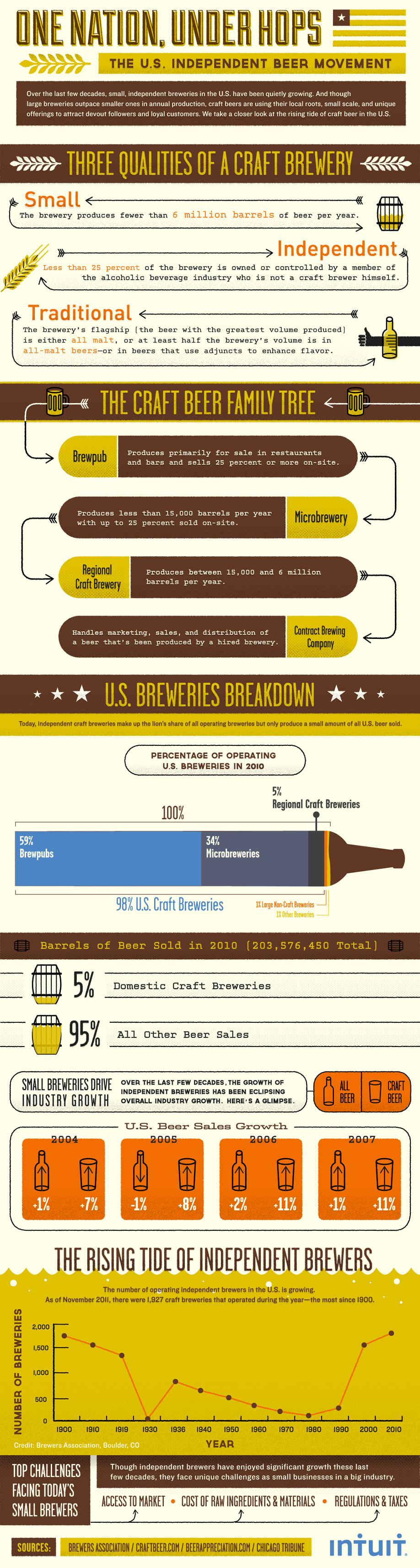
Those sentiments are illustrated nicely with this clever infographic, created by Column Five Media for Visual.ly, under the title How Indie Brewers Are Outpacing Beer Industry Growth. I just love the proliferation of infographics, they are my Kryptonite. I am powerless to resist them. Enjoy.
one-nation-under-hops

Filed Under: Just For Fun, Related Pleasures Tagged With: Hops, Infographics, Statistics

You’re In The Clear: The Health Benefits Of Moderate Consumption

January 7, 2013 By Jay Brooks

health
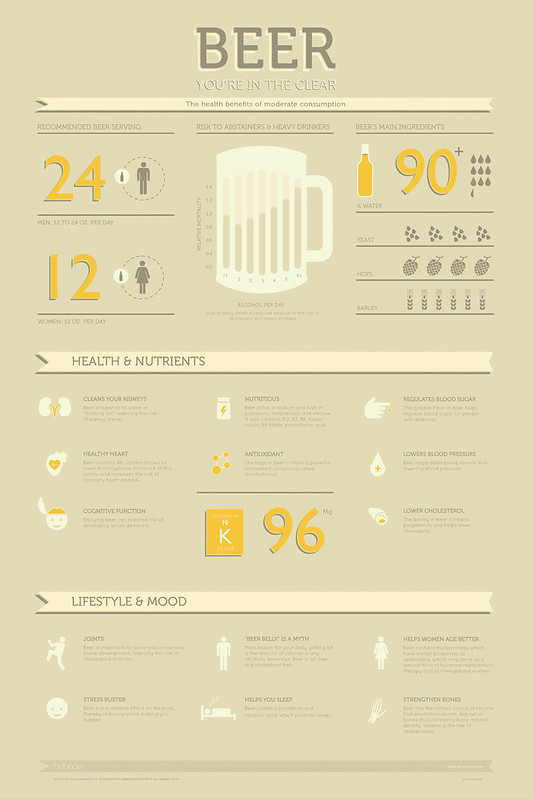
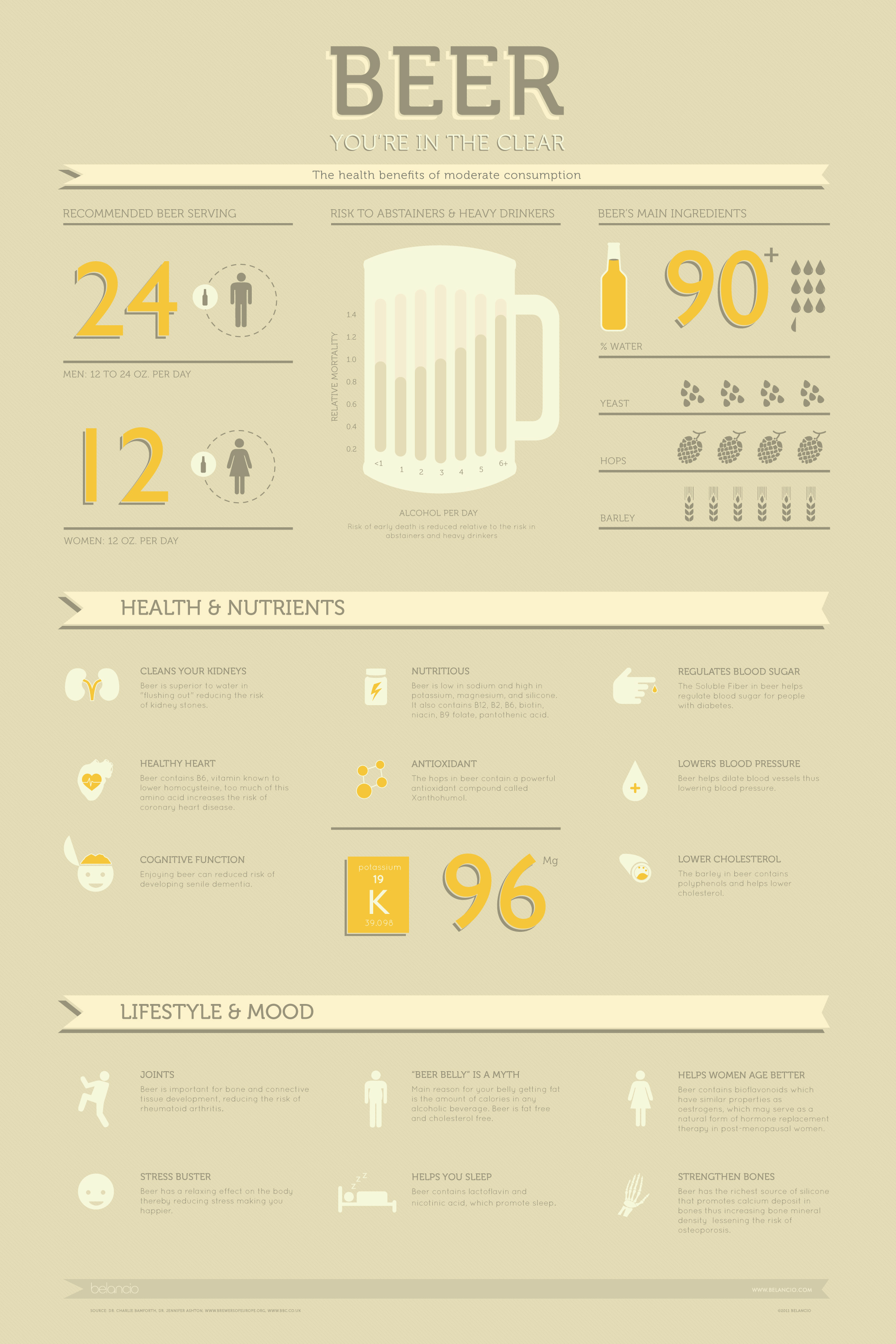
Here’s a great infographic about the Health Benefits of Moderate Consumption entitled Beer You’re in the Clear. It was produced a few years ago by the design firm Belancio, and highlights many of the benefit of the moderate consumption of beer, something the anti-alcohol folks continue to decry and deny. They’ve also made a limited edition with, in my opinion, better contrast, making it easier to read.

BeerClear-v2
You can see a larger, easier-to-read, version at Belancio and an even larger one at Fast Company.

Filed Under: Beers, Just For Fun, Related Pleasures Tagged With: Health & Beer, Statistics

Parents Drinking Weakens Children’s Vitality

December 9, 2012 By Jay Brooks

target-alcohol
Here’s an interesting piece of history, during the temperance movement of the early 20th century, when propaganda as a science was still in its infancy. Propaganda has been around almost as long as we’ve had civilization, but really came into its own with World War I, so these prohibitionist efforts were just before that, around 1909. And it would just be a curiosity, an artifact of another time, if not for the fact that the neo-prohibitionists today continue in the sad tradition of this same kind of nonsense, never missing an opportunity to chastise adults for their parenting in an effort to demonize alcohol and remove it once more from society. For the sake of the children continues to be a popular rallying cry, and just as ridiculous today as a century ago.

safeguard-babies

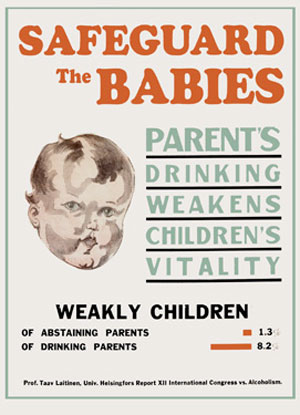
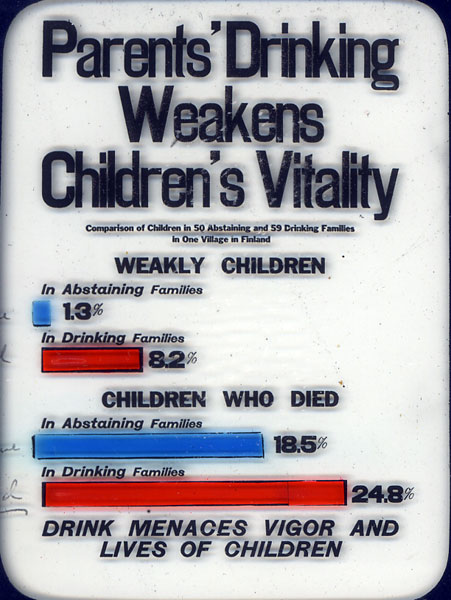
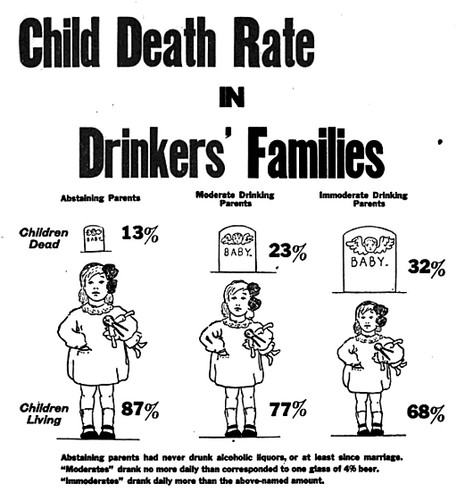
Safeguarding the Babies, apparently a popular poster from the time, argued that if you as an adult drank alcohol then you were creating weak children, ones with diminished “vitality,” a term never really defined. This, the poster claims, is based on science and states that families where the parents are teetotalers only have 1.3% weakly children while families where the adults drink have kids who are 8.2% weakly. Oh, the horror! It’s a little hard to read that in the poster, but a lantern slide made a few years later by the National Woman’s Christian Temperance Union in 1914, using the same data, is more clear and even goes on to suggest that in drinking families almost of a quarter (24.8%) of their children will die while abstaining families kids will perish only 18.5% of the time. So that must mean the 6.3% difference is due entirely to their being drink in the house, right? I mean, what else could it possibly be?

slides_parents_drinking

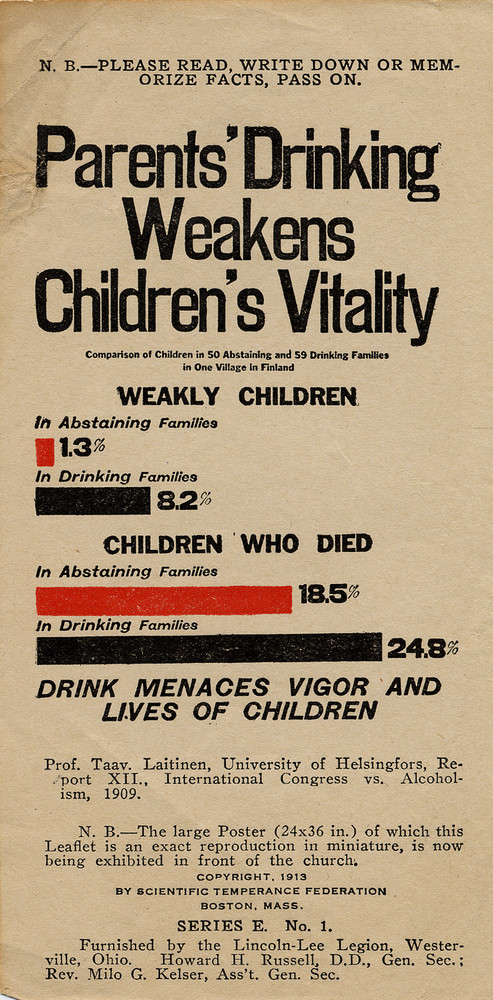
Yet another version, this one from 1913 and created by the Scientific Temperance Federation of Boston, Massachusetts, is one of at least 50 such poster that they made available to their followers, and through their “Scientific Temperance Journal,” which is about as scientific as you might expect. At least this one actually reveals the source of the “science,” which was a survey of 109 families in a single village in Finland. In 50 of those families, the adults didn’t drink, while in the other 59 they did. That’s the study, conducted by a professor Taav. Laitinen of the University of Helsingfors, which is the University of Helsinki, and apparently published as “Report XII International Congress vs. Alcoholism.”

parents-drinking

This study, and many other similar ones, was published in the “Handbook of Modern Facts About Alcohol” By Cora Frances Stoddard, a secretary in the Scientific Temperance Federation.

parents-drinking-1

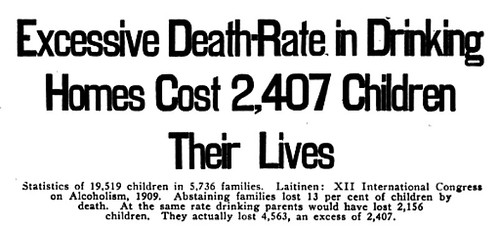
It’s hard to say if the 109 families in Laitinen’s “study” is a statistically significant cohort, but it seems unlikely. But Laitinen continued to expand his research to include more finnish families, eventually including nearly 6,000, and he continued to get predictably similar results.

parents-drinking-2

But scientific hooey aside, the message was clear. Drink, and your children will suffer. Drink, and your children are more likely to die. I tend to view the early 20th century as a more gullible time, and I can only assume many more people believed this nonsense without questioning it. Neo-prohibitionist groups today employ the same pseudo-scientific balderdash, only now they dress it up with degreed researchers and publish in slightly less questionable scientific journals, or at least ones that hide their true purpose better. But then, as now, it’s still laced with naked agenda to promote a specific cause, not to enlighten or educate for the sake of that knowledge. It is propaganda, pure and simple. The scare tactics are particularly offensive, since it calls into question the parenting of virtually anyone who drinks alcohol as somehow caring less for their children than parents who abstain. I’d love to say we live in a more enlightened age, but today’s anti-alcohol organizations continue to stoop just as low as cries of “think of the children” ring just as hollow now as when they questioned the “vitality” of our children merely by growing up in a household where drinking took place.

Filed Under: Beers, Editorial, Politics & Law Tagged With: Anti-Alcohol, History, Prohibitionists, Statistics

I’m A Craft Beer Drinker And I Vote

November 5, 2012 By Jay Brooks

politics-balloons
A couple of months ago, my friend and colleague, Don Russell — who often writes under the non de plume Joe Sixpack — wrote a provocative article declaring Craft-Beer Drinkers to Decide Election. With the presidential election tomorrow, I thought it fitting to take another look at that.

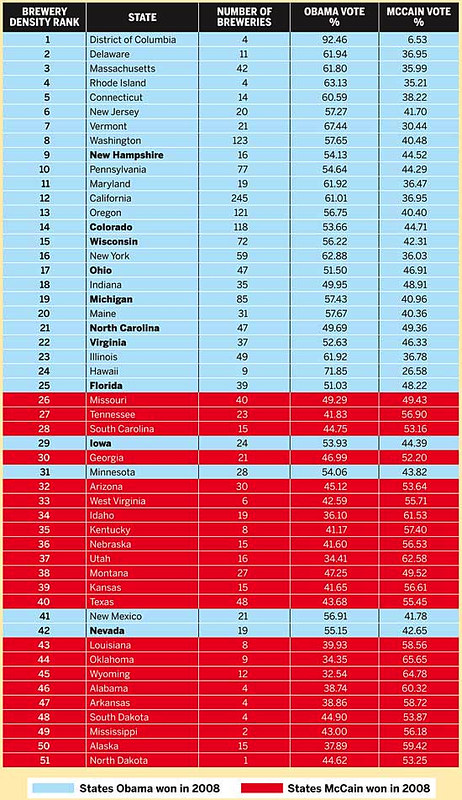
Russell ranked “the states by brewery density — the number of breweries per 1,000 square miles.” From that, a pattern emerged. Of the 25 states with the highest concentration of breweries, all of them voted for the Democratic candidate in 2008; what statisticians call a “positive correlation.” His interpretation:

The density of breweries in a state is at least partly related to the density of its population; the more people, the more breweries. Obama performs better in densely populated states because urban populations tend to be more diverse and liberal.

Naturally, the reverse is true: States with fewer breweries per square mile overwhelmingly vote Republican.

blue-vs-red-states-2010

Another colleague, Jeff Alworth in Portland, Oregon, disagreed with Russell’s analysis and said so in Gerrymandered! Craft Beer Is No Proxy for Political Leanings. He believes brewery density is the wrong metric to use, preferring breweries per capita. I confess that’s a statistic I’ve never warmed to, for no particular reason except that it seems to unfairly favor states with less people in many cases.

Russell doesn’t examine that, but he does also look at states by per capita beer consumption. In that instance, no illuminating trends appear. “Of the 10 biggest beer-drinking states, five voted for Obama in 2008, and five backed Sen. John McCain of Arizona.”

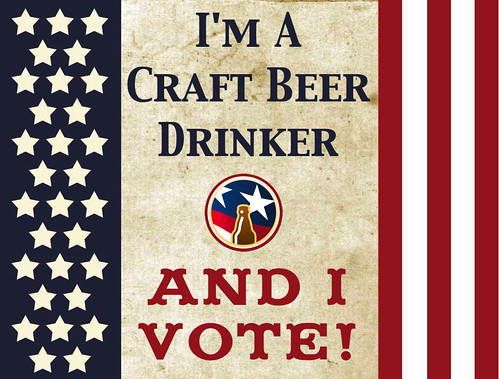
In the end, according to Russell. “What’s really important here is the type of beer voters are drinking.” Whichever way the election goes tomorrow, it will be interesting to see if any of this holds true. I can’t help but like the idea of craft beer deciding elections, however far-fetched. Still, the important thing is to drink craft beer … and vote. I want to see that bumper sticker: “I’m a craft beer drinker and I vote.”

craft-beer-voter

UPDATE: As Stan Hieronymus points out, I was remiss in not including Beer Drinkers For Obama.

Filed Under: Beers, Breweries, Editorial, Just For Fun, News, Politics & Law Tagged With: Statistics

Beer Bouncing Back

October 29, 2012 By Jay Brooks

bouncingball
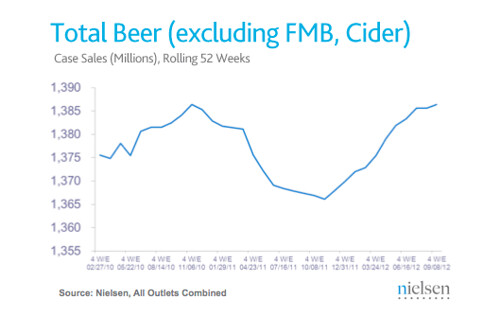
Nielsen, the company that tracks all things trackable, is speculating on their NelsonWire that beer is bouncing back and that this may signal the “beginning of a beer boom.” According to their data, “Beer sales are seeing a surge in growth, up 5 million cases (1.4 percent) in the last 12 weeks through September 1, 2012, in Nielsen-measured retail outlets. The same period last year saw a decline of 1.7 million cases.”

Total-Beer1k-2012

The main reason they cite for this is choice.

With more options on shelves and innovative product offerings, new consumers were attracted to the beer category. Nearly half of the households who were new to malt, or cider-based beverages (beer, flavored malt beverages and cider) in the past six months had bridged over from solely buying wine or spirits last year.

But as they’re focused to a greater extent on the bigger players in the category, they mean choice in a different way than you and I normally understand it. When Nielsen refers to choice, they mean “flavors, formats and packaging,” though in my experience it’s always “packaging options” that seem to get the most attention. But even with the term as common as flavor, it’s used here as more jargon instead of what you’d ordinarily think it means. By “new flavors,” they don’t mean more different styles or kinds of beer on the average beer set shelf. No, they mean line extensions like the two they give as examples: “Bacon Maple and Blue Raspberry Lemonade,” as a part of other already-established brands.

So while this is good news, and we should all welcome a coming “beer boom,” I can’t help but wonder if this “boom” of which they speak — which quite frankly the craft beer side has been seeing for a decade — is not going to favor them as much as the regional breweries and even the smaller craft breweries. That’s what it’s been doing for several years now, and I can’t see any reason to suspect that will change in the coming months or years, no matter how “bright the last quarter of 2012 may be for beer.” Still, a coming “beer boom” sure has a nice ring to it.

Filed Under: Beers, Editorial, News Tagged With: Big Brewers, Business, Mainstream Coverage, Statistics

Higher Alcohol Taxes Reduce Tax Revenue

October 24, 2012 By Jay Brooks

beer-tax
Given that the anti-alcohol folks, and especially my churlish neighbors Alcohol Justice, are continually beating the drum about alcohol taxes being too low, this news is not going to be particularly welcomed with open arms. A British think tank, the Institute of Economic Affairs (IEA), recently took a close look at the effect of higher taxes in alcohol and their report, Drinking in the Shadow Economy, found that the British “Treasury is losing as much as £1.2 billion every year to the illegal alcohol industry.” That, they conclude, is one of the effects of higher taxes on alcohol, because it creates an incentive for people to go outside the law and the safe world of regulated alcohol to make a quick buck. They found that “the illicit alcohol market is also closely associated with high taxes, corruption and poverty. The affordability of alcohol appears to be the key determinant behind the supply and demand for smuggled and counterfeit alcohol.” So place too high taxes on alcohol, and you invite in the wrong element, which we’ve seen in the U.S. before during Prohibition, and which we’re seeing right now with the war on drugs. If that futile policy was reversed, we’d save as much $13.7 billion annually by legalizing, regulating and taxing just marijuana, not to mention we’d remove the criminal element, make it safer and drastically reduce burdens on police, the justice system and prisons.

But back across the pond, the study also notes that the “demand for alcohol is relatively inelastic,” meaning people generally don’t drink less when prices go up, they instead find new ways to address the rising prices. As study after study has concluded, tax hikes are regressive and almost always hit poorer families the hardest, while not eliminating the problem the proponents of such measures claim they will fix.

But here’s that again, said another way:

Our analysis indicates that the affordability of alcohol does not have a strong effect on how much alcohol is consumed. Once unrecorded alcohol is included in the estimates, it can be seen that countries with the least affordable alcohol have the same per capita alcohol consumption rates as those with the most affordable alcohol.

I suspect that’s the case here, too. We know that price hikes cause people living near borders with other states to simply buy their alcohol in the next state over, causing further economic erosion. I don’t know if we have the same issue with counterfeit or illegal beer. Certainly there’s still Moonshine, but beer is probably not profitable enough on its own to warrant illegal breweries flaunting the tax code, not to mention how labor intensive and technology-dependent it is.

Another interesting portion of the report, answering the question “Why Tax Alcohol?”

Temperance and public health campaigners typically dismiss the black market as a problem that can suppressed through rigorous enforcement and tougher sentencing. At worst, they view a growing unofficial market as a price worth paying for a more sober society. This view is rooted in the belief that affordability is the main driver of alcohol consumption and that increasing prices by raising excise duty is therefore the single most effective way of reducing alcohol sales.

Ceteris paribus, economists would expect there to be some truth in this assertion, but there is too much real world evidence to the contrary for it to be taken as an iron rule. For example, alcohol consumption has fallen in most European countries since 1980 despite alcohol becoming significantly more affordable (OECD, 2011: 275).19 In Denmark, Sweden and Finland, the sudden drop in alcohol prices that resulted from EU accession did not bring about the kind of surge in alcohol consumption that the price elasticity models predicted.

A comparison of European countries suggests that affordability has a negligible and statistically insignificant negative effect on recorded alcohol consumption (see Figure 12). Moreover, as Figure 13 shows, when unrecorded alcohol consumption is included in the analysis, affordability does not appear to be a decisive factor in determining alcohol consumption from one country to the next.

Then there’s this long passage addressing some of the philosophy behind taxation which seems to fly in the face of much of the neo-prohibitionists propaganda playbook:

Contrary to temperance rhetoric, high alcohol taxes are not necessarily good for public health because, although excessive alcohol consumption undoubtedly carries risks to health, so too does moonshine. Counterfeit spirits and surrogate alcohol frequently contain dangerous levels of methanol, isopropanol and other chemicals which cause toxic hepatitis, blindness and death. These are the unintended consequences one associates with prohibition, albeit at a less intense level than was seen in America in the 1920s.

It should not be surprising that excessive taxation encourages the same illicit activity as prohibition since the difference is only one of degrees. As John Stuart Mill noted in 1859: ‘To tax stimulants for the sole purpose of making them more difficult to be obtained is a measure differing only in degree from their entire prohibition, and would be justifiable only if that were justifiable. Every increase of cost is a prohibition to those whose means do not come up to the augmented price’ (Mill, 1974: 170-171).

But in a less frequently quoted passage, Mill appears to approve of taxing alcohol to the apex of what we now call the Laffer Curve. Appreciating that governments need to raise funds and that these politicians must decide ‘what commodities the consumers can best spare’, Mill argues that taxation of stimulants ‘up to the point which produces the largest amount of revenue (supposing that the State needs all the revenue which it yields) is not only admissible, but to be approved of’ (Mill, 1974: 171).

This message tends to resonate more powerfully with politicians than Mill’s more libertarian pronouncements. Drinkers generally prefer low alcohol prices. Temperance campaigners nearly always demand higher prices. The politician, however, usually seeks to maximise tax revenues and will only react to the shadow economy when it becomes a serious threat to state finances. Nordlund and Österberg summarise the politician’s dilemma as follows:

‘Domestic economic actors can, of course, support the rules and regulations imposed by the state for controlling unrecorded alcohol consumption, but for these actors a better solution in combating unrecorded alcohol consumption would be the lowering of alcohol excise taxes… In most cases the state is not willing to follow this policy, as lower alcohol excise taxes in most cases mean lower levels of alcohol-related tax incomes. However, if the state is no longer able to control the amount of unrecorded alcohol consumption by different kinds of legal administrative restrictions the only remaining way to counteract, for instance, huge increases in travellers’ border trade with alcoholic beverages or an expansive illegal alcohol market is to lower the price difference between unrecorded and recorded alcohol by decreasing excise taxes on alcoholic beverages.’ (Nordlund, 2000: S559)

It scarcely matters to the politician whether unrecorded alcohol comes from legal or illegal sources. In either case, the treasury loses out on revenue. In Britain, HMRC estimates that the alcohol tax gap could be as much as £1.2 billion per annum, plus the costs of enforcement, and that this is largely because ‘duty rates on alcohol are far higher in the UK than in mainland Europe’ (National Audit Office, 2012: 2, 10). This is the price the state must pay for excessive taxation, but the politician is also aware that these high alcohol taxes raise £9 billion a year (Collis, 2010: 3). Being in possession of these facts he may conclude that reducing the illicit alcohol supply through tax cuts will probably reduce net alcohol tax revenues.

We argue that such a focus on maximising tax revenues is short-sighted and carries significant risks. Failing to deal with alcohol’s shadow economy threatens not only the public finances, but also public health and public order. Unrecorded alcohol has, as Nordlund and Österberg note, ‘the potential to lead to political, social and economic problems’ (Nordlund, 2000: S562). In addition to the health hazards presented by unregulated spirits, alcohol fraud in the UK is, according to the HMRC, ‘perpetrated by organised criminal gangs smuggling alcohol into the UK in large commercial quantities’ (HMRC, 2012: 8). Alcohol smuggling and counterfeiting is linked to other illegal activities, including drug smuggling, prostitution, violence, money-laundering and — in a few instances — terrorism.

Incidentally, you can download a pdf of the entire report here, and at the IEA website.

In the press release, the IEA concludes:

“The government’s focus on maximising tax revenues is short-sighted and dangerous. Aside from losing money by encouraging consumers to find cheaper illicit alternatives, public health and public order are also being put at risk by high prices. Policy-makers ought to take the threat of illicit alcohol production seriously when considering alcohol pricing in the future.”

“There is a clear relationship between the affordability of alcohol and the size of the black market. Politicians might view the illicit trade as a price worth paying for lower rates of alcohol consumption, but this research shows that the amount of drink consumed in high tax countries is exactly the same as in low tax countries.”

“Minimum alcohol pricing might seem like a quick fix to tackle problem drinking, but it is likely to cause many more problems by pushing people towards the black market in alcohol.”

While a fairly emphatic statement against higher taxes on alcohol, I assume that many will still wonder how applicable it is to the United States economy and society. Honestly, I’m sure there are differences, but the overall concept seems sound, at least to me. We can haggle over some of the details, but the idea that higher taxes isn’t always the answer just has the ring of truth to it.

Filed Under: Beers, Editorial, News, Politics & Law Tagged With: Anti-Alcohol, Business, Prohibitionists, Statistics, Taxes, UK

Politics & Big Beer Brands

September 28, 2012 By Jay Brooks

politics-balloons
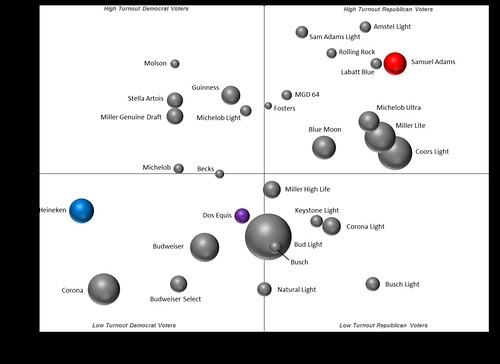
Here’s a curious piece of data, showing how which big beer brand you prefer may determine how likely you are to vote in the upcoming election and whether you lean more to the Democratic side of the aisle, or the Republican. The poll was conducted by Scarborough Research and the results written up in the National Journal as What Your Beer Says About Your Politics.

But it’s only the big brands that were tallied, the domestics and the most popular imports. The only one close to craft is Samuel Adams, who in most people’s mind, I think, is straddling both worlds right now. Even so, there are a few surprising results, at least to my mind. I would not have thought, for example, Samuel Adams drinkers would skew so heavily Republican. Maybe it’s the naked jingoism, the patriotic perception of the brand, I don’t know.

The other one that surprised me was that Heineken skewed so far on the Democratic side. I tend to think of Heineken as a brand that people who don’t know any better think is a high end, premium brand, in the same way bald, middle-aged men drive Corvettes to recapture their youth, not realizing it’s no longer the hip car it once was. But maybe that’s just my own bias. In any sort of polling, I rarely fall under the “typical” findings.

Take a look at the chart below and see what you think. Does it make sense to you?

beer-politics-2012
The chart is tough to see this small, but you can see it full size, or look at on the original National Journal post.

Filed Under: Beers, Just For Fun, Politics & Law Tagged With: Big Brewers, Imports, Statistics

Beer Institute Releases Results Of New Beer Drinkers Poll

September 27, 2012 By Jay Brooks

beer-institute
According to the Beer Institute (BI), recent economic analysis has revealed “that brewing and importing accounted for $223.8 billion in the economic output of the United States — with employees earning nearly $71.2 billion wages and benefits, and generating more than $44 billion taxes. In 2010, the last year tax statistics were available, 45 percent of what every beer drinker paid for a beer went to taxes of some kind, which “makes taxes the most expensive ingredient in your beer,” Joe McClain, president of the BI, stated.

The Beer Institute has just released a national poll of 1,000 likely voters, which found strong opposition to increasing taxes on beer. Nine out of 10 voters in the poll agreed that “raising taxes on beer will mean working class consumers will have to pay more.”

The poll also found that self-identified “beer drinkers” are a larger proportion of the electorate than self-identified supporters of either the Tea Party of Occupy Wall Street movement, and were evenly split between Republican and Democratic parties.

Beer drinkers are also more political than the average likely voter:

  • 68 percent of regular beer drinkers say they discuss what’s going on in the presidential campaign with friends or co-workers.
  • 66 percent of regular beer drinkers say they are going to be watching the presidential debates, meaning they are more likely to watch presidential debates than watch the World Series or an NFL game.
  • 25 percent say they will likely donate or contribute money to a political party, cause, or candidate running for public office.
  • 14 percent (or one out of seven) beer drinkers say they will likely volunteer for a political party, cause, or on the campaign for a candidate running this year.

Filed Under: Beers, Just For Fun, News, Politics & Law Tagged With: Poll, Press Release, Statistics

65 Major Brewery Projects In The Works

September 27, 2012 By Jay Brooks

factory
According to a press release by the Industrial Info Resources, there are at least “65 major capital and maintenance projects in the beer brewing segment that are under development or recently have started construction.” The public press release is very short, more of a tease really, as they want you to become a member and subscribe to their information. For just $5.95, I could read the terse 290-word press release, or instead I can tell you what they’re willing to tell is for free.

SUGAR LAND–September 27, 2012—Researched by Industrial Info Resources (Sugar Land, Texas)—Beer brewers, both large and small, are pouring investments into building new facilities and expanding existing operations to the tune of more than $800 million. Industrial Info has uncovered more than 65 major capital and maintenance projects in the beer brewing segment that are under development or recently have started construction. Project investment values range from $1 million to just more than $100 million.

Filed Under: Breweries, News Tagged With: Business, Statistics

Working For A Beer

September 25, 2012 By Jay Brooks

money
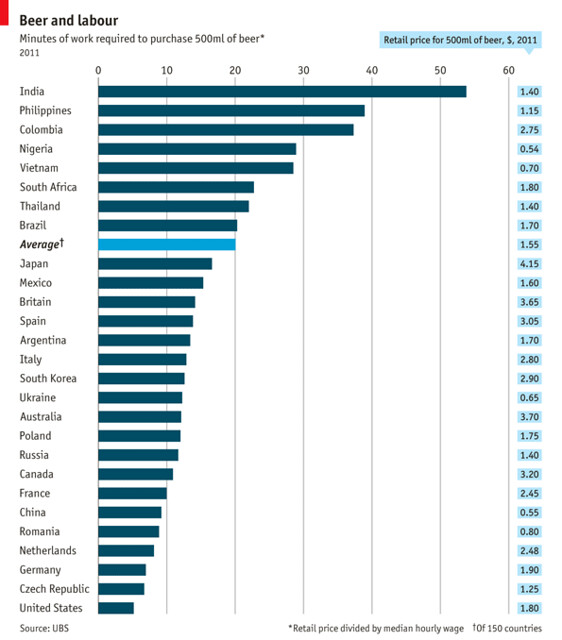
How long do you think you have to work before you can have a beer? I don’t mean how long before you think it’s time to take a break and enjoy a pint. No, I mean how long do you think you have to work in order to earn enough money to buy yourself a beer?

In the Economist’s Daily Chart, Thirsty Work, they detail the efforts of analysts at the Swiss Bank UBS to figure out how long the average German worker would have to work in order to buy him- or herself a half-litre of beer at Oktoberfest. They discovered that it would take “just under seven minutes of work.” But it’s not the same in every nation, as the chart below details. The avergae appears to be about 20 minutes of work for a beer, which doesn’t seem too bad. The worst place was India, where you’d have to work “nearly an hour” to make enough for a beer. The United States, I’m happy to say, is at the bottom, which is a good thing. It only takes us about 5 minutes to earn enough for a beer. Hell, I think I earned two beers just writing this post.

beer-and-labor

Filed Under: Beers, Just For Fun, News Tagged With: Economics, Statistics

« Previous Page
Next Page »

Find Something

Northern California Breweries

Please consider purchasing my latest book, California Breweries North, available from Amazon, or ask for it at your local bookstore.

Recent Comments

  • Ernie Dewing on Historic Beer Birthday: Charles William Bergner 
  • Steve 'Pudgy' De Rose on Historic Beer Birthday: Jacob Schmidt
  • Jay Brooks on Beer Birthday: Bill Owens
  • Steve 'Pudgy' De Rose on Beer Birthday: Charles Finkel
  • Steve 'Pudgy' De Rose on Beer Birthday: Bill Owens

Recent Posts

  • Beer In Ads #5204: Oh Brother! Griesedieck Bros. Genuine Premium Bock Beer Is Here! February 15, 2026
  • Historic Beer Birthday: Emil Resch February 15, 2026
  • Historic Beer Birthday: Philip Zang February 15, 2026
  • Beer In Ads #5203: Robert Portner’s Bock Beer February 15, 2026
  • Historic Beer Birthday: August Schell February 15, 2026

BBB Archives

Feedback

Head Quarter
This site is hosted and maintained by H25Q.dev. Any questions or comments for the webmaster can be directed here.