Brookston Beer Bulletin

Jay R. Brooks on Beer

  • Home
  • About
  • Editorial
  • Birthdays
  • Art & Beer

Socialize

  • Dribbble
  • Email
  • Facebook
  • Flickr
  • GitHub
  • Instagram
  • LinkedIn
  • Pinterest
  • RSS
  • Twitter
  • YouTube

Powered by Genesis

The Town of Malt

August 28, 2011 By Jay Brooks

uk
Last week, you may recall, that for the weekly beer in art last week I featured some sketches by French artist Gustave Doré. Those sketches were preliminary works that eventually were turned into engravings that became part of a larger work known as Doré’s London: A Pilgrimage, published in 1872. The final engravings appeared in Chapter 16 of the book, titled “The Town of Malt.” Digging a little further, I stumbled upon the text of Chapter 16, along with the six engravings that accompanied it. It’s an interesting time capsule and look backwards into what brewing was like in late 17th century London. Enjoy.

CHAPTER XVI: THE TOWN OF MALT
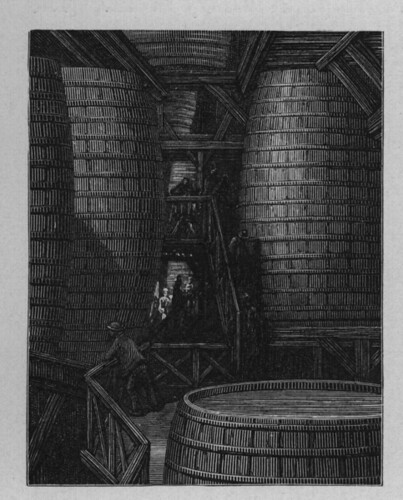
Dore-in-the-brewery-129
In the Brewery

Among the earliest of risers in London are those who supply it with its beer. Having seen the opening of Covent Garden Market on a summer morning (and there is not a more striking picture by the banks of the Thames), stroll along the Strand and Fleet Street, alive with newsboys and newsmen, and home-returning compositors; through Thames Street, over Southwark Bridge, to Park Street. Your nose will lead you to the town of Malt …

Dore-mixing-the-malt-1872
Mixing the Malt

… and Hops. The massive drays are out; the prodigious draymen are arrayed in their leather, that would gall any limbs but theirs of Titan build ; the stately horses that are the astonishment of the foreigner and the pride of the English brewer are tossing their noble heads and pawing the ground. The barrels are rolling and swinging in all directions. Thirsty London is being attended to, with a will: and with perfect order, under the control of matutinal clerks and overseers. Before the ordinary tradesman has touched his shutters, lumbering processions of heavily laden drays are debouching on various quarters of London, bearing the famous “entire” to scores of customers.

Within the gates are the government houses of the town of Malt and Hops, in which there are upwards of forty officials, who direct the coming and going, the filling and repairing, the brewing and selling of a rolling army of something like eighty thousand barrels. Their domain covers an acre of land, and comprises several streets bridged by light iron bridges, that look slight as spider-webs from the pavements.

A journey through the town of Malt and Hops is heavy work. The departments are many, and are all spacious. They follow in well-considered sequence. The mashing, the boiling, the cooling, the fermenting, the cleansing, the barrel-filling, the storing, the despatching, are so many departments of the government; with a sustaining aroma holding all in one atmosphere and which keeps the mind in an unbroken train of thought even when contemplating the stables where the famous horses are kept as daintily as in the Royal Mews. Perhaps the first startling scene in the round is the mash-tun.

Mashing is the elementary process of beer making, and the object …
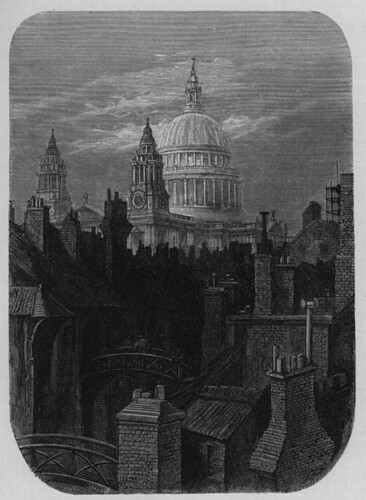
Doe-st-pauls-from-brewery-bridge-131
St. Paul’s from the Brewery Bridge

… of these strange workers with wooden spades is to mix the malt thoroughly with the water. The result is an amber liquid, called wort, lakes of which we proceed to view, lying placidly in tanks. During its progression to perfect beer the sweet wort grows sour. On its way it is pumped up from the cool lakes into gigantic copper boilers, and boiled with great care, for here the experienced and learned brewer shows himself. The boiling satisfactorily done, the wort flows out into broad lakes, airily situated, where it can become …
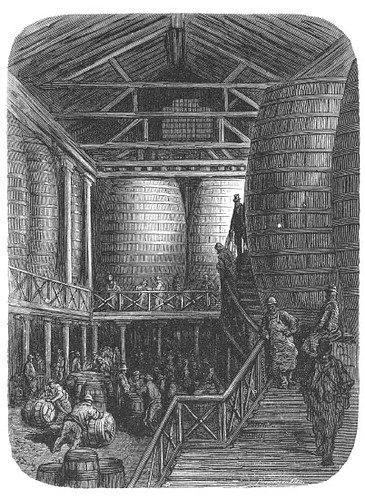
Dore-the-great-vats-1872
The Great Vats

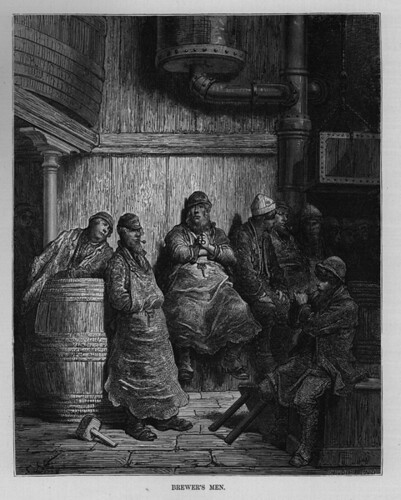
Dore-brewers-men-132b
Brewer’s Men

… rapidly cool, without getting sour; and then it gradually subsides into these prodigious gyle tuns, about which staircases are ranged, and in which you would have to drag carefully for the body of an elephant. In these towers, against which men look like flies, the wort ferments and we have porter, or “entire.” I should explain that “entire” is a combination of the qualities of three beers, that, in primitive London brewing days, were made separately, and mixed from different barrels in the customer’s glass. Hence the “Barclay, Perkins and Co.’s Entire” that is all over England, and the painting of which upon gaudy signboards occupies a distinct department in the town of Malt.

Looking over London from one of the high-perched galleries that traverse the streets of these mighty brewers’ realm, with St. Paul’s dominating the view from the north, our guide gently interposes the figure of Mr. Thrale, and his illustrious friend, that Londoner among Londoners, Samuel Johnson. We are upon classic ground. Where the coopers are overhauling hundreds of damaged barrels, and giving them their proper adjustment of hoops; where the red-capped draymen are gossiping in groups; where the enormous butts are ranged; where the smiths are shoeing the colossal horses, and where the 300 feet of stables stretches; Samuel Johnson lounged and talked, -and worked at his dictionary, under the protecting friendship of Mr. Thrale, then owner of the brewery. The rough old Doctor was executor to the will under which Mr. Thrale’s property passed into the families of its present owners, who have realised his description of its capabilities by extending it until it has become one of the representative industries of the world. “We are not,” said executor Johnson “to sell a parcel of boilers and vats, but the potentiality of growing rich beyond the dream of avarice.” The boilers and vats of the city of Malt realised £135,000, even when Messrs. Barclay and Perkins bought it.

How much would the boilers and vats: the drays and barrels, realise to-day?

The potentiality of growing rich beyond the dream of avarice may not have been reached even now by the firm; but a good step along the doctor’s highway has been taken. If “he who drinks beer thinks beer,” this must be a beer-thinking age, for how many foaming tankards take their laughing rise in this town of Malt! How many hop-yards to feed these vats and lakes? A humorous speculator, who accompanied us, and sat in a little office where we finally tasted the various brews, suggested, …

Dore-brewers-dray-134
The Brewer’s Dray

“Yes, and how many temperance advocates do these stupendous men and horses keep going, the ungrateful varlets!”

“There’s a good deal of ‘talkee’ yet to be done, sir,” a sensible drayman said to us, flirting a flower between his lips as he spoke, “before they teach English workmen that there’s sin and wickedness in a pint of honest beer.”

And with this he set his heavy dray in motion.

Filed Under: Art & Beer, Breweries, Just For Fun Tagged With: History, London, UK

Beer In Art #137: A View of the Genuine Beer Brewery Golden Lane

August 28, 2011 By Jay Brooks

art-beer
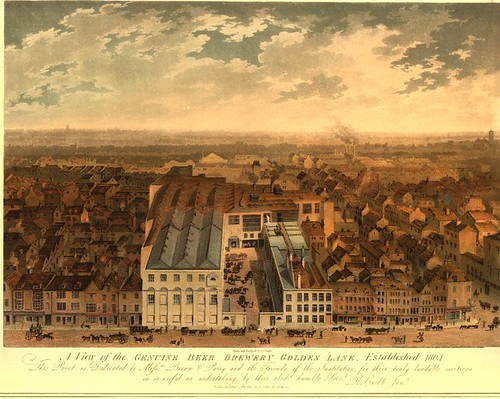
This week’s work of art is by Gerard de la Barthe, a 18th century French artist, as re-created by an English printmaker, painter and draughtsman named J.S. Barth. The painting/print is known as A View of the Genuine Beer Brewery Golden Lane, Established 1804.

view-of-the-genuine-beer-brewery

One of the original prints is in the collection of the British Museum, which was completed in 1807. The scene depicts the brewery in a wide angle shot that also shows part of the city of London from the same year.

Unfortunately, there’s little information about the original artist, Gerard de la Barthe.

Filed Under: Art & Beer, Breweries Tagged With: France, History, UK

Beer In Art #136: Gustave Dore’s Barclay Perkins Brewery Workers

August 21, 2011 By Jay Brooks

art-beer
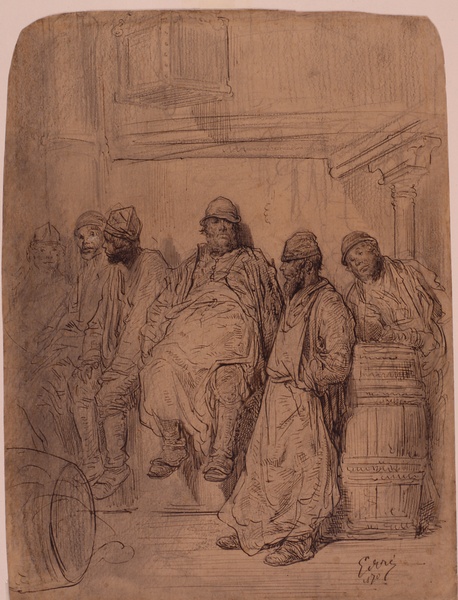
This week’s work of art is by the French artist known for his engravings, on wood and steel, along with his simple drawings, Gustave Doré, who did at least a couple of drawings in pencil, pen and ink of Barclay Perkins Brewery Workers.

Dore-barclay-perkins-1870

One of the most well-known, titled Ouvriers Brasseurs de Barclay Perkins, or Barclay Perkins Brewery Workers, which was completed in 1870, today hangs in the Musée d’Art Moderne et Contemporain de Strasbourg (in English the Strasbourg Museum of Modern and Contemporary Art).

It depicts the brewers not working, but resting, presumably in the middle of a hard day, still wearing their aprons and forage caps. They’re lounging around some barrels apparently in some unused corner of the brewery.

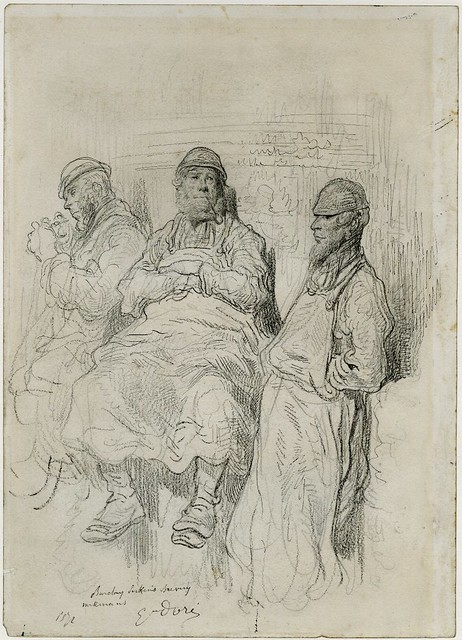
Dore-Workmen_at_Barclay_Perkin's_Brewery-1872

A second, similar drawing, entitled Workmen at Barclay Perkins’s Brewery is in the British Museum. It was done in 1872 and appears to be some of the same workers, although there are less of them and the space they’re in seems less well-defined. It was created using pen and grey ink, black chalk and graphite. Apparently it was a study done for a book of engravings entitled Doré’s London: A Pilgrimage. In Chapter 16 of the book, with the promising title “The Town of Malt,” three drawings of the Barclay Perkins Brewery appear, “together with an engraving after this drawing showing the workers against a more detailed background and with additional figures.”

You can read Doré’s biography at Wikipedia, and find links to more of his work at ArtCyclopedia. There are a few you can also see at a Woodcut Gallery, the Web Museum, Art Collections, toward the bottom of his Wikipedia page, and Cardiff University has a number of the engravings from Doré’s London.

Filed Under: Art & Beer, Beers Tagged With: France, History, UK

Beer In Ads #408: Live Life … Every Golden Minute Of It

July 6, 2011 By Jay Brooks


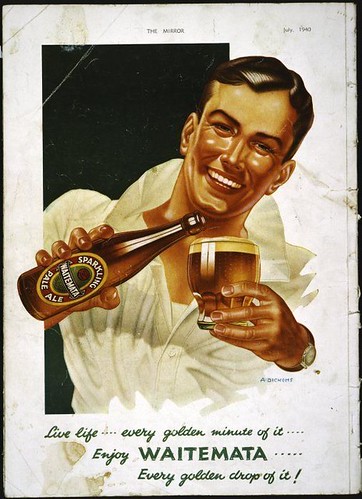
Wednesday’s ad is from 1940, and is for a New Zealand beer, Waitemata, that today no is owned by DB Breweries but is no longer made by the giant brewing conglomerate. Great artwork, though the Sparkling Pale Ale the man is pouring doesn’t look especially pale. But you have to love that tagline. “Live life …. every golden minute of it …. Enjoy WAITEMATA …. every golden drop of it.”

Waitemata

Filed Under: Art & Beer, Beers Tagged With: Advertising, History, UK

Beer In Ads #403: Mitchells & Butlers Good Honest Ale

June 29, 2011 By Jay Brooks


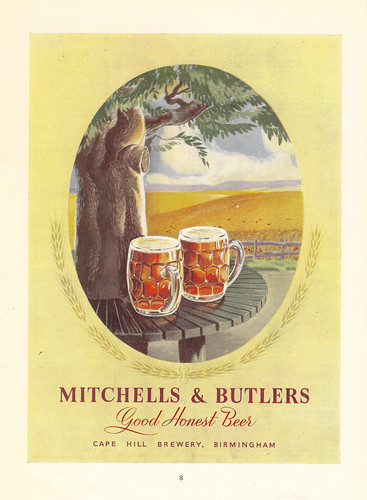
Wednesday’s ad is from around the later 1920s and is for a Birmingham, England brewery known as Mitchells & Butlers, operating the Cape Hill Brewery. I love the idyllic scene of two mugs of beer, sitting on a bench surrounding a large tree, looking out over a field of grain. Now that’s “Good Honest Beer.”

Mitchells-Butlers

Filed Under: Art & Beer, Beers Tagged With: Advertising, History, UK

No Beer At Royal Wedding?

April 25, 2011 By Jay Brooks

uk
Another royal wedding’s coming up this Friday. I care about it as much as the last one in 1981 — not one whit. In deference to my British colleagues and friends who cling to the notion that the royal family matters, I’ll spare you my usual diatribe. But it was announced recently that no beer will be served at the The Royal Wedding (with it’s own “official” website, how klassy) between Prince William and commoner — could there be a more insulting term to call someone to their face? — Kate Middleton.

That’s right, no beer at a British wedding. The reason, according to the Daily Mail, is that “while the younger royals enjoy a pint from time to time, neither Kate nor William is a big beer drinker so they decided to leave it off the menu.” Which is, of course, all well and good if you take the position that it’s their wedding, they can — and should — do as they like. Personally, I had my wedding reception in a brewery. And as British clergyman Sydney Smith quipped in 1934, “what two ideas are more inseparable than beer and Britannia?” So perhaps that makes more British than the man second in line to be king.

But, unlike my wedding or your wedding, this one hardly counts as a private affair, it’s a national event and should, I suspect, reflect the nation. At a time when British beer is suffering, pub closings are epidemic and neo-prohibitionists have their attack dogs out, you would think this might be a perfect time to celebrate the wedding with that most British of drinks, cask ale. But, no, apparently champagne is more to the liking of the royals, or at least the ones who planned the wedding. But here’s the part that should have every red-blooded Brit up in arms. This is the “official” reason given for the ban on beer at the wedding. “It is thought that guests knocking back pints of ale was considered rather unseemly for such a regal affair attended by royals and heads of state from around the world” or put even more bluntly by a Daily Mail source, “[l]et’s face it, it isn’t really an appropriate drink to be serving in the Queen’s presence at such an occasion.” Really, that’s the problem? That the Queen might object to the drink her people should be most proud of, that contributes greatly to her nation’s economy, and is enjoyed by the majority of her subjects being served at her grandson’s wedding? If the royal family was truly in touch with “their people,” I should think they’d come to a very different conclusion.

Their source added. “It was always their intention to give their guests a sophisticated experience and they have chosen the food and drink with this in mind.” And there the other shoe drops. Beer isn’t “sophisticated” enough for a royal wedding. Wow.

UPDATE: Pete Brown had a similar reaction to this news and wrote a post, Beer ‘Not Appropriate’ For Royal Wedding that made some similar points and then a great many more of them, all spot on. Though hilariously, you can see in the comments, there are many people who do think the royals are still above criticism and even that no one should use “bad” language when discussing them. Oh, dear, and we’re considered the provincial ones. Hilarious.

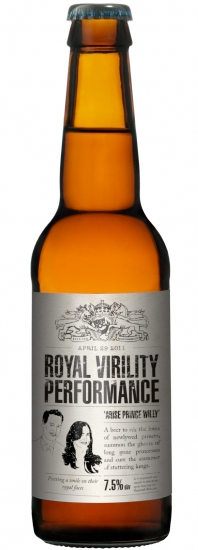
Luckily, Scotland’s BrewDog has just the thing for this sort of nonsense, a beer entitled Royal Virility Performance. With only 1,000 bottles to be released the day before the wedding, here’s how it’s described:

A limited-edition beer containing herbal viagra to mark the forthcoming royal wedding of Prince William and Kate Middleton on April 29th. Brewed using various well known aphrodisiacs, the limited edition artisanal beer will only be available to buy from the BrewDog.com website.

According to the specially commissioned label, the Royal Virility Performance contains herbal viagra, chocolate, Goat Weed and ‘a healthy dose of sarcasm’. The beer is a 7.5% ABV India Pale Ale and has been brewed at BrewDog’s brewery in Fraserburgh.

With this beer we want to take the wheels off the royal wedding bandwagon being jumped on by dozens of breweries; The Royal Virility Performance is the perfect antidote to all the hype. A beer should be brewed with a purpose, not just because some toffs are getting married, so we created something at our brewery that will undermine those special edition beers and other assorted seaside tat, whilst at the same time actually give the happy couple something extra on their big day.

BrewDog-royal-virility-btl

Filed Under: Editorial, Events, Food & Beer, News, Politics & Law Tagged With: new release, UK

UK Gov’t Statistics On Women Drinking Found To Be Wrong

April 19, 2011 By Jay Brooks

ofc-nat-stats
For the second time in a few years, a UK Government agency has admitted to making a mistake regarding statistics used in the creation and furtherance of alcohol policy. The first, in 2007, was when the UK’s Department of Health revealed that the definition of a hazardous drinker, that is what the safe limits of alcohol intake were said to be, was completely made up, quite literally “plucked out of the air.”

On Monday, the UK’s Office for National Statistics (ONS) “admitted that it misrepresented the trends in alcohol consumption and has issued a sincere apology to the Portman Group, the drinks industry organisation that champions responsible drinking.”

According to Straight Statistics:

In a report about the productivity of the NHS published at the end of last month, the claim was made that the proportion of women drinking more than 14 units a week had increased by a fifth since 1998, leading to a greater demand for healthcare. As Straight Statistics reported here, there was no justification for such a claim.

A change in methodology for measuring alcohol consumption in 2006 creates a break in the time series. If not allowed for, this gives the impression that the number of women who exceed 14 units a week has indeed increased. Plenty of anti-drink campaigners are happy to spread this false message but it came as a shock when the ONS did so.

David Poley, chief executive of the Portman Group wrote to Stephen Penneck, Director General of the ONS, who has now replied admitting that Mr Poley’s concerns are “entirely justified”. He blames a “lapse in the quality assurance process by which we check carefully the accuracy and reliability of any information that is for publication … unfortunately in this rare instance a key issue went unnoticed.”

The article and press release have been amended. The article, accessible here, is now proceeded by a correction notice. The press release now reads: “The percentage of males and females consuming over the weekly recommended alcohol limits declined from 2006 to 2009.”

Mr Penneck’s response is prompt, straightforward, and makes no attempt to fudge the issue. If only it were equally easy to persuade the media to look more critically at its assumptions about drinking being out of control.

At least they admitted their error. I doubt the same would be true on this side of the pond, where statistical errors tend to live in perpetuity if they serve the anti-alcohol agenda. But the original stories that parroted the incorrect statistics that drinking for women has increased in The Daily Telegraph, the Daily Mail and the Daily Star are still out there and, as far as I know, have not been corrected. They can’t be, really, because the stories focused on the false problem at the heart of the mistake. And that’s the same here, too, as propaganda — even after it’s been disproved — is still used by numerous anti-alcohol groups. Repeat a lie often enough and … well, you know the rest.

Filed Under: Editorial, News, Politics & Law Tagged With: Prohibitionists, Statistics, UK, Women

Beer In Ads #337: Red Tower, Famous The World Over

March 30, 2011 By Jay Brooks

ad-billboard
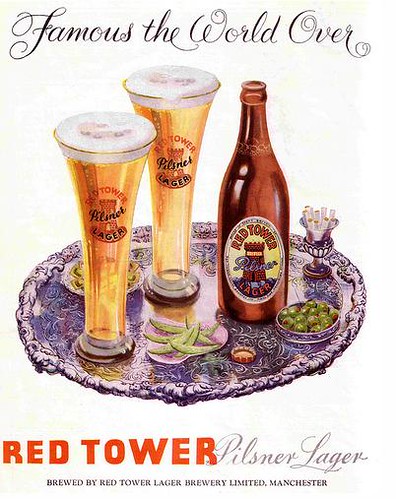
Wednesday’s ad is for a British beer, Red Tower Pilsner Lager from Manchester. The illustration is amazing. I love the details of the tray and all the little things on it. I have no idea when the ad is from, but it must be after 1933, when Walker & Homfray renamed its Royal Brewery for their popular new beer, the Red Tower Lager Brewery Ltd. By 1956, the brewery had been acquired by Scottish & Newcastle, so it seems likely the ad is from between 1933 and 1956.

red-tower

Filed Under: Art & Beer, Beers Tagged With: Advertising, History, UK

More Absurdity From The Lunatic Fringe

March 7, 2011 By Jay Brooks

nut
In another missive from the increasingly well-named Professor David Nutt, today in the UK Guardian he announed that There is no such thing as a safe level of alcohol consumption and then proceeded to claim that the reasons he believes that “the idea that drinking small amounts of alcohol will do you no harm is a myth” are fourfold:

  1. Alcohol is a toxin that kills cells.
  2. Although most people do not become addicted to alcohol on their first drink, a small proportion do.
  3. The supposed cardiovascular benefits of a low level of alcohol intake in some middle-aged men cannot be taken as proof that alcohol is beneficial.
  4. For all other diseases associated with alcohol there is no evidence of any benefit of low alcohol intake.

He elaborates slightly more on each of these, though not much more, and then follows up those grand sweeping pronouncements with the following:

“Hopefully these observations will help bring some honesty to the debate about alcohol.”

That’s one of those comically-spit-out-your-drink sort of statements, because what he just said was nowhere near honest. It would almost be funny except that mainstream media in Great Britain keep giving him a bully pulpit to proselytize from and people seem genuinely uncritical of what he has to say, which is even more baffling. Some of the comments to the Guardian article from supporters are downright scary, as they seem to believe he has science and evidence to support his wackadoodle claims. He doesn’t. Last year, when he proclaimed, to equal fanfare, that beer is more dangerous than heroin, his scientific evidence consisted of gathering together a group of like-minded individuals (that is people already predisposed against alcohol), many of whom were members of the made-up organization he started after the UK government sacked him — The Independent Scientific Committee on Drugs — and they sat together in a room one weekend and assigned arbitrary numbers for the amount of harm to society for various drugs based on their life experience, no actual data necessary. That’s what passes for science, and that they got the previously respected Lancet to publish it is downright bewildering.

Just a few thoughts about what’s wrong with every one of his four “proofs,” off the top of my head. At least I’m admitting I’m not researching these.

1. Sure, 100% rubbing alcohol will kill you. It’s 200 proof. Most chemical substances, compounds, etc. will kill you in sufficient doses. Most of the medicines we use to treat diseases will kill you if the dose is too high. That’s why they have warning labels and are doled out by doctors and pharmacists with specific instructions of how many, and when to start and stop taking them. For alcohol, we have the TTB and various state agencies to perform that role. Even things that are good for us become bad for us in higher doses — red meat, salt, vitamins, bacon (well, maybe not bacon). If we got rid of everything in the world with the potential to kill us, we’d be left with pretty much nothing.

2. Since Nutt claims we can’t predict who will become addicted to alcohol with the very first taste, then he suggests “any exposure to alcohol runs the risk of producing addiction in some users.” And that differs from everything else how? Assuming his anecdotal “evidence” that such immediate addiction is even possible — which seems unlikely at best — it’s hardly a basis for public policy. Not everybody reacted well to penicillin when it was introduced; should we have left all those people with diseases who could be cured by penicillin die just because less than 1% had an adverse reaction to it? This is just a post hoc fallacy of the worst kind.

3. Saying that the cardiovascular benefits are not proof ignores the many, many, many other studies that show positive health benefits for a myriad range of health concerns. The big enchilada, of course, is the numerous studies that show that total mortality is improved by the moderate consumption of alcohol; that is you’ll most likely live longer if you drink moderately than if you either don’t drink at all or drink too much. And a recent study seems to suggest that given a choice, drinking too much instead of abstaining will still lead to a better result. The FDA in its most recent dietary guidelines acknowledges this fact, yet Nutt completely ignores it and every other study that doesn’t fit his world view. Singling out one study to bash — his straw man — is about as dishonest a way to “bring some honesty to the debate” as I can imagine.

4. He concludes by just dismissing the vast body of medical and health studies that do in fact conclude there are health benefits to the moderate consumption of alcohol. He does this apparently by simply pretending they don’t exist, saying “there is no evidence of any benefit of low alcohol intake.” But just saying there are no benefits in the face of a mountain of contrary evidence is not, as his supporters seem to believe, scientific proof of any kind. It’s just the opposite, in fact.

I’m all for an honest debate about the positives and negatives surrounding alcohol, but if this is what passes for “honesty,” I think I’ll have to wait a little longer for that conversation.

Filed Under: Beers, Editorial, News, Politics & Law Tagged With: Prohibitionists, UK

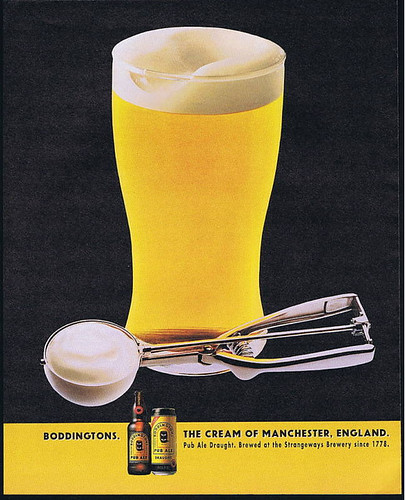
Beer In Ads #324: Boddington’s, The Cream Of Manchester

March 4, 2011 By Jay Brooks

ad-billboard
Friday’s ad is rather newer one, from 1996, is for Boddington’s, whose nickname — at least in ads — was “The Cream of Manchester.” It was a very popular imported brand for a time, though almost exclusively in the 16 oz. can. I always thought the ads with the ice cream scoop were a clever way to communicate the idea of its creaminess.

Boddingtons-1996

Filed Under: Art & Beer, Beers Tagged With: Advertising, History, UK

« Previous Page
Next Page »

Find Something

Northern California Breweries

Please consider purchasing my latest book, California Breweries North, available from Amazon, or ask for it at your local bookstore.

Recent Comments

  • Ernie Dewing on Historic Beer Birthday: Charles William Bergner 
  • Steve 'Pudgy' De Rose on Historic Beer Birthday: Jacob Schmidt
  • Jay Brooks on Beer Birthday: Bill Owens
  • Steve 'Pudgy' De Rose on Beer Birthday: Charles Finkel
  • Steve 'Pudgy' De Rose on Beer Birthday: Bill Owens

Recent Posts

  • Historic Beer Birthday: Adolph Schell February 12, 2026
  • Beer Birthday: Jennifer Talley February 12, 2026
  • Beer In Ads #5199: Fresh As A Frosty Morn, Congress Bock Beer February 11, 2026
  • Historic Beer Birthday: John Weidenfeller February 11, 2026
  • Beer Birthday: Dylan Schatz February 11, 2026

BBB Archives

Feedback

Head Quarter
This site is hosted and maintained by H25Q.dev. Any questions or comments for the webmaster can be directed here.