Brookston Beer Bulletin

Jay R. Brooks on Beer

  • Home
  • About
  • Editorial
  • Birthdays
  • Art & Beer

Socialize

  • Dribbble
  • Email
  • Facebook
  • Flickr
  • GitHub
  • Instagram
  • LinkedIn
  • Pinterest
  • RSS
  • Twitter
  • YouTube

Powered by Genesis

Historic Beer Birthday: Henry Hoerl

April 26, 2025 By Jay Brooks

blatz

Today is the birthday of Henry Hoerl (April 26, 1854-November 14, 1917). He was born in Altdorf, in Bavaria, Germany, the son of a German brewery owner, where he learned the trade. When he was 24, he came to the U.S. and found employment with a number of breweries throughout New York. In 1892, he moved to Milwaukee, Wisconsin to become the Superintendent of the Val. Blatz Brewing Co. a position he held for the rest of his life.

Henry-Hoerl

Here is his obituary from the American Brewers’ Review:

Henry-Hoerl-obit-1
Henry-Hoerl-obit-2
Henry-Hoerl-obit-3
BlatzBrewery1886

This biography of Henry Hoerl is his entry from “Freemasonry in Wisconsin: Biographical Sketches of Men who Have Been Prominent in the Various Masonic Bodies in the State,” published in 1900.

Henry-Hoerl-bio-1
Henry-Hoerl-bio-2
Henry-Hoerl-oval

And this biography is from “Memoirs of Milwaukee County: from the earliest historical times down to the present, including a genealogical and biographical record of representative families in Milwaukee County,” published by the Madison, Wisconsin Western Historical Society in 1909.

Henry Hoerl, for many years a prominent figure in the brewing circles of Milwaukee, has achieved his prominence through untiring energetic effort. He is of German descent and was born at Altdorf, Bavaria, Germany, April 26, 1854, the son of George and Anna (Funck) Hoerl, natives of the famous old city of Nuremberg. Henry, the subject of this review, received his education in the elementary schools of his native city and then took a course in the high school. After finishing his studies he was employed in breweries in Germany for several years. He served with distinction in the German army as sergeant of artillery of a Munich regiment. Ambitious to rise in the world and recognizing the greater possibilities and advantages offered in this country to young men of energy and determination, he left his home in 1878, when twenty-four years of age, and set out for the new world, entering upon a career in the course of which he encountered many disappointments, to ultimately reap the reward of honest efforts in abundant prosperity. Soon after landing in New York he found employment in the breweries there and took the brewmaster’s course in the New York Brewing Academy, winning the first prize in 1886. This brought him into prominence among the brewing men of the city and he secured an excellent position. In 1892 he moved to Milwaukee to become superintendent of the Valentine Blatz Brewing Company and has made their beer famous. On June 4, 1878, Mr. Hoerl married Katherine, the daughter of Michael and Katherine (Neuner) Strobel, of Albany, N. Y. Four children have come to bless this union: Emil, who is the proprietor of the Germania brewery of Altoona, Pa. ; Jenny, John M., who resides in Milwaukee, and Annie, the wife of George Schott, who runs a cooperage works in Cincinnati, Ohio. Mr. and Mrs. Hoerl are communicants of the Lutheran church, to which their ancestors have belonged for many generations. Mr. Hoerl is affiliated with the Masonic Order, having taken the Bine Lodge, the Chapter, Knights Templar and Consistory degrees, and he is also a member of the Mystic Shrine. Hoerl is a popular member of the Deutscher Club, the Millioki Club, the Milwaukee Music Vercin and the “West Side Turn Verein.”

blatz-tray

And finally, I came upon this little oddity via eBay. It’s an invitation sent to Hoerl at the Val. Blatz Brewing Co. in Milwaukee, Wisconsin.

Henry-Hoerl-invitation

The invitation was to attend a brewmaster’s convention of the United Brewer’s Association of the City of New York and the Surrounding Area, September 26-28, 1897. It doesn’t look like he mailed it back, but he may have been thinking about it, as he marked it for 2 train tickets to be reserved to get there.

Henry-Hoerl-invitation-bk

Filed Under: Birthdays, Just For Fun Tagged With: Germany, History, New York, Wisconsin

Beer In Ads #4946: Rahr’s Bock Beer

April 20, 2025 By Jay Brooks

Last year I decided to concentrate on Bock ads. Bock, of course, may have originated in Germany, in the town of Einbeck. Because many 19th century American breweries were founded by German immigrants, they offered a bock at certain times of the year, be it Spring, Easter, Lent, Christmas, or what have you. In a sense they were some of the first seasonal beers. “The style was later adopted in Bavaria by Munich brewers in the 17th century. Due to their Bavarian accent, citizens of Munich pronounced ‘Einbeck’ as ‘ein Bock’ (a billy goat), and thus the beer became known as ‘Bock.’ A goat often appears on bottle labels.” And presumably because they were special releases, many breweries went all out promoting them with beautiful artwork on posters and other advertising.

Sunday’s ad is for Rahr’s Bock Beer and was published April 20, 1935. The brewery was Rahr’s Brewing Co. of Green Bay, Wisconsin, which was originally founded in 1853. This ad ran in The Green Bay Press Gazette, also of Green Bay, Wisconsin.

Filed Under: Art & Beer, Beers, Breweries, Just For Fun Tagged With: Advertising, Bock, History, Wisconsin

Historic Beer Birthday: Mathias Leinenkugel

April 16, 2025 By Jay Brooks

leinenkugel
Today is the birthday of Mathias (sometimes spelled Matthias) Leinenkugel (April 16, 1866-June 3, 1927). He was the oldest child of Jacob Leinenkugel, who in 1867, along with John Miller, co-founded the Spring Brewery in Chippewa Falls, Wisconsin. In 1884, Jacob bought out Miller and the name was changed to the Jacob Leinenkugel Brewing Co. Mathias served as president of the family brewery from 1907 until his death in 1927. Miller Brewing Co. bought the brewery in 1988, but it continues to be managed by the Leinenkugel family.

Jacob-Leinenkugel-family-1842
Jacob Leinenkugel and his family, though I’m not sure, it seems likely that Mathias is the tall boy standing next to his seated father.

This biography is from Chippewa Falls History:

Mathias “Matt” Jacob Leinenkugel was the oldest of the children born to Jacob Leinenkugel. He was born April 16th, 1866. He grew up in Chippewa Falls with the rest of the Leinenkugel family. In 1889, he married Kathryn M. Watzl. Kathryn was born in 1868 in Montpelier, Wisconsin to John and Maria Watzl. Growing up around the brewery, naturally Mathias started working there. He started work there as a salesman from 1900 to 1907. In 1907, he was promoted to President of the Jacob Leinenkugel Brewery. He stayed in this position until his death on June 3rd, 1927.

Outside of the brewery, Mathias had a great family life with his wife and children. They lived at 821 North Bridge Street here in Chippewa Falls, Wisconsin. In 1890, they had their first child, Josephine Katherine Theresa. She was born December 6th, 1890. She would go on to be married twice, and have three children. Her first marriage was to Joseph (John) Black on April 16th, 1912. They were married in Chippewa Falls and remained there after their marriage. Unfortunately, John passed away in 1932 (John Black Dies).

After John’s passing, Josephine re-married on February 15th, 1941 to Thomas Gibbons. They spent the rest of their years together in Minnesota, as Gibbons was Ramsey County Sheriff until the mid-50’s.

Leinenkugels-Chippewa-Pride-Beer--Labels-Jacob-Leinenkugel-Brewing-Co_29959-1

This is his obituary from Find-a-Grave:

Mathias Jacob Leinenkugel was born the oldest child of Jacob Mathias Leinenkugel and Josephine Imhoff (Imhof on her death card which was all in German). He was born 16 April 1866 in Sauk City, Sauk Co, Wis.

In 1867 his parents came to Chippewa Falls and his father Jacob, trained by his father Mathias in the brewery trade, began a brewery.

Mathias worked in the brewery as a salesman and in the 1880’s met Kathryn M Watzl who was living in Chippewa Falls. They married at St. Charles Borromeo Catholic Church in Chippewa Falls, Wis on 18 June 1889.

Mathias was eventually president of the Jacob Leinenkugel Brewery in Chippewa Falls. They lived at 821 N Bridge St.

Mathias and Kathryn had 3 children: Josephine Catherine Theresa Leinenkugel, Jacob Mathias Leinenkugel, and Karl J (became Carl) Leinenkugel.

Mathias was ill a couple years with pulmonary tuberculosis and died in Chippewa Falls, Chippewa Co, WI on 3 June 1926 at age 60 years 1 month and 17 days of age. His death was recorded in Vol 21 page 34 of the Chippewa Co Court House records.

Leinenkugel-brewery-1930
The brewery around 1930.

And this fuller history is from the website Chippewa Falls History:

When people hear the name Leinenkugel, most would think of the beer or maybe even Chippewa Falls, Wisconsin. As the owner of Colette’s Tavern says, “Some people get hysterical when they find out I have it. The beer’s got some kind of charm.” Most, however, do not think of the rich and interesting history that has gone into the Jacob Leinenkugel Brewing Company. Most of this history comes from its origins and how over five generations, the business has kept within the Leinenkugel family. To properly tell the history of this family, we must start at the beginning with Jacob Mathias Leinenkugel himself. Jacob Leinenkugel was born May 22nd, 1842 in Prussia to Matthias and Maria Leinenkugel. Jacob and his entire family arrived in New York on August 2nd, 1845. They had taken a ship, the American, from Amsterdam to New York, New York. Jacob Leinenkugel was three at the time of this trip. The Leinenkugel family settled in Prairie du Sac, Wisconsin and stayed there to raise their children. In 1865, Jacob Leinenkugel married Josephine Imhoff in Sauk City, Wisconsin. Two years later, Jacob, Josephine and their son, Mathias, all moved to Chippewa Falls when Jacob started the Spring Brewery, now known as the Jacob Leinenkugel Brewing Company.

Leinenkugel's-Spring-Brewery

The brewery was constructed in 1867 on property along the Duncan Creek which Jacob had purchased from Hiram Allen. Jacob Leinenkugel established the Spring Brewery with John Miller. In their first year alone, they “…delivered 400 barrels…with a small cart pulled by a horse named Kate.” Originally, the Brewery only had two teams of horses, which meant they could deliver kegs of beer up to ten miles outside of Chippewa Falls. “During the early years, Jacob Leinenkugel drove the wagon himself.” The Spring Brewery was named as such because it was built near the Big Eddy Springs in Chippewa Falls. These springs “…poured nonacidic, non-alkaline water that the brewery uses without treatment to this day.” The Spring Brewery soon became the Jacob Leinenkugel Spring Brewery Company when John Miller sold his share in 1883.

It is said that “Jacob Leinenkugel…was more than a brewer of Leinenkugel’s beer. Described as a noble, magnanimous man and a generous contributor to Notre Dame Church, he served two years as mayor.” Indeed, Jacob Leinenkugel was more than just a brewer. He also had a rich family life. He had five children with his first wife, Josephine. The oldest, Mathias “Matt” Jacob was born in 1866. Their oldest daughter, Rose, was born in 1867. Their next oldest son, William, was born in 1870. Susan, the second oldest daughter, was born nine months later in 1870. And finally, they had one child who was born in 1873 but sadly passed away as an infant. Josephine Leinenkugel passed away in 1890, at the age of 44. A few years later, Jacob Leinenkugel re-married in 1892. He married Anna Wilson and had two children. Della, the oldest, was born in 1894 and Edward was born in 1896.

Leinenkugel-fermenting-tanks-1897
Leinenkugel’s fermenting tanks in 1897.

Leinenkugel-chippewa-pride-tray

Filed Under: Birthdays, Breweries, Just For Fun Tagged With: History, Wisconsin

Historic Beer Birthday: Emil Schandein

April 16, 2025 By Jay Brooks

jacob-best
Today is the birthday of Emil Schandein (April 15, 1840-July 22, 1888). He was born in Bavaria, Germany, but emigrated to America when he was sixteen, in 1856. Arriving first in New York, he moved shortly thereafter to Philadelphia, and moved around quite a bit, until finally settling in Milwaukee, Wisconsin in 1866 where he joined the Philip Best & Co. brewery staff. That same year he married Best’s daughter Lisette, and her father sold the remaining half of the business to her husband, making Frederick Pabst president, and Schandein vice-president. Schandein was a director of the brewery from 1873-1888. When he passed away in 1888, Lisette was elected vice-president.

Emil-Schandein

This is the Google translation of Emil’s German Wikipedia page:

Schandein was born in 1840 in Obermoschel . His parents were the royal tax and community beneficiary Joseph Wilhelm Schandein (1800-1862) and Louisa Schandein (b. Barth). His uncle was the historian Ludwig Schandein.

At the age of 16 he emigrated to the USA and settled in Philadelphia . After working in different cities, he moved to Watertown, Wisconsin, in 1863. There he married Elizabetha “Lisette” Best, a daughter of the breeder owner Phillip Best.

Together with his brother-in-law Frederick Pabst, he bought shares in his Philip Best Brewing Company and from 1873 until his death took the post of vice-president.

In addition to his work for the brewery, Schandein was one of the founders and first president of the German Society of Milwaukee. He was also director of the Northwestern Life Insurance Company, the Second Ward Savings Bank and President of the Milwaukee Brewers Association.

Emil Schandein died in 1888 during a stay in Germany. He is buried at the Forest Home Cemetery in Milwaukee.

Only after his death was in 1889, the Saddle Your Mansion, a villa in the German Renaissance style, on the 24th and Grand Avenue (now Wisconsin Avenue) in Milwaukee completed. The Milwaukee County Emergency Hospital was built in 1929 on the site of the building.

His widow, Lisette Schandein, assumed his post as vice president after his death until 1894. She died in 1905 during a stay in Germany.

Shandein bequeathed part of his estate to the Kaiserslauter Kreisrealschule and to the Pfälzisches Gewerbemuseum. The Schandeinstrasse in Kaiserslautern is named after him. The Schandeinstrasse in Speyer, however, is named after his uncle Ludwig.

phillip-best-stock-1873

This Phillip Best Brewing Co. stock certificate, from 1873, is signed by then-president Emil Schandein.

This is from the “National Cyclopaedia of American Biography, Vol. III,” published in 1891:

Emil-Schandein-cyclopedia-1
Emil-Schandein-cyclopedia-2

Filed Under: Birthdays, Just For Fun Tagged With: Germany, History, Wisconsin

Historic Beer Birthday: August Krug

April 15, 2025 By Jay Brooks

schlitz-globe
Today is the birthday of August Krug (April 15, 1815-December 30, 1856). Krug was born in Miltenberg, Bavaria, Germany, but when he was 33, in 1848, emigrated to the U.S. and settle in central Wisconsin. He opened a restaurant and the following year, 1849, added a brewery, which was known then as the August Krug Brewery. When he died young, in 1856, his bookkeeper, Joseph Schlitz took over management on behalf of Krug’s widow, Anna Marie. In 1858, Schlitz married Krug’s widow and renamed the brewery after himself.

Here’s a biography of him from Find-a-Grave:

Brewer. His August Krug Brewery was the foundation that became the giant Joseph Schlitz Brewing Co. in Milwaukee, Wisconsin. Born Georg August Krug in Miltenberg, Bavaria, Germany, he came to the USA about 1848, established a restaurant in Kilbourntown (now central Milwaukee), Wisconsin and added a small brewery in 1849 which, limited by lack of refrigeration to brewing in cooler months, produced about 150 barrels the first year. In 1850, his father, Georg Krug, came to visit, surviving a shipwreck on the way. The father managed to save himself, Krug’s eight-year-old nephew August Uihlein and $800 in gold. The gold was used to expand the brewery and hire four people, including Joseph Schlitz as bookkeeper. Krug, who is credited with building Kilawukee’s first underground brewer’s vault tunneled into the hill to provide the consistent cool temperatures essential to brewing and storage, died seven years after his brewery produced its first barrel of beer. The bookkeeper, Schlitz, acquired both his brewery and then his widow after Krug died in 1856. The brewery’s market share increased steadily, and sales doubled when Schlitz entered the Chicago market immediately after the Chicago Fire in 1871. Schlitz was lost at sea in 1875, after which Krug’s four nephews began the Uihlein dynasty that was to run the company during its long history. In the 1960s, Schlitz was the second-largest brewer in the world; during the 1970s it was troubled by indictments for improper marketing, by insufficient advertising and by public resentment over a change in the brewing recipe; finally a 1981 strike lead to the closure of their Milwaukee plant although it was still the USA’s third-largest brewer when purchased by the Stroh Brewery Company of Detroit (now part of Pabst Brewing Co.) in 1982.

schlitz_first_brewery
The August Krug Brewery, c. 1850s.

This portion of the brewery’s history from Immigrant Entrepreneurship is entitled “Political Revolution, Emigration, and Establishing a Regional Player in Brewing: August Krug and Joseph Schlitz” and is the early section that includes Krug’s contributions:

At the beginning was the German revolution of 1848. Georg August Krug (born April 15, 1815 in Miltenberg, grand duchy of Hesse-Darmstadt; died: December 30, 1856 in Milwaukee, WI) was born the son of Georg Anton Krug (1785–1860) and Anna Marie Ludwig (1784–1864), who owned the brewery “Zum Weißen Löwen,” the predecessor of today’s Faust brewery, in Miltenberg. This was a small and contested town at the River Main, which belonged until 1803 to the Electorate of Mayence (Mainz), became part of the grand duchy of Baden in 1806, was transferred to the grand duchy of Hesse-Darmstadt in 1810, and finally became part of the Kingdom of Bavaria in 1816. Georg August Krug worked in the family business but also became a member of a group of revolutionists surrounding a local doctor and farmer, Jakob Nöthig, who later emigrated to the U.S. after he was accused of being a ringleader (Rädelsführerei) of a local band of political agitators and other offenses against the Bavarian authorities. Krug and his father were among the petitioners in Miltenberg on March 8, 1848 who demanded liberal reforms. On the following day Miltenberg was shaken by protests and turmoil, and Bavarian armed forces reestablished order. Facing official prosecution, the younger Krug became part of the first wave of politically-motivated emigration. He arrived in the United States in May 1848, where he used only his second name and where he was naturalized on December 15, 1854.

In Milwaukee, at that time a preferred destination for the 48ers, August Krug established, probably with his savings, a saloon and restaurant on 4th and Chestnut Streets. Far from Bavaria, he still managed to receive additional support from his family. First, his fiancée Anna Maria Wiesmann Hartig arrived from Miltenberg (Oct. 9, 1819–Jan. 20, 1887) and they eventually married—likely in 1849. She was the daughter of Michael Wiesmann and Christina Schlohr, both from Miltenberg. Her presence allowed an expansion of his business activities. While Anna Maria Krug managed the restaurant, August Krug started a small brewing business at a nearby building at 420 Chestnut Street in 1849. Second, his father Georg Anton Krug arrived in the United States on October 25, 1850, accompanied by his grandson, 8-year-old August Uihlein. Such visits were not without risk: the visitors travelled on the Helena Sloman, the first German steamship on the transatlantic route. It encountered distress at sea on November 28, 1850 and sunk. Nine people were killed, but the vast majority of the crew and the passengers, in total 175 persons, were rescued by the American ship Devonshire. Georg Anton Krug lost a Bavarian beer pump, which went down with the wreckage, but he rescued $800 in gold (or $23,000 in 2010 dollars). This capital was invested into the brewery of his son and used to hire three additional employees, including a bookkeeper named Joseph Schlitz.
August Krug became a respected citizen. In 1850, his real estate property was valued at $1,600 ($46,100 in 2010 dollars). His household consisted of five people: himself and his wife Anna Maria, two brewery workers (both from Bavaria), and a young 18-year-old women, probably a servant. Krug was apparently a respected voice in his neighborhood, as his name was invoked in a newspaper advertisement for a local fireproof tile maker. He could afford to visit Germany in 1855, where he was able to meet with his relatives again.

By the mid-1850s, Krug already saw himself as a competitor for preeminence with other German immigrant brewers in Milwaukee in particular the Best family and Miltenberg-born Valentin Blatz (1826–1894). However, he was injured in an accident late in 1856, when he tumbled down a hatchway, and passed away several days later. The value of the eleven lots of real estate he owned was estimated at $20,050 ($532,000 in 2010 dollars). There were a total of $15,296.76 in claims and demands against the estate, including $276.50 owed to bookkeeper Joseph Schlitz (in 2010 dollars, equivalent to roughly $406,000 and $7,330, respectively).

krugbrewery1936article

august-krug

Filed Under: Birthdays, Breweries, Just For Fun Tagged With: Germany, History, Wisconsin

Beer In Ads #4922: It’s Wise To Ask For Braumeister Bock Beer

March 27, 2025 By Jay Brooks

Last year I decided to concentrate on Bock ads. Bock, of course, originated in Germany, in the town of Einbeck. Because many 19th century American breweries were founded by German immigrants, they offered a bock at certain times of the year, be it Spring, Easter, Lent, Christmas, or what have you. In a sense they were some of the first seasonal beers. “The style was later adopted in Bavaria by Munich brewers in the 17th century. Due to their Bavarian accent, citizens of Munich pronounced ‘Einbeck’ as ‘ein Bock’ (a billy goat), and thus the beer became known as ‘Bock.’ A goat often appears on bottle labels.” And presumably because they were special releases, many breweries went all out promoting them with beautiful artwork on posters and other advertising.


Thursday’s ad is for Braumeister Bock Beer and was published March 27, 1950. “Braumeister Bock Beer: The Only Genuine Milwaukee Bock Beer at the Regular Price,” which was originally published March 22, 1955 in the Saginaw News, which I believe was in Saginaw, Michigan, a medium-sized town in Eastern MIchigan located just below Saginaw Bay by Lake Huron. The brewery was the Independent Milwaukee Brewery of Milwaukee, Wisconsin, which was founded in 1901 by five partners: Henry N. Bills, William Gutknecht, Charles Evers, Emil Czarnecki, and William Jung. It’s flagship brand was Braumeister. The survived Prohibition and lasted until 1962, when the G. Heileman Brewing Co. of nearby Lacrosse bought the brewery and closed it down the following year. This ad ran in the Cincinnati Post, of Cincinnati, Ohio, and includes the headline: “It’s WISE to Ask for ‘Milwaukee’s Choicest’ Bock beer” and features our intrepid genius goat, wearing glasses and mortarboard and tassel. The same ‘wise’ goat was featured in an earlier ad for Braumeister Bock and elicited several comments pondering why it was wearing eyeglasses. I think we can safely say it was to make him appear smarter.

Filed Under: Art & Beer, Beers, Breweries, Just For Fun Tagged With: Advertising, Bock, History, Ohio, Wisconsin

Beer In Ads #4917: Now! It’s Bock Beer Season!

March 22, 2025 By Jay Brooks

Last year I decided to concentrate on Bock ads. Bock, of course, originated in Germany, in the town of Einbeck. Because many 19th century American breweries were founded by German immigrants, they offered a bock at certain times of the year, be it Spring, Easter, Lent, Christmas, or what have you. In a sense they were some of the first seasonal beers. “The style was later adopted in Bavaria by Munich brewers in the 17th century. Due to their Bavarian accent, citizens of Munich pronounced ‘Einbeck’ as ‘ein Bock’ (a billy goat), and thus the beer became known as ‘Bock.’ A goat often appears on bottle labels.” And presumably because they were special releases, many breweries went all out promoting them with beautiful artwork on posters and other advertising.

Saturday’s ad is for “Braumeister Bock Beer: The Only Genuine Milwaukee Bock Beer at the Regular Price,” which was originally published March 22, 1955 in the Saginaw News, which I believe was in Saginaw, Michigan, a medium-sized town in Eastern MIchigan located just below Saginaw Bay by Lake Huron. The brewery was the Independent Milwaukee Brewery of Milwaukee, Wisconsin, which was founded in 1901 by five partners: Henry N. Bills, William Gutknecht, Charles Evers, Emil Czarnecki, and William Jung. It’s flagship brand was Braumeister. The survived Prohibition and lasted until 1962, when the G. Heileman Brewing Co. of nearby Lacrosse bought the brewery and closed it down the following year. I love that their goat looks so smart. It must be the glasses and the mortarboard and tassel.

Filed Under: Art & Beer, Beers, Breweries, Just For Fun Tagged With: Advertising, Bock, History, Milwaukee, Wisconsin

Beer In Ads #4906: Braumeister Bock Beer

March 11, 2025 By Jay Brooks

Last year I decided to concentrate on Bock ads. Bock, of course, originated in Germany, in the town of Einbeck. Because many 19th century American breweries were founded by German immigrants, they offered a bock at certain times of the year, be it Spring, Easter, Lent, Christmas, or what have you. In a sense they were some of the first seasonal beers. “The style was later adopted in Bavaria by Munich brewers in the 17th century. Due to their Bavarian accent, citizens of Munich pronounced ‘Einbeck’ as ‘ein Bock’ (a billy goat), and thus the beer became known as ‘Bock.’ A goat often appears on bottle labels.” And presumably because they were special releases, many breweries went all out promoting them with beautiful artwork on posters and other advertising.

Tuesday’s ad is for Braumeister Bock Beer and was published March 11, 1951. The brewery was the Independent Milwaukee Brewery of Milwaukee, Wisconsin, which was founded in 1901 by five partners: Henry N. Bills, William Gutknecht, Charles Evers, Emil Czarnecki, and William Jung. It’s flagship brand was Braumeister. The survived Prohibition and lasted until 1962, when the G. Heileman Brewing Co. of nearby Lacrosse bought the brewery and closed it down the following year. But in 1951, they claimed to have Milwaukee’s most famous brewmaster for brewing Prize Bock Beer.”

Filed Under: Art & Beer, Beers, Breweries, Just For Fun Tagged With: Advertising, Bock, History, Wisconsin

Beer In Ads #4900: Braumeister Genuine Bock Beer

March 5, 2025 By Jay Brooks

Last year I decided to concentrate on Bock ads. Bock, of course, originated in Germany, in the town of Einbeck. Because many 19th century American breweries were founded by German immigrants, they offered a bock at certain times of the year, be it Spring, Easter, Lent, Christmas, or what have you. In a sense they were some of the first seasonal beers. “The style was later adopted in Bavaria by Munich brewers in the 17th century. Due to their Bavarian accent, citizens of Munich pronounced ‘Einbeck’ as ‘ein Bock’ (a billy goat), and thus the beer became known as ‘Bock.’ A goat often appears on bottle labels.” And presumably because they were special releases, many breweries went all out promoting them with beautiful artwork on posters and other advertising.

Wednesday’s ad is is for Braumeister Genuine Bock, and is from March 5, 1956. The brewery was the Independent Milwaukee Brewery of Milwaukee, Wisconsin, which was founded in 1901 by five partners: Henry N. Bills, William Gutknecht, Charles Evers, Emil Czarnecki, and William Jung. It’s flagship brand was Braumeister. The survived Prohibition and lasted until 1962, when the G. Heileman Brewing Co. of nearby Lacrosse bought the brewery and closed it down the following year. But in 1954, they claimed to have the only “Genuine” bock beer in Milwaukee.

Filed Under: Art & Beer, Beers, Breweries, Just For Fun Tagged With: Advertising, Bock, History, Milwaukee, Wisconsin

Beer In Ads #4799: Pabst Bock Beer

November 21, 2024 By Jay Brooks

After taking a few months off from my “Beer in Ads” series, having finished documenting the Miss Rheingold ad campaign that lasted from 1941 to 1964, I thought it was time to bring back the ads, and decided to concentrate on Bock ads for the foreseeable future. Bock, of course, originated in Germany, in the town of Einbeck. Because many 19th century American breweries were founded by German immigrants, they offered a bock at certain times of the year, be it Spring, Easter, Lent, Christmas, or what have you. In a sense they were some of the first seasonal beers. “The style was later adopted in Bavaria by Munich brewers in the 17th century. Due to their Bavarian accent, citizens of Munich pronounced ‘Einbeck’ as ‘ein Bock’ (a billy goat), and thus the beer became known as ‘Bock.’ A goat often appears on bottle labels.” And presumably because they were special releases, many breweries went all out promoting them with beautiful artwork on posters and other advertising.

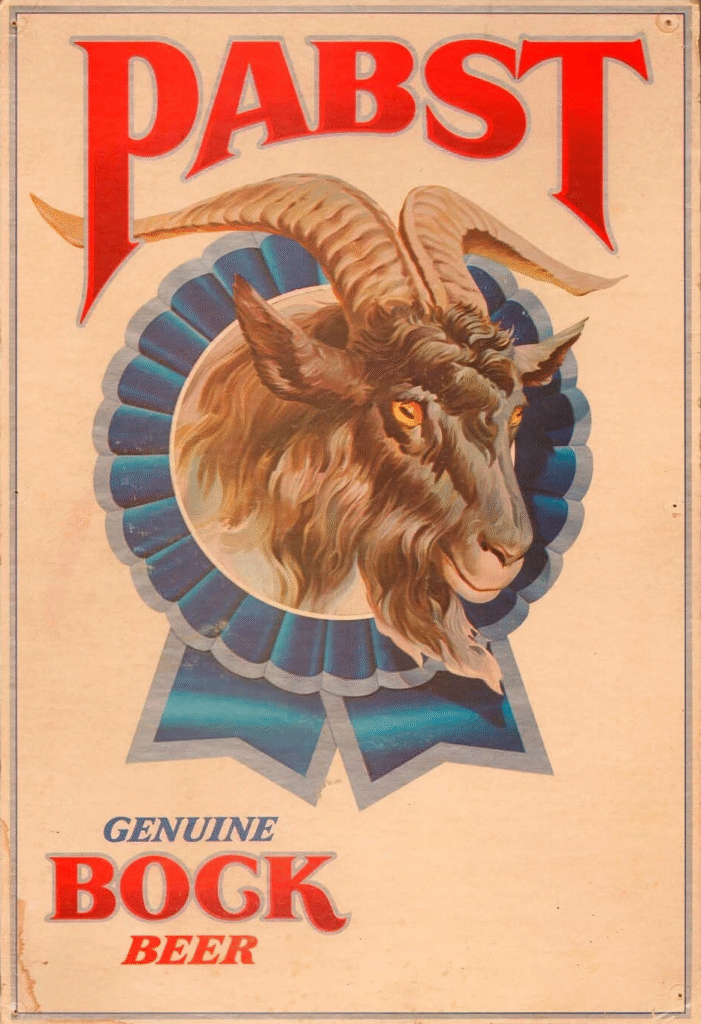
Thursday’s ad is for the Pabst Brewing Co. originally founded in Milwaukee, Wisconsin. This poster for their “Bock Beer” was created in 1936 by an unknown lithographer.

Filed Under: Art & Beer, Breweries, Just For Fun Tagged With: Advertising, Bock, History, Pabst, Wisconsin

« Previous Page
Next Page »

Find Something

Northern California Breweries

Please consider purchasing my latest book, California Breweries North, available from Amazon, or ask for it at your local bookstore.

Recent Comments

  • Bob Paolino on Beer Birthday: Grant Johnston
  • Gambrinus on Historic Beer Birthday: A.J. Houghton
  • Ernie Dewing on Historic Beer Birthday: Charles William Bergner 
  • Steve 'Pudgy' De Rose on Historic Beer Birthday: Jacob Schmidt
  • Jay Brooks on Beer Birthday: Bill Owens

Recent Posts

  • Beer In Ads #5220: Hello People! I Am The Centlivre Bock Beer Goat April 13, 2026
  • Beer Birthday: Ray McCoy April 13, 2026
  • Historic Beer Birthday: George Gund II April 13, 2026
  • Historic Beer Birthday: Albert C. Houghton April 13, 2026
  • Beer Birthday: Andreas Fält April 13, 2026

BBB Archives

Feedback

Head Quarter
This site is hosted and maintained by H25Q.dev. Any questions or comments for the webmaster can be directed here.