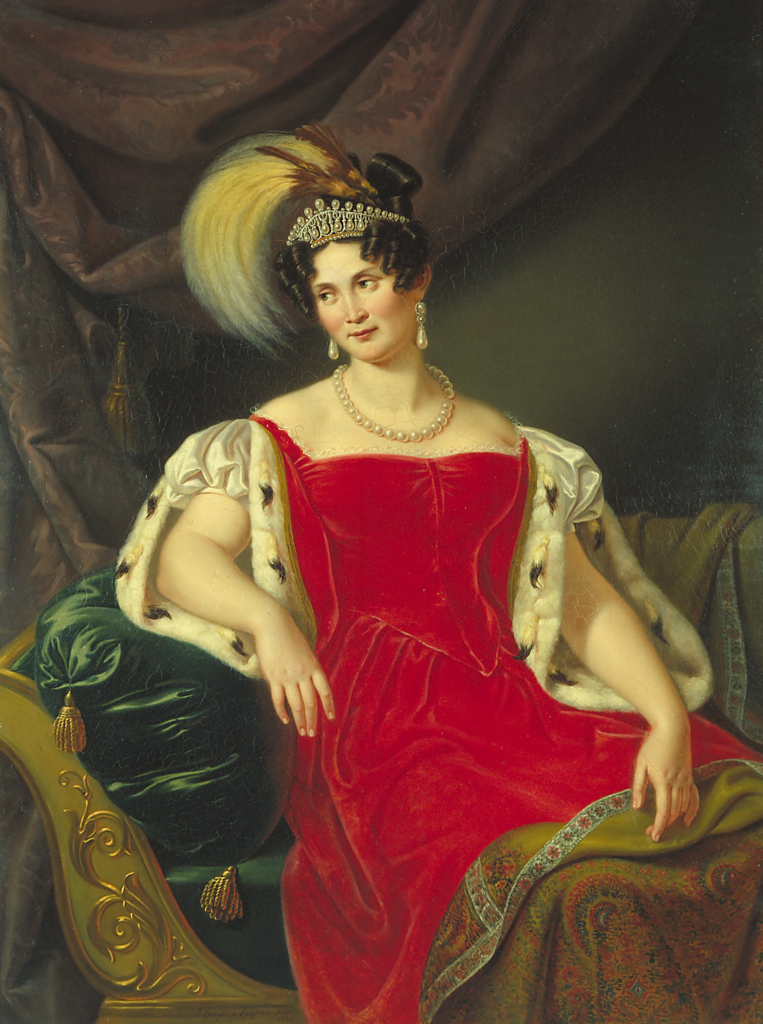
Today is the birthday of Therese of Saxe-Hildburghausen, who was born July 8, 1792. She’s perhaps most famous now for her wedding reception, which turned into Germany’s largest, and most famous, folk festival, Oktoberfest. Here’s how Munich’s official website tells the story:
Crown Prince Ludwig, later to become King Ludwig I, was married to Princess Therese of Saxony-Hildburghausen on 12th October 1810. The citizens of Munich were invited to attend the festivities held on the fields in front of the city gates to celebrate the happy royal event. The fields have been named Theresienwiese (“Theresa’s fields”) in honor of the Crown Princess ever since, although the locals have since abbreviated the name simply to the “Wies’n”.
That’s all about the wedding, and Ludwig, so here’s one account of her history:
Therese Charlotte Luise von Sachsen-Hildburghausen was on the short list in 1809 to become the bride of Napoleon Bonaparte, but instead she was matched with Crown Prince Ludwig I. The festivities celebrating their marriage in Munich on October 12, 1810 was the first Oktoberfest.
She was the sixth daughter of Frederick, Duke of Saxe-Hildburghausen, and his wife, Charlotte, a cultured pair who hosted poets and artists and turned their little duchy into “a little Weimar”, despite a lack of financial resources.
She was educated in both Classical German and French. Raised as a Lutheran, she kept her Protestant faith in Catholic Bavaria throughout her life.
Ludwig was fearful that Napoleon would force him to marry a French princess and so moved swiftly to marry a German. He visited Hildburghausen December 21-24, 1809 and chose Therese over her younger sister, Luise, who was considered more beautiful.
Although Ludwig was frequently absent on his many journeys or involved in “friendships” when at home, she suffered his dalliances according to the norms for women of her time and class and bore him nine children.
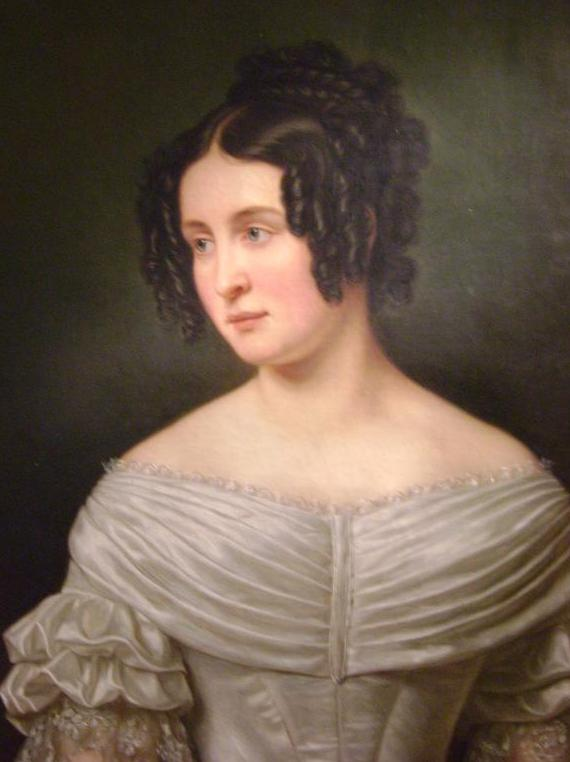
Therese von Sachsen-Hildburghausen painted by German artist Joseph Karl Stieler around 1810.
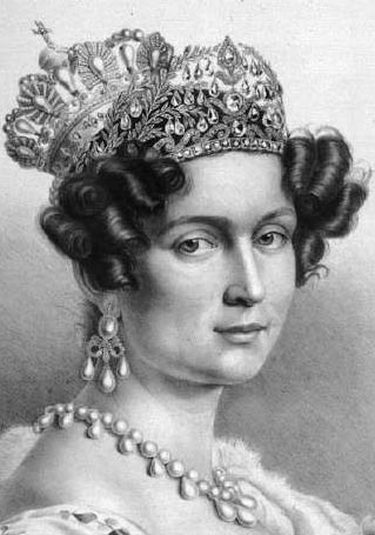
Coronation diadem of Queen Therese of Bavaria 1810.
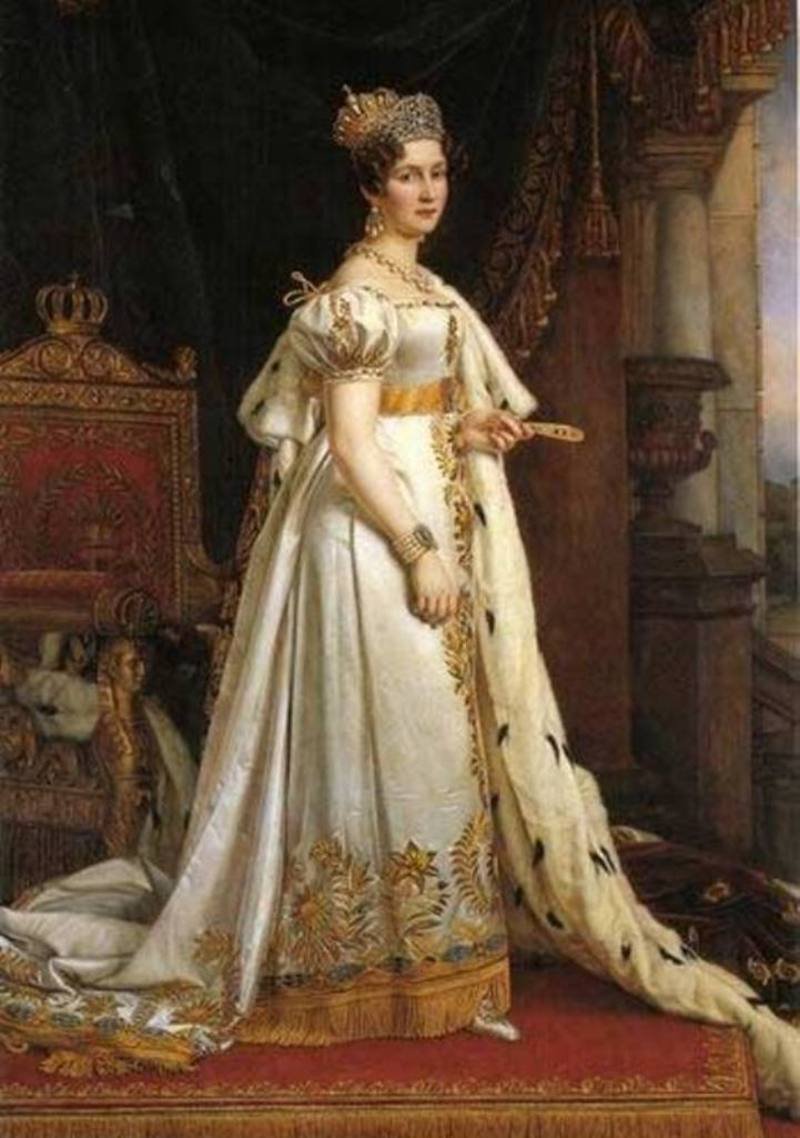
Also by Joseph Karl Stieler. This portrait was painted in 1827.
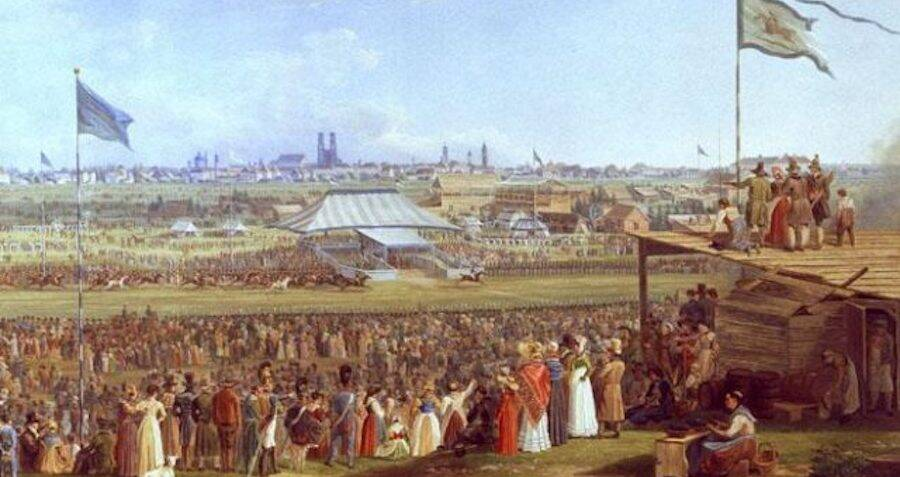
The Wittelsbachs’ court painter created this within a week of the first horse race’s completion.
Princess Therese in late 1809
Queen Therese with her family around 1830.
Queen Therese, by Julie von Egloffstein, around 1836.
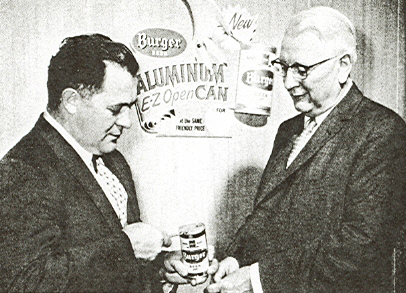
Today is the birthday of Frank J. Selinger (July 8, 1914-June 15, 2000). He was born in Philadelphia and was trained as a chemist and later became a brewmaster, first with the Esslinger Brewing Co. in Philadelphia, but later with the Burger Brewing Co. and Anheuser-Busch. But in 1977, he accepted the position of CEO for Schlitz Brewing and even appeared in television commercials for them in the early 1980s.
Here’s an obituary of Sellinger, from the Williamsburg Daily Press:
Francis J. Sellinger, a former brewing executive in Milwaukee, St. Louis, Cincinnati and Philadelphia, died Thursday, June 15, 2000, at Williamsburg Community Hospital. He was 85.
A native of Philadelphia, Mr. Sellinger graduated in 1936 with a degree in chemistry from St. Joseph’s College in Philadelphia. According to his son, Joseph Sellinger, he initially wanted to become a doctor but took a job in a brewery in order to help support his family. He began his career in the brewing industry in 1936 as chief chemist and assistant brewmaster with the Esslinger Brewing Co. in Philadelphia. In 1952, he joined the Burger Brewing Co. in Cincinnati, and he became vice president and general manager in 1956.
Mr. Sellinger joined Anheuser-Busch Inc. in St. Louis, Mo., in 1964. During his 14 years with the company, he held many senior executive positions, including vice president of engineering, and was a key figure in the company’s rapid brewery expansion during the 1970s, with the construction of breweries in Columbus, Ohio; Jacksonville, Fla.; Merrimack, N.H.; Williamsburg, Va.; and Fairfield, Calif. Mr. Sellinger was also heavily involved in the promotion of new technological advances within the company.
“He was the one that understood the direction the economics of the industry were going in,” said Patrick Stokes, president of Anheuser-Busch Inc.
He also played a key role in the development of the company’s Busch Gardens-The Old Country theme park and the Kingsmill Residential Community and Resort, both in Williamsburg.
In 1978, he became the vice chairman and chief executive officer of Schlitz Brewing Co. in Milwaukee. According to Joseph Sellinger, one of his first tasks at Schlitz was to turn the image of the company around. He worked to accomplish this by returning the company to a traditional brewing process. In addition, Mr. Sellinger appeared in the “Taste My Schlitz” television advertising campaign that began in 1978. Joseph Sellinger said that the locales for his father’s commercials ranged from barley fields to bars. Mr. Sellinger continued his career at Schlitz until his retirement in 1983 to Kingsmill in Williamsburg.
After his retirement, Mr. Sellinger became involved with the Anheuser-Busch Golf Classic, now the Michelob Golf Classic, and worked for St. Bede’s Catholic Church.
Mr. Sellinger will be remembered for his integrity, caring and generosity toward his family, friends and employees. He came from very humble beginnings, said Joseph Sellinger, yet gave so much to others.
Frank Sellinger (left), when he was Vice-President and General Manager of Burger Brewing.
And this is from the New York time, from March 1, 1981, an article by Ray Kenny entitled “Trying to Stop the Flight from Schlitz.”
MILWAUKEE SHORTLY after Frank J. Sellinger went to work at the Jos. Schlitz Brewing Company in November 1977, he faced the first in a long list of problems.
A daughter, who then lived on the West Coast, telephoned and confessed: “Daddy, I don’t like that beer.” She had a lot of company. Schlitz, which had reformulated its flagship brand in a disastrous economy move in the 70’s, has been fighting a steady decline in sales ever since. Earnings plunged from almost $50 million five years ago to a $50.6 million loss in 1979 when it sold its newest brewery.
Said Mr. Sellinger: “I told my daughter, ‘Honey, do me a favor. Try Schlitz Malt Liquor. If you still don’t like it, go back to Budweiser.'”
After all, Mr. Sellinger said, “Anheuser-Busch put bread and butter on the Sellinger table for a lot of years.” Mr. Sellinger was an executive there all those years. Now, as vice chairman and chief executive at Schlitz charged with getting people to drink Schlitz again, he has reworked its taste, pitted it against the major beers in taste competitions televised live and gone on television commercials himself as the company’s down-to-earth pitchman. He has also pared expenses, cut excess brewing capacity and tightened quality control.
For all that, Schlitz is still losing sales position. In its best year, 1976, the company sold 24.2 million barrels. In 1980, shipments declined 11 percent on the year, to 15 million barrels. The company lost its fingertip hold on third place in the industry, behind the Anheuser-Busch Companies, which sold 50.2 million barrels in 1980, and the Miller Brewing Company, a subsidiary of Philip Morris Inc., which shipped 37.3 million barrels last year. Schlitz dropped to fourth place, behind its crosstown rival, Pabst, which shipped 15.1 million barrels.
“This company faced the toughest marketing problem you’ve ever seen,” an outside director said. “Beer drinkers are intensely loyal and we drove them away. Getting them to switch back is a horrendous challenge.”
Despite the continued falling sales, the company managed to show a profit last year of $27 million, or 93 cents a share, on revenues of $1 billion. Mr. Sellinger’s efforts apparently have paid off, along with gains by Schlitz’s container division and some profits attributed to nonoperating areas of the business. Clearly, corporate executives and members of the Uihlein (rhymes with E-line) family, who continue to hold the controlling interest in the company, were buoyed by the earnings swing.
“When sales are falling, the first thing you do is arrest the decline,” Mr. Sellinger said. “We’ve slowed things down but it’s too early to tell whether we’ve turned it around. Ask me again in June.”
Mr. Sellinger, 66, was named vice chairman and chief executive officer at Schlitz last April after coming on board in 1977 as president. One of the first things he did in an attempt to slow falling sales was to formulate what he calls “one helluva good brew.” He assembled technical personnel and urged them to create a flagship beer that would appeal to the eye as well as the taste.
“It has to look good,” he said. “Americans drink with their eyes. Beer has to be rich in flavor and hold its head. “There is just so much you can do. You can increase the barley malt and change the amount of hopping – the ratio of hops to corn. But the malt is the soul of the beer.
“From January of 1978 until July, we conducted test after test after test. Finally, we all agreed, and I’ll tell you, if we can get people to taste the beer, we’ll keep ’em.”
Then he sought to improve quality control. “If the quality guy at a plant says it doesn’t go, it doesn’t go,” he said. “He reports to headquarters, not to the plant manager, and if that means we dump 5,000 cans because of high air content, then we dump 5,000 cans.”
Mr. Sellinger pared the payroll to 6,100 employees, eliminating 800 to 1,000 jobs. “I believe in paying fair wages,” he said, “but I can’t afford two workers for one job. We eliminated a lot of people. We sacrificed a few for the good of the many.”
As for expenses, he said, “We had grown fat. Lax. I mean, how many WATS lines do you really need? How many copies do you have to make? There a million ways to save.”
He cut deeply into excess capacity when he closed the company’s newest brewery – a six-year-old facility in Syracuse, N.Y., in 1979. The move, together with the closing of a small brewery in Honolulu, trimmed production capacity by 5.4 million barrels. But the company is still swimming in capacity. Last year it was capable of turning out 25.6 million barrels while it sold 15 million.
A year ago, the Syracuse plant was sold to Anheuser-Busch for $100 million. The company absorbed a $44.3 million loss in the process. “That was a beautiful brewery,” Mr. Sellinger said, “but it was an albatross. That doesn’t mean the decision to build it wasn’t right at the time. If your sales trend is a plus 12 percent a year, then you know that in three and a half years – the time it takes to construct a brewery – you will need so much beer to satisfy demand. The 1974 trend told us we would have to spend $157 million for the beer we would need by 1977.”
B REWERIES are built with the wholesalers in mind, Mr. Sellinger said. “We pressure them to sell Schlitz and they want to know whether Schlitz will have the beer if the business continues. We can’t say, ‘we have no beer.’ That takes all their incentive away.”
But if the customers leave, there’s no need for a brewery. “That’s the chance business takes constantly,” Mr. Sellinger said. “Look at our friends at Miller. Their trend line has been a plus 24 percent a year, but now it’s 3 1/2 percent.” Between 1954 and 1964, no breweries were built in the United States, the Schlitz chief recalled.
“Only Anheuser-Busch and Schlitz had the guts to borrow the money at 9.2 percent interest and build new plants. We didn’t have a ‘cash cow,’ ” he said, using his favorite description for Philip Morris. “What would Miller’s profit be if they paid even 8 percent interest on that Philip Morris investment?”
Schlitz embarked on an expensive campaign featuring live taste tests on television, pitting its product, at various times, against Miller High Life and Anheuser’s Budweiser and Michelob. Half the 100 Budweiser drinkers pulled the lever for Schlitz in one test supervised by Tommy Bell, a widely recognized referee in the National Football League. Other scores were respectable. But some critics said that the nature of the tests gave Schlitz the advantage. (Since the participants in a given test were all, say, Budweiser drinkers, Schlitz could claim victory if any favored its beer.)
Concluded Joseph Doyle, a brewing industry analyst at Smith Barney Harris Upham & Company: “All the media coverage (of the taste tests) is giving Schlitz a big bang for their buck. I’d count the campaign a huge success if it arrests the decline of the brand, and it looks like it is doing that.”
The company trumpeted the results in follow-up newspaper ads, but there are no current plans to continue the live taste tests. Nevertheless, Mr. Sellinger’s desk is piled with letters and comments. “Here’s one from five students at Holy Cross – Bud drinkers – who have started a Tommy Bell/Schlitz fan club,” he said. “The young drinkers are the ones you want to win.”
The company has not disclosed sales figures related to the television campaign but some distributors reported sales gains. “We doubled our January sales in the first week,” after the commercials began, reported Jack Lewis, a distributor in Cleveland. Joe Scheurer, in Philadelphia, said his sales were up 10 percent. Other distributors reported gains.
Mr. Sellinger, who prefers the term “beer tasting” to beer guzzling, will drink to that.
Here’s one of Sellinger’s TV ads, this one from 1981.
Last year I decided to concentrate on Bock ads. Bock, of course, may have originated in Germany, in the town of Einbeck. Because many 19th century American breweries were founded by German immigrants, they offered a bock at certain times of the year, be it Spring, Easter, Lent, Christmas, or what have you. In a sense they were some of the first seasonal beers. “The style was later adopted in Bavaria by Munich brewers in the 17th century. Due to their Bavarian accent, citizens of Munich pronounced ‘Einbeck’ as ‘ein Bock’ (a billy goat), and thus the beer became known as ‘Bock.’ A goat often appears on bottle labels.” And presumably because they were special releases, many breweries went all out promoting them with beautiful artwork on posters and other advertising.
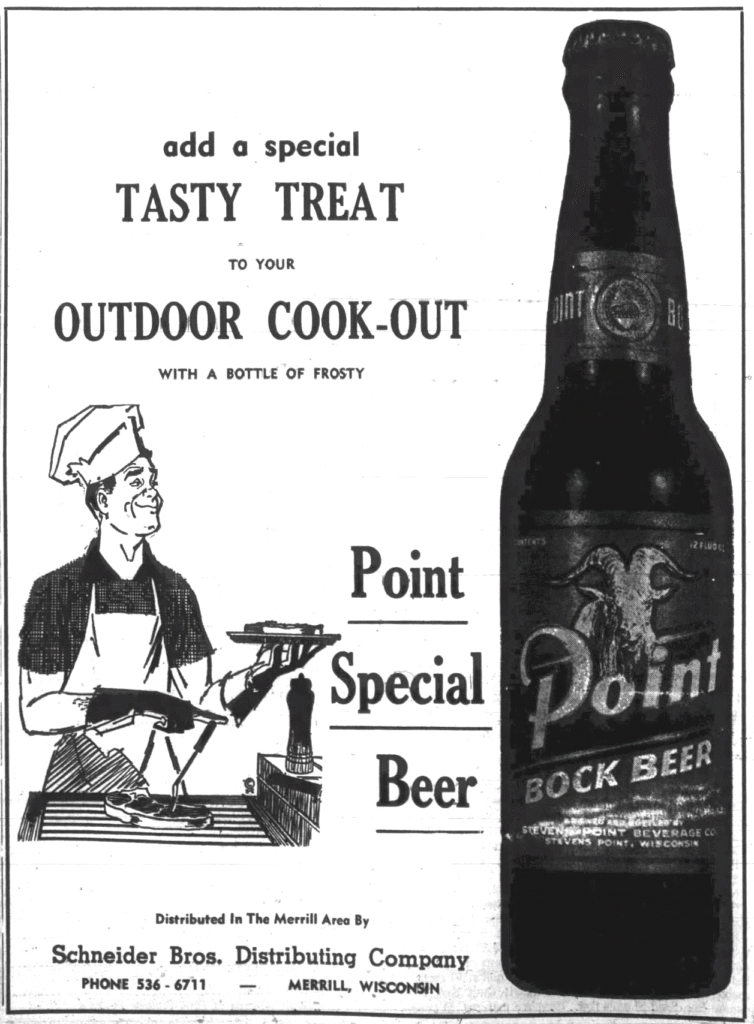
Monday’s ad is for Point Bock Beer, which was published on July 7, 1967. This one was for the Stevens Point Brewery of Stevens Point, Wisconsin, which was originally founded in 1857. This ad ran in The Merrill Daily Herald, of Merrill, Wisconsin.
Last year I decided to concentrate on Bock ads. Bock, of course, may have originated in Germany, in the town of Einbeck. Because many 19th century American breweries were founded by German immigrants, they offered a bock at certain times of the year, be it Spring, Easter, Lent, Christmas, or what have you. In a sense they were some of the first seasonal beers. “The style was later adopted in Bavaria by Munich brewers in the 17th century. Due to their Bavarian accent, citizens of Munich pronounced ‘Einbeck’ as ‘ein Bock’ (a billy goat), and thus the beer became known as ‘Bock.’ A goat often appears on bottle labels.” And presumably because they were special releases, many breweries went all out promoting them with beautiful artwork on posters and other advertising.
Sunday’s ad is for another unnamed Bock Beer, which was published on July 6, 1906. This one mentions a famous bock beer, though there is an agent for the brewery listed, Phil Thierolf. He apparently launched a business as a Wholesale and Retail Liquor Dealer in Nebraska around 1899. I found another ad he placed in the “Semi-Weekly News-Herald” indicating that he represented both the “Yellowstone (Kentucky) distillery” and the “Anheuser-Busch Brewing Ass’n” of St. Louis. So the bock he was touting in this ad may have been Budweiser Bock, but who knows. He easily could have had additional clients. Pro Tip: if you’re going to advertise that you have for sale a “famous ‘Bock‘ beer,” maybe list the goldarn brewery. Just a thought. This ad ran in The Evening Journal, of Plattsmouth, Nebraska.
The ad seems like it’s from the future for 1906. First that face looks at too little emoji-like, but more telling still is the phrase “Don’t Worry. Be happy.” a full 82-years before Bobby McFerrin used it in his 1988 hit song “Don’t Worry, Be Happy.“
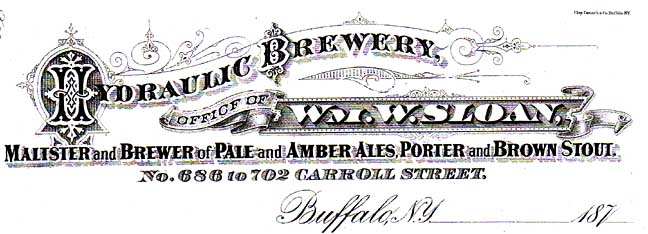
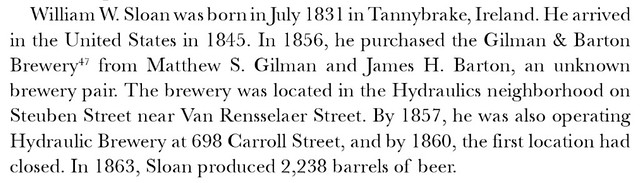
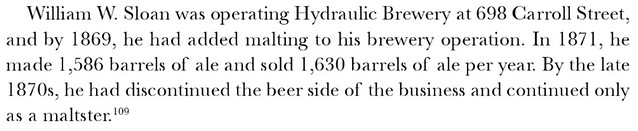
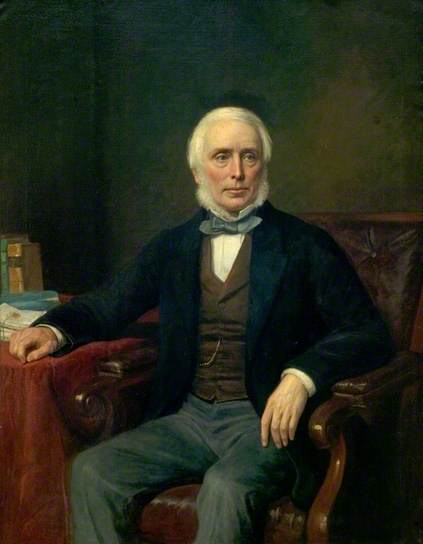
Today is the birthday of William Wilson Sloan (July 6, 1831-May 7, 1901). He was born in Ireland, and moved to Buffalo, New York. Originally a malster, he bought into Buffalo’s fifth brewery, the McCulloch Brewery around 1857. There’s very little I could find about Sloan, and even less in the way of images or photographs.
Alexander McCulloch and his son John were listed as brewers, Seneca Street in the 1832 Buffalo Directory. Charles C. Relay of Buffalo’s second brewery is also listed as a brewer, Seneca Street. Could Relay and McCulloch have brewed together for a short time?
The “Hydraulics” was an area near present day Seneca and Hydraulic Streets where a canal was dug in 1828 from Buffalo Creek to produce hydraulic power for an industrial zone. The 1832 Buffalo Directory lists this area as having a grist mill, hat body shop, pail factory, last factory, woolen factory and one brewery believed to be McCulloch’s. Around 1836 the Hydraulics name was changed to “Clintonville” with a population of 500. It was later incorporated into the city of Buffalo.
Alexander had three sons with his wife Elizabeth: Alexander Jr. the eldest, John H. and James. Alexander Sr., who turned the brewery over to his eldest son around 1836, continued to live in Clintonville with his wife until his death around 1846. The McCulloch’s became an important family in what was then called the “Hydraulics” or “Clintonville”. Alexander Jr. and his brothers operated their brewery located on Mill Street near the Hydraulic canal (later Hydraulic St.) until 1843 when they relocated to Steuben Street (later becoming part of Carroll Street) also near the Hydraulic canal. The Attica Railroad laid tracks into Buffalo down Mill Street in the early 1840’s. This is probably what caused McCulloch to relocate his brewery to Steuben Street.
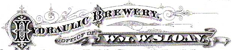
In 1847 the McCulloch’s sold their brewery to James H. Barton and Matthew J. Gilman. The Barton and Gilman Brewery operated until 1857 when it was sold to William W. Sloan. Sloan named his brewery the Hydraulic Brewery. The location remained the same but the address changed to 686 – 702 Carroll Street. Sloan continued brewing and malting at the Hydraulic Brewery until 1876.
And Buffalo Beer: The History of Brewing in the Nickel City, by Michael F. Rizzo and Ethan Cox has some more:
Today is the 41st birthday of Colin Presby, former head brewer at Golden Avalanche Brewing in Kutztown, Pennsylvania, and even worked for a time at Stoudt’s. More recently, he became the fleet brewmaster or brew admiral of Carnival Cruise Lines. He grew up in nearby Reading, like me (although for me it was nearby Shillington) but I was very familiar with Kutztown (my first wife went to the University there and so did my great-grandfather). Colin and I haven’t met in person but were introduced online through a mutual friend — Maureen Ogle if memory serves — and have corresponded quite a few times since, and I suspect we’d be fast friends if I still lived in the area I affectionately refer to as Dutch Wonderland. Join me in wishing Colin a very happy birthday.
Colin at the Philly Beer Geek competition in Philly in 2013.
Colin and Peggy at the 2012 Sly Fox Goat Races.
The wedding couple last year when Colin married Fatman Jake (presumably not the name her parents gave her).
Colin (a.k.a. Bockman) and his wife at the Philly Beer Geek finals in 2013.
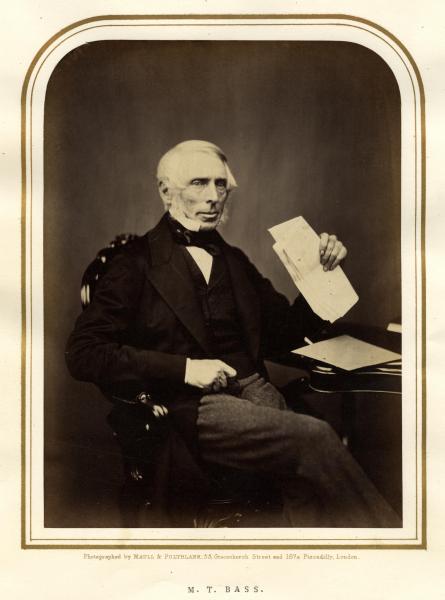
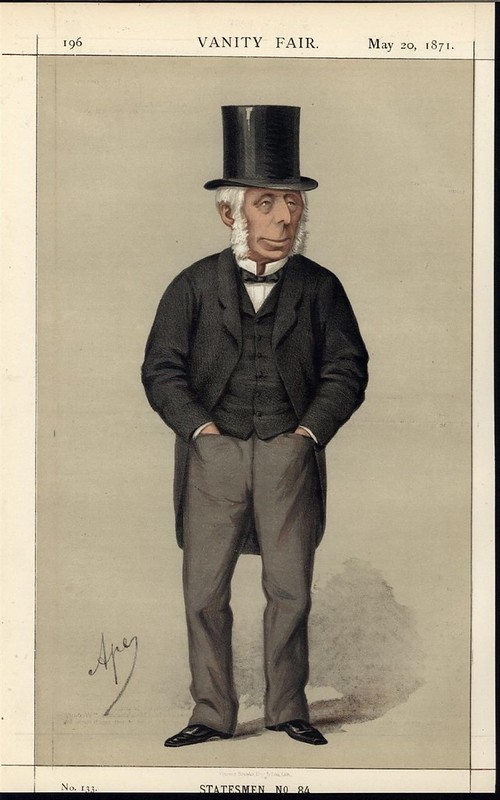
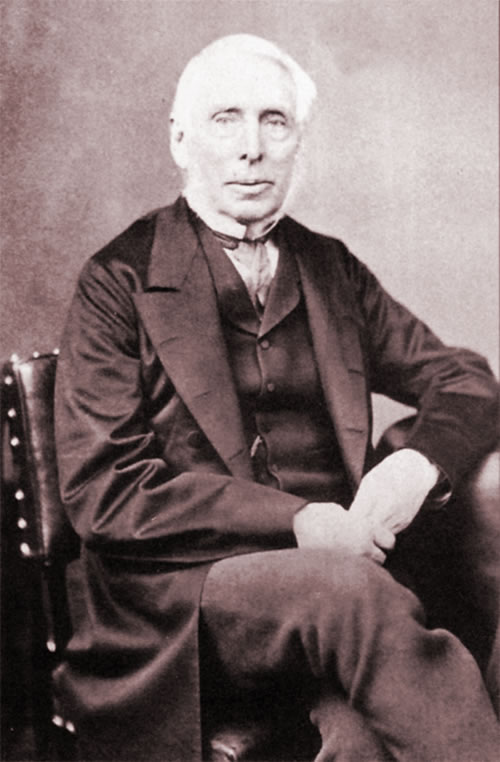
Today is the birthday of Michael Thomas Bass (July 6, 1799-April 29, 1884). He was the grandson of Bass Brewery founder William Bass. Michael Thomas Bass Jr. took over control of the company in 1827, and “under his leadership, the Bass Brewery became the largest brewery in the world and the best known brand of beer in England.” Bass was also a member of parliament, representing Derby “in the House of Commons as a member of the Liberal Party between 1848 and 1883 where he was an effective advocate for the brewing industry.”
Bass was born in Burton upon Trent in 1799, the son of Michael Thomas Bass (senior) who had expanded the Bass brewery founded by his father William Bass in 1777 and made it a major exporter to Russia. His mother, Sarah Hoskins, was the daughter of Abraham Hoskins, a prominent lawyer of Burton.
Bass attended the grammar school in Burton upon Trent and finished his schooling in Nottingham. At the age of 18, he joined the family business as an apprentice when business was not going well because the Napoleonic Wars had disrupted trade with Russia. However, the sales of India Pale Ale in India and southeast Asia were taking off by the 1820s.
Bass took over control of the company in 1827 and continued the export focus on Asia. By 1832-33, the company was exporting 5,000 barrels of beer representing 40% of its output in that year
The coming of the railway to Burton upon Trent in 1839 helped the growth of the business by reducing transport costs. The company had four agents in the 1830s in London, Liverpool, Stoke-on-Trent and Birmingham. By the 1880s, this had grown to 21 in the United Kingdom and another in Paris. The export trade was supplied by the agencies in London and Liverpool.
Under Bass’s leadership, company production and sales had grown enormously. Production of ale had grown to 340,000 barrels in 1860 and to almost a million barrels in the late 1870s. By 1881, the company had three breweries and 26 malthouses covering 145 acres (0.59 km2) in Burton upon Trent. The company was Britain’s biggest brewery and was one of its best known companies.
Bass was first elected as the member for Derby in 1848 and served until 1883. His obituary in the Brewers Journal stated that he was known more “in the House of Commons for his regular attendance than for any feats of oratory.” He focussed on being a national advocate for the brewing industry against efforts by nonconformists within the Liberal Party to legislate against alcohol.
Bass was an orthodox Liberal supporting free trade, low taxes and improving living standards for the working class. He promoted legislation to abolish imprisonment for small debtors. His legislation against organ grinders on the grounds that they were street nuisances was less successful.
He was known as a philanthropist both in Burton upon Trent and Derby. His obituarists claimed that his contributions totalled £80,000 and that he had given Derby a new library, School of Art, recreation ground, and swimming baths.
Bass represented Derby until the final years of his life. William Ewart Gladstone offered Bass a peerage which he declined preferring to stay in the House of Commons.
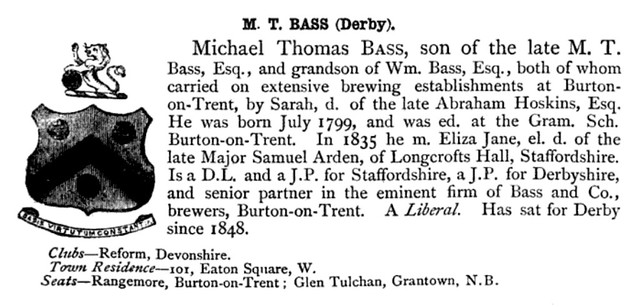
And here’s his entry from Debrett’s House of Commons and the Judicial Bench, published in 1882:
BASS, MICHAEL THOMAS (1799–1884), brewer, was born on 6 July 1799. He was the son of M. T. Bass and grandson of William Bass, both of whom carried on extensive brewing establishments at Burton-on-Trent.
Bass was educated first at the grammar school, Burton-on-Trent, and afterwards at Nottingham. On leaving school he joined his father in business and acted as a traveller. The opening up of the Trent and Mersey Canal gave the first great impetus to the trade of the Burton breweries, and the firm of Messrs. Bass did not fail to utilise this and other developments of modern enterprise.
Bass’s first official connection with the county of Derby was as an officer in the old Derbyshire yeomanry cavalry, in which capacity he assisted in quelling the local riots which occurred before the passing of the Reform Bill of 1832. He speedily acquired an important position in the county, partly from the extensive ramifications of his business, and partly from the interest he took in public affairs, and in 1848 he was requested to come forward as a candidate for Derby in the liberal interest. The sitting members had been unseated for bribery, and in the election which followed Bass was returned at the head of the poll. For the borough of Derby he continued to sit uninterruptedly until his retirement in 1883. Bass was a liberal. He was assiduous in the attention he gave to his parliamentary duties, but was not a frequent speaker.
His personal character gained him the esteem of opponents and friends. He exhibited a lively concern in all questions bearing upon the welfare of the working classes, and in 1866 he requested Professor Leone Levi to institute a wide and methodical inquiry into the earnings of the working classes throughout the kingdom. Bass brought in a bill by which householders might require street musicians to quit the neighbourhood of their houses. A letter of thanks was j addressed to him by a number of the most distinguished authors and artists in London, including Carlyle, Tennyson, Charles Dickens, J. E. Millais, Francis Grant (president of the Royal Academy), and others. Bass also took an active part in abolishing imprisonment for debt, but his popularity at Derby suffered a temporary check by reason of his opposition to the Ground Game Act. The constituency, however, never swerved from its allegiance, although between the time when he was first elected and the last occasion when he was returned to parliament the number of electors had increased tenfold.
An interesting statement, compiled under authority, shows that the foundation of the business of the Burton breweries was laid in 1777 by one William Bass. Fifty years later Bass & Co. still confined their trade in bitter beer to India. In 1827 they began to open up a trade in this country, but no great strides were made until the year (1851) of the Great Exhibition. From this date their reputation began to spread over the metropolis and throughout England. In 1880 the firm did as much business in three days as it was accustomed to do in twelve months fifty years before. It appears that in the year 1878 they paid for carriage alone to the railway and canal companies and other carriers the sum of 180,102l. Messrs. Bass’s ale stores near St. Pancras Station cover three floors, each two acres in extent, and each containing 30,000 barrels of 36 gallons of ale. The firm possess other extensive stores, as well as the breweries at Burton, which are of enormous extent and employ a staff of three thousand persons. In 1882 the average annual amount of the business was assessed at 2,400,000l., and the yearly amount paid in malt-tax and license duty was 286,000l. A calculation made in 1871 demonstrated that the yearly revenue derived from beer and British and foreign wines and spirits amounted to about twenty-eight millions sterling, being more than a third of the whole revenue, and towards this amount Messrs. Bass contributed upwards of 780l. per day.’ A further compilation showed that ‘the stock of casks necessary to carry on the business consisted of 46,901 butts, 159,608 hogsheads, 139,753 barrels, and 197,597 kilderkins, or in all 543,859 casks. The yearly issue of Bass’s labels amounts to more than one hundred millions.’
When the agitation arose amongst railway servants in 1870 for a reduction in their oppressive hours of labour, Bass was their most powerful friend. By his instrumentality an agent was despatched throughout the country to gather information and organise plans for relieving the condition of railway servants and removing the grounds of their complaints. The facts made known led to the establishment of the Railway Servants’ Orphanage at Derby.
The new church of St. Paul’s, at Burton, was built and endowed by Bass. He also raised a smaller church near his residence, Rangemore, a chapel-of-ease, Sunday schools, and an institute and reading-rooms for the use of the working classes of Burton. The entire cost of his benefactions to St. Paul’s parish in that town has been placed at not less than 100,000l. In addition to this, and to private charities almost innumerable, he presented the town of Derby with a large recreation ground and public swimming baths, at a cost of 12,000l., as well as a free library involving an outlay of 25,000l., and an art gallery upon which many thousands of pounds were expended.
Bass died at Rangemore Hall on 29 April 1884. He was extremely simple in his tastes and habits. He refused all offers of social distinction, declining a baronetcy and a peerage which were offered him by successive governments. As a mark of the general esteem, however, in which he was held, a baronetcy was conferred (during his own lifetime) upon his eldest son, Sir Michael Arthur Bass, M.P. for East Staffordshire.
Last year I decided to concentrate on Bock ads. Bock, of course, may have originated in Germany, in the town of Einbeck. Because many 19th century American breweries were founded by German immigrants, they offered a bock at certain times of the year, be it Spring, Easter, Lent, Christmas, or what have you. In a sense they were some of the first seasonal beers. “The style was later adopted in Bavaria by Munich brewers in the 17th century. Due to their Bavarian accent, citizens of Munich pronounced ‘Einbeck’ as ‘ein Bock’ (a billy goat), and thus the beer became known as ‘Bock.’ A goat often appears on bottle labels.” And presumably because they were special releases, many breweries went all out promoting them with beautiful artwork on posters and other advertising.
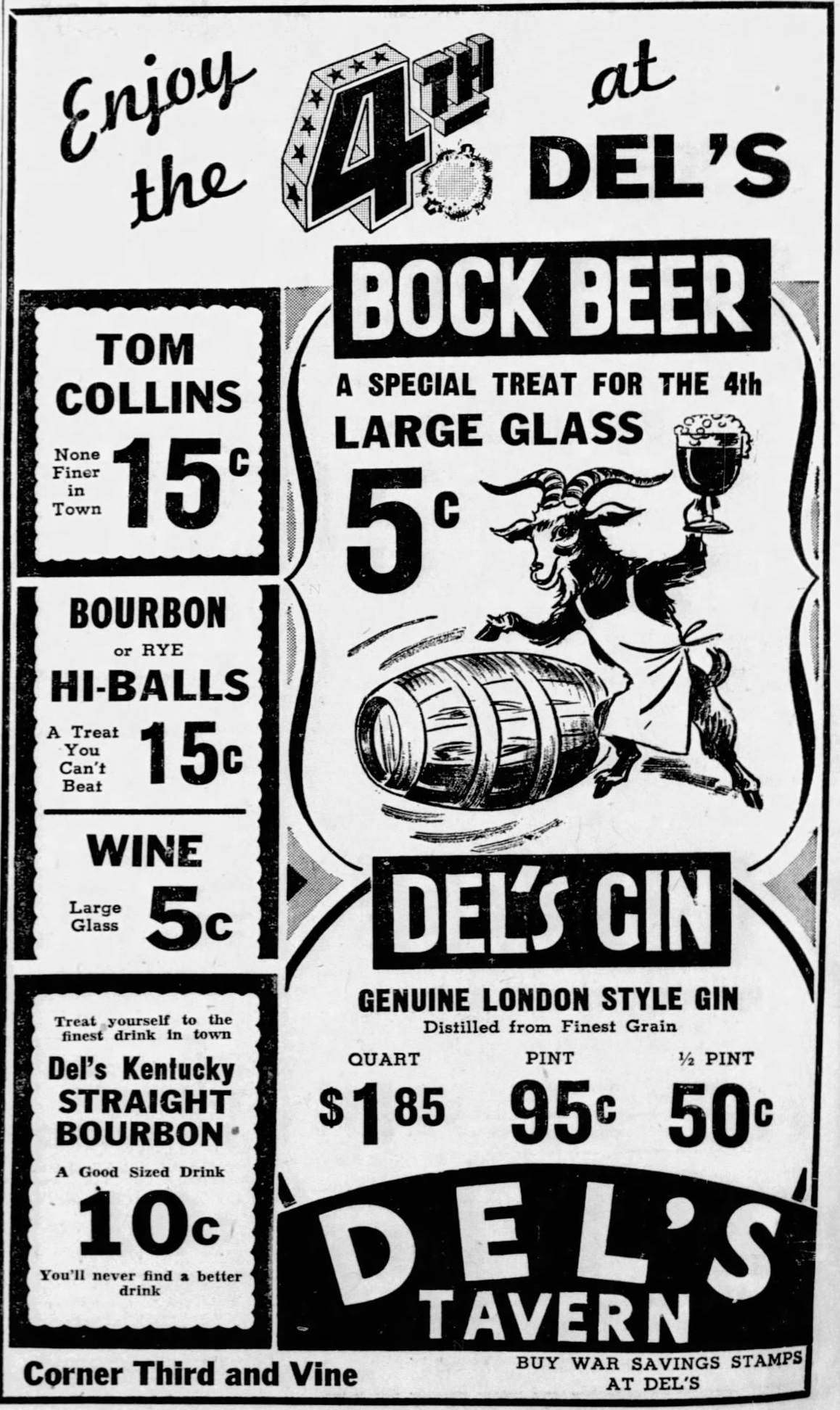
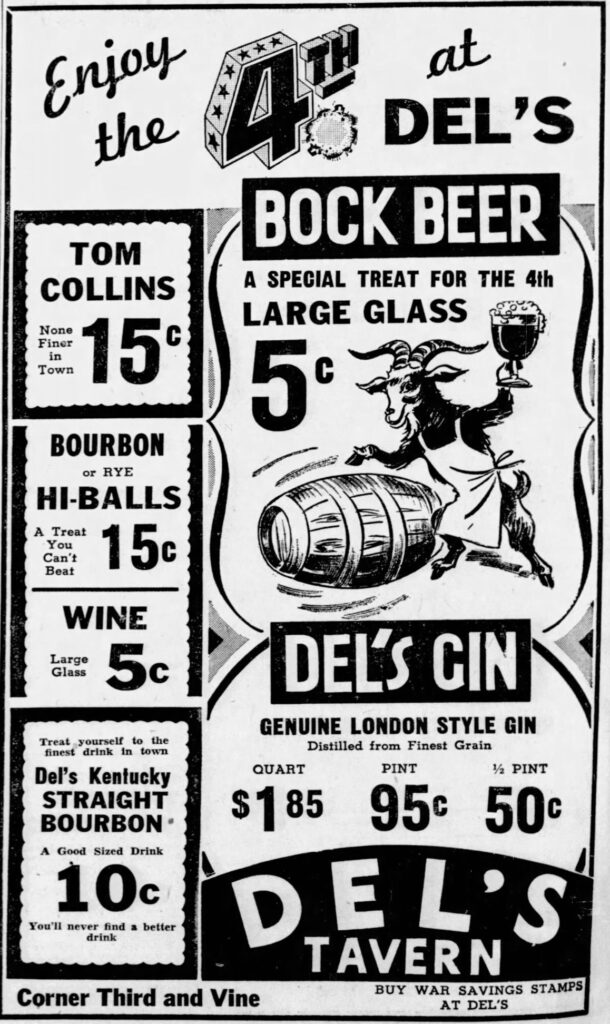
Saturday’s ad is for Bock Beer at Del’s Tavern, which was published in July 1942. This one was for an unnamed bock, though itvwas probably a local one. The iconic La Crosse bar was originally founded in 1933. This ad ran in The La Crosse Tribune, also of La Crosse, Wisconsin.
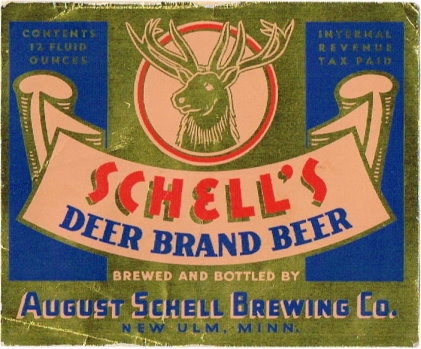
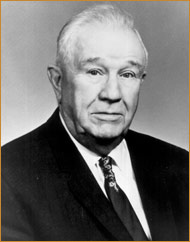
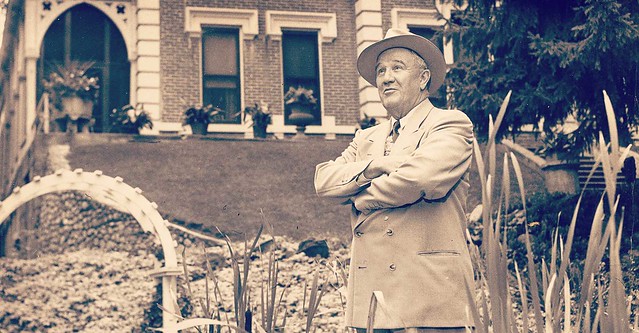
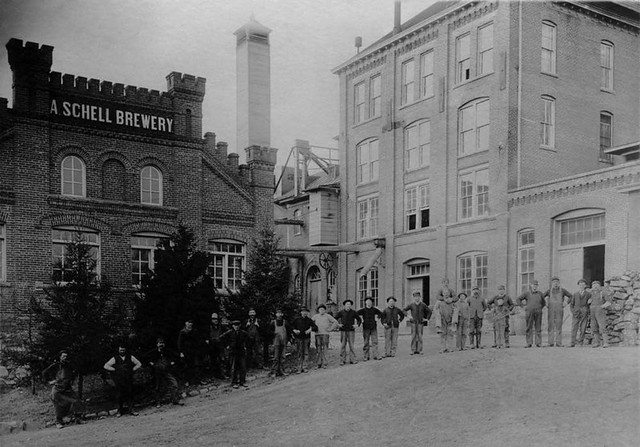
Today is the birthday of Alfred W. Marti (July 5, 1886-November 22, 1977). He was born in Saint Paul, Minnesota, and was the son of George Marti and Emma Schell, whose father founded August Schell started the Schell’s Brewery in 1860 in New Ulm, Minnesota. Schell’s Brewery is still in business today, and is still owned by the family who started it. “It is the second oldest family-owned brewery in America (after D. G. Yuengling & Son) and became the oldest and largest brewery in Minnesota when the company bought the Grain Belt rights in 2002.” A pharmacist by trade, when August’s son Otto, who had been running the brewery after his father died, also died suddenly in 1911, George stepped up and became the manager and president of the brewery. He thought it would be temporary, but he remained at the brewery for the rest of his life, and in 1934 when he passed away, his son Alfred took over for him. He remained in charge of the brewery until 1969, when his son Warren took over for him.
This account of the Schell Brewery under Alfred Marti is from the “Land of Amber Waters: The History of Brewing in Minnesota,” by Doug Hoverson:
This portion of a history of the August Schell Brewery, from Funding Universe, mentions Alfred Marti and his role in the company:
The next generation, represented by Alfred Marti, took over brewery management in 1934 after George Marti passed away. The younger Marti added entertainment to the brewery’s local allure by establishing the Schell’s Hobo Band, which still performs in the community today. In 1969, Alfred Marti retired, passing on leadership to his son Warren.
Last year I decided to concentrate on Bock ads. Bock, of course, may have originated in Germany, in the town of Einbeck. Because many 19th century American breweries were founded by German immigrants, they offered a bock at certain times of the year, be it Spring, Easter, Lent, Christmas, or what have you. In a sense they were some of the first seasonal beers. “The style was later adopted in Bavaria by Munich brewers in the 17th century. Due to their Bavarian accent, citizens of Munich pronounced ‘Einbeck’ as ‘ein Bock’ (a billy goat), and thus the beer became known as ‘Bock.’ A goat often appears on bottle labels.” And presumably because they were special releases, many breweries went all out promoting them with beautiful artwork on posters and other advertising.
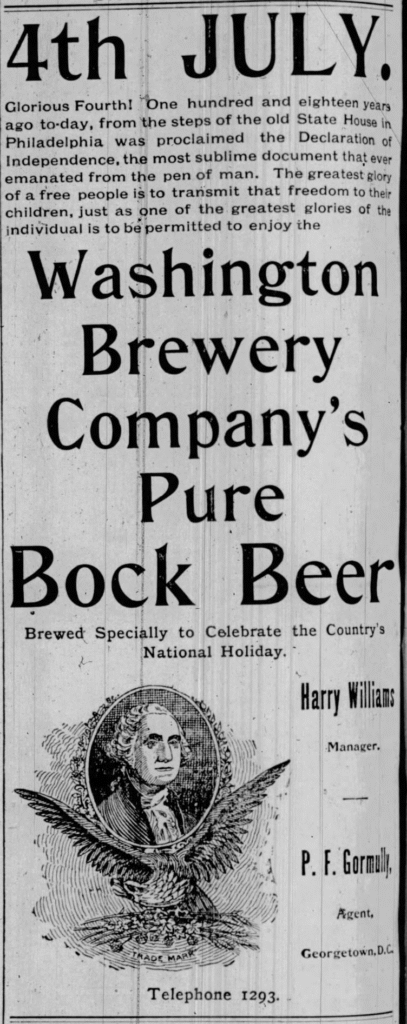
Friday’s ad is for Washington Brewery’s Pure Bock Beer, which was published on July 4, 1894. This one was for the Washington Brewery Co. of Washington, D.C., which was originally founded in 1857. This ad ran in The Washington Post, also of Washington, D.C.