He “was a German-American poet, novelist, and short story writer. His writing was influenced by the social, cultural, and economic ambience of his adopted home city of Los Angeles. Bukowski’s work addresses the ordinary lives of poor Americans, the act of writing, alcohol, relationships with women, and the drudgery of work. The FBI kept a file on him as a result of his column Notes of a Dirty Old Man in the LA underground newspaper Open City.
Bukowski published extensively in small literary magazines and with small presses beginning in the early 1940s and continuing on through the early 1990s. He wrote thousands of poems, hundreds of short stories and six novels, eventually publishing over sixty books during the course of his career. Some of these works include his Poems Written Before Jumping Out of an 8 Story Window, published by his friend and fellow poet Charles Potts, and better-known works such as Burning in Water, Drowning in Flame. These poems and stories were later republished by John Martin’s Black Sparrow Press (now HarperCollins/Ecco Press) as collected volumes of his work. As noted by one reviewer, “Bukowski continued to be, thanks to his antics and deliberate clownish performances, the king of the underground and the epitome of the littles in the ensuing decades, stressing his loyalty to those small press editors who had first championed his work and consolidating his presence in new ventures such as the New York Quarterly, Chiron Review, or Slipstream.”
In 1986, Time called Bukowski a “laureate of American lowlife”. Regarding his enduring popular appeal, Adam Kirsch of The New Yorker wrote, “the secret of Bukowski’s appeal … [is that] he combines the confessional poet’s promise of intimacy with the larger-than-life aplomb of a pulp-fiction hero.”
During his lifetime, Bukowski received little attention from academic critics in the United States, but was better received in Europe, particularly the UK, and especially Germany, where he was born. Since his death in March 1994, Bukowski has been the subject of a number of critical articles and books about both his life and writings.
He wrote about his drinking quite a bit in poems, short stories and in legend. Below is one of his more memorable quotes:
But that’s just the tip of the iceberg, so to speak. Drinking was a favorite topic of Bukowski and his writings on the subject were collected into a single volume entitled “Charles Bukowski On Drinking” in 2019. Here’s a few gems from that volume:
From “Charles Bukowski Answers 10 Easy Questions”
“Question: What would you say is the best brand of American beer on the market today?
Bukowski: Well, that’s a bit difficult. Miller’s is the easiest on my system but each new batch of Miller’s seems to taste a bit worse. Something is going on there that I don’t like. I seem to be gradually going over to Schlitz. And I prefer beer in the bottle. Beer in the can definitely gives off a metallic taste. Cans are for the convenience of storekeepers and breweries. Whenever I see a man drinking out of a can I think, “now there is a damn fool.” Also, bottled beer should be in a brown bottle. Miller again errs in putting the stuff into a white bottle. Beer should be protected both from metal and from light.
Of course, if you have the money, it’s best to go up the scale and get the more expensive beers, imported or better-made American. Instead of a dollar 35 you have to go a dollar 75 or 2 and quarter and up. The taste is immediately noticeable. And you can drink more with less hangover. Most ordinary American beer is almost poison, especially the stuff that comes out of the spigots at racetracks. This beer actually stinks, I mean, to the nose. If you must buy a beer at the racetrack it is best to let it sit for 5 minutes before drinking it. There is something about the oxygen getting in there that removes some of the stink. The stuff is simply green.
Beer was much better before World War 2. It had tang and was filled with sharp little bubbles. It’s wash now, strictly flat. You just do the best you can with it.
Beer is better to write with and talk with than whiskey. You can go longer and make more sense. Of course, much depends upon the talker and the writer. But beer is fattening, plenty, and it lessens the sex drive, I mean, both the day you are drinking it and the day after. Heavy drinking and heavy loving seldom go hand in hand after the age of 35. I’d say a good chilled wine is the best way out and it should be drank slowly after a meal, with just perhaps a small glass before eating.
Heavy drinking is a substitute for companionship and it’s a substitute for suicide. It’s a secondary way of life. I dislike drunks but I do suppose I take a little drink now and then myself. Amen.”
brewed and filled by … (1964)
“everything in my beercan hand is sad, the dirt is even sad under my fingernails, and this hand is like the hand of a machine and yet it is not— it curves itself completely (an effort containing magic) around the beercan in a movement the same as roots pounding a gladiola up into the sun of air, and the beer goes into me.”
beerbottle (1974)
“a very miraculous thing just happened: my beerbottle flipped over backwards and landed on its bottom on the floor, and I have set it upon the table to foam down, but the photos were not so lucky today and there is a small slit along the leather of my left shoe, but it’s all very simple: we cannot acquire too much: there are laws we know nothing of, all manner of nudges set us to burning or freezing; what sets the blackbird in the cat’s mouth is not for us to say, or why some men are jailed like pet squirrels while others nuzzle in enormous breasts through endless nights—this is the task and the terror, and we are not taught why. still, it’s lucky the bottle landed straightside up, and although I have one of wine and one of whiskey, this forsooths, somehow, a good night, and perhaps tomorrow my nose will be longer: new shoes, less rain, more poems.”
The Bukowski Tapes (1985)
“I think a man can keep on drinking for centuries, he’ll never die; especially wine and beer . . . I like drunkards, because drunkards, they come out of it, and they’re sick and they spring back, they spring back and forth . . . If you gotta be anything, be an alcoholic. If I hadn’t been a drunkard, I probably would have committed suicide long ago. You know, working the factories, the eight hour job. The slums. The streets. You work a god damn lousy job. You come home at night, you’re tired. What are you gonna do, go to a movie? Turn on your radio in a three dollar a week room? Or are you gonna rest up and wait for the job the next day, for $1.75 an hour? Hell, no! You’re gonna get a bottle of whiskey and drink it. And go down to a bar and maybe get in a fist fight. And meet some bitch, something’s going on. Then you go to work the next day, and do your simple little things, right? . . . Alcohol gives you the release of the dream without the deadness of drugs. You can come back down. You have your hangover to face. That’s the tough part. You get over it, you do your job. You come back. You drink again. I’m all for alcohol. It’s the thing.”
beer (1976)
“I don’t know how many bottles of beer I have drunk while waiting for things to get better. I don’t know how much wine and whiskey and beer mostly beer I have drunk after splits with women— waiting for the phone to ring waiting for the sound of footsteps, and the phone never rings until much later and the footsteps never arrive until much later when my stomach is coming up out of my mouth they arrive as fresh as spring flowers: ‘what the hell have you done to yourself? it will be 3 days before you can fuck me!’
the female is durable she lives seven and one half years longer than a man, and she drinks very little beer because she knows it’s bad for the figure.
while we are going mad they are out dancing and laughing with horny cowboys.
well, there’s beer sacks and sacks of empty beer bottles and when you pick them up the bottles fall through the wet bottom of the paper sacks rolling clanking spilling grey wet ash and stale beer, or the sacks fall over at 4 A.M. in the morning making the only sound in your life.
beer rivers and seas of beer beer beer beer the radio singing love songs as the phone remains silent and the walls stand straight up and down the beer is all there is.”
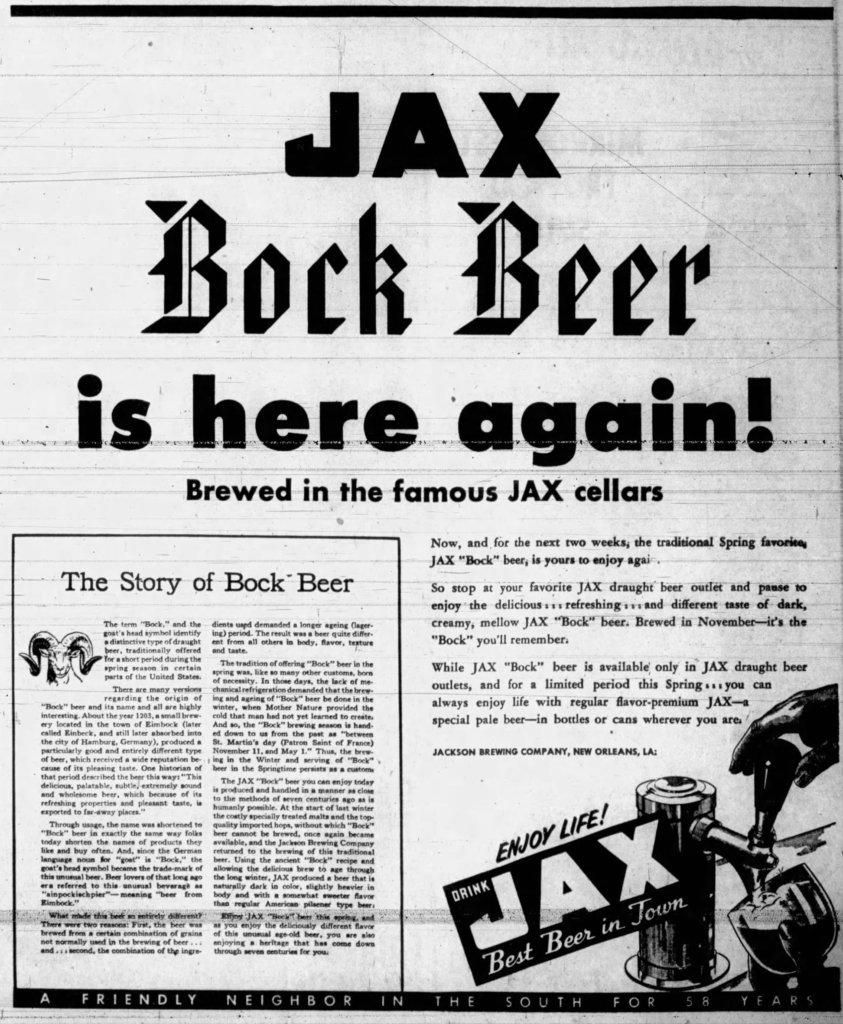
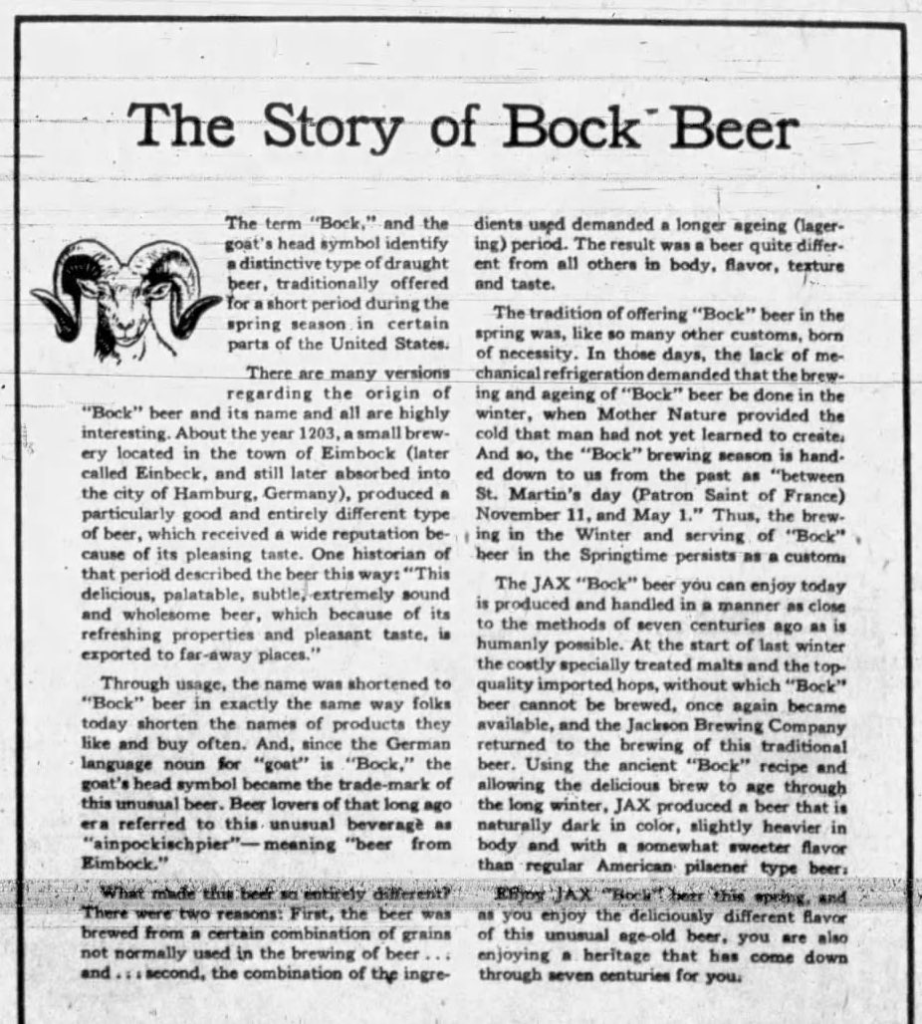
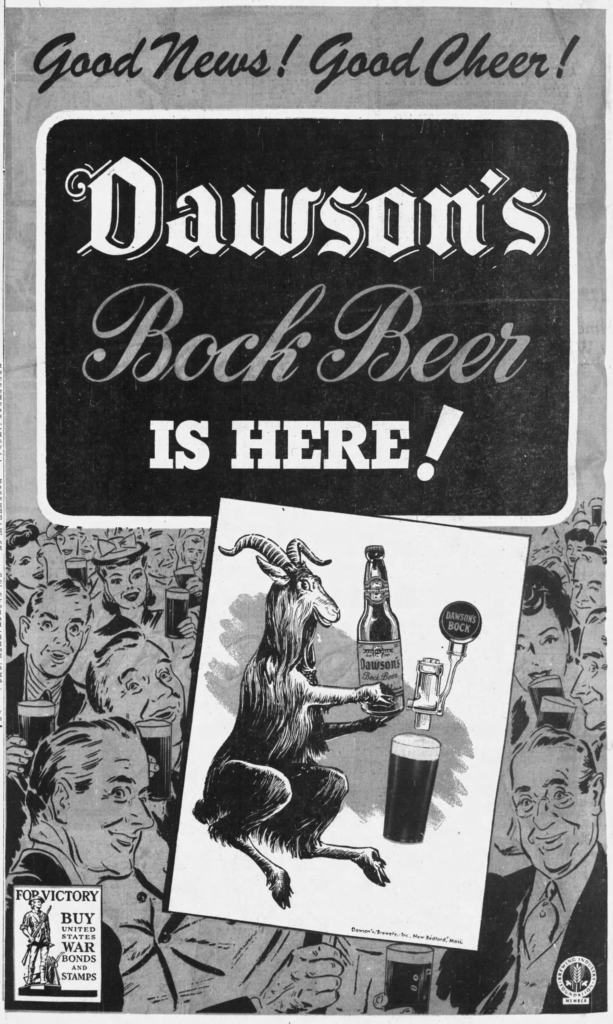
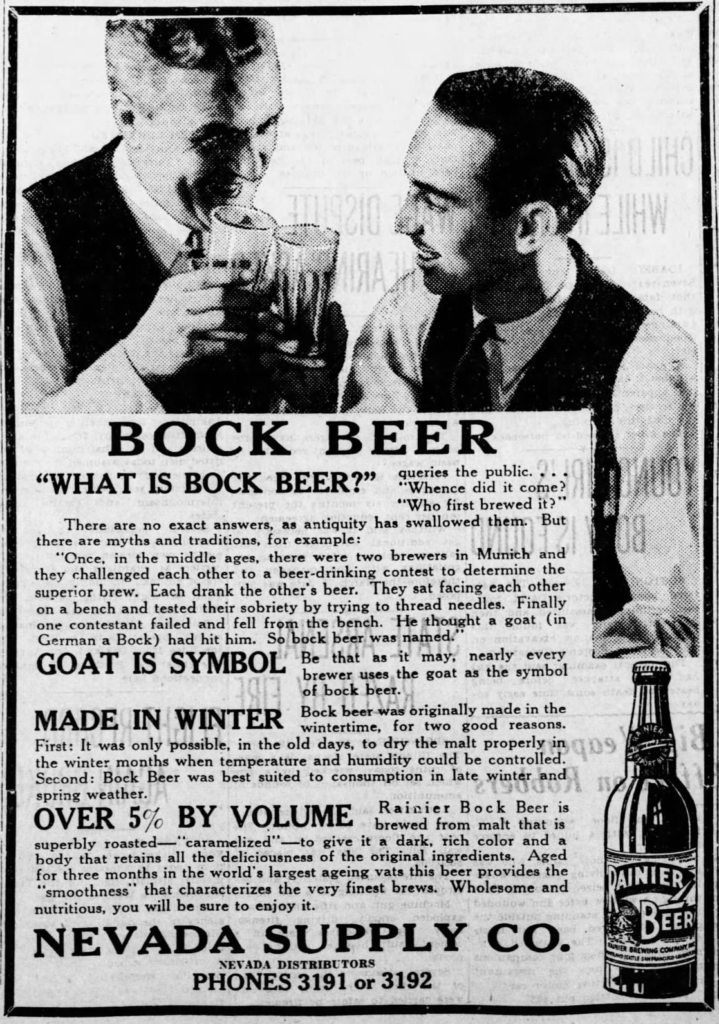
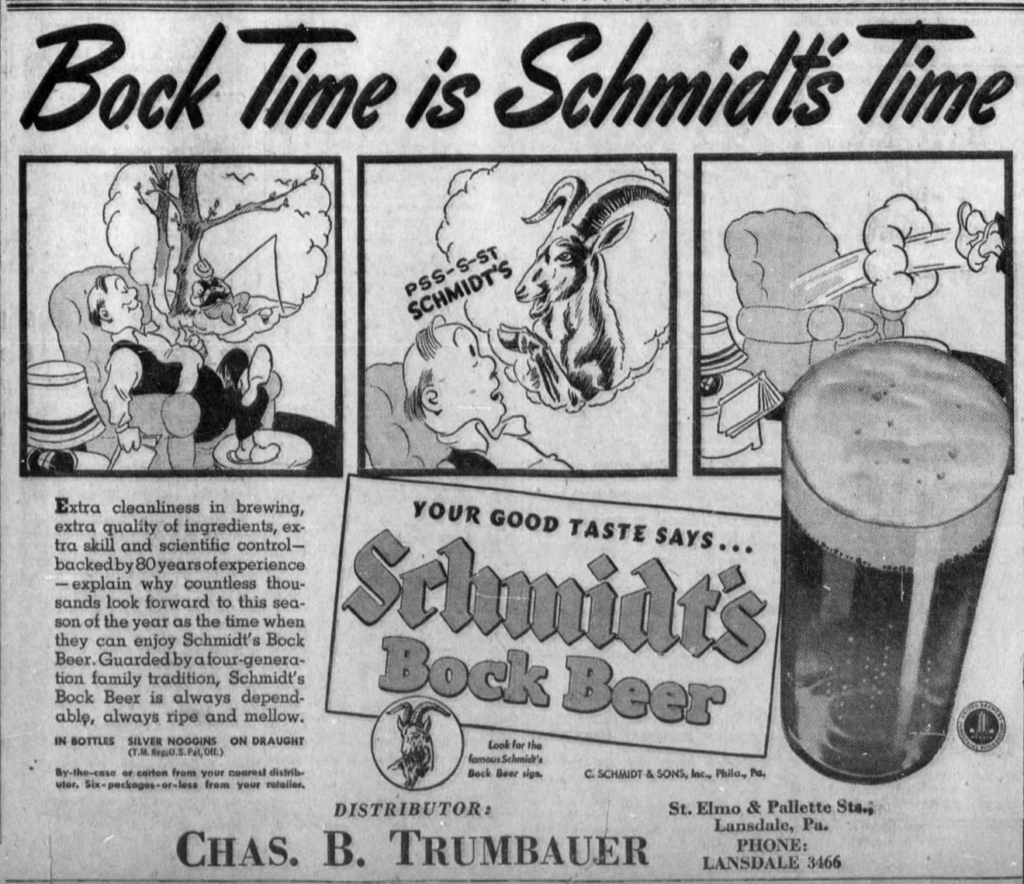
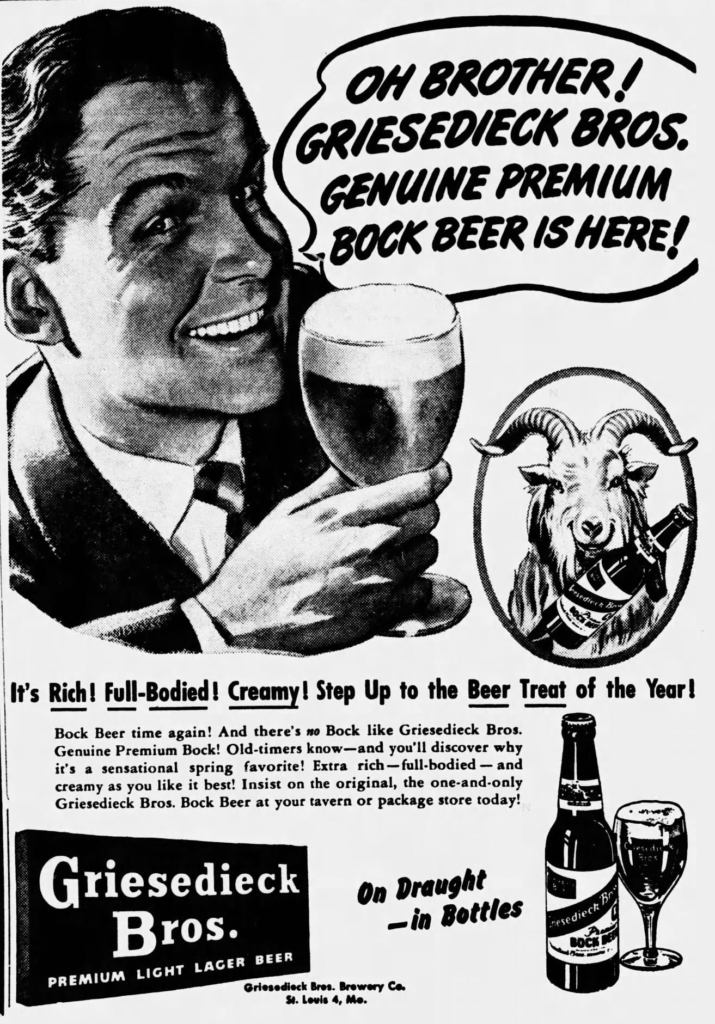
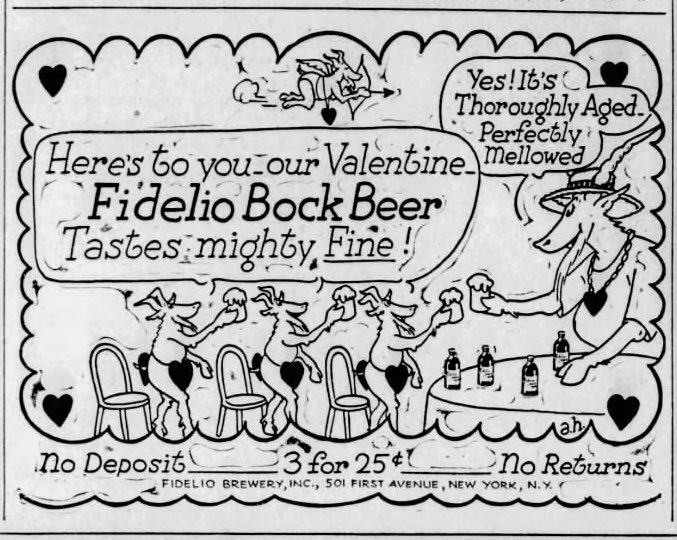
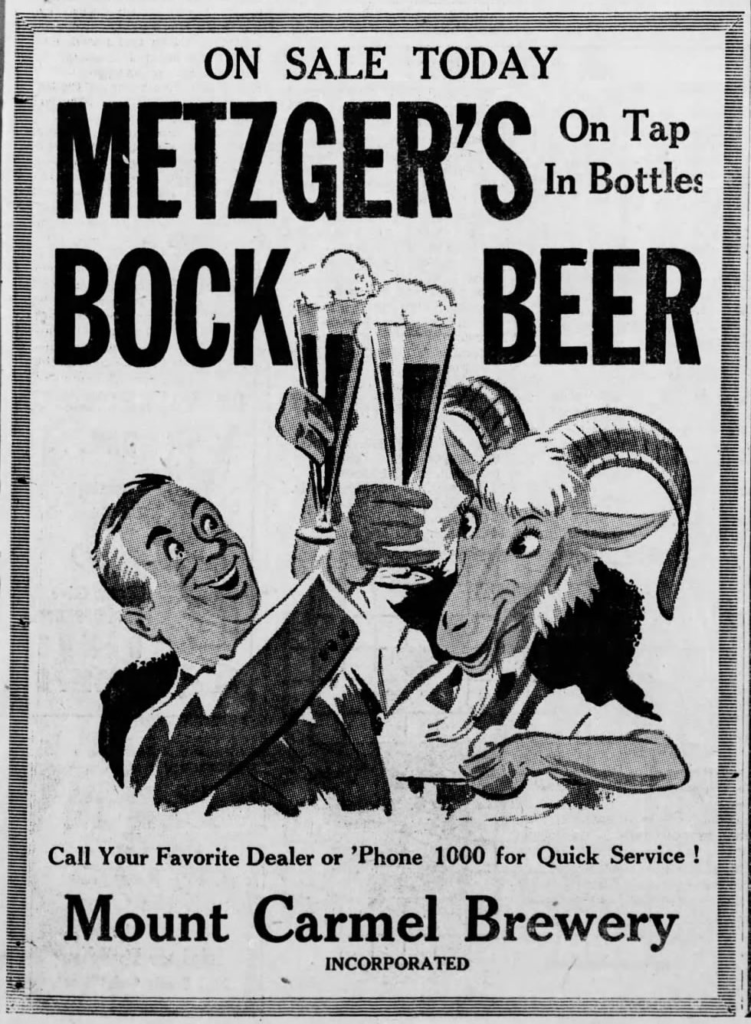
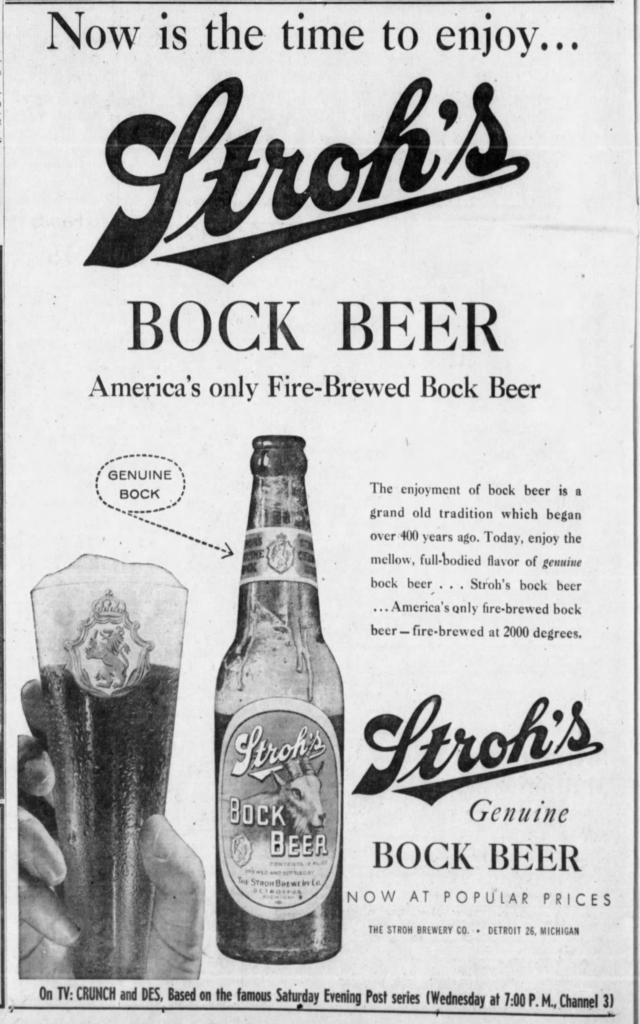
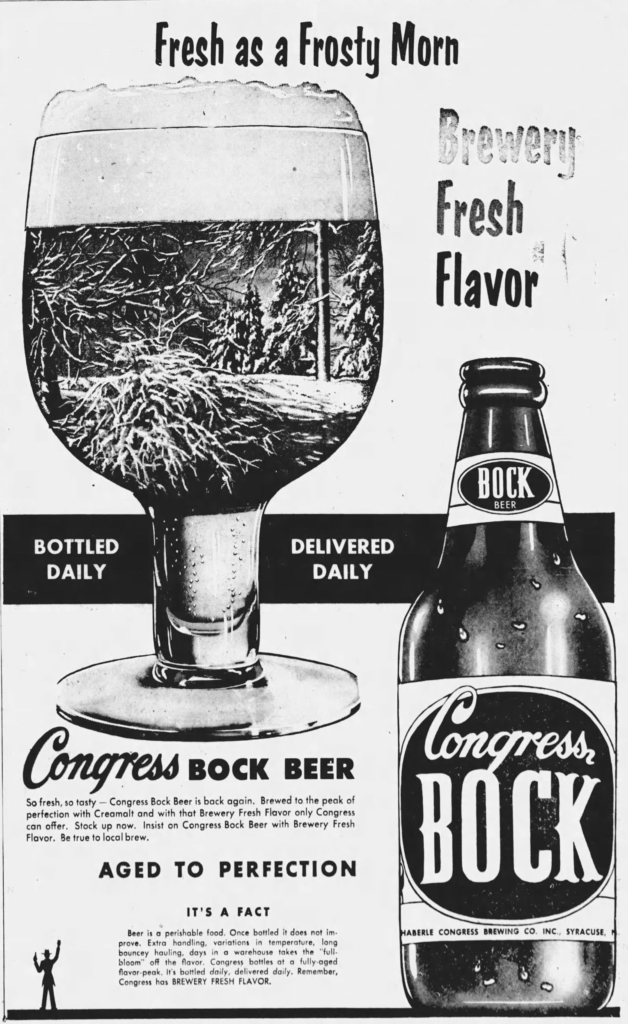
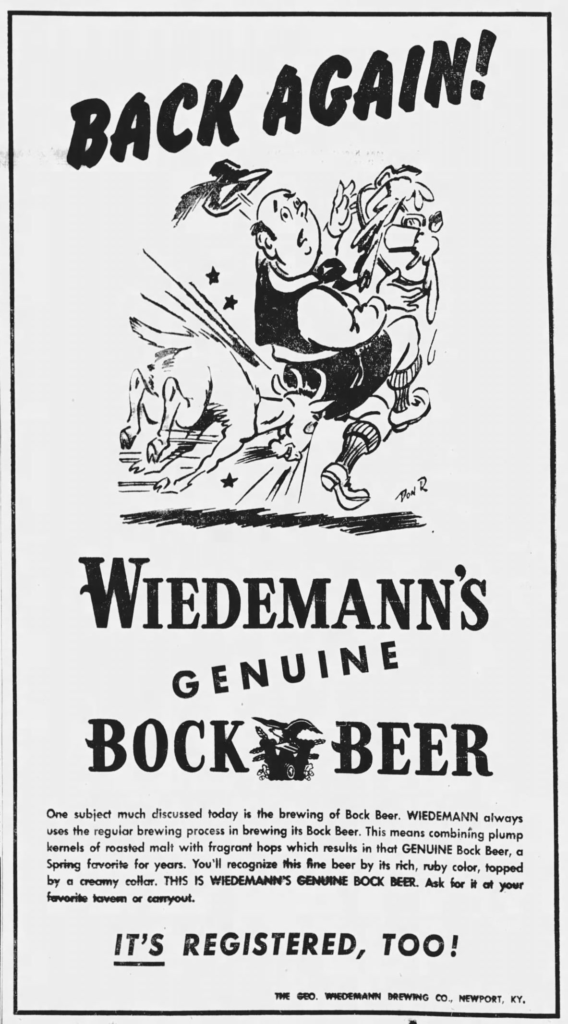
Last year I decided to concentrate on Bock ads. Bock, of course, may have originated in Germany, in the town of Einbeck. Because many 19th century American breweries were founded by German immigrants, they offered a bock at certain times of the year, be it Spring, Easter, Lent, Christmas, or what have you. In a sense they were some of the first seasonal beers. “The style was later adopted in Bavaria by Munich brewers in the 17th century. Due to their Bavarian accent, citizens of Munich pronounced ‘Einbeck’ as ‘ein Bock’ (a billy goat), and thus the beer became known as ‘Bock.’ A goat often appears on bottle labels.” And presumably because they were special releases, many breweries went all out promoting them with beautiful artwork on posters and other advertising.
Friday’s ad is not for a specific Bock Beer, but for an upcoming Bock Beer Festival at the Alpine Village Beer Garden, and was published on August 15, 1969. This one is for the Alpine Village in Torrance, California, which was originally founded in 1968. They had Bavarian Dances every weekend, but the Bock Beer Festival took place on august 17. Unfortunately, it closed during Covid, but has recently been designated as culturally significant and saved from demolition. This ad for the event ran in The Daily Breeze, of Hermosa Beach, California.
Last year I decided to concentrate on Bock ads. Bock, of course, may have originated in Germany, in the town of Einbeck. Because many 19th century American breweries were founded by German immigrants, they offered a bock at certain times of the year, be it Spring, Easter, Lent, Christmas, or what have you. In a sense they were some of the first seasonal beers. “The style was later adopted in Bavaria by Munich brewers in the 17th century. Due to their Bavarian accent, citizens of Munich pronounced ‘Einbeck’ as ‘ein Bock’ (a billy goat), and thus the beer became known as ‘Bock.’ A goat often appears on bottle labels.” And presumably because they were special releases, many breweries went all out promoting them with beautiful artwork on posters and other advertising.
Thursday’s ad is for Stiegl Golden Bock Beer, which was published on August 14, 1982. This one is for the Stiegl Brauerei of Salzburg, Austria, which was originally founded in 1492. This ad for the imported beer ran in The Chicago Tribune, of Chicago, Illinois.
Last year I decided to concentrate on Bock ads. Bock, of course, may have originated in Germany, in the town of Einbeck. Because many 19th century American breweries were founded by German immigrants, they offered a bock at certain times of the year, be it Spring, Easter, Lent, Christmas, or what have you. In a sense they were some of the first seasonal beers. “The style was later adopted in Bavaria by Munich brewers in the 17th century. Due to their Bavarian accent, citizens of Munich pronounced ‘Einbeck’ as ‘ein Bock’ (a billy goat), and thus the beer became known as ‘Bock.’ A goat often appears on bottle labels.” And presumably because they were special releases, many breweries went all out promoting them with beautiful artwork on posters and other advertising.
Wednesday’s ad is for New South Bock Beer, which was published on August 13, 1914. This one is for the New South Brewery & Ice Co. of Middlesboro, Kentucky, which was originally founded in 1891. They also had a second brewery located in Atlanta, Georgia, which is undoubtedly why this ad ran in The Atlanta Journal, also of Atlanta, Georgia.
Last year I decided to concentrate on Bock ads. Bock, of course, may have originated in Germany, in the town of Einbeck. Because many 19th century American breweries were founded by German immigrants, they offered a bock at certain times of the year, be it Spring, Easter, Lent, Christmas, or what have you. In a sense they were some of the first seasonal beers. “The style was later adopted in Bavaria by Munich brewers in the 17th century. Due to their Bavarian accent, citizens of Munich pronounced ‘Einbeck’ as ‘ein Bock’ (a billy goat), and thus the beer became known as ‘Bock.’ A goat often appears on bottle labels.” And presumably because they were special releases, many breweries went all out promoting them with beautiful artwork on posters and other advertising.
Tuesday’s ad is for Dobler Bock Beer, which was published on August 12, 1953. This one is for the Dobler Brewing Co. of Albany, New York, which was originally founded in 1865. It’s les for their bock specifically but an advertorial for the 20th anniversary of the brewery bottling their beer, which includes Private Seal Beer, Dobler 1865 Special, Dobler Pale Ale, along with the Bock Beer. This one ran in The Troy Record, of Troy, New York.
Last year I decided to concentrate on Bock ads. Bock, of course, may have originated in Germany, in the town of Einbeck. Because many 19th century American breweries were founded by German immigrants, they offered a bock at certain times of the year, be it Spring, Easter, Lent, Christmas, or what have you. In a sense they were some of the first seasonal beers. “The style was later adopted in Bavaria by Munich brewers in the 17th century. Due to their Bavarian accent, citizens of Munich pronounced ‘Einbeck’ as ‘ein Bock’ (a billy goat), and thus the beer became known as ‘Bock.’ A goat often appears on bottle labels.” And presumably because they were special releases, many breweries went all out promoting them with beautiful artwork on posters and other advertising.
Monday’s ad is for Gambrinus Bock Beer, which was published on August 11, 1913. This one is for the Gambrinus Brewing Co. of Portland, Oregon, which was originally founded in 1875. This ad ran in The Oregon Labor Press, now known as the NW Labor Press, and is written for the members of over three dozen local unions in Oregon and Southwest Washington.
Despite this being an ad for Gambrinus Bock Beer, there were some more ads right next to the Bock ad that were interesting, too. First, there’s an ad for the International Union of the United Brewery Workmen of America. Then, below that, there’s another ad for the Bartenders International League of America (now known as the Hotel Employees and Restaurant Employees Union), that also shows a pin for bartender union members to wear at work.
Last year I decided to concentrate on Bock ads. Bock, of course, may have originated in Germany, in the town of Einbeck. Because many 19th century American breweries were founded by German immigrants, they offered a bock at certain times of the year, be it Spring, Easter, Lent, Christmas, or what have you. In a sense they were some of the first seasonal beers. “The style was later adopted in Bavaria by Munich brewers in the 17th century. Due to their Bavarian accent, citizens of Munich pronounced ‘Einbeck’ as ‘ein Bock’ (a billy goat), and thus the beer became known as ‘Bock.’ A goat often appears on bottle labels.” And presumably because they were special releases, many breweries went all out promoting them with beautiful artwork on posters and other advertising.
Sunday’s ad is for Fox De Luxe Bock Beer, which was published on August 10, 1951, though strictly speaking it was for a liquor store called LaCorte’s Park-In Liquors, located at 552-56 State Line St., in Calumet City, Illinois. [I checked, it appears to be the site of a Wendy’s today.] The ad was actually advertising a variety of alcohol, some twelve different products, but I cut them all out except the one bock beer and its neighbor. The bock is from the Peter Fox Brewing Co. of Chicago, Illinois, which was originally founded in 1896 as the Hoffman Bros. This ad ran in The Hammond Times, an afternoon paper serving Hammond, Whiting, and East Chicago, Indiana, though now is headquartered in Munster, and it just a few miles (less than 4) from the liquor store.
Last year I decided to concentrate on Bock ads. Bock, of course, may have originated in Germany, in the town of Einbeck. Because many 19th century American breweries were founded by German immigrants, they offered a bock at certain times of the year, be it Spring, Easter, Lent, Christmas, or what have you. In a sense they were some of the first seasonal beers. “The style was later adopted in Bavaria by Munich brewers in the 17th century. Due to their Bavarian accent, citizens of Munich pronounced ‘Einbeck’ as ‘ein Bock’ (a billy goat), and thus the beer became known as ‘Bock.’ A goat often appears on bottle labels.” And presumably because they were special releases, many breweries went all out promoting them with beautiful artwork on posters and other advertising.
Tuesday’s poster is for Falken Schaffhauser’s Oster-Bock, and was published in 1931. This one was made for the Bierbrauerei Falken Schaffhausen, or Falcon Brewery, of Schaffhausen, Switzerland. The brewery was founded in 1799, and is still in business today, and is “considered the only independent brewery in the Schaffhausen region,” and is Switzerland’s 5th largest brewery. This one is for their Schaffhauser Oster-Bock (Easter Bock) and shows three musician playing around a small cask of beer, while a dog laps up the drippings from a bowl below the tap. It was created by Swiss artist Arnold Oechslin.
Last year I decided to concentrate on Bock ads. Bock, of course, may have originated in Germany, in the town of Einbeck. Because many 19th century American breweries were founded by German immigrants, they offered a bock at certain times of the year, be it Spring, Easter, Lent, Christmas, or what have you. In a sense they were some of the first seasonal beers. “The style was later adopted in Bavaria by Munich brewers in the 17th century. Due to their Bavarian accent, citizens of Munich pronounced ‘Einbeck’ as ‘ein Bock’ (a billy goat), and thus the beer became known as ‘Bock.’ A goat often appears on bottle labels.” And presumably because they were special releases, many breweries went all out promoting them with beautiful artwork on posters and other advertising.
Thursday’s ad is for Hornung’s White Bock Beer, which was published on August 7, 1936. This one was for the Jacob Hornung Brewing Co. of Philadelphia, Pennsylvania, which was originally founded in 1885. This ad ran in The Evening Sun, of Hanover, Pennsylvania.
Last year I decided to concentrate on Bock ads. Bock, of course, may have originated in Germany, in the town of Einbeck. Because many 19th century American breweries were founded by German immigrants, they offered a bock at certain times of the year, be it Spring, Easter, Lent, Christmas, or what have you. In a sense they were some of the first seasonal beers. “The style was later adopted in Bavaria by Munich brewers in the 17th century. Due to their Bavarian accent, citizens of Munich pronounced ‘Einbeck’ as ‘ein Bock’ (a billy goat), and thus the beer became known as ‘Bock.’ A goat often appears on bottle labels.” And presumably because they were special releases, many breweries went all out promoting them with beautiful artwork on posters and other advertising.
Tuesday’s poster is for Falken Schaffhauser’s Oster-Bock, and was published in 1930. This one was made for the Bierbrauerei Falken Schaffhausen, or Falcon Brewery, of Schaffhausen, Switzerland. The brewery was founded in 1799, and is still in business today, and is “considered the only independent brewery in the Schaffhausen region,” and is Switzerland’s 5th largest brewery. This one is for their Schaffhauser Weihnachts-Bock (Christmas Bock) and shows a snowman holding mug full of beer and a small Christmas tree. It was created by Swiss artist Arnold Oechslin.