
Tuesday’s ad is a 1920s ad for an Italian beer that’s still in business — Pedavena. Similar to yesterday’s French ad, this one also features a king carrying a beer. Is it Gambrinus? Who knows.
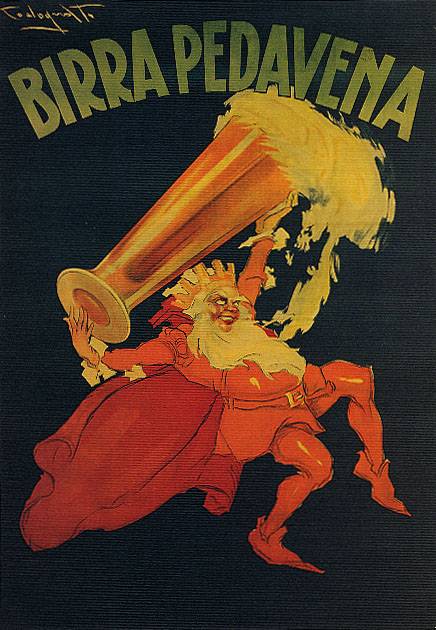

Tuesday’s ad is a 1920s ad for an Italian beer that’s still in business — Pedavena. Similar to yesterday’s French ad, this one also features a king carrying a beer. Is it Gambrinus? Who knows.
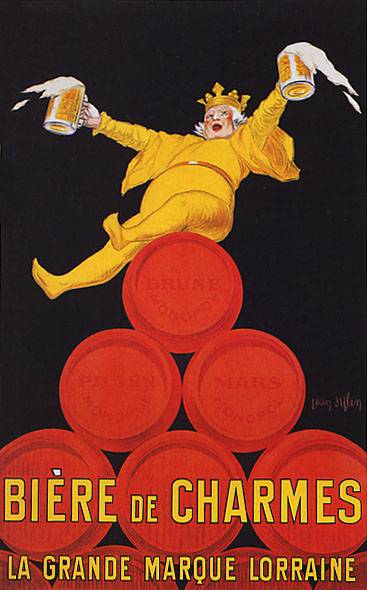
Monday’s ad is the third ad we’ve featured by famed illustrator Jean D’Ylen. Biere de Charmes was done in 1924 for the French brewery located in the Lorraine that was founded in 1864. The king — Gambrinus perhaps? — sitting atop a pyramid of wooden kegs with two full mugs of beer, one in each hand, seems poised to fall, or at least spill his beer.

Today’s work of art is by the German Dadaist George Grosz. He was born in Germany, but after 1938 he painted primarily in the United States, though he returned to Berlin late in life. He was perhaps best known for his caricatures. This week’s work, completed around 1928, is known as Political Conversation, The Café. It’s done in watercolor and ink on paper and today hangs in the Museo Thyssen-Bornemisza, in Madrid, Spain.
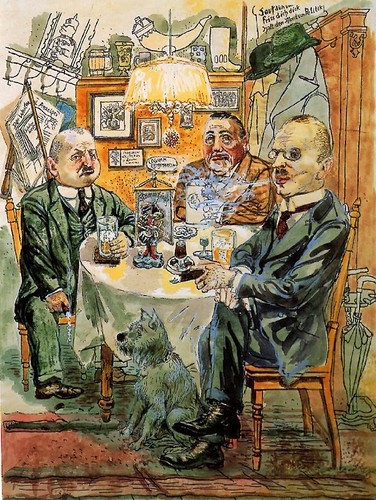
Here’s one analysis of the painting:
George Grosz has painted a typical Bierstube scene. Three Germans have gathered in a café to smoke and drink beer. Following his Dadaist period, Grosz — an excellent draftsman and keen social observer — returned to figurative art. He was one of the leading members of the movement known as New Objectivity (Neue Sachlichkeit). But he was also skilled at genre painting, a gift he used to push the art of caricature to new levels of expression.
To learn more about George Grosz, you can start with Wikipedia and MoMA has a biography from the Oxford University Press. MoMA also has a gallery of his work, as does Olga’s Gallery and ArtCyclopedia has numerous links to other galleries showing his art.

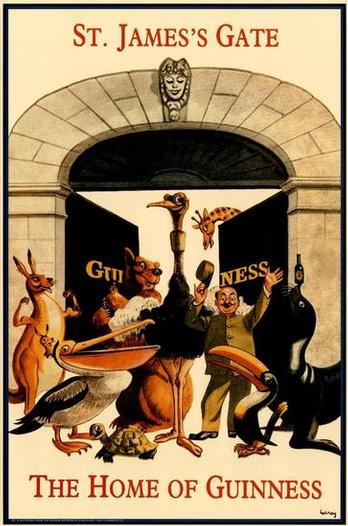
Our 104th Guinness ad is another group portrait of many of the iconic Guinness animals and their zookeeper. Last week it was at the zoo, this week they’re at St. James Gate, the “Home of Guinness.” Which is ironic, since I was there last night — sort of. More on that later today.
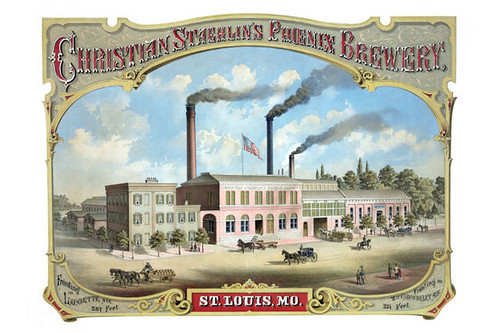
Friday’s ad is old one, undoubtedly from the 19th century. It’s for a St. Louis brewery, the oddly named Christian Staerlin’s Phienix Brewery. I love these old industrial illustrated love letters, showing large, gleaming colorful industrial complexes. They seem to have been quite common at one time. I wonder if anyone’s ever done a survey of all of them. Now that would be a cool coffee-table book.
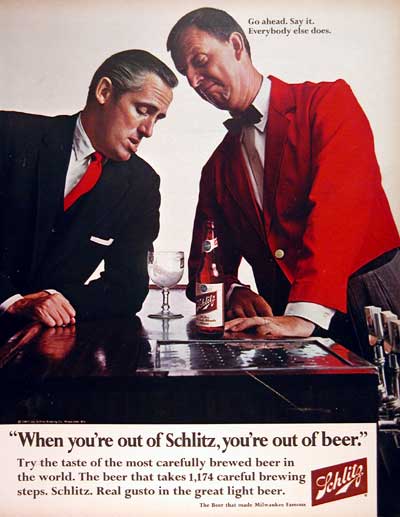
Thursday’s ad is another one for Schlitz, this one from 1967. Using their iconic slogan “When you’re out of Schlitz, you’re out of beer,” it’s presumably meant to be humorous. Showing an interesting contrast, with the patron in a black suit with a red tie while the serve sports a red suit, or at least jacket, with a black tie, they’re both looking longingly at the empy glass and bottle between them. Unfortunately, I don’t feel too badly for them, as I can see several taps in the foreground that undoubtedly have beer that is at least the equal of Schlitz.
And one other interesting tidbit stands out. “The beer takes 1,174 careful brewing steps.” Wow, that’s some very busy brewers. I’d love to see an itemized list of all those steps.
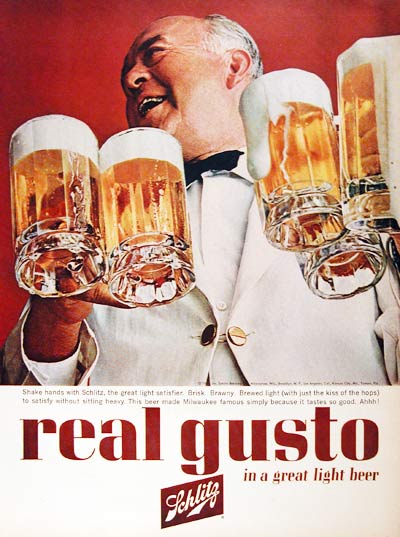
Wednesday’s ad is for Schlitz, from 1966. It’s another of the “real gusto” series, this one showing a server in a white tuxedo carrying five mugs full of beer. Look closely at the foam. Does that look real to you?
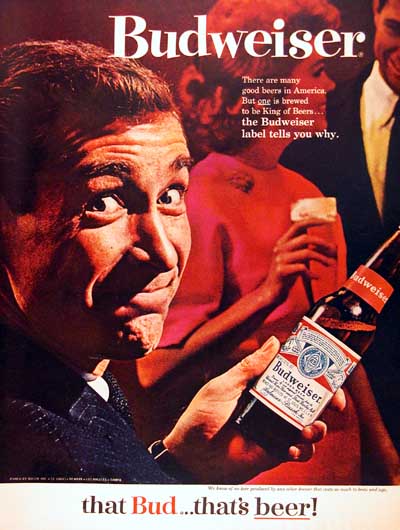
Tuesday’s ad is another one for Budweiser, also from 1964 and again withe tagline “that Bud… that’s beer!” In this one, a man with a goofy-looking expression is holding a bottle of beer at a party, and appears to be drinking it straight from the bottle.
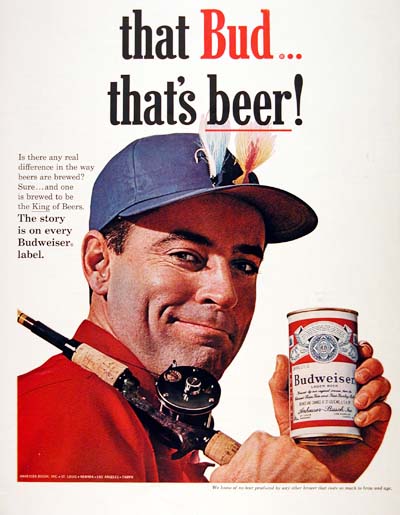
Monday’s ad is for Budweiser, from 1964. The ad features a fisherman holding a flat-top can, with his rod over his shoulder and flies stuck into his cap. But it’s really the copy that stands out in this ad, staring with the tagline “that Bud… that’s beer!” But look to the left, here’s a gem. “Is there any real difference in the way beers are brewed? Sure, and one is brewed to be the King of Beers.” Sure? Well, that sure tells us a lot about how Bud was brewed differently from every other similar-tasting American lager in 1964. Nice.
Today’s work of art is by the social realist French artist Marcel Gromaire, and the majority of his ouvre depicted characters in social settings. Our featured painting is no exception, and it shows a pair of men enjoying some pints of beer in a pub, inn or cafe. The title of the work is The Beer Drinkers, which Gromaire painted in 1924. Today it hangs in the Musee d’Art Moderne de la Ville de Paris.
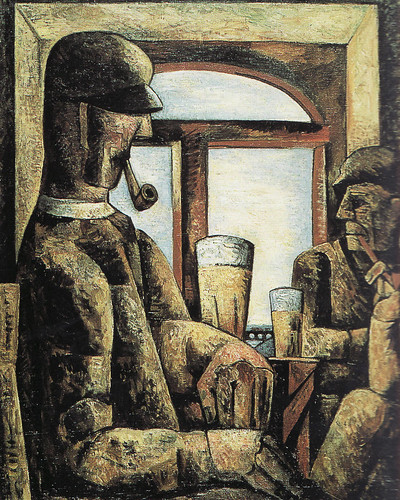
Here’s one analysis of the painting:
Marcel Gromaire was decidedly northern in his style, and after 1918, became one of the foremost practitioners of what could be called Expressionist Cubism. In this genre scene, he depicts beer drinkers smoking pipes in a rundown cafe. The simplified forms, the exaggerated features, the geometric construction and the restrained colours are all characteristic of this expressive painting.
To learn more about Marcel Gromaire, you can start with Wikipedia and there are a few more of his works on ArtNet and Scholars Resource. ArtCyclopedia has many more links, as well.