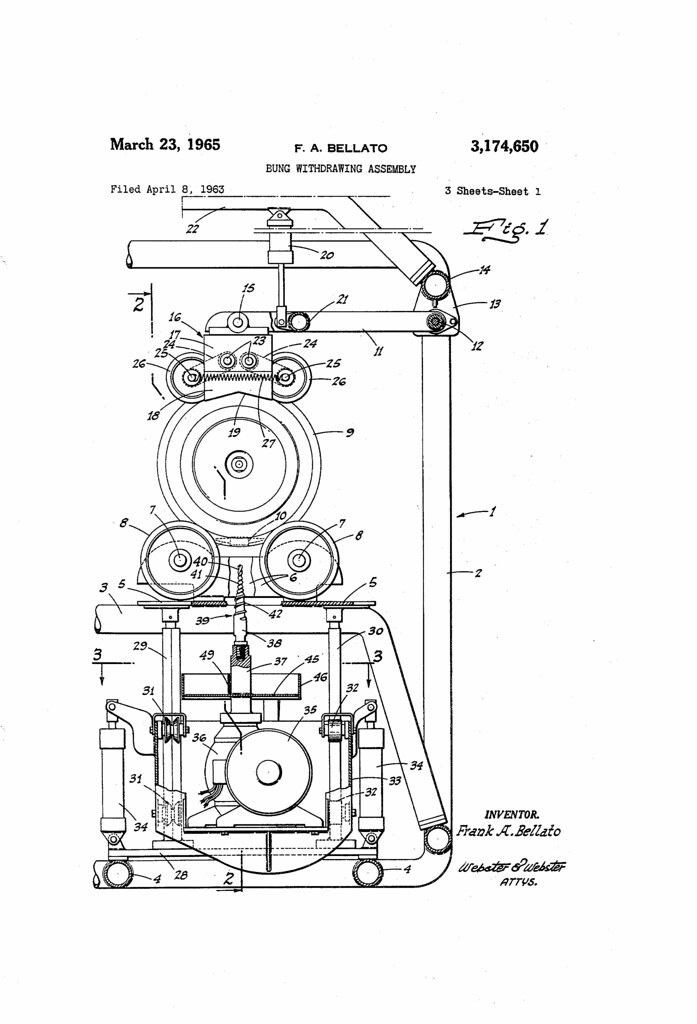
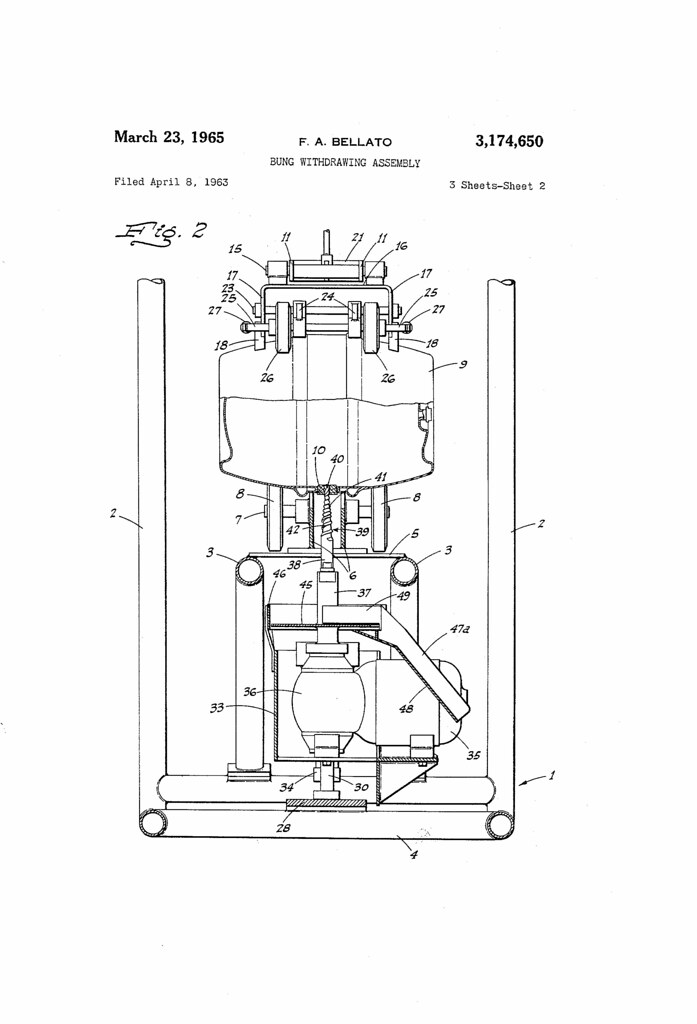
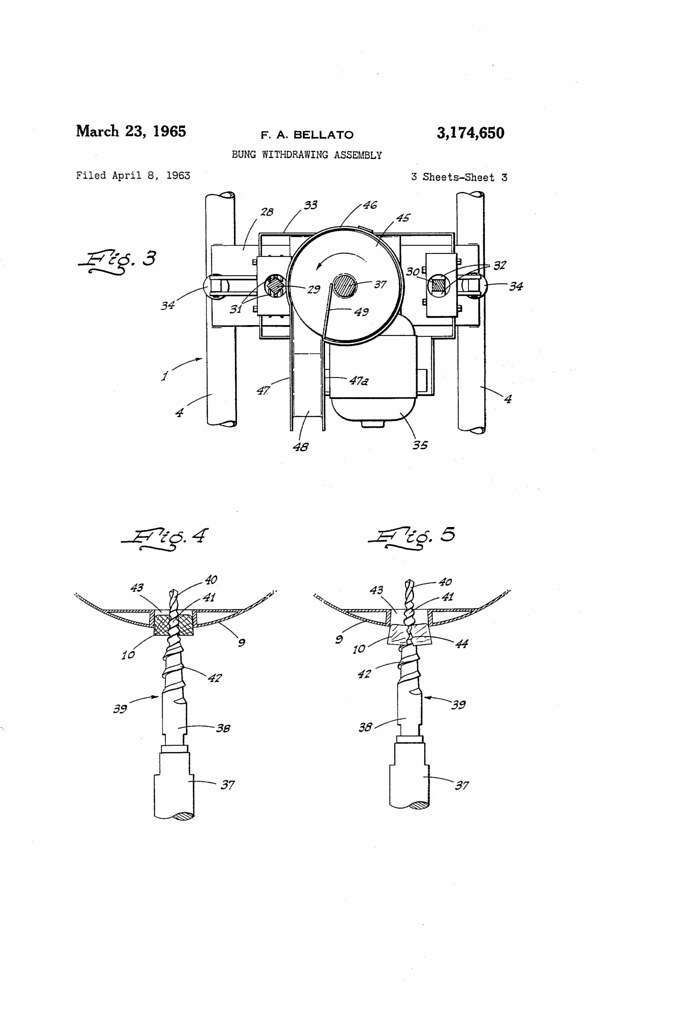
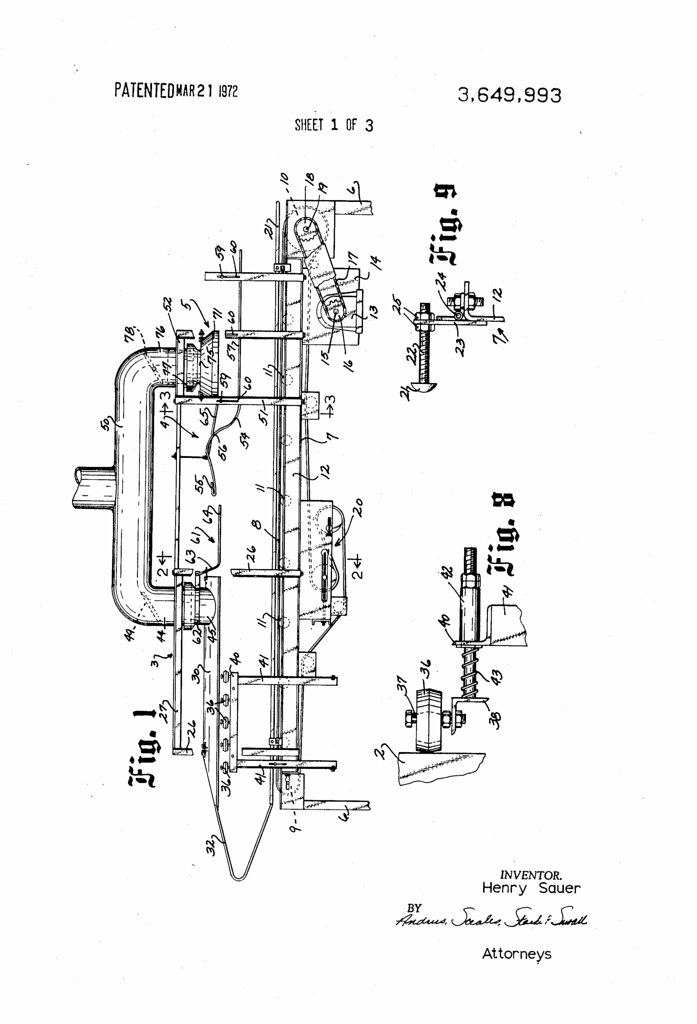
Today in 1912, US Patent 1018703 A was issued, an invention of Wilhelm Griesser, for his “Building for Cooling and Storing Beer.” This one seems crazy, an entire building being patented. There’s no Abstract, but the description states that the “present invention has reference to storage buildings, and it comprehends generally a structure which is adapted primarily for cooling and storing beer and is designed to be built up floor by floor as the tanks are arranged in position one above another, so as to produce, in effect, at its completion, a tower or the like wherein the tanks are inclosed and supported by a homogeneous monolithic casing of cementitious material, the tanks being built into the casing, during the actual construction of the latter, in such a manner that their metal walls and the walls of the casing mutually reinforce each other.”


Patent No. 3022617A: Conveyor Keg Palletizing Device

Today in 1962, US Patent 3022617 A was issued, an invention of John Miller and Vincent J. Russoman, assigned to Schaefer Brewing Co., for their “Attachment for Conveyor Keg Palletizing Device.” There’s no Abstract, and given that there are a record (for me at least) 45 drawings showing the patented device, there’s precious little by way of description, so I guess just look at the pretty pictures.


Patent No. 1992261A: Pulp Or Fibrous-Mass Breaker

Today in 1935, US Patent 1992261 A was issued, an invention of William F. Traudt, for his “Pulp or Fibrous-Mass Breaker.” There’s no Abstract, but in the description Traudt explains that his “invention relates to improvements ‘in breakers or disintegrators for fibrous material, such as the filter-mass employed in breweries for filtering beer, the breaker of this application being primarily intended for breaking up the soiled or used filter-mass coming from the beer filters preparatory to washing or reclaiming it for reuse.”

Patent No. 200744A: Improvement In Ale Or Beer Measures

Today in 1878, US Patent 200744 A was issued, an invention of Thomas Millee, for his “Improvement in Ale or Beer Measures.” There’s no Abstract, but in the description Millee explains that the “object of my invention is to provide a ready and convenient means of ascertaining the quantity of liquor in the measure, including that portion which is contained in the form of froth or foam; and in order to accomplish this object I cover or inclose the outlet from the interior of the measure to the measuring tube, by soldering strips of metal to the side and bottom of the measure at the point where the tube connects therewith, so as to form a separate compartment at the base of such tube on the inside of the measure above the bottom, which compartment has small apertures leading’ into it, arranged so that the foam or froth will not be driven against or through them into this compartment when the liquor is drawn or poured into the measure, all of which will more clearly appear by the drawings and description of the different parts.”

Patent No. 447131A: Process Of Making Malt Liquor

Today in 1891, US Patent 447131 A was issued, an invention of John Griffiths, for his “Process of Making Malt Liquor.” There’s no Abstract, but the description very generally states that the “invention relates to an improvement in the art of making malt liquors by which the quality of the liquor is improved,the cost of production reduced, a considerable saving effected in the time and appliances heretofore required, and a consequent gain realized in the capacity of a brewery.”

Patent No. 2926087A: Method Of Carbonating A Malt Beverage

Today in 1960, US Patent 2926087 A was issued, an invention of Frank Otto Rickers, assigned to the George Wiedemann Brewing Co, for his “Method of Carbonating a Malt Beverage.” There’s no Abstract, but the description states that the “one of the principal objects of the invention is to provide a method for carbonating beer at a very much more rapid rate than has been possible heretofore.”

Patent No. 2147862A: Beer Dispensing Apparatus

Today in 1939, US Patent 2147862 A was issued, an invention of Hans Sollinger, for his “Beer Dispensing Apparatus.” There’s no Abstract, but the description states that the “invention relates to a beer dispensing apparatus by means of which beer can be dispensed without pressure from barrels situated at a lower level than the faucet,” before going into more detail:
The apparatus is also suitable for dispensing wine and cider and has, in known manner, a packing ange against which the Vessel to be filled is pressed and hermetically closed by the suction action of the air pump. According to the invention the dispensing faucet of the apparatus is connected by a gearing with the air pump by which, when the apparatus is in use, the air is drawn out of the beer glass pressed against the packing surface and then, when the dispensing faucet is subsequently opened and during the filling of the glass, the excess carbon dioxide flowing into the glass passes into the pump whereupon, during the return movement of the gearing, the dispensing faucet is closed, and the air and excess carbon dioxide in the pump is returned by the pump to` the barrel through a filter.

Patent No. 3078166A: Continuous Brewing

Today in 1963, US Patent 3078166 A was issued, an invention of James Shanks Hough and Robert William Ricketts, for their “Continuous Brewing.” There’s no Abstract, but the description states it’s for a “fermentation process in which means are secured for controlling the quantity of yeast present in the fermenting liquid and hence the rate of fermentation.” They continue in the application:
Still another object of the present invention is to provide a process whereby wort can be fermented with production of substantially smaller quantities of yeast than is possible in known processes.
Continuous processes for the fermentation of brewers wort are known and these are claimed to have a high rate of production in comparison with the conventional batch processes. In the known processes, however, a yeast separation stage is employed in which yeast is separated from the fermented wort and in most known processes the yeast separated from the fermented wort is recycled to the fermentation stage. The present invention permits a more compact apparatus to be used as no separate yeast separation stage is required unless it is specifically desired to produce yeast in conjunction with the production of beer. This is achieved by using a process which permits the separation of the yeast from the fermented wort to be effected in the actual fermentation vessel.


Patent No. 7332342B2: Barley Kernel Husk Evaluation

Today in 2008, US Patent 7332342 B2 was issued, an invention of Isao Kishinami, assigned to Sapporo Breweries Ltd., for his impossibly long patent name, “Disposing barley kernels with husks in a sulfuric acid solution having a 40% to 60% concentration, agitating the solution having the barley kernels disposed therein for a prescribed time, and observing the degree of husk remaining on the barley kernels subsequent to the agitation.” Here’s the Abstract, only slightly longer than the title:
An object of the present invention is to provide a method for evaluating the physical strength of husks of a barley ingredient for malt manufacture. Barley kernels with husks are disposed in a sulfuric acid solution with a concentration of approximately 40% to 60%, and are agitated for a prescribed time (e.g. approximately 1 hour) using a stirrer bar or the like. After agitation, the barley kernels are treated with a mixed liquid of Methylene Blue and Eosin, and the degree of peeled husk (remaining degree) is examined by referring to the degree of dyed barley kernels, to thereby evaluate the physical strength of the husks of the barley kernels.


Patent No. 2782013A: Lauter Tubs

Today in 1957, US Patent 2782013 A was issued, an invention of Edwin L. Dittrich, assigned to Pfaudler Co. Inc., for his “Lauter Tubs.” There’s no Abstract, and the OCR didn’t work very well on this one, so it’s hard to read. What I can make out is that “this invention relates to lauter tubs and has for its object to provide several improvements thereto.
A lauter tub is essentially a device for straining wort liquid from the mash-grains; and comprises -a perforated false bottom resting on and separated from the tank bottom itself by spacer studs attached to the false bottom. The tank bottom is provided-with suitable drainage openings. The invention provides a combined gear drive and hydraulic system unit motivating the shaft which revolves in a universal bearing attached to the bottom of the tank, said shaft having vertical freedom of movement through out lifting the false bottom.”