Brookston Beer Bulletin

Jay R. Brooks on Beer

  • Home
  • About
  • Editorial
  • Birthdays
  • Art & Beer

Socialize

  • Dribbble
  • Email
  • Facebook
  • Flickr
  • GitHub
  • Instagram
  • LinkedIn
  • Pinterest
  • RSS
  • Twitter
  • YouTube

Powered by Genesis

Beer In Ads #5028: Falken Schaffhauser Oster-Bock

July 18, 2025 By Jay Brooks

Last year I decided to concentrate on Bock ads. Bock, of course, may have originated in Germany, in the town of Einbeck. Because many 19th century American breweries were founded by German immigrants, they offered a bock at certain times of the year, be it Spring, Easter, Lent, Christmas, or what have you. In a sense they were some of the first seasonal beers. “The style was later adopted in Bavaria by Munich brewers in the 17th century. Due to their Bavarian accent, citizens of Munich pronounced ‘Einbeck’ as ‘ein Bock’ (a billy goat), and thus the beer became known as ‘Bock.’ A goat often appears on bottle labels.” And presumably because they were special releases, many breweries went all out promoting them with beautiful artwork on posters and other advertising.

Friday’s poster is for Falken Schaffhauser Easter Bock Beer, and was published in 1930. This one was made for the Bierbrauerei Falken Schaffhausen, or Falcon Brewery, of Schaffhausen, Switzerland. The brewery was founded in 1799, and is still in business today, and is “considered the only independent brewery in the Schaffhausen region,” and is Switzerland’s 5th largest brewery. This one is for their Schaffhauser Bock and shows a very thirsty man who apparently shimmied up the town maypole to grab one of the bottles of beer tied to the wreath at the top. It was created by Swiss artist Arnold Oechslin.

Filed Under: Art & Beer, Beers, Breweries, Just For Fun Tagged With: Advertising, Bock, History, Switzerland

Historic Beer Birthday: Jan Albin Goetz-Okocimski

July 18, 2025 By Jay Brooks

Today is the birthday of Jan Albin Goetz-Okocimski (July 18, 1864-April 24, 1931). He was the son of Johann Evangelist Götz, who founded the Okocim Brewery in 1845. Located in Brzesko in southeastern Poland, Jan Albin “expanded the family business, married a Polish aristocrat, and changed his name to Goetz-Okocimski. In 1945 the brewery was nationalized, then reprivatized in the 1990s. Carlsberg first acquired an interest in 1996, eventually acquiring full control in 2004.”

File:Jan Goetz Okocimski.jpg

This biography of Goetz-Okocimski is from his Wikipedia page:

Baron, Jan Albin Goetz-Okocimski was a Polish brewer of German ancestry, head of Okocim Brewery, a philanthropist and patron of the arts, a “Freiherr” (baron) of the Habsburg Empire, a conservative politician, activist and a member of the Austrian parliament and Polish sejm.

AGAD Legitymacja kolejowa Jana Götza Okocimskiego.JPG

Born to Johann Evangelist Götz and Albina Götz in 1864, in 1911 he polonized his name to “Goetz-Okocimski”. At the end of the 19th century, together with his wife, baroness Zofia née Sumińska, he built a palace in Brzesko, in Austrian architectural style, surrounded by an English garden. From 1904 until his death he was the sole owner of Okocim brewery. In 1925 for his social activism, as well as business and agricultural contributions to the industry of newly independent Poland he was awarded the Commander’s Cross of Order of Polonia Restituta.

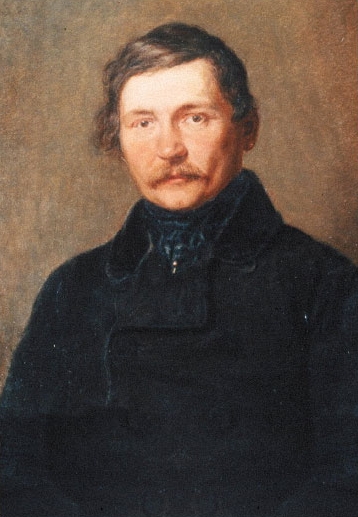
Jacek Malczewski - Portret Jana Albina Goetza Okocimskiego 1916.jpg
Portrait of Jan Albin from 1916 by Jacek Malczewski.

This is the entry from the Wikipedia page for the Okocim Brewery:

[Götz was] a German beer maker born in Wirtemberg together with Joseph Neumann, from Austria-Hungary, and local Polish noble, Julian Kodrębski. The first batch of beer was brewed on February 23, 1846. During the “Rabacja“, an Austrian-inspired peasant uprising in Galicia in 1846, directed at Polish nobility as well as affluent merchants, Götz barely escaped with his life. He survived thanks to help from local friends and the fact that the workers of his brewery stood up in his defense, certifying that his business provided good pay and decent working conditions. In turn, Götz helped to save the life of Julian Kodrębski, who had partly funded his brewery, by hiding him in woods on the banks of the Uszwica river in Brzesko, and providing him with food which was delivered over the course of ten days by workers from the brewery.

After the death of Neumann, Götz became the sole owner of the brewery. He modernized the enterprise and expanded it, adding a malthouse in 1875. In 1884 the brewery was visited by J. C. Jacobsen, the founder of Carlsberg brewery in Denmark.

After the death of Johann Evangelist Götz in 1893, the brewery was taken over by his son, Jan Albin Goetz. Jan Albin further expanded the family business, married a Polish aristocrat, and changed his name to Goetz-Okocimski. The Götz family quickly assimilated into Polish culture, became Polish patriots and engaged itself in Polish politics. Among other endeavors they funded a statue of Adam Mickiewicz, a gallery and the Juliusz Słowacki Theatre in Kraków, contributed money to buy out the Wawel castle from Austrian authorities. Jan Albin was also the president of the Koło Polskie (“Polish Circle”) in the Austrian parliament, and after Poland regained its independence a senator to the Polish sejm He built a private rail link between the brewery and the Brzesko rail station. As the richest person in Lesser Poland at the time he was also a philanthropist and a patron of the arts.

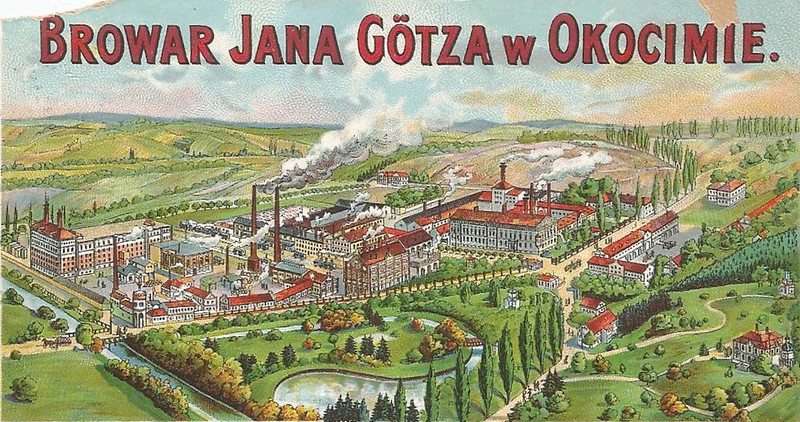
Okocim_Browar_1900
The Okocim Brewery around 1900.

This account of the history of the Okocim Brewery is translated from Polish website:

John the Evangelist Goetz – the man from whom it all began.

At that time, Jan Goetz was a true visionary. Considered the father of modern brewing in Poland, he was one of the pioneers in the production of so-called Bavarian beer, bottom fermentation.  The revolutionary nature of this method consisted in breaking with traditional forms of brewing beer, unchanged since the early Middle Ages. The new method consisted of aging at low temperatures of 7-12 º (in ice-cooled cellars) as well as bottom-up and back fermentation. This new species, called the lager, with a characteristic golden color and dense foam, beat the traditional types of beer on the head in terms of taste and allowed to store longer.
 
Although the founder of Okocim Brewery Jan Götz came from German Langenenslingen, he emphasized his belonging to Poland from the beginning. Soon for his involvement in the life of the local community, he received the nickname noble – Okocimski – and adopted the Polish name Goetz.
 
One of Jan Goetz’s principles was: best of the best. That’s how the best ingredients made beer, which brought Goetz fame and fortune. Goetz also kept in touch with other brewers, exchanging experiences and training in the art of brewing beer. At the end of the 19th century, Goetz met Jacob Christian Jacobsen, the creator of Carlsberg Brewery, who is only two years younger brother of Okocim.
 
The beginnings of Okocim Brewery
 
The history of the plant begins in 1845. It was then that Okocim with a small amount of money, sufficient only to build a small brewery, came then thirty-year-old Jan Goetz. Together with a partner, he began building a state-of-the-art brewery in Poland at that time. It was the quality of the beer brewed in it that made Goetz brewery very quickly become one of the largest in Poland. In 1846, the first bright full in Poland was brewed in Okocim. The first beer was only 7,500 buckets (1 bucket – approx. 60 l).
 
In the years 1846 – 1879, the volume of production in Okocim reached 24,000. hl.  In the 1980s, three types of beer were introduced: Marcowe, Lager and Bock. The brewery, in particular, became famous for the latter, commonly known as bock. The brewery’s success gradually increased. 
At the end of the nineteenth century, the brewery achieved an increase in production to 120 thousand hl. The beginning of the 20th century is already production at the level of 385,000 hl. In addition, the Okocim brewery from the beginning of its existence specialized in the production of oak barrels, not only for its own needs, but also for other breweries.

okocim-postcard

Okocim Brewery – beer for generations
 
In 1893, after the death of John the Evangelist, Okocim Brewery passed into the hands of his son, Jan Albin Goetz. In recent years before World War I, the brewery was at the forefront of the best of 1,200 breweries throughout the Austro-Hungarian monarchy.  During the war, the Russian army forced the brewery to stop brewing for several months.  After opening in 1915, the quality of beer dropped significantly.  However, already in free Poland Jan Albin managed to restore Browar Okocim to the highest brand.  During this period Okocimskie and Slodowe beers with the addition of sugar were brewed, as well as seasonal St. John’s beer.
 
After the death of his father, Antoni Jan Goetz became the owner of the brewery. Soon he launched a porter, which was sold in elegant, engraved bottles. The brewery’s prosperity was interrupted by the outbreak of World War II. Antoni Jan Goetz and his family fled to France from the approaching German army, and the brewery passed into the hands of the occupier and began producing beer for the army.

When the Red Army approached Okocim, the German administrator, Karl Schroeder, ordered the dismantling of the basic machinery and equipment of the plant and taking them to Magdeburg. However, the train did not leave Silesia. The equipment was found and checked back by the brewery employees. The machines were quickly mounted to their former places, thanks to which the brewery began production in the same year.

After World War II, the brewery was expropriated and functioned as the State Brewing Company in Okocim, later renamed Okocimskie Brewing and Sweet Factory. Despite the lack of major modernizations, it was one of the most prosperous breweries in the country. It mainly brewed OK Pils beer, but also Caramel beer (formerly Słodowe).

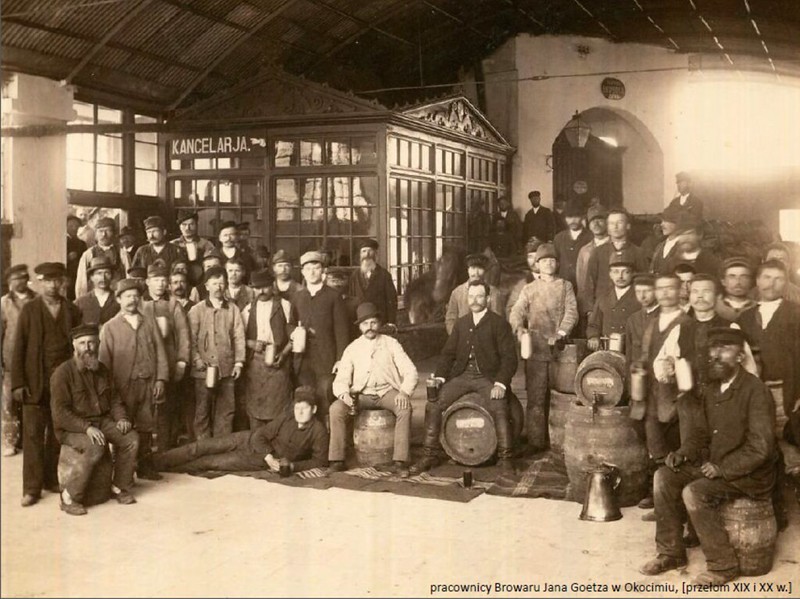
okocim-workers

The Goetz family – responsible employers, patrons of culture and art 
 
The Goetz family was not only interested in beer – they supported culture, art and engaged in local life. Along with the brewery, the city also developed. New jobs were created. Thanks to the philanthropy of John the Evangelist, the first folk primary school, a neo-Gothic church, presbytery and library were opened in the vicinity of the brewery. In 1898, the Goetz took part in the buyout of Wawel from the Austrians, financially supported the construction of the Adam Mickiewicz monument on the Krakow Market Square, the construction of the theater Słowackiego and the opening of the gallery in the Sukiennice.
 
The Goetz family took special care of the brewery’s employees. In 1878, Okocim was one of the few workplaces to have its own credit and loan fund. Then a theater room was built, and a brass band was created.
 
Jan Goetz, as an avid social activist, founded a volunteer fire department, often leading the way in danger. He was awarded the Papal Order of St. New Year’s Eve and the Gold Cross of Merit with the Crown awarded by the emperor for participating in fire fighting around Okocim.
 
Jan II Albin Goetz Okocimski was an avid patron of the arts. In his collection he had canvases of artists such as Chełmoński and Malczewski. Family members were painted by, among others, Stanisław Wyspiański and Olga Boznańska.
 
Okocim Brewery today
 
Today, the Okocim brewery is undoubtedly a contemporary brewery, but drawing on its unique history.  Not only when it comes to buildings, many of which remember the Goetz family, but above all in the approach to brewing beer and the principles that are passed down from generation to generation among Okocim brewers.

okocim-employees

Filed Under: Birthdays, Breweries, Just For Fun Tagged With: History, Poland

Historic Beer Birthday: Josef Sedlmayr

July 18, 2025 By Jay Brooks

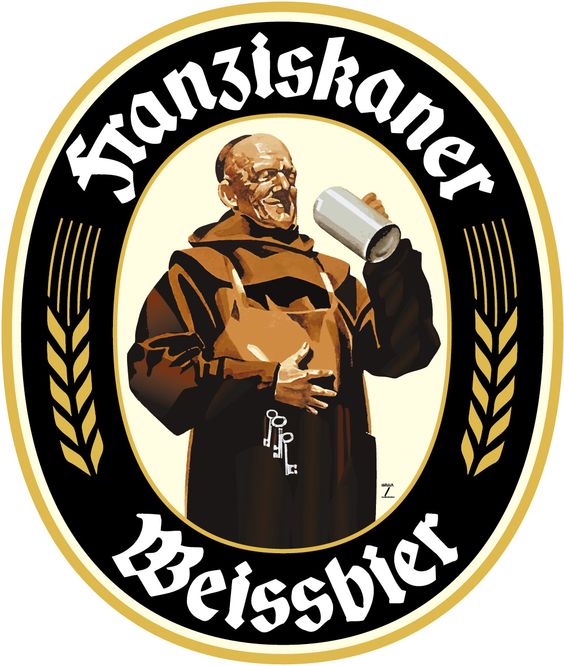
franziskaner
Today is the birthday of Josef Sedlmayr (July 18, 1808-March 12, 1886). He was the son of Gabriel Sedlmayr, who owned Spaten brewery, and Josef owned the Franziskaner brewery, though the two breweries later merged.

Joseph-Sedlmayr
Joseph Sedlmayr in 1861

Here’s a very short biography on Find a Grave:

Owner of the Franziskaner Brewery in Munich, which was established near the Franciscan Monastery in Munich in 1363. Up to and during Sedlmayr’s time it was known as the Franziskaner-Leistbrauerei.

According to Spaten’s website (which owns Franziskaner today)

At the same time, one of the sons of Gabriel Sedlmayr – Joseph, was the owner of the brewery Leist (Leistbrauerei), which dates back to the fifteenth century.

In 1858, he bought shares in the Franziskaner brewery, and from 1861 Joseph Sedlmayr becomes its sole owner.

In 1865, the entire production of the brewery Leist is transferred to the Franziskaner-Brauerei.

At Oktoberfest in 1872 becomes presented a new beer with an amber colour, which gave rise a new style known since then as Marzenbier.

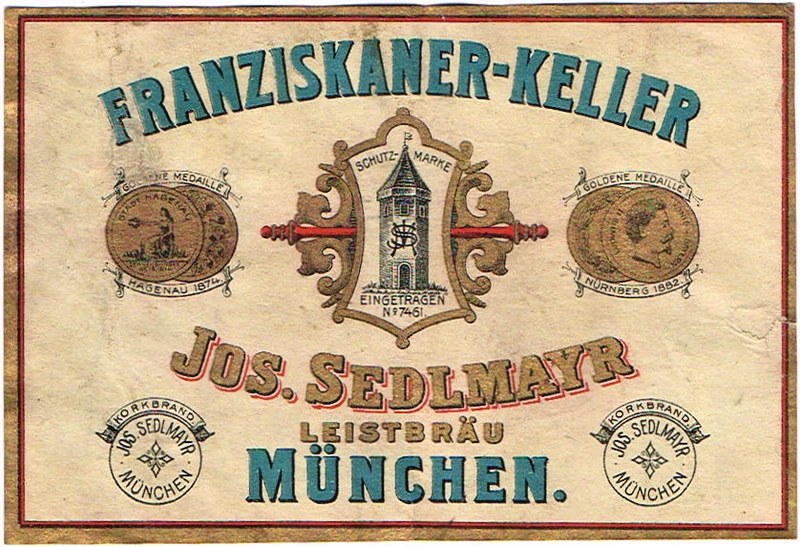
Franziskaner-Keller-Labels-Jos-Sedlmayr-Leistbrau

And here’s a timeline from the Sheehan Family Companies website:

  • 1363 – Franziskaner’s roots can be traced back to 1363. It was in this year that the brewer Seidel Vaterstetter is first mentioned as the owner of the ‘brewery next to the Franciscans’ in the Munich Residenzstrasse. The name ‘Franziskaner’ derives from the Franciscan monastery diagonally across the street.
  • 1841 – The Franziskaner Brewery moves to Lilienberg in Munich’s eastern suburb of Au. In the same year Augustin Deiglmayr, a son-in-law of Spaten’s owner Gabriel Sedlmayr the Elder, buys the Residenzstrasse brewery.
  • 1861 – Joseph Sedlmayr, owner of the Leist Brewery (probably founded in the 15th century) and son of Spaten’s Gabriel Sedlmayr the Elder, buys out August Deiglmayr, with whom he has been co-running the Residenzstrasse brewery since 1858.
  • 1865 – The Leist Brewery in Sendlinger Strasse stops its brewing operations, which are now left entirely to the Franziskaner Brewery.
  • 1872 – ‘Ur-Märzen’, the amber-colored Oktoberfest beer from Franziskaner-Leist, is served for the first time at the Schottenhamel Tent on the Oktoberfest fairgrounds. Brewed from a Viennese recipe, this golden-yellow beer is stronger than the summer beer.
  • 1909 – Gabriel Sedlmayr III, the son of Joseph Sedlmayr, turns the Franziskaner-Leist Brewery into a family-owned joint stock company, the ‘Joseph Sedlmayr Zum Franziskanerkeller (Leistbräu) AG’.
  • 1922 – The Franziskaner-Leist Brewery and the Spaten Brewery, likewise owned by the Sedlmayr family, unite to form a single joint stock company, the ‘Gabriel und Joseph Sedlmayr Spaten-Franziskaner-Leistbräu AG’, in order to combat the economic problems of the crisis-ridden postwar years and to capitalize on synergies.
  • 1935 – The Munich artist Ludwig Hohlwein designs the company’s distinctive trademark, which is still used today. The Franciscan Friar continues to stand for the unsurpassed quality of Franziskaner’s premium weiss beer.

franziskaner-1935

Curiously, the iconic Franziskaner image of the monk that’s used on their labels was only created in 1935

franziskaner-weissbier

Filed Under: Birthdays, Breweries, Just For Fun Tagged With: Germany, History

Beer In Ads #5027: Iron City’s Famous Bock Beer

July 17, 2025 By Jay Brooks

Last year I decided to concentrate on Bock ads. Bock, of course, may have originated in Germany, in the town of Einbeck. Because many 19th century American breweries were founded by German immigrants, they offered a bock at certain times of the year, be it Spring, Easter, Lent, Christmas, or what have you. In a sense they were some of the first seasonal beers. “The style was later adopted in Bavaria by Munich brewers in the 17th century. Due to their Bavarian accent, citizens of Munich pronounced ‘Einbeck’ as ‘ein Bock’ (a billy goat), and thus the beer became known as ‘Bock.’ A goat often appears on bottle labels.” And presumably because they were special releases, many breweries went all out promoting them with beautiful artwork on posters and other advertising.

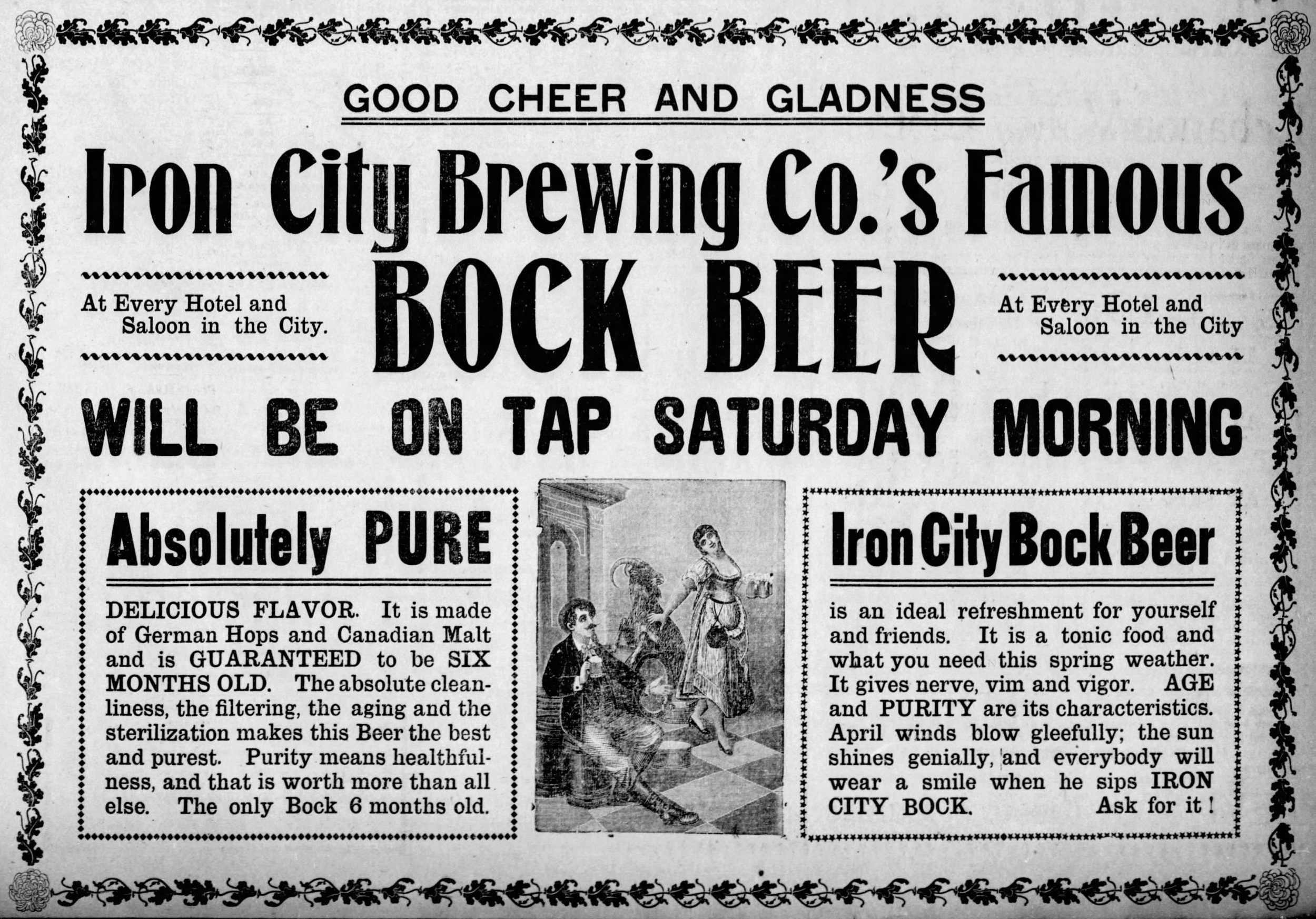
Thursday’s ad is for Iron City Brewing Co.’s Famous Bock Beer, which was published in 1905. This one was for the Iron City Brewing Co. of Pittsburgh, Pennsylvania, which was originally founded in 1861. This ad ran in The Daily News, of Lebanon, Pennsylvania.

Filed Under: Art & Beer, Beers, Breweries, Just For Fun Tagged With: Advertising, Bock, History, Pennsylvania

Historic Beer Birthday: Anthony Straub

July 17, 2025 By Jay Brooks

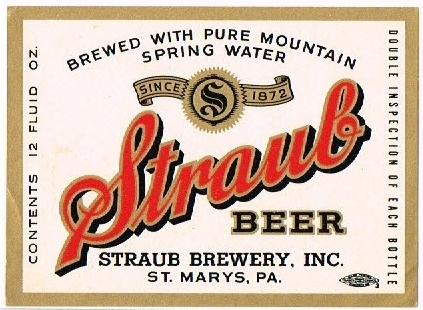
straub
Today is the birthday of Anthony Straub (July 17, 1882-June 13, 1962). He was the son of Peter Straub, who founded the Straub Brewery in St. Mary’s, Pennsylvania in 1872. Anthony took over running the family brewery after his father died in 1913. The brewery is still owned and operated today by the Straub family.

straub-and-sons
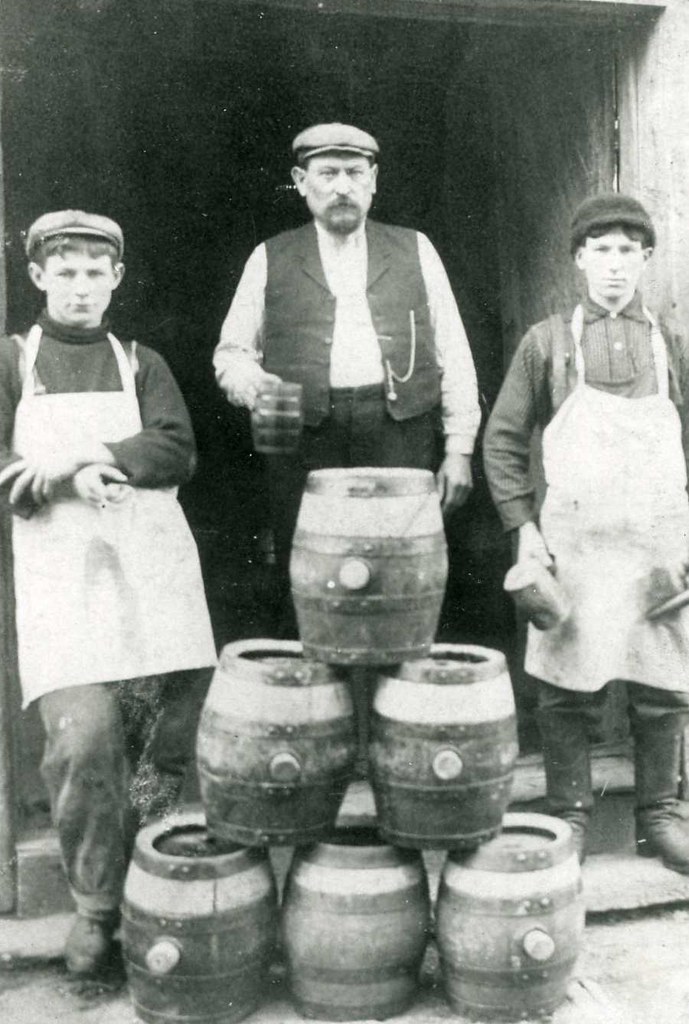
Peter Straub and two of sons, I think Anthony is on the left.

He’s mentioned in the biography from his father’s Wikipedia page:

The Straub family had been brewing a local beer for generations. As expected Peter learned a trade important to the brewing art. He became a Cooper, a craftsman who makes wooden barrels. Peter aspired to be a brewer and at the age of 19 in 1869 immigrated to the United States for a better and more prosperous life. Upon his arrival in the United States he found employment at the Eberhardt and Ober Brewing Company in Pennsylvania. Peter admired his employers’ pledge to forfeit $1,000 if any adulteration was found in their beer, and as he honed his brewing skills to a sharp edge, he adhered faithfully to this promise. Eventually he tired of city life and moved north to Brookville, where he perfected his brewing process while working in the Christ and Algeir Brewery.

Peter later moved to Benzinger (St. Marys), where he met and married Sabina Sorg of Benzinger. The couple settled in Benzinger and had ten children: Francis X., Joseph A., Anthony A., Anna M., Jacob M., Peter M. (who died at two years of age), Peter P., Gerald B., Mary C., and Alphons J.

Peter’s employment in Benzinger was with the Joseph Windfelder Brewery and he worked there until he purchased the Benzinger Spring Brewery (founded by Captain Charles C. Volk in 1855) from his father-in-law, Francis Xavier Sorg. It was then that Straub Beer and the Straub Brewery was born.

straub-family-1904
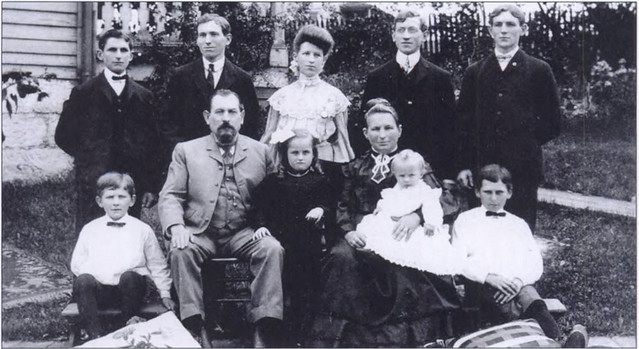
The Straub Family in 1904. Anthony is in the second row, on the right.

Early on, Peter introduced his sons to the world of brewing. Straub used wooden kegs for his beer. He always placed a red band around his barrels to ensure that people would know they were drinking his beer and so that he would get them back. As a lasting trademark tribute to Peter, the brewery continues to place a bright red band around each of its barrels. Red has become a trademark color for the brewery.

Following Peter’s death on December 17, 1913, his sons assumed control of the brewery, renaming it the Peter Straub Sons Brewery. During this time, the brewery produced Straub Beer as well as other beer, such as the pilsner-style Straub Fine Beer and Straub Bock Beer. In 1920, the Straub Brothers Brewery purchased one half of the St. Marys Beverage Company, also called the St. Marys Brewery, where St. Marys Beer was produced. During Prohibition, which lasted from January 29, 1920, until December 5, 1933, the brewery produced nonalcoholic near-beer. On July 19, 1940 they purchased the remaining common stock and outstanding bonds of the St. Marys Beverage Company.

straub-brewery-1895-closeup
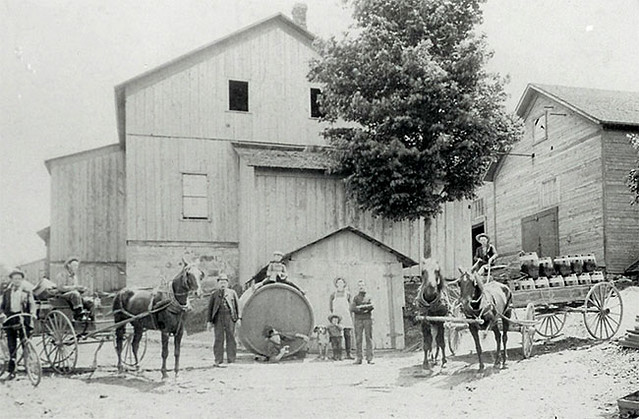
The Benzinger Spring Brewery in 1895.

And this account is by Erin L. Gavlock, from 2009, at the Pennsylvania Center for the Book at Penn State:

Straub owned and operated the Benzinger Spring Brewery until he died in 1912 and left the company to his son, Anthony. Anthony Straub changed the name of the brewery to “Peter Straub Sons’ Brewery,” the only alteration he would make to his father’s business. From there, Peter Straub’s beer would become a Pennsylvania legend.

The Bavarian Man, a long-time image of the Straub Brewery that recalls its German roots.
Fast-forward over a hundred years from Straub’s humble beginnings to today and one will find the Straub Brewing pledge remains unchanged. The company still serves only unadulterated beer to its customers, proclaiming to be “The Natural Choice.” “Our all grain beer is brewed from Pennsylvania Mountain Spring water and we don’t add any sugar, salt, or preservatives to our recipes,” brew master Tom Straub told St. Marys’ Daily Press. “You can say our beer is a fresher, healthier choice than many of the selections in the marketplace.” Although time and technology have forced a transformation in brewing techniques and standards, the taste, ingredients, and the location of Straub have remained constant. Still located in St. Marys, the brewery depends upon the same mountain water from the Laurel Run Reservoir to blend with all-natural ingredients of cornflakes (used to produce fermentable sugars), barley and hops. “Our brewing process is virtually unchanged since our great, great, grandfather, Peter Straub, perfected it in 1872,” Straub’s promises. The reason behind sticking to the fresh taste of the original recipe is simple: people like it. Through the century, Straub has grown a dedicated patronage in western Pennsylvania with its traditional flavor. “Our style of brewing has pretty much stayed the same over the years, but what is interesting is that our popularity has grown and the reputation of our hand-crafted beer has increased,” Straub CEO Bill Brock said. “It is nice to know that we are becoming increasingly popular not for something we’ve changed, but rather for something we’ve always done well.”

The choice to protect and maintain the brewing customs has kept Straub a small, family owned brewery. “We’ve always thought small. We’re more about quality than quantity,” Dan Straub, former CEO, told Fredericksburg, Virginia’s Free-Lance Star. Until June 2009, Straub Beer was only distributed in glass bottles throughout Pennsylvania and Ohio. Now Straub is being brewed and distributed in aluminum cans in Rochester, New York at the High Falls Brewery. The recipe and method have not changed in the new setting and are under the careful watch of brew master Tom Straub. Despite the recent company growth, Straub still only produces about 45,000 barrels of beer per year. “We are unique; we are much larger than a micro brewery yet far, far smaller than some of the leading national brands,” said Bill Brock. In the middle ground, the brewery has managed to survive beer tycoons, economic depression, and cultural trends—a tough maneuver for a company exporting from Pennsylvania’s least populated region. “I believe the brewery has survived because of the fact that it is family owned; it is steeped in tradition and we have an absolute passion for making beer and our products,” said Brock. “From my perspective, the company and our traditions are a huge legacy and there is a clear obligation to continue these traditions.” Keeping to the family legacy has allowed Straub to persevere through the years to become the second oldest brewery in Pennsylvania after Yuengling.

Staying small and faithful to the company’s founding principles has enabled Straub to keep traditions that other larger breweries have been forced to abandon. The returnable bottle, an eco-friendly service that allows customers to send glass bottles back to the brewery for recycling, is still offered at Straub. “We stayed with the returnable bottles first of all, and I think this is really important, because we have a really strong customer base and they like the returnables,” Bill Brock said during a 2009 radio broadcast. “Over the years we maintained it while other breweries slowly fazed them out.” For Straub, a successful regional brewery, shipping bottles back to the factory is feasible, where it would create more pollution for national brands to do the same. In the future, Straub hopes to go greener and offer more returnables to customers. “We’d love for it to grow,” Brock said. “We think it is the right thing to do and if we can blend the right thing to do with making our customers happy that’s almost a perfect world.”

straub-family-1900s
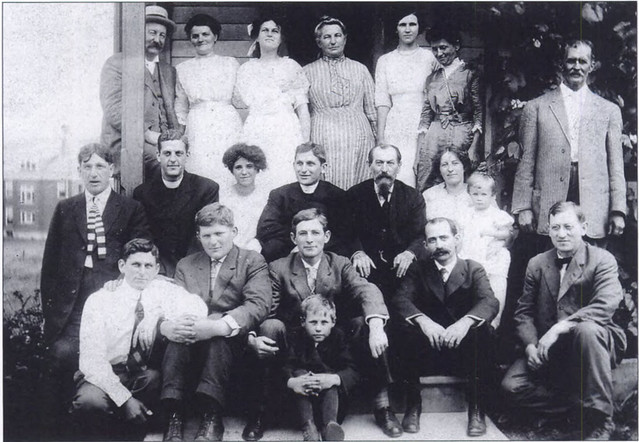
The family in the early 1900s. Anthony is the third from the left in the front row.

Another Peter Straub tradition kept to make customers happy is the Eternal Tap, an oasis for Elk County beer drinkers. The Eternal Tap, established long before any of the brewery’s current chief operators were born, is a “thank you” gesture for patrons, daily providing two mugs of complimentary, fresh cold beer to anyone of legal drinking age. “The roots of it go as far back as the brewery itself and I am sure that my great, great, grandfather, his workers and their friends would spend time at the end of the week enjoying a few pints of freshly brewed beer,” Brock said. According to Bloomington, Illinois’ Pantagraph, the Eternal Tap sprang up shortly after Peter Straub received the Benzinger Spring Brewery from his father-in-law as a way to draw beer enthusiasts to the taste of Straub. Since the marketing gimmick started in 1872, the Eternal Tap has not been turned off, giving free beer to customers in good times and bad.

Although Straub has been in operation for more than a century since its founder’s death, if Peter Straub were able to return to his brewery today, he might feel as if he still ran it. The original recipe, the customer appreciation, and the environmental concerns he founded his business upon are still principal brewing laws at Straub today. For the descendants of Peter Straub, keeping the tradition was second nature. “For me, being President/CEO, my job is to be faithful to the traditions and it is really not that difficult,” Brock said. “I have one of the best jobs in the world and I have been given the opportunity to continue an important tradition and legacy.”

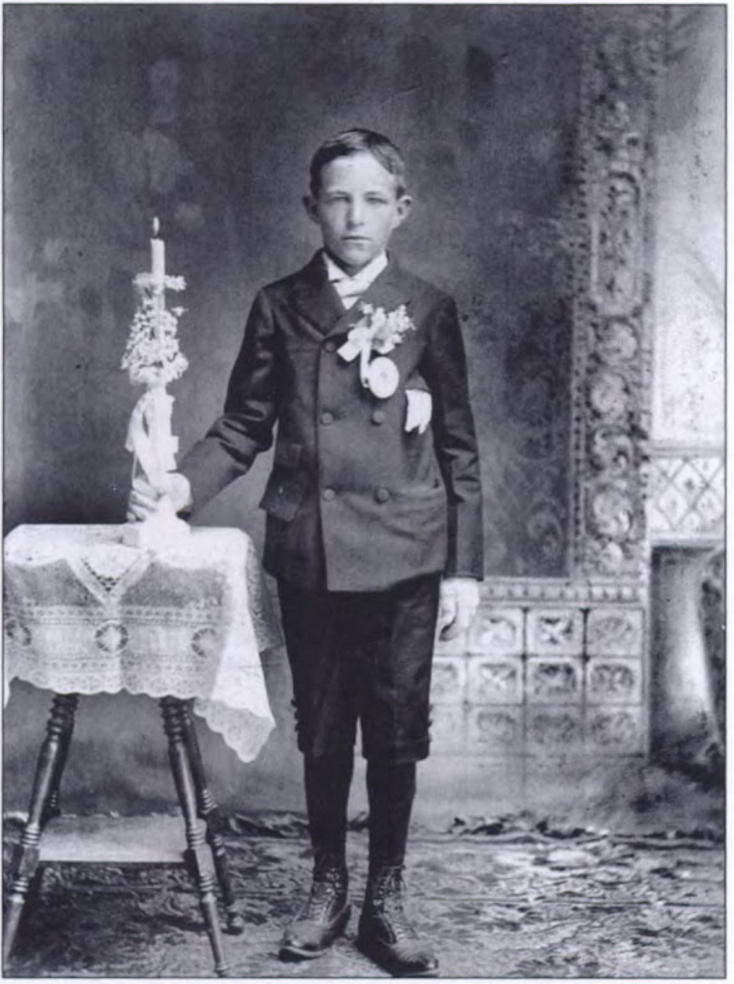
anthony-straub-1889s
Anthony after his first communion in the late 1800s.

Filed Under: Birthdays, Breweries, Just For Fun Tagged With: History, Pennsylvania

Historic Beer Birthday: James Pawley Dawes

July 17, 2025 By Jay Brooks

Today is the birthday of James Pawley Dawes (July 17, 1843-June 11, 1907). He was the grandson of Thomas Dawes, who immigrated from England to Lower Canada in 1808 and three years later established the Dawes Brewing Co. in Lachine. His father and uncle ran the brewery after his grandfather passed away, and then J.P. and his brother took over,  and it remained in the family until 1952.

This biography is from the Dictionary of Canadian Biography:

James Pawley Dawes’s grandfather Thomas Dawes immigrated from England to Lower Canada in 1808 and three years later established a brewery in Lachine. After receiving his early education in Montreal, James Pawley journeyed to England, where he became an apprentice in the brewing trade at Evershed, near Burton upon Trent. He returned to Lachine to work in the family brewery and on the death of his father in 1878 inherited, with his brother Andrew Joseph, his father’s share in the business. Together with their uncle Thomas Amos Dawes, the two brothers directed the enterprise. The Daweses’ establishment was one of the major breweries in the Montreal area. In 1863 its output was the second highest, ahead of that of Molson’s Brewery but behind that of the leading producer, William Dow and Company. Its offices were on Rue Saint-Jacques, Montreal, but production remained concentrated in nearby Lachine, where by the early 1880s the firm had a complex of buildings on Rue Notre-Dame and at least 370 acres of land to grow barley and hops. In 1909 the Dawes brewery would join with several others, including the Dow brewery, to become National Breweries Limited. Dawes ceased brewing operations in Lachine and relocated in Montreal. While the other breweries involved in the merger were closed, both the Dawes and Dow breweries continued to function. In 1952 Canadian Breweries Limited was to purchase National Breweries and change its name to Dow Breweries Limited.

The prominence of the Dawes family in the relatively small community of Lachine extended beyond their brewery and landholdings. James Pawley was a jp in nearby Caughnawaga (Kahnawake), Thomas Amos was a jp in Lachine, and Andrew Joseph was for many years a municipal councillor and mayor of Lachine. James Pawley was the family member at the forefront of entrepreneurial activities to promote the development of Lachine. He initiated the building of the first telegraph line from Montreal to Lachine and in 1882 helped the Dominion Bridge Company Limited, founded that year by Job Abbott, locate a 24-acre site for its works. The town council, which included Andrew Joseph, was undoubtedly acutely aware of the economic impact of such a large industrial enterprise and offered subsidies and tax incentives to help attract it, in exchange for guarantees of investment and employment for local residents. Although the company’s earliest successes rested on the construction of railway bridges in the Montreal area, the business soon expanded to include the construction of bridges and structural-steel buildings across Canada.

Dawes was a major shareholder of the Dominion Bridge Company. He served on its board of directors from 1890 to 1892 and as vice-president from 1893 to his death, during the period when it became a national enterprise. In the frequent absences of its president, James Ross, Dawes chaired the monthly meetings. Although Ross was the driving force behind the company, Dawes brought special skills to bear as a negotiator in the political arena. He scored his greatest coup as a lobbyist on the company’s behalf in 1890, meeting with Quebec premier Honoré Mercier and members of his cabinet to persuade the government to stop giving preferential treatment to Belgian bridge contractors. Thereafter the Quebec government shifted most of its bridge-building business to the Dominion Bridge Company.

From 1886 to 1907 Dawes was on the board of directors of another national institution, the Merchants’ Bank of Canada, owned largely by the Allan family. The bank held large investments in railways and government debentures, including those issued by the town of Lachine. Dawes was less active in the bank than in the Dominion Bridge Company, but he regularly attended directors’ meetings. His diverse business interests also included a directorship in the Alliance Assurance Association of Canada and the presidency of the board of directors of Montreal’s prestigious Windsor Hotel.

Dawes’s wealth provided him with time to pursue other activities. Sports, especially horse-racing, seem to have occupied at least as much of his time as his business interests. Moreover, he was as prominent a sportsman as he was a businessman. He was a member of the Montreal Hunt Club and in his youth had participated in many hunting meets. Around 1900 he joined business associate Hugh Montagu Allan in an effort to revive steeple-chasing within the club. He established his own racing stable, Maplewood, in Lachine. Entries from his stable were quite successful in flat-racing and over steeplechase courses, in both Canada and the United States. His horses won the Quebec version of the Queen’s Plate on 11 occasions, and were often raced at Saratoga Springs, N.Y. Active in horse-racing organizations, he was an important participant in Lachine’s Bel-Air Jockey Club, serving during the 1890s as vice-president and president. In 1899 he helped organize Quebec’s Queen’s Plate at the Bel-Air club and invited Governor General Lord Minto Elliot and Prime Minister Sir Wilfrid Laurier to attend.

Dawes’s other major sporting activity was sailing. A member of the Royal St Lawrence Yacht Club, he often entered his yacht the Surprise in regattas held on Lac Saint-Louis. He was also a member of the Forest and Stream Club in Dorval and the Royal Montreal Golf Club.

James Pawley Dawes’s career centred on Lachine, where his family had made extensive investments and the town’s economic development was his main concern. Through his involvement in such sectors as banking, insurance, and, in particular, manufacturing, he was able to move beyond a purely local economy to become involved in ventures of national importance. His entrepreneurial success was probably the result of equal measures of readily available capital, personal initiative, and his standing as a member of a notable local family. As a successful manufacturer, on an equal footing with the élite of the Montreal business community, Dawes also had the opportunity to build another successful career as a sportsman.

This biography of Dawes is from the Musee de Lachine website in Montreal, Quebec’s exhibition on Black Horse Beer entitled “Pour boire il faut vendre” (To get a drink you have to sell):”

Born in Ambleside, England, Thomas Dawes (about 1775-1863) was the eldest of six children. He arrived in Canada in his early thirties, in 1808. In 1811, he settled in the area of Montréal called Côte des Argoulets (today’s Verdun borough), where he found work at a brewery run by Joseph Chapman. The brewing business suited him, it seems, since it became his lifelong career.

Thomas Dawes married Charlotte Weller in 1817, with Joseph Chapman and James Ogilvie as witnesses. The Dawes and Ogilvie families appear to have been friends. The connection was confirmed a few years later when, on April 21, 1826, Thomas Dawes and his associate Archibald Ogilvie bought from Stephen Finchlay a parcel of land southwest of Montréal, near what is now 28th Avenue in Lachine. Banking on his experience, Dawes set out to operate a farm and a brewery on the 4-acre by 30-acre lot.   

This image has an empty alt attribute; its file name is 48711092983_4008d4774c_b.jpg

This account of the brewery and the Dawes family is a Google translation from “Historie du Quebec:”

The name  Dawes evokes one of the most famous breweries in Quebec. It was in 1811 that Thomas Dawes founded the Dawes Brewery, which was Lachine’s first industrial enterprise. Dawes is the third brewery on the island of Montreal, after the Molson brewery , founded in 1786, and the Dunn brewery , which appeared in 1809.

The Dawes Brewery is a family business, and no less than four generations of Dawes manage it, before selling the company to Canadian Breweries .

After Thomas Dawes, his sons James P. Dawes and Thomas A. Dawes took over. The third generation is represented by Andrew J. Dawes and James P. Dawes Jr. The fourth, by Norman Dawes, who has run the brewery for decades. But he sold it in 1952.

The Dawes were involved in the development of Lachine. Indeed, Thomas A. Dawes was mayor of Lachine from 1868 to 1869, while Andrew J. Dawes held this position from 1888 to 1893. It was the Dawes who funded the foundation of the Lachine General Hospital and of several churches , the tram network and the installation of the first Lachine telegraph line.

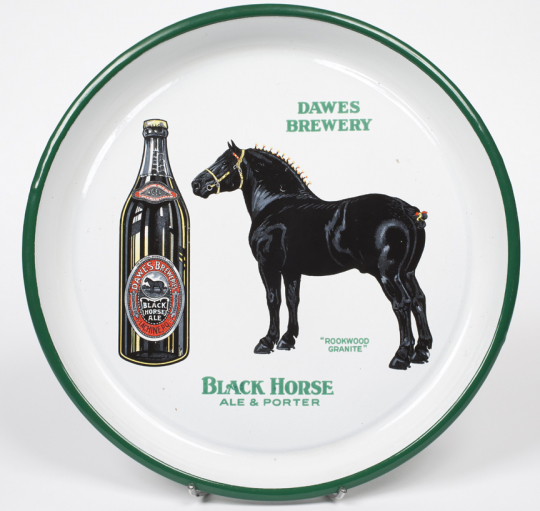
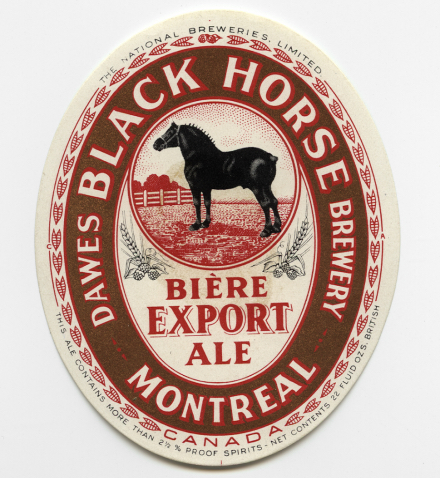
In addition, the Dawes family was among the founders of the Société d’Assurance Automobile du Québec , created in 1904 under the name of the Automobile Club of Canada . Andrew J. Dawes also headed Bell Canada, the Merchant Bank and other large companies. In addition, the Dawes imported and raised black percherons and contributed to the improvement of this horse breed. It will be remembered that it was Percherons who ensured the delivery of the beer and that they thus became the symbol of the Dawes brewery thanks to Black Horse beer .

In 1862, the Dawes built their imposing family home in Lachine (which was not sold until 1940). Around the Dawes area, large fields were devoted to the cultivation of barley and hops.

The decline of the Dawes brewery began in 1909, when sixteen Quebec breweries merged into the National Breweries Ltd. consortium. But the Dawes Brewery survived this ordeal, even if the company felt the effects of American prohibition in the 1920s. In 1939, it became the Dawes Black Horse Brewery, recalling its most famous beer.

In 1944, the Dawes proposed a merger with Molson, but the latter refused for fear of establishing a monopoly. The National Breweries Ltd. consortium was finally sold in 1952. It was bought by Canadian Breweries . The group is renamed Dow Brewery (moreover, the Dow Brewery had already existed for years, it was the designation for the whole consortium). The  Dawes Black Horse Brewery disappears, as does the great Dawes dynasty. The Dow has long become one of the most popular brands among Quebecers, but that’s another story.

This image has an empty alt attribute; its file name is 49751631748_65194de230_c.jpg
This image has an empty alt attribute; its file name is 49752165626_0f6fc0f9f3_o.jpg
This image has an empty alt attribute; its file name is 49752497317_5501f252ff_o.jpg

Filed Under: Birthdays, Breweries, Just For Fun Tagged With: Canada

Beer In Ads #5026: Falken Schaffhauser Oster Bock

July 16, 2025 By Jay Brooks

Last year I decided to concentrate on Bock ads. Bock, of course, may have originated in Germany, in the town of Einbeck. Because many 19th century American breweries were founded by German immigrants, they offered a bock at certain times of the year, be it Spring, Easter, Lent, Christmas, or what have you. In a sense they were some of the first seasonal beers. “The style was later adopted in Bavaria by Munich brewers in the 17th century. Due to their Bavarian accent, citizens of Munich pronounced ‘Einbeck’ as ‘ein Bock’ (a billy goat), and thus the beer became known as ‘Bock.’ A goat often appears on bottle labels.” And presumably because they were special releases, many breweries went all out promoting them with beautiful artwork on posters and other advertising.

Wednesday’s poster is for Falken Schaffhauser Easter Bock Beer, and was published in 1930. This one was made for the Bierbrauerei Falken Schaffhausen, or Falcon Brewery, of Schaffhausen, Switzerland. The brewery was founded in 1799, and is still in business today, and is “considered the only independent brewery in the Schaffhausen region,” and is Switzerland’s 5th largest brewery. This one is for their Schaffhauser Bock and shows a very thirsty man who apparently shimmied up the town maypole to grab one of the bottles of beer tied to the wreath at the top. It was created by Swiss artist Arnold Oechslin.
Filed Under: Art & Beer, Beers, Breweries, Just For Fun Tagged With: Advertising, Bock, History, Switzerland

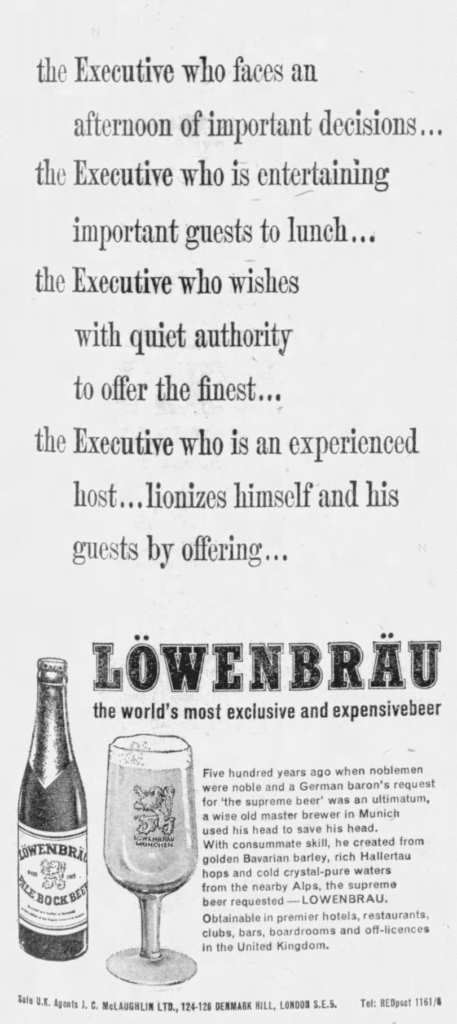
Beer In Ads #5025: Löwenbräu Pale Bock Beer

July 15, 2025 By Jay Brooks

Last year I decided to concentrate on Bock ads. Bock, of course, may have originated in Germany, in the town of Einbeck. Because many 19th century American breweries were founded by German immigrants, they offered a bock at certain times of the year, be it Spring, Easter, Lent, Christmas, or what have you. In a sense they were some of the first seasonal beers. “The style was later adopted in Bavaria by Munich brewers in the 17th century. Due to their Bavarian accent, citizens of Munich pronounced ‘Einbeck’ as ‘ein Bock’ (a billy goat), and thus the beer became known as ‘Bock.’ A goat often appears on bottle labels.” And presumably because they were special releases, many breweries went all out promoting them with beautiful artwork on posters and other advertising.

Tuesday’s ad is for Löwenbräu Pale Bock Beer, which was published on July 15, 1964. This one was for the Löwenbräu Brewery of Munich, Germany, which was originally founded in 1383. This ad ran in The Evening Standard, of London, England. The text is pretty hilarious, and that final tagline: “Löwenbräu the world’s most exclusive and expensive beer.”

Filed Under: Art & Beer, Beers, Breweries, Just For Fun Tagged With: Advertising, Bock, Germany, Great Britain, History

Historic Beer Birthday: Otto Schell

July 15, 2025 By Jay Brooks

august-schell
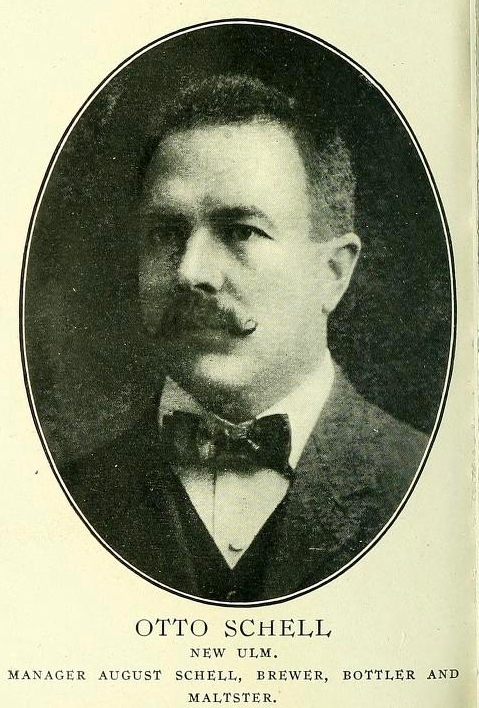
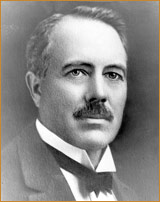
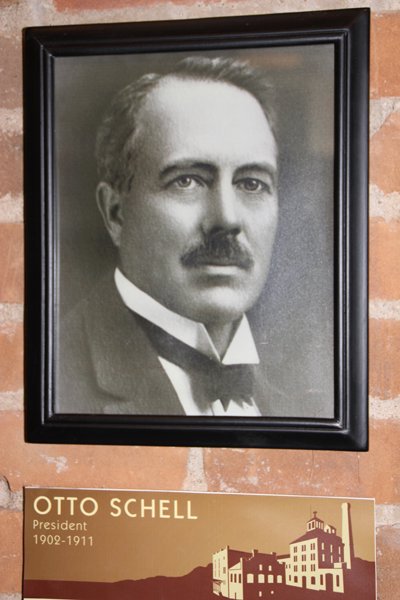
Today is the birthday of Otto Schell (July 15, 1862-January 14, 1911). He was born in New Ulm, Minnesota, the son of August Schell, who founded August Schell Brewing Co. Schell’s Brewery is still in business today, and is still owned by the family who started it. “It is the second oldest family-owned brewery in America (after D. G. Yuengling & Son) and became the oldest and largest brewery in Minnesota when the company bought the Grain Belt rights in 2002.” When August died in 1891, he left the brewery to his wife Theresa, with his son Otto as manager of the brewery. “While the brewery mourned the loss of its founder, Otto became its driving force. In 1902 the brewery was incorporated and Otto was elected president, his mother Theresa was elected vice-president, and his brother-in-law George became secretary-treasurer. Otto was president from 1902 until his untimely death in 1911.

This is his obituary from the New Ulm Review, for January 18, 1911:

It would be difficult to call in mind the death of any citizen in this community that came with more shocking effect and produced a more sincere mourning throughout the entire city than does that of Otto Schell. Is it possible that the man of sturdy physique and with healthy and pleasant countenance, seen on our streets but the day before, greeting his friends and acquaintances in his usual pleasant way should now lie cold in death? Yes it is true. Otto Schell died about 10 o’clock, apparently of no other cause than a choking spell which according to the first reports, was due to a severe cold he contracted some time ago. An autopsy held over his body however revealed the fact that his sudden death was cause by uraemic poison due to kidney trouble of severeal years standing. Even on the morning of the day of his death he resumed his regular duties at the office of the brewery continuing same until noon. Before going home he called on his aged mother who lies at the point of death. This was his daily custom. Being somewhat indisposed he remained at home that afternoon, but was able to partake of a hearty supper. At about 8 o’clock, however, his condition became such as to necessitate a physician who promptly responded, but whose help was of no avail, The end came at 10 o’clock.

otto-schell

In the death of Mr. Schell New Ulm loses one of its most prominent and public spirited citizens. Having been born and reared in this city its welfare was always uppermost in his mind. His ardent love for the beauties of nature prompted him to convert the surroundings of his home and establishment into a veritable beauty spot. This trait also made him valuable to the community at large in the capacity as park commissioner, which office he held for several years. His loss is furthermore keenly felt by various enterprises in which he was interested in a financial and social way, such as the New Ulm Stone Co.; the Brown County Agricultural Society; the Citizens State Bank; the New Ulm-Maennerchor; the 2nd Regiment Band; the Sons of Hermann Lodge; the Freemasons; the Arbelterverein, etc. The State Horticultural Society elected him a Life-member. He also belonged to the State Brewmasters Association. Although he never held a political office he was ever ready to be of servce to the community by lending his assistance with his practical knowledge, ability and experience.

The relation of the deceased as employer of his employees was such as to give evidence to his manly character and kindness of heart. This sincere sorrow manifested by them at the announcement of his death gave ample proof of the high esteem in which he was held by everyone in his employ.

The highest tribute, however that can be paid to any man is his ideal attitude toward the immediate members of his family. And in this respect too much can not be said in honor of the deceased. Although the loss of Mr. Schell is a heavy blow to the community it will be most keenly felt by his wife, children and all relatives. A loyal and true husband, a loving, kind and affectionate father, a dear brother, a devoted son, a good neighbor will be missed in the Schell home.

He had the rare faculty of strictly attending to his own business and never allowing himself to be unduly influenced by any faction sentiment. Herein lies the secret of the fact that he was probably as popular a man in all factions as as ever lived in the confines of this city.

Otto Schell was born July 15,1862 in New Ulm. He received his education in the public schools of this city. At the age of 16 years he went to St. Paul, attending a business college in that city. Completing this course he became a student at the Mankato Normal School. Having finished his business education he worked in his father’s office for about one year. When 19 years old he made a journey to Germany, visiting his father’s native town where he remained a little over a year. On his return he resumed the office work at his father’s brewery.

On the 6th of October, 1885 he was married to Miss Adelia Schwertfeger of New Ulm. After the death of his father, August Schell, the deceased managed the extensive business for his mother. When in the year 1903 the brewery was converted into a stock company he became the president and business manager of the new concern, which position he held up to the time of his death. In 1901 he made another trip to Germany being accompanied by his wife and two children.

Mr. Schell is survived by his wife and two children, Walter. 16 years and Mrs. Cleveland Frederich of Springfield; his aged mother, Mrs. August Schell; three sisters, Mrs. Geo. Schneider, Mrs. Geo. Marti of this city and Mrs. Yoerg, of Winthrop and one brother, Adolph of Portland, Oregon.

Otto_Schell-0

And this is the portion of the Schell story from Immigrant Entrepreneurship that discusses Otto’s involvement in the brewery:

August Schell navigated the challenges of developing a rural business by strengthening family ties in the brewery’s operation. Like many small business founded by immigrants, family dynamics played a large role in the company as the children grew older. They would play a more crucial role in brewery operations as August Schell became increasingly unable to walk due to steadily worsening rheumatoid arthritis. He turned over day-to-day operations to his family in the late 1870s. The first family member to emerge within the company was Schell’s oldest son, Adolph. Adolph traveled to Chicago to learn brewing techniques and train at another brewery before coming back to New Ulm. By 1879, Adolph was directly involved in managing the company. Though August Schell initially appointed his younger son, Otto, as master brewer for the firm, by the mid-1880s he had decided that Otto was better suited than Adolph to take the reins of the company.

After attending public school in New Ulm, Otto attended business college in St. Paul and completed a business education degree at nearby Mankato Normal College. When he was nineteen years old, Otto lived for a year in his father’s German hometown while studying brewing. After returning to the U.S., he began working in the brewery’s business office. The exact reasons behind August Schell’s decision to groom his younger son as his successor are no longer known, but soon after Adolph’s brief period as brewmaster and Otto’s return to New Ulm, Adolph was shifted out of key leadership roles in the company and given a variety of other jobs. Adolph then established his own business distributing Schell beer in areas a few hours west of New Ulm, and later moved to California in 1889 to start a fruit and chicken ranch. Though newspaper reports highlighted Adolph’s desire for a better climate as the deciding factor in his move, family reports emphasized the growing enmity between the brothers. By the early 1880s, Otto Schell had taken control of the brewery’s operations. When August Schell died after becoming increasingly weakened by arthritis at the age of 63 in 1891, he had ensured that his company would continue to prosper while still remaining in family hands.

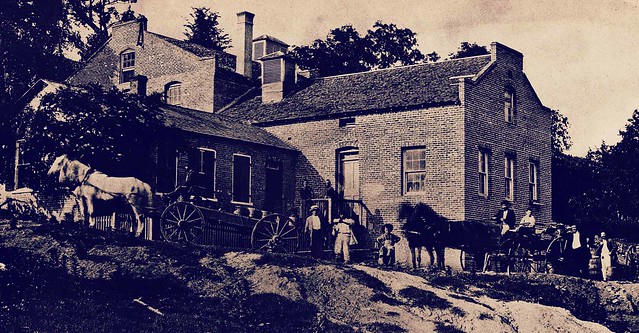
Such family politics along with the frontier challenges and his growing competition spurred August Schell and his son, Otto, to expand and innovate. By 1879, August Schell’s continuous expansion had created a massive brick brewery with several outbuildings on the bluffs of the Cottonwood River. The main brewery was 150 feet long and from 30 to 80 feet in depth. Two main copper brew kettles dominated the brewery – one with a 25-barrel capacity and the other with a 12-barrel capacity. Underneath the main floor of the brewery were seven separate stone cellars for lagering beer and malting barley. There were four ice houses capable of storing 700 tons of ice. The ice was harvested from the Cottonwood River which ran 100 feet below the brewery at the bottom of the cliff. Each block of ice would be attached to tongs and hauled by a team of horses to the cellars via a rope and pulley system.

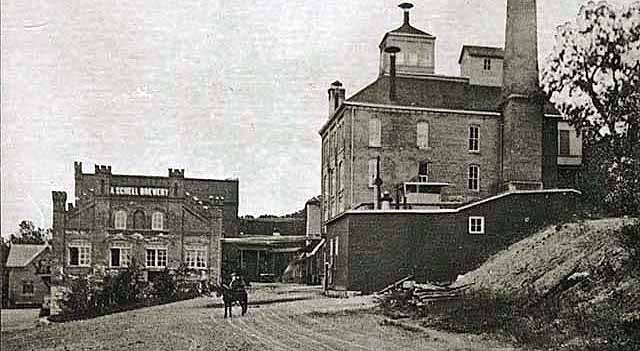
Schell-brewery-1860s

Schell Brewing Company’s physical plant grew even more once Otto Schell took over daily operation of the company and initiated a major renovation of the brewery. In 1887, the company installed bottling equipment in order to reach broader regional markets and appeal to retailers and consumers who did not wish to purchase an entire barrel of beer at one time. The brewery kept expanding the market for its beer as railroads made transporting beer into new regions easier. For example, in 1890, the company built an ice house in St. James, Minnesota, (about 30 miles south of New Ulm) as a distribution point. In the fall of 1890, Schell erected a new two-story brick building to house beer and ice, as well as a barley storage house to take the place of an older framed building, at a cost of $7,000 for both ($179,000 in 2011 dollars). By 1891, Schell’s produced nearly 9,000 barrels of beer a year. Otto Schell proposed to more than double the brewery’s capacity so that it could produce over 20,000 barrels a year. The expansion would take the company to a production level that only a few other breweries in the state could match, even in the Twin Cities. With plenty of cash netted from doing a brisk business over the previous several years, Schell plowed the money back into the physical plant. He hired a Chicago architect to design the changes. Throughout much of the fall and winter of 1892-1893, the brewery shut down in order to complete the rebuilding effort. For approximately six weeks, new roads were built around the facility. Shell spent almost $20,000 ($510,000 in 2011 dollars) on constructing this modernized and expanded brewery. Most of the new expansion was completed just as the Panic of 1893 derailed the United States’ economic engine. Without having to rely upon loans or banks to stay solvent, however, the Schell Brewing Company weathered the Panic of 1893 remarkably well.

Otto Schell both expanded the brewery’s physical plant and invested heavily in new, expensive machinery to stay at the head of the crowded brewing industry in New Ulm. In 1895, the company again expanded by building a four-story malting house adjacent to the brewery with the intent of manufacturing malt on a commission basis. In the mid-1890s, the brewery upgraded its machinery including a new copper kettle able to produce 125 barrels of beer at a time, steel mash tubs and tanks, and other up-to-date equipment. In 1897, Otto Schell traveled to St. Louis, a city with a sizeable German-American community, to buy ice machines for better refrigeration of beer and improved ventilation. Otto Schell invented and patented a new machine and a new method for separating hops from beer in 1902. This innovation cut the costs associated with filtering the beer in half, which further increased revenue in the long term.

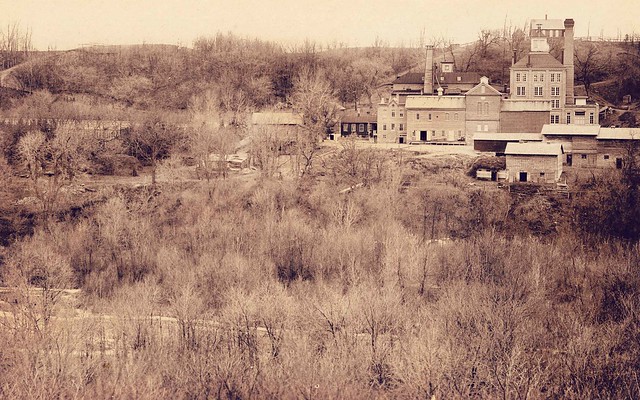
Schell-brewery-distance
The Schell brewery seen from a distance.

When Otto Schell incorporated the August Schell Brewing Company in October of 1902 at $300,000 ($8,090,000 in 2011 dollars), he established a tradition of appointing only family members to the board of directors. The original board of directors listed Otto Schell as president, Theresa Schell, his mother and the wife of founder August Schell, as vice-president, and George Marti as secretary and treasurer. When Otto Schell died at the age of 48 in 1911, George Marti, August Schell’s son-in-law, took over as president of the August Schell Brewing Company. Operation of the company has remained within the Marti family ever since.

Though August Schell Brewing Company remained a relatively small regional brewery (one among many prior to Prohibition) compared to giants such as Anheuser-Busch and Schlitz, the close ethnic ties cultivated by German immigrants and organizations in New Ulm helped the firm to maintain a distinct identity and regional appeal. Continued family connections also played a role in sustaining the August Schell Brewing Company during Prohibition when it produced root beer (1919 Root Beer) and candy to stay afloat. Considering how few breweries remained viable outside of the large corporate breweries in post-Prohibition and post-World War II America, the fact that New Ulm boasted two breweries into the 1960s is noteworthy but also reflects the regional support for local brewing operations. After over 100 years in business, Hauenstein Brewing Company, Schell’s closest and most direct competition in its marketplace, closed its doors permanently in 1969. Such persistence proved stronger in rural ethnic communities like New Ulm where linguistic ties held people closer to others like them compared to similar sized ethnic communities in larger cities.

Schell-brewery-1879

Social Status, Networks, and Public Life

Although the Turnverein organization aided August Schell’s initial rise in Cincinnati and later New Ulm society, Schell’s growing wealth and regional prominence soon made him a respected public figure beyond his status as a Turner. By the late 1870s, August Schell could indulge in developing his interests outside of business. He spent considerable wealth to design and create a new family mansion and elaborate gardens in the 1870s. Acting the part of a respected member of society, August Schell became a patron of the arts by hiring a young, and eventually notable, artist, Anton Gag, to help in the creation of his mansion. Like his father, Schell delighted in the outdoors and everything associated with it. He continually added to his deer park, the symbol of his brewery, which eventually grew to include sixteen deer by the time of his death in 1891. Every time an animal was added to his menagerie, the newspapers reported it. For example, while there were plenty of native deer in the area, Schell imported a tame fawn from Wisconsin to inhabit his backyard. Numerous wild animals from the Upper Midwest increasingly called the Schell deer park home, including wild geese, cranes, and pheasants. Schell’s tastes in animals ran to the exotic as he got older. In 1890, the newspaper reported that Schell’s pet monkey had escaped from its cage and was only captured five days later.

As August Schell rose in public prominence, he gradually separated himself from the local Turnverein. Schell remained a member of the Turners until his mid-fifties in 1884. Neither of his sons became members of the New Ulm Turnverein (though his son-in-law, George Marti, who eventually took over the family business in the early twentieth century became a member in 1879). Even prior to 1884, though Schell may have remained a member of the Turners, he became less prominently involved in the organization. Due to rising tensions between Turners and non-Turners in the region, Schell’s actions are not surprising. Small-town, frontier societies, in particular, breed familiarity and close ties but also sharp resentments among a population where everyone was a known quantity. The stark differences in worldviews of the Catholic German-Bohemians (who formed the bulk of the working class in New Ulm) and the liberal Turners like Schell who disdained organized religion bred underlying tensions within the community. Schell and his fellow Turners dominated the public life of New Ulm for decades. Even into the 1890s, the Turners still controlled the six-member school board that set the curriculum, hired teachers, managed the land owned by the school district, and planned construction of new schools. The total removal of religion from the schools, enforced by Turner school board members, angered many citizens of New Ulm. The Turners’ outright opposition to religion was anathema to religious parents at time when elsewhere in the United States the separation of church and state was much more loosely interpreted by school boards. This strong conviction flowed naturally out of their freethinking, liberal philosophy. Education, they believed, was the best means to combat the mysticism and superstitions bred by organized religion. Controlling the public school board, the Turners stamped their liberal philosophy upon the schools’ curriculum. For example, they used German-language textbooks published by the Turners. The public schools closed for Turner holidays as well. Furthermore, the school board held their meetings at Turner Hall. Though the Turners themselves continued using German as their primary language for years to come, they insisted that English receive primary consideration in the public schools. Their children would be raised as Americans who would be comfortable in an English-speaking world. This sentiment was not embraced by all within the borders of New Ulm. The 1892 annual New Ulm school meeting during which new school board member would be elected became a referendum on Turner influence in New Ulm in all areas of public life. One of the candidates that won a seat on the board in this election was a prominent businessman, Charles Silverson, owner of the Eagle Roller Mill in New Ulm and an immigrant from Baden as well. Silverson and his allies now openly charged the Turners with manipulating the public school system and the city’s politics.
Schell-brewery

Whether intentional or not, Schell and his family were conspicuously absent among the business leaders who participated the fight over control of the public school system of New Ulm. For immigrant entrepreneurs like Schell, getting caught up in such social and political divisiveness could have had clear financial repercussions among a knowledgeable customer base with alternate choices. Although Schell held a strong market presence in south-central Minnesota, he still faced competition not just from other breweries in New Ulm but from even more distant breweries, especially with the advent of the railroad. Seeking to maintain the widest customer base, Schell likely knew he would lose market share if he, his family, or his company were perceived as part of the simmering social crisis in the region. The Schell Brewing Company, like nearly all small-town businesses, had to negotiate intensely personal tensions within the local community in order to thrive. Market share and financial success were often impacted not simply by their product alone but by public perceptions of the company and its leaders.

Although factions within New Ulm hardened their animosity towards each other, the Schell Brewing Company remained above the fray. These examples of opposition to the Turners provide a valuable window into the community during the crucial period in Schell’s company history when control was passing from August Schell to his son, Otto. Well before the conflict of the 1890s, the Schells’ had become regarded as major public figures in New Ulm and the surrounding region not because of their status as Turners but because of their beer. Without alienating their old Turner allies and connections, the Schell family withdrew from membership in the Turners just as the non-Turner population increased dramatically, which proved to be a wise business move for the firm (perhaps as forward-looking as any other decision in the company’s history). The conflict could have led to the family being branded as elitist Turners. Instead, the Schell family retained their long-developed status as widely respected businessmen.

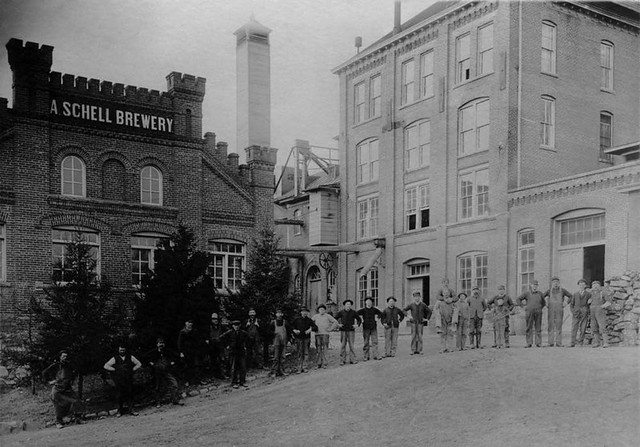
Schell Brewery workers around 1900.

Filed Under: Birthdays, Breweries, Just For Fun Tagged With: History, Minnesota

Beer In Ads #5024: Now Ready! Gettleman’s Bock Beer

July 14, 2025 By Jay Brooks

Last year I decided to concentrate on Bock ads. Bock, of course, may have originated in Germany, in the town of Einbeck. Because many 19th century American breweries were founded by German immigrants, they offered a bock at certain times of the year, be it Spring, Easter, Lent, Christmas, or what have you. In a sense they were some of the first seasonal beers. “The style was later adopted in Bavaria by Munich brewers in the 17th century. Due to their Bavarian accent, citizens of Munich pronounced ‘Einbeck’ as ‘ein Bock’ (a billy goat), and thus the beer became known as ‘Bock.’ A goat often appears on bottle labels.” And presumably because they were special releases, many breweries went all out promoting them with beautiful artwork on posters and other advertising.

Monday’s ad is for Gettelman’s Bock Beer, which was published on July 14, 1939. This one was for the A. Gettelman Brewing Co. of Milwaukee, Wisconsin, which was originally founded in 1855. This ad ran in The Journal Times, of Racine, Wisconsin.

Filed Under: Art & Beer, Beers, Breweries, Just For Fun Tagged With: Advertising, Bock, History, Wisconsin

« Previous Page
Next Page »

Find Something

Northern California Breweries

Please consider purchasing my latest book, California Breweries North, available from Amazon, or ask for it at your local bookstore.

Recent Comments

  • Bob Paolino on Beer Birthday: Grant Johnston
  • Gambrinus on Historic Beer Birthday: A.J. Houghton
  • Ernie Dewing on Historic Beer Birthday: Charles William Bergner 
  • Steve 'Pudgy' De Rose on Historic Beer Birthday: Jacob Schmidt
  • Jay Brooks on Beer Birthday: Bill Owens

Recent Posts

  • Beer Birthday: Alexandra Nowell March 18, 2026
  • Beer In Ads #5169: The Best Of The Bocks March 17, 2026
  • Beer In Ads #5168: Hey! It’s Bock Beer Day To-Day! March 17, 2026
  • Beer In Ads #5167: Acme Bock Is Back Tomorrow! March 16, 2026
  • Historic Beer Birthday: John Land March 16, 2026

BBB Archives

Feedback

Head Quarter
This site is hosted and maintained by H25Q.dev. Any questions or comments for the webmaster can be directed here.