
The foodie website Chowhound recently posted a complimentary report on the San Diego beer scene. As some commenter’s ponted out they mssed a few worthy spots such as O’Briens’s and the Liar’s Club, but for a weekend trip they did a pretty good job.
Aussie Beer & Chocolate
Despite the questionable questioning question mark in the title, there’s a good, positive beer and chocolate story on tomorrow’s — damned international dateline — “The Age,” a Melbourne, Australia newspaper. When I saw the title, Beer and Chocolate?, and that damnable question mark, I confess that I flinched, expecting the worst. But happily, the author was merely toying with us and, after a short set up, comes clean that it’s “Belgian truffles and Chimay Grand Reserve or a slice of chocolate mud cake with a foaming mug of James Squire Porter or Coopers Stout” that will be the subject matter at hand. Yum.
Trappist Beers & Chocolate Dinner
Bruce Paton, the Beer Chef’s, 3rd annual Beer & Chocolate Dinner paired ten Trappist beers from six out of the seven monastery breweries authorized to call themselves Trappists by the International Trappist Association (ITA). In addition to hors d’oeuvres accented with chocolate (paired with Orval and Chimay Cinq Cents), there were four courses. The first course was a delicious lobster bisque infused with milk chocolate and crème fraiche and paired with Westmalle Dubbel and Chimay Premiere. When they started bringing the bowls of bisque into the dining room, the air was thick with the aroma of lobster, but when you tasted it the chocolate really came through as the dominant flavor.
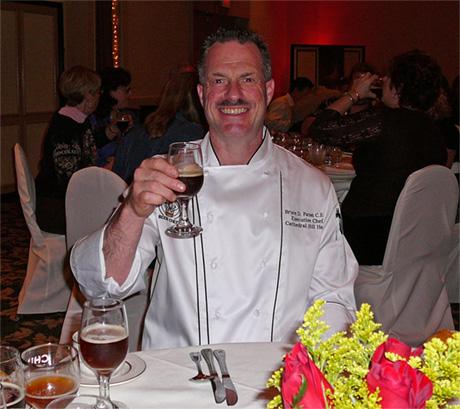
The table I sat at was Chef Bruce’s table, too, so we got some great insight on how he chose the pairings, found the ingredients and prepared the dishes. Next up was breast of squab with sweet potato chocolate flan and natural jus paired with Achel and Westmalle Tripel.

The third course was Angus beef short ribs braised in Chimay with parsnip puree dark chocolate port wine reduction served with Chimay Grand Reserve and Rochefort 8. The beef was so tender you didn’t need your knife. Also, the parsnips were all but completely overwhelmed by the chocolate flavors, which complemented the meat perfectly.
Guests at the dinner, from left. Cornelia Corey and Ray McCoy (Beer Drinkers of the Year 2001 and 2003, respectively), Bryan Harrell (the Celebrator’s man in Tokyo) and Portland beer writer Fred Eckhardt (who pioneered the beer and chocolate dinner way back in 1988)

The dessert course billed was an “Exploration of Chocolate Delights” which in this case meant three very different chocoholic desserts. There was a lemony chocolate cheesecake, a chocolate mousse with white chocolate pieces in it and a strawberry wearing a tasty white chocolate tuxedo. These were paired with Rochefort 10 and De Koningshoeven Quadrupel. The De Koningshoeven is only one of the seven Trappist breweries in the Netherlands (the rest are all in Belgium) though it is better known by its European name, La Trappe. The only Trappist beer not represented was, of course, Westvleteren, which no longer distributes its beer outside the monastery.
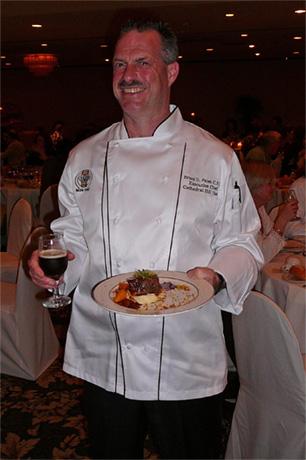
Beer Chef Bruce Paton with his two great passions, food and beer. Thanks Bruce for another terrific dinner. Look for a Valley Brewing dinner at the end of April and a Allagash beer dinner in late May.
Newsweek Discovers Vintage Beer
Alright, it didn’t make the magazine, but it is a “web exclusive” on the Newsweek website. It is an article by Andrew Romano entitled Beer By the Year (thanks to Joe in Florida for sending me the link). The article is about vintage beers and the 25 of them Gramercy Tavern in New York City has added to their menu. It’s great to see Newsweek do a piece on aged beers, though the article suffers from the usual snide disbelief that beer could be worth spending money on and be something beyond a drink for the masses, or as Romano envisions it, an “equal-opportunity inebriator.”
Then there’s this dissmissive description:
This is beer we’re talking about. You know, the stuff shirtless football fans drink from a helmet. Sure, boosters might do well to take a page from wine’s playbook: according to the latest figures from the National Institutes of Health, alcohol consumption from beer (per capita) is down 6 percent since 1992, while “classier” vino is up 17 percent.
A little later in the article Romano grudgingly admits that some beers may benefit from aging but then claims that that’s true only “in theory.” He makes this claim because the final product may not necessarily turn out to be good after all. Why? One explanation is that the aging must be done properly: at the right temperature, in a dark place, etc. Here’s his other reasons.
Brewers, unlike vintners, release their beverages when they’re ready to drink, and aging is an inexact science. Given time, some bottles soar; others sour. With vintage beer, you always run the risk of liking the final draft less than the first.
This makes it sound as if he’s inferring that wine doesn’t have such issues, that aging wine is an exact science. But the exact same risks he brings up are true for wine, as well. First of all, plenty of wines are released too early but just as many are ready to drink, too. And then to age a wine properly, all the same steps involving light, temperature and so on must also be followed for the wine to have benefitted from the aging process.
Many — if not most — of the beers meant to be aged are not released when they’re green, but have in fact been aged for a period of time before being released to the public for further aging. I spoke to Vinnie Cilurzo of Russian River Brewing and he confirmed that he does age many of his beers either in the tank, barrel or bottle before releasing them to the public, some for a few weeks and some for many months. He wants the flavors to be right and the taste to have mellowed or changed in a positive way before they’re out of his hands.
I don’t quite understand why the author feels the need to qualify aging beer as having unique risks. “Given time,” not every bottle of wine will age well either, so why is he making it sound like aging is a different process for wine and beer?
Happily, Romano doesn’t stick with that tone and for the most part is convinced that vintage beers are worth their higher price tag. Romano and his dinner companion try six vintage beers and like all of them, and love a couple, especially the 1992 Thomas Hardy.
According to the article, Gramercy Tavern “gave beer-by-the-year its big-league, fine-dining debut with a select 25-bottle list of vintage suds from Europe, Japan and North America. The response, says assistant beverage director Kevin Garry, has been ‘amazing’—and it could mean more mainstream acceptance to come. ‘Based on how our guests have reacted, I can totally see vintage beer catching on at other places,’” says Garry, who pairs his bottles with cheeses and desserts. ‘I’d love to see it become the next cool thing in the fine-dining world.’”
As the article ends, Romano can’t resist bad-mouthing beer one more time in his last sentence, which concludes, “[w]e stumble home shortly thereafter.” Let’s see, two men share six bottles of beer. That’s three apiece. And not all were big 750 ml bottles. Thomas Hardy bottles are 11.2 ounces. Yes, some of the beers were strong, but overall not compared to the average wines. Would a wine writer having consumed an equal amount of wine ever claim to have “stumbled” home afterwards? Not in a million years.
Celebrator Beer News Anniversary Party This Sunday
This coming Sunday is the 19th anniversary party for the Celebrator Beer News, one of the magazines that I write for. It will be held at Trumer Brauerei in Berkeley, California from 4 to 8 pm. This year will also feature a Mardi Gras theme, with three bands, craft beer from fifteen breweries and BBQ and Cajun/Creole food. Tickets are $40, and are available on-line from the Celebrator website. To get a flavor of what the party will be like, check out my photos from last year. I’ll be there, most likely working the door, so say hello when you check-in at the entrance.
From the press release:
The Celebrator Beer News will celebrate its 19th anniversary on February 18, 2007, with a Mardi Gras-themed party from 4 to 8 pm at the Trumer Brauerei in Berkeley, Calif.
At least 15 other breweries will pour favorite brews. Meet Celebrator writers and beer industry luminaries, including pioneer figures in the craft beer movement. Cajun/Creole food, music from three bands and beer are included!
Breweries pouring include Anchor Brewery, Anderson Valley, Pacific Coast, Deschutes, Ommegang, BridgePort, Russian River, Sierra Nevada, Triple Rock, Trumer Pils, Valley Brewing, Widmer/Redhook and more.
Music includes a Dixieland Jazz Band and an industry Battle of the Bands with performances by the Hysters (Anchor Brewery) and the industry-staffed Rolling Boil Blues Band!
Tickets are on sale now: $40 per person, including BBQ and Cajun/Creole food, beer and music. Discount rooms will be available at the Cathedral Hill Hotel in San Francisco ($79 per night). Call 800-622-0855 and ask for the Celebrator rate. If you want to stay in Berkeley after the event, there is a deal at the Hotel Durant. Call 510-845-8981 and ask for the Manager’s rate. This event takes place one day after the start of the Barleywine Festival at the Toronado!
For more information, call 510-538-2739. Ticket sales by Visa/MC, phone 800-430-BEER or buy tickets here through PayPal.
Shoo Fly Beer Pie
I was surprised to come across a recipe for Shoo Fly Pie, especially in a Chicago area newspaper. I grew with Shoo Fly Pie, it was available at most restaurants and bakeries where I grew up. It’s essentially an Amish or Mennonite dessert, although there are versions of it in the deep south, too. It’s basically a pie made with molasses as the filling. Because it’s so sweet it was thought to attract flies which then have to be “shooed” away, and that’s supposedly how it got its name. When I was a little kid, I thought it was made with actual flies and refused to eat it. But now I love it, though it’s not the sort of thing you find here in California.
But the Northwest Herald has a recipe in their Saturday edition for Brown Ale Beer Shoofly Pie, courtesy of the NBWA. Authentic shoo fly pie, of course, doesn’t use beer and the Amish drink very little alcohol, and many drink none at all. But I can certainly see how adding some brown ale could work quite well, so I’m willing to give it a try. Here are a number of traditional recipes for Shoo Fly Pie at Berksweb, a tourist website for the county where I grew up in Pennsylvania.
Wet-Bottom Shoo Fly Pie.
Here’s the Brown Ale Beer Shoofly Pie recipe:
1 cup, plus 2 tablespoons all-purpose flour
3/4 cup light brown sugar (packed)
3/4 teaspoon ground cinnamon
1/4 teaspoon salt
1/4 cup cold butter, cut into small pieces
1 large egg
3/4 cup brown ale beer (porter beer may be substituted)
1 cup mild molasses
1 teaspoon baking soda
1/4 cup boiling water
1 (9-inch) ready-to-use refrigerated pie crust (or frozen 9-inch pie shell, thawed)Preheat oven to 375 degrees F.
In bowl of a food processor, combine flour, brown sugar, cinnamon and salt. Pulse to mix. Add butter; pulse until mixture resembles fine crumbs. Remove 1/2 cup of the crumb mixture and set aside.
In large bowl, beat egg until well blended. Add beer and molasses; stir until just combined. In small cup, dissolve baking soda in boiling water. Stir into molasses mixture; add crumb mixture from food processor bowl. Stir mixture until well blended.
Pour mixture into pie shell. Top with reserved 1/2 cup crumb mixture. Bake in oven 35 minutes, or until filling is puffed and just set, and crumb mixture is lightly golden. Cool completely.
The Chronicle’s Super Bowl Suggestions
With two days until the Super Bowl, as big a television party event as there is, the San Francisco Chronicle makes a few suggestions on how to choose the right beer for your party foods. Though the author, Christina Kelly, can’t resist throwing wine into the mix, too, because, of course, she’s a wine writer. And that’s exactly who’d you want to write a piece about beer and food pairings, a wine columnist.
So as a result, wine is the very first word written in one of the few articles one might reasonably expect could be, for a change, all about the beer. She admits “tradition” gives the Super Bowl to beer, but still can’t help talking about how inexpensive wines “work surprisingly well” with “[m]ost game day foods.” Which is, I think, hogwash. Most of the spicy foods enjoyed at the average Super Bowl party distort wine’s flavors. As Garrett Oliver explains it, spicy flavors turn “white wines hot and red wines bitter.”
But the Chronicle’s “rule of thumb” for beer is “the hotter and spicier the food, the darker the beer.” Why would you pair spicy foods with roasted malt flavors like coffee and chocolate? A much better choice would be lighter and/or hoppier beers that can stand up to the spices and cut through them. But of course, she’s probably talking about darker more modestly, insofar as almost everything with flavor is darker than American-style light lager.
So here are the snack foods and their suggestions. I’ll ignore the wine suggestions, as, I think, they should be ignored.
Guacamole
Okay, to be fair she didn’t do too badly here, suggesting a pale ale. I agree with that one though would add that an IPA would work well, too. I don’t know why she mentions an Australian beer, when one from Goose Island or the Pale Ale from Alcatrazz Brewing in Indianapolis would make more sense. Also, she suggests you “try a Pilsner beer like Beck’s,” which I wouldn’t wish on a mortal enemy. If you want a pilsner, get a real one, though I think a richer amber lager would work better anyway. The Super Bowl is a peculiarly American event, what’s with all the imported beer suggestions?
Chili
This is priceless. “A no-brainer here — select a frosty Corona or a Negra Modelo and a wedge of lime. It’s refreshing and the lime works great with chili, no matter how spicy.” I think the brain might be useful here after all, especially to help you avoid a beer with a lime in it and particularly Corona, one of the worst beer choices anyone can make. If I read her sentence again, it sounds like she’s also saying you could put a lime wedge in the Nega Modelo, too. I can’t imagine that’s what she means, but it does read that way.
Better still would be a nice brown ale, like BridgePort’s new Beer Town Brown, or an Irish stout. Even a pale ale or IPA would work better than an insipid Corona. You want something rich enough to stand up to the strong flavors in most chili.
Potato Chips
I know I promised to stay away from the wine suggestions, but I simply can’t imagine pairing cheese Doritos with “a medium and fruity Zinfandel.” I do, however, believe she’s correct when she writes “[p]lain chips work with nearly every beer.” Of course, I love potato chips almost as much as my children, so I’m not exactly rational about this one.
Nachos
If spice and jalapenos dwell on your nachos, go for a malty beer — Anchor Liberty Ale has a firm malt background that will cool the tongue. You can’t go wrong with Anchor Porter either.
Hmm. I’m not sure I think of Anchor Liberty Ale as a big “malty” beer. It’s hops are certainly restrained compared to, say, Sierra Nevada Pale Ale, but it’s still a pale ale. If you think malty is the way to go, a marzen or Oktoberfest beer would probably work better. But floral, citrusy hops that’s found in most pale ales and IPAs would also work quite nicely.
Buffalo Wings
With the kind of spicing in buffalo wings, I’m not convinced that a hoppy beer — as she suggests — is the answer. She also states that “spicier needs the darker bitter to take on the hot sauce,” which to me seems to suggest the author believe that dark equals hoppy. Perhaps I’m mis-reading that, but what else could she mean by “darker bitter?”
Actually, I think a maltier beer such as a brown ale, a porter or even an amber ale would pair up much better. The author also mentions that “a hefeweizen brought those wings to their knees” when it was slathered in a red hot sauce, but I can’t see how wheat beer would stand up to it, much less bring them to their knees. But that, at least, I’d be willing to test.
Pizza
Finally we agree. Anderson Valley Brewing’s Boont Amber is an excellent pizza beer, as are most good pale and amber ales, along with marzens and amber lagers, too. Depending on the toppings, I can see an IPA performing well but generally a more well-balanced beer should do the trick.
Overall, Christina Kelly’s article and suggestions aren’t terrible though I do disagree strongly with some of her choices. More importantly, I still don’t quite understand why the media insists on handing out beer assignments to wine writers. That’s quite frustrating both on a personal and professional level. How much more fun would this article have been if the Chronicle had instead asked a wine writer to choose the wine pairings and also hired a beer writer to choose the beers? Let them go head to head. That would have been a much better way to go, in my opinion. In that way, they could have let the reader decide for themselves knowing an expert in each field had made the choices.
Half Moon Bay’s Restaurant Reviewed
Inside Bay Area today has a nice review of the restaurant at Half Moon Bay Brewing by the coast in Princeton-by-the-Sea. The food gets an okay review which is improved overall by the location, atmosphere and the view. The reviewer does like the beer at least, as she writes.
Most people looking to fill their bellies are here for the beer. The brewery employs Alec Moss, a brewer with deep roots concocting beers for breweries in San Francisco and San Mateo. All of the beers, which are brewed on site, are good, but my favorites are the robust amber and the citrus-y Princeton-by-the-Sea IPA.
Alec in the brewhouse at Half Moon Bay Brewing taken about a year ago when several Bay Area brewers got together there to sample one another’s Poor Richard’s Ales brewed for Benjamin Franklin’s 300th birthday anniversary.
And just to annoy the people who believe children and beer don’t mix, here are some photos of my daughter Alice during the same brewery visit, when she was about eighteen months old.
Eager to help out in the brewery.
Proving she’s Daddy’s little girl by trying to steal a taste (no, I didn’t let her).
Pennichuck Pairing of Food & Beer
The Nashua Telegraph in southern New Hampshire has some suggestions for pairing beer and food courtesy of Mike Labbe, the brewer at Pennichuck Brewing.
Brussels in January
On Friday, we left England and took the Chunnel train under the English Channel to Brussels for a quick day trip.
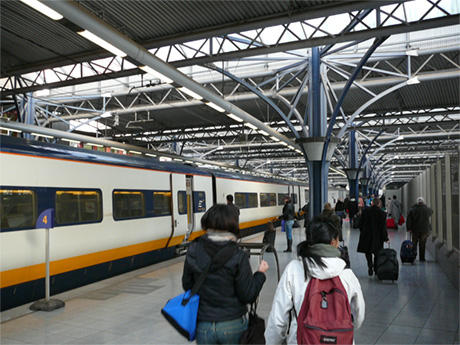
The Eurostar train in Brussels.
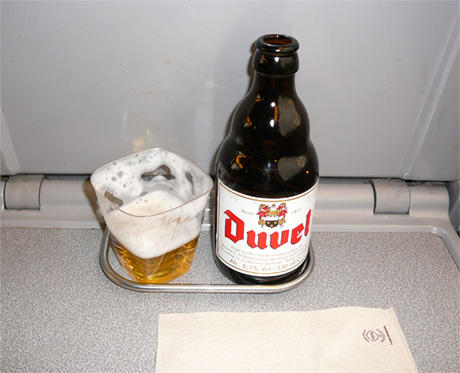
Where you can get a Duvel to enjoy on board.
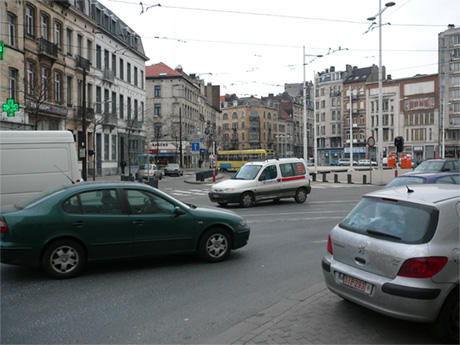
Downtown Brussels near the Midi train station.
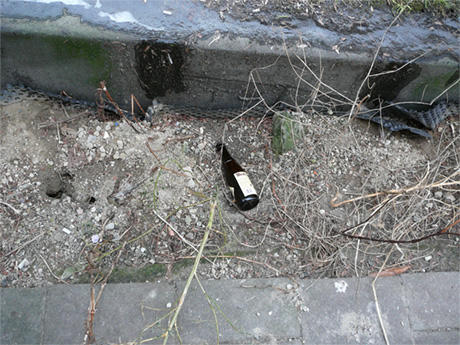
Where even their beer trash is better.
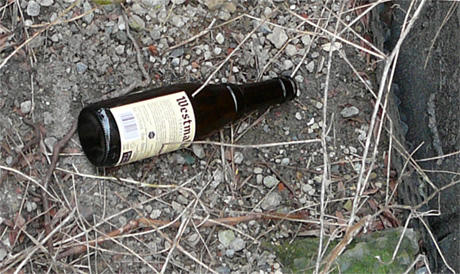
That’s a discarded bottle of Westmalle Tripel.
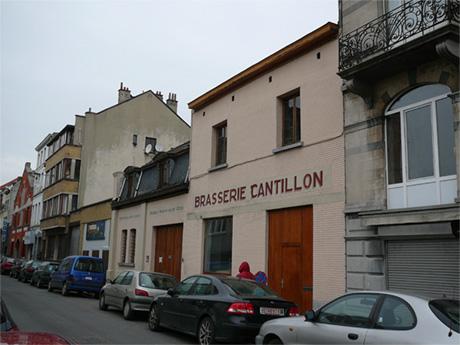
First stop was a tour of Brasserie Cantillon, the last remaining brewery in Brussels.
For the full brewery tour, visit the photo gallery.

Cantillon owner Jean-Pierre Van Roy and me after our tour.
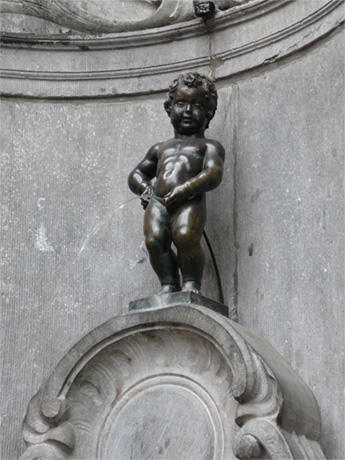
After our tour, we did some quick sightseeing. This, of course, is the famous Manneken-Pis.

Across the street from which was the Poechenellekelder, a bit touristy but with a decent beer selection.

The nearby Grand Place.

Including the Brewers Union building.
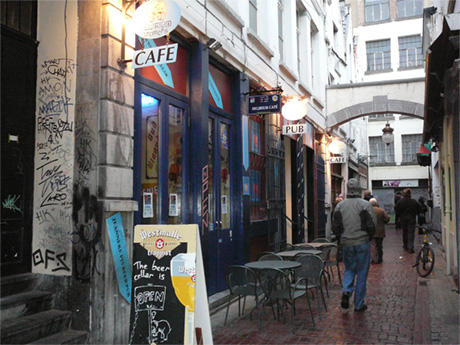
And, of course, the Delirium Cafe, also packed with tourists.
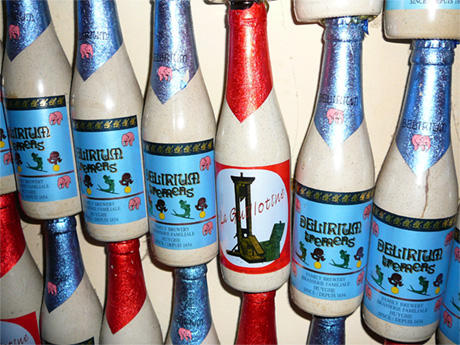
With a spiral staircase lined with Delirium Tremens bottles.
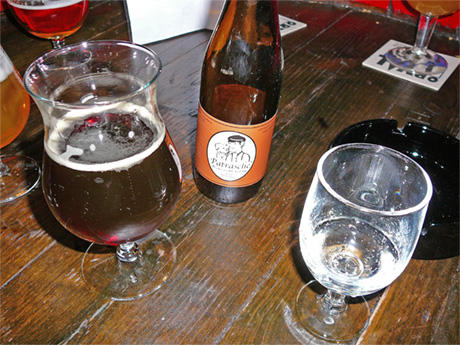
The Floris Absinthe bar across the alley was closed until eight, by the Delirium Cafe had one type of absinthe so I could try some with my beer.

Afterwards, we had a quick dinner at Bier Circus. Here Shaun shows off his steak and the ubiquitous plate of frittes.
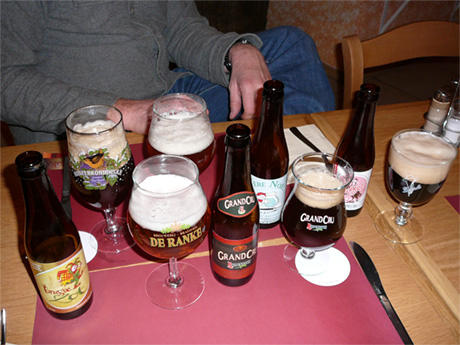
And our beer selection with dinner.
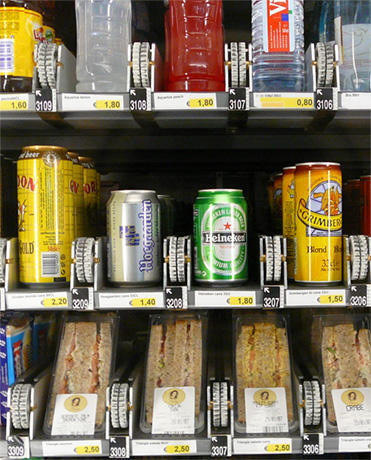
Back at the train station to return to London there was an interesting selection of canned beer in the vending machines. All in all, the trip was too quick to do anything but scratch the surface of the city, but at least we had a chance to do that. I’m certainly looking forward to returning and spending a little more time there.