Brookston Beer Bulletin

Jay R. Brooks on Beer

  • Home
  • About
  • Editorial
  • Birthdays
  • Art & Beer

Socialize

  • Dribbble
  • Email
  • Facebook
  • Flickr
  • GitHub
  • Instagram
  • LinkedIn
  • Pinterest
  • RSS
  • Twitter
  • YouTube

Powered by Genesis

No Beer At Royal Wedding?

April 25, 2011 By Jay Brooks

uk
Another royal wedding’s coming up this Friday. I care about it as much as the last one in 1981 — not one whit. In deference to my British colleagues and friends who cling to the notion that the royal family matters, I’ll spare you my usual diatribe. But it was announced recently that no beer will be served at the The Royal Wedding (with it’s own “official” website, how klassy) between Prince William and commoner — could there be a more insulting term to call someone to their face? — Kate Middleton.

That’s right, no beer at a British wedding. The reason, according to the Daily Mail, is that “while the younger royals enjoy a pint from time to time, neither Kate nor William is a big beer drinker so they decided to leave it off the menu.” Which is, of course, all well and good if you take the position that it’s their wedding, they can — and should — do as they like. Personally, I had my wedding reception in a brewery. And as British clergyman Sydney Smith quipped in 1934, “what two ideas are more inseparable than beer and Britannia?” So perhaps that makes more British than the man second in line to be king.

But, unlike my wedding or your wedding, this one hardly counts as a private affair, it’s a national event and should, I suspect, reflect the nation. At a time when British beer is suffering, pub closings are epidemic and neo-prohibitionists have their attack dogs out, you would think this might be a perfect time to celebrate the wedding with that most British of drinks, cask ale. But, no, apparently champagne is more to the liking of the royals, or at least the ones who planned the wedding. But here’s the part that should have every red-blooded Brit up in arms. This is the “official” reason given for the ban on beer at the wedding. “It is thought that guests knocking back pints of ale was considered rather unseemly for such a regal affair attended by royals and heads of state from around the world” or put even more bluntly by a Daily Mail source, “[l]et’s face it, it isn’t really an appropriate drink to be serving in the Queen’s presence at such an occasion.” Really, that’s the problem? That the Queen might object to the drink her people should be most proud of, that contributes greatly to her nation’s economy, and is enjoyed by the majority of her subjects being served at her grandson’s wedding? If the royal family was truly in touch with “their people,” I should think they’d come to a very different conclusion.

Their source added. “It was always their intention to give their guests a sophisticated experience and they have chosen the food and drink with this in mind.” And there the other shoe drops. Beer isn’t “sophisticated” enough for a royal wedding. Wow.

UPDATE: Pete Brown had a similar reaction to this news and wrote a post, Beer ‘Not Appropriate’ For Royal Wedding that made some similar points and then a great many more of them, all spot on. Though hilariously, you can see in the comments, there are many people who do think the royals are still above criticism and even that no one should use “bad” language when discussing them. Oh, dear, and we’re considered the provincial ones. Hilarious.

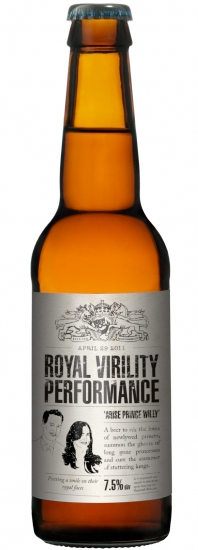
Luckily, Scotland’s BrewDog has just the thing for this sort of nonsense, a beer entitled Royal Virility Performance. With only 1,000 bottles to be released the day before the wedding, here’s how it’s described:

A limited-edition beer containing herbal viagra to mark the forthcoming royal wedding of Prince William and Kate Middleton on April 29th. Brewed using various well known aphrodisiacs, the limited edition artisanal beer will only be available to buy from the BrewDog.com website.

According to the specially commissioned label, the Royal Virility Performance contains herbal viagra, chocolate, Goat Weed and ‘a healthy dose of sarcasm’. The beer is a 7.5% ABV India Pale Ale and has been brewed at BrewDog’s brewery in Fraserburgh.

With this beer we want to take the wheels off the royal wedding bandwagon being jumped on by dozens of breweries; The Royal Virility Performance is the perfect antidote to all the hype. A beer should be brewed with a purpose, not just because some toffs are getting married, so we created something at our brewery that will undermine those special edition beers and other assorted seaside tat, whilst at the same time actually give the happy couple something extra on their big day.
BrewDog-royal-virility-btl

Filed Under: Editorial, Events, Food & Beer, News, Politics & Law Tagged With: new release, UK

Boycott Under Way On Beer Stocked By Alabama A-B Distributors

April 25, 2011 By Jay Brooks

alabama
Free the Hops, the organization in Alabama that successfully won the fight over hard opposition to allow beer over 6% abv in the state, is calling for a boycott of both Anheuser-Busch products along with those beers distributed by A-B Houses in Alabama. The boycott is a result of A-B distributor lobbyists “blocking the Legislature’s passing [of] the Brewery Modernization Act,” which Free the Hops helped pass “in the Alabama Senate earlier this month.” The Birmingham News has a full account of the story in an article entitled Free the Hops calls for boycott of beers stocked by Anheuser-Busch distributors in Alabama. Free the Hops also has a boycott statement on their website along with a list of the distributors involved. Essentially the law would simply allow brewpubs to no longer be subject to antiquated laws, such as having to be located in “a historic building” or be located in “a county that had a brewery prior to 1918.” Ridiculous stuff. It would be hard to argue that the law as it stands makes any sense or is a fair under any definition. But apparently the A-B beer distributors in Alabama see it as competition that cannot be allowed, despite the fact that in most of the other 49 states, brewpubs and beer distributors happily co-exist with one another.

I was originally in favor of the boycott, as it seems like there isn’t much choice insofar as what the Bud houses are doing. But as several people have pointed out, it will also harm a great number of craft brewery’s business in the state as well. Free the Hops obviously recognizes that fact and their concern is buying craft beer from one of the A-B distributors is still “channeling profits to wholesalers.” So in a way, it’s a bit like chemotherapy. Honestly, I’m conflicted. As Lew Bryson said in an exchange we had on Facebook. “This is odd territory for most beer drinkers: asking them to boycott a DISTRIBUTOR rather than a brand is confusing enough, but asking them to boycott craft beers to help craft beer…? Not going to work. If I were in Alabama, I would directly encourage people not to support a boycott of any craft brands for this reason. This is not the way to do it.” So I think we all agree that boycotting the ABI products is the way to go, but as for the craft brands … that seems like a much trickier, thornier issue. I can see both sides of the argument, and am left unsatisfied by either one. In the end, I think it’s going to be up to everyone’s individual conscience on what to boycott.

Filed Under: Beers, Breweries, Editorial, Events, News, Politics & Law Tagged With: Alabama, Anheuser-Busch, Beer Distributors, Law

UK Gov’t Statistics On Women Drinking Found To Be Wrong

April 19, 2011 By Jay Brooks

ofc-nat-stats
For the second time in a few years, a UK Government agency has admitted to making a mistake regarding statistics used in the creation and furtherance of alcohol policy. The first, in 2007, was when the UK’s Department of Health revealed that the definition of a hazardous drinker, that is what the safe limits of alcohol intake were said to be, was completely made up, quite literally “plucked out of the air.”

On Monday, the UK’s Office for National Statistics (ONS) “admitted that it misrepresented the trends in alcohol consumption and has issued a sincere apology to the Portman Group, the drinks industry organisation that champions responsible drinking.”

According to Straight Statistics:

In a report about the productivity of the NHS published at the end of last month, the claim was made that the proportion of women drinking more than 14 units a week had increased by a fifth since 1998, leading to a greater demand for healthcare. As Straight Statistics reported here, there was no justification for such a claim.

A change in methodology for measuring alcohol consumption in 2006 creates a break in the time series. If not allowed for, this gives the impression that the number of women who exceed 14 units a week has indeed increased. Plenty of anti-drink campaigners are happy to spread this false message but it came as a shock when the ONS did so.

David Poley, chief executive of the Portman Group wrote to Stephen Penneck, Director General of the ONS, who has now replied admitting that Mr Poley’s concerns are “entirely justified”. He blames a “lapse in the quality assurance process by which we check carefully the accuracy and reliability of any information that is for publication … unfortunately in this rare instance a key issue went unnoticed.”

The article and press release have been amended. The article, accessible here, is now proceeded by a correction notice. The press release now reads: “The percentage of males and females consuming over the weekly recommended alcohol limits declined from 2006 to 2009.”

Mr Penneck’s response is prompt, straightforward, and makes no attempt to fudge the issue. If only it were equally easy to persuade the media to look more critically at its assumptions about drinking being out of control.

At least they admitted their error. I doubt the same would be true on this side of the pond, where statistical errors tend to live in perpetuity if they serve the anti-alcohol agenda. But the original stories that parroted the incorrect statistics that drinking for women has increased in The Daily Telegraph, the Daily Mail and the Daily Star are still out there and, as far as I know, have not been corrected. They can’t be, really, because the stories focused on the false problem at the heart of the mistake. And that’s the same here, too, as propaganda — even after it’s been disproved — is still used by numerous anti-alcohol groups. Repeat a lie often enough and … well, you know the rest.

Filed Under: Editorial, News, Politics & Law Tagged With: Prohibitionists, Statistics, UK, Women

Rare Beer Prices On eBay

April 18, 2011 By Jay Brooks

ebay
A GT Wharton posted an interesting survey that he conducted about the prices people will bay for rare beer on eBay. His article, entitled Market Behavior for Rare Beer: eBay Auction Prices in Review appeared today on Rate Beer’s Hop Press. It appears to be a quite thorough look at auction prices realized over a one-month period. His dataset included 887 auctions. The average price was $122 ($137 w/shipping included). $9.50 was the low price and $999 the highest.

The five most expensive auctions by 12oz volume were:

  1. Midnight Sun M: $544.77
  2. Cantillon Don Quijote: $312.40
  3. Cantillon Rose de Gambrinus 1992 Vintage: $284.00
  4. Russian River Depuration: $265.07
  5. Flossmoor Station Wooden Hell: $260.12

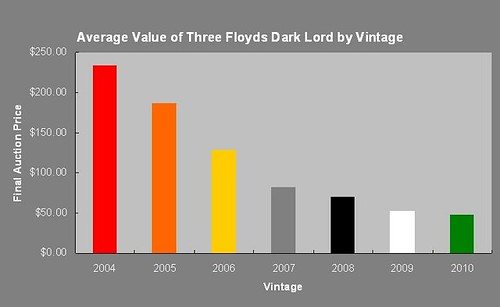
And here, for example, is a chart showing “Average Value of Three Floyds Dark Lord by Vintage.”
Wharton-Ebay1

Interesting stuff. He doesn’t go into the moral dilemma of selling beer on eBay and the fact that most brewers decry the practice, but from a merely numbers perspective it’s worth a read.

Filed Under: Beers, Editorial, Politics & Law Tagged With: Business, Websites

When Science Becomes Propaganda: The Caffeine & Alcohol Conundrum

April 18, 2011 By Jay Brooks

science
Ugh. To me there’s nothing worse than junk science, especially when it’s in the service of an agenda. And that’s how this latest “study” in the journal Alcoholism: Clinical and Experimental Research comes across. The title of the “study” is Effects of Energy Drinks Mixed with Alcohol on Behavioral Control: Risks for College Students Consuming Trendy Cocktails and was conducted at the Universities of Northern Kentucky and the Maryland School of Public Health. Here’s how the press release for the study explains it:

  • A new laboratory study compares the effects of alcohol alone versus alcohol mixed with an energy drink on a cognitive task, as well as participants’ reports of feelings of intoxication.
  • Results show that energy drinks can enhance the feeling of stimulation that occurs when drinking alcohol.
  • However, energy drinks did not alter the level of behavioral impairment when drinking alcohol, particularly for impaired impulse control.
  • The combination of impaired impulse control and enhanced stimulation may make energy drinks combined with alcohol riskier than alcohol alone.

Energy drinks mixed with alcohol, such as Red Bull™ and vodka, have become trendy. While this consumption has been implicated in risky drinking practices and associated accidents and injuries, there is little laboratory research on how the effects of this combination differ from those of drinking alcohol alone. A recent laboratory study, comparing measures of intoxication due to alcohol alone versus alcohol/energy drink, has found that the combination of the energy drink enhanced feelings of stimulation in participants. However, the energy drink did not change the level of impairment for impulsive behavior. These findings suggest that energy drinks combined with alcohol may increase the risks associated with drinking.

But take a closer look at what that says. The caffeine stimulates. Well, duh. That’s what caffeine does. Did anybody doubt that? Then the study goes on to say that “energy drinks did not alter the level of behavioral impairment when drinking alcohol,” meaning it didn’t make people more drunk. Then they conclude combining caffeine and alcohol “may increase the risks associated with drinking [my emphasis].”

Here’s how they conducted it:

Marczinski [lead author] and her colleagues randomly assigned 56 college student participants (28 men, 28 women), between the ages of 21 and 33, to one of four groups that received four different doses: 0.65 g/kg alcohol, 3.57 ml/kg energy drink, energy drink/alcohol, or a placebo beverage. The participants’ behavior was measured on a task that measures how quickly one can execute and suppress actions following the dose. Participants also rated how they felt, including feelings of stimulation, sedation, impairment, and levels of intoxication.

“We found that an energy drink alters the reaction to alcohol that a drinker experiences when compared to a drinker that consumed alcohol alone,” said Marczinski. “A consumer of alcohol, with or without the energy drink, acts impulsively compared to when they had not consumed alcohol. However, the consumer of the alcohol/energy drink felt more stimulated compared to an alcohol-alone consumer. Therefore, consumption of an energy drink combined with alcohol sets up a risky scenario for the drinker due to this enhanced feeling of stimulation and high impulsivity levels.”

“To reiterate,” said Arria, “the investigators found that the presence of an energy drink did not change the level of impairment associated with alcohol consumption.” It did, however, change the perception of impairment.

“The findings from this study provide concrete laboratory evidence that the mixture of energy drinks with alcohol is riskier than alcohol alone,” said Marczinski. “College students need to be aware of the risks of these beverages. Moreover, clinicians who are working with risky drinkers will need to try and steer their clients away from these beverages.”

But that’s hardly “concrete” as she characterizes it. In fact, it’s the very opposite of concrete. It didn’t change impairment, just how people felt about it, how they perceived it. From that “insight” they concluded that since being stimulated “sets up a risky scenario for the drinker” that therefore the risk is greater. And they recommend that people should “be aware of the risks.” So far, so good. But if you didn’t realize drinking coffee after alcohol would stimulate you, perhaps you shouldn’t be in college after all. Maybe it’s time to lower your sights if that obvious bit of wisdom eluded you. I hear McDonald’s is hiring.

When Marczinski states that “[y]oung people are now drinking alcohol in different ways than they have in the past” I have to wonder what her evidence is for that nonsense. People have been mixing caffeine and alcohol for as long as the two have been around, I’d wager. This is one of those generational things, where the older one always believes the younger generation is worse than they were. The only difference between when I was a kid and now, at least regarding caffeine and alcohol, is that you don’t have to go to the trouble of mixing it yourself.

And I shouldn’t have to say this, but I’m not a fan of alcopops or alcoholic drinks with caffeine added (that is not naturally occurring like many coffee stouts, for example). But for me, that’s not the issue. The issue is society going out of its mind over a perceived problem for which there is only anecdotal evidence that there even is a problem. And this study seems like more of the same. I don’t like these drinks, don’t drink them myself, but I don’t think they should be banned just because some people don’t like them. There are obviously adults who bought them, and want to continue buying them, and they shouldn’t be removed from shelves just so that kids can’t buy them. Kids are already prohibited from buying them. If kids can still get them, that’s an entirely different problem. Kids can’t own guns either, but I don’t see any movement to ban all guns so that we can keep them out of the hands of children. That’s just not how a society should function. We shouldn’t make the world safe for our children by only allowing kid friendly products to be in it.

In the end, this “study” is hardly the hard evidence that the caffeine and alcohol conundrum has now been solved and they’ve found the data to close the book on this scourge. Even its authors know as much, as they use qualifying words all over the place. Their hesitation is right there in the title of the press release, which is “Drinking energy beverages mixed with alcohol may be riskier than drinking alcohol alone.” [my emphasis.] Up front, it tells you this is not as conclusive as you might otherwise think because they admit that a greater risk is simply possible. Beyond using an almost laughable 56 test subjects, the study simply jumps to anecdotal conclusions that are not supported by what passes for hard data. There really isn’t any hard data beyond people’s feelings after having consumed alcohol and then alcohol with caffeine and the authors then concluding those feelings might turn into actions that were riskier.

But even as honestly as the study states that their “findings suggest that energy drinks combined with alcohol may increase the risks associated with drinking,” naturally that’s not how it’s being reported. Every headline has essentially removed the qualifying “might” and made it sound far scarier and more conclusive than it really is. Here’s just a few examples.

Combining Energy Drinks with Alcohol More Dangerous Than Drinking Alcohol Alone at Partnership for a Drug Free America and as linked to a Join Together e-mail blast. And that report begins by stating that “A new study finds that consuming a caffeine-infused energy drink combined with alcohol is more dangerous than drinking alcohol alone.” But that’s not what the study concluded at all.

Likewise, HealthDay’s headline was Alcohol-Energy Drink Combo Riskier Than Booze Alone, Study Says, MedPage states Alcohol and Energy Drinks, a Risky Combination and News Feed Researcher claims Study: Alcohol, Energy Drinks Are Risky Combo. But again, those headlines are misleading. That’s not what the “study” claims. The “study” never even mentions drunk driving, but sure enough some of the news reports do. All the “study” says is that drinking alcohol and caffeine might make you feel more stimulated which might possibly lead you to act more impulsively, which might make you engage in riskier behaviors. Maybe. Maybe we can agree that’s not exactly science, but propaganda.

Filed Under: Editorial, News, Politics & Law Tagged With: Prohibitionists, Propaganda, Science, Statistics

The Brain and Alcohol Research Project

April 17, 2011 By Jay Brooks

trinity-college
Trinity College, in Hartford, Connecticut, at the end of March released some preliminary results after three years of a five-year study entitled the Brain and Alcohol Research Project. In a press release entitled What Students’ Brains Have Told Us about the Effects of Binge Drinking, they revealed the following:

Young adults who binge drink tend to perform worse in class than normally would have been expected, but only in the first year of college. After that, drinking to excess produces no discernible difference in academic performance.

So the obvious takeaway from that is that during a student’s first year away from home and away from parental rule, young adults tend to go a little wild that first year but then settle down into academic life for the remaining three years of their four-year college experience. They may not stop drinking, but they figure out how to hit the books, too. It seems rather predictable when you think about, especially when there’s virtually no alcohol education prior to college and in some states even parents are forbidden from educating their own children about drinking.

But it also seems to fly in the face of the neo-prohibitionist hue and cry about underage drinking being as bad for student performance as believed. And undoubtedly the worst of it is because it’s underground as a result of the minimum age being 21 instead of a more reasonable 18.

Also known as BARCS (for Brain and Alcohol Research with College Students), the project is “a large-scale longitudinal study that includes more than 2,000 college students from diverse backgrounds, set out to definitively address previously unanswered questions such as: Can heavy drinking in college affect brain structure and grades? If so, is it related to the overall amount of alcohol consumed or more to consumption patterns, such as binging and blackouts? Why is it that many students drink heavily in college but only a minority goes on to have alcohol problems after college? Are all adolescents affected equally by alcohol in terms of possible effects on brain and risk for later alcohol abuse? Is there a way to identify the people who will be longer-term problem drinkers?”

Unfortunately, I believe they begin with a failed premise. The study defines binge drinking “as a pattern of drinking that raises a person’s blood alcohol content to 0.08 percent or above.” That means drinking enough to be considered drunk at the lowest BAC allowed in most jurisdictions is the same as binge drinking. It’s amazing how what it means to binge drink keeps getting lower and lower, presumably in an effort to make the perceived problem seem increasingly worse. But this greater incidence of binge drinking is due entirely to continually redefining its meaning. Equating binge drinking with merely being drunk (under the legal definition) removes any distinction between the two and renders it meaningless.

Filed Under: Editorial, News, Politics & Law Tagged With: Prohibitionists, Statistics

Thirty Percent Of Americans Drink Once A Week

April 16, 2011 By Jay Brooks

harris-poll
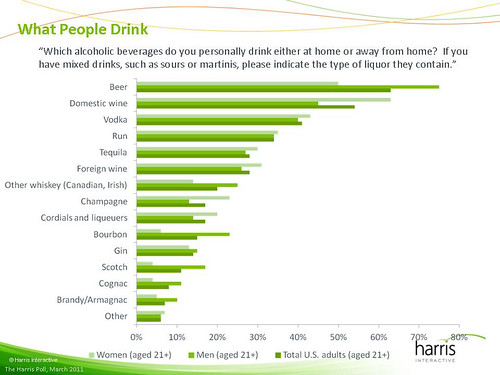
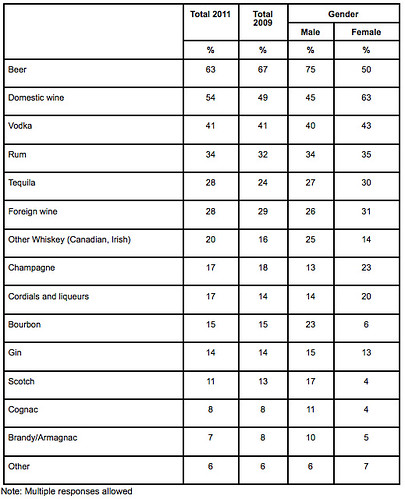
A Harris Poll conducted in March of this year concluded that Three in Ten Americans Drink Alcohol at Least Once a Week. The poll, conducted by Harris Interactive, surveyed 2,379 adults between March 7 and 14, 2011. Not surprisingly, beer continues to be the most popular alcoholic beverage, followed by American wine and vodka. And men still drink beer more than women “75% vs. 50%.”

Harris-What_People_Drink-2011

Here are some other findings from the poll:

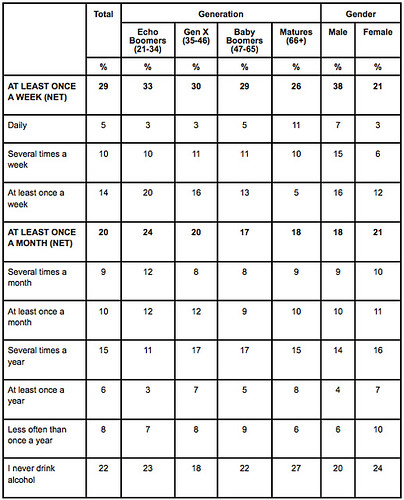
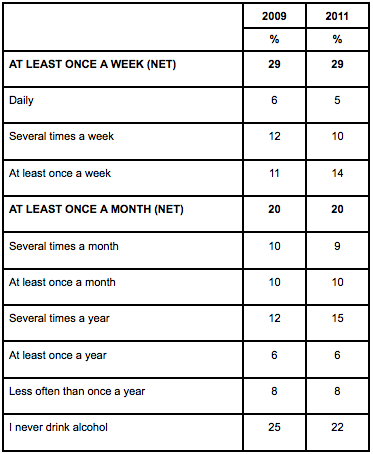
Question 1: “How often do you drink alcohol, including beer or wine?”

Harris-2001-1

Question 2: “How often do you drink alcohol, including beer or wine?”

Harris-2001-2

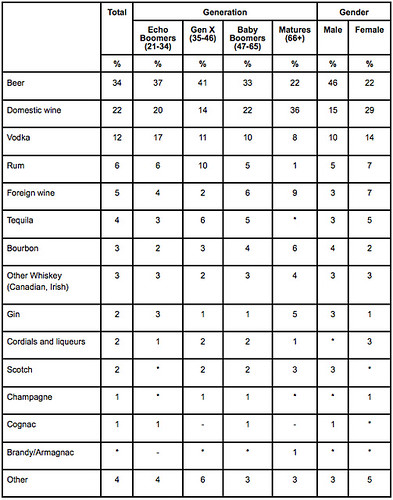
Question 3: “Which alcoholic beverages do you personally drink either at home or away from home? If you have mixed drinks, such as sours or martinis, please indicate the type of liquor they contain.”

Harris-2001-3

Question 4: “Although you may drink several types of alcoholic beverages, which one type would you say you drink most often?”

Harris-2001-4

Naturally, I have a couple of quibbles:

  1. Why did they separate out domestic and foreign wine, but not domestic and foreign beer?
  2. “It’s probably not surprising that men and women have different drinking preferences.” Maybe, but isn’t this something of a self-perpetuating prophecy? I know plenty of women who love beer and find wine too sweet. I also know women who claim to find beer too bitter but drink their weight in coffee. I can’t help but wonder if we keep reinforcing this by asking the question, and people respond with the answer they think is the case, which ends up making it real when maybe it’s not.
  3. “According to many doctors and medical studies, a glass of wine is good for one’s health. And even beyond wine, a drink, as long as it’s in moderation, is something that people shouldn’t be afraid of having.” Goddammit, why does this one persist, that “wine” is good for you but the rest are not? By omission, the statement implies that beer and other alcohol is not “good for one’s health” or at a minimum not “as” good which infuriates me. And adding the qualifying statement that “beyond wine” it’s okay to drink the other alcoholic drinks “as long as it’s in moderation” likewise implies that it’s healthful to drink as much wine as you like. How can they be so detail-oriented about the statistics involved in polling, and so ignorant in their statements of analysis? Sheesh.

Filed Under: Beers, Editorial, News Tagged With: Poll, Statistics, United States

Your Brain On Beer

April 14, 2011 By Jay Brooks

brain-2
A new study conducted at the Waggoner Center for Alcohol and Addiction Research at The University of Texas at Austin appears to indicate that alcohol actually helps your memory, at least at the synapse level; that “alcohol primes certain areas of our brain to learn and remember better.” The new study, published in the April 6 edition of the Journal of Neuroscience, is a mouthful, entitled Previous Ethanol Experience Enhances Synaptic Plasticity of NMDA Receptors in the Ventral Tegmental Area. And the Abstract isn’t much clearer:

Alcohol addiction (alcoholism) is one of the most prevalent substance abuse disorders worldwide. Addiction is thought to arise, in part, from a maladaptive learning process in which enduring memories of drug experiences are formed. However, alcohol (ethanol) generally interferes with synaptic plasticity mechanisms in the CNS and thus impairs various types of learning and memory. Therefore, it is unclear how powerful memories associated with alcohol experience are formed during the development of alcoholism. Here, using brain slice electrophysiology in mice, we show that repeated in vivo ethanol exposure (2 g/kg, i.p., three times daily for 7 d) causes increased susceptibility to the induction of long-term potentiation (LTP) of NMDA receptor (NMDAR)-mediated transmission in mesolimbic dopamine neurons, a form of synaptic plasticity that may drive the learning of stimuli associated with rewards, including drugs of abuse. Enhancement of NMDAR plasticity results from an increase in the potency of inositol 1,4,5-trisphosphate (IP3) in producing facilitation of action potential-evoked Ca2+ signals, which is critical for LTP induction. This increase in IP3 effect, which lasts for a week but not a month after ethanol withdrawal, occurs through a protein kinase A (PKA)-dependent mechanism. Corticotropin-releasing factor, a stress-related neuropeptide implicated in alcoholism and other addictions, further amplifies the PKA-mediated increase in IP3 effect in ethanol-treated mice. Finally, we found that ethanol-treated mice display enhanced place conditioning induced by the psychostimulant cocaine. These data suggest that repeated ethanol experience may promote the formation of drug-associated memories by enhancing synaptic plasticity of NMDARs in dopamine neurons.

Professor Hitoshi Morikawa, who wrote the paper, is slightly less jargon-laden and impenetrable on the University’s website, where he more generally lays out the goals of his research:

This lab specifically focuses on the dopaminergic neurons in the ventral midbrain. They are activated by the perception and expectation of rewards. Therefore, the dopaminergic projections from the midbrain to the limbic structures constitute an endogenous reward circuit. Behaviors that lead to the enhancement of dopamine release in this brain reward circuit tend to be repeated (reinforced). Addictive drugs induce stronger stimulation of dopaminergic transmission than almost any natural reinforcers (food, sex, etc). Thus, drugs are repeatedly used (abused) in vulnerable individuals, which will lead to plastic changes in the reward circuit.

The amount and temporal profile of dopamine release is controlled by the firing pattern of dopamine neurons, which is determined by the interaction of their intrinsic membrane properties and the afferent inputs they receive from other neurons. Accordingly, we make detailed analyses of the influence of addictive drugs on membrane ionic conductances and neurotransmitter inputs of dopamine neurons, and investigate the resulting alteration in the firing pattern. We use brain slices because they retain intact synaptic connections that are necessary for these studies. Brain slices are obtained from drug-naïve animals and animals that are chronically treated with drugs to elucidate the plastic changes induced by repeated exposure to drugs in vivo. Technically, we perform patch clamp electrophysiological recordings combined with confocal fluorescent imaging of intracellular ions. These methods will allow us to delineate the cellular events that determine the excitability of neurons with a preciseness that could not be attained by other conventional techniques. Therefore, this lab offers an ideal system to link the behavior of certain types of central neurons to that of a whole organism.

But a science news website, Physog.com has the most understandable account of the study, and what it means.

Essentially, and somewhat confusingly, the study shows that while common view that too much alcohol can be bad for memory retention and learning, that how your brain reacts to it is more complicated than that.

“Usually, when we talk about learning and memory, we’re talking about conscious memory,” says Morikawa, whose results were published last month in The Journal of Neuroscience. “Alcohol diminishes our ability to hold on to pieces of information like your colleague’s name, or the definition of a word, or where you parked your car this morning. But our subconscious is learning and remembering too, and alcohol may actually increase our capacity to learn, or ‘conditionability,’ at that level.”

So while short terms losses may occur, long term gains in subconscious memory may also be taking place. “Morikawa’s study found that repeated ethanol exposure enhances synaptic plasticity in a key area in the brain, [and] is further evidence toward an emerging consensus in the neuroscience community that drug and alcohol addiction is fundamentally a learning and memory disorder.”

When we drink alcohol (or shoot up heroin, or snort cocaine, or take methamphetamines), our subconscious is learning to consume more. But it doesn’t stop there. We become more receptive to forming subsconscious memories and habits with respect to food, music, even people and social situations.

In an important sense, says Morikawa, alcoholics aren’t addicted to the experience of pleasure or relief they get from drinking alcohol. They’re addicted to the constellation of environmental, behavioral and physiological cues that are reinforced when alcohol triggers the release of dopamine in the brain.

“People commonly think of dopamine as a happy transmitter, or a pleasure transmitter, but more accurately it’s a learning transmitter,” says Morikawa. “It strengthens those synapses that are active when dopamine is released.”

Alcohol, in this model, is the enabler. It hijacks the dopaminergic system, and it tells our brain that what we’re doing at that moment is rewarding (and thus worth repeating).

Among the things we learn is that drinking alcohol is rewarding. We also learn that going to the bar, chatting with friends, eating certain foods and listening to certain kinds of music are rewarding. The more often we do these things while drinking, and the more dopamine that gets released, the more “potentiated” the various synapses become and the more we crave the set of experiences and associations that orbit around the alcohol use.

Between that, and new research from the University of Michigan that may have identified a gene — the GABRA2 — that increases the risk of alcoholism in certain individuals, it seems clear that there are environmental and genetic factors that make some people more susceptible to becoming unable to drink responsibly, along with the obvious psychological factors, too. But what that also suggests is that alcoholism is more like a food allergy insofar as it does not effect everyone in the same way, and in fact the vast majority of people who do consume alcohol are able to do so responsibly and in moderation, which also allows them to take advantage of the many health benefits of drinking in moderation. Contrary to neo-prohibitionist propaganda, not everyone becomes an alcoholic with the first sip they take. Most, in fact, not only don’t, but never do, yet the anti-alcohol contingency tends to treat alcohol as a toxic substance that is dangerous to everyone equally or that everyone has the potential to become an alcoholic. I just don’t think that’s true. And the science seems to bearing that out. And because of all the beer I’ve consumed, I can remember all that, too. Thank you, beer.

Filed Under: Editorial, News, Politics & Law Tagged With: Science, Statistics

The Top 50 Annotated 2010

April 13, 2011 By Jay Brooks

ba
This is my fifth annual annotated list of the Top 50 so you can see who moved up and down, who was new to the list and who dropped off. So here is this year’s list again annotated with how they changed compared to last year.

  1. Anheuser-Busch InBev; #1 last five years, no surprises
  2. MillerCoors; ditto for #2
  3. Pabst Brewing; ditto for #3
  4. D. G. Yuengling and Son; Same as last year
  5. Boston Beer Co.; Same as last year
  6. Sierra Nevada Brewing; Same as last year
  7. New Belgium Brewing; Same as last year
  8. North American Breweries; new entity
  9. Craft Brewers Alliance; Moved down 1 for 2nd straight year
  10. Spoetzl Brewery (Gambrinus); Moved down 1
  11. Deschutes Brewery; Up 2
  12. Independent Brewers United (IBU); Same as last year, with a new name
  13. F.X. Matt Brewing; Moved down 1, after moving up 1 last year
  14. Minhas Craft Brewery; Down 2 over last year
  15. Bell’s Brewery; Up 4 from #19 last year
  16. Harpoon Brewery; Up 1 from #17 last year
  17. Boulevard Brewing; Down 1 from #16 last year
  18. Goose Island Beer; Up 2, for 2nd straight year, from #20 last year
  19. Dogfish Head Craft Brewery; Shot up 5 from #24, after being up 9, 5 and 4 the three previous years
  20. Alaskan Brewing; Down 2 from #18 last year
  21. Long Trail Brewing; Leapt up 14 from #35 last year
  22. August Schell Brewing; Up 4 from last year
  23. Stone Brewing; Same as last year, though they were up 5 each of last two years
  24. Abita Brewing; Up 4 from #28 last year
  25. Brooklyn Brewery; Up 2 from #27 last year
  26. Lagunitas Brewing; Jumped up 10 from #36 last year
  27. Full Sail Brewing; Down 5 for the 2nd straight year
  28. Shipyard Brewing; Down 3 from #31 last year
  29. Summit Brewing; Same as last year
  30. New Glarus Brewing; Up 2 from #32 last year
  31. Great Lakes Brewing; Up 2 from #31 last year
  32. Anchor Brewing; Down 2 from #30
  33. Iron City Brewing; Down 8, after dropping 12 last year, after a Chapter 11 bankruptcy and moving production out of Pittsburgh
  34. Kona Brewing; Fell 13 after being up 2 last year, and 14 the previous year
  35. Rogue Ales/Oregon Brewing; Down 1, after being up 2 last year, canceling being down 2 the previous year, and up 2 the year before that, essentially hovering
  36. Firestone Walker Brewing; Up 4 from #40 last year
  37. Winery Exchange Inc. / World Brew; Novato CA; new to the list this year
  38. Sweetwater Brewing; Up 1 from #39 last year
  39. Mendocino Brewing; Down 2 from #7 last year, after falling 8 the previous year
  40. Flying Dog Brewery; Up 2 from #42 last year
  41. Victory Brewing; Same as last year
  42. Gordon Biersch Brewing; Down 4 from #38 last year
  43. BJs Restaurant & Brewery; Down 1 from #43 last year
  44. Stevens Point Brewery; Up 6 from #50 last year
  45. Odell Brewing; Down 1 from #44 last year
  46. BridgePort Brewing (Gambrinus); Up 1 from #47 last year
  47. Cold Spring Brewing; Not in Top 50 last year
  48. Rock Bottom Brewery Restaurants; Down 3 from #45 last year
  49. Oskar Blues Brewing; Not in Top 50 last year
  50. Straub Brewery; Down 3 from #46 last year

Some new companies made the list, two from mergers — North American Breweries and Independent Brewers United — along with Winery Exchange Inc. as a result of doing a contract private label beer for the Walgreen’s pharmacy chain, Big Flats.

Two breweries are new to the list this year, Oskar Blues and Cold Spring Brewing again, who fell off last year but had been on the list the year before that under their former name, Gluek Brewing. Two more are off the list, Big Sky Brewing and Lost Coast Brewing, who had just cracked the list last year.

If you want to see the previous annotated lists for comparison, here is 2009, 2008, 2007 and 2006.

Filed Under: Beers, Editorial, News Tagged With: Big Brewers, Business, Statistics, United States

Old Enough To Fight, Old Enough For Beer

April 13, 2011 By Jay Brooks

under-21
You probably already saw that Alaska Republican state representative Bob Lynn, a Vietnam vet from Anchorage, is proposing changing his state’s law to allow active duty servicemen to drink as well as die for their country. Seems reasonable enough, but it puts at risk millions of dollars in federal highway funding, because the national minimum drinking age statute mandates that in order to receive federal highway money, a state has to keep its minimum drinking age at 21. The federal law, strong-armed into existence by MADD in the 1980s, effectively bullied states into towing the neo-prohibitionist line. The minimum age is supposed to be a state decision, but no state could afford to leave money on the table so reason and common sense never had a chance, not when the decision was between money and screwing over the rights of young adults who probably weren’t going to vote anyway.

As recently as yesterday, MADD was still crowing that they’re responsible for reducing drunk driving deaths despite the fact that every unbiased economist believe the two are essentially unrelated. The truth is that drunk driving was already in decline in the 1980s, as evidenced by the fact that all age groups saw declines, not just 18-21 year olds.

The Wall Street Journal today has an interesting op-ed piece by Glenn Harlan Reynolds, a law professor at the University of Tennessee, entitled Old Enough To Fight, Old Enough To Drink.

He starts with the obvious argument that an adult who can fight to defend our country (and potentially die in that effort) should at the very least have all the rights and privileges of adulthood. But as a nation we are virtually unique in the world at denying our soldiers between the ages of 18-20 the right to drink alcohol. When I was in the military, we had a soda machine in our day room filled with cans of beer (I think they cost 50 cents) and we were allowed to drink at the bar on base, both at the base I was stationed at in Virginia and then later at my permanent duty station in New York City. Not one person at either location ever abused that privilege. A few got drunk from time to time, but never in a way that affected their responsibilities and their duty.

Which is why I’m so surprised by the military reaction. According to an NPR report, state military commanders have stated they believe it “would encourage unhealthy behavior.” I’m starting to think the military just can’t stand change of any kind, and will complain about any and every proposed change. I recall quite vividly that when I was in the Army, they made a big deal out of us working for civilians, that they were in charge and it was our duty to serve and follow orders. Yet every time some change is proposed to the military, the higher military ranks ignore their own rule and whine to high heaven. But their job is the same as the lowliest private: to shut up and follow orders.

Other complaints include that “[t]he law could set a precedent, said Rep. Alan Austerman, R-Kodiak, where any young person whose profession puts them at risk of losing their life, such as police or firefighters, could be allowed to drink.” Yes, and it’s a valid argument. Adulthood should include all the rights and privileges, not all but one. I don’t really understand how these people can look someone in the face and say, ‘sure you can risk your life, but you’re still not quite an adult yet, we still can’t trust you with alcohol.’ That’s deeply disturbing.

Other protestations include that it “could further increase drunken driving arrests of young soldiers who would drive back from off-base bars” and “[a]lcohol is involved in a third of misconduct incidents on Alaska’s military installation, three generals said in a letter to Rep. Dan Saddler, co-chairman of the House Special Committee on Military & Veterans’ Affairs.” But those are both absurd defenses. Soldiers would still be subject to the same laws as before, and suggesting that they might start breaking the law shows very little faith in them, doesn’t it? Essentially, I think it comes back to our unhealthy perception of alcohol, that people can’t be trusted with it, and therefore it has to be heavily regulated.

My own experience is that as a soldier at 18, my peers who either got jobs or went to college stayed more immature than the people I served with in the military, despite being the same age. As a result, for a while I was in favor of mandatory one-year conscription after high school because the discipline I believe was good for me and I could see how it might have benefited others, too. A few other nations do this, and I haven’t heard any arguments against it. I doubt that’s changed much, so it seems doubly troubling to me that the military is so set against this that they’d accuse their own men and women of being unable to handle alcohol, while expecting them to handle guns, grenades and other weapons. And doesn’t the statement that alcohol is already involved on military bases suggest that it’s the same problem that’s on college campuses, that having it be illegal is what’s causing the problems because it drives it underground?

One of the most telling statements in Reynold’s article is the following:

Research by economist Jeffrey A. Miron and lawyer Elina Tetelbaum indicates that a drinking age of 21 doesn’t save lives but does promote binge drinking and contempt for the law.

Safety is the excuse, but what is really going on here is something more like prohibition. A nation that cares about freedom—and that has already learned that prohibition was a failure—should know better. As Atlantic Monthly columnist Megan McArdle writes, “A drinking age of 21 is an embarrassment to a supposedly liberty-loving nation. If you are old enough to enlist, and old enough to vote, you are old enough to swill cheap beer in the company of your peers.”

And I love his political analysis at the end:

Democrats traditionally do well with the youth vote, and one reason is that they have been successful in portraying Republicans as fuddy-duddies who want to hold young people down. This may be unfair—college speech codes and the like don’t tend to come from Republicans—but the evidence suggests that it works. What’s more, the first few elections people vote in tend to set a long-term pattern. A move to repeal the federal drinking-age mandate might help Republicans turn this around.

Republicans are supposed to be against mandates aimed at the states, so this would demonstrate consistency. Second, it’s a pro-freedom move that younger voters—not yet confronted with the impact of, say, the capital-gains tax—can appreciate on a personal level. Third, it puts the Democrats in the position of having either to support the end of a federal mandate—something they tend to reflexively oppose—or to look like a bunch of old fuddy-duddies themselves.

Principle and politics. If the Republicans in Congress don’t pick up on this issue, we’re going to have to wonder what they’ve been drinking.

My guess is propagandist kool-aid. And while I believe that every eighteen-year old should be allowed to consume and purchase alcohol, it seems monumentally wrong that at the very least our brave young men and women who volunteered to serve and defend our peculiar way of life can’t drink a beer.

UPDATE: Shortly after posting this, I received an interesting press release from the Competitive Enterprise Institute, an organization in Washington DC that appears to lean toward the right or possibly Libertarian.

From the press release:

In most European countries the drinking age is far lower than 21. Some, like Italy, for example, have no drinking age at all. Yet, the rates of alcoholism and teenage problem drinking are far greater in the United States. The likely reason for the disparity is the way in which American teens are introduced to alcohol versus their European counterparts. While French or Italian children learn to think of alcohol as part of a meal, such as a glass of wine at dinner, American teens learn to drink in the unmonitored environment of a basement or the backwoods with their friends. A 2009 study by the National Institute on Drug Abuse, National Institute of Health, and U.S. Department of Health and Human Services concluded that 72 percent of graduating high school seniors already consumed alcohol.

Statement by Michelle Minton, CEI’s Director of Insurance Studies:

The current age limit has created a culture of hidden drinking and disrespect for the law. Regardless of whether a person is in the military or simply an adult civilian, he or she ought to be treated as such. If society believes you are responsible enough to go to war, get married, vote, or sign a contract, then you are responsible enough to buy a bottle of beer and toast to living in a country that respects and protects individual rights. It is long past time the law caught up with that reality.

Filed Under: Beers, Editorial, News, Politics & Law Tagged With: Alaska, Law, Prohibitionists

« Previous Page
Next Page »

Find Something

Northern California Breweries

Please consider purchasing my latest book, California Breweries North, available from Amazon, or ask for it at your local bookstore.

Recent Comments

  • Ernie Dewing on Historic Beer Birthday: Charles William Bergner 
  • Steve 'Pudgy' De Rose on Historic Beer Birthday: Jacob Schmidt
  • Jay Brooks on Beer Birthday: Bill Owens
  • Steve 'Pudgy' De Rose on Beer Birthday: Charles Finkel
  • Steve 'Pudgy' De Rose on Beer Birthday: Bill Owens

Recent Posts

  • Beer In Ads #5204: Oh Brother! Griesedieck Bros. Genuine Premium Bock Beer Is Here! February 15, 2026
  • Historic Beer Birthday: Emil Resch February 15, 2026
  • Historic Beer Birthday: Philip Zang February 15, 2026
  • Beer In Ads #5203: Robert Portner’s Bock Beer February 15, 2026
  • Historic Beer Birthday: August Schell February 15, 2026

BBB Archives

Feedback

Head Quarter
This site is hosted and maintained by H25Q.dev. Any questions or comments for the webmaster can be directed here.