Brookston Beer Bulletin

Jay R. Brooks on Beer

  • Home
  • About
  • Editorial
  • Birthdays
  • Art & Beer

Socialize

  • Dribbble
  • Email
  • Facebook
  • Flickr
  • GitHub
  • Instagram
  • LinkedIn
  • Pinterest
  • RSS
  • Twitter
  • YouTube

Powered by Genesis

Poisoning People During Prohibition: A Disturbing Parable

March 19, 2010 By Jay Brooks

poison
This may well be the most disturbing story about our Nation’s Prohibition ever told, and one that’s certainly been kept fairly secret. While doing research on her book, The Poisoner’s Handbook, author Deborah Blum discovered that anti-alcohol factions of the U.S. government became so fanatical that they poisoned illegal alcohol either directly or indirectly, possibly killing, or more correctly murdering, as many as 10,000 U.S. citizens! Let that sink in. The whole sordid tale can be found on Slate, entitled The Chemist’s War: The little-told story of how the U.S. government poisoned alcohol during Prohibition with deadly consequences. I’d encourage you to read the entire article, but here are the nuts and bolts.

The government added chemical substances to alcohol used for other purposes, like paint thinner, and unscrupulous bootlegger’s were stealing industrial alcohol and then converting it to something that could be consumed. So the government, knowing full well that it would end up being drunk by people, started spiking it with chemicals that were very, very harmful, ones that the bootlegger’s chemists couldn’t deal with and the result was thousands of deaths. Why would our government do that? Here, Blum cites the frustration of lawmakers to stop people drinking along with prohibitionists who were surprised by our “country’s defiant response to the new laws [which] shocked those who sincerely (and naively) believed that the amendment would usher in a new era of upright behavior.”

During Prohibition, however, an official sense of higher purpose kept the poisoning program in place. As the Chicago Tribune editorialized in 1927: “Normally, no American government would engage in such business. … It is only in the curious fanaticism of Prohibition that any means, however barbarous, are considered justified.” Others, however, accused lawmakers opposed to the poisoning plan of being in cahoots with criminals and argued that bootleggers and their law-breaking alcoholic customers deserved no sympathy. “Must Uncle Sam guarantee safety first for souses?” asked Nebraska’s Omaha Bee.

Only a handful of people in fact spoke out against this practice. One was Charles Norris, chief medical examiner for New York City, who referred to the program as “our national experiment in extermination.”

“The government knows it is not stopping drinking by putting poison in alcohol,” New York City medical examiner Charles Norris said at a hastily organized press conference. “[Y]et it continues its poisoning processes, heedless of the fact that people determined to drink are daily absorbing that poison. Knowing this to be true, the United States government must be charged with the moral responsibility for the deaths that poisoned liquor causes, although it cannot be held legally responsible.”

Frankly, I don’t see why they couldn’t be held legally responsible since they were in effect knowingly poisoning people, especially after the first deaths occurred. That they didn’t stop it then says quite a lot about how determined they were. It often appears to me that modern day prohibitionists take an ends-justify-the-means approach to further their agenda and will employ just about any tactic, despite its consequences or ethical disconnect. It would appear that’s nothing new after all. The fact that more people don’t know about this dark chapter of our history of prohibition makes it easier for today’s anti-alcohol supporters to continue their quest for another national alcohol ban. Let’s hope we can all learn from this mistake of history and aren’t doomed to repeat it.

Filed Under: Editorial, Politics & Law Tagged With: History, Prohibitionists

Beer, Health & Nutrition

March 15, 2010 By Jay Brooks

health
There’s a nice article by the nutrition correspondent for Ask Men, Simon McNeil, entitled The Health Benefits of Beer. There’s no new ground covered, but he does offer a good overview of recent findings showing that beer is healthier for us — in moderation of course — than previously believed. It’s also great to see that message get some play in a mainstream magazine.

Filed Under: Beers, Editorial, News Tagged With: Health & Beer

National Action Alert: Help Craft Brewers Reduce Taxes

March 15, 2010 By Jay Brooks

tax
If you’re a regular Bulletin reader, you’ve already seen me rant about how unfairly taxes are levied on the brewing industry, who has to pay more taxes than any other product sold in America, except tobacco. With the help and support of the Brewers Association, H.R. 4278 has been introduced into thee U.S. House of Representatives seeking a redress of those egregious taxes. The BA has issued a national action alert, asking beer lovers everywhere to contact their elected officials to ask them to co-sponsor the bill. Here’s the press release:

Federal legislation in the U.S. House of Representatives, H.R. 4278 (link opens a PDF), seeks to enact a reduction in beer excise tax for America’s small brewers.

For small brewers brewing less than 6 million barrels annually, this legislation would cut the small brewer tax rate in half, to $3.50/barrel on the first 60,000 barrels, and reduce the upper tax rate from $18/barrel to $16/barrel on beer production above 60,000 barrels up to 2 million barrels.

Of the 1,525 breweries in America, 962 are brewpubs and 470 are the smallest bottling breweries, which produce volumes of 15,000 barrels of beer a year or less and sell their beers in local markets. Once barrel equals about 13.8 cases of beer.

The original small brewer tax rate of $7/barrel was established in 1976 and has never been updated. Since then, the annual U.S. production of America’s largest brewery increased from about 45 million to 107 million barrels and over 200 million barrels globally (or 1,240,000,000 five-gallon batches of homebrew!). Much has changed and the challenges small brewers face as small American businesses have grown dramatically since 1976.

Why is this a good idea?

  1. A tax reduction will help grow small business breweries and provide greater access to the beers you enjoy.
  2. Harvard University’s John Friedman’s study, Economic Impact of Small Brewers Excise Tax Reduction (H.R. 4278), (link opens a PDF), reveals that H.R. 4278 would also help stimulate job creation quickly and at a low cost:
    • The bill would generate more than 2,700 new jobs over the first year to 18 months, followed by an average of 375 new jobs per year over the following four years.

Please contact your U.S. Representative and ask that he/she sign on as a co-sponsor of H.R. 4278.

We have developed a resource page to give you the information and tools you need to make the case to your Representative for supporting this tax relief measure—and by extension, for supporting the small brewery businesses that are such a vital part of our local communities.

On the resource page, you will find a link to a list of current sponsors of H.R. 4278. If your Representative DOES NOT appear on this list, please take a moment and email your Member of Congress to ask them to cosponsor H.R. 4278.

If your Representative is already a cosponsor, please email him/her a brief thank you for their support of small brewers and you, the craft beer drinker and enthusiast.

Here’s some links to help you find out who your elected officials are so you know who to contact:

  • Contacting the Congress
  • Project Vote Smart
  • U.S. House of Representatives official website
  • U.S. Senate official website
  • Who Is My Representative?

Okay, people get contacting. Your brewers thank you.

Filed Under: Breweries, Editorial, Politics & Law Tagged With: Government, Taxes, United States

Senator Asks Military To Let Fighting Soldiers Drink Beer

March 11, 2010 By Jay Brooks

camo-beer
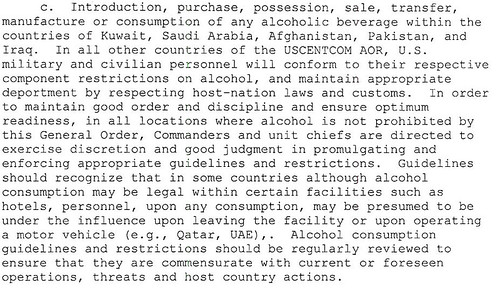
Since we’ve been in the Middle East and Afghanistan, we’ve struggled with how to keep our soldiers happy and yet respect local laws and customs. In March of 2006, General Abizaid of the U.S. Central Command, signed General Order No. 1 to help clarify and determine how our men and women fighting overseas are permitted to relax and conduct themselves. One thing General Order No. 1 prohibits them from enjoying is a beer, or indeed any alcohol whatsoever.

Under Prohibited Activities:

general-order-1b

According to a Wired report:

In part, the order is out of sensitivity to “host-nation” culture. But it’s also a major safety issue. Alcohol, firearms and heavy machinery don’t mix, and the Department of Defense doesn’t want to have to explain a rise in negligent weapons discharges to angry members of Congress.

Recently, however, Senator Jim Webb of Virginia (Dem.), during a Senate Armed Services Committee meeting, floated the idea that “U.S. military commanders should consider loosening the ban to allow ‘alcohol for stress relief.’”

Now before you jump down my throat, consider that there’s already a problem with the “increased use — and abuse of — of prescription drugs by deployed troops” with “troops popping pills to fight everything from fatigue to depression. The Pentagon is even investigating using pills as a preventive treatment for post-traumatic stress.” So his suggestion that maybe letting the troops have an occasional beer while off duty might have some benefits to the mental and physical health of our soldiers doesn’t seem too outlandish under the circumstances. During my time in the military I was never in a war zone, so I never experienced this kind of prohibition. Hell, we had a coin-operated soda machine in our day room filled with cans of beer.

But beyond respecting the “host-nation culture,” weren’t troops in World War II, Korea and other police actions permitted limited amounts of alcohol? My stepfather was in Vietnam with the Marines in the early 1960s and I know he drank quite a bit while he was there. From time to time, he’d open up about his time “in country” and what they’d do when they were off-duty, and it involved a lot of drinking, much of did in fact seem designed to relieve stress. I can’t help but think the ban is more a sign of the times than about any real danger from soldier’s drinking in moderation.

If soldiers made it through at least WWII, Korea and Vietnam safely while being able to have a drink, it doesn’t seem like they’d fare any worse today. Winston Churchill quipped that his staff should “make sure that the beer — four pints a week — goes to the troops under fire before any of the parties in the rear get a drop.” And before that John Churchill, First Duke of Marlborough, said. “No soldier can fight unless he is properly fed on beef and beer.” And before that Frederick the Great concluded that “many battles have been fought and won by soldiers nourished on beer.” But yeah, I understand the argument that war is different now, but I’m pretty sure that argument has been used during every single increasingly modern war. I just don’t agree with it. Given all we ask of our soldiers and how badly our government has treated so many of them, I think we should be doing everything possible to help them relax and unwind whenever they get a little time away from the job.

And even within the scope of respecting cultures, it doesn’t seem too out of line to me that something like the “green zone” or some other spot that’s secluded and separated from the native population could be created where soldiers could relax and have a drink. They did just that for the Super Bowl, where an exception was made and beer was served during the game.

The Wired piece concludes:

Would the military consider lifting its ban on booze? I highly doubt it. Gen. Stanley McChrystal, the top U.S. commander in Afghanistan, banned alcohol at NATO’s International Security Assistance Force headquarters in Kabul, after he noticed coalition officers dozing off at a picnic table.

Now I hope I’m not going too far here, but why were officers taking a nap at a picnic (presumably after drinking alcohol) such an Epiphanal moment for the general? What on earth is wrong with a tired, stressed soldier having a drink and catching a little shuteye while off duty? They weren’t belligerent. They weren’t fighting. They weren’t getting into any mischief. They were taking a nap. And this sight made General McChrystal worried enough that he decided, not to figure out how his soldiers could get the rest they needed, but instead to ban the alcohol that helped them fall asleep. Personally, I’m all for letting them have a beer once in a while. At the very least, they’ve earned it.

Filed Under: Beers, Editorial, News, Politics & Law Tagged With: Government, Middle East, United States

More On 2nd Raid Of Pennsylvania Distributor

March 11, 2010 By Jay Brooks

v-mask
Yesterday on Don Russell’s Beer Radar, he had the basic information on a second raid by the PLCB and Pennsylvania State Troopers. As promised, a fuller account was published today, with additional reporting by Bob Warner, in the Philadelphia Daily News. Here’s the account, entitled In Another Raid, State Police Hit Beer Distributor, Origlio’s, in Far Northeast.

The state continues to confiscate Duvel, Monk’s Café Flemish Sour Red Ale and even Hacker-Pschorr, despite all three brands having been registered and sold for many years. Russian River Brewing’ Supplication was also one of the beers confiscated, but in that case Vinnie Cilurzo admitted he’d simply forgotten the paperwork for the very small number of cases shipped to Pennsylvania. As reported by Russell, Cilurzo stated. “We are a small mom-and-pop brewery and every once in a while something slips through the cracks.”

What continues to be troubling is that this is essentially just paperwork errors and miscommunication and it’s being treated like the crime of the century. Did they really need to go in armed, like storm troopers? Were they expecting trouble or that gunfire might be necessary? It’s not like they were raiding a bootlegger’s den and could expect Tommy guns to be carried by everyone inside the distributorship. It seems absurd to think there might be some justification for that level of power display.

As another remarked. “‘It’s just a clerical problem, but they’re treating this stuff like contraband,’ said one distributor who asked not to be identified.” See what we’ve created? Here’s a legitimate businessman who’s afraid to be identified while criticizing the PLCB and the state police for fear of retaliation, despite the fact that as a citizen he has every right to do so. When we aren’t comfortable exercising basic rights like that because we believe we’ll be targeted by the people we’re criticizing (who, let’s not forget, are there to serve the people), that, to me, is a very scary development indeed. Now that’s a chilling effect. This is just going from bad to worse.

UPDATE: Thanks to James Costa for pointing this out. Today, the Philadelphia Inquirer’s food writer, Rick Nichols, gives us his take on the PLCB raids in Beer Raid Backfires on Liquor Agents.

Filed Under: Beers, Editorial, News, Politics & Law Tagged With: Government, Pennsylvania

ABI To Buy Modelo This Year

March 10, 2010 By Jay Brooks

grupo-modelo
Grupo Modelo is the largest beer company in Mexico, and their most popular beer, of course, is Corona. For many years, Anheuser-Busch has owned a non-controlling 50% share of the company, but after the InBev merger they own 50.2% but only 49.3% voting. And I think they’ve been coveting control for a long, long time and now they may finally get it.

Yesterday, Reuters had an item, AB InBev to Buy Modelo This Year, suggesting it’s likely a deal will go through, and will be completed later this year. The price tag looks to be about $10.8 billion. Earlier this year, Heineken bought FEMSA, Mexico’s second largest beer company. So if ABI buys Modelo, the majority of the country’s beer market will be owned by foreign companies, just like in the U.S.

Filed Under: Breweries, Editorial, News Tagged With: Anheuser-Busch, Anheuser-Busch InBev, Business, International

PLCB Conducts Second Raid On Distributor

March 10, 2010 By Jay Brooks

pennsylvania
Pennsylvania’s beer scene appears on the brink of martial law, with the state police last night raiding one of the distributors who carries some of the beer confiscated earlier this week, such as Duvel. Don Russell has posted to his Beer Radar blog what is known so far, and promises to have a fuller account of the shenanigans tomorrow in the Daily News, again with reporting by him and Bob Warner. I’ll update this post with a link when it’s up.

From Beer Radar:

What we’re witnessing isn’t just bureaucratic incompetence or the result of outdated laws. This is an act of unrepentant arrogance. As one local restaurant operator remarked of the BLE [Bureau of Liquor Enforcement], “They don’t answer to anybody. They’re running amok.”

Stay tuned, this is only the beginning ….

Filed Under: Beers, Editorial, News, Politics & Law Tagged With: Pennsylvania

Boycott UPS For Refusing To Ship Beer

March 6, 2010 By Jay Brooks

ups
Wow, this is one of those seriously WTF stories (thanks to Lisa Morrison for tweeting it). The Idaho Statesman has a disturbing little story entitled UPS, FedEx Side With Wine in Beer Battle by their beer columnist, Patrick Orr. To work yourself up into the proper lather, I recommend reading the whole column first.

But essentially, an internet beer retailer — Brewforia.com — after 18 months of uneventful UPS shipping asked UPS for a specific contract to ship to other retailers, beyind the regular customers he’d been shipping to all along. Instead, UPS “told him they weren’t going to deliver Brewforia products anymore — no matter if a state allows such deliveries direct to consumers or not — and were not going to offer a contract.”

Their website has an entire page on wine shipments and how they do them. UPS ships wine for countless online wine stores. Beer is mentioned just once, here:

UPS provides service for other alcoholic beverages (beer and alcohol) on a contract basis only. For shipments containing beer or alcohol, shippers must enter into an approved UPS agreement for the transportation of beer or alcohol as applicable, must be licensed and authorized under applicable law to ship beer and alcohol, and may ship only to licensed consignees. UPS does not accept shipments of beer or alcohol for delivery to consumers. UPS accepts shipments of beer or alcohol only among and between selected states.

According to the Idaho column:

“When asked why UPS will deliver wine and not beer, [Susan Rosenberg, a spokeswoman for UPS] said ‘that has just been a policy that we have had. It’s a program where our focus has been working with a number of licensed wine shippers.'” “For right now, UPS has chosen policy where beer contracts are for business-to-business shipments.”

UPS goes on with even more nonsensical gobbledygook:

Rosenberg said the issue is complicated by some states defining wine differently than beer and having different distribution requirements. UPS officials have been working with wine retailers for longer and don’t have any immediate plans to revisit their beer policy, Rosenberg said.

No, heaven forbid thy revisit their beer policy to bring it in line with the world in 2010. So the obvious answer now to “What Can Brown Do For You” is nothing if you’re beer, everything if you’re wine. That they utterly fail to see the hypocrisy in that is baffling, especially since they’re essentially throwing away money by their refusal to treat beer equally. It’s important to remember this is a policy decision, not a reaction to any law. Beer can be shipped to consumers in a majority of states, UPS has just chosen not to.

Personally, I think we need to organize a grassroots response and inundate UPS with just how ridiculous they’re being. Hypocrisy should not be rewarded.

Filed Under: Beers, Editorial, News, Politics & Law Tagged With: National

Anti-Alcohol Ads Driving People To Drink … More

March 2, 2010 By Jay Brooks

target-alcohol
I’ve long held the belief that anti-alcohol ads that attempt to stop people from drinking by trying to make them feel guilty are ineffective. Pointing out the harm that such people may cause to themselves or others never seemed like the right way to encourage responsible behavior. Many, if not most, people who abuse alcohol, or any other substance, usually do so for some underlying reason. Attacking the result and not the cause always seemed like the wrong approach, like blaming the gun instead of the person who pulled the trigger. It turns out my intuition may have been correct after all.

A study soon to be published in the April edition of the Journal of Marketing Research appears to confirm that. The article, Emotional Compatibility and the Effectiveness of Antidrinking Messages: A Defensive Processing Perspective on Shame and Guilt by Nidhi Agrawal and Adam Duhachek, is based on research conducted at the University of Indiana. Their research revealed that not only do such guilt-ridden ads not work, but they actually exacerbate the problem, making it worse.

According to IU researcher Duhachek:

“The public health and marketing communities expend considerable effort and capital on these campaigns but have long suspected they were less effective than hoped,” said Adam Duhachek, a marketing professor and co-author of the study. “But the situation is worse than wasted money or effort. These ads ultimately may do more harm than good because they have the potential to spur more of the behavior they’re trying to prevent.”

That’s right folks, the neo-prohibitionist groups that have been trying to guilt people into not drinking have actually been making people drink more, perhaps causing more harm than if they’d just shut up and let people live their lives.

Here’s more about the study from a recent press release from the Indiana University Newsroom:

Duhachek’s research specifically explores anti-drinking ads that link to the many possible adverse results of alcohol abuse, such as blackouts and car accidents, while eliciting feelings of shame and guilt. Findings show such messages are too difficult to process among viewers already experiencing these emotions — for example, those who already have alcohol-related transgressions.

To cope, they adopt a defensive mindset that allows them to underestimate their susceptibility to the consequences highlighted in the ads; that is, that the consequences happen only to “other people.” The result is they engage in greater amounts of irresponsible drinking, according to respondents.

“Advertisements are capable of bringing forth feelings so unpleasant that we’re compelled to eliminate them by whatever means possible,” said Duhachek. “This motivation is sufficiently strong to convince us we’re immune to certain risks.”

So essentially, the ads trigger a defense mechanism that causes people “to believe that bad things related to drinking can only happen to others and can actually increase irresponsible drinking.”

Onlybeer
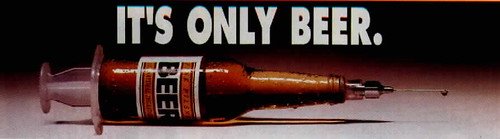
An anti-alcohol group’s PSA equating beer with heroin. It was never funny, and I always found it offensive, but it turns out it may have even driven people to drink more. You can also see more of the ads the researchers used for their study at the Media Awareness Network.

Even though the study won’t be published until next month, you can read an advance pdf of it at the Advance Articles page of the Journal (it’s the sixth one from the top). The study is 32-pages long, with another 10 pages of bibliography and other supporting data.

While the study stops short of suggesting that such ads have over time made teens and other target demographics drink more, they do caution that future ads seeking to curb dangerous behaviors employing “guilt and shame appeals should be used cautiously.” Essentially, they politely suggest that the anti-alcohol community think about what they’re doing and the consequences of ad campaigns that do not include a well-planned media strategy. What I wonder is whether or not the groups responsible for such ads will feel any guilt themselves for driving people to drink more.

UPDATE: Advertising Age had another story about this study, but from the perspective of the journal article’s other author, Nidhi Agrawal, from the Northwestern University’s Kellogg School of Management.

Filed Under: Editorial, News, Politics & Law Tagged With: Advertising, Prohibitionists, Statistics

Toyota Puts The Brakes On Pints For Prostates

February 28, 2010 By Jay Brooks

pints-for-prostates
This is a bit of a head-scratcher, especially give the recent troubles that Toyota has been experiencing. You probably already know about my friend and colleague Rick Lyke‘s great campaign, Pints For Prostates, that seeks simply to raise awareness about prostate cancer and encourage men to get tested for it. As a cancer survivor, Lyke is understandably passionate about his cause and has done a lot of good work toward his goals.

As he notes, despite all the Toyota controversy, the car company is, of course, still trying to sell its cars. One marketing scheme they’ve introduced is asking NASCAR fans to “Sponsafy” a race car using an online graphics program. Fan-craeated cars are posted in an online gallery and are voted on, with the winner having their actual car design on the pace car for NASCAR Sprint All-Star Race in Charlotte, NC on May 22, 2010.

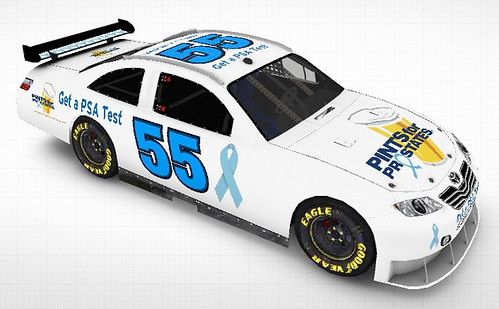
Here, I’ll let Rick pick up the story: “Well, I thought “sponsafying” a car for the contest might be a fun way to promote the Pints for Prostates campaign and reach a few men with a simple message: “Get a PSA Test.” After all, look at what the NFL did for the cause of breast cancer awareness early this past season by allowing players to wear pink.” So he designed and submitted the car below.

PfP-Toyota

Here’s where things take a turn for the weird. Again, here’s Rick:

Amazingly, Toyota Racing has rejected the design saying it “Contains offensive or inappropriate content.” Really? What is offensive about a car design that encourages men to pay attention to their health? Using the universal language of beer to reach men with an important health message certainly cannot be inappropriate for a sport that was once sponsored by a tobacco company and has had cars sponsored by beer, spirits and wine brands for decades. Makes you wonder if Toyota has something against men’s health?

There is still time for the Pints for Prostates ride to be part of the Toyota Sponsafy promotion and with your help we can make it happen. Please send a quick email to Kym Strong (kym_strong@toyota.com) of Toyota Motorsports and Greg Thome (greg_thome@toyota.com) of Toyota Corporate Communications. Use the subject line “Race the Pints for Prostates Car.”

As of this morning, there were 6,390 cars on Toyota’s online gallery but none with a healthy, helpful message to keep men safe from prostate cancer. And the reason for that — which I still can’t quite wrap my head around — is because it’s “offensive” (to whom?) and is “inappropriate content (what exactly?).” Take a look at the design. What do you see? I see a light blue ribbon, the logo (a pint glass with the text “Pints for Prostates” and another light blue ribbon) and the text “Get A PSA Test” in several places. Seriously, WTF!?! If you agree that makes no sense, let’s all e-mail Toyota as Rick suggests. Tell them you don’t find Pints For Prostates inappropriate at all, but you are offended by Toyota’s response to it.

Filed Under: Editorial, Related Pleasures Tagged With: Health & Beer, Sports, Strange But True

« Previous Page
Next Page »

Find Something

Northern California Breweries

Please consider purchasing my latest book, California Breweries North, available from Amazon, or ask for it at your local bookstore.

Recent Comments

  • Bob Paolino on Beer Birthday: Grant Johnston
  • Gambrinus on Historic Beer Birthday: A.J. Houghton
  • Ernie Dewing on Historic Beer Birthday: Charles William Bergner 
  • Steve 'Pudgy' De Rose on Historic Beer Birthday: Jacob Schmidt
  • Jay Brooks on Beer Birthday: Bill Owens

Recent Posts

  • Beer In Ads #5240: Rieker’s Bock Beer Is Now On The Market May 3, 2026
  • Historic Beer Birthday: Herman Adolph Schalk May 3, 2026
  • Beer In Ads #5239: The National Drink May 2, 2026
  • Beer Birthday: Anders Kissmeyer May 2, 2026
  • Beer Birthday: Bruce Paton May 2, 2026

BBB Archives

Feedback

Head Quarter
This site is hosted and maintained by H25Q.dev. Any questions or comments for the webmaster can be directed here.