Brookston Beer Bulletin

Jay R. Brooks on Beer

  • Home
  • About
  • Editorial
  • Birthdays
  • Art & Beer

Socialize

  • Dribbble
  • Email
  • Facebook
  • Flickr
  • GitHub
  • Instagram
  • LinkedIn
  • Pinterest
  • RSS
  • Twitter
  • YouTube

Powered by Genesis

Beer of the Times: Wheat

July 12, 2006 By Jay Brooks

Eric Asimov has a good article in today’s New York Times about wheat beers, well-research with lots of history. The Times also did a tasting of wheat beers, and here I think they made a few key gaffes. They stated from the outset that they were “looking for American versions of Bavarian-style brews” but tasting director Bernard Kirsch added “a few German sleepers.” That Bernie, what a cut-up. And they found that “as expected, the American wheat beers were all over the map, with brewers taking great liberties with the style.”

But here’s the thing. Not all of the beers they tasted were in fact Bavarian-style hefeweizens. Now is that the brewer’s fault or Bernie’s fault for the beers he chose? Either on purpose to confuse the panel or through ignorance of the style, he picked several non-German-style hefeweizens, inlcuding Widmer Hefeweizen. Widmer is in fact an American-style hefeweizen that is a completely separate style for GABF judging. Widmer defined that style, a fact panelist Garrett Oliver was well aware of. But when the panel dismissed Widmer, they said it “bore little relation to the style.” Of course it did, it was a different style.

So when Garrett’s own Brooklyner Weisse was chosen as the winner of their tasting, he “was unembarrassed by the panel’s unanimous approval.” Frankly, I think he should have been, at least a little bit. Generally speaking I think it’s a bad idea to sit in judgment on a panel in which one of your own beers is present. If you’re judging at the Great American Beer Festival you can’t even judge a category in which you’ve entered a beer, even if the flight you’d be judging doesn’t include your own beer. I’m sure he can be objective and personally I feel quite certain he was. Unfortunately, it’s all about the perception of impropriety. A few years ago, I judged at a beer festival sponsored by a brewery. When one of that brewery’s beers was chosen as the winner of a particular category, they disqualified themselves to remove that very perception.

Now I like Garrett Oliver and think he’s done as much to promote good beer as any living human could, especially in regard to advocating beer and food. In that area he’s been the leading expert. If he’s giving a seminar, talk or dinner I always try to attend. They’re invariably very worthwhile events, with much good beer education to boot. So this seems like a strange faux pas for him. He’s been involved with many of the Times’ tastings in the past and I suspect when they asked him, he felt he couldn’t say no. I honestly felt connflicted about posting anything negative about Garrett, because I do hold him in such high regard. Ultimately, I had to mention it because to not do so would have been to compromise my position on this issue even though I knew that Garrett is one of those rare people who could walk above such controversy and be objective under the circumstances. So I think he either should have removed his own beer from the tasting (which for business reasons I imagine might have been difficult) or excused himself for this tasting, even though very few people, and no one who knows Garrett, would have a problem with it.

Three of the beers they gave poor marks to were, according to the panel, “well past their prime” which I take to mean out of code, past their pull date, in other words no longer in a condition to drink. This is undoubtedly the fault of a distributor or retailer as beer should be pulled from the shelf once it’s past its code date. And Bernie should never have accepted samples of this type. Perhaps they weren’t clearly marked and I don’t know the method Bernie used in collecting his samples. But unless he got them from the brewery itself, in my opinion, the Times should not have penalized the brewers who made these beers with a bad review because they got an old sample.

They did at least like my favorite of the style, Franziskaner Hefe-Weissbier. It’s especially good on draft though the bottled beer is excellent, as well.

Filed Under: Editorial, News Tagged With: Mainstream Coverage

Technology is Not Always a Good Thing

July 5, 2006 By Jay Brooks

Today’s Denver Post business section has a profile of Outlast Technologies, the company that’s making the gimmicky “Cold Wrap” labels that are designed to absorb the heat from your hand rather than warm the beer to a temperature where you might be able to actually taste it. It took Outlast a full year to design the label and goodness knows what amount of money, which is ironic because I can solve their problem for a fraction of whatever Coors spent. Here’s how. In order to keep heat radiating from your hand from warming your beer, open the bottle, take it in your hand and gently pour it into a pilsner glass. Voilà, no more problem. If only they had consulted with me first.

Here is Coors’ press release about the cold wrap, which also explains the “Stay Cold Glassware,” another part of the strategy to keep the beer from having any discernable taste.

So it appears that Coors’ main focus in selling their beer is all about how cold it is and how they’ll use technology to make it stay cold. This is good news, of course, if you know how it tastes warm. But do a taste test for yourself. Get Pilsner Urquell, Czechvar, Lagunitas Pils, Victory Prima Pils or similar good pilsner beers. Let them and your Coors Light warm to between 45 and 50 degrees Fahrenheit (7-10° C). Now taste them. Which ones still taste good? That should tell you everything you need to know about which beer is right for you.

At the risk of repeating myself, beer that’s too cold chemically alters the beer and change its taste. The reason you generally don’t notice it is simply because drinking any liquid at that temperature also numbs many of your taste buds. Several volatile components in the beer aren’t released in your mouth and disappear undetected down your throat. The beer’s flavor profile is considerably narrowed and some tastes disappear completely. Cold beer also effects the beer’s balance because hop character survives better than malt or fruity esters. This is the reason bland lagers, which are generally less well-hopped, do better at cold temperatures and explains why ales are generally served at warmer temperatures. A good rule of thumb is the colder the beer, the less of it you can actually taste.

This is why all the big breweries emphasize the coldness of their beers as a selling point. The warmer you drink their products, the less likely it is you will enjoy them. And it’s why they spend millions to persuade you that you should drink their beer as cold as possible. That would be fine except that now millions of people belive that cold beer is a desirable thing, when in fact it’s not. It’s a remarkable success story for adveritising and marketing, and tragic failure for those of us who actually like the taste of beer.


But the gimmicks don’t stop with the bottle. Coors also spent a fortune developing the “Frost Brew Liner,” a “blue” coating inside the beer can that is supposed to keep the beer colder. There is very little actual information about this, and their press release reveals only the following:

In order to protect the Rocky Mountain taste of its beer, all Coors cans contain a Frost Brew Liner. With new graphics this summer, Coors Light is making it easy for consumers to identify the liners by making them visible with blue pull tabs and rims. The Frost Brew Liner cans with the blue rims will be on shelves May 1, 2006.


But an anonymous insider involved in the manufacture of the product says “in fact the blue colored lining is a potential threat to flavor and product compatibility, but their [Coors] marketing department insisted. We would really like to discourage the idea!” As I understand it, the chemicals in the blue dye they had to use to make the lining blue — which was done strictly for marketing reasons — actually has the potential to be harmful to the beer. This is particularly troubling as several dozen craft breweries put their beer in cans, taking advantage of improved technology for the can linings. This new technology removes the former problems with canned beer insofar as there is no longer a problem with leeching or metallic flavors being imparted to the beer. So along comes Coors and essentially puts the problem literally back into the can.

So marketing concerns trumped common sense, the stability of the product itself, and has created a situation with the potential to harm the image of canned beer at a time when good beer is starting to be put into it in growing numbers. Of course, the real solution again is that beer should never, ever be consumed out of the delivery vehicle (bottle, can or keg) and should always be poured into a glass. There are myriad reasons for this is but now there’s one more to add to the list. Keep in mind that almost all advertising is mere propaganda and especially ignore any that suggests cold beer is better.

Filed Under: Editorial, News Tagged With: Business, Colorado

Coors: Destroying Beer on Purpose?

June 26, 2006 By Jay Brooks

If your product is virtually indistinguishable from most of your major competitors, then you make yourself stand out through marketing and advertising. No gimmick is off-limits if it will steer customers to pick up your product instead of the other guys. This seems especially true of the makers of American-style lagers like Bud, Miller and Coors along with the pilsner-derived imports like Heineken, Corona and Stella Artois, to name but a few. Over the years we’ve seen some entertaining — if pointless — ad campaigns for all of them. Creative promotions, merchandising, sponsorships of sports teams and events, logo’d clothing, hats, towels — you name it — and a new product for every new trend of the moment (remember the dry beers, ice beers, low-carb beers, etc.). We’ve come to expect the ridiculous and shake our heads at the inanity. Unfortunately, many times the ads and novelties seem to undermine beers very image and over time have contributed to beer being perceived as something wholly different than it really is.

But even with all that history and low expectations behind it, the latest move by Coors to bring to market — at great expense — a beer to be served at below freezing simply boggles the mind. Now generally when beer dips below freezing ingredients begin to break down, primarily the proteins which come out of solution. This causes them to separate and form small flakes that swim around in the beer and make it cloudy. Of course, because of the alcohol beer freezes at a point that’s already slightly below freezing, the exact point depending on the percentage of alcohol. Alcohol itself freezes at -173° F.

This is also the reason frosted, frozen glasses stored in the freezer are such a terrible idea. They also chemically alter the beer and change its taste. The reason you generally don’t notice it is simply because drinking any liquid at that temperature also numbs many of your taste buds. Several volatile components in the beer aren’t released in your mouth and disappear undetected down your throat. The beer’s flavor profile is considerably narrowed and some tastes disappear completely. Cold beer also effects the beer’s balance because hop character survives better than malt or fruity esters. This is the reason bland lagers, which are generally less well-hopped, do better at cold temperatures and explains why ales are generally served at warmer temperatures. A good rule of thumb is the colder the beer, the less of it you can actually taste.

So Coors has launched Coors Sub-Zero, a beer that is chilled down to -2.5° C (27.5° F)

According to Coors’ press release, it “uses space age technology developed in Britain [at Burton-on-Trent]; its patented pouring process naturally forms soft crystals of the crispest, cleanest, ultra-cold lager that melt away in the mouth. Best of all, they keep Coors Sub Zero cooler for longer, giving sensational refreshment and taste.” The pricetag was more than £10 million (over $18 million USD).

The beer delivers an entirely new taste experience. The soft frozen lager crystals create a subtle sensation of snow on your tongue. And the super-chilling, along with the clean, clear taste of the lager, combine to create an extraordinary, refreshing crispness.

The way Coors Sub Zero is poured is technically and physically unlike anything else behind a bar in Britain. During the one-minute, fully automated pour-process, the specially made beer glass constantly revolves on a turntable – creating what must be the most impressive beer-pouring spectacle ever seen.

Hmm, frankly I’m more impressed by taste than space-age technology and a magic show, but maybe that’s just me.

Coors describes what the experience will look like in a bar:

To serve the beer, as either a pint or a half, the bartender puts on a ‘science show’ for the customer:

  1. The glass is placed on the turntable and the launch button is pressed [which cools it with a spray of cold water]
  2. [The lager is stored at high pressure and is poured into the glass at a temperature of -2.5C.]
  3. The glass is rinsed with chilled water before the lager is dispensed at sub zero temperature [high pressure makes the beer stay cold and keeps it from freezing]
  4. Two seconds before the end of the pour comes the ‘sonic trigger’ – a process of ‘supernucleation’ which causes soft frozen lager crystals to gather in the top of the glass [these are ultrasonic waves which form crystals of ice around the gas bubbles]
  5. Finally, the condensation that has formed during the pour is removed — and a crystal clear pint is presented to the customer

[my additional explanations]

What’s stranger still is where the beer is being launched. Great Britain’s wonderful ales are best consumed at temperatures much, much warmer than freezing. In fact, the English consume very few beverages at even a cool temperature, much less at freezing. Trying to find ice in a British restaurant is maddeningly impossible for us uncouth Americans. So it’s strange to see quotes that people there want colder beer. That seems a bit odd to me.

Here’s the Coors spin machine at work:

Said Stuart Renshaw, Head of Marketing for International & Portfolio Brands for Coors Brewers: “We have listened to consumers and their requests for colder and colder beer. With Coors Sub Zero the cold beer lover’s dream has finally come true – a pint that stays cold right to the bottom of the glass and the first ever pint that actually seems to get colder in your hand.

“Coors Sub Zero is the perfect ice cold refreshment. It brings together traditional brewing excellence and 21st century dispense technology to deliver a unique drinking sensation”.

Scientist Dr Alan Samson, who has worked on Sub Zero since 1998, said: ‘For years companies have been trying to pull a truly cold pint, but now the technology has caught up.

‘It is a natural phenomenon ‘ nothing is added or taken away to the lager. The only problem is that we wasted 8 million pints getting it right.’

It seems to me they spent a lot of money and are now trying to create a market for it, rather than the other way around. One hundred pubs are expected to have the special system installed by the year’s end with the first in sometime next month.

In the end, it’s hard not to view this development as an abomination since it perpetuates the myth that beer must be as cold as possible, or now perhaps even colder. This is bad for the perception of beer in general and helps only those beers that would suffer for being consumed at a warmer temperature. And we all know who they are.

Filed Under: Beers, Editorial, News Tagged With: Business, Europe, Great Britain

The Long Tail Applied to Craft Beer

June 24, 2006 By Jay Brooks

long-tail
I stumbled happily upon The Long Tail yesterday, a new economic model for the digital age by Chris Anderson, the editor-in-chief of Wired. It came up in the context of a new division created by Anheuser-Busch within their company to explore new products, but more about that later. His economic model originated in an article he wrote in the October 2004 issue of Wired Magazine, which is where the term “the long tail” was first coined. Anderson has expanded it into a book of the same name which is coming out next month and he has a blog about it, too. The Wired article isn’t very long and is well worth your time to read. But I’ll assume you’re not as fascinated by this kind of thing as I am and summarize it as follows.

Essentially it’s not a new discovery — apart from its novel application to the internet — but concerns probability theory statistics and is a “long-known feature of statistical distributions” known as “Zipf, Power laws, Pareto distributions and/or general Lévy distributions.”

Wikipedia explains it thusly:

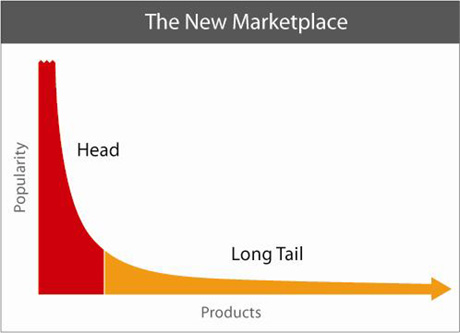
In these distributions a high-frequency or high-amplitude population is followed by a low-frequency or low-amplitude population which gradually “tails off”. In many cases the infrequent or low-amplitude events—the long tail, represented here by the yellow portion of the graph—can cumulatively outnumber or outweigh the initial portion of the graph, such that in aggregate they comprise the majority.

Such distributions are surprisingly common. In standard English, the word “the” is the most common word and other short words such as “of”, “is” and “have” are also quite common. These common words are vastly more common than most other words. For example, about 12% of all words are “the” (while “barracks” occurs less than 1 out of 50,000 words), but cumulatively, words roughly as rare as “barracks” make up about a third of all text. These rare words are the long tail in English vocabulary.

Wikipedia also has a nice further description of it including its origins and many examples. And Anderson’s blog contains a nutshell version of the theory.

lt

A short digression is in order here. I take a decidedly odd pleasure in reading about economics, the dismal science. Over the last several years I’ve digested several overviews of the history of economics, its leading lights, and so on. I’m not proud of it mind you, I think of it more as a guilty pleasure. Stuff like Thomas Frank’s One Market Under God, Robert Heilbroner’s The Worldly Philosophers and even Freakonomics, which was actually quite interesting. I especially enjoy the writings of Paul Krugman, the Princeton professor who writes a column for the New York Times. His collection of columns, The Great Unraveling, is a terrific — if occasionally depressing — read. And you thought I did nothing but drink beer.

So after reading Anderson’s article, I was struck by how many parallels there were to the beer industry even though his focus was business on the internet and how it is unmaking traditional business models. This analogy seems especially true concerning the relationship between mainstream or big breweries and craft beer. It doesn’t suggest how a new model of distribution might work the way it does on the internet, but it goes a long way toward explaining many of the problems craft brewers are having getting their products to market and in developing greater demand for them. If you’re still with me so far, what follows is my feeble attempt to examine those similarities. I think there are some valuable lessons that may be drawn from such a comparison of economic models.


An Analysis of Chris Anderson’s “Long Tail” Theory as Applied to the Beer Industry

Here is Anderson, in the original article, explaining the underlying reasons that an old book that was almost out-of-print became a bestseller thanks to Amazon.com, word of mouth and their snowballing effects.

It is an example of an entirely new economic model for the media and entertainment industries, one that is just beginning to show its power. Unlimited selection is revealing truths about what consumers want and how they want to get it in service after service, from DVDs at Netflix to music videos on Yahoo! Launch to songs in the iTunes Music Store and Rhapsody. People are going deep into the catalog, down the long, long list of available titles, far past what’s available at Blockbuster Video, Tower Records, and Barnes & Noble. And the more they find, the more they like. As they wander further from the beaten path, they discover their taste is not as mainstream as they thought (or as they had been led to believe by marketing, a lack of alternatives, and a hit-driven culture).

This is exactly how and why (at least in part, there other factors to be sure) mainstream beer outsells craft beer by such a wide margin. Think of mainstream beer as the bland stuff churned out by the world’s biggest breweries and made to appeal to the lowest common denominator. To be fair these breweries for the most part do make products that are well-made and very consistent. But even these breweries are beginning to acknowledge that they are virtually indistinguishable from one another. What’s the one thing they all have in common? Availability. They’re available literally everywhere beer is sold, even at the most hardcore of craft beer taphouses (with just a couple of notable exceptions). Everybody carries the hits with very few “deep catalog” beers. (Remember we’re talking hypothetically here.) We really can never know what consumers will buy if they’re continually offered only an extremely narrow selection of all available beers. If, however, every beer that is packaged in the world were offered in every store and given equal weight (same placement, same quantities, etc.), what would the sales breakdowns look like then? I would bet dollars to donuts that many, many people would choose a different beer than their usual choice, even after the initial novelty of such selection wore off. As Anderson notes, people would be more apt to experiment and they’d “discover their taste is not as mainstream as they thought (or as they had been led to believe by marketing, a lack of alternatives, and a hit-driven culture.” Every convert I’ve ever helped along reaches a point where they realize they’d been sold a bill of goods about what beer is supposed to taste like. And once they discover how diversely rich and flavorful good beer is, very few will willingly make the trip back to the mainstream.

Most people are lazy about some decisions in their lives — I count myself among them — and take the easiest path available. You have to. None of us can be passionate about everything. Choices must be made. For example, to me all laundry detergents are the same. I could care less which one I buy and usually end up buying the cheapest one. Now I suppose there are some people who are quite passionate about their laundry detergent. My grandmother never used anything but Tide. She refused to use any other detergent. So convinced was she that Tide was the superior one that she would turn down even free alternatives. My point is some choices we have to make are done on a kind of autopilot. This human tendency makes availability perhaps the single most important reason for current buying patterns in all manner of things, including beer. They’re all the same, right? Does that sound overly simplistic? Not when you consider that craft beer has only a 3.5% market share, meaning 96.5% percent believe essentially just that.

Anderson continues:

For too long we’ve been suffering the tyranny of lowest-common-denominator fare, subjected to brain-dead summer blockbusters and manufactured pop. Why? Economics. Many of our assumptions about popular taste are actually artifacts of poor supply-and-demand matching — a market response to inefficient distribution.

Mainstream beers certainly fit the lowest-common-denominator epithet. Very few people can actually taste the difference between American-style lagers which, although based upon pilsners, bear as much resemblance to their progenitors as frogs do to man, despite a common ancestry. Without trying to sound condescending, many people think these taste good because they’ve been told they taste good … over and over again.

But most of us want more than just hits. Everyone’s taste departs from the mainstream somewhere, and the more we explore alternatives, the more we’re drawn to them. Unfortunately, in recent decades such alternatives have been pushed to the fringes by pumped-up marketing vehicles built to order by industries that desperately need them.

Hit-driven economics is a creation of an age without enough room to carry everything for everybody.

Historically, all breweries were essentially local or regional at most. There were no national breweries until after the invention of refrigeration. Beer did not travel well enough before that time and so breweries were limited in the territory in which they could sell their beers. Several factors changed in a short space of time, making national breweries feasible for the first time after World War 2. Keeping beer cold, of course, came before that time but a national media and especially television that made reaching the entire nation possible was also very important. It’s no coincidence that tomorrow is the 55th anniversary of Pabst becoming the first brewer to advertise in color when CBS broadcast a special one-hour inaugural show (June 25, 1951). It was there very ability to do so that allowed Pabst to become nationally recognized.

Then there was post-war prosperity and the national highway system, which made shipping to anywhere in the U.S. more economical. These caused products of all stripes from soup to nuts to create national identities. In order to appeal to this much wider consumer base, they were generally re-tooled to appeal to the lowest-common denominator. For beer, this actually began during the war, when the military requested beer for the troops that was watered down so as to avoid soldiers too inebriated to fight. Many returned with a taste for the bland.

So the bland American-style lagers developed over time to appeal to almost everyone or at least offend no one. Add to that immense advertising and marketing budgets with television and sports sponsorships and you can create national brands. Fortunes were won and lost as the breweries battled one another for dominance on a national scale. Brewing history is littered with the losers of this period. Hundreds of once prominent and popular regional breweries are gone. Our brewing heritage itself all but stamped out in the name of commerce. Prior to the late 1970s, the American beer scene was on the brink of extinction. Our most popular beers made us the laughingstock of the world. There were a few pockets of resistance here and there, but by and large the war was almost over. But then a backlash began that became the microbrewery revolution, which in twenty-five or so years has created a beer culture that is the envy of the world. More different styles of beer are now brewed in America than any other place in the world. Almost all innovation in brewing is happening at the craft beer level. American beers consistently win a higher proportion of awards in international competitions. By any measure, this is a phenomenal achievement. It’s too bad 96.5% of Americans are scarcely aware of it.

The only companies that can afford a seat at the national advertising table are the mainstream breweries. Therefore their voices are the only ones that can be heard. This unrelenting barrage of marketing has created a market so propped up that it would likely collapse if they suddenly stopped. This perpetual marketing machine can be compared to running on a treadmill. As long as you’re moving your legs you’ll stay in the same place but stop and you’ll be thrown off.

Anderson explains some reasons for this phenomenon:

[T]he [entertainment] industry has a poor sense of what people want. Indeed, we have a poor sense of what we want. We assume, for instance, that there is little demand for the stuff that isn’t carried by Wal-Mart and other major retailers; if people wanted it, surely it would be sold. The rest, the bottom 80 percent, must be subcommercial at best.

But as egalitarian as Wal-Mart may seem, it is actually extraordinarily elitist. Wal-Mart must sell at least 100,000 copies of a CD to cover its retail overhead and make a sufficient profit; less than 1 percent of CDs do that kind of volume. What about the 60,000 people who would like to buy the latest Fountains of Wayne or Crystal Method album, or any other nonmainstream fare? They have to go somewhere else. Bookstores, the megaplex, radio, and network TV can be equally demanding. We equate mass market with quality and demand, when in fact it often just represents familiarity, savvy advertising, and broad if somewhat shallow appeal. What do we really want? We’re only just discovering, but it clearly starts with more.

This goes back to shoppers walking down the beer aisle week after week, month after month, year after year and seeing the same beers every time. If there were a demand for other beers, the stores would stock them, right? How do they know if there’s a demand for something they don’t carry. How many people ask about products they don’t see? In my experience, unless it’s peculiarly popular for some reason, hardly ever. Think about your own experience. Your local grocery store doesn’t carry the jam you like. But they do have a dozen other brands that look fine. Are you more likely to just choose from the available choices or inquire (or complain) and give up jam on your morning toast? If you’re like most if us, you’ll buy the Smuckers without a second thought and get on with your life.

Also, as the mainstream domestic brewers are experiencing a loss of revenue lately craft beer is showing rising consistent growth. This has led many industry observers to conclude that consumers are demanding a greater diversity of available flavors. This would seem an ideal opportunity for craft brewers — and especially the regional players — to step in and give the people what they’re clamoring for. But the mainstream brewers will not allow that to happen if they can possibly help it. And for the most part they do have the resources, necessary clout and wherewithal to do just that. This explains why many big breweries are frantically adding to their portfolios by creating new products, buying existing ones and pairing with successful import and domestic breweries in distribution deals. Because availability is control. The more products they can control, the more market share they can control and the more they can squeeze competition out of the marketplace while providing to the market a illusory perception of greater diversity while actually doing the opposite.

To get a sense of our true taste, unfiltered by the economics of scarcity, look at Rhapsody, a subscription-based streaming music service (owned by RealNetworks) that currently offers more than 735,000 tracks.

Chart Rhapsody’s monthly statistics and you get a “power law” demand curve that looks much like any record store’s, with huge appeal for the top tracks, tailing off quickly for less popular ones. But a really interesting thing happens once you dig below the top 40,000 tracks, which is about the amount of the fluid inventory (the albums carried that will eventually be sold) of the average real-world record store. Here, the Wal-Marts of the world go to zero – either they don’t carry any more CDs, or the few potential local takers for such fringy fare never find it or never even enter the store.

The Rhapsody demand, however, keeps going. Not only is every one of Rhapsody’s top 100,000 tracks streamed at least once each month, the same is true for its top 200,000, top 300,000, and top 400,000. As fast as Rhapsody adds tracks to its library, those songs find an audience, even if it’s just a few people a month, somewhere in the country.

This is the Long Tail.

In the world of beer, the long tail is currently evident only in large liquor chains such as Beverages & more and their ilk along with the few beer-only stores like San Francisco’s new City Beer Store, Belmont Station and Bottleworks. The main problem is that beer cannot be effectively dispensed digitally, meaning you can’t download a beer. Pity. How great would it be to have a USB tap from which you could download any beer you wanted. But enough fantasy. Because of this dilemma, the long tail does not currently present a solution to this predicament. But it does provide some useful reasons why things are the way they are. Perhaps that knowledge will eventually suggest a way.

Anderson concludes:

What’s really amazing about the Long Tail is the sheer size of it. Combine enough nonhits on the Long Tail and you’ve got a market bigger than the hits. Take books: The average Barnes & Noble carries 130,000 titles. Yet more than half of Amazon’s book sales come from outside its top 130,000 titles. Consider the implication: If the Amazon statistics are any guide, the market for books that are not even sold in the average bookstore is larger than the market for those that are. In other words, the potential book market may be twice as big as it appears to be, if only we can get over the economics of scarcity.

So the real goal of craft brewers appears to be overcoming the “economics of scarcity.” This may mean creating new models of distribution. Maybe it’s time to revisit self-distribution again or consider pooling resources to create craft specialty distributors. Many such attempts have failed in the past but maybe the business world would be more accepting of them in today’s climate. Certainly Stone Brewing seems to be making this idea work. Businesses are generally in favor of products that sell and make them money.

Many beer distributors have pushed a narrow range of products on retailers because they themselves were manipulated and bullied to do so. For example, I have heard accounts of Augie Busch sitting in a distributor’s conference room petulantly throwing bottles of craft beer so they exploded with a jangling crash against the wall to show his disdain for any product not under his thumb because the businessman running the beer distributor had the temerity — and as it turns out foresight — to sell products his customers actually wanted. But now the mainstream beer slump is hurting them, too, which is what is driving the big guys to scramble to fix this slump. Otherwise, their distributors will look more favorably on carrying products that are selling.

Opportunity is knocking on the door. We should answer it. At the very least we should capitalize on it. There are probably other ways to address this problem that we haven’t even thought of yet. But in an industry that so thrives on innovation, we should be able to come up with something. Time to think outside the cold box.

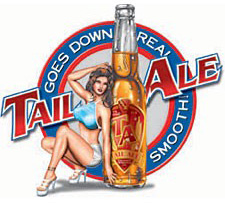
This is the longneck tail.

tail-ale

Anheuser-Busch’s New “Long Tail Division“

Business Innovation Insider is a blog in conjunction with FORTUNE’s Innovation Forum (a conference held annually in late November), reports on business innovation. A piece in yesterday’s edition was entitled “The long tail of the alcohol distribution curve” and concerned a new division created by Anheuser-Busch called “Long Tail Libations.” The goal of this new division is to develop “more “niche” alcohol products to supplement the company’s “hits”. From this it seems a reasonable inference that the division was set up to explore niche markets down along the long tail of the market.

The Wall Street Journal, explained Anheuser-Busch’s expansion into new markets:

Anheuser-Busch, battling industry market-share losses to purveyors of wine and liquor, is hinting that it will make an effort to enter the liquor industry… Anheuser has made some tentative moves into the liquor business. Last year, it formed a separate division, Long Tail Libations, to develop, test and market distilled spirits. Its first product, Jekyll & Hyde, a liqueur, is being test marketed in a handful of places. Over the past few years, the St. Louis-based brewer also has joined forces with Bacardi to produce flavored malt beverages, so-called malternatives, under the Bacardi Silver label.

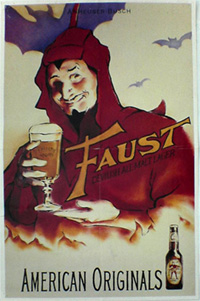
There’s been a lot of attention paid to remarks made by Augie 4.0 at a state regulator’s meeting where he stated that they “might” consider going into the spirits business. Also, on February 9 of this year, A-B filed a trademark application for a distilled spirit called Faust, a name they’ve used in the past for their “American Originals” series of beers, which was part of their original assault on craft beer.

faust

But as Jim Arndorfer, editor of Miller’s BrewBlog, wryly pointed out, given that they’ve created this new division— Long Tail Libations — and are test marketing a liqueur, “doesn’t that mean they’re already ‘in the business'”? All of these stories seem to be focusing on the supposed “possibility” of A-B spirits while ignoring the fact that they are already making them. The Business Journal of Jacksonville article — which is the one most media ran — used a headline that said A-B “hints at liquor market entrance.” It seems to me if you have an actual spirit people can hold in their hands and buy then you’ve moved well beyond just “hinting.”

But of course, that’s not their only tactic. They developed dozens of new beers and beer-like malt beverages and are testing many of them in the marketplace. I tried a number of them at last year’s Great American Beer Festival. They’ve introduced two new stealth micros into the organic market. Distribution deals and/or bought into regional brewers such as Goose Island with many more rumored to be in negotiations to be added to their craft alliance that currently includes Redhook and Widmer Brothers. They’ve signed distribution agreements with several imported beers in the last few months (Tiger and Grolsch) and bought outright the Chinese Harbin. And, of course, they recently bought the domestic brand Rolling Rock. Reportedly talks are ongoing with InBev to distribute their European products. They’re even currently trying to create a gluten-free beer.

From the Business Innovation Insider:

As the president of Anheuser-Busch’s U.S. beer operations pointed out, “We will have to re-evaluate our business model going forward in terms of expanding beyond beer and broadening our position within the total alcohol industry.” Does that sound like a Long Tail strategy or what? As the Liquor Snob points out, the new Jekyll & Hyde drink is about the furthest thing from good ol’ Budweiser beer:

“The company is currently dipping its toe in the hard liquor pond, testing out a new liquor it’s developed called Jekyll and Hyde, which comes as two liquors designed to be mixed together. The product comprises of two liqueur bottles. Jekyll is a scarlet red, sweet spirit tasting of wild berries, while Hyde is an herbal tasting, black spirit that floats on top when poured over the red-colored Jekyll. The two products are meant to be served together, although consumers can drink them separately as well, the company said.

Can a box wine be far behind? A partnership with Gallo? They’re obviously leaving no stone unturned so why not?

The important thing to be learned from all this is that Anheuser-Busch knows about Chris Anderson’s Long Tail theory and is moving toward putting it into practice in a way he probably didn’t envision. That they have the business acumen and resources to pull it off — failing any active resistance — seems to me all but a fait accompli.

This revelation that A-B has embraced the long tail theory also makes their recent behavior more understandable and explainable. For example, when Wild Hop Lager first appeared, many asked why such a large company would go after the organic market, which is such a small market. But as long tail theory expounds, it’s not about the size of each market. It’s all the small markets combined that add up to something. And A-B is trying to move into as many niche markets as possible. From organic beers to small imported beers like Tiger and Grolsch to national brands like Rolling Rock. They’re trying to own both the head and the tail — in other words dominate every facet of the beer (and alcohol) business. They won’t be satisfied by anything less than a total sweeping victory.

When craft beers first came into wider public consciousness in the mid-1990s, the big breweries did respond with their own faux craft beers. Coors had Blue Moon and Killian’s. Miller had Red Plank Brewery with its popular Icehouse along with the many regional brands they’d bought up and shut down during the heady days of the 1980s. Anheuser-Busch had their American Original Series, Elk Mountain, Michelob, Red Wolf, Tequiza and Pacific Ridge Pale Ale.

The second wave of attacks from A-B have included Anheuser World Select, Antarctica Rio Cristal, Aruba Red, BE (B-to-the-E), Bare Knuckles Stout, Beach Bum Blonde Ale, Blue Horizon (a Blueberry Lager), Brewhouse Lager, Brew Masters Private Reserve, Budweiser Select, Busch Hefeweizen, Demon’s Hop Yard IPA, Devil Ray Red, Devon’s Original Shandy, Foxhound Lager, Jack’s Pumpkin Spice Ale, Killarney’s Red Lager, Leaf Peeper Pils, Lone Palm Ale, Michelob Ultra, 9th Street Market, Phillies Red Lager, Red, Safari Amber, Spring Heat Spiced Wheat, Stone Face Ale, Stone Mill Pale Ale, Tilt, Tomahawk Amber Ale, Wild Blue, Wild Hop Lager, Winter Bourbon Cask Ale, and ZiegenBock. Whew, that’s a long list, though it’s not even an exhaustive one. There are likely many more that were only test marketed that few are aware of anymore. And there are undoubtedly new product tests going on and/or planned right now. If you throw enough up against the wall, some of them are bound to stick.

To understand why this is so troubling, you have to get inside the mind of retailers. Big retailers employ buyers, usually many buyers, whose job it is to decide which products will be carried and in what quantities, placement, which are advertised, and on and on. Most are, of course, overworked and underpaid. I was one of them once upon a time. The more products you can buy from the fewest sources the better. It makes you more efficient if you don’t have to meet with what seems like an endless stream of suppliers. That’s one of the reasons beer distributors have been so successful. A buyer can meet with one person who represents many, many brands. Only the bigger players get an audience with buyers of big chains. The rest have to work through distributors, sales rep. companies, etc. So if your local Anheuser-Busch distributor (several of which, where legal, are actually owned by A-B) carries not only your big sellers (Bud, Bud Light) but also products that cover a wide range of niches you’d like to fill then it will be very tempting to buy most everything in their portfolio. Add to that the leverage of being the biggest seller and you can see why most succumb to that temptation so willingly. It just makes good business sense, most will tell you. The unwritten and unspoken agreement is that those who support the best sellers by carrying all their products will get the most favorable terms and make the most money. If you know the brands, you can see this play out in almost every convenience store, gas station, drug store and grocery store that carries beer. You can actually walk down the aisle and see that all the beer there comes from a very small number of suppliers/distributors. The diversity you see is mostly illusory.

This makes it very, very difficult for small brewers to get their beer into larger chain stores at all. It’s the reason A-B’s Craft Alliance with Redhook and Widmer (with more new ones coming) has been so successful. It’s why in stores with few beer skus, if you see any craft beer at all, you’ll almost always see Redhook or Widmer. For some reason this has damaged Redhook’s reputation (many derisively now call them “Budhook“) but left Widmer relatively unscathed. But Widmer has been the more successful of the two, which has allowed them to maintain their independence and, perhaps more importantly, has allowed them to maintain the perception of Independence, which has kept consumer confidence high. Plus Rob and Kurt are great people who support the craft beer industry. But the real danger is that having so many brands under the control of one company makes it increasingly easy to squeeze out everybody else. Bud distributors are under increasing pressure to carry only A-B brands so the strategy is to give the distributors what they want within A-B so they don’t have any reason to look elsewhere for products their customers (the retailers) want. This may make the grocery chain happy, but it’s a disaster for almost everybody else. And it’s getting worse and worse. There’s much less diversity on the average grocer’s beer shelf than there was ten years ago.

All of this taken together reveals a strategy in which the goal is to literally cover every imaginable market with an eye toward either destruction or domination. Either will suit shareholder aims. It’s been the method of big corporations since time immemorial, though A-B has raised it to something of a perverse fine art. I don’t think I’ve ever seen it on this scale. The sheer number of brands hints at the soberness of the endeavor. You know they’re not fooling around. We must take this threat seriously, too. I think we have to acknowledge that it is a direct assault. To not do so is to be unable to craft the proper response. And while everything is going for the craft beer industry these days with excellent growth, renewed interest and even occasional good press, we are still quite vulnerable and our position remains precarious. So we must, I think, proceed with extreme caution. And we must act as a cohesive group, which is why I am so worried about the Goose Island alliances in the industry. The possible ramifications for that development could be dire indeed. The beachhead we’ve established along the long tail must be defended. Our very survival depends on it.

Filed Under: Editorial, News Tagged With: Business

NBWA Continues Lobbying for the Rich

June 22, 2006 By Jay Brooks

I knew this issue wasn’t going away. Congress is again moving toward letting the rich get richer while the rest of us get poorer. A compromised version of the repeal of the estate tax passed the House today and while it’s not quite as onerous as outright repeal, it still leaves a very bad taste in my mouth. What’s that flavor? Greed. Bloomberg has a nice overview of today’s events regarding the estate tax vote. Why is this here? Because the National Beer Wholesaler Association continues to make this their top priority. It has very little to do with the beer business per se, apart from keeping a very wealthy few beer wholesalers as rich as Croesus.

From the NBWA press release:

NBWA Applauds House Vote Calling for Permanent Relief from the Death Estate Tax

ALEXANDRIA, Va. – The National Beer Wholesalers Association (NBWA) today applauded House passage of legislation that aims to provide the nation’s small business owners with permanent relief from the onerous death estate tax. H.R. 5638, the Permanent Estate Tax Relief Act of 2006, sponsored by Ways and Means Committee Chair Bill Thomas (CA-22), passed the House with bipartisan support.

“Today’s vote represents recognition by the House that it is high time to deliver a permanent solution to the death estate tax to America’s small business owners,” said NBWA President Craig Purser. “While full outright repeal is the ultimate goal, in this intense political climate we acknowledge that partial relief is better than nothing. Those groups that oppose Chairman Thomas’s bill in favor of holding out for a vote on full repeal must understand that small business owners need permanent relief now, and the window of opportunity is closing.

“The onus is now on the Senate to act swiftly. The Senate asked for legislation from the House and the House answered the call. Now is the time for Senators to stand up for small, family-owned businesses and support this effort to provide permanent relief from the death estate tax once and for all.”

Horse manure. You can read my earlier equally fair and balanced rant entitled “Enough Already: Time to Cry Bullshit” about this issue.

Filed Under: Editorial, News Tagged With: Business, Law, National, Press Release

Beware of Flashing Lights

June 22, 2006 By Jay Brooks

If you see a flashing red light, run. Run fast. You never know what it might be. Don’t stop to check it out. Perhaps it’s a bomb? After all, that’s what happens to a society when daily terror alerts, local news and a war in Iraq all conspire to keep us fearful, docile and obedient. That’s certainly what happened Tuesday when a bartender at the Swan Lake Resort in Plymouth, Indiana (population: 10,728) saw a flashing red light. Without investigating — after all he thought it might be a bomb — he called police and 35 hotel guests were evacuated.

So why is this here on a beer blog? Because it turned out the blinking light was from a Pabst Blue Ribbon promotional sign suction-cupped to the window and not, happily, a terrorist cell run amuck. Now Plymouth may not be in the middle of nowhere, but you can probably see it from there. The nearest big town is Fort Wayne (not exactly a giant either, at 220,000) 84 miles from there and Chicago is 100 miles away. So yeah, when I see a blinking red light my first thought has got to be terrorist attack. What else could it be?

I don’t mean to necessarily make light of this, but who believes a small town in the midwest almost no one has ever heard of is going to be al Qaeda’s next target? The resort manager was quoted as saying that “the unintentional false alarm is part of living in the post 911 world.” [my emphasis] Now maybe this is because I use words all day, but unintentional? It wasn’t unintentional, which means “not deliberate or intentional; inadvertent.” The alarm was sounded deliberately. A light was seen, a judgment made, and the authorities alerted. Calling it unintentional is just to placate their guests who had to leave their rooms for half an hour.

“Our employee saw something unusual and reported it,” resort manager Doug Leedke said. Was this a new bartender? A new sign? Was the bartender not familiar with POP advertising materials generally? How did he get from blinking light to bomb? What was thought process that would have led him — or indeed anyone — down that path? I live only a few minutes from a site that has been mentioned as a potential target several times — the Golden Gate Bridge — and I almost never think anything about it in those terms. Should I? I don’t think so. I don’t want to go all que será, será, but beyond taking a few obvious precautions, there’s not really a lot I can do.

Another news source reported that the “bartender called authorities about the suspicious flashing light at 12:30 a.m. Monday, and guests were evacuated about six minutes later, said Doug Leedke, general manager of the resort in Plymouth. Six minutes later!?! There must not be an awful lot of crime in Plymouth because I don’t think there’s anywhere in the Bay Area that I could get authorities to do anything in six minutes, which is not to disparage our fine boys in blue here.

Sadly, none of the reports showed a picture of the Pabst ad, and I sure would like to see it so I can decide if this really is as ridiculous as it appears. I searched Pabst’s website hoping to stumble across it but no luck.

Something similar just happened a few days ago when a kindly old woman in Japan left a six-pack by way of thanks at her local police precinct. Again, their first thought was also bomb, and everybody was evacuated until the bomb squad could confirm it contained malt, hops, water and yeast and not nitroglycerine.

I think the beer industry should adopt the slogan “beer not bombs” in an effort to stave off this wave of bad publicity. We need to create a positive message. We can’t have people seeing beer and their first thought is it might explode. I’m not aware of an epidemic of infected malt that would cause gushing on the scale where people would start wearing crash helmets when they shop for beer. So we should be able to safely predict that your beer won’t explode. Fingers crossed.

Filed Under: Editorial, Just For Fun, News Tagged With: Midwest

Bitburger M.I.A.

June 20, 2006 By Jay Brooks

After the public backlash in Germany over Anhesuer-Busch’s being named the beer sponsor for the World Cup games, A-B eventually bowed to public pressure and worked out a compromise that was supposed to insure that a German beer would also be available at all games. The brand chosen was Bitburger, whose Bit brandname had been deemed too close to Bud so that A-B was told they couldn’t use that name in their advertising. Instead they would have to use Anheuser-Busch Bud, which doesn’t exactly roll off the tongue. So a compromise was worked out. Bitburger could be sold at all World Cup games and A-B could advertise their product as simply “Bud.”

One little hitch, though, is that A-B appears to have reneged on its part of the deal. According to George Parker on AdHurl:

Interesting bit in this weeks Der Spiegel exposing the great Anheuser-Busch beer sham. Apparently in an attempt to placate the Germans, the company agreed to allow German beer to be sold alongside its Bud. But once the fans were inside the stadium… No Bitburger – The reporter was forced to drink Bud… With dreadful consequences. Seems like an incredibly bad piece of PR on the part of Anheuser-Busch. Unless some genius there thought “Oh, once they taste it, they’ll love it.” Listen Busch VI or VIII or whatever, I wouldn’t drink Bud in the US, and I certainly wouldn’t go to Germany to drink it. Dumb arrogant move!

He’s referring to a report in Der Spiegel by Marc Young:

I can now expose the great Anheuser-Busch beer sham. The US brewer bought the sole rights to sell beer in World Cup stadiums before Germany even knew it would host this summer’s tournament. But in an attempt to head off a nasty public backlash, the company cleverly agreed to allow German beer to be sold alongside its Budweiser. This was good PR, but I can report that there appeared to be no Bitburger — the German brewer Anheuser-Busch cut a deal with — to be had anywhere in the stadium. Maybe Bitburger got one stand outside near the security checks or something. But all I could find was Bud on tap.

That’s what you call a perfect strategic move to get what you want and screw everybody else. You placate everybody and difuse a potentially disasterous PR situation. Then you don’t deliver on your part of the bargain and by the time anyone figures out they’ve been had it’s too late to do anything about it. So the ads and signs all read “Bud” instead of “Anheuser-Busch Bud” but there’s still no German beer you can buy. Even if Marc Young missed it somehow, it still shows how difficult they made it even for someone making a particular point of trying to find Bitburger. And once you’re in the stadium there’s not really anything you can do except be pissed off. You can either drink Bud or nothing. A-B sure is showing the Germans — and every other nation represented at the World Cup — where the “ugly” in “ugly American” comes from. Nice job spreading goodwill. Because this isn’t just a black eye for an American corporation, it’s a black eye for America as a whole. Like it or not, America’s corporate image abroad is all most people see of us and so this skewed image of America as a whole is formed at least in part by those interactions with our corporations. When they act like … well, like corporations, they color people’s impressions of you and me, too.

Filed Under: Editorial, News Tagged With: Business, Europe, International

Beer Marketing in Your Underwear?

June 20, 2006 By Jay Brooks

world-cup06
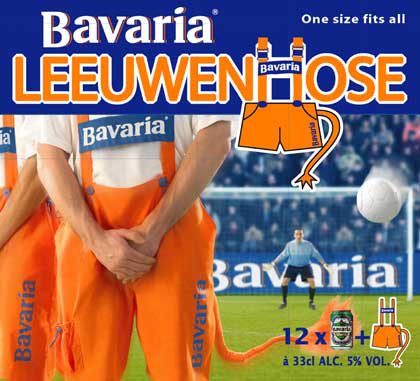
Yesterday’s World Cup match between the Netherlands and the Ivory Coast must have been quite a spectacle. As widely reported, over a thousand Dutch ticket holders arrived wearing orange lederhosen bearing the name of a Dutch brewery. Read that sentence again. Notice anything strange about it? Because it’s exactly the way this story has been reported by all but one or two news organizations. What’s missing is the name of the brewery, which was Bavaria NV. As revealed by IPKat, “For the record, most media – presumably because they benefit handsomely from Budweiser’s vast advertising budget – coyly refuse to tell us the identity of this Dutch upstart.”

bavaria

So anyway, over a thousand Dutch fans show up wearing orange lederhosen with the beer brand name Bavaria on them. Dutch soccer fans traditionally don all things orange before games of their beloved “Oranje,” which is the nickname of the Netherlands national team and the distinctive color of their uniforms. So there’s nothing necessarily odd in that, and this is, after all, the biggest soccer tournament on the planet. But officials at the stadium in Stuttgart ordered them to remove their lederhosen or they would not be allowed to enter the stadium to see the game, despite having paid for their tickets. The majority simply removed them and went into the match and watched it in their underwear.

lederhosen

You can buy your own pair of orange lederhosen at the Bavaria online shop. They only cost about eight bucks, plus shipping. Or you can buy a twelve-pack and get a free pair. “The idea is supposed to be a gentle mockery of the Germans’ penchant for real lederhosen during the World Cup period. The lederhosen also feature a tail and a lion motif — the national symbol of Holland. So far over 250,000 pairs of lederhosen have flown off the shelves and they have become a cult item among Dutch soccer fans.”

Given that the lederhosen have long been available from the brewery and they are perfect for the rabid soccer fan, I don’t really see the problem. Go to any football game in the U.S. and you’ll see countless fans wearing their team’s colors in all manner of available merchandising paraphenalia. Is it really that much of a stretch to imagine in a succesful marketing promotion many people wearing the same item to a game. In a stadium the size of Stuttgart’s (seating is 52,000) is a thousand people wearing the same team promotional item really that hard to believe?

Even if it is to hard for you to believe, so what if the brewery gave away the lederhosen or made it very easy to obtain them? Companies have been doing that since Adam Smith first used his invisible hand to avoid a “hand ball” foul. If more of them actually wore them to a game than anticipated, they should be pleased as punch, and FIFA and sponsor Anheuser-Busch should shut the hell up about it. That’s just the market for you.

But that’s not what they did, of course. Instead, they took a different tack.

“Anheuser Busch’s Budweiser is the official beer for the tournament and world soccer’s governing body fiercely protects its sponsors from brands which are not FIFA partners. Markus Siegler, FIFA’s director of communications, said at its daily media briefing yesterday that the governing body was alert to the kind of ‘ambush’ marketing Bavaria had attempted.

From the Yahoo UK article:

“Of course, FIFA has no right to tell an individual fan what to wear at a match, but if thousands of people all turn up wearing the same thing to market a product and to be seen on TV screens then of course we would stop it.

“I don’t know exactly about what happened in Stuttgart, but it seems like an organised attempt to conduct a mass ambush publicity campaign was taking place.”

Peer Swinkels of the Dutch brewery told Reuters by telephone it was “absolutely ridiculous” and “far too extreme” to order the fans to take off their lederhosen and said the brewery had complained to FIFA.

“I understand that FIFA has sponsors but you cannot tell people to strip off their lederhosen and force them to watch a game in their underpants. That is going too far.”

Also from IPKat:

Said FIFA: “Anyone can wear whatever they want, but if a company tries to carry out ambush marketing, FIFA must prevent that happening. In common with the IOC (International Olympic Committee) and UEFA, we do not tell individual supporters what to wear, but … FIFA has already won a court case against a beer manufacturer who tried this sort of thing”.

What this means is “Anyone can wear whatever they want, if FIFA says so”.

American beer Budweiser and Germany’s Bitburger are thus the only beers that can be sold, or even worn by spectators, in the 12 World Cup stadiums. The IPKat wonders what FIFA would have done, had the offending garments been t-shirts worn by thousands of young ladies.

PR Professional John Cass had this to say about how the incident will likely effect Anhesuer-Busch:

I think FIFA just created a public relations disaster for Anheuser-Busch by requiring 1,000 Dutch football supporters to remove their trousers when entering an international football match.

FIFA thought that the bright orange trousers represented a “marketing ambush” tactic. FIFA officials blocked entry to the stadium of any Dutch fans wearing the trousers, rather than miss the game 1,000 fans took off their trousers and watched the match in their underwear.

I think the FIFA officials have lost sight of the boundaries between business and common decency. As for Anheuser-Busch, I would not want to be the PR Manager today. This sort of protection of Anheuser-Busch’s sponsorship by FIFA surely cannot be endorsed by the company, otherwise Anheuser-Busch will be remembered this World Cup as company that took 1,000 Dutchmen’s pants away from them.

FIFA might be right that the Dutch company’s marketing tactic ambushed the World Cup stadium. But in the end what matters most in marketing terms is how a company’s brand it perceived through its marketing efforts. I’ve been searching through the web this evening, and it’s not looking good for Anheuser-Busch. Most comments are from Europe, and the majority of the posts are either incredulous or negative about the incident, for Anheuser-Busch:

I say “tough luck corporate sponsors”, money shouldn’t be able to buy the right to subject people to this kind of indignity. At the very least these people should have been offered alternative netherwear. In fact I think they should sue the sponsor who insisted on this and campaign to boycott their wares. So watch out Budweiser, I’m off Bud now (Nouslife Blog).

Where’s all this World Cup goodwill?

… and I always thought it wasn’t the winning that was important, but the taking part (No Offence Intended).

The PR disaster that is Budweiser’s sponsorship of the World Cup gets worse (CMM News).

The Netherlands beat Ivory Coast 2-1. I think I’ll be rooting for them in their next match, which of course I’ll be watching wearing nothing but my underwear with a nice cold Bavaria Beer by my side.

Filed Under: Editorial, Just For Fun, News Tagged With: Business, Europe, Germany, Marketing, Sports, The Netherlands

Fowl Ball?: Widmer Buys a Piece of Goose Island

June 8, 2006 By Jay Brooks

Well this one certainly came out of left field. I’m not quite sure what to think about it. I really like Kurt and Rob Widmer. I like them a lot, in fact, both personally and professionally. They pioneered American-style hefeweizen, in fact invented the style. They co-founded the Oregon Brewers Festival to support and promote the craft beer industry as a whole. They brew many great beers — their potato beer is still the best of its type I’ve ever had — in many diverse styles. And they’re both very affable and down to earth people who make the beer community a better place for their having been a part of it. So I originally greeted the news of their arrangement with Anheuser-Busch somewhat suspiciously. But in the end they’ve been able to make it work for them, a trick few have been able to pull off. Which makes Widmer Brothers all the more impressive for having been able to walk that fine line between craft and business so successfully.

So does buying a minority interest in Goose Island Brewing of Chicago make sense? In some ways, yes it does. From a distribution point of view, it seems to make very good sense for both parties. If each begins making the other’s beer for their own markets, that too makes good business sense. So why does it give me pause? I’m not sure, but I think it has something to do with A-B buying a 35% stake in Goose Island and then Widmer buying a presumably much smaller piece, when they themselves are are part-owned by A-B (39.5%). I can’t put my finger on what bothers me about this, perhaps it is just simple paranoia on my part. For now, I’ll try to concentrate on the positive aspects of this and try to silence that voice in the back of my head and wish Kurt, Rob and John and Greg Hall all the best.

Filed Under: Editorial, News Tagged With: Business, Midwest, Oregon, Portland

Enough Already: Time to Cry Bullshit

June 6, 2006 By Jay Brooks

Okay, I’ve had enough. Time to speak out. I’ve been getting press releases from the National Beer Wholesalers Association for many months now about the [expletive deleted] estate tax (it’s correct name by the way; they keep calling it the “death tax,” which alone pisses me off). I’ve been simply deleting them but the sheer number of the e-mails I’ve gotten over the last few months is truly staggering, maybe one every other week. There is no other issue facing the beer industry that’s received that kind of attention from a trade organization since they talked about changing the way that breweries are taxed. And it doesn’t even directly relate to beer, just the companies themselves. Today I got yet another one and it was the straw that broke the proverbial camel’s back. There has simply been far to much attention paid to this issue and far too much misinformation given the small number of people it will benefit. Even though the NBWA is a trade organization of companies that distribute beer, it’s seldom that I agree with their agenda, and this is a perfect example. It happens — take the Costco case in Washington — but generally they advocate for their members and that’s not always the same as what it is in the best interests of craft brewers, which is where my sympathies lie.

But their relentless pursuit of this estate tax agenda framed in terms of protecting family businesses from having their hard-earned money taken from them is, simply put: bullshit. The only people effected by the estate tax will be people whose estates are valued above a certain amount and chances are if you’re reading this you’re not someone who will be effected by it. 99% of the people in the U.S. will pass their estates on to their loved ones and pay zero income tax. So that begs the question “why is the NBWA so hot about this issue?” And the answer is simple. Because their membership is choked with a few mega-huge distributors who are part of the 1% that might have to pay something when one of their patriarchs (or matriarchs) sadly passes away. The “small family-owned businesses” that the NBWA goes on about saving is just propaganda. But at this point I’m beyond that epithet. Let’s call a spade a spade. It’s just bullshit. This is a few rich families using a trade organization for their own selfish ends. When their press release talks about “92,000 hardworking Americans” almost none of them will be effected by the estate tax, unless of course, the family decides to fire some of them rather than lose their country club membership.

To read the facts about about this issue, try Myths and Facts About the Estate Tax at Fair Economy. Or try Nolo Press’ assessment. And here’s an estate tax calculator at Americans for a Fair Estate Tax. There is also information at the IRS.

A report in late April by Public Citizen revealed that:

18 families worth a total of $185.5 billion have financed and coordinated a 10-year effort to repeal the estate tax, a move that would collectively net them a windfall of $71.6 billion.

Here’s the propaganda-filled NBWA press release:

As the Senate prepares for a possible vote on the [estate] tax this week, the National Beer Wholesalers Association (NBWA) is ensuring Senators know that America’s beer distributors need permanent relief from this onerous tax.

Earlier today, NBWA’s Federal Affairs team delivered a bottle of Blue Moon beer to each Senator. Each bottle was accompanied by a message urging Republicans and Democrats to set aside their differences and provide small businesses with permanent relief from the death tax once and for all.

“Beer distributors around the country have waited a long time for the Senate to act on the death tax,” said NBWA President Craig Purser. “Since it happens only once in a blue moon, we wanted to take the opportunity to remind Senators how important permanent death tax relief is to the small family-owned businesses that NBWA represents.”

Permanent relief from the federal death tax is a top legislative priority for the nation’s beer distributors. Many beer distribution companies have been family-owned and -operated since the repeal of Prohibition in 1933. Today, beer distributors employ more than 92,000 hardworking Americans. Aside from stripping these small business owners of their livelihood, the death tax can also cost the community jobs and economic output.

At the left is the marketing piece sent to every member of Congress urging them to repeal the estate tax, along with a bottle of Blue Moon beer. Below is the label to Blue Moon Belgian White Ale, the stealth micro owned by Coors, itself a rich family-owned company. Kind of ironic, isn’t it?

So what are we to conclude from the facts vs. the propaganda spewing out of the NBWA? I think it tells us a lot about the make-up of beer distributors nationwide. There are, of course, small beer distributors doing a great job of promoting and selling great beer. I personally know several of them, past and present, in California, Oregon and Washington. But I don’t think any of their interests are being served by squandering NBWA funds on fighting the estate tax. But I guess the little distributors don’t have much of a voice in a trade organization so obviously dominated by giant companies.

I think the reason this pisses me off so much is the misuse of emotional imagery about “America’s family-owned businesses.” All the rhertoric paints a distorted picture of reality that benefits a few rich families which — and this should not be overlooked — if they’re successful means the rest of us will be picking up their tab. If the estate tax is repealed and that money is no longer collected from these super-rich families then one of two things will occur. Either the services that money would have paid for will be cut or you and I will be paying higher taxes to make up the difference. That means small craft brewers and beer consumers will have to pay so that these super-rich beer distributor families can stay super-rich. Now how fair does that sound?

Filed Under: Editorial Tagged With: Business, National, Press Release

« Previous Page
Next Page »

Find Something

Northern California Breweries

Please consider purchasing my latest book, California Breweries North, available from Amazon, or ask for it at your local bookstore.

Recent Comments

  • Bob Paolino on Beer Birthday: Grant Johnston
  • Gambrinus on Historic Beer Birthday: A.J. Houghton
  • Ernie Dewing on Historic Beer Birthday: Charles William Bergner 
  • Steve 'Pudgy' De Rose on Historic Beer Birthday: Jacob Schmidt
  • Jay Brooks on Beer Birthday: Bill Owens

Recent Posts

  • Beer Birthday: Chris Cramer May 9, 2026
  • Beer In Ads #5245: Wiedemann’s Brewing Bock Beer May 8, 2026
  • Beer Birthday: Dave Alexander May 8, 2026
  • Historic Beer Birthday: Emil Christian Hansen May 8, 2026
  • Beer In Ads #5244: Southern Brewing Bock Beer May 7, 2026

BBB Archives

Feedback

Head Quarter
This site is hosted and maintained by H25Q.dev. Any questions or comments for the webmaster can be directed here.