Brookston Beer Bulletin

Jay R. Brooks on Beer

  • Home
  • About
  • Editorial
  • Birthdays
  • Art & Beer

Socialize

  • Dribbble
  • Email
  • Facebook
  • Flickr
  • GitHub
  • Instagram
  • LinkedIn
  • Pinterest
  • RSS
  • Twitter
  • YouTube

Powered by Genesis

Patent No. 1995626A: Manufacture Of Minim Alcohol Beverage

March 26, 2015 By Jay Brooks

patent-logo
Today in 1935, US Patent 1995626 A was issued, an invention of Karl Schreder, for his “Manufacture of Minim Alcohol Beverage.” There’s no Abstract, as far as I can tell, Minim means low-alcohol. I wonder if that was a common term back then? It’s not one I hear these days. Curiously, although the invention relates to what they call “low alcohol beverages,” the percentage of alcohol is never discussed, which strikes me as odd. Here’s what is revealed:

It has been found that Termobacterium mobile (Lindner) (Pseudomonas Lindneri-Kluyver) discovered by Professor Dr. Lindner is particularly suitable for the manufacture of beverages containing a low proportion of alcohol.

A process for the manufacture of beverages of this kind forms the subject-matter of the present application.

For obtaining a high grade end product it is essential that the preparation of the malt and of the wort be carried out carefully.

Okay, but what is the “high grade end product?” Is it non-alcoholic or near beer below 0.5% a.b.v.? Or something that might be considered a session beer with an alcohol percentage lower than a beer of typical strength?
US1995626-0

Filed Under: Beers, Just For Fun, Politics & Law, Related Pleasures Tagged With: History, Law, Patent, Science of Brewing

Patent No. 1021669A: Beer-Tapper

March 26, 2015 By Jay Brooks

patent-logo
Today in 1912, US Patent 1021669 A was issued, an invention of William W. Frisholm, for his “Beer-Tapper.” There’s no Abstract, but the description states that his “invention is an improvement in beer tappers, and consists in certain novel constructions, and combinations of parts, hereinafter described and claimed. Sometimes the language in these is just wonderful, case in point:

The object of the invention is to provide an improved device for tapping beer and other effervescing liquids which will permit the entering of the device into the keg or other receptacle without waste, and which, while permitting the free egress of the liquid, will also permit the entrance of air under pressure to force out the liquid.

US1021669-0

Filed Under: Beers, Just For Fun, Politics & Law, Related Pleasures Tagged With: History, Kegs, Law, Patent

Patent No. 848228A: Cooler For Beer

March 26, 2015 By Jay Brooks

patent-logo
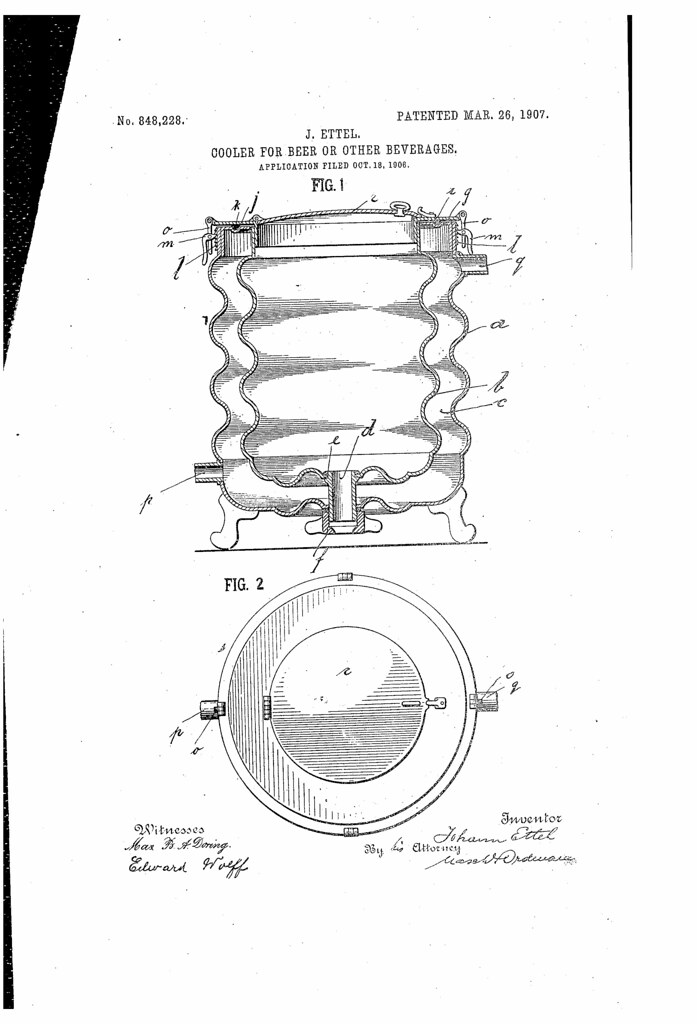
Today in 1907, US Patent 848228 A was issued, an invention of Johann Ettel, for his “Cooler for Beer or Other Beverages.” There’s no Abstract, and the description is without a doubt one of the worst OCR conversions I’ve ever seen. For example, here’s what should be the introduction, verbatim:

To afl’ whom` if my Concern.- l Be it’known that I, JOHANN ETTEL, a enbject of the Em eror of AustriaHungalj, Brooklyn, county of Kings,

new and useful Improvements in (loolers for Beer or other Beverages, of Whiel’ithe following is eepeei’lieet-ion- L The`presentinvention ‘has for its object to provide n. meier for heer or other beverages principally in hors;restaurant-s, mul the like.- v

Which I think we can infer that Johan Ettel, who was from Austria-Hungary, but living in Brooklyn, invented a new beer cooler.
US848228-0

Filed Under: Beers, Just For Fun, Politics & Law, Related Pleasures Tagged With: History, Kegs, Law, Patent

Patent No. 8678247B2: Creamy Foam Beer Dispensing System

March 25, 2015 By Jay Brooks

patent-logo
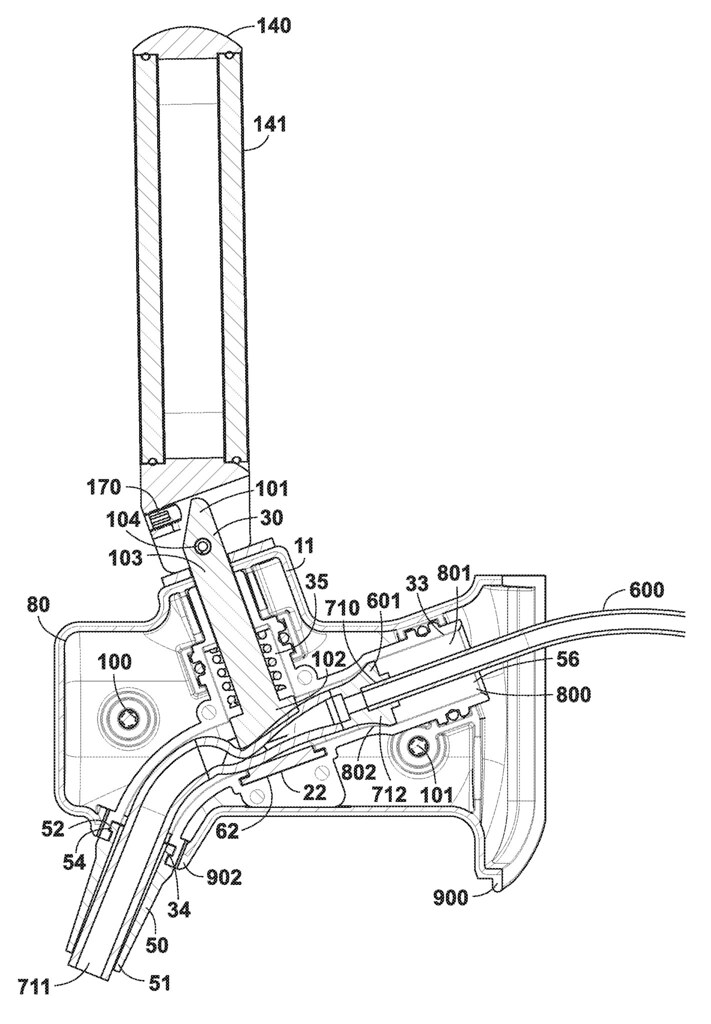
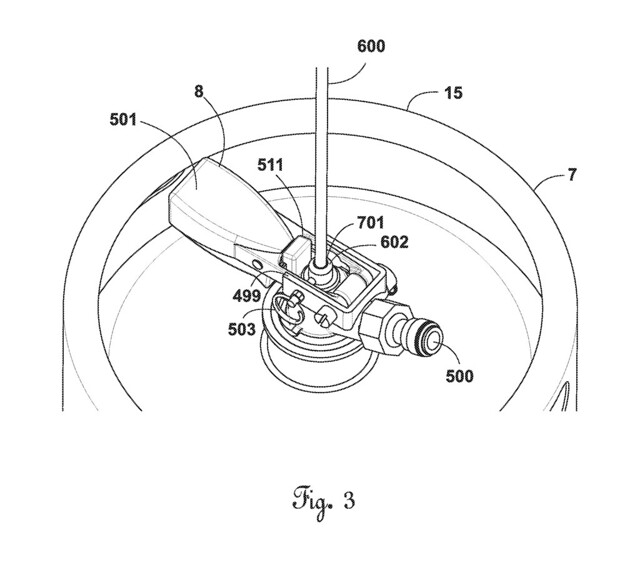
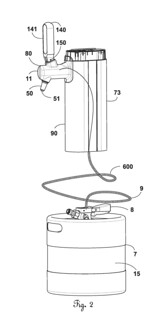
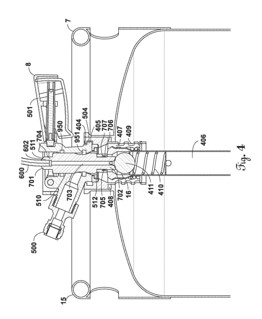
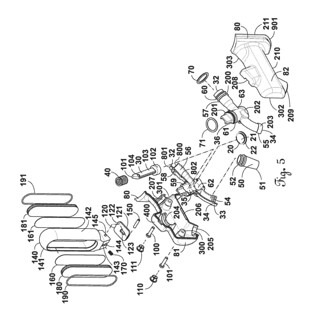
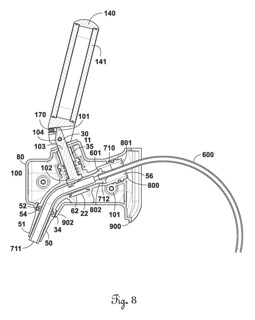
Today in 2014, just one year ago, US Patent 8678247 B2 was issued, an invention of Paul Haskayne, Robert W. Shettle, Donald W. Smeller, Jarrell L. Jennings III, and Merrill R. Good, assigned to the Lancer Corporation, for their “Creamy Foam Beer Dispensing System.” Here’s the Abstract:

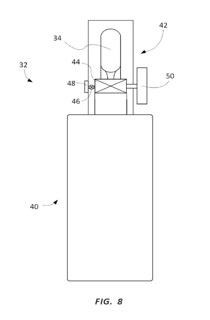
A creamy foam beer dispensing system includes a coupler removably securable with a keg, a transportation tube, and a faucet having a handle coupled with a plunger communicating with the transportation tube. The handle is movable among a closed position, an open position, and a creamy foam position. In the closed position, the handle maintains the plunger squeezed against the transportation tube such that no beer flows from the faucet. In the open position, the handle lifts the plunger substantially, completely off the transportation tube such that beer flows smoothly from the faucet. In the creamy foam position, the handle lifts the plunger off the transportation tube a distance such that an aperture created in the transportation tube produces creamy foam flow from the faucet.

US08678247-20140325-D00000
US08678247-20140325-D00001
US08678247-20140325-D00003

US08678247-20140325-D00002 US08678247-20140325-D00004

US08678247-20140325-D00005 US08678247-20140325-D00008

Filed Under: Beers, Just For Fun, Politics & Law, Related Pleasures Tagged With: Kegs, Law, Patent

Patent No. 3501934A: Apparatus For Repairing Kegs

March 24, 2015 By Jay Brooks

patent-logo
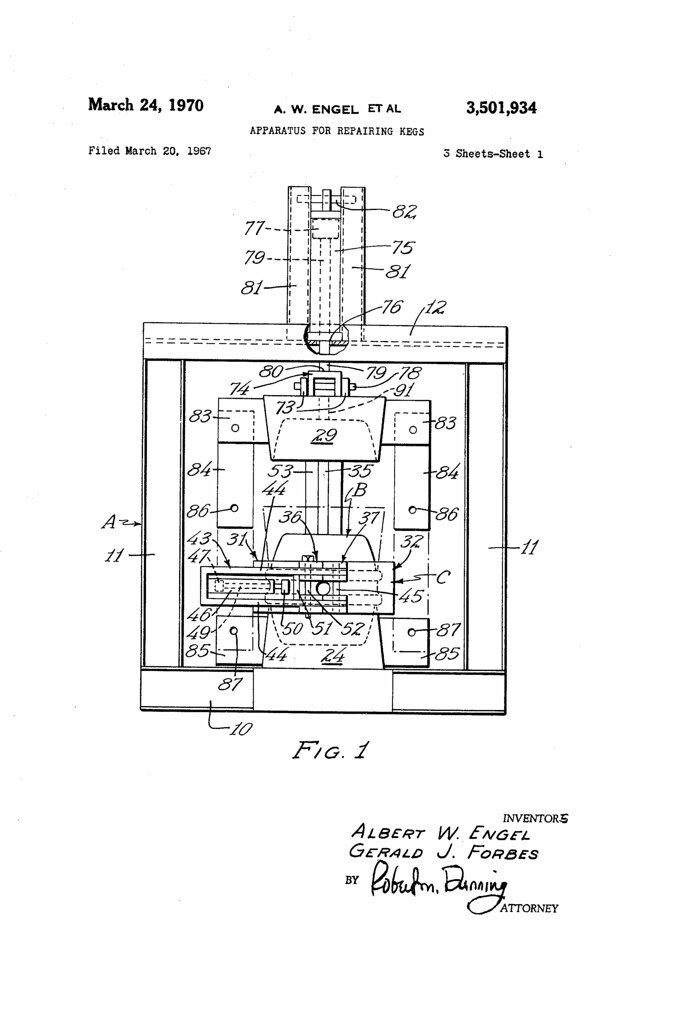
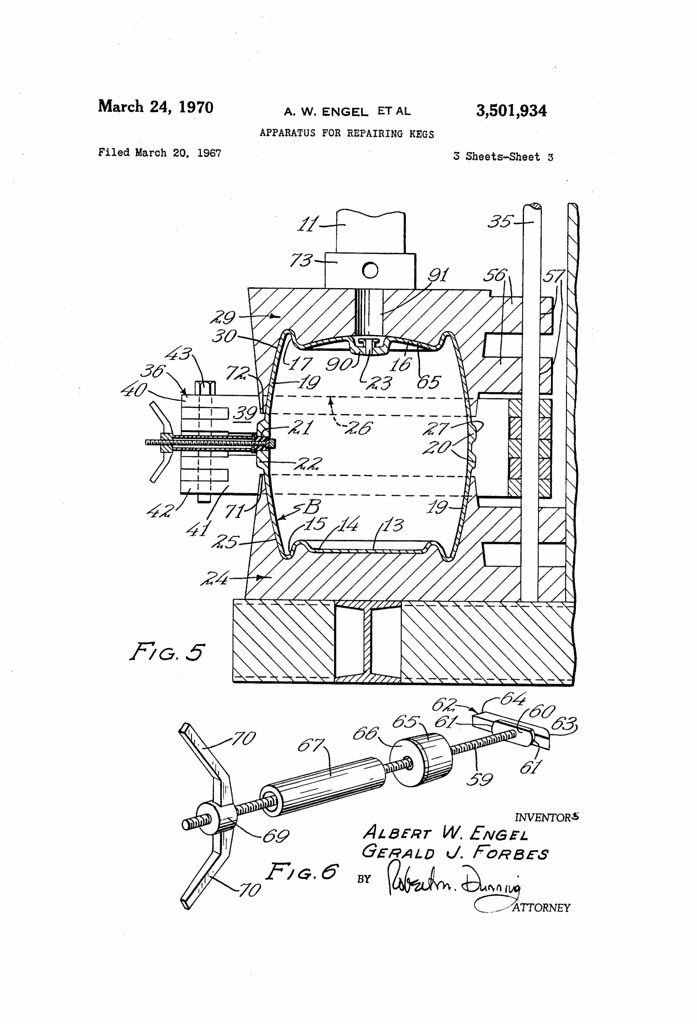
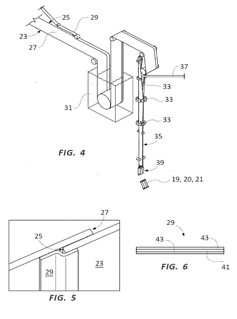
Today in 1970, US Patent 3501934 A was issued, an invention of Albert W. Engel and Gerald J. Forbes, for their “Apparatus For Repairing Kegs.” There’s no Abstract, but the description states that the invention relates to a “method and apparatus for repairing metal kegs, such as the aluminum kegs used for containing beer. The apparatus includes a die shaped to the outside form of the keg. The deformed externally projecting parts of the keg are pressed into an area defining original confines of the keg. In other words all external projections are forced inwardly by pressure. To return the keg to its original condition, the keg is filled with water, and an explosive is placed in the keg. The explosive is detonated to blow the keg back to its original form. The method comprises a hydraulic means of expanding kegs against a closed die to return the kegs to their original shape.”
US3501934-0
US3501934-1
US3501934-2

Filed Under: Beers, Just For Fun, Politics & Law, Related Pleasures Tagged With: History, Kegs, Law, Patent

Patent No. 3174650A: Bung Withdrawing Assembly

March 23, 2015 By Jay Brooks

patent-logo
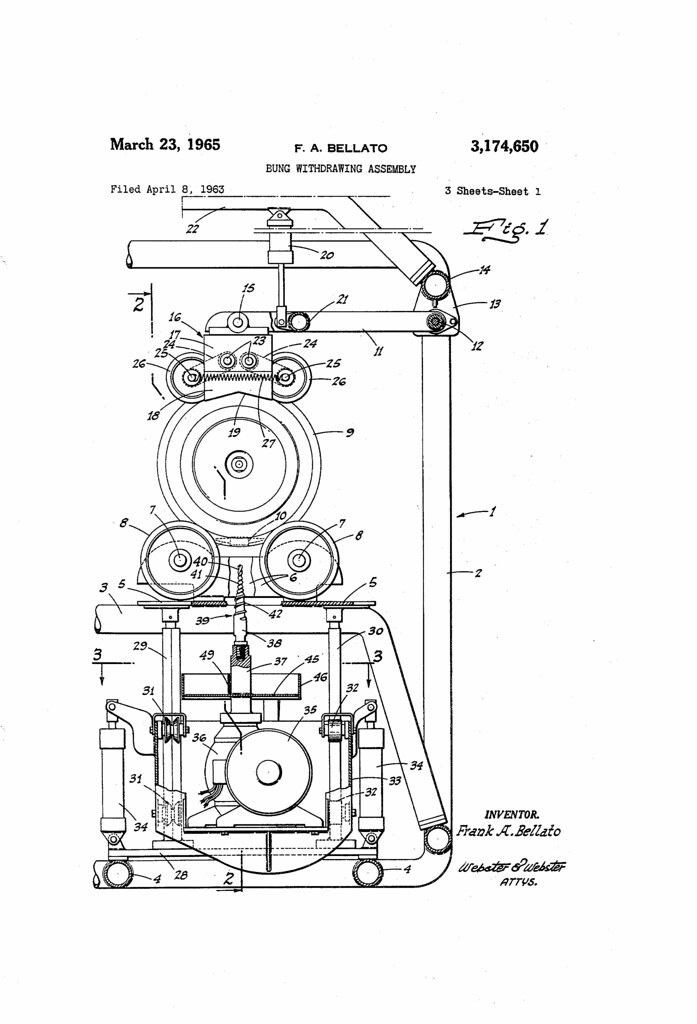
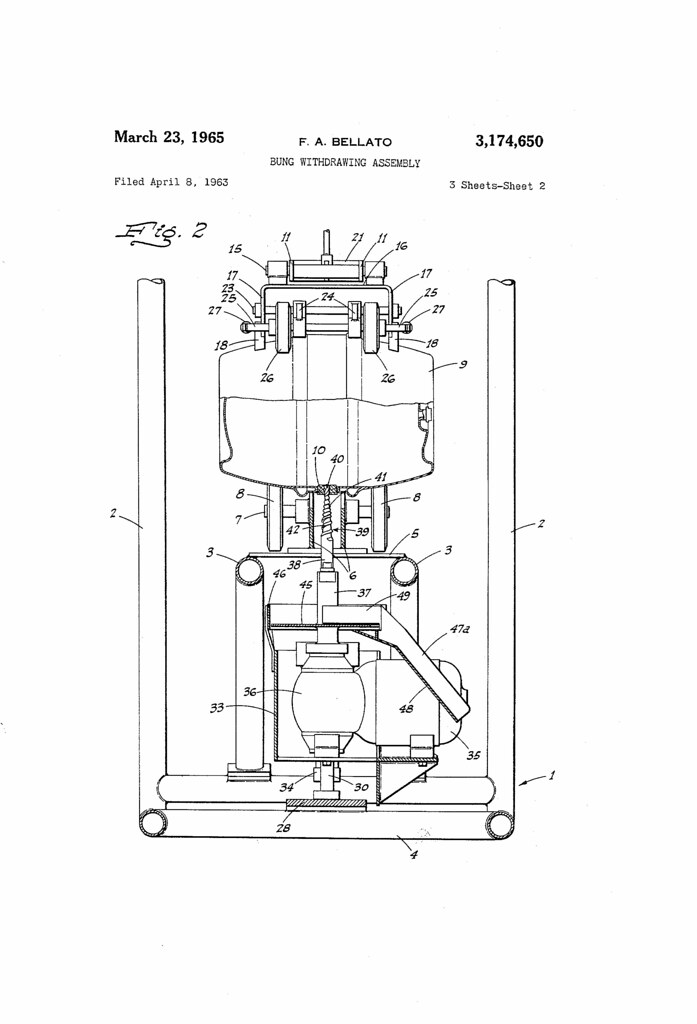
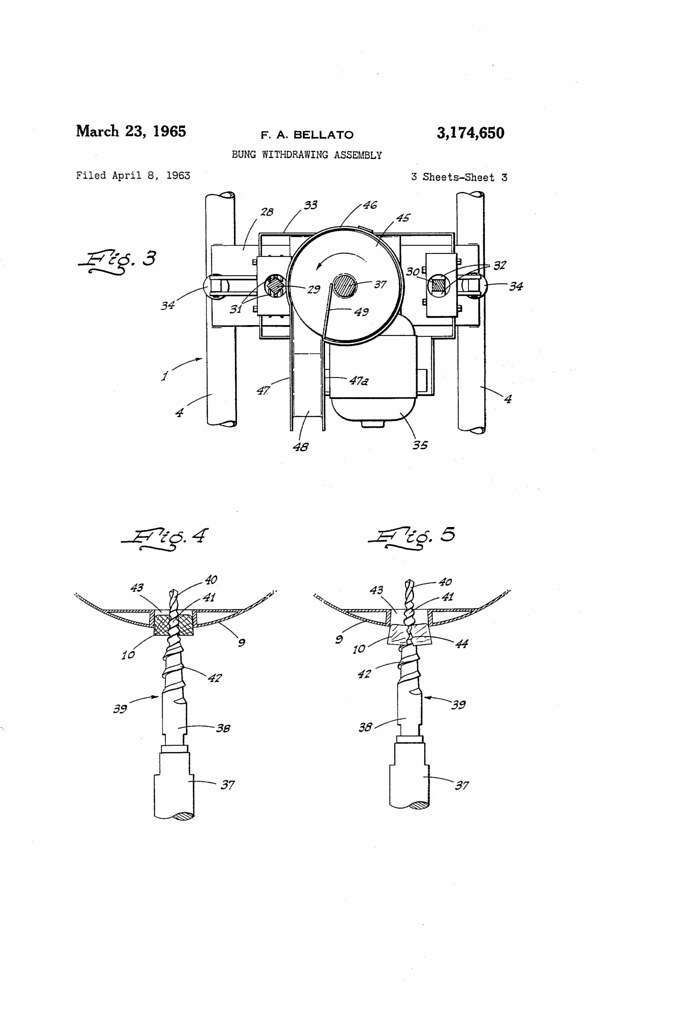
Today in 1965, US Patent 3174650 A was issued, an invention of Frank A. Bellato, for his “Bung Withdrawing Assembly.” There’s no Abstract, but the description states simply that the “invention relates to a device for removing the wooden bungs from beer kegs and similar containers after such kegs have been emptied of their contents.” Then the goals of their patent application are laid out:

A major object of the invention is to provide an auger, of special form for the purpose, having a pilot portion arranged so as to first penetrate the bung along a path axially of the bung without possible deviation from such path such as grain direction or irregularities in the wood of the bung might cause, and having a portion following the pilot portion arranged to then advance into the bung in a manner to cause the bung to be withdrawn from the bung hole and split into separate sections so that such sections will fall of themselves from the auger.

It is another and important object of the invention to provide a means for operatively mounting the auger, both for rotation and axial movement, in an upwardly facing position, and a means for supporting the keg above the auger in such a position that the bung, which as usual is in one side of the keg, will be disposed in a downwardly facing position directly in line with the auger.

The importance of having the bung disposed in an inverted position, with the auger disposed below the keg and bung, is that no chips or wood dust, as created by the action of the auger, can enter the keg but will drop down clear of the keg.

A further object of the invention is to provide a catch tray and carryotf chute in connection with and directly below the auger which will receive, and cause to be carried alway, all chips, withdrawn bung pieces, as well as any liquid residue dropping from the empty keg when the bung is withdrawn, and keep such waste matter from possibly fouling the auger supporting and operating mechanism.

The keg, when initially placed on the supporting means, may not always be disposed with the bung in the necessary downwardly facing position, and a still further object of the invention is to provide a keg support-ing means which enables the keg, after once being supported, to be easily rotated so as to dispose the bung in the proper position for engagement by the auger.

In connection with this latter feature, it is also an object of the invention to provide a clamping unit for engagement with the top of the keg, which will rst exert a yieldable hold-down action on the keg which still allows the keg to be rotated if necessary, and which will then clamp the keg against any movement. At the same time, the clamping means is mounted so that it can be readily moved clear of the keg so as to offer no interference with the placement of the keg on or removal of the same from the supporting means.

US3174650-0
US3174650-1
US3174650-2

Filed Under: Beers, Breweries, Just For Fun, Politics & Law, Related Pleasures Tagged With: Brewing Equipment, History, Law, Patent, Science of Brewing

Patent No. DE2145298A1: Instant Beer Powder

March 22, 2015 By Jay Brooks

patent-logo
Today in 1973, US Patent DE 2145298 A1 was issued, an invention of Siegfried Beissner, for his “Instant Beer Powder — by vacuum-freeze drying.” Here’s the Abstract:

Beer is subjected to vacuum-freeze drying at -10 degrees to -20 degrees C, under a press. of about 0.5 atm. with agitation. Beer can be rapidly restored by treating the powder with water and a source of CO2 (pure CO2 or a mixt. of NAHCO3 and tartaric acid) and/or alcohol. The CO2-source and/or alcohol can be enclosed in capsules made from water-sol. gelatine and packed together with the beer powder.

instant-powdered-beer

Given that we’re seeing this type of product in the trade recently, and the anti-alcohol groups have been going apeshit, I would have thought this was a more recent invention. But a version of it was around at least as early as 1973, over forty years ago. I wonder why it took so long for it to make it to market?

Filed Under: Beers, Just For Fun, Politics & Law, Related Pleasures Tagged With: History, Law, Patent, Science of Brewing

Patent No. 3649993A: Apparatus For Opening The Flaps Of A Container And Removing Debris Therefrom

March 21, 2015 By Jay Brooks

patent-logo
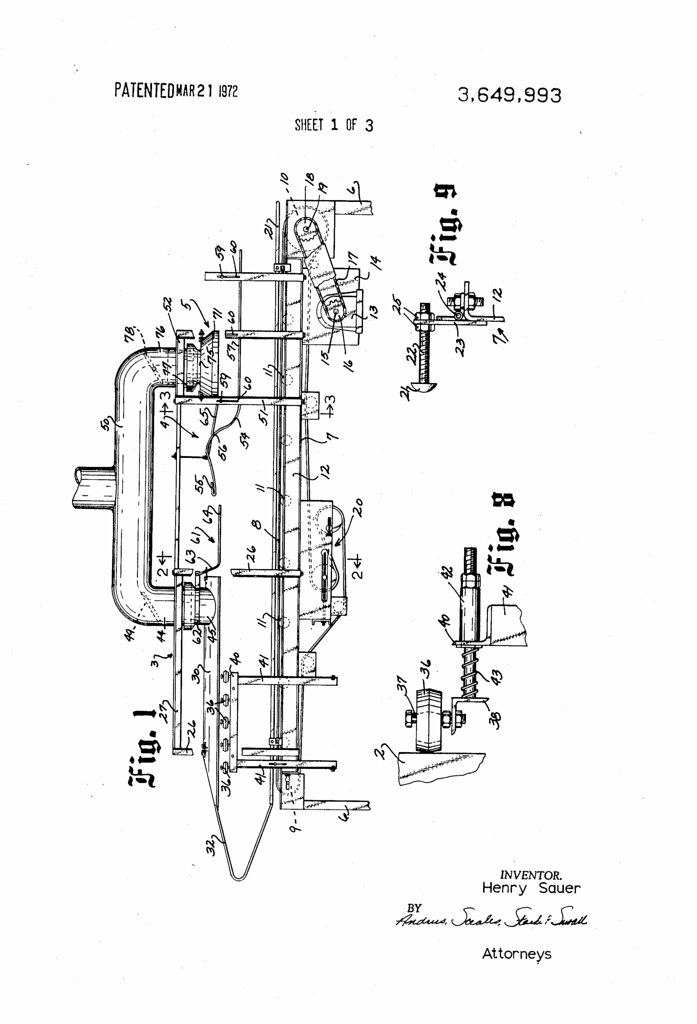
Today in 1972, just one year ago, US Patent 3649993 A was issued, an invention of Henry Sauer, assigned to Schlitz Brewing Co., for his “Apparatus For Opening The Flaps Of A Container And Removing Debris Therefrom.” Here’s the Abstract:

An apparatus for opening and spreading the top flaps of a carton containing packaged articles such as bottles, and for cleaning the carton after the flaps are opened. The carton containing the articles is moved along a conveyor and the sides of the carton are engaged by pressure members which deform the sides and pivot the flaps, if closed, to a partially open position. The carton then passes beneath a vacuum duct, which acts to raise the flaps. After the flaps have been raised, the carton moves into engagement with a spreader unit which spreads the flaps laterally outward. With the flaps in the spread position, the carton is then conveyed beneath a second vacuum duct which acts to draw lightweight debris from the carton.

US3649993-1
US3649993-2
US3649993-3

Filed Under: Breweries, Just For Fun, Politics & Law, Related Pleasures Tagged With: Brewing Equipment, History, Law, Patent

Patent No. 20140079868A1: Packaging For Decarbonated Beer Base Liquid

March 20, 2015 By Jay Brooks

patent-logo
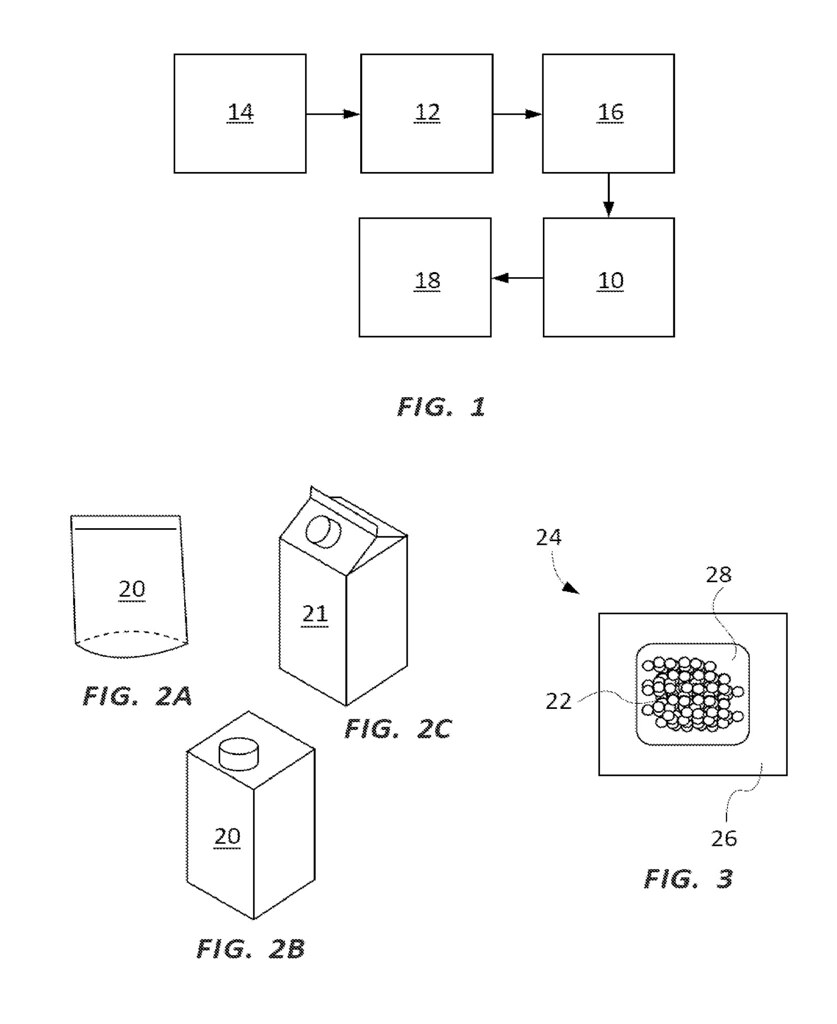
Today in 2014, just one year ago, US Patent 20140079868 A1 was issued, an invention of Jerome Pellaud, Aaron Penn, Wilfried Lossignol, and Neeraj Sharma, assigned to Anheuser-Busch, LLC, for their “Packaging For Decarbonated Beer Base Liquid.” There’s no Abstract, but there’s a lengthy summary after the introduction which appears to serve the same function:

A package for a decarbonated beer base liquid may comprise a non-rigid wall defining an internal orifice, a seal extending along a seam of the non-rigid wall and providing an oxygen barrier, and a decarbonated beer base liquid hermetically sealed in said internal orifice. An individually packaged base liquid for making personalized malt-based beverages may comprise at least about 0.1% wt ethyl alcohol, at least about 3% wt malt extract solids, and a carbon dioxide level between about zero grams per liter and about 1.5 grams per liter.

This is without a doubt one of the odder patents I’ve come across in my year-long quest to document beer-relayed U.S. Patents. This is apparently more aimed at markets outside the U.S., but that doesn’t mean we might not see it used here, as well. Take a look at some of the language used in the “Background.”

In recent years, malt-based beverages, and especially beers, are a fast growing market in many countries such as China and India. In many of these countries, the taste and beer-type preferences are culturally different from markets such as North and South America and Europe. Most breweries operating world-wide, however, provide a limited number of beer types, and hence, beer tastes. Due to globalization, the availability of specialized beer types that meet specific consumer demands becomes a challenge, both in terms of logistics and in terms of the amount of different beer types and tastes to be developed and produced.

Beer taste is dependent on the ingredients used (e.g., malt-type, adjunct levels, hops type and levels, other ingredients such as fruit flavors, water composition, etc.) and operational settings (e.g., boiling time, yeast type used for fermentation, fermentation temperature profile, filtration, etc.).

Brewing finished beer, wherein all the ingredients are introduced into the beer prior to bottling, has a major drawback in that the formulation and thus the taste, smell, color and other organoleptic properties of the beer are fixed.

One of their initial premises, that “Most breweries operating world-wide, however, provide a limited number of beer types, and hence, beer tastes” is pretty funny. There are at least 400 different types of beers but they’ve chosen to concentrate on one and turn it into a commodity, only to use that now as a negative to promote this idea. Strange. Brewing and bottling beer they characterize as a “drawback” because the way that beer tastes is then “fixed.” Hilarious.

So from what I see here it seems like they’re setting the groundwork for a new business model where you create a base beer with little to no character and then infuse or add whatever flavors you want to create the finished product, not at a brewery, but at the point of consumption. Have you see the new magic soda machines at fast food restaurants where you press a few buttons and can be served 100 or more different flavors of soda? That’s where I think they may be going with this, but with beer. That certainly seems like a scary proposition.

US20140079868A1-20140320-D00001

US20140079868A1-20140320-D00002 US20140079868A1-20140320-D00004

US20140079868A1-20140320-D00005 US20140079868A1-20140320-D00006

US20140079868A1-20140320-D00007

Filed Under: Beers, Just For Fun, Politics & Law, Related Pleasures Tagged With: Anheuser-Busch InBev, Law, Malternatives, Patent

Patent No. EP 2450290 B1: Plastic Beer Keg

March 19, 2015 By Jay Brooks

patent-logo
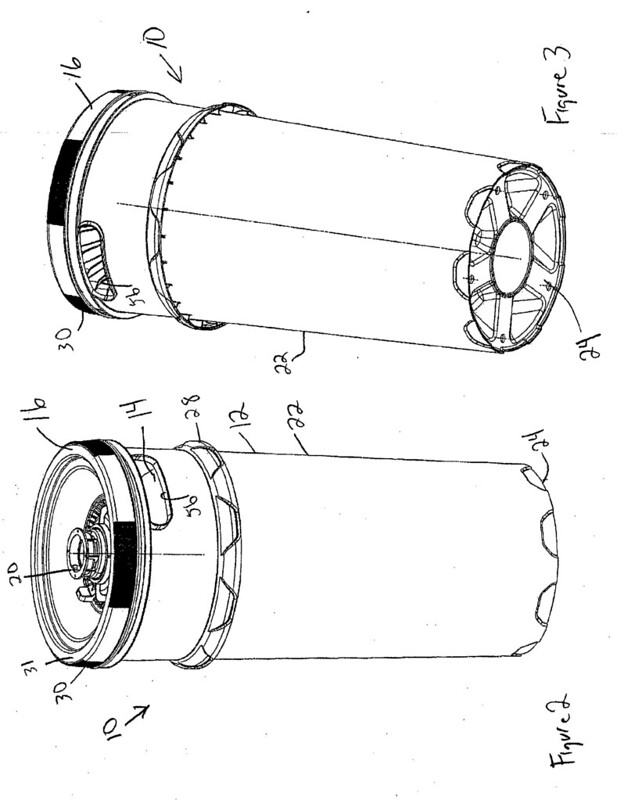
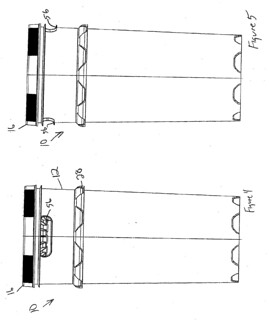
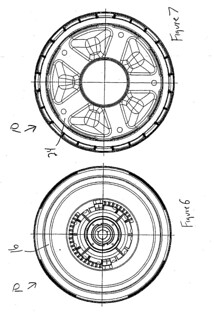
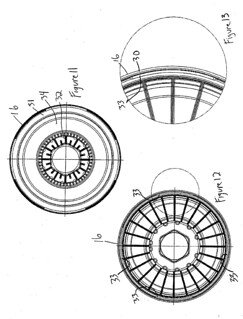
Today in 2014, just one year ago, US Patent EP 2450290 B1 was issued, an invention of William P. Apps, assigned to Rehrig Pacific Company, for his “Plastic Beer Keg.” There’s no Abstract, but there’s a lengthy summary after the introduction which appears to serve the same function:

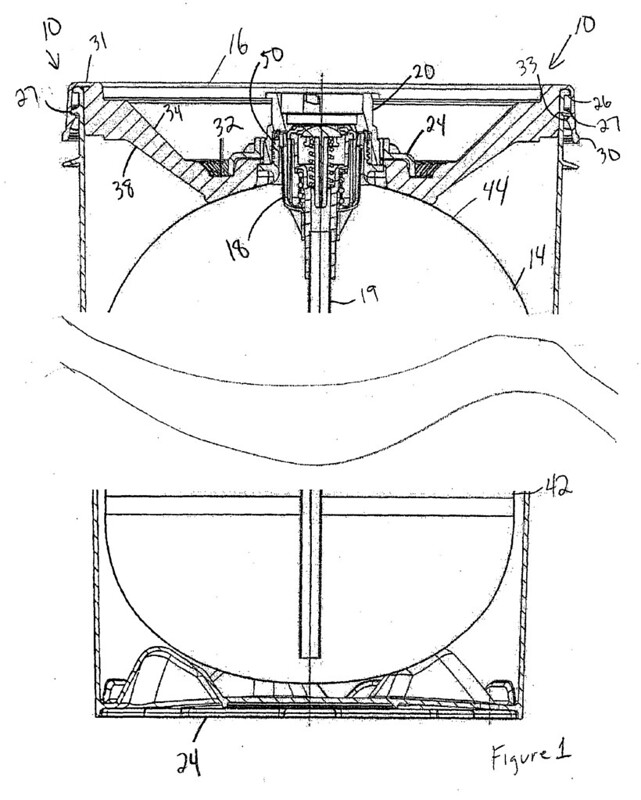
According to the present invention there is provided a plastic beer keg as claimed in claim I and a method as claimed in claim 6. The locking ring secures the liner to the lid, and the locking ring is configured to release the liner from the lid upon impact of the keg in a drop. This can be accomplished by molding the locking ring from a softer material, which flexes to release the liner on impact, or a more brittle locking ring or a locking ring with design-in stress concentrators, which breaks to release the liner on impact.

In the method of the present invention, the liner of the beer keg is filled with beer while the locking ring is securing the neck portion of the liner to the lid, but the locking ring is removed after filling and prior to shipping of the beer keg. The filled keg is shipped, sold and used without the locking ring. The locking ring may be reused in the filling of many kegs.

Also disclosed is a plastic keg that includes a liner including a neck portion and a body portion. A lid having an opening is disposed at least partially over the liner. The liner is disposed in an outer container having a wall with at least one locking rib projecting therefrom. The locking rib angles downward and the lid secured to the outer container by the at least one locking rib. Optionally, the lid can be snapped onto the locking rib or rotated to lock onto the locking rib. This can be accomplished by an angled surface on at least one of the locking rib and the shoulder of the lid that snaps under the locking rib.

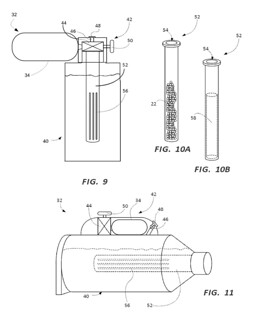
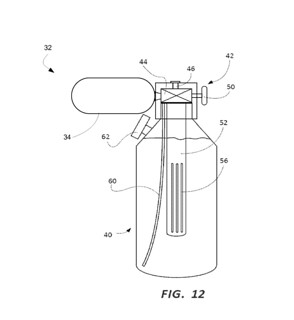
2450290-imgf0001
2450290-imgf0002

2450290-imgf0003 2450290-imgf0004

2450290-imgf0007 2450290-imgf0008

Filed Under: Beers, Just For Fun, Politics & Law, Related Pleasures Tagged With: Kegs, Law, Patent

« Previous Page
Next Page »

Find Something

Northern California Breweries

Please consider purchasing my latest book, California Breweries North, available from Amazon, or ask for it at your local bookstore.

Recent Comments

  • Bob Paolino on Beer Birthday: Grant Johnston
  • Gambrinus on Historic Beer Birthday: A.J. Houghton
  • Ernie Dewing on Historic Beer Birthday: Charles William Bergner 
  • Steve 'Pudgy' De Rose on Historic Beer Birthday: Jacob Schmidt
  • Jay Brooks on Beer Birthday: Bill Owens

Recent Posts

  • Beer In Ads #5205: Moerlein’s Celebrated Bock Beer, An Easy Winner April 5, 2026
  • Historic Beer Birthday: Fritz Funke April 4, 2026
  • Historic Beer Birthday: Herman Zibold April 4, 2026
  • Beer In Ads #5204: Bock Beer! The First Genuine Bock Of The Season April 4, 2026
  • Historic Beer Birthday: Marcus Rapp April 4, 2026

BBB Archives

Feedback

Head Quarter
This site is hosted and maintained by H25Q.dev. Any questions or comments for the webmaster can be directed here.