Brookston Beer Bulletin

Jay R. Brooks on Beer

  • Home
  • About
  • Editorial
  • Birthdays
  • Art & Beer

Socialize

  • Dribbble
  • Email
  • Facebook
  • Flickr
  • GitHub
  • Instagram
  • LinkedIn
  • Pinterest
  • RSS
  • Twitter
  • YouTube

Powered by Genesis

The David Vs. Goliath Prohibitionist Myth

December 11, 2013 By Jay Brooks

prohibition
This one always bugs me. Many prohibitionist groups invoke the Bible story of David and Goliath to suggest that they represent the little man against the giant, faceless, impersonal alcohol companies. Alcohol Justice earlier today tweeted this gem begging for donations to “Help Alcohol Justice stand-up to Big Alcohol’s harmful practices.” Along with the tweet was this image:

david-vs-goliath

Beyond the obnoxious religious posturing, as if alcohol companies or people who drink it are irreligious, or that those who belong to either group are Philistines, the unequal position is untrue. The reality is that most of the prohibitionist groups currently operating are very well-funded. The mother of them all, the Robert Wood Johnson Foundation “spent over a quarter of a billion (that’s billion, not million) dollars ($265,000,000.00) in just four years alone further developing and funding a nation-wide network of anti-alcohol organizations, centers, activist leaders, and opinion writers to promote its long-term goal.”

Similarly, MADD’s Focus is squarely on money and fund-raising. Here’s what Alcohol Facts has to say about MADD:

Non-profit organizations typically permit their chapters to keep most of the money they raise. For example, Remove Intoxicated Drivers (RID) chapters get to keep 90% of all funds they raise. But MADD claims ownership of every penny raised by all its many chapters. Thus, after raising $129,000 locally and turning it all over as MADD demands, the Las Vegas chapter received a check from the national office for $1.29 (one dollar and twenty nine cents) as its share. MADD’s “focus is on greed,” said the chapter President, who reported “I’ve never seen such bloodsuckers!”

All items in some issues of Mothers Against Drunk Driving’s MADD E-Newsletter are devoted entirely to MADD’s primary mission of fund-raising. There are no pleas for sober driving, no calls for more sobriety checkpoints, no news reports, no petitions for legislation to reduce impaired driving and improve traffic safety — just fund-raising appeals. Most issues of the MADD E-Newsletter usually have at least one or two items not devoted to soliciting money.

MADD’s national web site lists all local chapters. Each listing is followed by a plea to “Donate Locally.” This is clearly deceptive because it implies that funds given to local chapters will be handled differently than funds given to the national office. In reality, all funds, wherever donated, must go directly and completely to the national office for use as it sees fit.

They go on:

Mothers Against Drunk Driving is always hungry for more money. Although the organization’s financial investments exceed 25 million dollars, it has paid telemarketers huge fees to raise tens of millions of dollars per year from hard-working Americans. MADD has spent almost two out of every three dollars raised on fund-raising, forcing the American Institute of Philanthropy (AIP) to downgrade its evaluation of the organization to a “D.” MADD has spent twice as much on fundraising as the AIP finds acceptable. It would appear that raising money has become an end in itself at the MADD bureaucracy, with numerous employees, high salaries, expensive fringe benefits, and huge retirement funds.

In addition, the New Prohibition adds:

MADD operates more like a big business than a charity, with the majority of its funding going toward salaries and fringe benefits instead of public safety programs.

MADD’s 2007-2008 operating budget was over $45 million.

Alcohol Justice, who tweeted the David and Goliath reference, is funded by the Buck Trust. According to the New Prohibition, “the Leonard and Beryl Buck Foundation (Buck Trust) was created in 1975 after Beryl Buck left $9.1 million to Marin County, California with the provision that it be used to serve the needs of the County residents.” Alcohol Justice claims they receive just 3% of the Buck Trust’s funding, although despite the Trust’s provision that it be used locally, AJ’s reach and focus is well beyond Marin County’s borders.

According to AJ’s own publicly available financials, in 2012 they were worth a little over $1.6 million and had assets of almost $1.6 million at the end of the year. Of their annual budget, by far the largest chunk was spent on salaries, which were in excess of $600,000 and they spent over $800,000 in total compensation.

The point is, the prohibitionists are spending a lot of money, but is big alcohol spending that much more, such that they’re Goliath to the prohibitionist’s self-proclaimed David?

A Huffington Post report from 2010, entitled Food & Alcohol Industries’ Lobbying Dollars totals industry spending and, removing the food portions, alcohol spends about $4.2 million. A tidy sum to be sure, but it’s obviously dwarfed by just the Robert Wood Johnson Foundation’s $66.5 million per year over the past four years (totaling $265 million). According to Open Secrets, the alcohol industry isn’t even among the Top 20 since 1998. For 2013, Open Secrets reckons that the alcohol industry has spent $15.7 million, or only about 23.6% of what the Robert Wood Johnson Foundation alone spends. Add in what all the rest are spending, and the percentage goes down even more.

What’s obvious is that this David vs. Goliath propaganda is just that: propaganda. It’s a myth that the prohibitionists are tiny grassroots groups fighting against the giant alcohol Goliaths. It may be useful in raising money — clearly prohibitionist group’s most important concern — but it’s just not true. Please, put down the slingshot.


Filed Under: Editorial, Politics & Law Tagged With: Prohibitionists, Propaganda

History of Addiction Pt. 2: The Industrial Revolution

December 11, 2013 By Jay Brooks

evolution
Today’s infographic is part 2 of a four-part series on the History of Addiction. The second part covers the Industrial Revolution, from the 18th century through just before World War II. Tomorrow, part 3.

history-of-addiction-the-industrial-revolution
Click here to see the infographic full size.

Filed Under: Beers, Breweries, Just For Fun, Politics & Law Tagged With: History, Infographics

Raise A Tax

December 9, 2013 By Jay Brooks

stpatrick
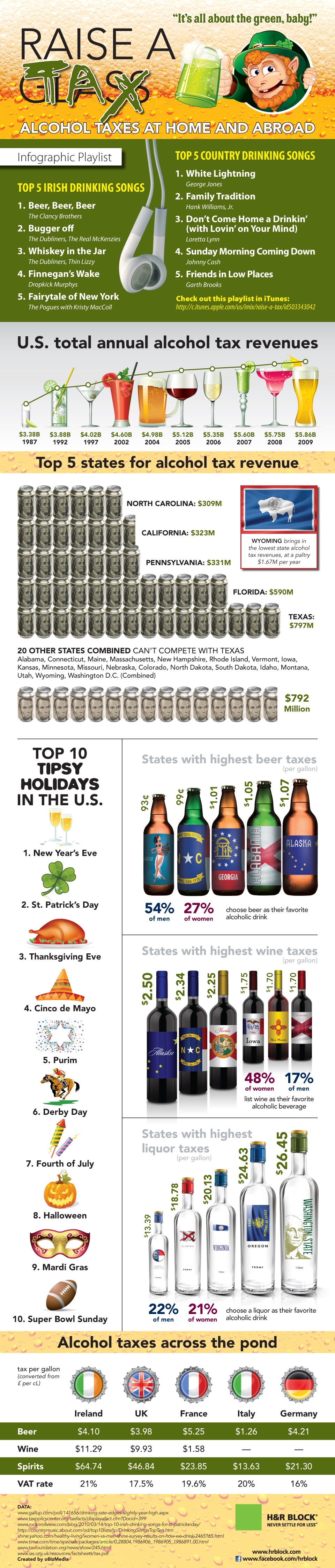
Today’s infographic, in honor of today being Green Monday, is entitled Raise a Tax, or “It’s all about the green, baby!” Not surprisingly, it was created by H&R Block.

alcohol-taxes-in-the-us-and-around-the-world
Click here to see the infographic full size.

Filed Under: Beers, Just For Fun, Politics & Law Tagged With: Infographics, Taxes

What’s In A Pipe?

December 8, 2013 By Jay Brooks

pipe-2
Here’s a curious artifact from the 1842 Temperance Almanac, and a great example of why the prohibitionists were as nutty then was they are today. They saw, and see, evil and vice everywhere, with any single one not unto itself, but instead having to lead to more ruin and debauchery. While today we know that smoking isn’t the best choice you can make, in the mid-1800s it was considered a fairly benign pursuit, and in fact remained so well into my lifetime. I recall staying up with my psychotic stepfather, a chain-smoker, to watch the last television commercial air before midnight on New Year’s Day when they became forbidden on January 2, 1971. I’ve never been a cigarette smoker, though I used to enjoy the occasional cigar from time to time. The one thing I dislike more than smoking is obnoxious non-smokers, especially ex-smokers. But even the most ardent anti-tobacco advocate would have to admit that puffing on a pipe will not with absolute certainty lead to drinking alcohol. There’s no causation. That some people do both is, at best, a coincidence brought upon by the obvious fact that many people smoke (especially in 1842) and many people drink. But there are surely enough examples in everyone’s own experience to render such a blanket statement untenable. But for prohibitionists, it gets even weirder.
whats-in-a-pipe
So, as Sigmund Freud would later say, “sometimes a pipe is just a pipe.” Just don’t expect a prohibitionist to believe it. Instead, if you smoke a pipe, you won’t be able to help yourself, it will cause you to drink and get drunk. According to 1842 prohibitionist logic, “smoking induces intoxication” — meaning it will actually “bring about, produce, or cause” you to drink. But that’s not where it ends, get drunk and that in turn “induces bile,” which is “a bitter, alkaline, yellow or greenish liquid, secreted by the liver, that aids in absorption and digestion, especially of fats.” That, in turn, “induces jaundice” — “yellow discoloration of the skin, whites of the eyes, etc., due to an increase of bile pigments in the blood, often symptomatic of certain diseases, as hepatitis” followed inevitably and inexplicably by “dropsy,” which is “an infectious disease of fishes, characterized by a swollen, spongelike body and protruding scales, caused by a variety of the bacterium Pseudomonas punctata.” Yeah, that seems likely. But wait, it gets even worse. That fish disease you can’t help but contract “terminates in death.” So definitely enjoy that tobacco. Or as they conclude. “Put that in your pipe and smoke it.” I’m willing to bet you can find modern prohibitionists who still believe it’s true, or that at least once you take a drink your life is over and can only fall into abject ruin.

Filed Under: Beers, Editorial, Just For Fun, Politics & Law Tagged With: History, Prohibitionists

Four Score and Seven Beers Ago

December 5, 2013 By Jay Brooks

repeal-day
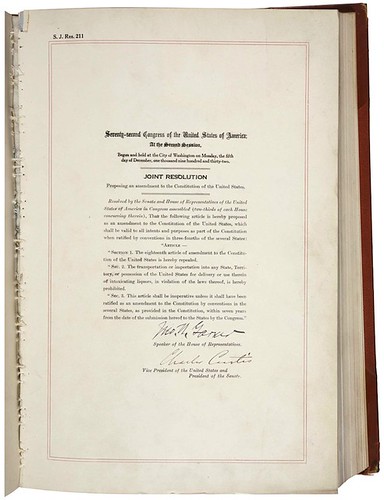
Today, of course, is the 80th anniversary of the repeal of prohibition, a.k.a. Repeal Day. Below is the original resolution from Congress, signed the following day.

21st_Amendment_Pg1of1_AC

You may recall that earlier this year was also the 150th anniversary of the Gettysburg Address. So I was goofing around this morning and modified Lincoln’s famous speech as a toast to the end of prohibition, which I titled “Four Score and Seven Beers Ago.” A score, to save you from checking Dictionary.com is 20 years, which is how long ago the 21st Amendment was ratified. Enjoy.

Four score and seven beers ago our fathers brought forth on this continent, the end of prohibition, conceived in Liberty, and dedicated to the proposition that all men are entitled to a beer.

Now we are engaged in a great social war, testing whether that nation, or any nation so conceived and so dedicated, can long endure. We are met in a great brewery of that war. We have come to dedicate a portion of this kettle, as a final resting place for the malt who here gave its life that that beer might live. It is altogether fitting and proper that we should toast this.

But, in a larger sense, we can not dedicate — we can not consecrate — we can not hallow — this beer. The brave malt, hops and yeast, who fermented here, have consecrated it, far above our poor power to add more hops or filter it. The world will little note, nor long remember what beer we drank here, but it can never forget what they brewed here. It is for us the drinkers, rather, to be dedicated here to the unfinished beer which they who brewed here have thus far made with noble hops. It is rather for us to be here dedicated to the great task of drinking more beer — that from these honored beers we take increased devotion to that cause for which they gave the last full measure of hops — that we here highly resolve that these bottles shall not have been emptied in vain — that this nation, under God, shall have a new birth of freedom to drink beer — and that this beer of the people, by the people, for the people, shall not perish from the earth.

Don’t read too much into it, again I was just goofing around with the words. I suppose it could be used as a toast if you were at a brewery, but otherwise, it’s just a little spoof, nothing more.

prohibition-ends

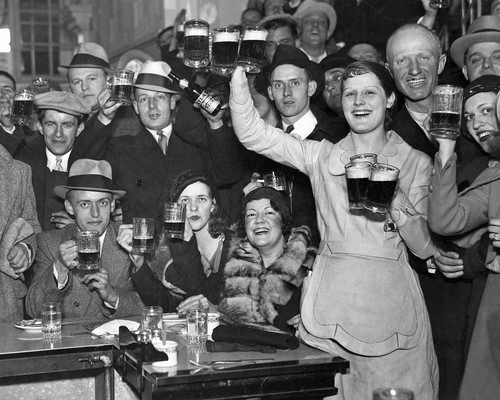
So join me in bridging time and drinking a toast to prohibition’s end, 80 years later, and, of course, stay wet, my friends. Happy Repeal Day.

stay-wet

Filed Under: Beers, Breweries, Events, Just For Fun, Politics & Law, Related Pleasures Tagged With: History, Poetry, Prohibition

Prohibition Did What?!

December 5, 2013 By Jay Brooks

18th-amendment
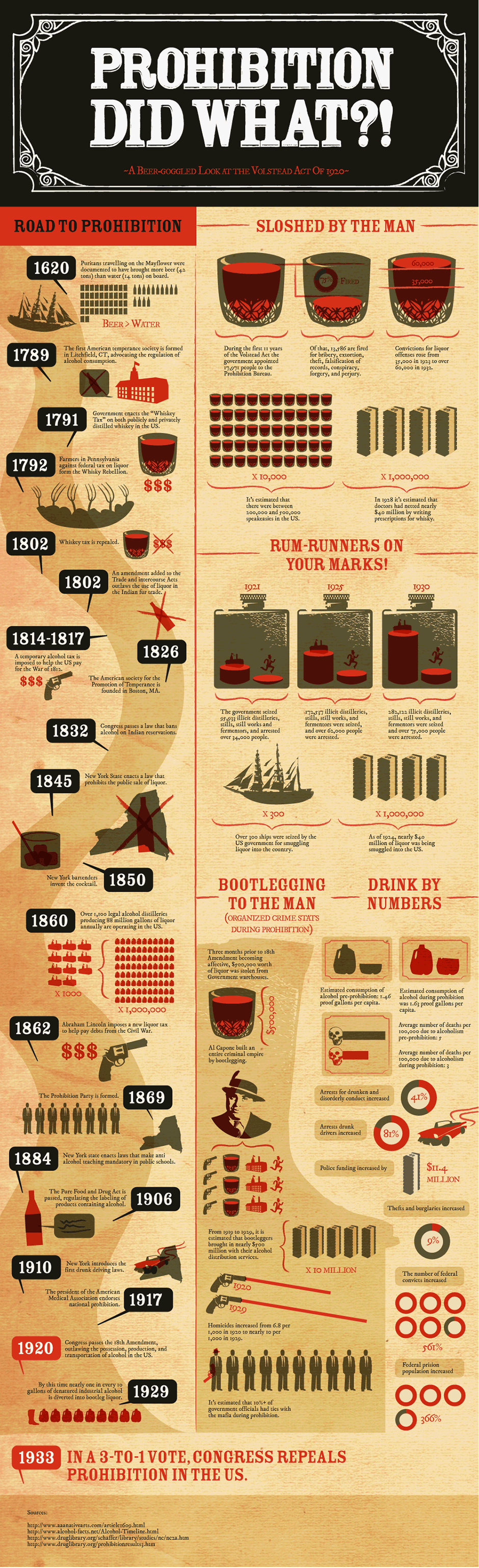
Today’s infographic, since today is the day in 1933 when the 21st Amendment passed, repealing Prohibition, is one I’ve posted before, entitled Prohibition Did What?! It goes in to many of the effects that Prohibition had on the country, none of them particularly positive.

prohibition-did-what
Click here to see the infographic full size.

Filed Under: Beers, Breweries, Just For Fun, Politics & Law Tagged With: History, Infographics, Law, United States

Self-Fulfilling Prophecy Propaganda

December 4, 2013 By Jay Brooks

ouroboros-dragon
Here’s another great example of the circle jerk nature of prohibitionist groups. This is, I’m finding, the standard operating procedure for most, if not all, of them. They decide what they’re opposed to, in this case alcohol, and then they commission — that is pay for — research that they claim proves their point. Tobacco companies are the classic example, insofar as they funded lots of studies showing how safe smoking was despite independent research revealing just the opposite. How the “study” is framed is one of the many troubling aspects of how they do this. Assumptions are made that all alcohol is bad and that people who consume it will abuse it and be a burden on society, causing innumerable harms to themselves and others. That’s a persistent theme that permeates much of the so-called scientific literature, there’s hardly a whiff of impartiality if you look deeply enough into it.

A pointed example I recall, outside the alcohol world, is the Meese Commission Report which was directed by then-President Ronald Reagan to find a link between pornography and criminal or anti-social behavior. The important difference between this, and the earlier commission by Johnson/Nixon which resulted in the 1970 Commission on Obscenity and Pornography, is that from an impartial starting point that report found no such link. In fact, the 1970 commission “recommended against any restrictions for adults” and overall “the report found that obscenity and pornography were not important social problems, that there was no evidence that exposure to such material was harmful to individuals, and that current legal and policy initiatives were more likely to create problems than solve them.” Regardless of your feelings about pornography, what’s significant is that Reagan’s mandate to Meese was not to see if there was causation between pornography and violence, but was instead he was tasked with finding one. That was the goal of the report, to find a link to please Reagan’s base on the religious right who weren’t happy with the results of the 1970 report. And that’s how I feel about GAPA and the countless quasi-scientific prohibitionist organizations and their “studies.” They are, by design, looking for trouble, and so naturally they find it everywhere they look.

So once they’ve manufactured and/or exaggerated the problem, the next step is to get the research published in quasi-scientific journals, in some cases one owned or funded by the same organizations. Then they send out press releases claiming their position has been scientifically proven. They usually neglect to mention that they themselves created the “science” they’re touting because it’s more effective if it appears to be objective. Unfortunately, it rarely is, but such is the state of journalism today that press releases are more often reprinted verbatim without any fact-checking or even questioning the content. It’s apparently enough if it simply has a credible-sounding “scientific” journal name attached to it. Once you’ve got enough of these “studies” you can then hold a conference of like-minded individuals where you can present your findings.

So in October of this year, the “Global Alcohol Policy Conference” was held in South Korea. It was hosted by a group I wasn’t familiar with; the Global Alcohol Policy Alliance (GAPA), but which appears to be more of a loose organization of national prohibitionist groups that was formed in 2000 to share information and hold annual conferences. Although I don’t know many of the international groups, the people from the U.S. make it clear who’s invited to the party. GAPA board members include George Hacker, who runs the notorious prohibitionist Center for Science in the Public Interest (CSPI); Thomas F. Babor, the author of Alcohol: No Ordinary Commodity: Research and Public Policy (an anti-alcohol handbook) and David Jernigan, who’s the Director of the also notoriously anti-alcohol Center on Alcohol Marketing and Youth (CAMY), funded by the Centers for Disease Control and Prevention Behavior and Society at the Johns Hopkins Bloomberg School of Public Health. Jerigan was also the author of this travesty: Bud Blamed In Absurd E.R. Visit Study.

Here’s where the circle gets tighter and more insular. There are sixteen board members for GAPA. At the recent Global Alcohol Policy Conference, there were eight speakers on the program. Of those eight, six are also board members of GAPA. Similarly, GAPA is divided into regions. The North American region includes four member organizations: CSPI (Centre for Science in the Public Interest), The Marin Institute (now known as Alcohol Justice), The Center on Alcohol Marketing and Youth and the Office of Alcohol and Other Drug Abuse, created by the collaboration of the AMA and the Robert Wood Johnson Foundation. If you’re a regular reader here you’ll no doubt recognize those groups as being prohibitionist to their core.

Looking over the program for the conference, the topics all revolve around the negative aspects of alcohol, the harms, the addicts, the too-low taxation and regulation. Reading over the titles, it’s hard not to leave with the impression that it’s about how to bring down alcohol completely. I couldn’t find one positive word about drinking, which seems incongruous to my life experience and literally just about every person I know. Surely, they could find some balance to their efforts, but instead it feels punitive, divisive and almost mean-spirited. Some of the speeches given during the conference are available for download, while others — most, really — give you an error message when trying to download: “Applicants sponsored by alcohol manufacturers are not allowed.” How did they know? What don’t they want people in the alcohol industry to know about regarding what they’re saying or doing?

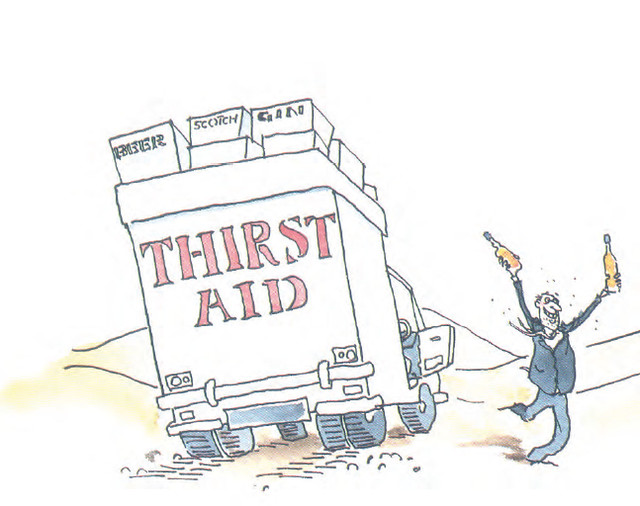
Another glimpse into prohibitionists worldwide comes from GAPA’s internal magazine, The Globe. In the latest issue, Issue 3 2013 they tackle such horrible behavior by alcohol companies as donating water to disaster relief with the overall theme of “Beware of the Alcohol Industry Bearing Gifts.”
thirst-aid
I recall the Marin Institute similarly whining when Anheuser-Busch canned water and sent it to Haiti after the devastating earthquake there, a story I detailed in Let No Good Deed Go Unpunished.

So how was the conference portrayed in the news online? Upstreaming Alcohol Policy reported that an “important theme running through the conference was the role of the global alcohol industry in maintaining and intensifying alcohol-related harm through its tactics and practices.” In other words, we’re all evil and wish your family harm, a persistent theme in all prohibitionist propaganda. Corporations & Health Watch agreed and went even further, reporting that “Dr. Thomas Babor of the University of Connecticut, for example, stressed reasons to doubt the sincerity of the global alcohol industry in its insistence to be part of the solution to alcohol problems.” Yes, we want everybody binge-drinking all the time, every day. There’s nothing better for the alcohol industry than drunk people killing themselves and others, especially when we all have families and want them in harm’s way, too. I’m so sick of this one, where alcohol is criticized for advertising or wanting to sell more products because that, they claim, is “clearly to increase overall consumption — a strategy which is inimical to public health and public safety.” Every alcohol corporation, at least under U.S. law, is like every corporation, beholden to shareholders and must do what they can to increase the share price, in other words increase the business. It’s the law. There’s plenty of corporate behavior I’m not wild about, but at least I understand it. If you want corporations to act differently, change their charters; change the law governing them. But stop making it sound like they’d kill their mothers for a dime. Stop painting them, and all of us in the alcohol industry, as evil. We’re just not.

Their conclusion was that “reducing the global burden of alcohol-related harm will require advocates to effectively counter that industry influence – through reliance on the best science, savvy media advocacy, and robust grassroots organization.” The black humor and irony in that is that the science they’re referring to is anything but the “best” — or evidence-based, as they often phrase it. “Savvy media advocacy” means propaganda which I find usually contains falsehoods and exaggerations, at best. And “robust grassroots organization” means, more often than not, groups funded by large, wealthy prohibitionist groups like the Robert Wood Johnson Foundation or others.

The overall impression I have from watching these groups for over twenty years is that they’re so shamelessly dishonest in their actions and their rhetoric that I can’t really understand how they can claim the high moral ground that’s so inherent in their position. They set up the argument as a David vs. Goliath situation which is laughably wrong. Does “big alcohol” have a lot of money. Sure, but so does the Robert Wood Johnson Foundation and most of the others. They’ve been spending their money influencing politicians, spreading their message and trying to persuade others to their way of thinking. Does that sound like the same thing that they accuse alcohol manufacturers of doing? It should, because they’re doing exactly the same thing, and have been since at least 1933, when Prohibition ended. The only real difference is they claim to be doing it for righteous reasons and believe those of us who enjoy drinking a beer or even making or selling it, are the spawn of satan. The problem with that is that we’re not. We’re ordinary people, often with many of the same set of beliefs as the prohibitionists. Contrary to the propaganda, we beerists love our friends and families, have our own faith, are civic-minded and contribute to our community and society at large. We’re regular people who also enjoy drinking beer. Period. It’s only through the lens of prohibitionists that we appear any different. And until that cycle is broken and prohibitionists stop creating self-fulfilling propaganda, we’ll never solve any of the real problems that some individuals have with alcohol.

ouroboros-dragon

Filed Under: Beers, Editorial, Events, Politics & Law Tagged With: Anti-Alcohol, International, Prohibitionists, Propaganda

Handy Drinking Laws

December 4, 2013 By Jay Brooks

scales
Today’s infographic is an overview of drinking laws in the United States created by Medical Insurance.org, although the website no longer seems to work. To be fair, it appears to be from around 2007, and shows an interesting quartet of U.S. maps illustrating different aspects of alcohol laws followed by a list of control state info and sale hours by state.

handy-drinking-laws
Click here to see the infographic full size.

Filed Under: Beers, Politics & Law Tagged With: Infographics, Law, United States

Scotland Finds That Banning Multiple Purchases Doesn’t Stop Consumption

December 1, 2013 By Jay Brooks

scotland
In order to stop people from overindulging, Scotland passed the Alcohol Act 2010 and it took effect in October 2011. One of the things it did was to ban “promotional tactics such as buy-one-get-one-free (BOGOFs)” along with other similar measures “because it was believed by some in the Scottish government that multi-buy promotions encouraged a greater consumption of alcohol.” Not surprisingly, the alcohol industry warned that such measure wouldn’t work.

Despite warnings by the drinks trade that legislating against certain retailing techniques would fail to address the root causes of alcohol misuse, Scotland went ahead with the multi-buy ban, requiring retailers with outlets across the UK to employ different selling techniques for alcohol in shops north of the Scottish border.

So the Department of Health Policy Research Programme (Policy Research Unit in Behaviour and Health) conducted a study to determine the effectiveness of the ban. The main findings were that they didn’t work — shock, surprise. “Controlling for general time trends and household heterogeneity, there was no significant effect of the multi-buy ban in Scotland on volume of alcohol purchased either for the whole population or for individual socio-economic groups.” In addition, there “was also no significant effect on those who were large pre-ban purchasers of alcohol.” Since “[m]ost multi-buys were for beer and cider or for wine,” people were simply forced to shop with greater frequency. “The frequency of shopping trips involving beer and cider purchases increased by 9.2% following the ban, while the number of products purchased on each trip decreased by 8.1%. For wine, however, these effects were not significant.”

Their conclusion was that “[b]anning multi-buy promotions for alcohol in Scotland did not reduce alcohol purchasing in the short term.” You’d think at this point that policymakers would realize that trying to stop people from buying as much alcohol at one time as they want would do nothing except inconvenience adult purchasers of products they’re legally entitled to buy and consume. As they discovered, what any person with common sense could have told them, prohibitions of almost any kind will not work. Responsible people will remain responsible no matter the situation they’re faced with and people predisposed to overindulge or abuse themselves with alcohol will find a way to do so. Didn’t thirteen years of Prohibition make that abundantly clear? Yet all this type of regulation accomplishes is to punish the law-abiding, responsible adults who want to enjoy a legal adult beverage. Prohibitionists keep placing hurdles in front of them in misguided belief that they’re helping society, when all they’re really doing is making life a little more difficult for everybody without actually solving the problem they’re claiming to be tackling.

Which is why even the folks who conducted this study can’t help themselves, when one of their conclusions is to suggest what’s needed is not a new or different approach. Instead, they fall back on the same old things that aren’t working. “Wider regulation of price promotion and price may be needed to achieve this.” Sure, keep throwing gasoline on the fire. That should fix it. As far as I can tell, it’s an institutional failure to be able to see the perceived problem in anything but the same old tropes. Because they sound good on paper, one presumes, they keep trying the same policies and keep arguing for the same old policy changes even though it’s demonstrated time and time again that they not only don’t work, but actually make life a little worse for a majority of people. Maybe it’s time we stopped listening to the prohibitionists? They obviously think nothing of punishing all of society in the mistaken belief that people will then drink less, even though it’s perfectly legal for adults to enjoy alcohol. They don’t care that a majority of people drink alcohol in moderation and responsibly, they’re all about throwing out the baby with the bathwater. It’s their modus operandi. But it’s not working.

scottish-beer-circle

Filed Under: Beers, Politics & Law Tagged With: Anti-Alcohol

Misleading With Headlines

November 29, 2013 By Jay Brooks

pinocchio
Here’s another lesson on how to mislead people with your headlines, brought to us, of course, by the group who claims to be keeping the alcohol industry honest, the good people of Alcohol Justice. This is at least the third time I’ve seen them tweet this headline — they do so love to beat dead horses — and this morning I happened to see it again: Diageo Admits Targeting 18-24 Year Olds with Red Stripe Jamaican Alcopop. Clicking on the link in the tweet takes you to a press release from earlier this month with a very similarly misleading title: Diageo Admits Targeting 18-24 Year Olds for Red Stripe Alcopop.

Sounds bad, right? Oh, no! Has Diageo really admitted to targeting underage kids with alcoholic products? Have they finally run afoul of the law, as Alcohol Justice (A.J.) continues to insist that all of us who work in the alcohol industry are evil inside? Oh, we probably hate children, too? Raise your hand if you think that’s what they’ve caught Diageo admitting. If your hand shot up, you may want to read someone else’s blog. Maybe one focusing on puppies or cute cat photos. Here’s what A.J. is complaining mightily about. In Jamaica, Diageo is test-marketing a malt-based alcohol beverage associated with the Red Stripe brand, called Burst, and is hoping to attract the 18-24 youth market there. In what A.J. terms “a shocking display of truth rarely seen among alcohol producers,” it was someone in Jamaica who made this criminal statement. I assume they’ve alerted the district attorney or attorneys general to start the indictment, and extradition, proceedings.

But before you grab your pitchfork from the closet, let’s examine this a bit closer. Jamaica, like the majority of the civilized work, allows adults to drink before age 21, most at a more reasonable 18. In Jamaica, however, according to the International Center for Alcohol Policies the age when people can legally consume alcohol is actually 16, although some sources say Jamaica has no minimum age. So let’s look at this again. A spokesperson for Red Stripe, a Jamaican company (owned by Diageo), speaking in Jamaica about a Jamaican test market, talks about a product they believe will appeal to persons who are between the ages of 18 and 24, where the minimum age is 16. So explain to me again what laws have been broken, or why this is such a headline-generating admission?

The answer is that she also included this horrific bit in her statement: Burst “is [also] being considered for United States distribution.” Wow, a multi-national company is thinking that one of their products that sells in one market might also sell in another. Based on this stunner, A.J. concludes that “‘It’s clear now that Diageo tests alcopop beverages on 18-24 year old cohorts of young women and men in other countries before marketing them in places like the United States where the drinking age is appropriately higher,’ said Bruce Lee Livingston, Executive Director / CEO of Alcohol Justice.” Talk about a tempest in a teacup. Talk about unmitigated bullshit propaganda blown up to create a headline, is more like it.

Michael Scippa, Public Affairs Director at Alcohol Justice, adds. “Now that we have in a producer’s own words, that they are targeting people under the age of 21 with alcopops, we are renewing our call for change to reduce the threat to youth.” Hey skippy, they admitted they were “targeting” drinkers under 21 where it’s legal to drink when you’re under 21. It’s legal for them to sell to whatever the age group is legal in that country, something you undoubtedly know. But I guess the temptation was too great to make it sound like that also meant they were going after underage drinkers in the U.S., too, even though they said nothing of the kind. If, and when, they decide to sell Burst in the U.S., you can’t possibly believe they’ll openly target anyone under 21 years of age. Considering you claim to be keeping big alcohol honest, it’s a wonder anyone listens to you at all, given how fast and loose you play with the truth. Because if nothing else, this is a willful bending of statements and facts to fit your narrative, and omitting in the headline the fact that the statements were made in Jamaica, about Jamaica, makes it obvious you intended to mislead people with that headline.

In the final paragraph A.J.’s chief propagandist Bruce Lee Livingston has the temerity to suggest that “[i]t may also be time for even state attorneys general to subpoena Ms. Mitchell[‘s] … records. Erin Mitchell works for Diageo in Jamaica. I’m fairly certain state attorneys general do not have subpoena powers in other countries, a fact I’m certain he knows, as well. But it makes a more alarmist finale to this hatchet job of misleading propaganda. Don’t look now, but I think your nose is growing.

pinocchio-tells-a-lie

Filed Under: Editorial, Politics & Law Tagged With: Anti-Alcohol, Malternatives, Prohibitionists

« Previous Page
Next Page »

Find Something

Northern California Breweries

Please consider purchasing my latest book, California Breweries North, available from Amazon, or ask for it at your local bookstore.

Recent Comments

  • Bob Paolino on Beer Birthday: Grant Johnston
  • Gambrinus on Historic Beer Birthday: A.J. Houghton
  • Ernie Dewing on Historic Beer Birthday: Charles William Bergner 
  • Steve 'Pudgy' De Rose on Historic Beer Birthday: Jacob Schmidt
  • Jay Brooks on Beer Birthday: Bill Owens

Recent Posts

  • Beer Birthday: Alexandre Bazzo April 10, 2026
  • Beer In Ads #5214: Poth’s Bock Beer April 10, 2026
  • Historic Beer Birthday: Rudolf Brand April 10, 2026
  • Beer In Ads #5213: Bock Beer Cascade Quality April 9, 2026
  • Historic Beer Birthday: Otto Schinkel Jr. April 9, 2026

BBB Archives

Feedback

Head Quarter
This site is hosted and maintained by H25Q.dev. Any questions or comments for the webmaster can be directed here.