

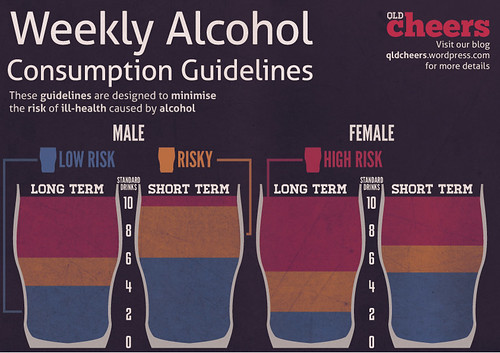
Today’s infographic is from Australia, showing their recommended Your Weekly Consumption Guidelines as an infographic. It was created by the Australian website QLD Cheers.

State Beer Excise Tax Rates

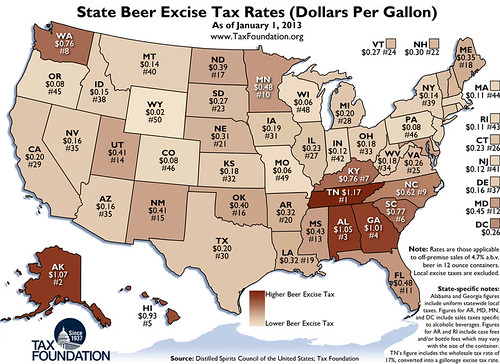
Today’s infographic is a map of the State Beer Excise Tax Rates for each of the fifty states as of January 1, 2013. It was created by the Tax Foundation as one of their weekly maps. It’s just the state excise taxes brewers must pay, and doesn’t include either federal excise taxes or any local excise taxes. Tennessee has the highest state excise taxes and Wyoming has the lowest, a fact that the anti-alcohol folks like to exploit and whine about as often as they can whenever these maps show up online, never discussing context or the total taxes each state brewer pays. Not surprisingly, since oftentimes these are also referred to as sin taxes, six out of the highest ten states are in the south, with Florida at #11 and Mississippi at #13. California’s near the middle.
Click here to see the map full size.
Alabama Passes Homebrew Legislation

This is great news, Alabama may soon become the last state to legalize homebrewing since Prohibition, thanks in large part to the grassroots efforts of Right to Brew. According to the American Homebrewers Association:
The Alabama legislature has passed a bill that, once signed by Governor Robert J. Bentley, will effectively legalize homebrewing throughout the state. Alabama will be the last state in the nation to legalize homebrewing.
“Homebrewing has been an integral part of the history of America, so it’s thrilling to know that soon all 50 states will support this growing hobby and long-standing tradition,” said Gary Glass, director, American Homebrewers Association. “We appreciate the backing of all of the homebrewers, the dedicated grassroots efforts of Right to Brew and the legislators who have worked so diligently to make homebrewing a reality in Alabama. We are especially grateful to Representative Mac McCutcheon who introduced this bill and has fought long and hard for its passage, along with Senator Bill Holtzclaw.”
Alabama is the last state holding out against legalizing homebrewing. In March 2013, Mississippi became the 49th state to pass homebrew legislation. The AHA has been working with Right to Brew for five years in order to get the Alabama bill passed.
Homebrewing became federally legal in 1979, though the 21st Amendment predominantly leaves regulation of alcohol to the states. Therefore, even though homebrewing is federally legal, it is up to individual states to legalize homebrewing in state codes. Once the Alabama bill is signed by Gov. Bentley, it will be the first time since pre-Prohibition days that homebrewers in all the states can legally brew at home.
The next step is for the Alabama governor to sign the bill into law. If you’re in Alabama, please urge the governer to do so. You can find out how to help at the Craft Beer website.
UNICEF Study Of Underage Drinking Yields Surprising Results

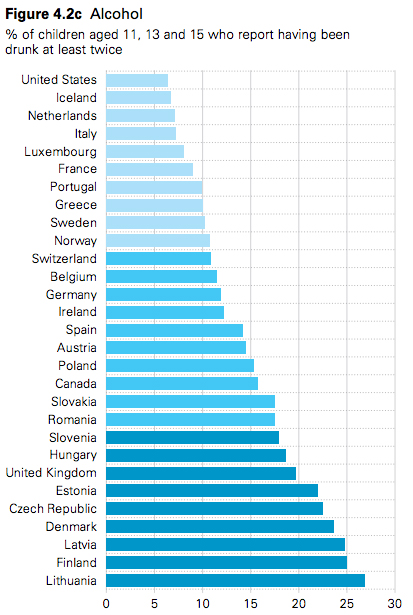
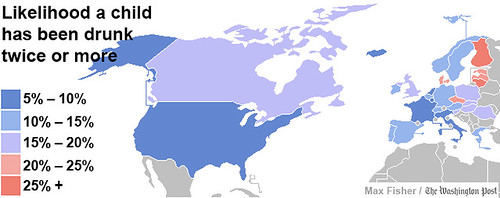
Actually, the results are only surprising if you’re a neo-prohibitionist or you’ve gotten all your information from them about underage drinking in the form of their relentless propaganda, posturing and fund-raising scare tactics. What a new study by UNICEF found was that the U.S. has the least number, or percentage, of kids drinking underage compared with nearly thirty developed countries. They looked at the drinking patterns of people 11, 13 and 15 years of age.
The study, Child Well-Being in Rich Countries, showed that overall the U.S. is in the bottom third, coming in number 26 of 29. Sad, really, but not terribly surprising if you’ve been paying attention. They looked at a variety of factors, and in Dimension 4 they tackled “risk behaviors,” including alcohol. Here’s how the 29 countries stacked up.
Other findings that contradict the standard anti-alcohol agenda and how they tend to frame the state of underage drinking include the following.
- More than three-quarters of the 21 countries also saw declines in alcohol use by young people – as measured by the proportion of 11-, 13- and 15-year olds who report having been drunk on at least two occasions.
- The biggest falls were again recorded in Germany (where the alcohol abuse rate fell from 18% to under 12%) and in the United Kingdom (which saw a decline from 30% to just under 20%).
The Washington Post reported these findings, but curiously spun the story as sort of a win for the neo-prohibitionists. The author, Max Fisher, suggests that because the U.S. is the country least likely to have kids drinking it “lends a bit of credence to the U.S.’s relatively late and well-enforced drinking age, unusual in the Western world.” Of course, there’s no causal link for such a statement whatsoever, but such is the power of decades of propaganda. As the Post’s foreign affairs blogger, he should probably stick to what he knows. He continues, saying that the U.S. is “joined by the tee-totaling kids of Iceland, the Netherlands and, believe it or not, Italy.” Iceland’s minium age is 20 (although “possession or consumption of alcohol by minors is not an offense”), the Netherlands is 16 (for alcohol that’s under 15% a.b.v., 18 if over) and Italy is 16. So there’s no real pattern that can be gleaned from the countries with the lowest reported underage drinking. And in fact the rest of the top ten are either 16, 18 or even have no minimum age, so trying to link a higher minimum drinking age with lower consumption is misleading at best, a little obnoxiously anti-alcohol at worst.
In the next paragraph he then contradicts himself. “Despite the strong wine cultures in Italy, France and Spain – or maybe because of them, given the degree to which it cultivates drinking “to enjoy,” as I’ve heard many French say – children in those countries are among the least likely to get drunk.” So in those “drinking cultures,” the kids aren’t as likely to get drunk for cultural reasons, but in our drinking culture it’s due to more stringent laws? With that attitude, no wonder he was surprised by the results of UNICEF’s study.
But in two of the countries with the most vocal anti-alcohol organizations, Great Britain and the U.S., not only are both countries lower than the propaganda might suggest, both nations have falling rates of this measure, too. In the U.S., we dropped from 12% to 6%, half of what it was just eight years before, And in the UK, it dropped from 30% to below 20%, falling more than a third. But as we’re learning, for many anti-alcohol organizations it’s not about results or the mission, it’s about punishment or profit for themselves. Even as rates of underage drinking continue to fall, their rhetoric increasingly gets turned up, becoming more radicalized and intransigent as they try to squeeze the last dollars out of their followers. It probably won’t surprise you to find out that not one of the usual neo-prohibitionist groups whose websites I checked even mentioned this study, despite it having been published over a week ago. If the results had been different, it would have been on their respective homepages immediately.
The Neo-Prohibitionist Agenda: Punishment Or Profit

Regular bulletin readers know well my disdain for the hypocritical anti-alcohol organizations trying their damndest to remove all alcohol from society or, failing that, make everyone who makes, sells or enjoys alcohol as miserable as they are. Not surprisingly, at the recent Alcohol Policy 16 Conference, which took place in Arlington, Virginia in early April, they revealed just how far their hypocrisy extends yet again.
Angela Logomasini, who attended the conference on behalf of Wine Policy, noted that during a panel discussion on alcohol tax policy that the “entire discussion revolved around how to lobby for taxes and profit in the process.” Given that the subtitle of the entire conference was “Building Blocks for Sound Alcohol Policies,” she can be excused for believing that the discussion might involve “research related to the impact of taxes on alcohol abuse” or whether “higher taxes really reduce alcohol abuse.” Such reasonable topics, however, were not even discussed. Instead, as I said, the entirety of the talk “revolved around how to lobby for taxes and profit in the process.”
Logomasini continued her description of the panel discussion:
Rebecca Ramirez of the Bloomberg School of Public Health at Johns Hopkins University presented her qualitative research on the framing of pro-tax messaging for use in lobbying campaigns. It included interviews with policymakers and activists involved in these campaigns. Ramirez’s discussion eventually turned to earmarking, which is apparently the key reason many groups are involved. Officials with one disability advocacy group, she noted, told her flat out they simply didn’t care about the public health impacts of taxes. They were in the game solely to get some of the tax revenue steered toward their organization.
She wonders aloud how that might serve the public good, and it appears she’s not the only one. Surprisingly enough, Bruce Lee Livingston, sheriff of my local anti-alcohol posse Alcohol Justice, disagrees, apparently believing profiting from lobbying efforts does not serve the public health. He takes a different view. Livingston “commented during the question and answer portion that activists are unable to get taxes high enough to actually produce positive public health benefits. Rather, he called for a ‘charge-for-harm’ approach, which is based on the assumption that anyone who drinks deserves to be punished.” That’s the same bullshit approach he took trying to get an additional tax on alcohol in San Francisco in 2010, all but writing the script for Supervisor John Avalos’ ultimately failed Alcohol Mitigation Fee Ordinance.
So, as Angela Logomasini observes, there were only two approaches or reasons to raise alcohol taxes brought up by essentially every neo-prohibitionist group in the country, or at least in attendance. As I’ve been ranting for years now, none of those reasons had anything to do with public health, or safety, or any other lofty goals. These self-proclaimed “public health advocates” only want to raise taxes on alcohol for two reasons: either to enrich themselves and profit from the alcohol companies their groups target or to punish every single person who dares to enjoy a pint of beer or glass of wine. And yet they still maintain non-profit status.
If nothing else, this should teach us that like many modern charitable organizations, they’ve strayed very far from their original purpose and self-preservation and profit are their only motives now. As I’ve said many, many times, they need a reason to exist and so they keep reinventing themselves in order to survive and keep their — in the parlance of Mel Brooks’ Blazing Saddles — phony baloney jobs. And so raising money becomes the driving force, not any interest in bettering the world, instead just pandering to their members’ fears, paranoia and prejudices. And if all of us who enjoy beer, and drink responsibly, get punished in the process, so what? Apparently, that’s just a bonus.
Pabst’s Blue Ribbon Competition

Mental Floss had an interesting story about how Pabst Brewing Co. got the blue ribbon that graces every bottle and can of their beer. In How Did Pabst Blue Ribbon Win its Blue Ribbon? author Matt Soniak details the events at the 1893 Columbian Exposition in Chicago that led to Pabst claiming total victory and justifying that blue ribbon in the years that followed.
Solo Cup Serving Suggestions

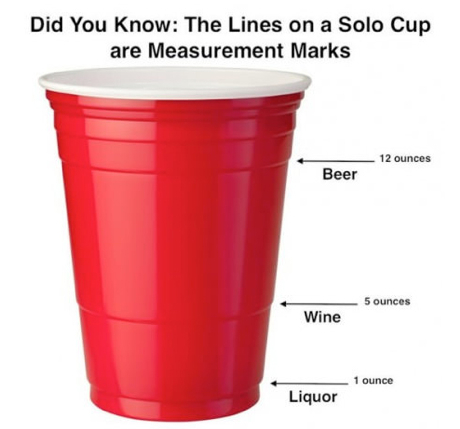
Today’s infographic is something of a coincidence. In the summer of last year, some unknown person posted the graphic below showing what they believed the lines around those ubiquitous red Solo cups you find at countless parties might mean.
Click here to see this only a little bit bigger.
And it was fairly compelling, but the Solo company said it was not intentional. According to Business Insider, “It turns out that while Solo Cup lines match up pretty closely with appropriate servings for beer, wine and liquor, they aren’t really meant for that. It’s just Solo Cup folklore.” Solo also posted their own infographic on their Facebook page, with alternate suggestions for what the lines could be used for, perhaps preferring not to have them associated exclusive;y with alcohol.
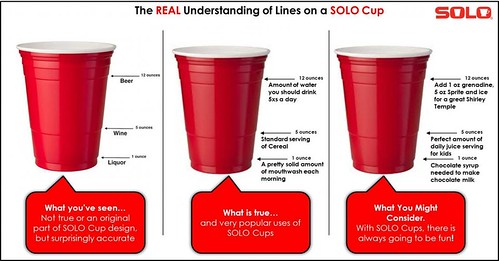
Click here to see Solo’s rebuttal graphic full size.
Spirituality On Tap

With Win Bassett about to enter the seminary, this story from Madison, Wisconsin, stood out as something he could do to combine his callings. According to the Cap Times, a couple of local taverns, the Chief’s Tavern and the Fountain, both in Madison, are hosting regular events combining beer and religion.
The Fountain is hosting a group known as Spirituality on Tap, who meets the on the first Sunday or each month “to talk about faith and spirituality in a relaxed, comfortable environment.”
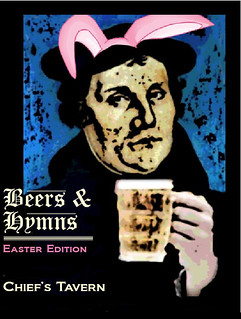
The second group takes over Chief’s Tavern for “Beer & Hymns,” where members of a nearby Lutheran Church meet to drink a few pints and sing a few hymns.
As one attendee quipped. “It’s easier to talk to a pastor standing next to a bar stool.” Another admitted that “a pub or a local bar is a more comfortable space than a church is.” Best of all, another advocate had this to say. “This is about recognizing that many people equate alcohol with alcoholism … those two things, while related, are not the same. We need to be sensitive to those that have struggled, but not demonize alcohol itself.” Amen to that.
That’s how all church should be held, frankly. Win, can you do something about that?
Mississippi Makes Homebrewing Legal

The American Homebrewers Association announced this morning that the governor of Mississippi, Phil Bryant, signed into law a bill effectively legalizing homebrewing within the state. Congratulations to all of beer lovers and homebrewers in Mississippi that worked so hard for so long to make this happen, and especially the hoproots organization Raise Your Pints. Forty-nine down, one to go. Now that Mississippi finally allows homebrewing, only Alabama does not permit its citizens to brew beer at home. Check out the full story at the AHA’s press release.

How Beer Gave Us Civilization

While I’m firmly in the “beer came before bread” camp in the anthropological debate about what sparked civilization, evidence has been mounting for that view since it was first proposed over a half-century ago. In a new opinion piece in the New York Times by Jeffrey P. Kahn, the CEO of WorkPsych Associates, entitled How Beer Gave Us Civilization, he lays out the case for why “we needed beer” and runs through an overview of early civilization’s introduction of alcohol and why it was so necessary to our development. He also brings into the debate a recent study from the Journal of Archaeological Method and Theory, What Was Brewing in the Natufian? An Archaeological Assessment of Brewing Technology in the Epipaleolithic, which adds new support for what I call the “beer first” theory.
He unfortunately ends with the long-discredited Benjamin Franklin beer quote, but apart from that gaffe, it’s a good read. Just stop short of the final two paragraphs, and it’s even better. He should have just finished with this sage observation. “Beer’s place in the development of civilization deserves at least a raising of the glass.” Hear, hear.
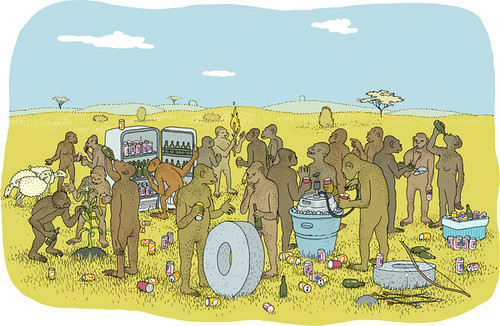
Illustration by Anders Nilsson.