

As reported in England’s Telegraph, a new Spanish study has concluded that the best thing you can drink after playing vigorous sports is not Gatorade, but beer. Specifically, the study found that for the dehydrated person, beer helps retain liquid better than water. Wow, finally a good reason to work out.
Soviet Anti-Alcohol Posters
I happened upon this cool bit of history while searching for some images the other day. It’s the Museum of Anti-Alcohol Posters, a collection of old Soviet propaganda posters on the evils of drinking. There are more then thirty of them here, with translations. What struck me most in looking through them is that they’re really not all that different from the propaganda used by neo-prohibitionists working today in the United States. It’s the same sort of sensationalist nonsense with little basis in facts. But it’s somewhat comforting to know that propaganda is propaganda, no matter where it came from, and they are sort of fun to see. Enjoy.
Translation: “Rich inner substance.”
Translation: “Profiteer is a worst enemy.”
Greenpeace Asserts GE Rice Used in Bud

Greenpeace today released the results of an independent analysis of rice at an Arkansas mill which supplies rice to Anheuser-Busch for use in their beer. The lab found genetically engineered rice in 75% of the samples. From the press release:
An independent laboratory, commissioned by Greenpeace, detected the presence of GE rice (Bayer LL601) in three out of four samples taken at the mill. The experimental GE rice is one of three rice varieties that were first found in 2006 to have contaminated rice stocks in the US. Since then, GE contamination has been found in approximately 30 per cent of US rice stocks. This has had a massive negative impact on the US rice industry as foreign markets, where GE rice has not been approved, have been closed to US rice.
“Anheuser-Busch must make a clear statement about the level of GE contamination of the rice used to brew Budweiser in the US and spell out what measures are in place to ensure this beer does not reach the company’s export markets,” said Doreen Stabinsky, Greenpeace International GE Campaigner.
“US beer drinkers need Anheuser-Busch to explain why it is not preventing use of this genetically-engineered rice in the US. If, as the company has informed Greenpeace, all of the Budweiser exported from the US or manufactured outside of the US is guaranteed GE free then Anheuser-Busch needs to state this publicly, and explain the double standard,” said Stabinsky.
Greenpeace informed Anheuser-Busch of the test results prior to their release and sought clear information from the company on the extent of contamination and its global policy on the use of GE ingredients. Anheuser-Busch responded that the rice is approved in the US and is not used in brewing Budweiser destined for export. The full extent of the contamination remains unclear, however.
LL601 GE rice was retroactively granted approval by the US Dept of Agriculture in an effort to reduce public concern and company liability despite 15,000 public objections. The European Food Safety Authority stated that there was insufficient data to make a finding of safety. Greenpeace says that US consumers have a right to know if this GE rice is used to make Budweiser. This GE rice is not approved outside the US so the Budweiser brewed with it could not be sold abroad.
Anheuser-Busch is the largest single rice buyer in the US, buying 6-10 per cent of the annual US rice crop. Budweiser is one of only a few beers having rice as an ingredient. The brand is found in around 60 countries through a mix of exports and local brewing arrangements.
I recently did an article on green breweries and interviewed the Senior Group Director of Environmental, Health and Safety for A-B. I was pleasantly surprised at just how many things they were doing to be “green” so it seems surprising that they’d overlook genetically engineered rice being used in the beer itself. One thing you can say about Anheuser-Busch is that they do care about their public perception, so it will be interesting to see their reaction to this revelation.
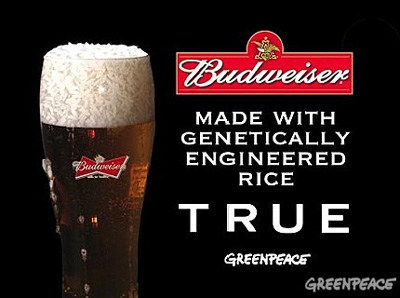
Doug Muhleman, Anheuser-Busch’s Group Vice President of Brewing, Operations and Technology, released a statement yesterday which I think suggests that Greenpeace is not the virtuous one in this story. On closer examination, this may be more about international politics than beer. Here’s Muhleman’s statement:
Greenpeace’s statements regarding our beer brands are false and defamatory. All of our products are made according to the highest quality standards and in complete compliance with the laws in each country where we sell our beers.
We stand in support of U.S. farmers, who are partners with us in the quality of our products. Greenpeace recently asked us to join their advocacy campaign on genetically modified crops. We refused their calls to boycott U.S. farmers, and they are now retaliating.
The use of genetically modified crops in the United States is not new. The vast majority of the commercial corn and soybean supply in the United States contains genetically modified versions that are certified to be safe for human consumption by the U.S. Government.
We use U.S. rice for brewing our products for U.S. consumption. U.S.-grown long-grained rice that may have micro levels of Liberty Link proteins present is fully approved by the U.S. Government, having determined that it is perfectly safe for human consumption. Moreover, the Liberty Link protein, like all proteins, is substantially removed or destroyed by the brewing process. Liberty Link has not been found in any of our tests of our beers brewed in the United States.
We fully comply with all international regulatory standards on the use or presence of genetically modified ingredients wherever our beers are sold internationally, as well. Neither Anheuser-Busch, nor our international licensed brewing partners use genetically modified ingredients, including genetically modified rice, in brewing products sold in any country with legal restrictions.
We talked with Greenpeace, hoping to help them understand the facts. We are disappointed that they instead chose to pursue pressure tactics.
Now I’m no fan of GMO’s, but they have been used here for many years and, like it or not, they’re a part of our massive food system. Short of pulling out every crop in the country and starting over, I’m not exactly sure what would satisfy Greenpeace. Certainly the way Greenpeace is seeking to sensationalize this seems more bullying than anything. I confess I was alarmed when I first read the story but having looked at it more closely in the interim I’m not sure their tactics are entirely warranted.

Me with Doug Muhleman at an A-B reception at GABF last year.
Catholic Irony vs. Miller

There’s a festival in San Francisco every year, the Folsom Street Fair, that celebrates sexual diversity, fetishes and leather lifestyles. The event has a rich history of fighting conventional wisdom and poverty, as well. It’s a registered non-profit organization and also has all the things that typical street fairs have: music, food, beer and sponsors. One of the four main event sponsors this year, known as “presenting sponsors,” is Miller Brewing Co. Which is all well and good, or at least it was until the fair organizers unveiled this year’s poster for the event.
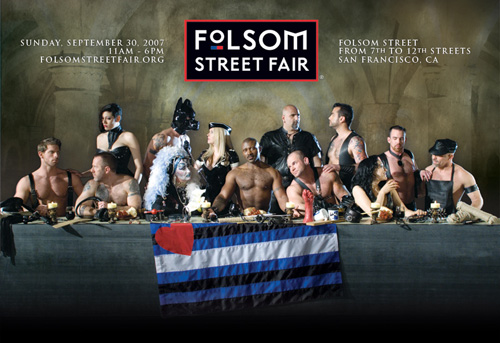
It’s an obvious parody of Leonardo Da Vinci’s painting The Last Supper, which along with his Mona Lisa, Edward Hopper’s Nighthawks, Grant Wood’s American Gothic and Edvard Munch’s The Scream, is undoubtedly one of the most parodied works of art in the world. Do a Google Image’s search for “last supper parody” and no less than 6,360 images pop up. The poster is meant to show diversity in many forms; racial, gender, sexual preference and lifestyle. If you’re deeply religious it’s possible that you won’t like the image but that’s the price you pay for living in a free society. Everybody wants tolerance in the first person, such as “tolerate my beliefs” but it’s gets harder for those same people in the third person, as in “tolerating his beliefs.” Enter the Catholic League, which bills itself as a “Catholic civil rights organization” and states its purpose is to “defend the right of Catholics – lay and clergy alike – to participate in American public life without defamation or discrimination.” Their mission also includes working “to safeguard both the religious freedom rights and the free speech rights of Catholics whenever and wherever they are threatened.” All laudable goals, except that it appears the free speech rights of non-catholics count for naught. Since Tuesday the Catholic League has put out five press releases “calling on more than 200 Catholic, Protestant, Jewish, Muslim, Buddhist and Hindu organizations to join with [them] in a nationwide boycott of Miller beer.”
Yesterday, SABMiller released the following statement:
Statement Regarding Folsom Street Fair
While Miller has supported the Folsom Street Fair for several years, we take exception to the poster the organizing committee developed this year. We understand some individuals may find the imagery offensive and we have asked the organizers to remove our logo from the poster effective immediately.
Not good enough, sayeth the Catholic League, calling Miller’s press release a “lame statement of regret.” Then they kicked things into high gear. “We feel confident that once our religious allies kick in, and once the public sees the photos of an event Miller is proudly supporting, the Milwaukee brewery will come to its senses and pull its sponsorship altogether. If it doesn’t, the only winners will be Anheuser-Busch and Coors.” See, even Catholics aren’t aware of the craft beer movement and believe there are only three breweries in the U.S. And certainly imports were overlooked, too. Some kidding aside, this is certainly a quagmire for Miller, and this has been receiving a lot of media attention, as stories involving sex usually do in our society. There’s nothing like titillation to increase reader- and viewer-ship.
Locally, at least, not everybody agrees as one gay member of the clergy had this to say via the Bay Area Reporter.
“I disagree with them I don’t think that [Folsom Street Events] is mocking God,” said Chris Glaser, interim senior pastor at Metropolitan Community Church – San Francisco. “I think that they are just having fun with a painting of Leonardo da Vinci and having fun with the whole notion of ‘San Francisco values’ and I think it’s pretty tastefully and cleverly done.”
Glaser added, “I think that oftentimes religious people miss out on things because they don’t have a sense of humor. That’s why being a queer spiritual person we can laugh at ourselves and laugh at other people.”
Even Speaker of the House Nancy Pelosi, herself a Catholic, issed the following through her press secretary, Drew Hammill. “As a Catholic, the speaker is confident that Christianity has not been harmed.” Exactly. And while the people Fox News interviewed called it a “mockery of religion,” “blasphemy” and suggested that it’s “bad for society,” I can’t see the Catholic League’s point.
First of all, they don’t own the image of Da Vinci’s Last Supper and it’s already been parodied countless times. The event itself has been painted by numerous artists over the centuries. Honestly, I don’t see how the “religious freedom rights and the free speech rights of Catholics” have been infringed upon or how catholics have been in any way defamed. The Last Supper even as an idea is not the exclusive province of Catholicism. If they had left it alone, it would have been a minor event in a local community.
And why pick on Miller? There are dozens of other sponsors, too, including SF Environment, an environmental group, and the San Francisco Bay Guardian, a local weekly newspaper. I almost hate to wonder, might this also be a little bit because it’s beer? Many neo-prohibitionist groups are also religiously based. But really, what did Miller do wrong? They sponsored a local event that’s perfectly legal, has the support of the local community and government. They’ve been sponsoring it for years. Then suddenly the event does something that the Catholic League doesn’t like. They’re offended. So what? Miller tries to soothe the situation, obviously seeing it for the powderkeg it is and asks to have their logo taken off the offending poster, but bravely continues to sponsor the event. Good for them. Why shouldn’t they? How is that in any way the “corporate arrogance” the Catholic League accuses them of? What’s arrogant about that? If you want to talk arrogance, then we need to look at the Catholic League. Being arrogant is defined as “making claims or pretensions to superior importance or rights,” which is exactly what they’re doing by asserting that their “right” to not have their religion criticized or challenged — if indeed that’s really what’s being done, which I seriously doubt — is above the free speech rights of the criticism or challenge. I doubt many in the Catholic League have read Richard Dawkin’s The God Delusion, but one of the book’s soundest arguments is that religion has become the only idea, concept, belief, whatever that can’t be criticized. That we’re taught we must respect one another’s beliefs and not question them. Why? Why is every single other idea in the world able be talked about critically but not religion? It just doesn’t make sense to me. Obviously, the Catholic League believes that or they wouldn’t be misreading this so badly. It seems obvious to me that the Folsom Street Fair poster isn’t attacking or criticizing religion and certainly isn’t targeting the Catholic religion. It’s obviously parody, which is protected speech under the First Amendment of our Constitution. Even the Supreme Court has said so, thanks to an unlikely person, Larry Flynt, publisher of Hustler, whose story is chronicled in the film The People vs. Larry Flynt.
But again, why pick on Miller? They didn’t make the poster. They didn’t print the poster. They didn’t approve the poster. All they did was sponsor the event. The Catholic League is the bully in this passionate play, and they’re the ones that deserve to be crucified, not Miller. It’s one thing to disagree with another point of view or not like what you perceive as criticism of your own, but it’s quite another to attack it and try to harm their business over that disagreement. That’s what bullies do. But there’s one more bit of irony in all this that needs saying. Obviously, many catholics and other religious conservatives have a great deal of difficulty dealing with non-traditional sexual lifestyles, some of which are center stage in the Folsom Street Fair. But the Catholic Church is no stranger to non-traditional sexual practices among its own clergy and has systematically been suppressing its own sexual misconduct literally ruining the lives of hundreds, maybe thousands, of children in the process. Check out the film Deliver Us From Evil for just the tip of iceberg. That’s really offensive, worthy of people being offended, not like this fake controversy and complaints of being wounded simply by an image they don’t like.
Frankly, I thought I’d never utter these words, but “It’s Miller Time.”
Shuck and Jive
There is little doubt that hops are or soon will be in short supply. I heard it at “Hop School” in Ralph Olson’s “state of the hop crop” report and I’ve heard it from almost every other quarter, as well. Belmont Station’s blog has a good summary of what Ralph had to say via Dave Wills at Freshops and Rick Sellers at Pacific Brew News has another summary from Deschutes brewer Larry Sidor, as well as a summary of world hop news. There have even been two recent fires at hop kilns, and while crop damage was minimal (though the kilns were destroyed) it still further reduced an already thin harvest. Lew Bryson also posted David Edgar’s summary from today’s Brewers Forum. Overall, there’s some good but mostly foreboding on the future availability of hops, and most notably prices may skyrocket. There simply isn’t enough hops to meet current demand and acreage has been declining for several years.
Enter corn into the mix. When George Bush started touting ethanol he increased incentives and subsidies for farmers to grow corn to make the alternative fuel. If you’re barely getting by growing a difficult and fragile crop like hops, switching to corn with all that federal moola looks mighty attractive. I’ve heard that now from a variety of sources. According to an Iowa State University study, food prices have risen an average of $47 per person as a result of the ethanol surge since last year. So it’s not just hops, but farmers are replacing a number of other crops with corn, too. This has been widely reported to be effecting food prices across the board. But once on a gravy train, few will voluntarily jump off, no matter that the train may be headed for a collision. And corn has been riding those amber waves for quite some time, especially once high fructose corn syrup made its debut in 1980. HFCS is now in what seems like every processed food you could name. So if government policy makes their situation even better, you would expect the corn industry to be overjoyed.
|
There’s a little interview today at Retail News online (subscription required) with S. Richard Tolman, CEO of the National Corn Growers Association, trying to allay fears that the corn subsidies are having unintended consequences. And if you want to lay such fears to rest, who better to ask than someone with a totally vested interest in convincing you that black really is the new white. Here’s the forthright honesty he employs to counter numerous claims and studies that suggest “ethanol production is exacerbating environmental impact problems.” Tolan’s answer: “Those claims are simply not true.” Deny, deny, deny. To the final question, “Critics contend that American farmers will be unable to keep up with demand for corn needed to produce ethanol. What’s the short-term and long-term thinking on this from corn growers?” he answers:
It’s that “planted more acres of corn this year than any time since World War II” line that should concern beer lovers everywhere. More acres of corn means less acres of something else. Believe it or not, when I was in the nation’s “hopbasket” — The Yakima Valley, Washington — last month I saw several large fields of corn. |
Ethanol production has doubled over the last three years, and in 2006 accounted for almost 5 billion gallons. But that’s still only around 5% of total gasoline needs, and corn growers are hoping to increase that to 10%. Doubling again the acreage for ethanol would mean a pretty substantial amount of land on which one thing — hops perhaps — would be converted to grow corn. It seems naive to think that’s not going to raise the price of whatever is no longer being grown on the land that’s now growing corn. So while it may seem odd to blame corn for the hop shortage, it is at least one of the factors that’s contributing to it. I’m certainly no energy expert, but I haven’t seen anything to convince me that ethanol is the panacea so many seem to believe it is. Even if planting all that new corn provides us with 10% of our fuel needs, we’ll pay for it somewhere else, either in higher food prices or a potential beer shortage. Frankly, I’d rather walk, bike or take mass transit than give up beer.
But nothing’s going to change if people continue to give a voice to industry stooges like Tolman with so obvious an axe to grind. Why would anyone, and especially people in the retail business, believe such pernicious propaganda? He’s telling retailers the goods they sell will not go up in price if there is less acreage of land to grow the ingredients needed to make or grow the things they sell. On top of that, he represents the very people changing the way that land is used. That’s shuckin’ and jivin’ of the first order.
The Milwaukee Beer Party
In a modern day version of the Boston Tea Party — but without the Indian costumes or a ship — Wisconsin beermakers staged a protest today by dumping out kegs of beer into the Milwaukee River. The Milwaukee Beer Party, which is what I’ll be calling it, was held to bring attention to Wisconsin SB 224, a state Senate bill that would make things more difficult for small local brewers.
From the AP article:
|
The whole issue started when the Great Dane Pub opened a third location in the Madison area, but couldn’t sell its own brews because the law only allows two such operations per chain.
The brewers are also upset that the law was introduced on July 3 and is already scheduled for a vote Wednesday in the Senate’s Transportation, Tourism and Insurance Committee.
“This is just a run-of-the-night operation that’s being ram-roaded down our throats,” said Russ Klisch, owner of Lakefront Brewery Inc. in Milwaukee and president of the Wisconsin Brewers Guild. “There are so many questions out there that have been unanswered.”
It appears that lawmakers were unaware if the consequences of the actions and amendments are in the works, according to Terry Tuschen, a spokeperson for the bill’s sponsor, Senator Fred Risser (D-Madison). “Everybody’s working hard to fix what needs to be fixed,” Tuschen said. Still, if you live in Wisconsin, it probably can’t hurt to contact your local state senator’s office and ask them not to support the bill unless those provisions are amended or removed.
The Milwaukee Beer Party
From Channel 3 Wisconsin
Oregon Leads Small Brewers Caucus

Last month, 34 members of the House of Representatives formed the Small Brewers Caucus to monitor and effect issues of interest to craft brewers. The week after the Craft Brewers Conference, on May 15, the caucus held its first meeting just prior to a reception on Capitol Hill celebrating “American Craft Beer Week” hosted by the Brewers Association.
From the original press release:
The House Small Brewers Caucus, co-chaired by U.S. Representatives Peter DeFazio (D-Oregon) and Greg Walden (R-Oregon), is currently composed of 34 Members of Congress who share an interest in the issues of importance to America’s small brewers. Brewers Association Board of Directors who were in Washington that day to participate in the American Craft Beer Week celebration, listened as Congressman Walden stated that the primary mission of the Caucus is to provide an interactive opportunity to learn about the dynamics of running a small business as a brewery, the brewing process itself and the quality and value of the beer and brewing activities. Several other Congressmen also in attendance spoke briefly to the group, among them Congressman DeFazio who is himself a homebrewer and a primary sponsor and leader in the successful effort to pass House Resolution 753 of 2006 commending American craft brewers and recognizing the first American Craft Beer Week.
“The fact that Members of Congress recognize the unique place small brewers and craft beer have in our society, is extremely gratifying and important,” said Brewers Association President Charlie Papazian also in attendance at the meeting. “There is a very real danger that the voice of the small members of the brewing community may not be heard over that of its larger brethren, so a group of legislators bound by a common interest in the history, tradition and excitement that are hallmarks of today’s small brewers, should help ensure our issues get fair consideration.”
The story is starting to get some attention in places where craft beer is closely tied to the local economy. For example, in Portland, Oregon, the Oregonian recently ran a story about the new caucus, focusing on the fact that both co-chairs are Representatives from Oregon. (Thanks Jim, for sending me the link.) Frankly, that makes sense given Oregon’s beer scene. With three other Oregonian members of the caucus from the Beaver State, that’s a total of five of the 34 members (or almost 15%). Most of the other members also appear to be from states with vibrant craft beer cultures. For example, California is the only other state with five members, including — I’m proud to be able to say — the Representative from my own District, Lynn Woolsey. She represents both Sonoma and Marin counties. New York and Pennsylvania have four members each, and there are three from Colorado, and two from Michigan. The eleven remaining members are each from a single state. Curiously, there’s no one from either Washington or Wisconsin. That seems surprising, since both states have quite a few breweries. It also appears to be a largely bipartisan group, with 20 Democrats and 14 Republicans.
It’s certainly nice to see our elected officials paying to least some attention to craft beer and the concerns of those who brew it.
The 34 members of the Small Brewers Caucus:
Rep. Peter DeFazio, co-chair (D-Ore.)
Rep. Greg Walden, co-chair (R-Ore.)
Rep. Harry E. Mitchell (D-Ariz.)
Rep. Vic Snyder (D-Ark.)
Rep. Brian Bilbray (R-Calif.)
Rep. Wally Herger (R-Calif.)
Rep. Darrell Issa (R-Calif.)
Rep. Mike Thompson (D-Calif.)
Rep. Lynn Woolsey (D-Calif.)
Rep. Marilyn Musgrave (R-Colo.)
Rep. Ed Perlmutter (D-Colo.)
Rep. Mark Udall (D-Colo.)
Rep. Dave Loebsack (D-Iowa)
Rep. Dennis Moore (D-Kan.)
Rep. Tom Allen (D-Maine)
Rep. Stephen F. Lynch (D-Mass.)
Rep. Thaddeus McCotter (R-Mich.)
Rep. Fred Upton (R-Mich.)
Rep. Russ Carnahan (D-Mo.)
Rep. Denny Rehberg (R-Mont.)
Rep. Mike Arcuri (D-N.Y.)
Rep. Kirsten Gillibrand (D-N.Y.)
Rep. Randy Kuhl (R-N.Y.)
Rep. Nydia Velazquez (D-N.Y.)
Rep. Tom Cole (R-Okla.)
Rep. Earl Blumenauer (D-Ore.)
Rep. Darlene Hooley (D-Ore.)
Rep. David Wu (D-Ore.)
Rep. Charles Dent (R-Penn.)
Rep. Phil English (R-Penn.)
Rep. Jim Gerlach (R-Penn.)
Rep. Patrick Murphy (D-Penn.)
Rep. Lloyd Doggett (D-Texas)
Rep. Virgil Goode (R-Va.)
If your representative isn’t on this list, consider writing him a letter and asking him or her to join the caucus and support small businesses such as craft breweries in their district.
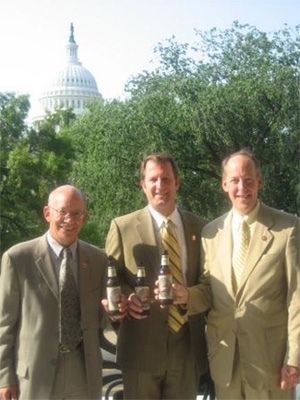
Representative Peter DeFazio, Gary Fish, owner of Deschutes Brewery, and Representative Greg Walden — all from Oregon — enjoying craft beer at the Capitol Hill reception May 15.
Wisconsin Wants More Beer Taxes
Another state is looking to enhance their revenue by tapping brewers on the shoulder. According to a report in yesterday’s Milwaukee Journal Sentinel, “[t]wo Democratic legislators vowed Monday to try to tap the state’s beer drinkers by seeking approval of a fivefold increase in Wisconsin’s $2-a-barrel beer tax, which has not been raised in 38 years.” Berceau wants to raise the tax to $10 per barrel supposedly to fund programs to “fight drunken driving and treat alcohol addiction and mental illness.” As recent studies have indicated though, such raises rarely result in the goals intended. I’ll never understand why responsible drinkers and brewers who contribute positively to the economy are routinely targeted for this kind of punishment because of a few bad apples. We don’t tax sugar makers and soda companies to fund health centers to treat obesity. We don’t ask people who can enjoy one piece of chocolate cake to foot the bill for over-eaters and the health costs they add to society, nor should we. Berceau wants the tax on a six-pack to be 18 cents, up from its previous level of 3.6 cents, which would add as much as $48 million to the amount people would have to spend to buy the same amount of beer.
“Wisconsin’s beer tax hasn’t been raised since ‘man walked on the moon,’ said Berceau, whose efforts to raise the tax have failed in the past,” suggesting she’s been in bed with her sponsors for some time. Those sponsors, some of whom presumably have made campaign contributions, include “the Wisconsin Prevention Network; the American Society of Addiction Medicine; Mothers Against Drunk Driving; the Mental Health Association of Wisconsin; and the National Association for the Mentally Ill of Wisconsin.”
According to the national Beer Institute, Wisconsin ranked sixth in beer consumption in 2006, with an average of 38.2 gallons consumed for every person 21 and older. Wisconsin’s $2-a-barrel tax is third lowest in the nation, behind the 59-cent levy in Wyoming and the $1.86 tax in Missouri.
$190 Billion Poured Into U.S. Economy by Brewing Industry
Each year, Beer Serves America, a joint venture by the National Beer Wholesalers Association and the Beer Institute, put together statistics on just how much money and jobs the brewing industry directly and indirectly pumps into the U.S. economy. It’s a pretty staggering amount, really, and is broken down in a variety of ways to give you a good idea of just where the contributions to the economy come from.
It’s an excellent rebuttal to the neo-prohibitionist position that alcohol does nothing for society, and I’ve rarely seen any of their groups address these positive statistics that show year after year how much is contributed to our society by beer and brewers.
Here’s the press release:
New Study Shows Beer Industry Contributes Billions Annually to U.S. Economy
Report Tallies Jobs, Wages, and Overall Economic Impact
WASHINGTON, D.C. – America’s beer industry, made up of brewers, beer importers, beer distributors, brewer suppliers, and retailers, directly and indirectly contributes nearly $190 billion annually to the U.S. economy according to a new economic impact study. The industry’s economic impact includes more than 1.7 million jobs—paying almost $55 billion in wages—as well as more than $36 billion in federal, state, and local taxes. The study of 2006 data was commissioned by the Beer Institute and the National Beer Wholesalers Association (NBWA).
“This study shows that more than ever, America’s brewers play a pivotal role in promoting strong and robust economic growth throughout our country,” said August A. Busch IV, president and chief executive officer, Anheuser-Busch Companies, Inc., and chairman of the Beer Institute. “Brewers in all 50 states have been supporting the economy in their communities for generations, creating jobs for their neighbors, tax revenue for public services, and promoting alcohol awareness responsibility initiatives for retailers, schools, and families.”
According to the study, the direct output of brewers, importers, beer distributors, and retailers into the American economy is almost $90 billion each year. The beer industry directly employs more than 900,000 Americans, paying them more than $25 billion in wages. Large and small brewers and beer importers employ 47,000 people, and the nation’s 2,750 beer distributors employ approximately 91,000 individuals across the country. Beer is a key driver of profitability for the more than 531,000 licensed beer retailers, according to TDLinx, a service of The Nielsen Company and the recognized leader in location information management. Beer sales help support roughly 800,000 jobs at these retailers, which include supermarkets, convenience stores, restaurants, bars, and other outlets.
“Beer distributors are independent family businesses like mine that provide a wide selection of fresh, quality beer to the nation’s retailers and strengthen the U.S., state, and local economies. Over 90,000 hard-working men and women across the country are employed by America’s beer distributors. These people do not work for minimum wage. They earn quality wages and benefits,” said Betty Buck, NBWA board chair and president of Buck Distributing Co. in Upper Marlboro, Maryland.
The production of beer helps support other segments of the economy as well. For example, the study showed more than $4 billion in economic contributions for the agricultural sector, including malting barley ($537.8 million), hops ($280.7 million), brewers rice ($222.9 million), and brewers corn ($58.4 million).
“These figures demonstrate that the beer industry extends beyond those who make and distribute our products,” said Jeff Becker, president of the Beer Institute. “As the single largest purchaser of rice in the country and one of the leading purchasers of other agricultural goods, the beer industry’s contributions to America’s farm economy are helping support rural families and small businesses coast to coast.”
“Millions of hard-working Americans earn their livelihood in brewing or beer distribution. This is an industry that takes great pride in the fact that its employees have good wages, employer-provided health care, and good benefits,” said NBWA president Craig Purser. “America’s beer distributors also work within a framework of individual state laws to ensure their products are sold only to licensed retailers who in turn are responsible for selling only to adults of legal drinking age.”
In addition to strengthening the U.S. economy, the industry plays a significant role in promoting responsible consumption of its products. Brewers, importers, and independent beer distributors have invested hundreds of millions of dollars in communities across the country to develop and implement numerous programs to promote responsibility and help fight alcohol abuse. These efforts, along with those of parents, law enforcement, educators, federal and state alcohol beverage regulators, and other community groups, have contributed to declines in illegal underage drinking and drunk driving over the past two decades, according to a variety of independent and government data.
The complete Beer Serves America Economic Impact study, including state-by-state and congressional district breakdowns of economic contributions, is available at the Beer Serves America Web site, www.beerservesamerica.org.
Trouble Brewing in Ohio
There’s a new budget bill before the Ohio state legislature that was intended to allow self-distribution of wine to retailers along with mail order wine. That’s all well and good, but somebody snuck into the amendment a provision “barring brew pubs from selling takeout bottles and sealed jugs of beer.” The author of the budget amendment, House Finance Chairman Matt Dolan (Republican), claims to have no idea how or who put in the anti-brewpub language.
The Wholesale Beer & Wine Association is reluctantly supporting the measure (they’re opposed to the direct sale of wine), but only if the brewpub language is deleted.
It was first noticed and reported on April 20, and by the next day several trade groups were in talks with lawmakers. On Saturday, the Cleveland Plain Dealer was editorializing how bad it would be for the state’s small brewers and had elicited a promise from the bill’s sponsor, Matt Dolan, “keep the brew pub provision out of the bill.”
Curiously, some early reporting highlighted the benefit to the wine business while ignoring the potentially mortal blow being dealt to brewpubs and the beer community. Luckily, most are now reporting about the problems that will be created by the newly inserted language, such as an AP report entitled “Wine-sales amendment called flawed.” It appears likely now that the anti-beer language will be removed, but if you’re in Ohio, I’d recommend contacing your representative and urging him or her to make sure that it does get taken out. We can’t be too careful about these things. As this episode so aptly illustrates, neo-prohibitionists will stoop low to damage the beer industry if they think they can get away with it
When the dust settles on this, I’d really like to see them investigate who it was that was so hostile to beer and tried to effectively kill Ohio’s brewpub business. We should all know what or who we’re up against in the fight against neo-prohibitionists, but it’s even worse when they don’t show their face and work clandestinely under cover of darkness.