Brookston Beer Bulletin

Jay R. Brooks on Beer

  • Home
  • About
  • Editorial
  • Birthdays
  • Art & Beer

Socialize

  • Dribbble
  • Email
  • Facebook
  • Flickr
  • GitHub
  • Instagram
  • LinkedIn
  • Pinterest
  • RSS
  • Twitter
  • YouTube

Powered by Genesis

Backlash Brewing?

January 25, 2008 By Jay Brooks

There was an interesting item in yesterday’s USA Today called Frustration Over Liquor Laws Brewing. The story details just a few of the battles around the country to update their state’s antiquated alcohol laws, which in many cases haven’t been updated since Prohibition’s repeal in 1933. I’m sure the neo-prohibitionists will be fighting these tooth and nail, employing their usual bag of dirty tricks, but perhaps it’s finally time to stop playing defense and pick up the ball. In Mississippi, for example, it’s still illegal to sell beer in excess of 6% abv. The argument against raising it, predictably, is, according to William Perkins of the Mississippi Baptist Convention Board, that an “intellectual argument ignores the ill effects of alcohol.” Well, I’d sure hate for logic or intelligence to interfere with his world view, but you can buy wine and liquor in Mississippi already and, unless it’s some weird watered-down varieties, those are all well above 6% so please tell me how that makes any sense whatsoever? Not to mention there are plenty of positive health claims that can be made not only about beer, but the moderate use of alcohol in general. If Perkins’ thinking shows nothing else, it’s illustrative that logic plays no role at all in the anti-alcohol league’s canon. By any means necessary seems to be the only rule. So perhaps it’s time to mount an offensive. After all, a good defensive very well may be a strong offense.

 

Filed Under: Editorial, Politics & Law Tagged With: History, Law, National, Prohibitionists

Beer vs. Wine in California Politics

January 16, 2008 By Jay Brooks

This Chronicle article comes to me via a local political blog, The Left Coaster, which curiously is also the name of the regular column I write for the Ale Street News, which in turn is located on the other coast.

Matier and Ross’ column today, The Bay Area could be the Clinton-Obama decider, contains this bit of wisdom from long-time state pollster Mark DiCamillo, dividing democratic voting patterns according to one’s preference for beer or wine.

Pollster Mark DiCamillo, who has been taking the state’s political pulse for 30 years, describes the beer vote as mostly blue-collar workers, the elderly and ethnic Democrats, especially Latinos, in the Los Angeles area and rural parts of the state.

The more liberal, more educated, wine-and-cheese crowd congregates here in the Bay Area, where more than a quarter of the ballots will be cast in the Democratic primary Feb. 5, he says.

And as DiCamillo sees it, the blue-collar group likes Clinton and the wine-and-cheesers go more for Obama.

I’m not exactly sure what to make of that. You’d have to search far and wide to find someone more liberal than myself, I’m reasonably well-educated, but I definitely would prefer to pair that cheese with beer. After all, the notion that wine and cheese work well together is really just a myth. And frankly, either candidate on those labels is pretty scary looking.

Not surprisingly, most of my friends are like-minded, so either DiCamillo is way off the mark or more probably, I’m so far removed from the pulse of the people that I don’t even register. I’m most likely the guy in their 2% plus or minus margin for error, so rarely do I agree with any of the choices polls usually offer. For example I’m not particularly wild about either Clinton or Obama, and think our media is doing its usual disservice to society by so nakedly picking sides so early in the campaign process. All the candidates are supposed to get equal time, but because they cover only who they want to and who they decide are the front-runners, it’s a self-fulfilling prophecy that subverts the very idea of a democracy.

But enough proof that I’m on the fringe, is DiCamillo suggesting that the more liberal and/or educated one is, the more likely that person is to prefer wine over beer? With Sonoma and Napa Counties, along with several others, so close to the Bay Area, it’s no surprise that we’re awash in wine lovers. But perhaps DiCamillo is unaware that this same area, the San Francisco Bay Area, might also be the second most important region in the country for craft beer. And the demographic that most frequently goes for craft beer? You guessed it; liberal and educated. Of course, craft beer drinkers are only a fraction of the total beer picture (though in the Bay Area we’re well above the national average) but doesn’t cheap table and box wine sell pretty well, too? And lets not ignore the many people who enjoy both beer and wine.

My only point in all of this is to ponder whether or not the traditional stereotype of beer as blue-collar and wine as white-collar might not be as true as it once was (if indeed it really ever was true), and especially when applied to craft beer? Better beer seems to cut across class lines to a great extent, at least it seems to me that you see all stratas of people at beer festivals, beer dinners and the like.

According to Ross and Matier, “[t]he big showdown between Hillary Clinton and Barack Obama could come down to California’s ‘beer-drinking Democrats’ versus its ‘wine and cheese’ liberals — with the Bay Area playing a pivotal role in the outcome.” I’m not sure about those labels, they just seem a bit outdated and too simple-minded for my tastes.


Filed Under: Editorial, Just For Fun, News, Politics & Law Tagged With: Bay Area, California, Statistics, Strange But True

Punishing Drinkers With Taxes

January 15, 2008 By Jay Brooks

The Marin Institute, one of the more blunt and churlish of the anti-alcohol organizations, is mounting an offensive to raise alcohol taxes an incredible “25 cents per drink” in California. Their vision — my nightmare — is to bring about “communities free of the alcohol industry’s negative influence and an alcohol industry that does not harm the public’s health.” But as they naturally see any influence as negative and everything that the alcohol industry does as harmful, what they really want is nothing short of an another Prohibition.

Throughout their rhetoric (and even the sources they’re relying upon) is a call for “fairness” and for alcohol to pay its “fair share,” whatever that really means. But the carrot they’re holding out is that by doing so it would help to alleviate California’s budget deficit that’s been plaguing us for several years now. But I fail to see how raising the taxes of people who drink is in any way fair. Effectively what they’re suggesting is that because our state managed to get itself in a fix, budget-wise, people who drink should be called upon to foot the bill. They just want to punish those of us who choose to drink, and yet they call it fair? The first definition (of 26) for the word “fair” is “free from bias, dishonesty, or injustice.” There’s clearly bias, it’s dishonest in my opinion to claim it’s because of our state’s tax problems, and it hardly seems just to have drinkers pay a disproportionate share to get us out of our budget hole. So it’s really the very opposite of fair.

This is the same nonsense that’s going on with Indian gaming right now, with several state proposals on November’s ballot. We committed genocide against Native Americans and broke every single treaty we ever made. So when Indian gaming successfully exploited one of the few advantages left to them, we still can’t seem to let them be. This is the second time California politicians have tried to get (or more accurately extort) a bigger piece of their gambling revenues, and the exponents of these propositions try to sell them in the same way as the Marin Institute is doing with beer taxes, by twisting the idea of “fairness.”

Of course, the real reason they can say with a straight face that it’s fair to ask drinkers to pay more taxes than teetotalers is this odd notion that, in the words of David Leonhardt, “taxes serve a purpose beyond merely raising general government revenue. Taxes on a given activity are also supposed to pay the costs that activity imposes on society.” I’m not necessarily against this idea entirely, but I don’t understand when it became an unquestionable fait accompli and why people are so quick to believe it. Why is this only ever said of things that some people don’t like? The costs on society for our general obesity and unhealthiness has not brought about taxes on fast food, sugar or high fructose corn syrup. Hummers, SUVs and other similar gas-guzzling vehicles not only are not taxed at a higher rate but actually receive federal and state tax breaks and incentives and have lower standards of fuel efficiency than regular cars. With their poor MPG they do great harm to our society yet are actively subsidized and encouraged by our government over cars that get more miles per gallon and are kinder to the planet. Check out this Slate article for more on this. I’m not saying that’s as it should be, simply that this idea that all products must contain within their profit structure some tax scheme that balances the price with their damage to society caused by them is wholly fallacious.

But even if it wasn’t such a weak argument, we don’t charge a higher percentage of a person’s tax burden for the fire department if they live in a tinderbox house vs. an inflammable brick home. Instead we average the cost to society out and charge everyone the same amount since everyone gets the same potential benefit. That’s a fair arrangement in every sense of the word. It’s good for the whole town, not just for you, if your house does not burn down. So there’s really no reason why we can’t apply that same logic to the whole of society. I realize that will be unpopular with folks who don’t think it’s fair that while they choose to abstain, they may have to pay for problems supposedly caused my decision to drink. But if it’s legal for everyone who pays taxes (except, those 18-20 years old — hey, another reason they should be allowed) to drink then I don’t see why it’s so troubling that we all share the costs of society equally. You may think it’s unfair because you feel you’re not causing the (hypothetical) problem. Well I think you’re being selfish by only wanting to pay for services that that either benefit you or were caused by you. In a sense, it’s like after building your inflammable brick house you refuse to pay to support the fire department any longer under the theory that your house is in order.

Maybe it’s just me, but I don’t want to live in a world where everyone is so selfish that they don’t want to help other people. Look at this another way. The vast majority of drinkers do so in moderation and never are any burden to society whatsoever. But a tiny percentage of drinkers do cause problems for themselves and others. There are at least two ways we can shape policy to deal with problem drinkers. We can treat the causes of the problems and make tougher laws to deal with them, and only them. Or we can make it harder on everybody’s ability to drink, thus punishing everybody for the sins of the few. It’s not too difficult to figure out which approach the neo-prohibitionists have chosen. Even if only one in every ten-thousand persons who drink may exact a cost on society they would prefer to punish the other 9,999, too.

Another one of the contentions is that the last time California raised taxes on alcohol was 1992. That increase was apparently one cent on a glass of wine and two pennies for a bottle or can of beer and one shot of hard liquor. So clearly a 25-cent increase seems reasonable?!? Maybe sixteen years is too long without an increase, I’m not going to argue that point. But even if the tax had been raised another penny every year, the tax would still only be 16 cents higher today, so please tell me how 25 cents is a fair suggestion? Or are they just shooting for the moon in the hopes of a negotiation that ends up compromising higher as a result?

And if it’s tax fairness they’re after, taxes of corporations have fallen much more dramatically over the past several decades. They haven’t just stagnated and gone down merely by adjusting for inflation, but have actively been lowered. At the same time, personal taxes on the poor and middle-class have gone up while tax cuts for the rich keep increasing. So if the Marin Institute really cares about California’s budget crisis, I think a more prudent approach might be trying to raise corporate taxes across the board and removing unfair tax cuts and loopholes for the wealthiest among us. It wasn’t alcohol that got us into this mess, so why make it foot the bill.

One of the main sources that the Marin Institute cites for their proposal is Let’s Raise a Glass to Fairness, a polemic about why the author, David Leonhardt, believes federal alcohol taxes should be raised. Some of the supposed alcohol-related costs to society he cites are the following:

  1. child abuse
  2. drunken-driving checkpoints
  3. economic loss caused by death and injury
  4. hospital bills for alcohol-related accidents

So let’s look at those claims.

1. Child Abuse: This one’s a head-scratcher for me. Sure it sounds bad, but what does it really mean? I was terrorized as a child by an alcoholic, psychotic step-father but even as a kid I knew it wasn’t the alcohol that caused him to be that way. There were myriad things in his life that made my step-father such a mess, and alcohol was the least of them. At its worst it was merely a convenient catalyst. If alcohol had been removed from the situation, something else would have filled the void. I can’t see how alcohol causes child abuse any more than cake is directly responsible for obesity.

2. Drunken-Driving Checkpoints: If these are such a burden to our nation’s purse strings, then by all means stop them. They’re already an invasion of civil liberties because they randomly presume guilt of everyone behind the wheel of a vehicle. But saying these are a cost of alcohol seems weird to me. The fact is that police forces choose to do them, they aren’t mandatory, and they’re more often done because of politics or pressure from local neo-prohibitionist groups. So they aren’t caused by alcohol, they’re caused by people against alcohol. There are plenty of legitimate ways for the police to do their job in keeping potentially dangerous drivers off the road that don’t involve these checkpoints.

3. Economic Loss Caused by Death and Injury: Now I certainly don’t want to downplay or make light of anyone’s loss or injury, but the alcohol didn’t cause either. The idiot person who drank too much or otherwise couldn’t control himself is responsible for a death or injury that resulted from his actions. And he should be punished to the full extent of the law. But don’t punish me or my right to drink moderately because some yahoo couldn’t act responsibly.

4. Hospital Bills for Alcohol-related Accidents: This is the same as the last one, it’s economic harm inflicted by a person and we should be blaming the individual person. People scoff at the Twinkie defense, saying it’s ridiculous that too much sugar might cause a person to commit a crime, but here Leonhardt is saying effectively the same thing.

He also throws around a lot of statistics about how many people die each year in “alcohol-related car accidents” along with “other accidents, assaults or illnesses in which alcohol plays a major role.” But as we learn time and time again, the way “alcohol-related” is defined is usually pretty deceptive. Many such studies have considered an accident “alcohol-related” if one of the passengers had earlier been drinking so it’s pretty hard to take such stats very seriously. Do people die from causes related to alcohol? I’m sure they do. But the number one cause of death: living. What I mean by that is every single thing we do every single moment has some risk associated with it. It’s a fool’s errand to dissect every thing we humans do and determine which ones to tax more heavily.

Leonhardt likens his strategy to the same argument for higher tobacco taxes, saying for alcohol the impetus “is even stronger” with this gem. “Tobacco kills many more people than alcohol, but it mainly kills those who use the product.” Did I miss a meeting? Isn’t one of the strongest reasons for all the recent tobacco bans that second-hand smoke is far more dangerous to people around smokers than previously believed?

He then goes on to say. “Many alcohol victims are simply driving on the wrong road at the wrong time.” And that may be true, and it is certainly tragic, but why then is it fair that I should pay more for my beer because of other drunk drivers, especially if I and millions of other responsible drinkers don’t place anyone else at risk. If the argument for fairness is that all alcohol drinkers should pay more for their beer because of the costs that alcohol exacts on society, how then does that same logic explain why this burden is so unfairly placed on all drinkers and not just the problem drinkers? Isn’t that just a teensy-weensy bit hypocritical?

Leonhardt later admits, or at least accepts, that there are plenty of responsible drinkers around and even quotes Jeff Becker, President of the Beer Institute. “Most people — the vast majority of consumers — don’t impose any additional costs on anyone.” But in the end he concludes that since he can’t figure out a way to “tax only those people who were going to drive drunk in the future” then it’s somehow fairer to just tax everybody who drinks. Yeah, that makes sense. No wonder the Marin Institute loves this guy.

But another flaw in this theory is that raising taxes on alcohol will raise an additional $3 billion in tax revenue to help with California’s $14 billion current deficit. One of the major prongs of the Marin Institutes’s plan is that by raising the price of beer, drinking will be curtailed once again. If people are drinking less, then how will that result in more tax revenues? If this proposal was really about solving California’s budget crisis, wouldn’t it make more sense to raise alcohol taxes and then actively encourage drinking to help raise more money to apply to the deficit? But this never really was about taxes or California’s budget crisis. It was always about keeping people from drinking or at least making it harder for them to do so. But not enough people were apparently getting their message and were — gasp — still enjoying a drink now and again. So instead they dressed this proposal up as a panacea for our state’s budget crisis hoping that people might respond more favorably to that gambit. Don’t you believe it.

Look, we have the highest federal budget deficit in history and many states, including my own, have similarly terrible fiscal situations that they’re facing. But no matter how much junk science you throw at this problem, alcohol did not cause our current situation. As a result, trying to raise more taxes by arguing that it would be fairer for the nation’s alcohol drinkers to help pick up the tab is just ludicrous. Perhaps taxes should be higher across the board to get us out of this deficit and that might include alcohol taxes, too. But politicians don’t like to raise taxes generally because people tend to vote out of office any politician who tries to do so, no matter how vital they might be in paying for our infrastructure and making our society work for everyone. So we keep electing fiscal conservatives who slash and burn social programs. And then we wonder why there’s no unemployment available when we get laid off so that the factory we used to work for can relocate overseas and chain ten-year old girls to a sewing machine to slave away for twelve-hour days, seven days-a-week for peanuts just so we can be spared the injustice of paying a few cents more for some crap we don’t really need at Wal-Mart. Let’s not change that situation, let’s blame alcohol instead. Raise a glass to fairness, indeed. I’ll buy the first round.


Filed Under: Editorial, Politics & Law Tagged With: Business, California, Law, Press Release, Prohibitionists, Statistics

The Beer Vote

January 4, 2008 By Jay Brooks

The NBWA has a fun little website up asking people to vote for which of the presidential hopefuls they’d most like to have a beer with. The voting is irrespective of parties, and so far Barack Obama is leading the pack with 26%, followed by Ron Paul with 14% and John McCain with 12%. Cast your vote now to have your beer preference heard.


Filed Under: Just For Fun, Politics & Law

Let No Good Deed Go Unpunished

December 21, 2007 By Jay Brooks

I confess at the outset that this story has nothing to do with beer, but is about bourbon … sort of. But it is also about the assault on alcohol — and to some extent civil liberty — a subject I find myself writing about more and more these days, so that’s why I decided to write this. I certainly didn’t set out to make the neo-prohibitionists my cause célèbre, but I find that few things get me as worked up and angry than people whose sole mission appears to be telling the rest of us how to live. I guess that makes me an anti-control freak, or something.

At any rate, the story involved a St. Petersburg, Florida man named Evan Preston who local authorities have dubbed the “Woodstock Santa.” He’s been given this epithet by local authorities, and especially city council member Bill Foster, who hopes to stop Preston from giving gifts to the homeless. Now lest I paint Foster as a complete Scrooge, he’s apparently okay with giving them blankets or a warm bowl of soup. What he doesn’t like is that Foster gives the homeless what they really want: booze.

The eccentric Evan Preston (at left in the long gray beard), age 72, owns a well-known jewelry and art store and has in the past helped the local community raise money for a variety of causes by donating artwork.

He’s apparently helped his town’s Make-A-Wish Foundation and also nearby Tampa’s Big Cat Rescue. Four years ago, he decided he wanted to do something for St. Petersburg’s growing homeless population that congregate around the downtown Williams Park, near his business. So for a few years now, he and several friends and colleagues pass out 100 bottles of bourbon and cigars to the homeless.

Here, let’s pick up the story from Tampa’s Creative Loafing website:

“At first, I thought it would be interesting to give out a six-pack and a cigar,” he says over a glass of homemade sangria in his kitchen. “When I saw the excitement in their faces, it was inspirational.”

After a few outings to various homeless enclaves around the city, he says, St. Pete’s homeless began to recognize him. When he pulled up in his Bentley, they would run at him, jump on the car and hug him tightly.

Preston became the homeless’ Santa Claus, a 6-foot-2 bearded Samaritan in a T-shirt and jeans who gave all the good street men and women what they really wanted for Christmas.

“Last time, a man came up and said, ‘Thank you, this is so much better than a warm blanket,'” he recalls. “It’s shocking how much everybody loves it.”

“There is no motive to what we do,” he says. “It’s a gesture of goodwill.”

Well, you just know something like that will not be permitted for very long, not without somebody trying to put a stop to it. And right on cue, Foster is appalled that someone might give alcohol to alcoholics. Part of his reasoning is that alcohol is what put them on the street in the first place. While that may be true in some cases, he really doesn’t know that with any certainty whatsoever. But the idea that not giving a homeless person that alcohol is somehow going to cure them or make their life any better seems ridiculous at best, and uncharitable and obnoxiously self-righteous at worst.

Apparently there’s already a local ordinance in force that prohibits passing out alcohol in public parks — which seems weird enough, why would that be a problem? — but the code does not apply to city streets or right of ways, a loophole that Foster is trying to close. He’s sent a memo to the mayor and other city council members urging them to make it illegal to hand out alcohol in essentially any public space. If you want to give your neighbor a bottle of wine this Christmas, you better be careful not to hand it to him on the sidewalk. Stay on your own property if you don’t want to break the law. Apparently it doesn’t matter that alcohol is legal for adults and giving gifts is likewise not a crime, but don’t put those two things together in Florida. Yeah, that seems reasonable.

In the memo Foster claims “Mr. Preston is an affront to every business owner and resident of the downtown area, and should not be a welcomed figure in St. Petersburg.” An affront? An affront is a “deliberate act or display of disrespect,” an “intentional slight.” I don’t know who Bill Foster thinks he is, but he obviously believes people should be bowing and scraping to his delusions of grandeur. Can he really have convinced himself that Preston is giving the homeless booze to personally offend him? This is a difference of opinion at best. I don’t see how it’s the business of government to regulate where citizens can commit a legal act like gift-giving? Foster may not like what Preston’s doing but in a free society that should be the end of it. But Bill Foster apparently believes a free society is only one where people do what he likes, and apparently he’s not even the only nut job on the city council.

“Is that really the best gift you can give somebody sleeping outside—bourbon?” said Rene Flowers. “I don’t know what a bottle of bourbon goes for these days, but I’m sure that would buy some soap, a small washrag, maybe a comb, some coffee, maybe a nice, hot meal.”

Where exactly would a homeless person use a washrag and soap exactly since they probably don’t have a bathtub for them to use there in Williams Park? And while a nice dinner does sound good, why does Flowers think that private citizens have to confine their charity to what she thinks is appropriate? For all their posturing, the homeless problem itself is never addressed by the city council, only that a private citizen shouldn’t be allowed to give them a little comfort from time to time at his own expense. It really doesn’t matter if you or anyone else thinks giving alcohol to a homeless person is a bad idea, in a free society any private citizen is and ought to be allowed to choose both the scope and nature of his charity. They should be applauding the fact that’s he’s doing something, anything. But from the response of the city council, they don’t seem overly concerned about the homeless people themselves. The very fact that there is such a homeless problem in this medium-sized town (the population is just under 250,000) suggests that whatever the city council is doing, if anything, it has not alleviated the situation or the conditions that caused these people to become homeless in the first place. Maybe it’s the guilt over their own failures that makes them lash out over someone merely trying to provide a little solace and comfort to someone whose life is, I can only assume, complicated and difficult, to say the least. But please, let’s stop attacking alcohol already, shall we? I’d like to get back to talking about beer again, thank you very much.


If you want to hear more about this, a local Tampa television, Tampa Bay 10, station did a report that’s online. Also, a Los Angeles radio station recently did an interview with Evander Preston which you can listen to online.
 

Filed Under: Editorial, News, Politics & Law Tagged With: Law, Prohibitionists, Southern States, Strange But True

North Carolina Targets Parents

December 12, 2007 By Jay Brooks

One of my favorite things about the internet, is how cyclical and serpentine it can be. You can start out somewhere and if you follow enough tangents — something I can’t frankly help — you end up in new and wonderful places or, at a minimum, at a place you either didn’t expect to find or didn’t know was out there. I find a lot of the things I write about by happy accident. One thing leads to another and before I know it I’ve stumbled yet again on something I think worth writing about myself. A good example of this is some new laws in North Carolina that took effect December 1. I learned of these new laws through a blog, The Agitator, which I found at another blog, Coffee and Diapers, which is a parenting blog that picked up on my earlier post about Mothers For Social Drinking (which I also originally found by accident).

At any rate, the original story came from a television station in the Raleigh-Durham area, WRAL Channel 5, which is a place I actually lived for several years. I used to be, in the early 1980s, a record buyer for a large chain of stores headquartered in Durham, North Carolina and lived in both Durham and later Chapel Hill. Having grown up in the northeastern state of Pennsylvania, being in the south was a real eye-opener, but that’s a story for another day.

Anyway, some forty new state laws went into effect at the beginning of December and their story addressed a few of them. They started out with the alcohol-related ones for whatever reason and there’s a couple of doozies. The first one that caught my attention I’m not really against per se, but I think it’s illustrative of how oddly people think about alcohol. From the WRAL story:

One law bans devices known as “alcohol inhalers,” which convert liquor into a mist that can be inhaled by the user. Lawmakers were concerned that the devices, which were assembled and distributed by a Greensboro company, were being marketed to underage drinkers.

Okay, to be clear, I think this sounds like a bad idea and it goes against my personal philosophies on the moderate enjoyment of alcohol and also because I’ve never been a fan of anything that has to enter my body through my nose. I knew plenty of people in the 1980s who disagreed with my personal nasal entry ban (my rhinoprohibition), but I never begrudged them their day in the snow. So okay, somebody figured out a way to snort alcohol. I wouldn’t do it myself, and I can’t understand why anyone else would want to either. But here’s what I really don’t get. “Lawmakers were concerned (my emphasis) that the devices were being marketed to underage drinkers.” Huh? So they decided that an ostensibly legal product should be made illegal precisely because minors might try to buy it. Let me put that another way. As an adult, I can no longer buy a (previously) legal product because law enforcement cannot effectively keep people (minors in this case) from illegally obtaining it. So effectively because they can’t stop underage use of this product, they’re willing to take away every adult’s right to buy it. Please tell me how that makes any sense whatsoever? That is about as ridiculous a justification for making something illegal as I’ve ever heard. Fast food is marketed to kids and demonstrably terrible for their health, yet I don’t see these same lawmakers rushing to ban Big Macs, Whoppers or happy meals. Soda is even worse, yet schools allow soft drink companies to put soda vending machines in schools. Apparently, that’s okay too. I guess it’s okay for our kids to be fat and toothless but heaven forbid they might even consider snorting a mist of alcohol despite the fact that it’s already against the law for them to do so. Just the possibility of that — there do not appear to be any actual facts of underage use — makes them locate their spines to “protect the children” and take one more step toward making their state fit only for children. How noble. How absurd.

But the one that got The Agitator worked up — and I can certainly see why — is this one:

Also, as of Saturday, people can lose their driver’s licenses for providing alcohol to anyone under 21. The penalty is important because many underage drinkers get alcohol from friends or family members, said Craig Lloyd, the executive director of the North Carolina chapter of Mothers Against Drunk Driving.

The law means that, theoretically, parents could be punished for giving a glass of wine to their 20-year-old son or daughter, even if the 20-year-old never gets behind the wheel.

Lloyd said that’s not excessive.

“It’s a zero-tolerance policy,” he said. “Breaking the law is breaking the law.”

As Radley Balko at the Agitator put it:

I know what you’re thinking. Surely authorities would never barge into someone’s home and arrest them for allowing their 18, 19, or 20-year-old son or daughter to have a beer, right?

Well, you’d think. But then, if you’d told me police might come to the home of a minor’s parents at 4 am, wake the entire family, then give the girl a breath test to see if she had been drinking at a party held hours earlier, I’d have been dubious, too.

But it’s happened. Never underestimate the absurd lengths to which the zero tolerance crowd will go to keep your kid stone-cold sober.

The link above is to an ALCU story from Michigan where apparently they’re the only state — for now, at least —where it’s “illegal for young adults and minors who are not driving to refuse a breathalyzer test when the police do not have a search warrant. Those who refuse to take tests in Michigan are guilty of a civil infraction and must pay a $100 fine.” under Mich. Comp. Laws § 436.1703(6).

And there was at least one instance that you can just see being repeated both there and in North Carolina, as well.

Ashley Berden was 18 years old when she attended a party at a friend’s house to celebrate her graduation from Swan Valley High School. After she left the party, Thomas Township police officers arrived and found her purse which she had forgotten. They then came to Berden’s house at 4:00 a.m., woke up her family and demanded that she take a breath test. The police did not have a warrant but they informed her that would be violating the law if she refused the test. The test registered a .00% blood-alcohol level, indicating that Berden had not been drinking.

Pretty scary stuff. Especially when you consider that in societies where parents are allowed to raise their own children as they see fit, there is a much lower incidence of abuse later in life. But this new North Carolina law will make any parent who gives their own son or daughter even a taste of beer or wine to educate them a criminal. In effect, the state of North Carolina has decreed they can do a better job of raising your children than you can. Naturally, the North Carolina chapter of Mothers Against Drunk Driving sees the world in stark black and white whereas the rest of us can see all the shades of gray that parenting really entails. Because it seems to me that they really believe they can do a better job of raising my child than I can. They seem to have all the answers and really believe they know best. In their world an adult is no longer an adult but must live in a world where anything unsafe for children is no longer allowed for adults, either. In their world, a parent has little or no control over how and what they can teach their children about the world. That’s what zero-tolerance really means. It means tolerating only one way of life over all others. That’s as scary a world as I can imagine, a world that is the very opposite of free.


Filed Under: Editorial, News, Politics & Law Tagged With: Law, Prohibitionists, Southern States

Mothers For Social Drinking

December 8, 2007 By Jay Brooks

mfsd
While searching for an image yesterday, I came across this interesting new group organized earlier this year: Mothers For Social Drinking. It was founded in February by Jennifer and Jeremiah McNichols, who created and write a parenting blog that specializes in product testing called Z Recommends. What prompted them to take action was an annoying item on MSNBC entitled Do playdates and happy hour mix?. After introducing three former working mothers who quit to raise their children — as I did — they set the scene of how they now choose to socialize, with “a sandbox, the swing set and a backyard bar.” Then with the sensationalized moral zealotry so prevalent in daytime television, ask the most puerile of questions. “But is that ok? Drinking while you’re watching your kids?” Just asking this questions speaks volumes about the imbalance in our society today. It is to my mind a ridiculous question and I’m at least pleased to know I wasn’t the only one to think so.

The notion that an adult cannot drink alcohol moderately when children are present is such an astonishingly simple-minded position to take that it’s hard to take it seriously. That so many people here seem to be doing so is shocking. Perhaps more surprising is the number of comments this Today Show story has generated on MSNBC: 256 messages by 213 authors on 22 separate web pages. And while some are supportive and reasonable, a far greater number display the mental acuity of the average Jerry Springer Show audience member. It’s shameful how our educational system has failed us if this is somehow representative of how most people think. I could only make it through a few page’s worth because I had to keep stopping to scream at my computer screen. Eventually, I just gave up to maintain my sanity.

The Today piece goes on ask more annoyingly truculent questions and then cowardly refuses to give any answers — or even their opinion — saying they should be left to “other moms” and “the experts.” One example of these is “[w]ho would drive to the hospital if a child were hurt?” Pul-leeze. Even assuming for a nanosecond that one or two glasses of wine would render anyone incapable of driving or that the sight of your child injured wouldn’t snap you immediately into soberness, has MSNBC never heard of calling 9-1-1 for an ambulance? Or do they believe a glass of wine would render the average mom too incompetent to even dial a phone?

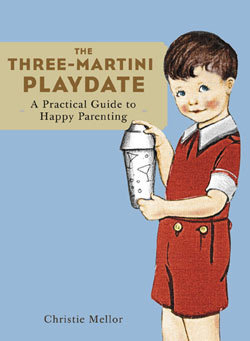
The New York Times also did a piece on this subject, albeit somewhat more reasonably, entitled Cosmopolitan Moms and takes the tone that although some may disagree there is nothing wrong with a few drinks during a playdate. They even highlight Christie Mellor’s parenting book, The Three-Martini Playdate, which has been on my Amazon wish-list ever since I first read a review of it a couple of years ago.

3mpd
The Three-Martini Playdate

I love the idea of parents banding together to fight this nonsense. Neo-prohibitionists should not be dictating to the rest of us how to live our lives or raise our children. But if they’re the only ones speaking then their voice will be the only one heard. Let’s make our view part of the pubic discourse, too.

Here is Mothers For Social Drinking’s “Statement of Belief:”

We, the undersigned, take exception to the claim that social drinking in the presence of our children is a sign of irresponsible or bad parenting. Further, we contend that it is moderation that makes responsible drinkers, and that moderation and good sense are the responsibility of all citizens; that healthy attitudes towards the consumption of alcohol are learned in the home; that successful parenting does not require us to sacrifice the exercise of our own maturity in order to protect our children’s innocence; and that our society has more to fear from the poor judgment and intemperance of institutions which prey on parental insecurities than with the hospitality we share with other mothers in our parenting journey.

What a beautifully written and well-stated sentiment. Change mothers to “mother and fathers” or “parents” and it’s nearly perfect. I realize using mothers is a nod and an alternative to that other notoriously mad anti-alcohol organization, so I think we can let that slide.

Mothers For Social Drinking have three different badges you can use to show your support if you run a blog or website. I would propose that if you’re a parent who enjoys drinking — mother or father — that you put up one of these on it, with a link to the statement of belief. I”ve also asked the folks at Z Recommends to make a badge with a glass of beer or send me their original graphic so I can create a companion badge for beer lovers.

mfsd-1 mfsd-2 mfsd-3

Z Recommends also has an interesting excerpt from an interview by Prof. David J. Hanson, Ph.D. (who hosts the wonderful website Alcohol: Problems & Solutions) with Dwight B. Heath, an anthropology professor at Brown University, who has studied the uses of alcohol across cultures for most of his career.

Dr. Heath: We have to be very careful in the messages that we send. It isn’t helpful to stigmatize a product that, when used in moderation, is associated with better health and greater longevity than is either abstaining or drinking heavily. This is especially the case when to do so tends to increase those problems that do exist.

Dr. Hanson: But isn’t it necessary to warn young people about the dangers of abusing alcohol?

Dr. Heath: Yes. It’s essential that we teach everyone the dangers of abusing alcohol, but in doing so we must be careful to distinguish between drinking in moderation and drinking abusively. Societies that have few alcohol problems tend to view drinking in moderation as entirely acceptable behavior, while they view abusive drinking as totally unacceptable behavior for anyone under any circumstances at any time.

Dr. Hanson: What else can we learn from other societies?

Dr. Heath: In societies that successfully control alcohol abuse, young people usually learn how to drink at home from their parents. In learning how to drink, they are also learning how not to drink. This helps promote moderation and reduces abuse. Importantly, this learning occurs in a caring, safe, supportive environment – not in a raucous fraternity house or military barrack. Again, perhaps ironically, groups that promote abstinence as the only option tend to experience more problems among those who do drink.

Filed Under: Editorial, Just For Fun, Politics & Law Tagged With: Prohibitionists, Websites

Happy Repeal Day

December 5, 2007 By Jay Brooks

Today is the 74th anniversary of the repeal of national Prohibition in the United States. Bob Skilnik has, naturally, the most complete account at his Beer In Food blog. His piece is called “National Prohibition; Its REAL Anniversary” and goes into great detail about the history swirling about at that time. It’s definitely worth a read.

In addition, Eugene, Oregon bartender Jeffrey Morgenthaler has been leading an effort to make December 5 a holiday and he’s also set up a Repeal Day website. And Dewar’s is also running a Repeal Day promotion to celebrate the day (and sell some whisky, of course). Seems like a good idea to me, we can never have too many holidays to remind us what a bad idea Prohibition was, especially with the neo-prohibitionists of today trying so hard to bring about another one.


Revelers enjoying the repeal of Prohibition in 1933.
 

Filed Under: Events, Just For Fun, Politics & Law Tagged With: History, Law, National, Other Events, Websites

Spot the Drunk

December 1, 2007 By Jay Brooks

Maybe it’s just my peculiar sense of humor but anytime I hear the phrase “spot the … anything” I think of Monty Python, as in “Spot the Looney.” So that was my first thought when I heard that Britain’s Home Office had issued very specific guidelines to members of the police on “How to Spot a Drunk.”

A few days ago the UK’s Home Office launched a new campaign against — and here’s the part I don’t get — being drunk in a bar. It’s called the “Responsible Sales of Alcohol Campaign” and British and Welsh police have apparently identified 1,500 pubs that they will be visiting every weekend between now and Christmas Eve to make sure that no bartender “knowingly” sells any alcohol to someone who is drunk. To me, that’s already a weird law (more on that below) but it’s been on the books for awhile now, though up until now there’s been no shortage of confusion about exactly what it means, legally at least, to be drunk. Anyone found selling to a drunk person will be levied “an £80 fixed-penalty fine.” But now the Home Office has issued more specific guidelines trying to define drunkenness. They have no legal standing, of course, but they are asking the police to use them to “identify potential drunken customers” and then “gather evidence of drunkenness, witness a sale and deal accordingly”. So even though it’s claimed that they do not have actual legal standing, if the police are using the guidelines, as they’ve been asked to, then they de facto do have standing.

Here’s the part I don’t get, though. If you can’t be drunk in a pub, where exactly are you allowed to be drunk? Since when is it the business of the police to decide how pissed anyone wants to get on any given evening? I think in many states here a bartender’s not supposed to serve a person if they’re excessively drunk — equally difficult to gauge and define. But this law makes it sound like you are permitted to go to a pub, order a beer, drink it, perhaps have another, but the moment you’re drunk you have to stop drinking immediately or the pub owner will face a hefty fine. That doesn’t make any sense to me. Assuming I’m not bothering anyone else and as long as I’m walking, taking a taxi or otherwise not endangering anyone but myself how the f@#k is that anyone’s business but mine? I should be able to drink until I can’t stand up straight if I want to. I’m not saying that’s a good idea or that anyone should want to drink that much, but the point is simply that it should not be the government’s business to protect me from myself. That’s what friends and loved ones are for. That’s paternalism at it’s worst.

So here are the guidelines:

A Noticeable Change in Behaviour

  • Bad tempered, aggressive;
  • Offensive language;
  • Becoming loud, boisterous or disorderly;
  • Becoming physically violent;
  • Becoming incoherent;
  • Slurring, or making mistakes in speech; and
    becoming argumentative.

A Lack of Judgment

  • Being careless with money;
  • Annoying other persons, employees etc;
  • Exhibiting inappropriate sexual behaviour;
  • Drinking quickly or competitively (“down in one“)

Clumsiness & Loss of Coordination

  • Swaying;
  • Staggering;
  • Difficulty with walking;
  • Falling down;
  • Bumping into furniture;
  • Spilling drinks;
  • Difficulty in picking up change; and
    Fumbling for cigarettes, or other items

Decreased Alertness

  • Drowsiness, dozing or sleeping;
  • Rambling conversation;
  • Loss of train of thought;
  • Difficulty in paying attention;
  • Not understanding what is said;
  • Glassy eyes and
  • Lack of focus.

Appearance

  • Unkempt
  • Dishevelled


I think you’ll agree after perusing his list that many of the items here are obvious and self-evident. Defining being drunk is a bit like pornography: it may be hard to define but we all think we know it when we see it. But others make almost no sense at all, especially by themselves. This story originally appeared in the British trade publication, The Publican, and many of the pub owners they interviewed agreed, to wit:

Licensees have slammed the guidelines. David Wine, licensee at the Six Bells in Felsham, Suffolk, said: “This is an absolute nonsense. So what if someone is dishevelled? Does that mean Bob Geldof will not be able to get served in pubs?”

Steve Andrews, licensee at the Seven Stars in Devon agreed the campaign was “absolutely ludicrous”. “I have a lot of farmers and builders come in here and they’re dishevelled.”

“I would also question why police should be paid to sit around in pubs on a Friday and Saturday night.”

Yeah, that disheveled one does stand out. It’s as if you’ll have to dress up to go to your local if you want to be served. Since when does good grooming and a fashion sense equate with soberness? The “bumping into furniture” and “spilling drinks” would give my wife some trouble, as she tends to be quite clumsy without the slightest amount of alcohol in her bloodstream. Even if any of these aren’t dispositive, they will undoubtedly get you noticed by the bar Bobby as someone who bears closer watching. And that hardly seems fair: targeting the butterfingered and slovenly for special attention. Don’t they already have enough to worry about?

Overall, looney does seem the right word to describe this scheme to keep barkeeps from overserving to enforce a law that seems quite odd in the first place. Can this really be the most important thing Britain’s police force has to contend with right now? Surely there must be some more serious threats to the peace.


Filed Under: Editorial, Politics & Law Tagged With: Europe, Great Britain, Law, Strange But True

A Cool, Blonde Drink of Offense

November 5, 2007 By Jay Brooks

Since I’m in Germany right now, this item caught my eye. It’s about the National Organization for Women (or NOW) singling out St. Pauli Girl’s new ad campaign as being “offensive to women.” Adrants described the new campaign as follows:

In its new campaign, dubbed “Drop Dead Refreshing,” St. Pauli Girl is playing a little game with us. Front and center in the brewer’s new print campaign is the image of a model Photoshopped to look like beer. As an added twist to the campaign, the model is said to be “renowned and popular” and those who care, can guess the model’s identity on the brewers website. Her identity will be revealed this spring.

St. Pauli Girl’s press release indicated the new ads would begin running this spring and I’m not sure when NOW weighed in with their offense. There are certainly ads at NOW’s website collection of offensive ads which I can understand them finding offensive with and with which I agree with their assessment. BUt I’m not so sire about the St.Pauli Girl ad. Here’s the ad reprinted below along with the caption from NOW’s website.

St. Pauli: A woman presented as a human beer bottle—now that should make you foam at the mouth. Once you’ve finished consuming her, should you just discard her like an empty beer bottle?

Here’s what I don’t understand. What makes NOW think the woman is being portrayed as a beer bottle? If your eyes aren’t enough, the press release makes it pretty clear that she’s not meant to be the bottle. She’s even wearing a dress made of beer, along with her entire body, except for hair which instead is, rather fittingly, the head of the beer. There at least two additional ads which make the case for her being beer rather than a bottle even more ironclad. As a result their analogy of discarding St. Pauli Girl after drinking her falls flat. I don’t think is necessarily the finest beer ad I’ve ever seen and St. Pauli Girl is not an especially wonderful beer, but I don’t see as the most egregious beer ad I’ve seen and it doesn’t rise to anywhere near Miller’s infamous mud wrestling ad.

We know sex sells. Men like it, but so do women. They just respond to its imagery in some starkly different ways. If you want to trigger sexual emotions in men or women you have to employ widely varying techniques to reach each gender. Does using sex in advertising by definition make it bad a priori? It seems to me that our proclivity to respond emotionally to sexual cues is deeply embedded in our nature and advertisers exploit that very human nature precisely because it’s so effective.

Advertisers are not generally speaking the most moral among us. They have a job to do and they do it pretty well but they rarely consider anything beyond their goal. As comedian Bill Hicks was fond of saying. “If you’re in advertising or marketing, please kill yourself. You are Satan’s little helpers and there’s no rationale for what you do. Go on. Kill yourself.” I guess what I always took away from that sentiment is that all advertising is essentially morally questionable because it uses whatever means necessary to achieve a goal and the idea that the ends justified the means was essentially taken for granted as an unquestionable foundation of the industry.

So I think their criticism of this specific ad comes down to the question of whether it’s better or worse than the general state of advertising. It doesn’t seem to me this is even the worst of the many questionable beer ads. First of all NOW seems to have misunderstood the ad by thinking the woman was being depicted as a bottle and then leapt to some self-serving conclusions that don’t really seem to be supported by the evidence. Is a great ad? No, not really. It’s better than some, worse than others. I realize as a man I’m ill-suited to decide what’s offense to women, but I don’t think that means whatever NOW says must be true just because they say so.

Filed Under: Editorial, Politics & Law Tagged With: Germany, National, Press Release

« Previous Page
Next Page »

Find Something

Northern California Breweries

Please consider purchasing my latest book, California Breweries North, available from Amazon, or ask for it at your local bookstore.

Recent Comments

  • Bob Paolino on Beer Birthday: Grant Johnston
  • Gambrinus on Historic Beer Birthday: A.J. Houghton
  • Ernie Dewing on Historic Beer Birthday: Charles William Bergner 
  • Steve 'Pudgy' De Rose on Historic Beer Birthday: Jacob Schmidt
  • Jay Brooks on Beer Birthday: Bill Owens

Recent Posts

  • Beer In Ads #5225: Fabled Ambrosia Of The Ancients April 17, 2026
  • Historic Beer Birthday: William O. Poth April 17, 2026
  • Beer In Ads #5224: Harvard Bock Beer April 16, 2026
  • Historic Beer Birthday: William H. Biner April 16, 2026
  • Historic Beer Birthday: Alan Eames April 16, 2026

BBB Archives

Feedback

Head Quarter
This site is hosted and maintained by H25Q.dev. Any questions or comments for the webmaster can be directed here.