Brookston Beer Bulletin

Jay R. Brooks on Beer

  • Home
  • About
  • Editorial
  • Birthdays
  • Art & Beer

Socialize

  • Dribbble
  • Email
  • Facebook
  • Flickr
  • GitHub
  • Instagram
  • LinkedIn
  • Pinterest
  • RSS
  • Twitter
  • YouTube

Powered by Genesis

Patent No. 256717A: Apparatus For Drawing Beer

April 18, 2016 By Jay Brooks

patent-logo
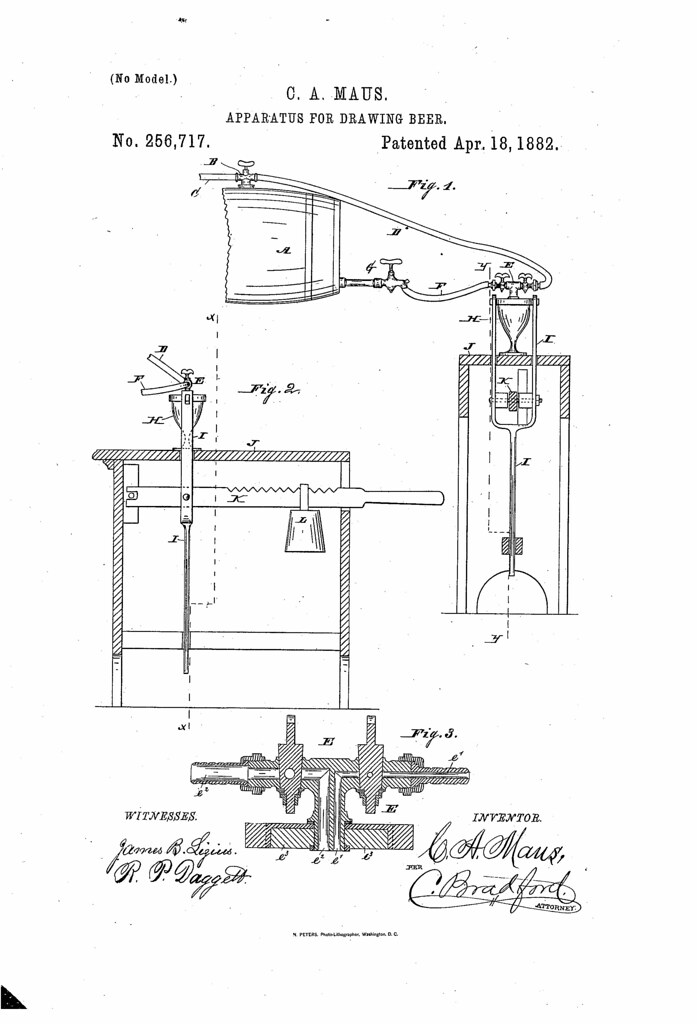
Today in 1882, US Patent 256717 A was issued, an invention of Clement Albert Maus, for his “Apparatus For Drawing Beer.” There’s no Abstract, although in the description it includes this summary:

The object of my said invention is to draw beer, ale, &c., from the keg or other vessel in which it is held without liberating the gases therein contained; and it consists in the construction and arrangement of parts hereinafter described and claimed.
US256717-0

Filed Under: Beers, Just For Fun, Politics & Law, Related Pleasures Tagged With: History, Kegs, Law, Patent

Patent No. 2155134A: Fermentation Process

April 18, 2016 By Jay Brooks

patent-logo
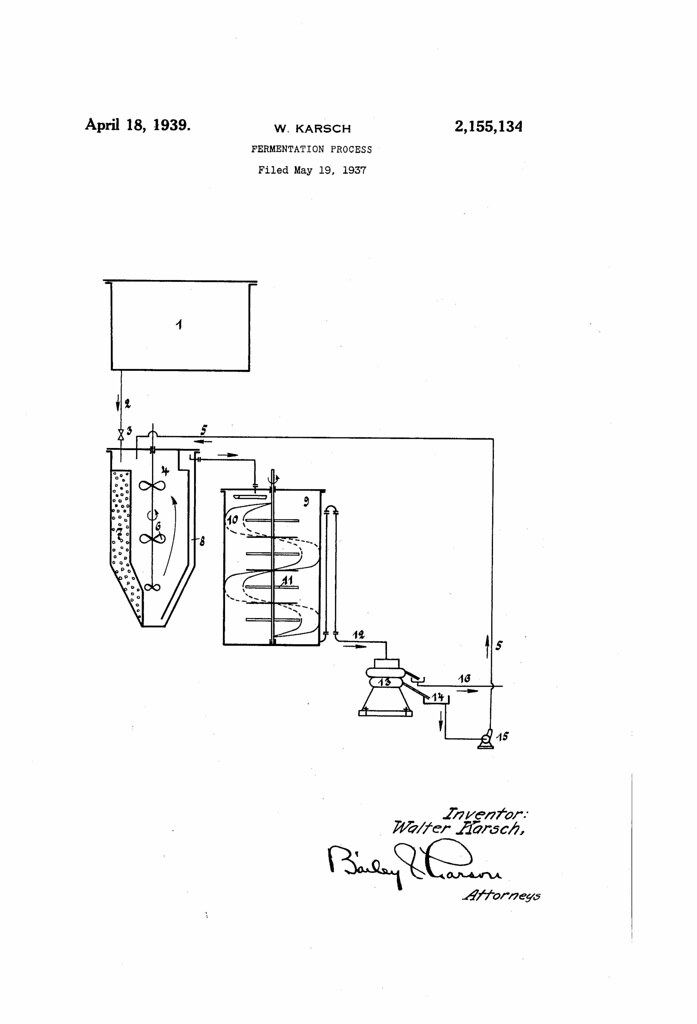
Today in 1939, US Patent 2155134 A was issued, an invention of Walter Karsch, for his “Fermentation Process.” There’s no Abstract, although in the description it includes this summary:

This invention relates to a fermentation process for the production of alcohol from liquids containing carbohydrates.

The invention provides that the total quantity of yeast shallrbe led positively and continuously in a circuit through a fermentation system consisting of a mixing device and a separating device in this wise that the total quantity of .yeast is moved unidirectionally from the mixing device to the separating device and back to the mixing 5 device. Preferably, after a predetermined controllable time, each yeast particle passes through the separating device and thus comes in contact, with fresh particles of sugar. The yeast is thus for a short time only free from the material to be fermented. The fermented liquor, after a predetermined controllable time, and after once traversing the fermentation system, leaves the said system beyond the separating device. It has been found that yeast can operate continuously in this process because it is removed as rapidly as possible from the conversion products formed. The loss of yeast cells observed with discontinuous fermentation practically does not occur in the present process. The mixing oi the yeast and of the liquor to be fermented is as intimate as possible, so that the conversion of the sugar to alcohol and to carbonic acid is effected with the greatest rapidity. At the exchange surface–the yeast membranes-by the intimate admixture the conversion products formed are withdrawn and new sugar molecules added.

By the flow through the fermentation system in the direction from the mixing device to the separating device it is further ensured that each yeast particle is separated positively after a predetermined time from the conversion products and is mixed with fresh sugar particles. No yeast particles can move in the fermentation system otherwise than in the desired direction, or settle, which is of great importance for the attainment of a maximum output of alcohol. Likewise the fermented liquor is led positively to the separating device, so that the result is obtained that the nocuous conversion products formed are separated as soon as possible from the yeast.

In the preferred embodiment the liquor is subjected to an after-fermentation in the interval between the mixing of the yeast with the liquor to be fermented and the separation of the yeast from the fermented liquor.

US2155134-0

Filed Under: Beers, Breweries, Just For Fun, Politics & Law, Related Pleasures Tagged With: History, Law, Patent, Science of Brewing

Patent No. 818056A: Beer-Cooler

April 17, 2016 By Jay Brooks

patent-logo
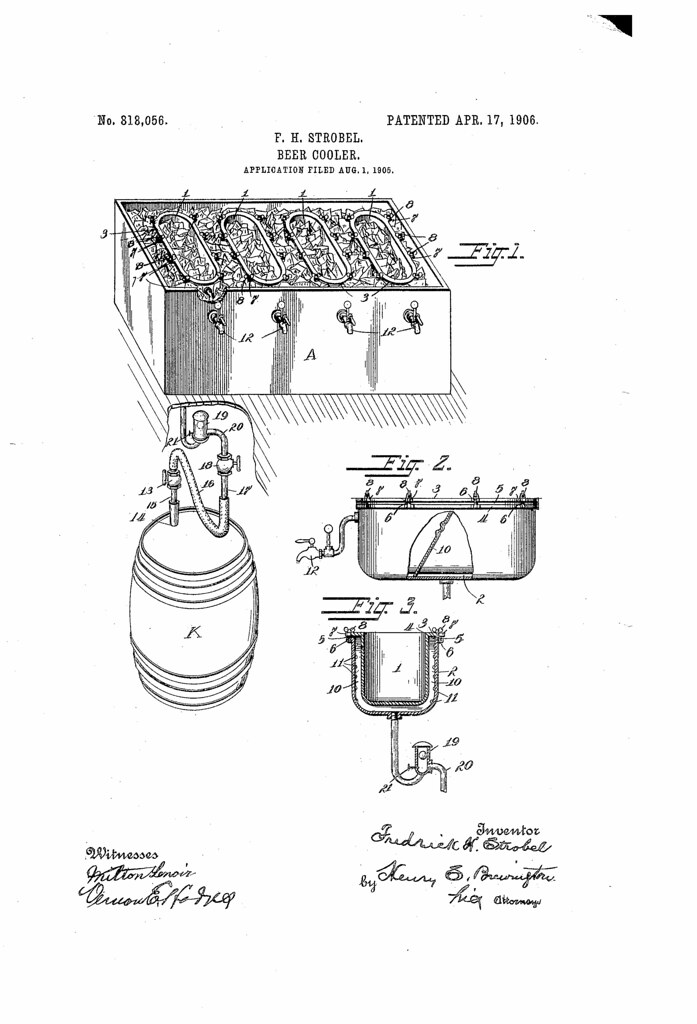
Today in 1906, US Patent 818056 A was issued, an invention of Fredrick H. Strobel, for his “Beer-Cooler.” There’s no Abstract, although in the description it includes this summary:

My invention relates to an improvement in beer-coolers and the principal object is to provide means for thinning out the volume of beer and spreading it over a correspondingly large surface as it is drawn from the tanks.

US818056-0

Filed Under: Beers, Just For Fun, Politics & Law, Related Pleasures Tagged With: History, Kegs, Law, Patent

Patent No. D192604S: Combination Beer Glass And Cocktail Shaker

April 17, 2016 By Jay Brooks

patent-logo
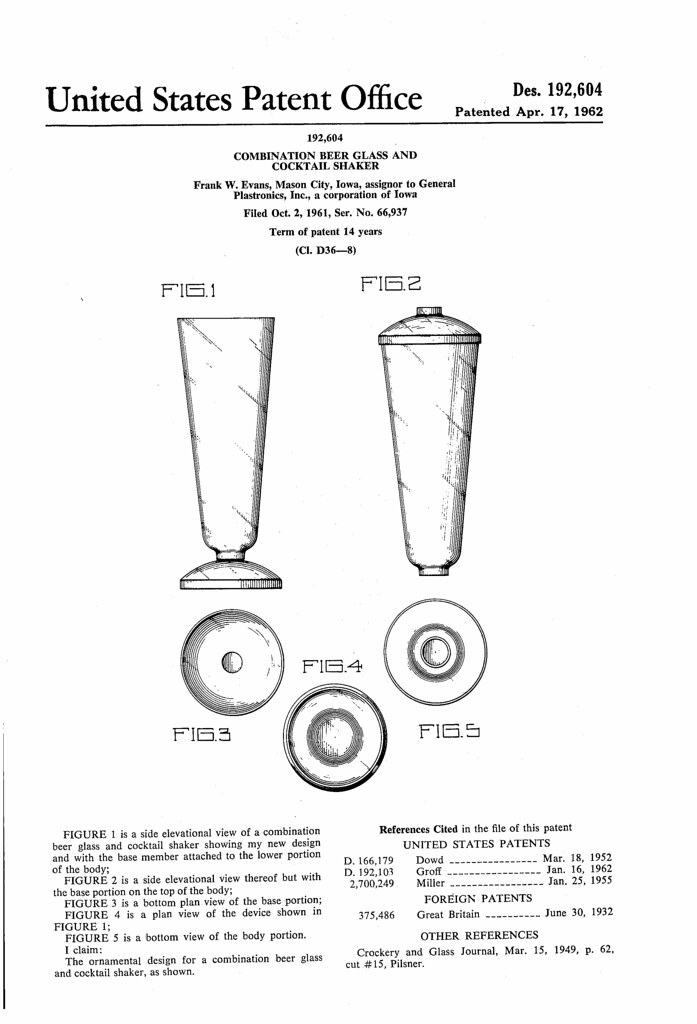
Today in 1962, US Patent D 192604 S was issued, an invention of Frank W. Evans, for his “Combination Beer Glass and Cocktail Shaker.” There’s no Abstract, although in the description it includes this summary:

The ornamental design for a combination beer glass and cocktail shaker, as shown.

USD192604

Filed Under: Beers, Just For Fun, Politics & Law, Related Pleasures Tagged With: Glassware, History, Law, Patent

Patent No. 20090098075A1: Hops-Based Deodorant

April 16, 2016 By Jay Brooks

patent-logo
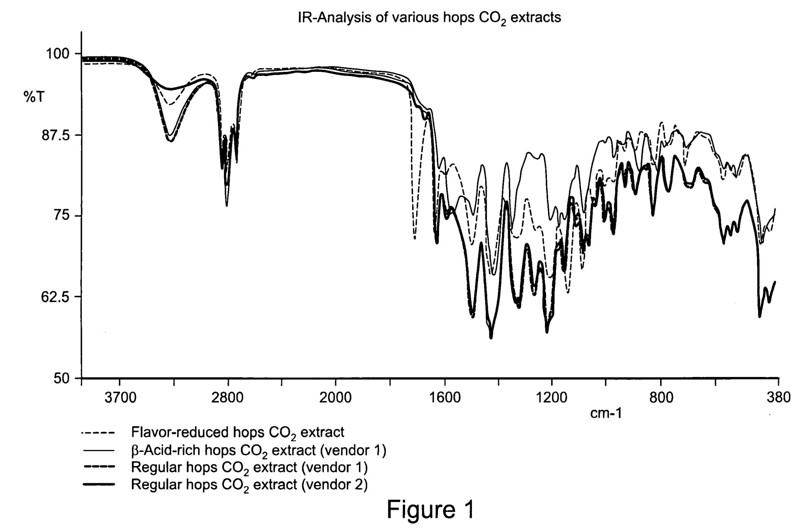
Today in 1963, US Patent 20090098075 A1 was issued, an invention of Chantal Bergeron, Stefan Gafner, and Jennifer L. Lafrance, for their “Hops-Based Deodorant.” Here’s the Abstract:

The present invention relates to deodorants and other body care products comprising a CO2 extract of the hops plant having bacteriocide/bacteriostat properties wherein the CO2 extract has a very low level of essential hops oils.

US20090098075A1-20090416-D00001

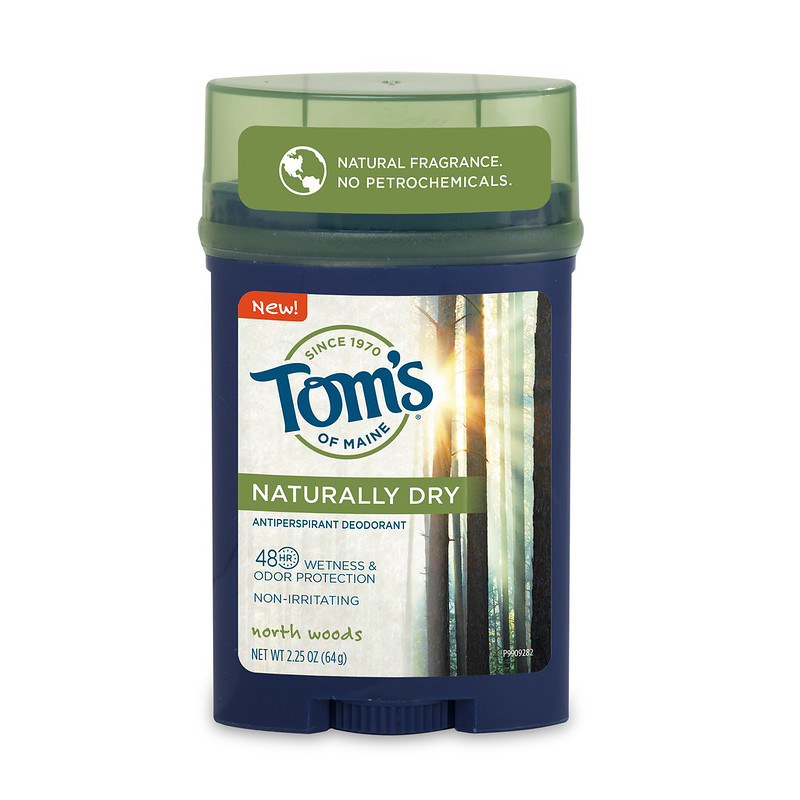
So some deodorants today do list hops as an ingredient, such as the Tom’s of Maine line, all of which list Hops extract [CO2] and caprylic/capric triglyceride as one of the ingredients.

AP_ Mens_NatDry_North_Woods

Which on Tom’s website they have a separate page for each of the body care ingredients, including Hops extract [CO2] and caprylic/capric triglyceride:

What is it?

The hop plant is a perennial herb that grows in vines. Native to Europe, Western Asia, and North America, it is known for the speed and persistence of its growth. Most people are familiar with hops because of its role in beer-making, although it also featured in ancient kitchens and the medical recipes of herbalists. First widely used in beer by monks in 9th- and 10th-century Germany, the hop didn’t gain popularity because of its flavor. Instead, the “bitter principles” of hops exhibit antimicrobial behavior, making the ingredient an effective preservative and stabilizer. In 1516, Wilhelm IV, lord of Bayern, ordered that hops be one of the required ingredients in beer in his Reinheitsgebot (Purity Law). That law led to similar enactments in other countries and helped to standardize the use of hops in brewing. Hops’ distinctive bitterness has now become one of the familiar attributes of a typical beer. Only the female flowers, known as cones, are used in beer-making. For our deodorants, we use hop resins extracted from the cones.

What does it do?

Unpleasant odor is caused by skin bacteria when we sweat. The “bitter principles” that help hops to preserve beer also, it turns out, fight odor. Hops inhibits the growth of bacteria in our deodorant by causing leakage in the bacterial cell membrane, which impairs bacterial function and therefore prevents odor. We use hops in all but our Long-Lasting Roll-On Deodorants.

What are the alternatives?

Lichen (Usnea barbata) has been in our (and many other natural) deodorants since 1991, and it provided effective and natural odor protection. However, a minor percentage of the general population—often, those who tend to have fragrance allergies—may experience a skin reaction to lichen. Even though it’s a relatively uncommon reaction, we weren’t satisfied, and our scientists continued to search for ingredients with less irritancy potential. We also felt increasingly uncomfortable with the environmental drawbacks to using lichen. Studies have shown that the large-scale harvesting of lichen may not be sustainable given its long regeneration rates.

What are the risks?

Hops are believed to have sedative properties, but topical application in the amount found in our deodorant will not cause sleepiness. Tom’s of Maine recognizes that no two people are alike, and even with pure and natural ingredients, some individuals may develop an allergic reaction that is unique to them. As with any product, be sure to discontinue use if you experience discomfort or other indications that the product may not be appropriate for your individual body chemistry.

Filed Under: Just For Fun, Politics & Law, Related Pleasures Tagged With: Health & Beer, History, Hops, Law, Patent

Patent No. 3085945A: Malting Process

April 16, 2016 By Jay Brooks

patent-logo
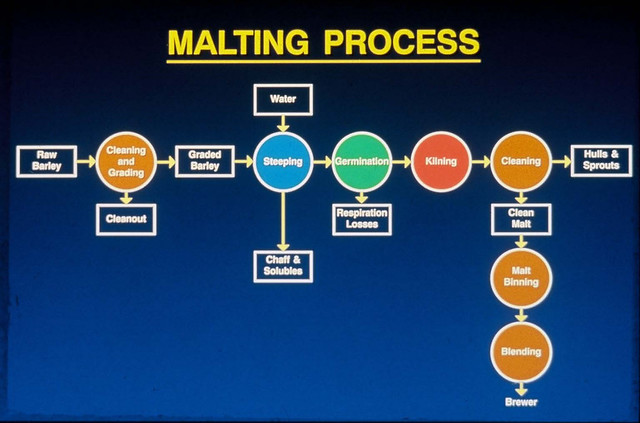
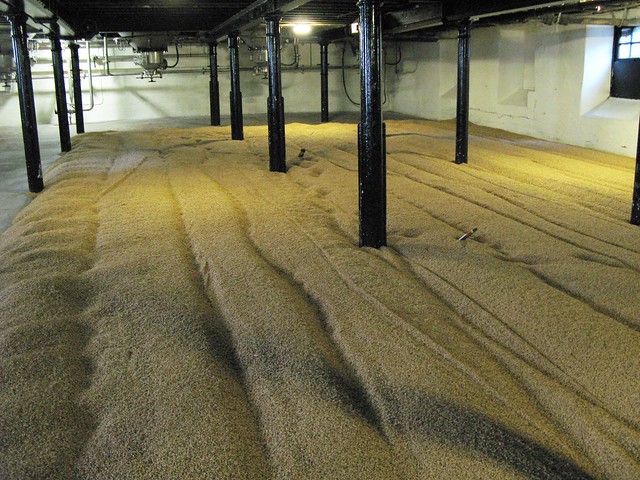
Today in 1963, US Patent 3085945 A was issued, an invention of Wayne W. Luchsinger and John G. Fleckenstein, assigned to the Kurth Malting Company, for their “Malting Process.” There’s no Abstract, although in the description it includes this summary:

According to the present invention there is provided a novel malting process which gives greatly increased malt recoveries and with other benefits which will be disclosed hereinafter. There is also provided a novel malt produced having substantially retarded, and/or essentially free of rootlets. This novel malting process broadly comprises acidulating a cereal grain, as well as contacting the cereal grain with a growth-stimulating amount of gibberellic acid, in the period from initial steeping to the growth or germination stage prior to any significant growth or germination, viz, usually within about 6 hours, and as much as 1 day, or slightly longer, after steep out, and thereafter completing the germination.

By acidulating is meant applying an acidic substance to the grain, such as by spraying or immersing the grain in an aqueous solution of the acidic substance to inhibit growth. Thus, the acidic substance can be incorporated in the steep water at any stage of the steeping operation or it can be applied to the grain at steep out or thereafter and before any significant growth or germination has resulted, viz, within about 6 hours and as much as 1 day or slightly longer after steep out. However, malt recoveries are generally progressively lowered as the acidulation treatment is delayed after steep out. Nevertheless, the malt recoveries generally obtained after such tardy or deferred acidulation are higher than without such treatment.

Acidulation without the addition of gibberellic acid to the grain inhibits growth but the grain is not converted to usable malt, especially at low pH values below 3.8. Gibberellic acid alone without acidulation promotes growth but losses due to respiration and rootlets are excessive.

Surprisingly, the combination of acidulation and gib- 4 untreated malt and, in fact, almost reaches the ultimate object of going from grain to malt without loss. The 1% loss in the aciduiated-gibberellic acid treated malt due to steeping and abrasion is presently considered unavoidable but negligible compared to the reduction in other losses.

The avoidance of wasteful rootlet formation in the process of this invention is particularly significant since the germinating grain (barley) is more readily stirred and because matting is avoided. The barley thus requires less volume during germination so that more barley can be malted with existing equipment than when rootlet growth takes place. For example, instead of germinating 250i) bushels in a bed, from 3500 to 4000 bushels can be germinated. The increased productive capacity leads to lower costs. Furthermore, the essentially rootlet-free malt produced according to this invention requires much less storage volume and transportation space than conventional malt with rootlets. In addition, this malt has a higher bushel weight than conventional malt after the rootlets are removed.

The reduction in loss due to respiration is also highly important, not only because of the waste of the kernel constituents which is avoided, but also because of the reduced amount of heat developed in respiration. This heat must be removed to maintain the grain at a proper malting temperature. Since less heat is evolved there is less to remove. Turning of the malt to avoid overheating thus can be reduced. There is also less expense involved in refrigeration since less cool air is needed to maintain the malting temperature.

malting-process
malting_floor

Filed Under: Beers, Just For Fun, Politics & Law, Related Pleasures Tagged With: Brewing Equipment, History, Law, Malt, Patent

Patent No. 3438531A: Plastic Bung For A Beer Barrel

April 15, 2016 By Jay Brooks

patent-logo
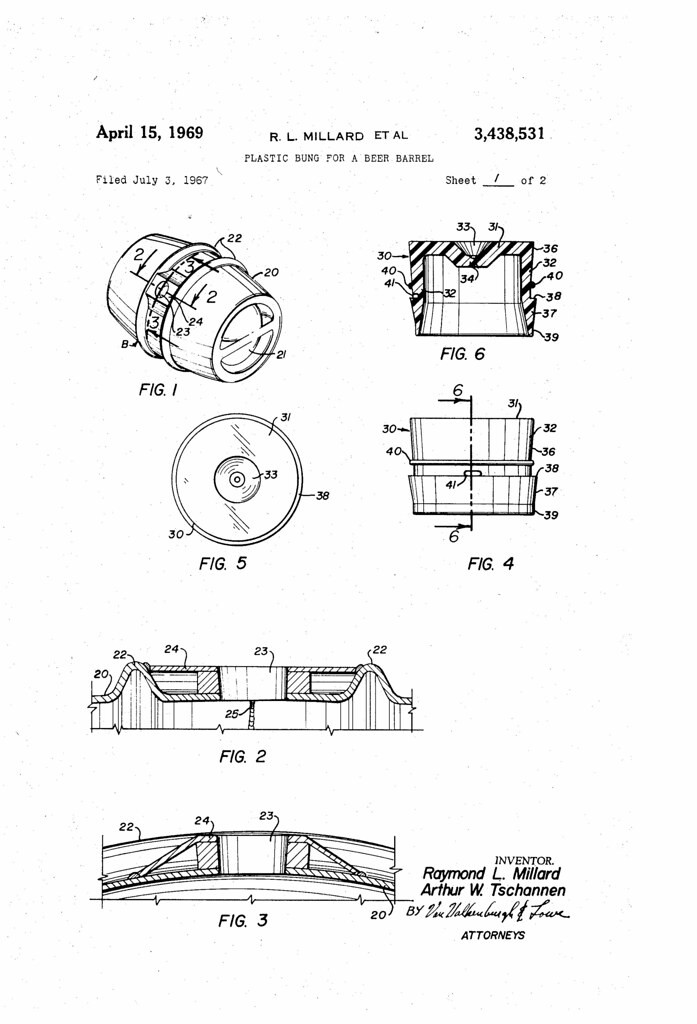
Today in 1969, US Patent 3438531 A was issued, an invention of Raymond L. Millard and Arthur W. Tschannen, assigned to the Adolph Coors Co., for their “Plastic Bung For A Beer Barrel.” There’s no Abstract, although in the description it includes this summary:

This invention relates to plastic bungs for beer barrels.

The invention comprises, in essence, a bung plug having a circular wall section sized and tapered to fit a standard bung orifice, and an oversized, tapered, conical skirt at the leading rim of this wall adapted to guide and subsequently lock the hung in the orifice. A seal ring circumscribes and outstands from the wall adjacent to the skirt and is in functional juxtaposition therewith, for the skirt protects the seal from scraping against the sides of the bung orifice until the bung is finally positioned.

It follows that the primary object of the invention is to provide a novel and improved plastic bung which may be fitted into an ordinary bung orifice in a beer barrel and will not thereafter leak.

Another object of the invention is to provide a novel and improved bung formed of a selected type of synthetic resin plastic material which combines the desirable properties of rigidity, resilience and the ability to cold flow at moderately high stresses, and which is formed and proportioned to stress the sealing portion of the bung against the walls of an orifice, by a resilient pressure in the body of the bung, with pressure sufficient to deform and to cold flow the sealing portion to produce a tight, leakproof fit.

Another object of the invention is to provide a novel and improved leakproof bung of such synthetic resin which will reliably seal a hung opening in a beer barrel that is scratched, pitted, marred or otherwise made irregular by use and abuse.

A further object of the invention is to provide a novel and improved bung for a beer barrel which is adapted to be securely fitted into the bung orifice of the barrel with out contacting, sliding or otherwise damaging the sealing portion of the bung against the wall of the bung orifice while the bung is being driven into place in the bung orifice.

US3438531-0
US3438531-1

Filed Under: Beers, Just For Fun, Politics & Law, Related Pleasures Tagged With: History, Kegs, Law, Patent

Patent No. 34943A: Beer Measure

April 15, 2016 By Jay Brooks

patent-logo
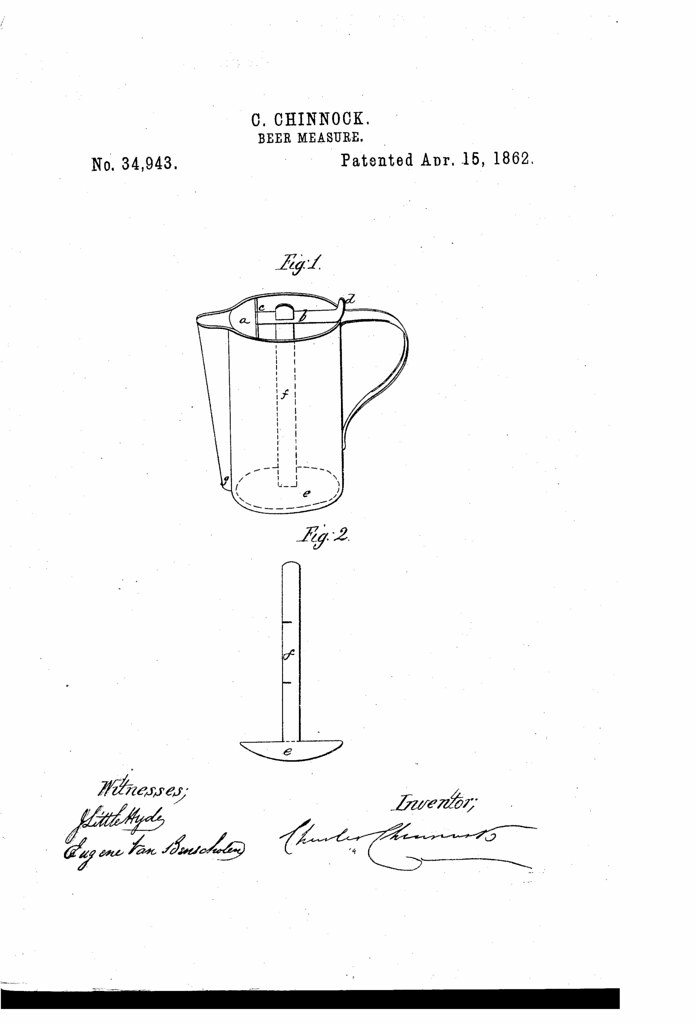
Today in 1862, US Patent 34943 A was issued, an invention of Charles Chinnock, for his “Beer Measure.” There’s no Abstract, although in the description it includes this summary:

I have invented a new and improved can and measure for liquids liable to froth or foam when drawn or measured and also to separate the froth or foam from the liquid when pouring into other vessel or vessels.

US34943-0

Filed Under: Beers, Breweries, Just For Fun, Politics & Law, Related Pleasures Tagged With: Brewing Equipment, History, Law, Patent, Science of Brewing

Patent No. DE202014002381U1: New Type Of Beer-Tasting Glass

April 14, 2016 By Jay Brooks

patent-logo
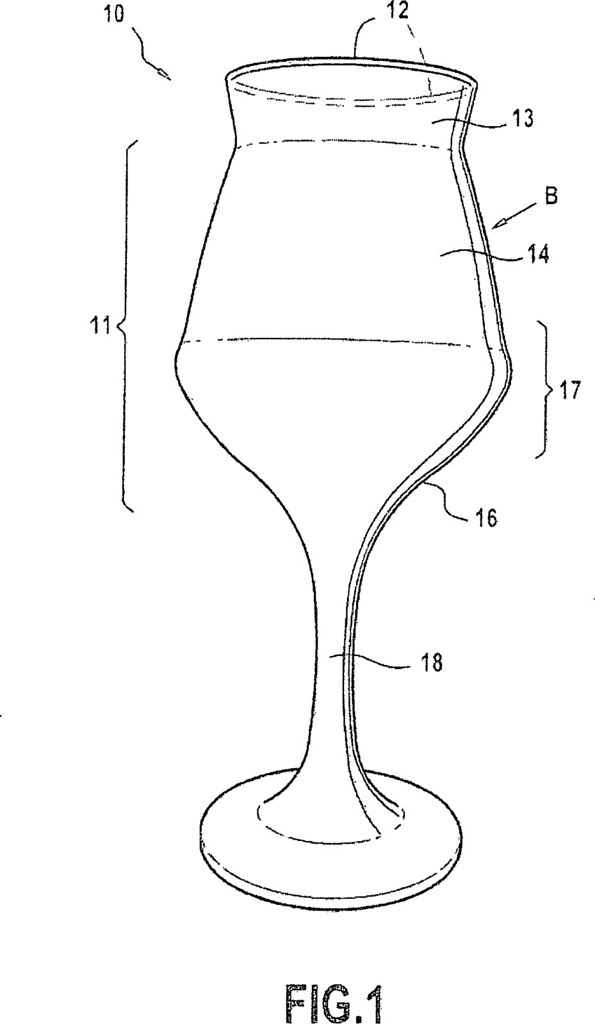
Today in 1979, German Patent DE 202014002381 U1 was issued, an invention of Vetreria Di Borgonovo S.P.A., for his “New Type of Beer-Tasting Glass.” Here’s the Abstract, translated from German:

Glass (10), namely thought to try out of beer (B) comprising:
– A receiving body (11) for receiving the consumer to cast into the glass beer (B), and
– A lower handle (18) for supporting and for manual handling of the glass,
wherein the receiving body (11) in turn comprises:
– An upper edge (12) having a rounded shape;
– An upper part (13), adjacent to the upper edge (12) and having an outwardly divergent flared shape;
– A central part (14), adjacent to the upper part (13) and having a bottom up to inwardly converging flared shape, and
– A circular lower part (16), which adjoins the central part (14) and with this at the bottom of the receiving body (11) of the glass (10) has a bulge (17);
wherein the glass (10) is adapted to allow a consumer who used to drink beer (B) the glass (10) both fully perceive the flavor characteristics and flavors of the drink and its visual characteristics, namely foam, to improve.

DE202014002381U1_0002

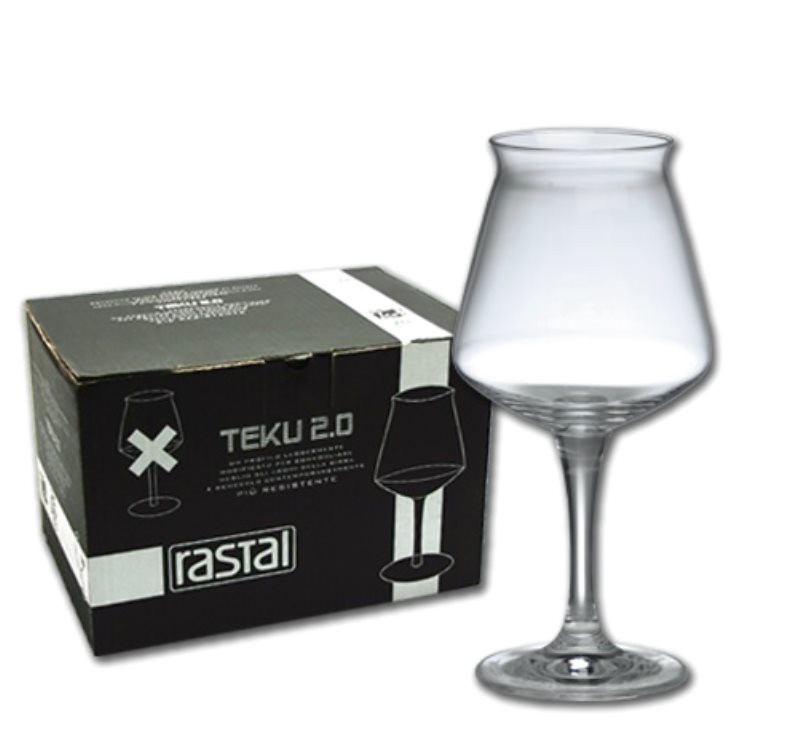
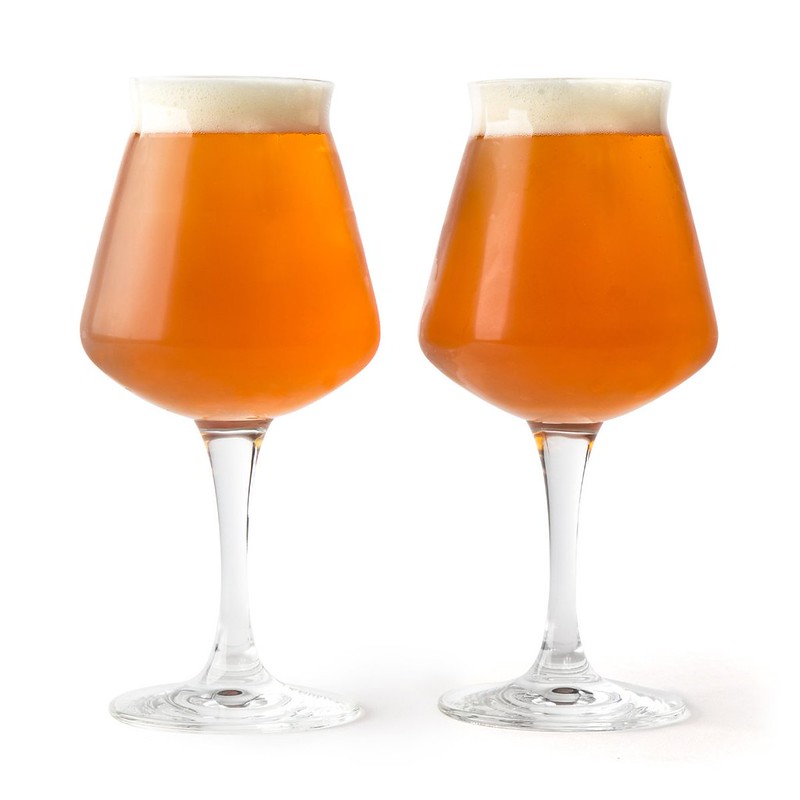
I think this is the Italian-designed glass that’s called a TeKu, and it certainly resembles the commemerative glass that the BA gave out at the Craft Brewers Conference in Portland last year.
teku-2
teka-glasses

Filed Under: Beers, Just For Fun, Politics & Law, Related Pleasures Tagged With: Glassware, History, Law, Patent

Patent No. 3505946A: Apparatus For Reconstituting Concentrated Wort

April 14, 2016 By Jay Brooks

patent-logo
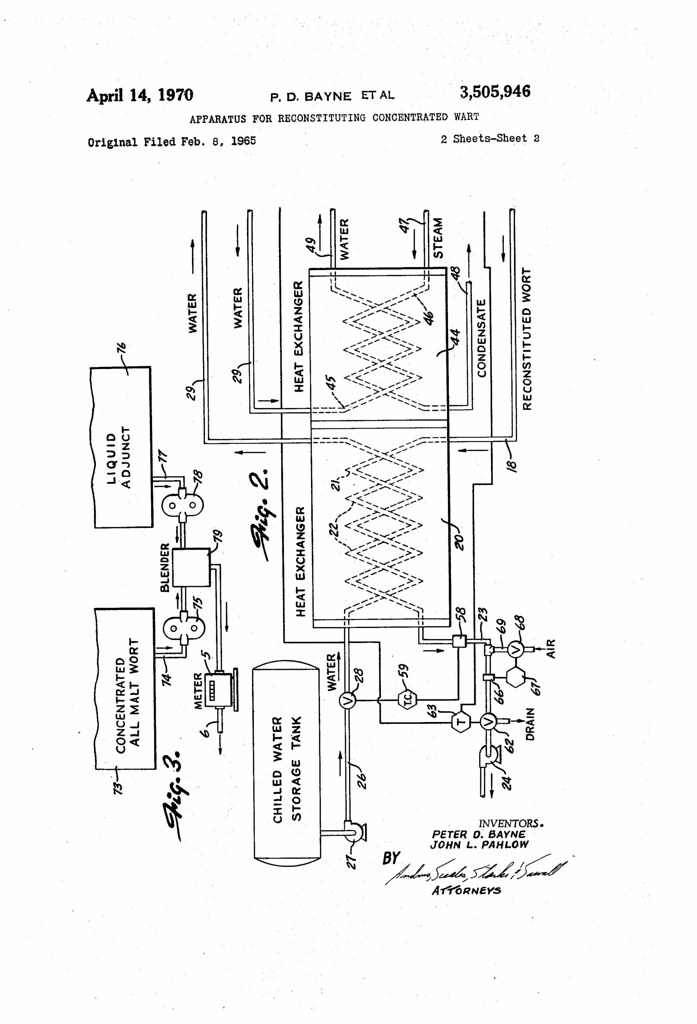
Today in 1979, US Patent 3505946 A was issued, an invention of Peter D. Bayne and John L. Pahlow, assigned to Schlitz Brewing Co., for his “Apparatus For Reconstituting Concentrated Wort.” There’s no Abstract, although in the description it includes this summary:

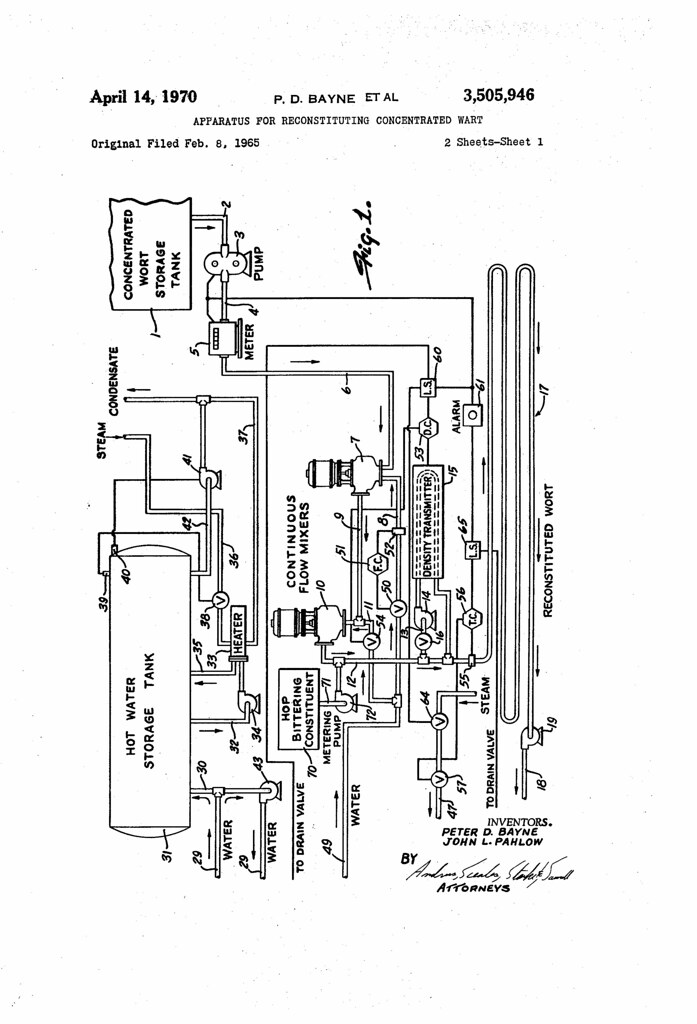
This invention relates to a process of brewing and more particularly to a process and apparatus for reconstituting concentrated brewers wort.

Wort concentration has great potential and can offer advantages by increasing the production efficiency of existing plants, increasing production volume without a corresponding increase in capital expenditure and providing a simplification of both production processes and control of product uniformity without sacrificing quality of product.

More specifically, concentrated wort provides several distinct advantages. Brewhouse equipment generally works at peak capacity for only a few months of the year. By concentrating wort during off season periods a more efficient use of the facility results so that the brewhouse equipment can be used more efficiently throughout the year.

In addition, concentrated wort can be shipped to distant points where it can be reconstituted, fermented, finished in plants which can be built at relatively low cost because they do not require the expensive grain handling and brewhouse equipment. Moreover, weight savings can be realized by shipping the wort concentrate as opposed to shipping malt and raw grains required for conventional brewing.

A system of wort concentration and reconstitution has outstanding potential in conjunction with a continuous or accumulated batch fermenting system. Wort concentrate is stable in storage and the concentrate can be metered into the present system in the desired flow rate, reconstituted, and then passed directly into the continuous fermenting system without storage. Using the reconstituting system of the invention in conjunction with a con tinuous fermentation process averts the necessity of holding the reconstituted wort at temperatures and under conditions which might create microbiological growth. Moreover, combining the reconstituting system with a continuous fermentation system completely eliminates the necessity of large storage tanks and chillers for maintaining a supply of wort for fermentation and provides a substantial cost saving in plant and equipment design over that of conventional systems.

The concept of wort concentration provides an alternate approach to the problems that some brewers have attempted to solve by freeze concentration of beer. Wort concentrate, because it does not contain alcohol, does not present the legal ramifications which accompany freeze concentrated beer.

The present invention is directed to a continuous, high capacity process for reconstituting concentrated wort. The wort is reconstituted without color gain, loss of hop bitter or alteration of flavor. According to the invention, concentrated wort at a temperature of from 60 to F., but preferably under and having a solids content of 80% is continuously pumped from a storage tank and/or shipping containers and passed into a mixing system. Deionized water, or filtered mains water, depending upon the purity of the water, is introduced into a mixer at a constant flow rate and is mixed with the stream of concentrated wort to partially reconstitute or dilute the wort. In some cases, particularly in high capacity installations, a second mixer in series may be employed and a second stream of either deionized water or filtered mains water is introduced into the second mixer down stream from the first mixer. This second or breakdown stream of water is continuously introduced at a variable flow rate and mixed with the partially reconstituted wort to complete the reconstitution to the fermentation gravity.

US3505946-0
US3505946-1

Filed Under: Beers, Just For Fun, Politics & Law, Related Pleasures Tagged With: History, Law, Patent, Science of Brewing, Wort

« Previous Page
Next Page »

Find Something

Northern California Breweries

Please consider purchasing my latest book, California Breweries North, available from Amazon, or ask for it at your local bookstore.

Recent Comments

  • Bob Paolino on Beer Birthday: Grant Johnston
  • Gambrinus on Historic Beer Birthday: A.J. Houghton
  • Ernie Dewing on Historic Beer Birthday: Charles William Bergner 
  • Steve 'Pudgy' De Rose on Historic Beer Birthday: Jacob Schmidt
  • Jay Brooks on Beer Birthday: Bill Owens

Recent Posts

  • Beer In Ads #5187: Ballantine’s Bock Is Here — With Horns! March 26, 2026
  • Historic Beer Birthday: Augustus Hoeveler March 26, 2026
  • Historic Beer Birthday: Bill Siebel March 26, 2026
  • Historic Beer Birthday: Conrad Windisch March 26, 2026
  • Beer Birthday: Rudi Ghequire March 26, 2026

BBB Archives

Feedback

Head Quarter
This site is hosted and maintained by H25Q.dev. Any questions or comments for the webmaster can be directed here.