
With Monday’s ad we continue our journey back to the French beer ads of the 1920s, this one for Biere de L’Eclair. A big man with big cigar, and an even bigger mug of beer. Who’s thirsty now?
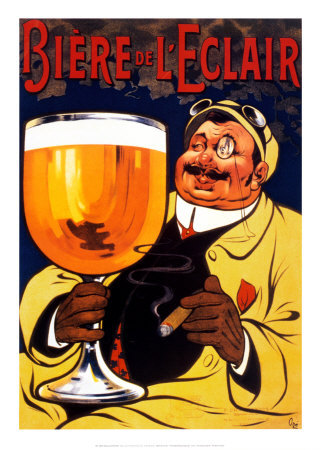

With Monday’s ad we continue our journey back to the French beer ads of the 1920s, this one for Biere de L’Eclair. A big man with big cigar, and an even bigger mug of beer. Who’s thirsty now?

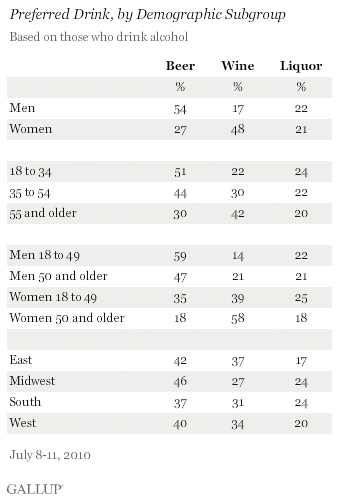
The annual Gallup Poll into American drinking habits was recently released. According to this year’s results, 67% of adults imbibe, a 1% increase from last year, and the highest percentage in 25 years. Also, the percentage of American abstaining hitting what looks to be the second-lowest number, 33%. Only around 1978-81 looks to have had fewer abstainers, which is great news since studies have shown that moderate drinkers tend to live longer than abstainers.
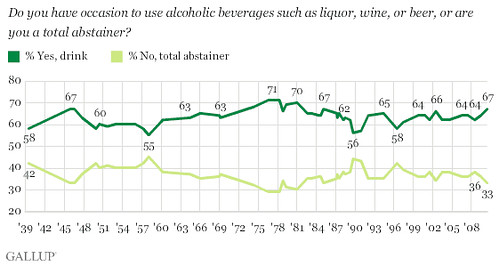
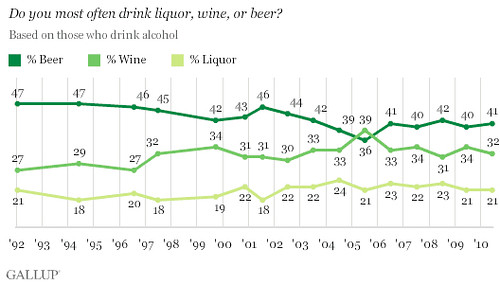
As has been the case in all but one suspect year, beer is the most consumer alcoholic beverage. I suspect, because even in the year people “reported” drinking more wine — 2005 — beer still outsold wine 4 to 1.
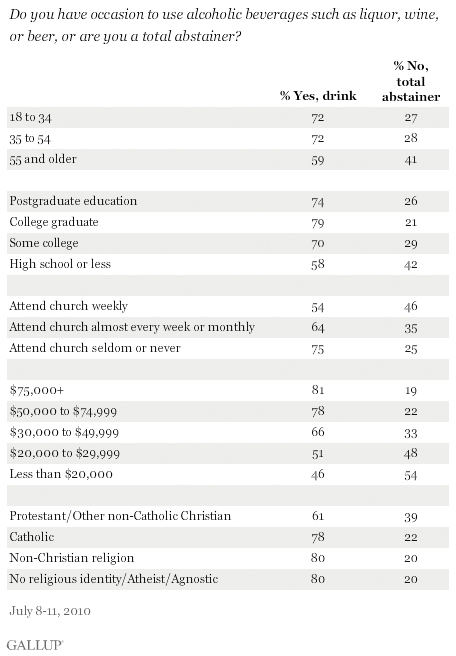
There’s some other interesting data about the demographics of current alcohol consumers. For instance, not surprisingly, there are more older abstainers. People with more education also drink more, and those with the least education comprise the majority of abstainers. Protestant Christians, followed by Catholics, have the largest number of abstainers.
And finally, by age and gender, men drink more beer, as do older people, regardless of gender. Somewhat surprisingly, the area of the country with the highest percentage of beer drinkers is the Midwest, followed by the East coast, the West coast with the South having the least.

Beer Advocate just released their latest list of the Top Beers on Planet Earth, at least according to their ratings. Just for fun, I’ve also looked through them and pulled out some interesting statistics about the list.
In the Top 100, there are beers from 44 breweries. Those breweries are from seven countries, with the U.S. having by far the most. In fact, 71 of the beers on the list are American, and are located in just 13 states. California, with 23 beers has the most. Here’s how they shake out:
The styles represented by the list are around 30, though I simplified and combined a few from Beer Advocate’s list. Around 14 styles have only one beer on the list. The top 15 break down as follows.
Nearly 60% (58) are above 5% a.b.v. but below 9%. 32 of the beers are 9% or above and ten of them are 5% and under. That’s far more middle of the road than I expected and it is quite different if you look at just the top 25. For the top 25 beers, 15 (or 60%) are extreme beers over 9% and the remaining 10 (0r 40%) are all over 5% but below 9%. The Top 25 also represent only 12 beer styles from 19 different breweries in 4 countries, shaking out like so:
The top 50, naturally, is somewhat in the middle, with extreme beers and middle-strength beers nearly equally represented, with only 1 below 5%. At fifty, only one more nation is represented, bringing the total to five. The highest canned craft beer came in at #30, with only two canned beers making the list, both of them from Oskar Blues. I don’t know what any of this ultimately means, but I thought it would be fun and interesting to take apart the beers that Beer Advocate users rated the highest and see what patterns emerged.
Obviously, the high number of American beers is a product of having been founded here and I presume the greatest number of users are still either here or at least in English-speaking countries, which may limit access to some beers. That may also be a factor in certain breweries making the list multiple times as a quick scan of them shows that the majority have fairly wide distribution throughout the U.S. The breweries having the most beers on the Top 100 list is below.
And here’s the original list:

Not sure how I missed this, but late last week, Duvel Moortgat announced that they had acquired De Koninck. I learned about it from Stephen Beaumont, but the press release has all the details:
Duvel Moortgat nv has reached agreement on the acquisition of 100% of the shares of the Brouwerij De Koninck group. With this acquisition, Duvel Moortgat expands its portfolio of specialty beers; it also aims to reinvigorate the De Koninck beer brand.
Brouwerij De Koninck is located in the heart of Antwerp and has a unique bond with the city. The De Koninck “Bolleke” is most popular in Antwerp and the surrounding area as well as in the Netherlands, but it also enjoys strong brand recognition throughout Belgium. Brouwerij De Koninck started its activities in 1827 when Jozeph De Koninck bought a coach house on the border between Antwerp and Berchem, currently known as “Afspanning De Hand”. These premises were converted into a brewery in 1833. Since then, the image of a hand has been immortalized in the brewery’s logo. Over the years, the Van den Bogaert and Van Bauwel families succeeded in building De Koninck into a valuable brand with a solid local reputation.
Bernard Van den Bogaert states: “This acquisition is a logical step. Because of the small size of our brewery, we have experienced a lack of commercial strength and distribution channels. During the last couple of years, Duvel Moortgat has proven that it possesses the right experience. And the fact that the two breweries have maintained an excellent relationship for generations adds an extra dimension to this acquisition.” Brouwerij De Koninck experienced its greatest success during the nineties, achieving a yearly production level of 130,000 hectoliters. As a result of a shrinking beer market and a strong decline in the pale ale segment, today less than 50% of that volume remains. Duvel Moortgat is also acquiring significant real estate, mainly located in the Antwerp region. This comprises the brewery site, about seven other properties and 63 cafés, including Antwerp icons such as “Den Engel” at the Grote Markt and the “Boer van Tienen” at Mechels Plein. The acquisition also includes beer trader Brouwerij De Valk, based in Wijnegem. De Valk has grown to become a key supplier in the Antwerp region, delivering to hundreds of cafés and restaurants on a daily basis.
Michel Moortgat (CEO of Duvel Moortgat) states: “We are very pleased to be able to incorporate Brouwerij De Koninck into the Duvel Moortgat Group. The “Bolleke” is not only a strong brand but also a quality specialty beer that fits perfectly into Duvel Moortgat’s range (Duvel, Chouffe, Maredsous, Liefmans, Vedett, Bel Pils). Our international distribution, including our own branches in Belgium, the Netherlands, France, the UK and the USA, provides an ideal operating base to progressively develop De Koninck. It did not take us long to reach agreement: family values and traditions are concepts that both breweries feel strongly about.”
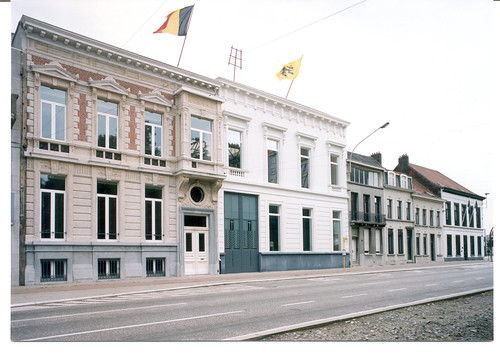
The De Koninck brewery in Antwerp.

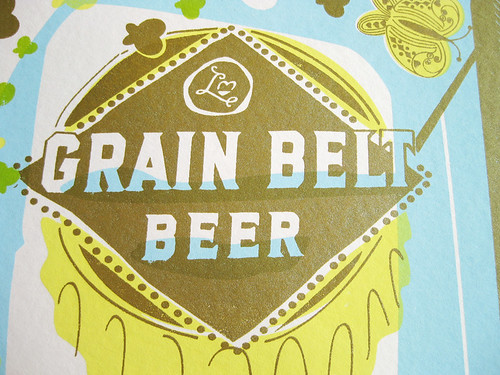
Today’s work of art is by contemporary artist Jamie Patrick Paul, who works in Minneapolis, Minnesota. The title of his 5-color screenprint is Lovely Day for a Bike Ride, and features the iconic Grain Belt sign in the background.
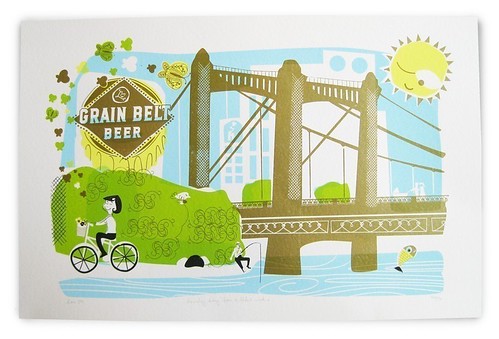
I love the work’s sense of whimsy. Below is a detail of the Grain Belt sign.
And he also did a night time version, A Lovely Night for a Bike Ride, though it looks far more dangerous than during the day.

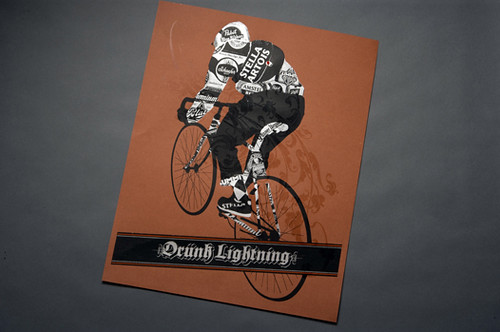
He also did an interesting piece using a lot of different beer elements, including beer itself for a poster entitled Drunk Lightning. Here’s how he described what went into it:
Drunk Lightning poster, a poster made nearly completely of beer. Gmund Bier paper made of recycled hops, Beer was poured in each ink color. Stella in the red, Guinness in the black, Pabst in the varnish.
You can see more of Paul’s work at his design portfolio and his website.

Rodger Davis’ IPAX IPA, from Triple Rock in Berkeley, California, was chosen best in show at the 13th annual IPA Festival earlier today at the Bistro in Hayward, California. The full list of winners is below.
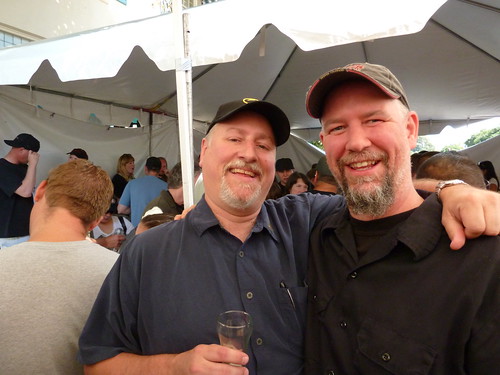
Me and Rodger Davis, brewer of the first place IPAX IPA at this year’s IPA Festival at The Bistro.

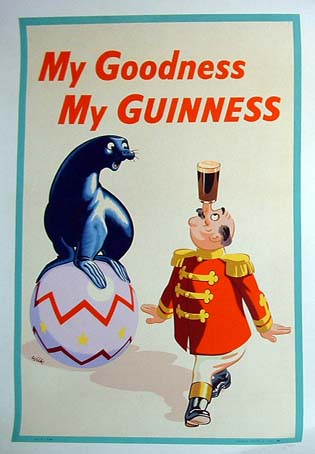
Our 30th Guinness poster by John Gilroy features a circus ringmaster showing a seal just how it’s done, balancing a bottle of Guinness on his own bulbous nose. The tagline is “My Goodness, My Guinness.”
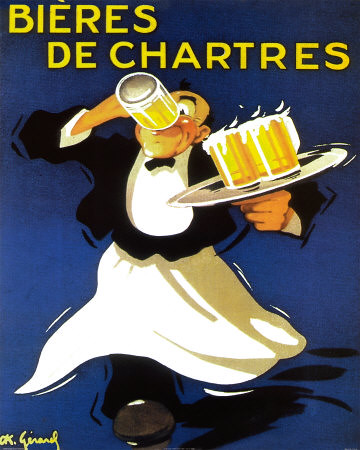
Friday’s ad is yet another French beer, this one for Bieres de Chartres. While I don’t know very much about it, or who the artist is, it’s from the same period of time — the 1920s — and is cut from the same cloth. It may even be a tad funnier, what with the waiter drinking the beer even as he delivers it.

Our 42nd Session is hosted by Derrick Peterman, from Ramblings of a Beer Runner. He’s chosen “A Special Place, A Special Beer” as his topic, which Derrick describes geographically, as follows:
The Session provides a unique opportunity to explore this connection between the beer in our glasses and the place it comes from with perspectives from all over the world.
So I ask for this 42nd Session that you write about a special place in your life, and a beer or brewery that connects you to that place. It can be the beer from your childhood home, a place you once lived, your current hometown, a memorable vacation you once took, or a place you’ve always wanted to go to but never had the chance. Please take a few moments to think about the how the beer connects you to this place, and share this with us. Of course, the definition of “place” is rather open ended, and in some cases, highly debatable, so it will be interesting to see the responses on what constitutes a place.
This was actually a simpler question than I expected, once I stopped to think about it. For me, I believe the most special place to have a beer, any beer, is at the source. The place where it was created — the brewery — I always find is my favorite place to try their beer, especially for the first time. Plus, in certain places the brewery has beers available that can’t be found anywhere else.
A number of years ago, for example, I visited the Radeberger Brauerei just outside Dresden, Germany. Their pilsner is one of the best in the world, at least in my opinion. But even better is the unfiltered zwickel version that they have only at the brewery. To be fair, they also used to sell it at one bar in downtown Dresden but last I heard a flood had closed it.
I love drinking beer at home, at the bar, at the restaurant — okay, anywhere — but not quite as much as in the brewery itself. That’s hallowed ground, in a sense. I’m not really a “ticker,” so I have no idea how many breweries I’ve visited over the years but it’s certainly a fair number. And they’re almost always where I’ve had the most memorable experiences. I don’t know if it’s the setting — I do love the feeling of being in a brewery — or being with the brewer, or some other intangible, but I inevitably get the sense that that’s the beer’s home. And things just always taste better when they’re home.

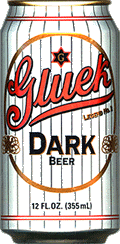
Cold Spring Brewing in Minnesota announced yesterday that they will no longer brew the historic Gluek brand. Gluek began brewing in 1857, before Minnesota was even a state.
In 1857 on the bank of the Mississippi River in an area which would someday be known as Minneapolis, German immigrant Gottlieb Gluek started the Mississippi Brewing Company. Soon the name was changed to the Gluek Brewing Company, and by 1964 Gluek became Minneapolis’s oldest continuously-operated business.
In 1858 the company brewed 3,996 barrels of beer, and by 1901 the annual capacity was second only to the two “giants” the Minneapolis Brewing Company (later renamed as the Grain Belt) and the Theo. Hamm Brewery of St. Paul.
But after 1964 it fell on hard times and, like many regional breweries, was bought by G. Heileman. The original brewery was torn down but a new one was later built back in Cold Spring, Minnesota in 1997. A couple of years ago, however, they renamed Gluek Brewing to Cold Spring Brewing as fewer and fewer consumers knew or cared about Gluek’s history in the region.
As an AP story reports:
By September, Gluek will be phased out. But vice president and general manager Doug DeGeest says Cold Spring Brewing is keeping the Gluek trademark, and it’s possible the beer could come back.
DeGeest says it was a business decision to discontinue the Gluek brand. He says the Cold Spring-based company cannot keep up with production and needed to decide which product in its portfolio of beers to discontinue.
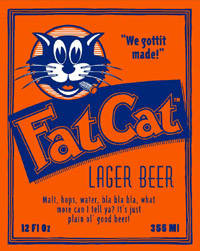
When I was the beer buyer at BevMo, we brought in some of the Gluek beer in cans and they also sold us a beer exclusively (for California, at least) which we sold as a private label beer. That was Fat Cat Lager, which was a decent enough all-malt generic lager. I believe Randy Mosher did the label design.
Regardless of Gluek’s ultimate place in American brewing history, it’s always sad to see another old brand consigned to the scrap heap of discontinued brands, but then I’m sentimental that way.