Brookston Beer Bulletin

Jay R. Brooks on Beer

  • Home
  • About
  • Editorial
  • Birthdays
  • Art & Beer

Socialize

  • Dribbble
  • Email
  • Facebook
  • Flickr
  • GitHub
  • Instagram
  • LinkedIn
  • Pinterest
  • RSS
  • Twitter
  • YouTube

Powered by Genesis

Free Tokens For Fremont Oktoberfest

September 9, 2008 By Jay Brooks

If you’re planning on going to the Fremont Oktoberfest in Seattle, Washington, which this year is being held September 19-21, buy your tickets online and receive two additional free tasting tokens. Just enter the code “FOKT” in the “Discount Code” window to get your extra tokens.


Filed Under: Uncategorized Tagged With: Uncategorized

Suds Surfing That Slippery Slope

September 9, 2008 By Jay Brooks

Let me start out by saying that I am not a big fan of Alcopops. I understand their appeal and the demographic that generally prefers them. I am of the opinion that they probably make it harder for craft brewers to capture the just-over-21 market because of the average younger persons’ preference for sweet flavors. But as malt-based beverages, they are in the family of beer, albeit often considered a distant cousin at best. I’ve been guilty myself of wanting to throw them under the bus sometimes, simply because they’re such a target for neo-prohibitionists. Because of their supposed popularity among younger drinkers, they’ve been an equally popular target for the anti-alcohol factions of society.

But let’s re-think this. It’s clearly not working to simply let malternatives take the fall. In California, recent legislation to tax alcopops as spirits — a quite ridiculously tortured and incorrect way of defining them that was done simply because neo-prohibitionists got to have their way — also may quite possibly do away with (or make prohibitively expensive) barrel aged beer, too. So maybe we should think about this in the same way we do freedom of speech. We may not like what someone has to say, but we understand that we must protect their right to say it or one day we, too, may be unable to express our opinion. That may be what’s happening with malt-based beverages. Even though many of us in the craft beer world may not like them, perhaps we should defend them. Wait, here me out. The truth is, once the neo-prohibitionists have put that segment of the alcohol business out of business, they won’t be satisfied and simply go home and live their lives. They’ll just move on to the next target.

It reminds of that famous quotation/poem by German Pastor Martin Niemöller:

“In Germany, they came first for the Communists,
And I didn’t speak up because I wasn’t a Communist;
And then they came for the trade unionists,
And I didn’t speak up because I wasn’t a trade unionist;
And then they came for the Jews,
And I didn’t speak up because I wasn’t a Jew;
And then . . . they came for me . . .
And by that time there was no one left to speak up.”

It wasn’t my intention to necessarily compare neo-prohibitionists to the Nazis, but in terms of tactics and propaganda, it’s not really a bad analogy. So I’m starting to think we should speak up for our malternative cousins. Whatever they say and do to go after them, eventually they’ll say and do to craft beer.

What brought all of this up was the news today that the Center for Science in the Public Interest (CSPI) has filed suit against MillerCoors arguing that Sparks, their alcoholic energy drink, “encourages binge drinking, underage drinking, drunken driving and sexual assaults.” At least that’s how most reports are characterizing the CSPI’s lawsuit, which you can read at the Milwaukee Business Journal, the St. Louis Post-Dispatch and MarketWatch.

From the Milwaukee newspaper:

Drinkers of caffeinated alcoholic drinks are more likely to binge drink, ride with an intoxicated driver, become injured or be taken advantage of sexually than drinkers of non-caffeinated alcoholic drinks, according to a 2007 study conducted at Wake Forest University and cited by the nonprofit.

Sparks contain 6 percent to 7 percent alcohol by volume, as opposed to regular beer, which typically has 4 percent or 5 percent alcohol.

Sparks’ appeal to young people is enhanced by its “sweet citrusy taste, redolent of SweeTarts candy, and the bright color of orange soda,” the nonprofit said in a statement.

“MillerCoors is trying to hook teens and ‘tweens on a dangerous drink,” said the nonprofit’s litigation director Steve Gardner, in a statement. “This company’s behavior is reckless, predatory and in the final analysis, likely to disgust a judge or a jury.”

Unless there are other versions, it’s seems pretty clear it’s 6% abv, not up to 7%. And their suggestion that MillerCoors is trying to “hook teens” is just inflammatory rhetoric. Like every company that sells alcohol, they understand just how important it is that they that don’t sell to minors. The penalties are just too severe, thanks to the neo-prohibitionist agenda and their scare tactics.

That fact that young people who are under 21 might also like sweet drinks is hardly a reason to force them to not offer them for sale to legal adults. Soda is sickeningly sweet — not to mention arguably worse for a person’s health than beer — and we don’t sue them to stop their sale because young people might be harmed by them. There are thousands of such products made for adults but not ideal or illegal for kids that we don’t think should be discontinued just because of their appeal to kids. It’s up to parents to decide what’s best for their own children and up to retail companies and law enforcement to restrict those products that are illegal for minors from being purchased by them. The very idea that something legal for adults should be wiped off the face of the earth because kids might like it too is one that continues to baffle me. Follow that logic to its obvious conclusion, and we’ll create a world suitable only for children. Given that childhood is all about learning to grow up and be an adult, it just makes no sense. When you consider that roughly 29% of the American population is under 21, that means neo-prohibitionists and the CSPI want to ignore 71% of the rest of society, in other words the vast majority.

Back in June, the CSPI notified Miller and Anheuser-Busch of their intent to file suit against them. Uncharacteristically, the normally litigious A-B decided to cave in to their demands and “agreed to take caffeine and other unapproved additives out of its two alcoholic energy drinks, Bud Extra and Tilt.” They also paid $200,000 to eleven states “to reimburse them for the cost of the investigation.” I can only presume they did so primarily to avoid negative publicity, and not due to any belief that they had done anything untoward.

In the St. Louis take on this story, they claim that the CSPI “said the drink contains ‘unapproved’ additives, including caffeine and guarana,” though it’s unclear who needs to approve them. They continue:

CSPI’s lawsuit argues that it is illegal to use caffeine, guarana, ginseng, and taurine in alcoholic beverages. The group argues that the Food and Drug Administration has given only very narrow approval for caffeine and guarana—with no allowance for alcoholic drinks—and no approval for ginseng in any food or beverage. Taurine is only approved for use in chicken feed, not human food, according to the group.

But I’ve seen soda with guarana, taurine, ginseng and, obviously, caffeine. And brewers have been brewing beer with coffee for at least a decade or two, with no issue having been raised by the FDA as far as I know. And as mentioned in the MarketWatch report, “the Federal Alcohol and Tobacco Tax and Trade Bureau has approved all product formulations and labels for the Sparks line.” MillerCoors continues:

Further, “we have and we will continue to ensure that the labeling, marketing and product formulations of all our brands meet all applicable federal regulations and that our brands are marketed responsibly to legal drinking-age adults.”

But let’s forget about those reports and go directly to the source. According to the lawsuit itself, which was filed in the District of Columbia, the two causes of action alleged by the CSPI are one; that Miller Coors violated the “D.C. Consumer Protection Procedures Act: Deception D.C. Code § 28-3901, et seq.” and two; that they also violated “D.C. Consumer Protection Procedures Act: Breach of Implied Warranty of Merchantability D.C. Code §§ 28:2-312-318.” Even if successful on either of the two counts, that means MillerCoors would only be enjoined from selling Sparks in Washington D.C., at least for now. Undoubtedly this is a test case, with the fate of the fifty states hanging in the balance. The complaint is filled with a laundry list of “facts,” which are actually not facts, but arguments (some of which are pure propaganda), including listing their own success in earlier lawsuits. Two of the so-called “facts” they allege are that “[t]hese drinks appeal strongly to underage drinkers, such as college students, because they taste more like a soft drink than an alcoholic beverage” and also that “[t]here is a physiological effect — and marketing message — that consuming alcohol and caffeine together allows one to drink more alcohol without feeling as intoxicated as would otherwise be the case.” The CSPI characterizes these two as “the most serious.” That means their biggest problem with Sparks is that people who prefer sweet tastes like them and they don’t like the way they’re marketed. But, of course, there are plenty of other sweet alcoholic drinks available. A recent survey by another neo-prohibitionist group found that underage drinkers’ clear preference is not beer (which is where Sparks would fit), but hard liquor with something added to sweeten it. Red Bull and vodka has been a popular mixed drink for many years. And a preference for wine and beer was roughly the same, and far below sweetened spirits, both at around 16%. But as usual, wine and spirits get a free pass, while beer is demonized.

In this case, though, it seems it’s not just the alcohol, but that it’s sweet and alcohol. Apparently that’s just too much. Of course, we should ask where that preference for all things sweet came from. Our genetic collective sweet tooth has been exploited by almost every single food company out there. Troll the average grocery store and pick up things at random. What you’ll discover is that practically everything has sugar in it. Stuff you would never, ever think might have sugar as an ingredient, does. For example, Morton’s Salt has sugar in it, for chrissakes. Sometimes they don’t call it sugar, but instead use chemical names ending in -ose, like sucrose (table sugar), maltose (malt sugar), fructose (fruit sugar), lactose (milk sugar), glucose (a.k.a. dextrose, grape sugar), and many, many more. And since food labels list ingredients in order of their concentration, many food companies list sugar several times in their individual forms, having several chemical names for sugar on one label, to hide the actual amount of sugar in their products. And sugar is arguably far worse for people’s health than alcohol. But you see little kids down to toddlers mainlining the stuff in soda, which probably started with all the juice they push on babies which is likewise loaded with sugar. Soda has such a high concentration of sugar that after drinking one, your body actually craves more liquid to dilute all that sugar you just drank in a hopeless effort to quench your thirst. Is it any wonder that we crave sweet tastes?

But neo-prohibitionists continue to blame the alcohol companies for this condition that was not of their making. You might argue that they shouldn’t exploit it, but when everybody else — and I do mean just about everybody — is pandering to kids and adults alike why shouldn’t they? I may not like these drinks, but I can’t reasonably say they shouldn’t be “allowed” to sell them, as the CSPI thinks they can, just because kids might like their sweeter taste. Even if they were outlawed, there would still be sweet wine and cocktails for kids looking to get drunk and satisfy their sweet tooth. Can the CSPI honestly believe that if there was no more Sparks around, kids would give up their desire for alcohol? I mean that rhetorically, of course. I know they’re not that stupid, so that suggests a larger agenda. This lawsuit is part of the CSPI’s Litigation Project, which is certainly an ominous sounding name for a “project.” What’s especially troubling is I can’t disagree with everything they’ve done so far. But the CSPI press release also boasts that their “agreement with Anheuser-Busch was the first alcohol-related accomplishment for CSPI’s litigation project.” If that doesn’t suggest additional lawsuits, I don’t know what else would.

I suggest that we support and help, if possible, MillerCoors with this latest attack on alcohol. No matter what we may think of malternatives or beers with caffeine and other additives, if we don’t speak up now, who will be here to speak for us when the neo-prohibitionists come for craft beer? I, for one, don’t want to slide down that slippery slope to another prohibition.


Filed Under: Uncategorized Tagged With: Uncategorized

Action Alert: Rally Tomorrow To Veto Trash & Trinkets Bill

September 8, 2008 By Jay Brooks

Tomorrow, September 9 at 10:30 a.m., a press conference will be held at Rubicon Brewing in Sacramento, California to rally support for a veto of AB 1245, dubbed “The Trash & Trinkets Bill.” The bill, supported by only one beer company — Anheuser-Busch — sailed through both the state house and senate, showing just what lobbying money can buy in the state of California. What will A-B get for it’s money? “AB 1245 would significantly increase the amount of marketing dollars Anheuser-Busch wants to spend courting new drinkers. Promoting an increase of 1200% in direct marketing swag the largest beer manufacturer in the U.S. wants to further exploit its marketing clout to the detriment of smaller brewers.”

“The real loser in the AB marketing game will be the consumer who will likely see reduced choices at their local market,” said Tom McCormick, executive director of the California Small Brewers Association. The fact that every single beer company — large and small, domestic and import — with the singular exception of A-B opposes this bill, it’s bewildering to me that our elected officials turn so blind an eye to the will of not only the people, but the majority of the business community, too, in passing this bill. With a total impact of over 24 and a half billion dollars, California represents 13% of the beer industry in America. We have more breweries than any other state and, until last year (when Colorado overtook us), brewed the most beer, too. Apparently our state government is more interested in the soon-to-be world’s largest multinational beer company being happy than they are in protecting the interests of the local beer economy as a whole. I know money is the grease that moves politics, but this is just such a blatant example of greed over what’s good for the state that it boggles the mind. Don’t we want our state elected officials to care more about the best interests of our state?

Come out and show your support tomorrow for vetoing the bill. It’s our last chance to keep the playing field where it is, not as level as we’d like but certainly more so than if Governor Schwarzenegger signs AB 1245 into law. On hand at Rubicon will be owner Glynn Phillips, Susan Little (owner of St. Stan Brewery in Modesto) and Tom McCormick (executive director of the California Small Brewers Association). Rubicon is located at 2004 Capitol Avenue in Sacramento, California.

Even the Sacramento Bee is opposed to the bill. This is from an editorial in the paper on Saturday:

Assembly Bill 1245: Anheuser Busch galloped into the Legislature this year like a team of Clydesdales. The company’s lobbying mission? To get a law passed that would allow beer brewers to distribute more free trinkets, such as Bud Light key chains. Smaller brewers and groups crusading against alchohol abuse oppose SB 1245 by Assemblyman Albert Torrico, D-Fremont. It sailed easily through both houses but deserves a red veto stamp on the governor’s desk.

Filed Under: Uncategorized Tagged With: Uncategorized

Hop Picking = Dirty Job

September 8, 2008 By Jay Brooks

I got an e-mail last evening from my friend Ralph Woodall, who’s the Director of Sales at HopUnion in Yakima, Washington. The Discovery Channel television show Dirty Jobs was in town last week shooting an episode on hop picking. Wikipedia describes the show as “host Mike Rowe is shown performing difficult, strange, and/or messy occupational duties alongside the typical employees.” They got in touch with HopUnion owner Ralph Olson less than two months ago and showed up last Tuesday for two days of picking hops and working the kilns.

The Yakima Herald-Republic has a short story and describes the cable show’s stay in Yakima.

Rowe spent two days picking and inspecting hops, working the kilns that dry the hops and making bales, Olson said. In addition to visiting Hopunion, which provides hop leaves, pellets, extracts and oils to the craft brewery industry, Rowe worked in the fields at Loftus Ranches in Moxee.

Ralph tells me the show will most likely air sometime this winter, but there’s no exact air date yet. I’ll keep you posted.


Ralph Woodall with Dirty Jobs’ host Mike Rowe.

Ralph Olson with Mike Rowe and the crew of Dirty Jobs in the upstairs break room at HopUnion’s offices in Yakima.
 

Filed Under: Uncategorized Tagged With: Uncategorized

Take Your Daughter To Hop-Picking Day

September 8, 2008 By Jay Brooks

As I’ve done for the last few years, Saturday morning I drove up to Moonlight Brewing to help out with picking the hops on Brian Hunt’s modest hopyard. It’s always a fun time, and harkens back to the time before hops began being picked by machinery. In those days, hop-picking was a community event, with entire families spending the day in the fields. When I told my own family my plans, my four-year old daughter Alice said she wanted to come along to pick hops, which warmed her father’s heart. So the day became “Take Your Daughter To Hop-Picking Day.”

Me and my daughter Alice, having her first hop-picking experience.

Moonlight Brewery owner Brian Hunt cutting hops from his hopyard to make his fresh hop ale.
 

For more photos from this year’s hop harvest at Moonlight Brewery, visit the photo gallery.
 

Filed Under: Uncategorized Tagged With: Uncategorized

Session #19: German Bier

September 5, 2008 By Jay Brooks

This is our 19th monthly Session a.k.a. Beer Blogging Friday and Jim at Lootcorp 3.0 has chosen Deutsches Bier (or German Beer) as the theme, and he’s even offering bonus points for “Bavarian-themed posts.” Here’s how he put his intentions in his announcement:

I’ve decided to make September’s topic Deutsches Bier – German beer. I want you all to focus on the wonderful contributions our German neighbors have made to the beer world. You can write about a particular German style you really enjoy, a facet of German beer culture which tickles your fancy, or any other way in which Germany and beer have become intertwined in your life. Bonus points for Bavarian-themed posts.

It was that last sentence that caught my attention. Bavaria, eh? Well, I have over 2,000 photos I took during the press junket I took to Bavaria with a dozen other beer journalists last November. And I’d hardly had a chance to look at them … until now. So this Session seemed the perfect opportunity to get off my duff and get those photos posted. It’s taken more than a week to go through them all, choose the best ones and re-size them for the web. But, whew, happy to say that’s done now.

Bavaria, of course, is one of the sixteen German federal states, similar to the 50 American states in terms of relative autonomy with a federal system. Bavaria is by far the largest by area, with over 70,500 square kilometers. The next closest — Lower Saxony — has less than 50,000, roughly two-thirds’ Bavaria’s size. Despite its expansiveness, it ranks second in population — to North Rhine-Westphalia. Its capital, naturally is Munich.

Germany’s famous Reinheitsgebot, or German Beer Purity Law, was originally a Bavarian regulation, having “originated in the city of Ingolstadt in the duchy of Bavaria on April 23, 1516, although first put forward in 1487, concerning standards for the sale and composition of beer. Before its official repeal in 1987, it was the oldest food quality regulation in the world.” Maybe, although in 1483 London passed a rule concerning the use of hops and other ingredients by City brewers. But that’s a story for another day. Certainly the Germans were better at promoting the Reinheitsgebot.

Although I would argue that there is wonderful beer throughout Germany, the Bavarians do take a singular pride in their beer traditions. Then there’s the Hallertau region of Bavaria, where a significant amount of hops is grown. All in all, Bavaria is probably the best place in Germany if you want to immerse yourself in beer.

 
Seven Days in Bavaria
November 4-10, 2007
 
11.4 Miltenberg Sunday: German Beer Trip, Day 1
11.5 Miltenberg Monday: Faust Brewery Tour: German Beer Trip, Day 2
11.5 Wurzburger Hofbrau Brewery Tour: German Beer Trip, Day 2
11.5 Weyermann Malting: German Beer Trip, Day 2
11.5 Schlenkerla: German Beer Trip, Day 2
11.6 Bamberg Biermuseum: German Beer Trip, Day 3
11.6 A Walk Around Bamberg: German Beer Trip, Day 3
11.6 Mahr’s Brau: German Beer Trip, Day 3
11.6 A Quick Stop at Fassla and Spezial: German Beer Trip, Day 3
11.6 Schlenkerla Production Brewery: German Beer Trip, Day 3
11.7 Lammsbrau Organic Brewery: German Beer Trip, Day 4
11.7 Furst Carl: German Beer Trip, Day 4
11.7 Anheuser-Busch’s Hallertau Hop Farm: German Beer Trip, Day 4
11.8 German Hop Museum: German Beer Trip, Day 5
11.8 Kaltenberg, Part 1: German Beer Trip, Day 5
11.8 Kaltenberg, Part 2: German Beer Trip, Day 5
11.8 Dinner at the Hofbrauhaus: German Beer Trip, Day 5
11.9 Spaten: German Beer Trip, Day 6
11.9 Augustiner Brau Munchen, Part 1: German Beer Trip, Day 6
11.9 Augustiner Brau Munchen, Part 2: German Beer Trip, Day 6
11.9 Paulaner Nockherberg: German Beer Trip, Day 6
11.9 Ayinger Brewery, Part 1: German Beer Trip, Day 6
11.9 Ayinger Brewery, Part 2: German Beer Trip, Day 6
11.9 Dinner at Schneider Weiss Brauhaus: German Beer Trip, Day 6
11.10 Castle Mindelburg: German Beer Trip, Day 7
11.10 Meckatzer: German Beer Trip, Day 7
11.10 Zotler Brauerei: German Beer Trip, Day 7
 

Of the photo galleries above, only the first few have any text yet, but I’m working on it. I also have some short films to add. Those should be up soon, too. If you feel like you just got stuck asking to watch somebody’s slide show of their last vacation, feel free to click away from here as fast as your little mouse finger can carry you.

If, however, you love brewery porn, I can promise you there’s tons — literally tons — of it in these galleries. The Bavarians love their brewing equipment and polish it to a high sheen. And they also love their rich brewing heritage so there’s no end to the mini-museums lovingly displaying their old equipment and other breweriana from both their recent and distant past.

Four of the smaller breweries we visited are just now starting to be imported to the U.S. as part of a new company, Barvaria Exports, dba “The Craft Brewers of Bavaria.” Our trip was paid for the Bavarian Brewers Federation, the Munich Brewers Guild, several agricultural trade organizations and even some American companies doing business in Germany. The four brewers who are part of the Craft Brewers of Bavaria are, naturally, members of at least one of the guilds. And I just know you won’t trust me if I don’t disclose that as soon as possible.

The trip was organized by these trade groups in the hopes of bringing attention to beer from Germany. Despite not being coerced in any way to write anything specific, good or bad, there are critics among us who dogmatically insist objectivity is impossible under such circumstances. Just by accepting the trip, I’ve been corrupted already so anything I write about it suffers from that bias. This is apparently especially true if I write anything favorable, because I guess you’re not intelligent enough to decide for yourself if I’m being truthful or and am simply writing a puff piece out of gratitude.

Hopefully by now you’ve figured out that I disagree with such nonsense. I welcomed the opportunity to visit breweries I’ve never been to and, in many cases, never even heard of, and without the generosity of the being invited on the trip it might have been many years before I wondered into these small towns and their breweries. I suspect that unless you travel regularly and extensively throughout Bavaria, you may not have been familiar with many of them either. So that means we all get to share in learning about these wonderful breweries. The four Craft Brewers of Bavaria are:

  1. Lammsbrau
  2. Meckatzer
  3. Miltenberger
    a.k.a. Faust
  4. Zotler Bier

A fifth brewery that we didn’t visit, St. Georgen Brau in Buttenheim, has been added to the venture. All of them are part of a relatively new appellation the EU designated in 2001, Bayerisches Bier (or Bavarian Beer), granting legal protection to Bavaria as a geographic appellation.

All of the beers we had from these breweries were exceptionally good. Even they’re far from household names in America, I hope distributors pick them up and, assuming that happens, that people buy them and give them a try. There’s one style from each brewery available in a four-pack, with a good range of different German beers. From Lammsbrau, an organic brewery, their Lammsbrau Light is a mild lager, not a a low-calorie beer but a session lager (4.1% abv) that also full-flavored. Meckatzer Gold is a tasty helles. The Miltenberger Helles Hefe-Weizen is a great German-style hefeweizen, though I confess their Schwarzviertler was absolutely one of my favorites. The Zotler Bier Korbinian Dunkel is a nice dark lager. But don’t take my word for it — after all I’ve only been there — try the beer for yourself. These are great German beers. I’d say so no matter how I managed to get to Bavaria and visit these breweries.


Filed Under: Uncategorized Tagged With: Uncategorized

Liquidated Liquid Lauded

September 4, 2008 By Jay Brooks

farmhouse-bc
I try not to pick on my fellow beer writers too much, especially as I’m acutely aware of my own imperfections and ability to make mistakes. I’m human, too, just like everyone else. But I make an exception for Todd Haefer, who writes the syndicated column “The Beer Man” for Gannett News Service. He took over for the original — and now Real Beer Man — Jim Lundstrom, when he left his position in 2005. You can read Jim’s account in a comment from a previous post I did about one of Haefer’s articles. I’ve written twice about Haefer spreading information I considered, um … unhelpful … back in the fall of 2006. One was about declaring barrel-aged beer dead and the other trashing Lagunitas’ labels.

Since then, I’ve pretty much ignored him. Whenever I see his byline come up in the wires, I just don’t look at it, figuring it’s not really worth my time. Maybe that’s unfair, but a Bulletin reader sent me his latest missive (thanks Doug) and I see I haven’t been missing much. It’s titled Farewell to Farmhouse Kolsch and sings the praises of a Kolsch brewed at least nine months ago, and probably even longer than that. Farmhouse Brewing was the brainchild of my friend Jeff Moses. He created the brand when he took over as GM of Coast Range Brewing in Gilroy, California several years ago. The Coast Range brand inexplicably didn’t sell well and so he figured a new brand name wouldn’t carry the same baggage. Coast Range’s brewer, Peter Licht, was quite talented and came up with some tasty beers under the Farmhouse label. Farmhouse beers did reasonably well, but it wasn’t enough to stave off the inevitable and Coast Range filed a Chapter 11 Reorganization bankruptcy in December of 2007, shuttering their doors at the same time. Having looked at the filing (I used to be in the bankruptcy business, believe it or not) it did not look good for their eventual successful reorganization owing primarily to some outstanding tax burdens accumulated over the years. Something like only one out of every ten Chapter 11 filings results in a successful reorganization. Most are converted to liquidation bankruptcies, with assets sold off to pay creditors.

Given their dire outlook, I stopped paying attention and right now don’t know where their case is at this point. It’s probably not over yet. These things tend to take a while. But in the meantime, whatever beer had been bottled before (or possibly just after) the filing is, according to the Beer Man, now being sold in Wisconsin, and he’s heard it’s also in Minnesota and New York, too. Undoubtedly, the Trustee got whatever he could for the beer and sold it at fire sale prices, probably cents on the dollar, just to get rid of it and get at least something for creditors.

Haefer speculates about their curious marketing of a Kolsch as a farmhouse ale — dude, there is no marketing for this beer, the company no longer exists. And when there was it was a brand name, a label, they never intended that anyone think all the beers were trying to be authentic farmhouse beers. All of the labels featured a crude folk-style painting of a barn from the area where the style of beer was originally brewed. Nobody was pretending that Kolsch or Porter or IPA was a farmhouse beer in terms of its style.

farmhouse-kolsch

Haefer goes on to give us his tasting notes on the beer, finding no fault with it whatsoever, and expressing his sadness in knowing that “it will no longer be made.” He finishes the article with some helpful hints to guide his readers on how they might find this elusive, all but extinct beer.

Since the brewery is no longer producing, the availability of Farmhouse Kolsch depends on whether local distributors took advantage of the liquidation sale. The brewery’s other beers that may pop up include a porter, saison, pale ale, imperial pale ale and a pilsner. It’s sad to have a beer like this and know it will no longer be made.

Many beers are available only regionally. Check the brewer’s Web site, which often contains information on product availability by mail.

Haefer knows they’re in bankruptcy and no longer brewing. What makes him think someone is updating the website with who’s carrying the liquidated beer outside of their home market? And couldn’t he have checked first? That way he would have discovered for himself that there’s almost no information about their availability on the website.

I guess I’m baffled by why any writer would choose to champion a beer that almost no one reading his work could find and even if they could, would be well past its prime, having been out-of-code for at least five months. Coast Range, like most craft breweries, did not pasteurize their beers, giving them a shelf life of roughly 3-4 months. That it’s so good to the Beer Man’s taste is either a testament to the craftsmanship and longevity of the beer itself, beating the odds and presumably having been handled spectacularly well every step of its long journey from brewery to warehouse to cross-country discount store, or to something else entirely — which decorum prevents me from saying. But I think you can figure it out. Beer man indeed.

Filed Under: Beers, Breweries, Editorial Tagged With: California, Writing

Forbes Picks America’s Best Beer Festivals

September 3, 2008 By Jay Brooks

MSNBC, through their partner Forbes Traveler, had a story today (sent to me by Pete Slosberg. Thanks Pete) that lists their choices for America’s Best Beer Festivals. It’s a surprisingly decent list, especially given other missteps Forbes Traveler has made with similar lists. A few months back, a magazine asked me to pick the top twenty beer festivals worldwide (but the assignment called for 25% abroad/75% U.S.) and eight of their eleven made my top twenty (or top 15 American festivals) and two more were listed as honorable mentions.

Here’s the Forbes list:

  1. Great American Beer Festival
  2. Oregon Brewers Festival
  3. Philly Craft Beer Festival
  4. Great Taste of the Midwest
  5. Belgium Comes To Cooperstown
  6. World Beer Festival
  7. American Craft Beer Fest
  8. San Diego Real Ale Festival
  9. Vermont Brewers Festival
  10. Great Alaska Beer & Barleywine Festival
  11. Yakima Fresh Hop Ale Festival

The accompanying article has an extensive interview with my friend Marty Jones and also Julia Herz, of the Brewers Association. Overall it discusses the top few fests and also what makes a good beer festival. All in all, a decent job.


Filed Under: Uncategorized Tagged With: Uncategorized

Obeerma

September 2, 2008 By Jay Brooks

In a post entitled Obama beer-averse? ‘Come on, man’, on the Swamp, Tribune’s Washington Bureau, where the author reports that “Barack Obama, defending his beer-drinking credentials, says his party’s ticket won’t be out-blue-collared by the Republican ticket with the union and hunting family on it.”

In a recent 60 Minutes interview by Steve Kroft:

“But you tried really hard to reach these people,” Kroft pressed. “You went and sipped beer, which I know you don’t particularly like — I mean you even…

“Steve, I had a beer last night,” Obama interjected. “I mean, where do these stories come from, man?”

“I’m the one… [that] doesn’t drink,” Biden added.

“Where does the story come from that…I don’t like beer? ” Obama asked. “C’mon, man,”

“Umm, beer ….” Tell me he’s not looking at the beer and thinking, “damn, that’s really good.”


Given Cindy McCain’s ties to Anheuser-Busch, it’s a safe bet Obama’s not drinking Budweiser. The beer in the photo below looks to be a pale ale or amber ale at the very least. It’s certainly not a light beer. Does that make this election big beer vs. small?


Filed Under: Uncategorized Tagged With: Uncategorized

Dinosaur Beer

September 2, 2008 By Jay Brooks

t-rex
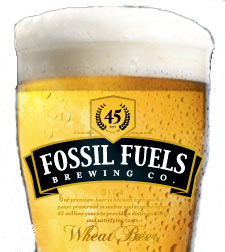
No, I don’t been those lumbering giants making flavorless beer-like industrial beverages which we all hope might one day become extinct, I’m talking about a beer made with roughly 45-million-year old yeast found in a bug entombed in amber, and extracted just like the plot of Michael Crichton’s Jurassic Park. This time around, the story involves Fossil Fuels Brewing Co., whose owners include Dr. Raul J. Cano, the Emeritus Professor at Cal. Poly in San Luis Obispo who originally made the discovery. According to the story in today’s Washington Post, the breakthrough came last month.

“I was going through my collection, going, ‘Gee whiz — this is pretty nifty. Maybe we could use it to make beer,’ ” says Cano, 63, now the director of the Environmental Biotechnology Institute at California Polytechnic State University in San Luis Obispo.

Last month? Hold on just a second. First of all the article mentions the following:

In April, at the World Beer Cup in San Diego, “we had one judge give us the highest marks, one just below and one who didn’t like it,” says Chip Lambert, 63, the company’s other second microbiologist. “We learned that the issue was that in these competitions, you brew to match the traditional concept of the style, which these yeast just don’t do.”

Ignoring for the moment that the World Beer Cup isn’t judged like that (there are no “highest marks” or anything similar), the Washington Post published this article yesterday, September 1. That would mean the World Beer Cup took place five months ago, not to mention that to enter that competition you have to register and submit your beer well in advance of the actual judging. I’m not trying to quibble with the story, a least that wasn’t my original intent, but this just doesn’t add up. Last month? Setting all that aside for the moment, I wrote about this two years ago, when Stumptown Brewing, in Guernville, California, made a beer called Tyrannosaurus-Rat, also using Dr. Cano’s ancient yeast.

This is part of what I wrote in Fall of 2006 in the Celebrator Beer News, reviewing a beer and barbecue festival held along the Guernville River at Stumptown:

But as good as the barbecue was, I was there for the beer. I was particularly keen to try what Stumptown was billing as a beer made with the world’s oldest yeast. Their “Tyrannosaurus-Rat” — or T-Rat for short — was essentially their popular “Rat Bastard,” but brewed using yeast that was 30 million years-old, give or take a few million years! How it got to be in Stumptown’s beer is nearly as interesting as the beer itself. It was discovered in the Dominican Republic trapped inside of a bee that was also trapped inside of a piece of amber, a terrific preservative. And the bee had been there for somewhere between 25 and 40 million years. Dr. Raul J. Cano, Emeritus Professor at Cal. Poly in San Luis Obispo, made the discovery in 1995 and managed to extract living bacterium, including a few strains of yeast, directly from the bee’s stomach. The ancient microorganisms were patented and also inspired the movie “Jurassic Park II.” It fell into Stumptown’s lap during a ski trip where the Hackett’s met a friend of Dr. Cano, and the rest, as they say, is literally ancient history.

I tried the T-Rat alongside of its modern counterpart, Rat Bastard, as they were the same in all respects except for the yeast. The Rat Bastard is a well-made pale ale, with good aromas and a crisp, clean palate. It has a generous hop bite that finishes bitter, then drops off sharply in the end. The T-Rat was much smoother, with softer, fruity flavor characteristics and just a touch of lemony sweetness that wasn’t tart. The finish is quite clean, with just a quiet hop presence lingering. While they’re both good beers, I think the T-Rat has a more complex, developed taste profile but its smoothness makes it great. The fact that it was made with such an old yeast is fascinating and given how good the beer is, no mere novelty.

There are also other anomalies. In my story, which relied primarily on Stumptown’s information, the yeast was found in a bee from the Dominican Republic. The Washington Post account, however, lists the Lebanese weevil as the yeast carrier. On top of that Dr. George Poinar, who was also involved in finding and extracting the DNA from amber, says on his biography web page that its age was 125 million-years old.

And here is the original press release for Stumptown’s version of the beer, from June 27, 2006:

For the first time, 25-40 million year old yeast has been used to brew a commercial batch of beer (“Tyrannosaurus Rat”) to be made available to the public on July 8th at Stumptown Brewery (15045 River Rd. Guerneville, Ca.). Dr. Raul Cano, Lewis “Chip” Lambert, and Peter Hackett will be celebrating this historic event and available for questions from 11:00A.M. on Saturday July 8th.

The public tasting of the T-Rat is the culmination of coincidences that involved a 20-40 million-year old bee trapped in amber and discovered in the Dominican Republic, a pair of renowned scientists, a ski weekend and an award winning microbrewery.

Amber is nature’s perfect preservative. It desiccates its specimens and protects them from damaging radiation of all types. Man has successfully used it to preserve their dead for thousands of years; Nature has preserved many of its inhabitants, including the recently identified spider web, in their elegant tombs for tens of millions of years.

Dr. Raul J. Cano, Emeritus Professor at California Polytechnic State University, San Luis Obispo, reported in Science (Volume 268, May 19, 1995) that he extracted a living bacterium from the gut of a stingless bee entombed in amber 25 – 40 million years ago. Independently, Lewis (Chip) Lambert, Fremont, CA, at the time Director of Pre-Clinical Research at a Bay Area biotech company, confirmed his work in a very skeptical scientific environment that has, for the most part, accepted its validity. In addition, Raul’s work became the underlying premise for the movie Jurassic Park.

The patented ancient microorganisms (USPO#5,593,883) became the focus of a new company based on the potential use of these microbial isolates for industrial and medical applications, and the hunt began. From the ancient-amber library came a few yeast strains and with them, the question, could they be used to make beer? The answer was a resounding yes as very good beer was brewed for the Jurassic Park II cast party and Raul’s daughter’s wedding reception.

After this initial success, Fossil Fuels Brewing Company was born with the motto “We bring good things back to life.” Using ancient yeasts that had all been thoroughly tested and selected for their beer-making properties, Fossil Fuels Brewing Co. planned to produce high quality distinctive beers with yeasts that had been isolated from amber.

The partners then proposed trials of these ancient yeasts to numerous microbreweries. Much to their surprise, in an industry that thrives on innovation, found a lack of enthusiasm among commercial breweries.

Fast forward a few years to the snowy slopes of Alpine Meadows where Carla Hackett was taking a ski lesson from Raul’s now friend and business partner, Chip. Carla had all the attributes of a great skier that her husband, an Aussie who owns the Stumptown Brewery in Guerneville, lacks. On the second, never the first, ride up the chair lift, an important relationship was established when the question was raised, “would you like to make some beer with some patented, 35-million year-old yeast?” The affirmative response started a brewing relationship between Stumptown Brewery and Environmental Diagnostics, Inc.

This random path led the ancient yeast to Stumptown Brewery on May 6th where Peter, Owner/Brewer, put the yeast to work. On June 21st came the news that “T-Rat” had finished fermenting and was conditioning. Perhaps most importantly, that it’s “very good, very unique. The yeast character is unusual, exotic, and very pronounced”.

fossil-fuels

On page two of the Post piece they finally do mention Stumptown’s involvement. The new versions, which include a wheat beer and a pale ale, are made at Kelley Bros. Brewing, which is in Manteca, California. I really enjoyed the pale ale version that Stumptown brewed and will eagerly try these two new versions. But I’m still a bit bewildered by the discrepancies that seem to accompany this story. But I guess history itself is a lot like that, so maybe it’s fitting after all. I wonder what “Cheers” is in dinosaur-speak? “Here’s tar in your eye?”

Filed Under: Beers, Just For Fun, News Tagged With: History

« Previous Page
Next Page »

Find Something

Northern California Breweries

Please consider purchasing my latest book, California Breweries North, available from Amazon, or ask for it at your local bookstore.

Recent Comments

  • Bob Paolino on Beer Birthday: Grant Johnston
  • Gambrinus on Historic Beer Birthday: A.J. Houghton
  • Ernie Dewing on Historic Beer Birthday: Charles William Bergner 
  • Steve 'Pudgy' De Rose on Historic Beer Birthday: Jacob Schmidt
  • Jay Brooks on Beer Birthday: Bill Owens

Recent Posts

  • Beer In Ads #5219: Good Old Point Special Bock Beer April 12, 2026
  • Beer In Ads #5218: The “Butter-In” Of The Season April 12, 2026
  • Beer In Ads #5217: The King Of All Beers April 11, 2026
  • Historic Beer Birthday: Gambrinus April 11, 2026
  • Beer In Ads #5216: The Finest Bock, As Usual April 11, 2026

BBB Archives

Feedback

Head Quarter
This site is hosted and maintained by H25Q.dev. Any questions or comments for the webmaster can be directed here.