Brookston Beer Bulletin

Jay R. Brooks on Beer

  • Home
  • About
  • Editorial
  • Birthdays
  • Art & Beer

Socialize

  • Dribbble
  • Email
  • Facebook
  • Flickr
  • GitHub
  • Instagram
  • LinkedIn
  • Pinterest
  • RSS
  • Twitter
  • YouTube

Powered by Genesis

Take Your Daughter To Hop-Picking Day

September 8, 2008 By Jay Brooks

As I’ve done for the last few years, Saturday morning I drove up to Moonlight Brewing to help out with picking the hops on Brian Hunt’s modest hopyard. It’s always a fun time, and harkens back to the time before hops began being picked by machinery. In those days, hop-picking was a community event, with entire families spending the day in the fields. When I told my own family my plans, my four-year old daughter Alice said she wanted to come along to pick hops, which warmed her father’s heart. So the day became “Take Your Daughter To Hop-Picking Day.”

Me and my daughter Alice, having her first hop-picking experience.

Moonlight Brewery owner Brian Hunt cutting hops from his hopyard to make his fresh hop ale.
 

For more photos from this year’s hop harvest at Moonlight Brewery, visit the photo gallery.

 

Filed Under: Uncategorized Tagged With: Uncategorized

Session #19: German Bier

September 5, 2008 By Jay Brooks

This is our 19th monthly Session a.k.a. Beer Blogging Friday and Jim at Lootcorp 3.0 has chosen Deutsches Bier (or German Beer) as the theme, and he’s even offering bonus points for “Bavarian-themed posts.” Here’s how he put his intentions in his announcement:

I’ve decided to make September’s topic Deutsches Bier – German beer. I want you all to focus on the wonderful contributions our German neighbors have made to the beer world. You can write about a particular German style you really enjoy, a facet of German beer culture which tickles your fancy, or any other way in which Germany and beer have become intertwined in your life. Bonus points for Bavarian-themed posts.

It was that last sentence that caught my attention. Bavaria, eh? Well, I have over 2,000 photos I took during the press junket I took to Bavaria with a dozen other beer journalists last November. And I’d hardly had a chance to look at them … until now. So this Session seemed the perfect opportunity to get off my duff and get those photos posted. It’s taken more than a week to go through them all, choose the best ones and re-size them for the web. But, whew, happy to say that’s done now.

Bavaria, of course, is one of the sixteen German federal states, similar to the 50 American states in terms of relative autonomy with a federal system. Bavaria is by far the largest by area, with over 70,500 square kilometers. The next closest — Lower Saxony — has less than 50,000, roughly two-thirds’ Bavaria’s size. Despite its expansiveness, it ranks second in population — to North Rhine-Westphalia. Its capital, naturally is Munich.

Germany’s famous Reinheitsgebot, or German Beer Purity Law, was originally a Bavarian regulation, having “originated in the city of Ingolstadt in the duchy of Bavaria on April 23, 1516, although first put forward in 1487, concerning standards for the sale and composition of beer. Before its official repeal in 1987, it was the oldest food quality regulation in the world.” Maybe, although in 1483 London passed a rule concerning the use of hops and other ingredients by City brewers. But that’s a story for another day. Certainly the Germans were better at promoting the Reinheitsgebot.

Although I would argue that there is wonderful beer throughout Germany, the Bavarians do take a singular pride in their beer traditions. Then there’s the Hallertau region of Bavaria, where a significant amount of hops is grown. All in all, Bavaria is probably the best place in Germany if you want to immerse yourself in beer.

 
Seven Days in Bavaria
November 4-10, 2007
 
11.4 Miltenberg Sunday: German Beer Trip, Day 1
11.5 Miltenberg Monday: Faust Brewery Tour: German Beer Trip, Day 2
11.5 Wurzburger Hofbrau Brewery Tour: German Beer Trip, Day 2
11.5 Weyermann Malting: German Beer Trip, Day 2
11.5 Schlenkerla: German Beer Trip, Day 2
11.6 Bamberg Biermuseum: German Beer Trip, Day 3
11.6 A Walk Around Bamberg: German Beer Trip, Day 3
11.6 Mahr’s Brau: German Beer Trip, Day 3
11.6 A Quick Stop at Fassla and Spezial: German Beer Trip, Day 3
11.6 Schlenkerla Production Brewery: German Beer Trip, Day 3
11.7 Lammsbrau Organic Brewery: German Beer Trip, Day 4
11.7 Furst Carl: German Beer Trip, Day 4
11.7 Anheuser-Busch’s Hallertau Hop Farm: German Beer Trip, Day 4
11.8 German Hop Museum: German Beer Trip, Day 5
11.8 Kaltenberg, Part 1: German Beer Trip, Day 5
11.8 Kaltenberg, Part 2: German Beer Trip, Day 5
11.8 Dinner at the Hofbrauhaus: German Beer Trip, Day 5
11.9 Spaten: German Beer Trip, Day 6
11.9 Augustiner Brau Munchen, Part 1: German Beer Trip, Day 6
11.9 Augustiner Brau Munchen, Part 2: German Beer Trip, Day 6
11.9 Paulaner Nockherberg: German Beer Trip, Day 6
11.9 Ayinger Brewery, Part 1: German Beer Trip, Day 6
11.9 Ayinger Brewery, Part 2: German Beer Trip, Day 6
11.9 Dinner at Schneider Weiss Brauhaus: German Beer Trip, Day 6
11.10 Castle Mindelburg: German Beer Trip, Day 7
11.10 Meckatzer: German Beer Trip, Day 7
11.10 Zotler Brauerei: German Beer Trip, Day 7
 

Of the photo galleries above, only the first few have any text yet, but I’m working on it. I also have some short films to add. Those should be up soon, too. If you feel like you just got stuck asking to watch somebody’s slide show of their last vacation, feel free to click away from here as fast as your little mouse finger can carry you.

If, however, you love brewery porn, I can promise you there’s tons — literally tons — of it in these galleries. The Bavarians love their brewing equipment and polish it to a high sheen. And they also love their rich brewing heritage so there’s no end to the mini-museums lovingly displaying their old equipment and other breweriana from both their recent and distant past.

Four of the smaller breweries we visited are just now starting to be imported to the U.S. as part of a new company, Barvaria Exports, dba “The Craft Brewers of Bavaria.” Our trip was paid for the Bavarian Brewers Federation, the Munich Brewers Guild, several agricultural trade organizations and even some American companies doing business in Germany. The four brewers who are part of the Craft Brewers of Bavaria are, naturally, members of at least one of the guilds. And I just know you won’t trust me if I don’t disclose that as soon as possible.

The trip was organized by these trade groups in the hopes of bringing attention to beer from Germany. Despite not being coerced in any way to write anything specific, good or bad, there are critics among us who dogmatically insist objectivity is impossible under such circumstances. Just by accepting the trip, I’ve been corrupted already so anything I write about it suffers from that bias. This is apparently especially true if I write anything favorable, because I guess you’re not intelligent enough to decide for yourself if I’m being truthful or and am simply writing a puff piece out of gratitude.

Hopefully by now you’ve figured out that I disagree with such nonsense. I welcomed the opportunity to visit breweries I’ve never been to and, in many cases, never even heard of, and without the generosity of the being invited on the trip it might have been many years before I wondered into these small towns and their breweries. I suspect that unless you travel regularly and extensively throughout Bavaria, you may not have been familiar with many of them either. So that means we all get to share in learning about these wonderful breweries. The four Craft Brewers of Bavaria are:

  1. Lammsbrau
  2. Meckatzer
  3. Miltenberger
    a.k.a. Faust
  4. Zotler Bier

A fifth brewery that we didn’t visit, St. Georgen Brau in Buttenheim, has been added to the venture. All of them are part of a relatively new appellation the EU designated in 2001, Bayerisches Bier (or Bavarian Beer), granting legal protection to Bavaria as a geographic appellation.

All of the beers we had from these breweries were exceptionally good. Even they’re far from household names in America, I hope distributors pick them up and, assuming that happens, that people buy them and give them a try. There’s one style from each brewery available in a four-pack, with a good range of different German beers. From Lammsbrau, an organic brewery, their Lammsbrau Light is a mild lager, not a a low-calorie beer but a session lager (4.1% abv) that also full-flavored. Meckatzer Gold is a tasty helles. The Miltenberger Helles Hefe-Weizen is a great German-style hefeweizen, though I confess their Schwarzviertler was absolutely one of my favorites. The Zotler Bier Korbinian Dunkel is a nice dark lager. But don’t take my word for it — after all I’ve only been there — try the beer for yourself. These are great German beers. I’d say so no matter how I managed to get to Bavaria and visit these breweries.


Filed Under: Uncategorized Tagged With: Uncategorized

Liquidated Liquid Lauded

September 4, 2008 By Jay Brooks

farmhouse-bc
I try not to pick on my fellow beer writers too much, especially as I’m acutely aware of my own imperfections and ability to make mistakes. I’m human, too, just like everyone else. But I make an exception for Todd Haefer, who writes the syndicated column “The Beer Man” for Gannett News Service. He took over for the original — and now Real Beer Man — Jim Lundstrom, when he left his position in 2005. You can read Jim’s account in a comment from a previous post I did about one of Haefer’s articles. I’ve written twice about Haefer spreading information I considered, um … unhelpful … back in the fall of 2006. One was about declaring barrel-aged beer dead and the other trashing Lagunitas’ labels.

Since then, I’ve pretty much ignored him. Whenever I see his byline come up in the wires, I just don’t look at it, figuring it’s not really worth my time. Maybe that’s unfair, but a Bulletin reader sent me his latest missive (thanks Doug) and I see I haven’t been missing much. It’s titled Farewell to Farmhouse Kolsch and sings the praises of a Kolsch brewed at least nine months ago, and probably even longer than that. Farmhouse Brewing was the brainchild of my friend Jeff Moses. He created the brand when he took over as GM of Coast Range Brewing in Gilroy, California several years ago. The Coast Range brand inexplicably didn’t sell well and so he figured a new brand name wouldn’t carry the same baggage. Coast Range’s brewer, Peter Licht, was quite talented and came up with some tasty beers under the Farmhouse label. Farmhouse beers did reasonably well, but it wasn’t enough to stave off the inevitable and Coast Range filed a Chapter 11 Reorganization bankruptcy in December of 2007, shuttering their doors at the same time. Having looked at the filing (I used to be in the bankruptcy business, believe it or not) it did not look good for their eventual successful reorganization owing primarily to some outstanding tax burdens accumulated over the years. Something like only one out of every ten Chapter 11 filings results in a successful reorganization. Most are converted to liquidation bankruptcies, with assets sold off to pay creditors.

Given their dire outlook, I stopped paying attention and right now don’t know where their case is at this point. It’s probably not over yet. These things tend to take a while. But in the meantime, whatever beer had been bottled before (or possibly just after) the filing is, according to the Beer Man, now being sold in Wisconsin, and he’s heard it’s also in Minnesota and New York, too. Undoubtedly, the Trustee got whatever he could for the beer and sold it at fire sale prices, probably cents on the dollar, just to get rid of it and get at least something for creditors.

Haefer speculates about their curious marketing of a Kolsch as a farmhouse ale — dude, there is no marketing for this beer, the company no longer exists. And when there was it was a brand name, a label, they never intended that anyone think all the beers were trying to be authentic farmhouse beers. All of the labels featured a crude folk-style painting of a barn from the area where the style of beer was originally brewed. Nobody was pretending that Kolsch or Porter or IPA was a farmhouse beer in terms of its style.

farmhouse-kolsch

Haefer goes on to give us his tasting notes on the beer, finding no fault with it whatsoever, and expressing his sadness in knowing that “it will no longer be made.” He finishes the article with some helpful hints to guide his readers on how they might find this elusive, all but extinct beer.

Since the brewery is no longer producing, the availability of Farmhouse Kolsch depends on whether local distributors took advantage of the liquidation sale. The brewery’s other beers that may pop up include a porter, saison, pale ale, imperial pale ale and a pilsner. It’s sad to have a beer like this and know it will no longer be made.

Many beers are available only regionally. Check the brewer’s Web site, which often contains information on product availability by mail.

Haefer knows they’re in bankruptcy and no longer brewing. What makes him think someone is updating the website with who’s carrying the liquidated beer outside of their home market? And couldn’t he have checked first? That way he would have discovered for himself that there’s almost no information about their availability on the website.

I guess I’m baffled by why any writer would choose to champion a beer that almost no one reading his work could find and even if they could, would be well past its prime, having been out-of-code for at least five months. Coast Range, like most craft breweries, did not pasteurize their beers, giving them a shelf life of roughly 3-4 months. That it’s so good to the Beer Man’s taste is either a testament to the craftsmanship and longevity of the beer itself, beating the odds and presumably having been handled spectacularly well every step of its long journey from brewery to warehouse to cross-country discount store, or to something else entirely — which decorum prevents me from saying. But I think you can figure it out. Beer man indeed.

Filed Under: Beers, Breweries, Editorial Tagged With: California, Writing

Forbes Picks America’s Best Beer Festivals

September 3, 2008 By Jay Brooks

MSNBC, through their partner Forbes Traveler, had a story today (sent to me by Pete Slosberg. Thanks Pete) that lists their choices for America’s Best Beer Festivals. It’s a surprisingly decent list, especially given other missteps Forbes Traveler has made with similar lists. A few months back, a magazine asked me to pick the top twenty beer festivals worldwide (but the assignment called for 25% abroad/75% U.S.) and eight of their eleven made my top twenty (or top 15 American festivals) and two more were listed as honorable mentions.

Here’s the Forbes list:

  1. Great American Beer Festival
  2. Oregon Brewers Festival
  3. Philly Craft Beer Festival
  4. Great Taste of the Midwest
  5. Belgium Comes To Cooperstown
  6. World Beer Festival
  7. American Craft Beer Fest
  8. San Diego Real Ale Festival
  9. Vermont Brewers Festival
  10. Great Alaska Beer & Barleywine Festival
  11. Yakima Fresh Hop Ale Festival

The accompanying article has an extensive interview with my friend Marty Jones and also Julia Herz, of the Brewers Association. Overall it discusses the top few fests and also what makes a good beer festival. All in all, a decent job.


Filed Under: Uncategorized Tagged With: Uncategorized

Obeerma

September 2, 2008 By Jay Brooks

In a post entitled Obama beer-averse? ‘Come on, man’, on the Swamp, Tribune’s Washington Bureau, where the author reports that “Barack Obama, defending his beer-drinking credentials, says his party’s ticket won’t be out-blue-collared by the Republican ticket with the union and hunting family on it.”

In a recent 60 Minutes interview by Steve Kroft:

“But you tried really hard to reach these people,” Kroft pressed. “You went and sipped beer, which I know you don’t particularly like — I mean you even…

“Steve, I had a beer last night,” Obama interjected. “I mean, where do these stories come from, man?”

“I’m the one… [that] doesn’t drink,” Biden added.

“Where does the story come from that…I don’t like beer? ” Obama asked. “C’mon, man,”

“Umm, beer ….” Tell me he’s not looking at the beer and thinking, “damn, that’s really good.”


Given Cindy McCain’s ties to Anheuser-Busch, it’s a safe bet Obama’s not drinking Budweiser. The beer in the photo below looks to be a pale ale or amber ale at the very least. It’s certainly not a light beer. Does that make this election big beer vs. small?


Filed Under: Uncategorized Tagged With: Uncategorized

Dinosaur Beer

September 2, 2008 By Jay Brooks

t-rex
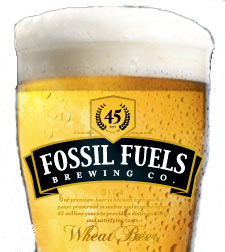
No, I don’t been those lumbering giants making flavorless beer-like industrial beverages which we all hope might one day become extinct, I’m talking about a beer made with roughly 45-million-year old yeast found in a bug entombed in amber, and extracted just like the plot of Michael Crichton’s Jurassic Park. This time around, the story involves Fossil Fuels Brewing Co., whose owners include Dr. Raul J. Cano, the Emeritus Professor at Cal. Poly in San Luis Obispo who originally made the discovery. According to the story in today’s Washington Post, the breakthrough came last month.

“I was going through my collection, going, ‘Gee whiz — this is pretty nifty. Maybe we could use it to make beer,’ ” says Cano, 63, now the director of the Environmental Biotechnology Institute at California Polytechnic State University in San Luis Obispo.

Last month? Hold on just a second. First of all the article mentions the following:

In April, at the World Beer Cup in San Diego, “we had one judge give us the highest marks, one just below and one who didn’t like it,” says Chip Lambert, 63, the company’s other second microbiologist. “We learned that the issue was that in these competitions, you brew to match the traditional concept of the style, which these yeast just don’t do.”

Ignoring for the moment that the World Beer Cup isn’t judged like that (there are no “highest marks” or anything similar), the Washington Post published this article yesterday, September 1. That would mean the World Beer Cup took place five months ago, not to mention that to enter that competition you have to register and submit your beer well in advance of the actual judging. I’m not trying to quibble with the story, a least that wasn’t my original intent, but this just doesn’t add up. Last month? Setting all that aside for the moment, I wrote about this two years ago, when Stumptown Brewing, in Guernville, California, made a beer called Tyrannosaurus-Rat, also using Dr. Cano’s ancient yeast.

This is part of what I wrote in Fall of 2006 in the Celebrator Beer News, reviewing a beer and barbecue festival held along the Guernville River at Stumptown:

But as good as the barbecue was, I was there for the beer. I was particularly keen to try what Stumptown was billing as a beer made with the world’s oldest yeast. Their “Tyrannosaurus-Rat” — or T-Rat for short — was essentially their popular “Rat Bastard,” but brewed using yeast that was 30 million years-old, give or take a few million years! How it got to be in Stumptown’s beer is nearly as interesting as the beer itself. It was discovered in the Dominican Republic trapped inside of a bee that was also trapped inside of a piece of amber, a terrific preservative. And the bee had been there for somewhere between 25 and 40 million years. Dr. Raul J. Cano, Emeritus Professor at Cal. Poly in San Luis Obispo, made the discovery in 1995 and managed to extract living bacterium, including a few strains of yeast, directly from the bee’s stomach. The ancient microorganisms were patented and also inspired the movie “Jurassic Park II.” It fell into Stumptown’s lap during a ski trip where the Hackett’s met a friend of Dr. Cano, and the rest, as they say, is literally ancient history.

I tried the T-Rat alongside of its modern counterpart, Rat Bastard, as they were the same in all respects except for the yeast. The Rat Bastard is a well-made pale ale, with good aromas and a crisp, clean palate. It has a generous hop bite that finishes bitter, then drops off sharply in the end. The T-Rat was much smoother, with softer, fruity flavor characteristics and just a touch of lemony sweetness that wasn’t tart. The finish is quite clean, with just a quiet hop presence lingering. While they’re both good beers, I think the T-Rat has a more complex, developed taste profile but its smoothness makes it great. The fact that it was made with such an old yeast is fascinating and given how good the beer is, no mere novelty.

There are also other anomalies. In my story, which relied primarily on Stumptown’s information, the yeast was found in a bee from the Dominican Republic. The Washington Post account, however, lists the Lebanese weevil as the yeast carrier. On top of that Dr. George Poinar, who was also involved in finding and extracting the DNA from amber, says on his biography web page that its age was 125 million-years old.

And here is the original press release for Stumptown’s version of the beer, from June 27, 2006:

For the first time, 25-40 million year old yeast has been used to brew a commercial batch of beer (“Tyrannosaurus Rat”) to be made available to the public on July 8th at Stumptown Brewery (15045 River Rd. Guerneville, Ca.). Dr. Raul Cano, Lewis “Chip” Lambert, and Peter Hackett will be celebrating this historic event and available for questions from 11:00A.M. on Saturday July 8th.

The public tasting of the T-Rat is the culmination of coincidences that involved a 20-40 million-year old bee trapped in amber and discovered in the Dominican Republic, a pair of renowned scientists, a ski weekend and an award winning microbrewery.

Amber is nature’s perfect preservative. It desiccates its specimens and protects them from damaging radiation of all types. Man has successfully used it to preserve their dead for thousands of years; Nature has preserved many of its inhabitants, including the recently identified spider web, in their elegant tombs for tens of millions of years.

Dr. Raul J. Cano, Emeritus Professor at California Polytechnic State University, San Luis Obispo, reported in Science (Volume 268, May 19, 1995) that he extracted a living bacterium from the gut of a stingless bee entombed in amber 25 – 40 million years ago. Independently, Lewis (Chip) Lambert, Fremont, CA, at the time Director of Pre-Clinical Research at a Bay Area biotech company, confirmed his work in a very skeptical scientific environment that has, for the most part, accepted its validity. In addition, Raul’s work became the underlying premise for the movie Jurassic Park.

The patented ancient microorganisms (USPO#5,593,883) became the focus of a new company based on the potential use of these microbial isolates for industrial and medical applications, and the hunt began. From the ancient-amber library came a few yeast strains and with them, the question, could they be used to make beer? The answer was a resounding yes as very good beer was brewed for the Jurassic Park II cast party and Raul’s daughter’s wedding reception.

After this initial success, Fossil Fuels Brewing Company was born with the motto “We bring good things back to life.” Using ancient yeasts that had all been thoroughly tested and selected for their beer-making properties, Fossil Fuels Brewing Co. planned to produce high quality distinctive beers with yeasts that had been isolated from amber.

The partners then proposed trials of these ancient yeasts to numerous microbreweries. Much to their surprise, in an industry that thrives on innovation, found a lack of enthusiasm among commercial breweries.

Fast forward a few years to the snowy slopes of Alpine Meadows where Carla Hackett was taking a ski lesson from Raul’s now friend and business partner, Chip. Carla had all the attributes of a great skier that her husband, an Aussie who owns the Stumptown Brewery in Guerneville, lacks. On the second, never the first, ride up the chair lift, an important relationship was established when the question was raised, “would you like to make some beer with some patented, 35-million year-old yeast?” The affirmative response started a brewing relationship between Stumptown Brewery and Environmental Diagnostics, Inc.

This random path led the ancient yeast to Stumptown Brewery on May 6th where Peter, Owner/Brewer, put the yeast to work. On June 21st came the news that “T-Rat” had finished fermenting and was conditioning. Perhaps most importantly, that it’s “very good, very unique. The yeast character is unusual, exotic, and very pronounced”.

fossil-fuels

On page two of the Post piece they finally do mention Stumptown’s involvement. The new versions, which include a wheat beer and a pale ale, are made at Kelley Bros. Brewing, which is in Manteca, California. I really enjoyed the pale ale version that Stumptown brewed and will eagerly try these two new versions. But I’m still a bit bewildered by the discrepancies that seem to accompany this story. But I guess history itself is a lot like that, so maybe it’s fitting after all. I wonder what “Cheers” is in dinosaur-speak? “Here’s tar in your eye?”

Filed Under: Beers, Just For Fun, News Tagged With: History

Choose Your Sides: Football Season Starts Thursday

September 2, 2008 By Jay Brooks

The 2008-09 NFL Football season starts on Thursday, which means there are still two days left to join the 2nd annual Brookston Beer Bulletin football games. There are two to choose from, one is a simple no-spread pick ’em game where you try to guess who will win each game, each week. If that’s too much of a commitment for you, then the other game — Survival Football — is perfect for you. Just pick one game each week to win, but be sure about your choice because if you’re wrong, you’re out for the year. Last man or woman standing wins.

So far we’ve got 23 people signed up for the Pick ‘Em League, so there are still 27 open spots for you to take. And only 20 folks have signed up for the Survival League, meaning there are thirty more people we can accommodate. What are you waiting for, come on, play along. The more, the merrier. Both games are free (you just need a Yahoo ID, which is also free). Below is a description of each game and the details on how to play.


Pro Football Pick’em

In this Pick’em game, just pick the winner for every game each week, with no spread, and let’s see who gets the most correct throughout the season. All that’s at stake is bragging rights, but it’s fun.

In order to join the group, just go to Pro Football Pick’em, click the “Sign Up” button (or “Create or Join Group” if you are a returning user). From there, follow the path to join an existing private group and when prompted, enter the following information…

Group ID#: 29057 (Beer Bulletin Pick’Em)
Password: bulletin


Survival Football

If picking all sixteen football game every week seems like too much, then Survival Football is for you. In Survival Football, you only have to pick one game each week. The only catch is you can’t pick the same team to win more than once all season. And you better be sure about each game you pick because if you’re wrong, you’re out for the season. Last man standing wins.

In order to join the group, just go to Survival Football, click the “Sign Up” button and choose to “Join an Existing Group”, then “Join a Private Group”. Then, when prompted, enter the following information…

Group ID#: 8612 (Beer Bulletin Survival)
Password: bulletin


Filed Under: Uncategorized Tagged With: Uncategorized

The Hot New Business: Hop Farming

September 1, 2008 By Jay Brooks

The Wall Street Journal had an interesting article last week about an apparently growing trend, entitled Hop Farmers Find Growth Business. Essentially it chronicles how many people saw all the stories that began last fall reporting the shortage of hops and the huge rise in prices for the essential beer ingredient and saw an opportunity. As a result, despite the steep learning curve and heavy capital needed, a number of people have apparently turned to growing hops. Some are brewers hoping to control at least a small portion of their own destiny, some are part-time entrepreneurs looking to cash in, while still others are trying to make a go of at as full-time hop farmers.

I know several brewers who have planted small amounts of hops on their existing property or have bought or leased additional land just for that purpose. In no case will it meet all their hop needs, but it will be a great story to tell, that they’re using at least some hops that they’ve grown themselves. Plus, many of the brewers I’ve talked to think it will be fun (though they know it’s hard work) and just want to see if they can do it themselves and outside the ideal climate of Washington, Oregon and Idaho. Hops did used to be most prevalent in upstate New York until the mid-1800s when a blight wiped out the entire industry there, so we know there are other climates where it will grow effectively. Curiously, at least two people told me they tried to get some help from the Hop Growers of America, a trade group that represents hop farmers in the tri-state area, but were soundly rebuffed. Their website states they “represent and promote the interests of U.S. growers” but dig a little deeper and you’ll see that’s not exactly accurate. Under “Growing Regions,” itself under “U.S. Hops,” the area even shown are the same three states of the Pacific Northwest Hop Growing Region. Since I know there are other hop farms — albeit quite small — around the country, when I inquired about those I was essentially told they were too small to matter.

This is one of those curious examples of how related, but competing, interests can diverge. It’s in the best interests of brewers to have a steady supply of all the hop varieties they want to use for an affordable price. I should probably say “lowest” price, but I believe most, if not all, brewers do sincerely understand and accept that hop farmers deserve a fair price. But, of course, the best interests of hop farmers is to get the best fair price they can and maximize the amount they can realize for their crops, usually on a per acre basis. The point of divergence often comes when trying to define what constitutes a price that’s “fair.” But you can also easily see why they would view any new hop farmer — no matter how small — as competition, especially outside the four main growing areas in the three typical Pacific Northwest states. And so they would be protectionist, and would not be willing to assist in their own demise or dilution of market share. I get that. But it is still a little disappointing that they wouldn’t be willing to help out a brewer growing such a small amount that it can’t be reasonably seen to be serious competition.

My friend Ralph Olson, who owns HopUnion, is quoted at the end of the Wall Street Journal piece warning that many of the new crop of hop farmers “won’t be in business in a few years. Prices will come down, and insects can wreak havoc.” And I think that’s essentially true. From everything I’ve learned talking with hop farmers and visiting the hop growing areas, hops is a difficult business that requires more effort than other kinds of farming. The processing equipment is capital intensive and dealing with potential pests and diseases a veritable nightmare. Many of the current hop growers are third or fourth generation, farming the same land as their ancestors. They say that hops gets in your blood and that is what keeps them in the game. Seeing what’s involved, I believe them.

But I also believe that the craft beer brewers got a little spooked by this last shortage, coming somewhat unexpectedly at a time when they were riding high on several years of double-digit growth. I myself had that sinking feeling when just as things seemed to be going so great for the industry, it appeared that the hop shortage/price increases might bring that growth to a screeching halt. Some brewers felt that the people who sell hops could have done a better job last year (and even before that) of managing the supply and the pricing and should have done more to warn the industry about the impending shortages. After the shortages revealed themselves, they encouraged every brewer to enter into long term contracts to ensure their price and supply, but prior to that time some brewers were unable to get a hop contract at any price.

Again, what I think we’re seeing here is competing interests, normally symbiotic, but occasionally — like now — less so. According to August 1st estimates, it appears this year’s harvest will be up 27% over last year. I haven’t seen that broken down by varieties yet, but most of the new acreage planted was the high alphas preferred by the large breweries rather than the diverse aroma hops that craft brewers need. So even with what appears to be good news overall, I expect that there will be some hop varieties still scarce and that prices won’t drop much, if at all.

But as long as there are still opportunities to make a living growing hops, we’ll see people try their hand at it. We can embrace them, as most brewers have done, or discourage them, like it would appear the hop growers, or at least the trade group that speaks for them, has done. While I can’t fault them for wanting to protect themselves and their market, especially those that have stuck with it during the lean times, it still strikes me as a somewhat bitter response. It will be interesting to see how many breweries make their beer with hops from unusual sources this fall, though in truth any hops planted for the first time last spring will not be at full yield (that takes three years). But with necessity being the mother of invention, I’m sure we’ll see a lot of creative innovation nonetheless.


Hops just before harvest time in Yakima, Washington, where over 70% of American hops are grown.


Filed Under: Uncategorized Tagged With: Uncategorized

SF Beer Week Coming In February 2009

September 1, 2008 By Jay Brooks

sfbw
When Tom Dalldorf and I came up with the idea for Beerapalooza six years ago, our original vision was a week-long series of events celebrating all the wonderful beer here in the Bay Area, California. Unfortunately, there was just two of us, and we could never quite find the time to pull it together in a way that matched our imagination of what it should have been. Beerapalooza became static, with essentially five annual events—which were all great fun—but that was it. It started off with the Bistro’s Double IPA Festival and finished up with the annual Celebrator Anniversary Party. In between there was the cheese tasting at Rogue’s San Francisco Public House, the Beer Chef’s Beer & Chocolate Dinner and the legendary Toronado Barleywine Festival.

Then earlier this year, Philly Beer Week blew our socks off. What Tom Peters and Don Russell were able to pull off their first year was nothing short of amazing. We were envious and a little guilty that we hadn’t managed to put the same effort into to a similarly grand event here in the Bay Area. We returned from Philadelphia re-energized and committed to pulling it together.

So five of us involved in one capacity or another in the beer world formed an ad hoc committee to organize and promote the successor to Beerapalooza, which we’ve dubbed “SF Beer Week,” which will be held over ten days next year, February 6-15, 2009.

Philly Beer Week characterized their town as being “America’s Best Beer Drinking City.” Since we’re friends with the Philadelphia beer community — hell, I’m originally from Pennsylvania, having grown up just a hour west of Philly — we thought we’d have a little fun with an East Coast/West Coast smackdown and so we’re calling the Bay Area “America’s Original Craft-Beer Drinking City.” Not only are we having a bit of fun with the faux rivalry, but we think we have a pretty good claim to that title. With both Anchor Brewing and New Albion in the Bay Area, not to mention Sierra Nevada and Mendocino Brewing (started with New Albion’s eqiupment), and the fact that three of the first five brewpubs were located in the Bay Area, we feel confident of our claim to that title.

The plan is to showcase the legacy and heritage of beer in the Bay, with a goal of coordinating 100-150 events. The week will be anchored by the Bistro Double IPA Festival, the Toronado Barleywine Festival and will end with a new full-blown Bay Area Beer Festival. In between there will be beer dinners, cheese and beer pairing events, other gourmet food events savoring our world-class cuisine, meet the brewer evenings, homebrewing demonstrations, music, films and even a museum exhibition exploring the history of Bay Area brewing, from Monterey to Sacramento and beyond.

A new website went live over the weekend, in conjunction with handing out postcards announcing SF Beer Week at the Slow Food Nation convention. There’s not much there yet, but you can sign up to receive a newsletter to follow along as we add information over the coming months leading up to the 10-day celebration. Instead of just a few people doing a lot of work on SF Beer Week, we’re enlisting the help of as much of the beer community that’s willing and interested in helping. In that way, our goal is to create an event that’s not just for beer enthusiasts, but by them as well. We also hope to get the support of the wider community in the form of recognition by the City or cities and possibly the state along with support from local tourism boards.

If you’re interested in volunteering or getting involved with SF Beer Week by hosting an event, please contact us via Email. Either way, watch the SF Beer Week website or here for news about the event’s progress. And most importantly, consider showing your support for Bay Area beer by attending as many of the events as your liver and wallet will allow. There should truly be something for everyone, whether you live in northern California or have chosen SF Beer Week as the perfect time to visit us.

sf-beer-week

Filed Under: Events, Just For Fun, Related Pleasures, SF Beer Week Tagged With: Announcements, Bay Area, California

Two New Ones From Stone

August 31, 2008 By Jay Brooks

Stone Brewing released two new beers this Labor Day weekend at the brewery, and they’ll be in stores beginning Tuesday. Both sound pretty interesting. The first is Cali-Belgique IPA. It’s a California-style IPA brewed with Belgian yeast. It will be available year round, but in limited amounts.

The second release is a collaboration called AleSmith • Mikkeller • Stone Belgian Style Triple Ale. There’s a great story on the back of the bottle written by Mikkel Bjergsø, one of the three brewers involved in creating the beer. He’s the co-founder of Mikkeller, a great microbrewery in Denmark. In addition to Stone, the other brewery involved was Alesmith Brewing in San Diego. It’s a one-time beer and will be available only once. When it’s gone, it’s gone.


Filed Under: Uncategorized Tagged With: Uncategorized

« Previous Page
Next Page »

Find Something

Northern California Breweries

Please consider purchasing my latest book, California Breweries North, available from Amazon, or ask for it at your local bookstore.

Recent Comments

  • Bob Paolino on Beer Birthday: Grant Johnston
  • Gambrinus on Historic Beer Birthday: A.J. Houghton
  • Ernie Dewing on Historic Beer Birthday: Charles William Bergner 
  • Steve 'Pudgy' De Rose on Historic Beer Birthday: Jacob Schmidt
  • Jay Brooks on Beer Birthday: Bill Owens

Recent Posts

  • Beer In Ads #5224: Harvard Bock Beer April 16, 2026
  • Historic Beer Birthday: William H. Biner April 16, 2026
  • Historic Beer Birthday: Alan Eames April 16, 2026
  • Historic Beer Birthday: Mathias Leinenkugel April 16, 2026
  • Historic Beer Birthday: Emil Schandein April 16, 2026

BBB Archives

Feedback

Head Quarter
This site is hosted and maintained by H25Q.dev. Any questions or comments for the webmaster can be directed here.