The Albuquerque Tribune had a nice, in depth profile today of brewer Bill Krostag of Turtle Mountain Brewing in Rio Rancho, New Mexico.

The Albuquerque Tribune had a nice, in depth profile today of brewer Bill Krostag of Turtle Mountain Brewing in Rio Rancho, New Mexico.
MSNBC recently shared a tasty sounding recipe for beer-battered fish and chips. The recipe is taken from a new cookbook, “The Summer Shack Cookbook: The Complete Guide to Shore Food” by Jasper White. There’s even a video of it taken from the Today show. I’m hungry just looking at the ingredients. Yum.
Here’s the recipe for the batter:
INGREDIENTS
- About 6 cups peanut, canola, or other vegetable oil for deep-frying
- 1-1/2 pounds (or a little more) skinless fish fillets (large flounder and fluke, haddock, hake cod, Pollock, ocean perch, or tautog), cut into 4 thin (less than 3/4 inch) slices
- About 3 tablespoons Spiced Seafood Salt, or salt and freshly ground black pepper to taste
- 1-cup all-purpose flour
For the batter:
- 1 cup of cornstarch
- One 12-ounce can beer or ale
- 1 large egg
- 1 teaspoon kosher or sea salt
DIRECTIONS
The batter can be made several hours in advance and refrigerated until ready to use.
- To make the batter: Combine the flour, cornstarch, beer, egg, and salt in a large mixing bowl and whisk well. The batter will be very light-slightly thinner than a regular pancake batter. Cover and refrigerate for at least 20 minutes, or up to 3 hours.
- Line a baking sheet with paper towels. Heat 3 inches of oil to 375 F in a 4-to-5-quart Dutch oven over medium heat or in a deep fryer.
- While the oil is heating, dry the fish fillets between several thicknesses of paper towels. Season with the spiced salt (or salt and pepper). Drop the fillets into the batter and toss with tongs to coat evenly.
- When the oil is hot, lift the fillets one by one from the batter with the tongs, letting excess batter drip back into the bowl, and lower them into the oil, holding each fillet suspended in the oil for a few seconds to set the batter and prevent it from sticking to the bottom of the pot. The temperature of the oil will drop when the fish is added, but you overheated the oil, to 375 F, to compensate for this. Don’t let the oil come back over 350 F once it recovers. Fry the fillets until deep golden brown, about 5 minutes. Transfer them to the paper towel-lined baking sheet with tongs. Serve the fish hot with the French Fries, coleslaw, tartar sauce, lemon wedges, and malt vinegar.
There’s also a recipe for “Boardwalk French Fries” to complete your meal. Sounds good to me. One of my favorite meals that my mother made was beer-battered fish and chips but, sadly, her recipe was lost when she passed away. As a result, I’m always looking for a close approximation of that comfort food from my childhood. This one looks pretty close, but who knows, I never really watched her make it. But there’s really only one way to find out. I guess I better get cooking.
A colleague of mine, Greg Kitsock, has been published a few times in the Washington Post lately, and that’s great news since so few beer writers break through through the wine glass ceiling of most major newspapers. Kitsock is now doing a biweekly column in the Post. And if that wasn’t terrific enough for him and the beer community at large, his column is also being syndicated, presumably by Post-affiliated papers. For example, I just stumbled on an article he did about canned beers and Oskar Blues in the Courier-Journal from Louisville, Kentucky. The original piece ran in the Washington Post a little over a week ago. That’s great news as far as I’m concerned.
Part of me breathes a sigh of relief when someone else I respect reacts the same way I do to something, case in point being the recent Slate beer slam that I wrote about yesterday. Not only did Food & Wine editor Nick Fauchald take offense, but so did fellow beer writers Stan Hieronymous and Jess Sand. On one hand there’s a certain comfort to know I’m not off the deep end, which is a place I often find myself, but on the other hand these sort of attacks on beer seem to be coming with an alarming frequency here of late. Increasingly, they seem calculated to cause offense in order to increase web traffic, ratings, exposure, etc. It’s what I’ve called the Coulter-effect since incendiary pundit Ann Coulter is a master at the ridiculously offensive statement that’s crafted just for that purpose of keeping herself in the public eye as an object of media attention without which presumably she’d whither and die (figuratively, I mean). There have been quite a few of these lately against beer that have caused quite a stir, but I won’t mention them by name so as not to give them more of what they crave — attention.
This latest one on Slate is heating up again, thanks to a Q&A with author Field Maloney that the Washington Post hosted yesterday at 10:00 a.m. I’m sorry I missed the live version, but there is a transcript, thoughtfully sent to me by a Bulletin reader (thanks Sean). Maloney answered a baker’s dozen of questions, most of which were asking for advice on what to drink, but a few were more illuminating, both for the questions themselves and Maloney’s answers.
Question #4 was from a wine blogger in the D.C. area, Winesmith, and he displays a great deal of ignorance (I don’t mean that derisively BTW, just that he doesn’t seem to be aware) about how well food and beer work together when he writes the following in his query. “More people are beginning to realize (consciously or not) that wine and food enhance each other, but beer is a refresher that washes food down.” To his credit, Maloney disagrees with this, and says he “think[s] [beer’s] flavors can play off the flavors of food nicely.” But the wholesale statement that wine is so self-evidently better with food than beer is remarkable in what it says about perception and how the self-avowed wine lover can become myopic in pursuit of a narrow range of tastes. Wine goes quite poorly with a wide range of foods, such as Barbecue, Cajun, Chinese, Indian, Japanese and Mexican, to name a few. As Garrett Oliver put it in his wonderful book, The Brewmaster’s Table, “spices distort wine flavors, turning white wines hot and red wines bitter.” And the caramelized flavors from roasted grains work perfectly with the similar caramelized flavors you get when you cook meat. I could go on and on, but the point is simply that I’m always surprised at what people don’t know and so surmise or presume to be true based on propaganda. It’s understandable but deeply troubling.
Question #7 concerns the much-discussed 2005 Gallup poll that was the basis for some of Maloney’s conclusions. The question, from Philadelphia, was that “despite the Gallup Poll in 2005 (the 2006 poll put beer back on top, by the way, but it didn’t get anywhere near the press attention the 2005 one did — more evidence of a wine-wing media bias…) beer continues to handily outsell wine, both in volume and dollar sales. What’s that indicate?” Maloney responds with these gems.
Some of the beer people pointed this out in 2005. Even though more Americans said they preferred wine in that pool, beer still outsold wine 6 to 1. So either a very few people drink a whole lot of beer, or people are more stuck on beer than they let on. I think because wine has become more of a “lifestyle” drink, people might be more likely to say they “prefer” wine in a poll, even though they actually drink more beer. But who knows? The unpredictable psychology of polling behavior is fascinating to me.
Also, I think the American media loves stories that indicate a shift in the status quo. In this case, with wine vs. beer, it was a shift in the status quo that seemed to reinforce some larger cultural trends. That kind of stuff is catnip to journalists.
Now this is just plain odd. Maloney actually admits “beer still outsold wine 6 to 1” along with his fascination with the “unpredictable psychology of polling behavior.” He then went on to explain why so much of the media pounced on the 2005 poll. So not only did he know that the poll was bogus and not indicative of a real trend, he even speculated on why it was so over-reported. So maybe this is just too obvious a question, but then why on Earth did he use the poll as support for his theory that suddenly wine is ascendant and beer is in a nosedive. Acknowledging that here is a bit like getting away with murder and then later saying offhandedly, “oh sure, I knew I killed her, but ….” To me, this makes Maloney a first class wanker, because it means everything that flowed from this first incorrect statistic (in paragraph two of his article) that he knew was incorrect is all malarkey. It makes the whole hatchet job more malicious somehow. I could more easily forgive using a faulty statistic if I thought it was an innocent mistake or that he genuinely believed it to be true. But writing falsehoods that you know to be false to support an already questionable conclusion is really hitting below the belt.
Finally, in Question #10, a person from Cleveland asked him to justify his position given the terrific growth that craft beer has experienced lately. Maloney’s answer was the same as in the sidebar of the original piece, and points out what I suspected, which is that many people who read the article didn’t even know there was a sidebar since to view it you had to click on a link in the middle of the story. Basically, Maloney dismisses the entire craft beer industry with a wave of his hand because it doesn’t represent a big enough piece of the pie. It’s a stunning piece of logic which in my opinion requires balls the size of kegs to even say out loud. It’s just so condescendingly insulting. It reminds me of the way some people treat children, the ones that refuse to take seriously anything they say until they reach a certain age. But 100 million cases of beer seems like a plenty big enough kid. To keep the analogy going, craft beer is in its mid-twenties, and has been showing signs of maturing for several years now. Pretending we don’t exist or that we don’t matter seems necessary only because our continued existence and health makes impossible the notion that beer is dead and wine victorious. It’s irresponsible journalism, in my opinion, to so nakedly ignore facts that do not support your conclusion.
Of course, Coultering doesn’t require facts, only that you be as outrageous as possible. Here Maloney excels. As he correctly points out in the beginning of his answer to Question #2, he states “I’m not a beer authority.” He just plays one in the press. Slate should have been wary of letting someone whose only apparent beer expertise is that he drinks the stuff declare an entire industry to be in its death throes and the healthiest portion of it irrelevant. Then again, maybe Slate was in on the Coultering. “But who knows?” Like Maloney, I too am nostalgic for a pastoral bygone era, but mine is for a time when journalists and the news media had standards and ethics. Maybe such a time never really existed, who knows? But I’ve decided that I won’t let facts get in my way, either. Apparently that’s not how it’s done anymore.
Today is our fourth Session a.k.a beer Blogging Friday and the theme is something of a departure from our usual topic. This month’s host is the Gastronomic Fight Club from Omaha, Nebraska, and they’ve chosen “Local Brews” as the theme, describing his goal as wanting to “create a guide book of tasting notes to drinking local.”
As I often do, I decided to tackle the theme literally, and so I went to the closest brewery, which is Moylan’s, a mere 1.7 miles from my home (2.3 if you take the freeway) in Novato, California.
We moved to the town of Novato in northern Marin in late December, just over five months ago. We sold our condo in San Rafael for a small house, but one with a yard for the kids and no more stairs (our condo was on four levels. After a while, it began to feel like we were living in an Escher drawing.) Condo life was also impersonal, and we craved more of a community and neighborhood feel to where we lived.
Novato is a relatively small (population approx. 50,000) bedroom community with a small downtown area. It was only established in 1960, making the town one-year younger than I am! We live only two blocks from the main downtown street, Grant Avenue. In the few months we’ve been here, it’s been far more enjoyable than the three years we lived in San Rafael. We can walk to a lot of places, which is great. One place that’s a little far, unfortunately, is the town’s only brewery.
Moylan’s is located on the outskirts, so to speak, a part of our only really big shopping center, Rowland Plaza, along with a Costco, Target, Staples, a multi-screen movie theatre and many other chain stores. It was built and opened in 1995 by Brendan Moylan, a Novato resident. Moylan also opened nearby Marin Brewing six years earlier, in 1989. In addition to the brewpub and full pub menu at the brewery, there is also a production facility where Moylan’s and Marin Brewing bottle several of their popular beers in 22 oz. bottles.
I had thought about going to Moylan’ for lunch, but I just couldn’t get it together and so didn’t manage to get there until around four in the afternoon. At that late hour I didn’t expect anyone to be in the brewery itself, but happily Moylan’s new head brewer Denise Jones was still there. She recently replaced James Costa who left to work at E.J. Phair. Denise has been brewing commercially for many years and is probably most well-known for her years at Third Street Aleworks in Santa Rosa. She poured us a beer and sat down with me to chat.
I told her about “The Session” and this months theme as we tried the Pomegranate Wheat, a beer that James Costa first made last year. Denise had told me she’s been increasing the amount of fruit and lowering the IBUs so I wanted to taste the difference. Indeed, it did taste more “juicy” and had a nice sweetness that wasn’t at all cloying.
Next, I tried their ESB on cask, but unfortunately it was oxidized. Denise confessed they’ve been having a problem with the line and she’s working on fixing it. In the meantime, I also tried the ESB from a regular carbonated tap and also the nitrogen line. It was interesting to have the same beer from three different delivery systems. Oxidation aside, the cask version naturally was the smoothest of the three, though the Nitrogen one was a pretty close second. No matter how many times I try it, I’m amazed every single time how much better cask beer is, especially when you can do a direct comparison. Not that Moylan’s ESB was bad, but even the oxidized cask was almost preferable to the harsh, forced CO2 of the regular version.
Denise brought up one aspect of drinking locally that had not occurred to me before. She suggested that one reason people preferred their local brew was that it was made with the same water that was already familiar to them and that familiarity made it automatically taste more unconsciously recognizable and thus was preferable on a visceral level. It reminds me of the way your Mom’s home cooking tastes better, not because it actually is better than a five-star restaurant, but because it has that familiarity, a certain nostalgia perhaps, that makes it taste better than it really ought to. Given that water, like human beings when you get right down to it, are mostly water it does make a certain kind of sense. I’m kicking myself that it hadn’t occurred to me before now. Many beers are rightly famous in part because of what the local water source added to the beer’s flavor, but that would be true of almost everything affected by the local water, from food cooked in it to the simple tap water you drink day after day.
After a pair of session beers, I decided to go out with a bang and for my final beer decided on Ryan O’Sullvan’s Imperial Stout. It’s a style I’m already fond of and I’ve had the beer before but I don’t order it on draft often enough. It’s a mighty fine beer and at 10% abv packs quite a wallop. It’s thick and viscous, something on the order 10W-30, and very full-flavored with hints of berries and roasted coffee. It’s a great sipping beer that deserves to be enjoyed slowly so it’s ever-increasing complexity come through as it warms. It was a nice beer to finish with and I sat and savored it after Denise left for her commute home to Napa.
Here’s a list of all the beers Moylan’s currently has on tap at the brewpub. The descriptions are their own. A dozen or more of their regular and seasonal beers are also available in 22 oz. bottles throughout the Bay Area and Califoria generally, as well as parts of Arizona, Massachusetts, New York, Ohio, Oregon, Rhode Island and Washington.
BEERS CURRENTLY ON TAP AT MOYLAN’S
- Unfiltered Wheat – A Light and Refreshing American Style Wheat Ale. 4.5%
- Pomegranate Wheat – Tasty Unfiltered Wheat blended with Pomegranate Juice that makes perfect Summer afternoon treat 5.0%
- Extra Special Bitter – Our Traditional English Style Bitter. This one is served on Co2 for a slightly more bitter finish. Enjoy! 5.2%
- Moylan’s Special Bitter – Our Traditional English Style Bitter served on Nitrogen for Smooth Maltiness and a Creamy Finish. 5.2%
- Tipperary Pale Ale– Our Award Winning Classic Style Pale Ale. It’s slightly hoppy with smooth, subtle malty finish. 5.0%
- India Pale Ale – This American Style IPA is Slightly Malty with an aggressive Hop flavor crisp finish, that leaves you wanting another. 6.5%
- Moylander Double IPA – This Ale has received a score of 97 points and a rating of SUPERLATIVE at the World Beer Championships in Chicago. Huge and Hoppy, Thick and Hearty . . . not faint of heart! 8.5%
- Hopsickle Triple IPA – A homage to hops with an Ale that stimulates the taste buds with the blast of Tomahawk, Cascade and Centennial hops. 9.2%
- Kilt Lifter Scotch Ale – “FIRST PLACE CALIFORNIA STATE FAIR 2005 & 2006” Our Flagship Beer! Traditional Scottish “Wee Heavy” Ale is Big, Rich, and Malty, with a Warm Finish. 8.0%
- Old Blarney Barley Wine – HUGE malt flavors with a big hop kick, this heavy ale is not for faint of heart! 10%
- Irish Dry Stout – A classic Irish style dry stout. Rich and Creamy with a roasted character finishes smooth and dry. Served on N2 4.8%
- Imperial Stout – A Monster Stout with a Warming Smooth Malty Finish and Hints of Roasted Coffee and Chocolate. 10.0%
- Cask Conditioned Ales – Irish dry stout & extra special bitter.
 vs.
vs. 
Yesterday Slate Magazine, in the guise of Field Maloney — who claims to drink beer — declared beer all but dead and wine standing over it in the boxing rink taunting it ala a triumphant Cassius Clay after he defeated Sonny Liston.
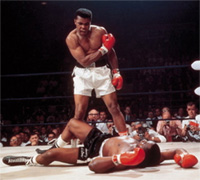
The only problem with that sentiment and, indeed, much of his article is that it simply isn’t true. He uses old and questionable statistics and ignores the entire craft beer segment of the marketplace, something like 99% of the breweries out there seem to be under his radar. That’s pretty remarkable given that he claims to like the very stuff he’s bashing. You’d think he’d know just a little bit more about it, wouldn’t you? He does briefly mention craft beer, but only to suggest that we’ve all pilfered wine’s descriptive language. Apparently wine drinkers own the term “floral.”
But every other time he uses the word beer, he’s using it in a very narrow sense. By beer, Maloney means Bud, Miller, Coors and maybe Pabst and any brands owned by the big guys. Period. Because the way he describes “beer marketers” and “American beer executives” it’s abundantly clear he’s not talking about the small fry.
While using support for his position that beer is down and out he uses the infamous 2005 Gallup poll that seemed to indicate that people were beginning to prefer wine to beer, calling the findings “astonishing.” As noted in the sidebar, however, the 2006 poll results returned beer to the top spot, which is where it had been virtually every year before 2005, too. The 2005 results were obviously anomalous but despite that it keeps showing up in print, used to push various agendas. Beer outsells wine roughly four to one, and has done so for many years. That statistic is easily verifiable, unlike what people say about what they like — their so-called preferences — and so it’s a far more accurate portrait of the alcohol landscape. And while overall consumption has been steadily decreasing for many years, and even if we allow for Maloney’s uncited figure of wines sales having doubled over the last ten years (from a small number to begin with), beer is still wildly more popular than wine and will continue to be for the foreseeable future.
The sidebar continues by dismissing the 2006 poll, despite the fact that every poll prior to 2005 agrees with it, saying “[s]till, while wine consumption has grown steadily in this country, beer consumption has remained flat. (The one exception to this trend is craft beers, which have enjoyed double-digit sales growth in the last few years. But craft beers command less than 5 percent of the domestic beer market. Anheuser-Busch alone, by comparison, controls about 50 percent of it.)” What I take away from that bit of tortured analysis is that because craft beer doesn’t represent a big enough piece of the pie, then it’s not worth talking about and it’s not indicative of any trends. Yet Anheuser-Busch has test-marketed or rolled out last year alone something like fifty new products that give the appearance of being craft beers to compete with this segment of the industry. They certainly wouldn’t be spending all their resources on such folly if craft beer wasn’t having an impact on them, so Maloney’s off-hand dismissal of craft beer seems misleading and counterfactual.
I’d love to see figures on big wines vs. boutique wine sales as a percentage of the total (though I suspect definitions are every bit as difficult as in the beer world) but I suspect Maloney doesn’t discount those small wine producers in quoting wine statistics and the gains they’ve made the way he discounts craft beer. And he appears to entirely ignore box wine, jug wine and other cheap wines made in vats the size of Montana, as if all wine was hand-crafted. The notion that all wine is fine wine is every bit as specious as saying all beer is industrial.
Brewers will no doubt get a kick out of this zinger. “The hallmark of beer is consistency: A brewer strives to make batch after batch of Pilsener so it tastes the same—and often succeeds without much difficulty.” So much for the author’s earlier jab about beer being the “result of a complicated process of manufacture.” If it’s not too difficult to make beer consistently, it must not be that complicated after all. That series of statements seems more than a little insulting to me. Most, if not all, of the winemakers I have met have the utmost respect for brewers and do think it’s harder or more complicated to make great beer than great wine. A winemaker I sat next to at a dinner at Mondavi many years ago told me that she thought what they did was easy compared to making beer and that the grapes did all the real work. So yes, I think there is something to beer being more of a complicated affair than wine, but I don’t see why that makes it any less of an art than he appears to believe is the case with winemaking.
Maloney also claims that it was our society’s “shift from an agrarian society to an urban, industrial one” that made beer our drink of choice, because mass production displaced hand made drinks, such as “hard cider (the rural drink of choice), rum, and whiskey.” But didn’t many rum and American whisky brands that are still with us today also get their start during the industrial revolution? If so, then why is beer the bad guy here? Also, he states that beer started to outsell cider “around the time of the Civil War,” but I’m not sure that’s true. I remember reading that cider’s popularity throughout the country did not wane until Prohibition, and that until that time it continued to outsell beer. If that’s true — I’m trying to remember and find where I read that — then it continued to be quite popular through many decades of industrialization. And that seems to contradict his premise that mechanization caused or was responsible for beer’s popularity during the 19th century.
Interestingly, additional criticism of Maloney’s article came from an unlikely source. Nick Fauchald, Senior Associate Food Editor at Food & Wine magazine, penned a rebuttal wonderfully entitled Beer to Wine: “I’m Not Dead Yet” in which he also cites craft beer’s recent gains and suggests the following.
Slate and other outlets sounding the beer death knell are missing one very important point: It’s the generic-tasting, mass-produced beer (Budweiser, Miller and their ilk) that Americans are waving off. American craft beer is still alive and kicking, experiencing its biggest growth since the microbrewery gold rush of the 1990s.
Slate even in mentioning craft beer manages to do so each time with a dismissive tone that makes it sound irrelevant to the discussion. But that ignores over 1400 independent small to medium-sized breweries and brewpubs successfully providing craft beer locally, regionally and even nationally. Craft beer is part of the slow food movement, part of organic food lifestyles, and a part of eating and drinking locally campaigns. It’s just one of many gourmet products, like coffee, chocolate, cheese, bread and many others, that have literally changed the way we perceive and think about them. Craft beer has raised the quality and status of American beer to the point where it has the respect and envy of beer lovers around the world. It’s only here in the U.S. that it gets so little respect.
Unfortunately, a lot of that criticism comes from food and wine sources. I don’t know or understand why so many wine and food writers appear to feel threatened by beer. I don’t know if it’s simple ignorance or malicious snobbery. Is it a kind of good ole boys mentality that can’t abide beer stealing some of their thunder? That sounds almost ridiculous, except that it seems to happen time and time again. Perhaps the real question is why they feel the need to pit the two against one another in the first place? Is it really a competition? Is it really us vs. them? I certainly don’t want to believe that’s it, because I love wine, too, as do most of the hardcore beer people I know, including other writers and brewers. And all of the winemakers I know love beer. So it comes down once more to the question I’ve asked time and time again: why can’t we all just get along. Seriously, I’m not just being rhetorical, but why can’t wine and beer seem to coexist and be supportive of one another? Why do Maloney and so many others feel the need to bash beer in order to lift up their preferred libation? It’s not everybody, obviously, as Nick Fauchald from Food & Wine nicely demonstrates, but it seems to me an awful lot of people who write about wine and/or food have it in for beer. Why is that? It’s got me crying in my beer, because it just doesn’t have to be that way.
UPDATE: Jess Sand over at the wonderful Bar Stories added a very thoughtful and lengthy diatribe on the same Slate article, as did Stan Hieronymous over at Appelation Beer.
On April 28, 2007, a UP Aerospace SL-2 rocket blasted off into space on a routine mission. It carried the ashes of deceased actor James Doohan, who portrayed “Scotty” on Star Trek (I actually met Doohan once in the early 1980s when I worked for a chain of videostores in North Carolina) along with Mercury 7 Astronaut L. Gordon Cooper and 200 other urns. SL-2 is short for UP Aerospace’s SpaceLoft-2 , a rocket suborbital sounding rocket. UP Aerospace sends up four to six such commercial rockets each year.
In addition to the remains sent into space, the payload consists of photographs, seeds, science experiments, soccer jerseys and the secret payload of Microgravity Enterprises, Inc.. According to their website, Microgravity Enterprises goal is to “develop space-based products and make them available to the general public at low affordable prices.” Currently, the make Space2O, bottled water enriched with electrolytes that were flown in space aboard the SL-2, and Antimatter, an energy drink in which many of the ingredients have likewise flown in space.
All that Microgravity Enterprises, which calls itself a space commercialization company, will say about the latest flight is that their payload contained the ingredients with which they’ll make the “first true space beer”. Company spokeswoman Linda Strine “says said ingredients, the amounts and types of which are secret and patented, will be delivered next week to a ‘production facility’ that in the span of a month will generate an otherworldly brew called Comet Tail Ale. “We flew enough ingredients to support almost a year’s worth of production,” says Darryl Hupfer, VP of sales and marketing for Microgravity Enterprises.
They’re spinning it pretty good, but I suspect it was the yeast that they flew into space. And their client, most likely, is nearby Kellys Brewpub, located in Albuquerque, New Mexico. As reported last year in the New Mexico Business Weekly, Kellys sent some yeast up in one of UP Aerospace’s rockets before but since it failed to reach suborbit (meaning that it didn’t reach the 45 mile-high threshold that defines where “space” begins) they brewed a beer they called “Test Flight Amber Ale.”
|
I have mixed feelings about this project because it seems so gimmicky and I know that the rocketed ingredients won’t make the beer taste any differently. But I am a former space geek — reinvigorated somewhat by my son Porter’s obsession with all things space-related — so it also seems like a fun idea, too. So I don’t wish to throw water on the fire or rain or their parade, but it also seems to be that this won’t be the “first true space beer” as the company claims. I’m pretty sure that the Apollo beer that was a contract beer around a decade ago used yeast that had been in space, too. It was in a distinctive blue bottle and they made an ale and a lager which was sold in six-packs. And I know that a German science experiment managed to get some yeast aboard one of the space shuttle flights. I know some of it they then used for research purposes, but I have a hard time believing they didn’t use at least some of it to brew a batch of beer. Who knows, perhaps Kellys also sent a few hop pellets in the rocket, too. In the end, it may come down simply to how you define a “true space beer.” |
Rob Tod, the owner/founder of Allagash Brewing of Portland, Maine, was in San Francisco Friday for a beer dinner at the Cathedral Hill Hotel. Bruce Paton, the Beer Chef, put on his usual spectacular fête and the meal and pairings worked magnificently. All of Allagash’s beers are in a Belgian-style, though most are quite experimental. Rob Tod really worked the crowd and made a great impression both with his stories and his beer. Having missed Valley Brewing’s dinner last month, it was great to enjoy another of Bruce’s dinners. There were a number of friends there and a great time was had by one and all.

Rob Tod had the crowd in the palm in his hand talking about his beers.

The Main dish, cutlets of slow roasted lamb with fingerling potato risotto and bing cherry compote, which was paired with Allagash Inoculator. Inoculator is a “one-off” beer made almost by accident. It started with their triple, aged in bourbon barrels with cherries from their local market added. The yeast they used was from Rodenbach and helped create a delightful 9.5% beer.
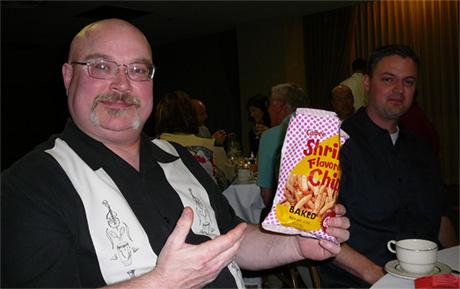
Dave Keene, from the Toronado, won a raffle at the dinner to support a local chef’s organization. One of the items in his prize basket was “Shrimp flavored Chips.”
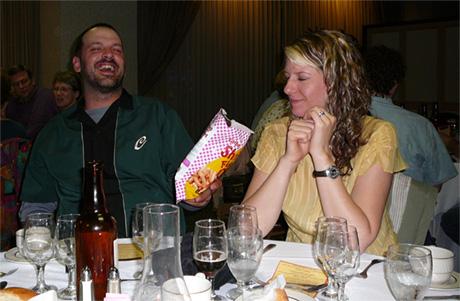
James Costa, from E.J. Phair Brewing, offers some to his wife, Caroline. Wisely, she declined. The smell alone was enough to produce a gag reflex.
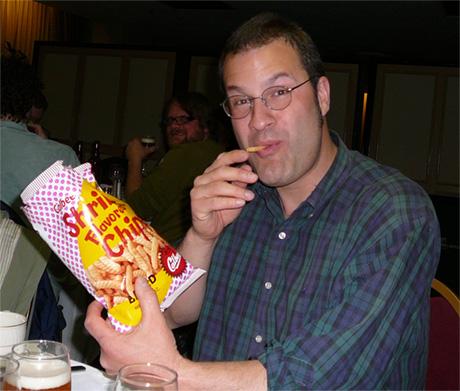
Rob Tod, on the other hand, was brave enough to actually eat them.
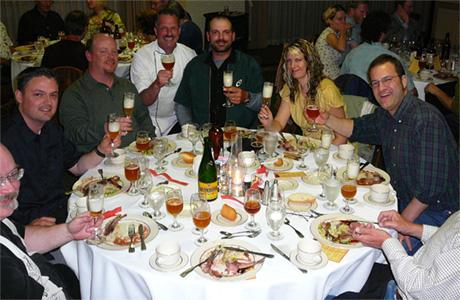
Chef Bruce stopped by our table. From left, Dave Keene, Vinnie Cilurzo (from Russian River), Arne Johnson (from Marin Brewing), James Costa and his wife Caroline, and Rob Tod.
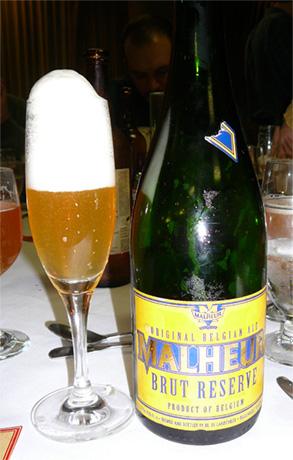
Chef Bruce also brought us a special bottle of Malheur Brut Reserve, Michael Jackson Commemorative Selection 2006. Yum.
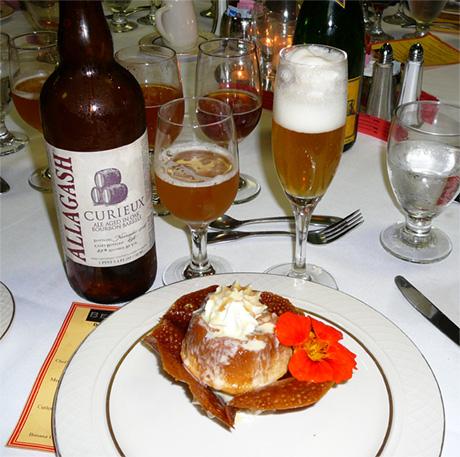
The Malheur (at right) also worked well with the dessert, Banana Upside Down Cake with Butterscotch Mascarpone, though the official pairing, Allagash Curieux, was inspired. Curieux is a tripel aged in Jim Beam barrels.

Chef Bruce and Rob Tod, who respectively provided the food and beer for our dinner.

Malin Palssoa and Eric Schiff (from San Francisco Brewing), fans of the Bulletin at the dinner. At least I think that’s their names, I had trouble reading my own handwriting the next day.
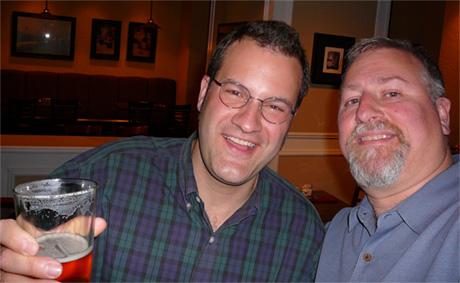
Enjoying some Blind Pig IPA at the hotel bar after the dinner, Rob Tod and me.
Chris Garrett, a Rogue employee created this humorous tour of the main brewery in Newport, Oregon. I first saw it during a seminar about internet marketing at the Craft Brewrers Conference this year. The speaker singled it out as a good way to use humor to reach your customer, but toward the end of it Garrett makes a little dig at the brewery’s owner, Jack Joyce. Jack was in the audience at the time and told the attendees that Garrett had been fired. He said it with a straight face, but knowing Jack’s sense of humor it’s hard to tell whether he was joking or not. He probably was, at least I hope so. At any rate, I recently came across it on YouTube and thought I’d share it since it is entertaining.
If you’re looking for something fun to try eating this Memorial weekend, this looks pretty tasty. It’s a recipe or “Beer Cheese Fondue,” which comes from Linda Larsen by way of About.com’s Busy Cooks
INGREDIENTS:
- 1 clove garlic, split in half
- 2 cups beer
- 1 lb. sharp Cheddar cheese, shredded
- 1 lb. mild Colby cheese, shredded
- 2 Tbsp. ketchup
- 1 Tbsp. Dijon mustard
- 2 tsp. Worcestershire sauce
- 1 onion, chopped
- 1 Tbsp. olive oil
- 1/2 tsp. hot red pepper sauce
PREPARATION:
Rub fondue pot with garlic and discard garlic. Pour beer into pot and heat over low heat until steam begins rising from surface.
In heavy skillet cook onion in olive oil until tender. Stir into fondue along with remaining ingredients and, stirring constantly, cook over low heat until melted and blended.
You may add more cheese or beer to reach the desired consistency. Serve immediately with dippers, including bread cubes, hot cooked sausages, and vegetables.
Fondue is one of those cheesy dishes — yes, pun intended — that had its social heyday in the swinging seventies. My mother had a fondue set and threw fondue parties, as did many of her friends. I’ve also been to one fondue restaurant, which was actually pretty good. Maybe it’s making a comeback, it’s not one of those things I pay attention to. But cheeseball perception of not, it’s very tasty, especially if you love cheese as much as I do. Putting beer into it and enjoying it with beer, too, could make it a lot of fun as a meal, too. I’m willing to give it a try, at least. Who’s with me?