9.16
California Brewers Festival (12th annual)
Discovery Park, Sacramento, California
916.368.BREW [ website ] [ map ]

9.16
California Brewers Festival (12th annual)
Discovery Park, Sacramento, California
916.368.BREW [ website ] [ map ]
U.S. District Judge Marsha Pechman placed another stay on her earlier ruling in the closely-watched Coscto decision she handed down in April. Her earlier ruling essentially dismantled Washington State’s three-tier system without regard to the consequences, including many of the protections that ensure a level playing field for businesses of varying sizes. Costco originally brought the suit because, if successful, they would reap enormous benefit, as would other big box retailers. The losers would include small retailers, small brewers and ultimately consumers once the landscape of the state’s alcohol business has been greatly altered after the changes are implemented. Costco and the business press have continued to spin the story by claiming it will lower prices of beer to the consumer, but that’s simply propaganda as I’ve pointed out before and again in response to a thoughtful comment.
The recent stay gives state lawmakers until May 1, 2007 to change Washington’s beer and wine laws through new legislation. Since her initial ruling effectively makes the current laws invalid, an entirely new system to control the relationships between manufacuters, distributors (if any) and retailers must be created. Whether that can be accomplished in under eight months in a way that’s fair to all concerned, including consumers, remains to be seen. But it seems a Herculean task and fated to fail, at least in my opinion. There are just too many competeing interests for almost any legislature to come up with a workable solution. It seems more likely that if any legislation is passed, it will favor the big box stores and big breweries but will at least appear to balance critics’ concerns, while not actually doing so. That’s been the general pattern of legislation in our business-dominated times. Big business contributes to political campaigns and politicians enact legeslation favorable to their benefactors. And as usual, you and I wll be left holding the empty non-returnable bottle.

Many people think that Jesus may have been a homebrewer. I have heard that when the Greeks first translated the bible from ancient Hebrew, that they lacked a word for beer and thus substituted the Greek word for wine in its place, perhaps thinking what difference would it make, an alcoholic drink is an alcoholic drink. I’m not sure this is directly on point, but the article Beer, Barley and [Hebrew symbols] in the Hebrew Bible certainly shows that this would have been quite possible and that there is some confusion about translations of this type for centuries.
So when Jesus turned the water into wine (in the Gospel of John 2:1-11), perhaps he was simply a homebrewer and making beer for the wedding party. It certainly seems more plausible to take vats of water and make beer out them than magically turn one liquid into a completely different one. It’s my understanding that the priests of the day would have been the ones who possessed the knowledge of how to make ancient beer so it follows that Jesus would have known this ancient art, as well. That’s probably why Jamie Floyd’s new Ninkasi Brewing in Eugene, Oregon has “Jesus Was a Homebrewer” printed on the back of his brewery t-shirts. And no less a beer luminary than Michael Jackson has also ruminated on this subject.
But while I’m very open to this possibility and believe it makes far more sense than the conventional story, I gather that many people of a more religious bearing than myself do not look upon this debate with anything but contempt. My understanding of fundamentalism is that many adherents refuse to entertain the idea that mistranslations may have occurred because they believe the translators themselves were divinely inspired and somehow led by the hand of god in their work. Whatever your own take on this theory, it follows that religion and beer are generally not fast friends, notwithstanding many christians do enjoy a pint from time to time. So I was mildly amused when I saw the new ad campaign for this year’s holiday season by the Churches Advertising Network (or CAN), an English group whose mission, in their own words, is to be “an independent, ecumenical group of Christian communicators which exists to provide high quality national Christian advertising campaigns, especially around major festivals, and to provide the means for local churches to share in and receive the benefit of such national campaigns.”
Apparently each year, CAN creates an ad campaign around Christmas to try to bring people back into the fold. “Previous CAN campaigns include a poster depicting Jesus as the revolutionary leader Che Guevara and one suggesting Mary was having a “bad hair day” when she discovered she was pregnant.”
This year’s campaign features a pint glass with the image of Jesus in the Brussels lace stuck to the side of the empty glass and a MySpace.com website for Jesus. CAN chairman Francis Goodwin said he hoped the poster and accompanying radio adverts would spark a debate about religion.
“The message is subtle but simple – where is God in all the boozing at Christmas?” said Goodwin.
“For many, Christmas is just drinking and partying and God is excluded, yet many young people are interested in finding deeper meaning and exploring faith.”
The poster is a nod to the occasional discoveries of holy images in everyday objects, from the face of Jesus in a frying pan, toast or fish finger, his mother Mary on a toasted cheese sandwich and even Mother Teresa in a sticky bun.
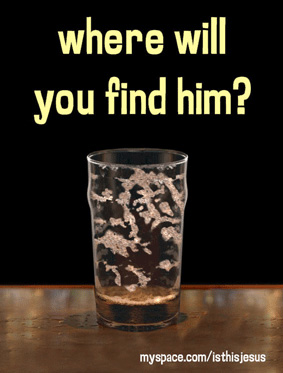
According to the group’s literature, here is their take on this image:
This year’s poster picks up on the current media preoccupation with finding images of Jesus in everything from egg yolks to currant buns. Next to an empty beer glass in which a face can be seen are the words “Where will you find him?” and pointing to the web address myspace.com/isthisjesus.
The poster aims to provoke thought and debate about where and how people find God. The myspace.com webspace will include a link to the rejesus website, which has creative features and reliable information on the Christian faith. Rejesus is supported by all the mainstream UK churches.
So why the image of an empty beer glass? Francis Goodwin, Chair of the Churches Advertising Network (CAN) says: “The message is subtle, but simple: where is God in all the boozing at Christmas? For many, Christmas is about drinking and partying, and God is excluded. Yet many young people are interested in finding deeper meaning and exploring faith. We hope the link to myspace.com will offer a fresh venue for them to discuss their feelings and debate the issues.”
Richard Johnston and Mark Gilmore, who produced the poster at Radioville, the ad agency for the campaign, say…
“We took the traditional silly-season news story in which people find images of Jesus in the side of trees, in a slice of toast or even within the bubbles of cheese on a pizza, and developed a number of new images showing Jesus’ face in unexpected places. Because of the season, CAN chose the beerglass route, where Jesus’ face is captured in the froth running down the side of an empty pint glass. The responses expected on myspace.com when the campaign launches should be quite illuminating.”
Yes, they should be quite “illuminating.” It will quite interesting to see what people say about this. I can’t imagine many American fanatics being very happy about this since so many neo-prohibitionists are also highly religious. One bit of unintentional humor is that when you visit the MySpace page, Jesus has “0” friends. Jesus has no friends? I’m sure that will change shortly, but for now I feel kinda bad for him. Perhaps I should buy him a beer.
Men’s Journal, a general interest magazine for men, for the third year in a row has selected their picks for the “25 best beers in America.” The list graces their October issue and while it is filled with terrific beers, such a list can never be considered definitive. As good a list as it is, there are as many great beers left off the list as there are on it, probably more.
It’s great news, of course, for the beers on the list. Hopefully they’ll get more attention and even possibly more sales generated from the article. But it doesn’t mean the beers not on the list aren’t in many cases every bit as good as those who made the cut this year. For those of us who judge beer regularly there are so many factors that come into play that a list like this one can never be truly taken serious for a variety of reasons. But the novelty of it appeals to all of us, myself included, and I imagine I scanned the list with as much interest as the average reader. Anything that shows craft beer in a positive light can’t be all bad, and this annual list (now in its third year) is certainly another good way to spread the message of how many good beers are being made all over the country. Now if we can just get more people to start drinking them, that would be really something.
Here’s the full list:

According to the “Beer Man” of Wisconsin’s Appleton Post-Crescent (and syndicated nationally on the Gannett News Service) — Todd Haefer — bourbon barrel stouts are just a fad. It’s nice to see any newspaper embrace beer and give space regularly to reporting on beer so I hate to contradict such a worthy endeavor, but I think misinformation can be just as damning as no information at all. Todd, who took over for the previous “Beer Man” in October of last year, had this to say in the course of reviewing a beer from Tyranena Brewing of Lake Mills, Wisconsin:
There was a craze a few years ago in microbrewery circles involving the aging of imperial stouts in bourbon barrels. Some were very good. But, as will likely happen with the current trend of “imperial India pale ales” and “imperial pilsners,” it soon ran its course. Examples do still exist, but not on a national scale.
Really? Bourbon Barrel beers are just another fad? As far as I know, there are still dozens of breweries still making a barrel-aged stout. I’m especially troubled by his characterizing them as no longer being “on a national scale.” Were bourbon barrel stouts ever on a national scale, by which I can only presume he means at least one beer that’s distributed nationally to all fifty states? Having just done a barrel-aged tasting for the next issue of the Celebrator, I can say quite comfortably that all beers aged in wood are on the rise. These things are quite literally coming out of the woodwork. More and more brewers are experimenting with what barrel-aging can add to their line-up of beers. Every year, there are more festivals dedicated to this niche style. The Bistro in Hayward, California, just added one which takes place November 11 and will include judging in three categories.
Perhaps Todd is speaking specifically about stouts aged on wood. But if there are less barrel-aged stouts today then a few years ago — and I don’t know of any evidence to suggest that — then there are many more styles now being aged in wood then ever before in the history of American beer. If a brewery today chooses an IPA to age instead of a stout does that make stout just a fad? I think stouts were the obvious place to begin experimenting with barrel aging beers and having found success there brewers are branching out in ever-widening directions to discover what other complexities can be achieved through the aging process. This is an exciting time in brewing and I don’t like the idea of saying that if bourbon barrel stouts led to barrel-aging other beers and a whole new type of beer-making process that they were “just a fad.” It’s just the wrong message to send, especially when the real story is much more positive.
All manner of beer today is being aged not just in bourbon barrels, but in various wine barrels, whiskey barrels, and even fruit barrels and who knows what else with some pretty spectacular results. And having previously been relegated to the experimental category, since 2002 the Great American Beer Festival has been judging “Wood- and Barrel-Aged Beer” as a separate category. Clearly this type of beer is here to stay. Barrel-aged beers are not “dry beers” or “low-carb” beers created by marketing men. The are a legitimate new additive process that produces some spectacular complexities in craft beers. We should celebrate that fact, perhaps with a barrel-aged stout? Who’s with me? I’m pouring.
This Saturday, September 16, at O’Neill’s Irish Pub near the ballpark in San Francisco there will be a Belgium Beer Tasting from 7:30-9:30 p.m. Several Belgian beers imported by Vanberg & Dewulf and Artisanal Imports will be available for sampling.
Tickets are $30 in advance and $40 at the door and tickets can be purchased online. Seating is limited to 300 people, so hurry up and reserve your spot. I’ll see you there.
Frm the press release:
Belgium beers are some of the best beers in the world and O’Neill’s Irish Pub is proud to host a very exclusive beer tasting party for two of the finest Belgian Import companies in America, Vanberg & Dewulf and Artisanal Imports. Featuring some of the finest Belgium beers accompanied by mouth watering appetizers. After the beer tasting the party will continue all night long with a live band and drink specials.
Some of the beers featured will include*:
From Artisanal Imports:
Bostels (Dues)
De Leyerth (Urthel)
Nethergate (Old Growler)
Neuzeller (Bath Beer)
St. Feuillien (Cuvee’ de Noel)
St. Bernardus (Grotten)
St. Jozef (Pax)From Vanberg & Dewulf:
Brasserie Dupont (Saison Dupont)
Brouwerij Boon (Boon Kriek)
Brasserie Castelain (Blonde Castelian)
Brouwerij Slaghmuylder (Witkap)
Brasserie Dubuisson (Scaldis)*Specific beer are subject to change based upon availability
9.16
Belgian Beer Tasting at O’Neill’s
O’Neill’s Irish Pub, 747 3rd Street (near AT&T park), San Francisco, California
[ website ] [ tickets ]
9.16
Belgian Beer Tasting at O’Neill’s
O’Neill’s Irish Pub, 747 3rd Street (near AT&T park), San Francisco, California
[ website ] [ tickets ]
9.13
Thirsty Bear 10th Anniversary Beer & Tapas Celebration Dinner
Thirsty Bear, 661 Howard Street, San Francisco, California
415.974.0905 x208 (Nicole Held) [ website ]
9.13
Denver Beer Dinner
Duo Restaurant, 2413 West 32nd Avenue, Denver, Colorado
303.477.4141 [ website ]
Once the news was out that City Brewery of La Crosse, Wisconsin was negotiating to buy the Latrobe Brewery, many people, myself included, stopped paying close attention to this story. You’ll recall that brewing giant InBev sold the brand name Rolling Rock to Anheuser-Busch on May 19 of this year. But the Latrobe Brewery where Rolling Rock had been brewed since 1939 was not part of the deal. It had been scheduled to close July 31 if a buyer could not be found and a mad scramble ensued involving local and state politicians, the media, imaginative rumors, InBev and all manner of possible buyers. Finally on June 21, it was announced that City Brewery was in negotiations. Everyone breathed a collective sigh of relief, and moved on to the next story.
But it’s been almost three months now and a deal to buy the brewery has still not been finalized. While negotiations are ongoing, the brewery closed July 31 and has been dormant since then. City Brewery met yesterday with officials from local and state agencies to work out issues surrounding how anticipated production increases will effect the capacity of water treatment facilities. Currently the brewery’s capacity is 1.3 million barrels and City Brewery wants to brew two million. Let’s hope the deal will be done soon and the now unemployed brewery employees can back to work.