Brookston Beer Bulletin

Jay R. Brooks on Beer

  • Home
  • About
  • Editorial
  • Birthdays
  • Art & Beer

Socialize

  • Dribbble
  • Email
  • Facebook
  • Flickr
  • GitHub
  • Instagram
  • LinkedIn
  • Pinterest
  • RSS
  • Twitter
  • YouTube

Powered by Genesis

Craft Lager Fest Winners Announced

August 26, 2006 By Jay Brooks

Although in its fourth year, the Craft Lager Fest is a festival I have not had the opportunity to attend. But I like the idea of it, being another niche festival that highlights a particular style of beer, in this case lagers broadly. But since the majority of craft beer is undoubtedly ales, shining a spotlight on lager styles is a great idea.

The Craft Lager Festival takes place in a small town in Colorado, Manitou Springs, which is near Pikes Peak. This year they got 30 breweries from Hawaii to Boston participating. The winning breweries are listed below.
 

2006 Winners List

Best of Show: Edge City Pilsener (Bristol Brewing)

PILSENER

  1. Edge City Pilsner (Bristol Brewing)
  2. Skinny Dip (New Belgium)
  3. Polestar (Lefthand Brewing)

EXPORT/HELLES:

  1. Engineer Light Lager
  2. Longboard Island Lager (Kona Brewing)
  3. Edge City Pale Bock (Bristol Brewing)

BOCK:

  1. Sam Adams Double Bock (Boston Beer Co.)
  2. Black Bull Bock (Rock Bottom)
  3. Butthead Bock (Tommyknockers)

STRONG LAGER:

  1. No 1st Place Awarded
  2. Dutch (Rockyard American Grill & Brewery)
  3. Pre-Prohibition Pilsner (Phantom Brewing)

OKTOBERFEST/VIENNA/MARZEN:

  1. Damn Straight Lager (Dillon Dam)
  2. Lewis & Clark Lager (Lewis & Clark Brewing)
  3. Steam Engine Lager (Steamworks Brewing)

OTHER SPECIALTY LAGER:

  1. Dunkelstilsken (CB Potts)
  2. Z Lager (Fort Collins Brewing)
  3. Founders (Carvers Brewing)

SUMMER SPECIALTY ALE:

  1. East meets Wheat (Phantom Canyon Brewing)
  2. Raspberry Wheat (Il Vicino)
  3. Wildcat White Ale (Rockyard American Grill & Brewery)


Filed Under: Events, News Tagged With: Awards, Colorado, Festivals

Maine Brewers Festival

August 26, 2006 By Jay Brooks

11.4

Maine Brewers Festival (13th annual)

Portland Expo, Portland, Maine
[ website ]

Filed Under: Uncategorized Tagged With: Uncategorized

Great American Beer Festival

August 26, 2006 By Jay Brooks

9.28-30

Great American Beer Festival

Colorado Convention Center, 700 14th Street, Hall F, 14th and Stout Streets, Denver, Colorado 80302
sponsored by:
Brewer’s Association [ website ] [ e-mail ]
303.447.0816 / 888.822.6273 [ festival website ]

Filed Under: Uncategorized Tagged With: Uncategorized

Cathedral Hill Beer Dinner (Russian River)

August 26, 2006 By Jay Brooks

9.18

Dinner with the Brewmaster: Russian River Beer Dinner

Cathedral Hill Hotel, 1101 Van Ness Avenue, San Francisco, California
415.874.3900 or 510.769.8422 [ website ]

Filed Under: Uncategorized Tagged With: Uncategorized

NY Brewfest

August 26, 2006 By Jay Brooks

9.8

New York Brewfest

South Street Seaport at Pier 16 & 17, New York, New York
sponsored by:
Heartland Brewery, 93 South Street at Fulton, New York, New York
707.769.4495 [ festival tickets ]

Filed Under: Uncategorized Tagged With: Uncategorized

Bomonti Beer Factory

August 26, 2006 By Jay Brooks

There’s not a lot of beer coming from Turkey. Efes is probably the one most known to us westerners. The first brewery in Turkey was started in 1890 by two brothers from Switzerland, the Bomonti brothers. In 1902 they built a new facility in the southern part of Istanbul which still stands there today. It is situated in the Bomonti district, which of course takes it name from the factory. Beginning in 1938, it was known as the Istanbul Tekel Beer Factory. It was abandoned in 1991, and locals returned to calling it the Bomonti Beer Factory. It’s a beautiful seven-story building.

Earlier this week, Global Investment Holding along with Çelebi Holding announced their intention to turn the building in Turkey’s biggest hotel by 2009, to be operated by Marriott International and known as the Marriott Bomonti Hotel Convention Center.

Today, Turkey’s Culture and Tourism Ministry disclosed they will reject and cancel the offer regarding the 49-year operating lease for the Bomonti Beer Factory because the price was too low. So the factory is once again available. Hopefully, someone will put it too good use. It’s a terrific looking building with great possibilities, not to mention a piece of brewing history.

Filed Under: Uncategorized Tagged With: Asia, Business, History

Five Reasons to Keep Drinking Beer

August 26, 2006 By Jay Brooks

The Metro, San Jose’s alternative weekly might not be exactly mainstream, but when I lived in the area the years ago, it was a pretty good paper. This week’s edition features a short little column listing five recently discovered health benefits associated with drinking alcohol in moderation. These included a healthier heart, lungs, bone density, help in fighting cholesterol, and reducing the risk of a stroke.

Filed Under: Uncategorized Tagged With: Bay Area, California, Health & Beer, Mainstream Coverage

Anhesuer-Busch Takes Over Marketing & Sales of Kirin

August 26, 2006 By Jay Brooks

Anheuser-Busch and Japan’s Kirin Brewery annnounced today that their alliance will be enlarged to include marketing and sales of Kirin beers in the United States. Currently, A-B contract brews all Kirin beers for the domestic market at its Los Angeles brewery. That relationship began ten years ago and included distribution, as well, through A-B’s network of 600 wholesalers. Since 1993, Kirin has been contract brewing Budweiser in Japan for the Japanese market.

August A. Busch IV, president of Anheuser-Busch, was quoted as saying. “American consumers have a great interest in high-end Asian cuisine and culture, including Asian beer.”

Now that’s high-end, klassy with a “k.” Anybody want to venture a guess as to how she’s holding that glass? It looks like it’s glued to her hand or was done with Photoshop.
 

Busch continued. “We are aggressively expanding our range of high-end beers to meet the diverse needs of our consumers. The Kirin beers are of the highest quality and have enormous potential, as the Asian influence is rapidly growing. This new agreement enhances a truly global relationship between our two companies. Now, we also share a deeper commitment to each other’s success.”

But the big three Japanese breweries — Asahi, Kirin and Sapporo — are experiencing the same loss of market share the big U.S. brewers are, and for much the same reasons. Japan’s consumers, mirroring their American counterparts, are demanding more flavorful beers. But at the same time, economic difficulties have led to price wars with so many customers shopping on price alone.

This in turn has led to the rise of cheaper beers made with grains other than barley. Because of oppressive taxes on beer in which over a third of a beer’s cost goes to the government, brewers have been making alternative brews using less than 67% malt by using rice, corn or even soybeans as substitutes. These beers can be sold for half of the all-malt beers. But as for taste, most say you get what you pay for. Long term, this is potentially very damaging to the industry.

As for Kirin’s story, American businessman William Copeland and German brewmaster Herman Heckard founded the Spring Valley Brewery outside Tokyo in 1870. For luck they put a “Kirin” on the label. A “Kirin” (Qilin in Chinese) is a mythical beast that is generally considered a sign of good luck. Though it was not necessarily lucky for the Spring Valley Brewery, which closed in 1884 and became the Japan Brewery Co. a year later under new owners from Yokohama. In 1907, the Mitsubishi family bought the brewery, renaming it the Kirin Brewery. Kirin is currently the best selling beer in Japan.

Filed Under: News Tagged With: Asia, Business, National, Press Release

Chateau Jiahu from Dogfish Head

August 25, 2006 By Jay Brooks

dogfish-head-green
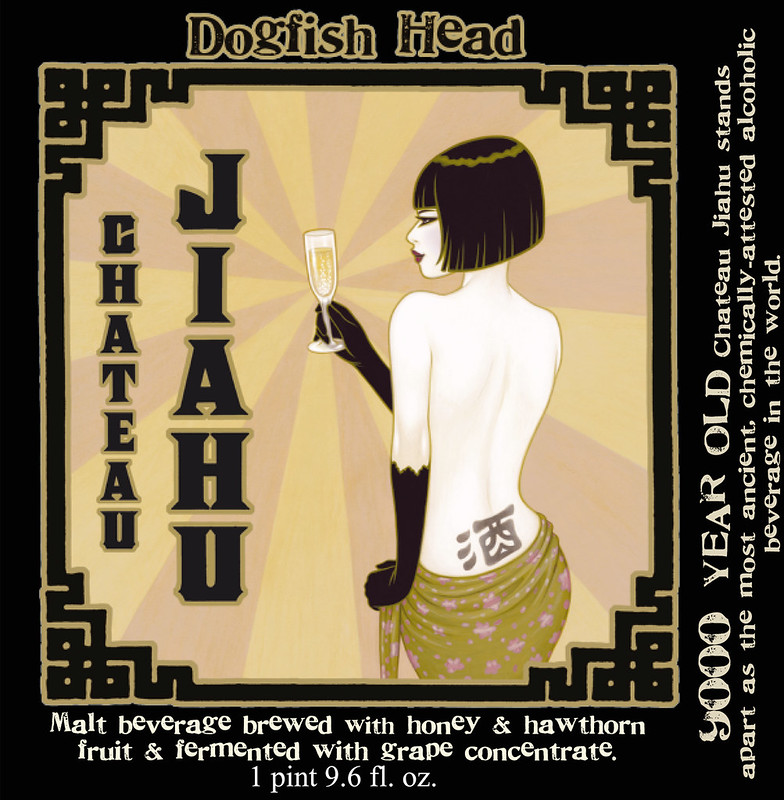
There’s another new beer coming out from Dogfish Head. Sam Calagione’s latest creation is Chateau Jiahu, which is based on an ancient beverage discovered in a pottery jar “in the Neolithic villiage of Jiahu, in Henan province, Northern China.” Approximately 9,000 years old, the concoction was a fermented drink made with rice, honey and fruit. Dogfish Head again worked with Dr. Patrick McGovern, a molecular archeologist at the University of Pennsylvania to faithfully recreate — as far as possible — this ancient beverage.

Dogfish Head explains the process they used:

In keeping with historic evidence, Dogfish brewers used pre-gelatinized rice flakes, Wildflower honey, Muscat grapes, barley malt, hawthorn fruit, and Chrysanthemum flowers. The rice and barley malt were added together to make the mash for starch conversion and degredation. The resulting sweet wort was then run into the kettle. The honey, grapes, Hawthorn fruit, and Chrysanthemum flowers were then added. The entire mixture was boiled for 45 minutes, then cooled. The resulting sweet liquid was pitched with a fresh culture of Sake yeast and allowed to ferment a month before the transfer into a chilled secondary tank.

A very limited number of 750 ml bottles are being produced and should be in stores early next month. Artist Tara McPherson (who also did the label for Fort) did a beautiful label for this beer.

jiahu-dogfish-head

Filed Under: Beers, News Tagged With: Eastern States, Press Release

America’s Drunkest Cities! America’s Dumbest Survey?

August 25, 2006 By Jay Brooks

Forbes.com, the online part of the conservative financial organization, announced recently their list of the nation’s “drunkest cities.” Here’s the full list:

  1. Milwaukee
  2. Minneapolis-St. Paul
  3. Columbus, Ohio
  4. Boston
  5. Austin, Texas
  6. Chicago
  7. Cleveland
  8. Pittsburgh
  9. Tie:
    • Philadelphia
    • Providence, R.I.
  10. St. Louis
  11. San Antonio
  12. Seattle
  13. Las Vegas
  14. Denver/Boulder
  15. Tie:
    • Cincinnati
    • Kansas City
  16. Houston
  17. Portland, Oregon
  18. Tie:
    • San Francisco-Oakland
    • Washington-Baltimore
  19. Phoenix
  20. Los Angeles
  21. Tie:
    • New Orleans
    • Tampa
  22. Norfolk
  23. Dallas-Fort Worth
  24. Tie:
    • Atlanta
    • Detroit
  25. Indianapolis
  26. Orlando
  27. New York
  28. Miami
  29. Charlotte, N.C.
  30. Nashville

Setting aside the inanity of such a list, how — one might reasonably wonder — did they come up with such a list and keep a straight face?

Well here’s what they have to say:

Each city was ranked in five areas:

  1. state laws
  2. drinkers
  3. heavy drinkers
  4. binge drinkers
  5. alcoholism

Each metro was assigned a score in each category, based on quantitative data. All five categories were then totaled into a final score, which was sorted into our final rankings. For a fuller explanation, read the methodology used.

But here they are in nutshell, with some of my own commentary.

1. State Laws:

Cities were ranked on a scale of 1 to 8, with states deemed to have the least restrictive laws getting a higher score. They considered such intangibles as whether MADD liked that state’s alcohol laws, whether there was a law banning open containers and if kegs had to be tagged with identifying tags. Well, how scientific. How any of those vague standards can be said to make one state more “drunk” than another is simply ludicrous. The idea that a more permissive society in and of itself causes alcohol abuse or even leads to it is specious at best. Just because open containers are allowed, for example, does not mean citizens will necessarily abuse alcohol. That such a flimsy set of criterion was used and is being reported seriously is astounding.

2. Drinkers:

Cities were ranked from highest to lowest and given a score based on the number of each town’s residents who admitted to having one drink in the last month. One drink! Have we really gone so far down the neo-prohibitionist path that one drink in 30 days is equal to being an alcohol abuser? The idea that the more people who have one drink each month, the more abuse is occurring in a geographic area is so fallacious that it’s downright insulting. They use the seemingly non-judgmental term to describe this as a larger “percentage of [the town’s] population are alcohol consumers.” Well so what? last time I checked alcohol was still legal in this country and I can hardly see how a drink a month rises to the level where any reasonable person would be concerned.

3. Heavy Drinkers:

Scored similar to #2, but this time it was based on “the number of adult men who reported having had more than two drinks per day, and adult women having had more than one drink per day.” Apparently that’s what constitutes a “heavy drinker.” It doesn’t appear to make a difference what type of drink it is which apparently means there’s no difference between three pints of beer and three pints of whiskey per day. Yeah, that seems reasonable. So a beer with lunch and two with dinner and you’re a heavy drinker!

4. Binge Drinkers:

Scored like the previous two, the Forbes survey defined “binge drinking” as five or more drinks on one occasion. Is that ever? Within a year? What? To say that if you’ve ever had five beers at one party makes you a binge drinker is beyond ridiculous. It’s more than a little misleading to suggest that drinking one beer short of a six-pack one time makes you anything bad at all. Take the Super Bowl as an example. With pregame, long commercial breaks, an overblown half-time show and post game analysis it weighs in easily at least as long as five hours. So if you had one beer every hour during that one occasion you were a binge drinker according to Forbes and the CDC. Sure you are. What utter rubbish.

5. Alcoholism:

As laughably contemptible as the first four criteria were, this one takes the cake. Scoring was done “based on the number of Alcoholics Anonymous meetings held in the area, as a proportion of the number of residents over the legal drinking age.” Okay, personally I don’t agree with the idea of AA. To me, people are simply trading one addiction for a more socially acceptable one. But it obviously does work for some people and at least those who go to AA are trying to help themselves. So to measure a town’s relative drunkenness by the number of people trying to help themselves is not only wildly off the mark, it’s highly insulting to those attending the meetings. Is there a calculation or formula that explains how many people are alcoholics but not seeking help through AA. Are there no other methods, perhaps even private ones or clinics, besides AA?

The ways in which these results were calculated is so completely outside the realm of reality that it’s amazing an organization so supposedly respectable would have anything to do with it. I haven’t even scratched the surface on the ways in which these results are misleading and just plain wrong. They’re just too obvious and there are too many ways in which to show how embarrassingly disgraceful this list is.

A report on the survey by television station KPTV Channel 12 in Oregon added the following:

Forbes pointed out some surprising results. Some stereotypically “partying” cities didn’t rank high on the list. Las Vegas came in at only No. 14; New Orleans, home to Bourbon Street and Mardi Gras, only ranked in 24th place. And a town known for spring-break revelers, Miami, was only No. 33 on a list of 35 cities.

Well, perhaps it was the way in which the rankings were created in the first place. Given the amount of alcohol that flows in Las Vegas, couldn’t that fact alone be a clue that the results are erroneous? Saying people drink more in Providence, Rhode Island or Columbus, Ohio than in Vegas isn’t just “surprising,” it’s downright fiction. It could only come out that way if you design the survey to have little or no basis in reality.

So given how obviously absurd this all is, you have to wonder why an outfit like Forbes would put its name on something like this and publish it at all. It’s not exactly obvious what they’re up to. But if you look closely at the other items in Forbes’ “The Business of Nightlife,” of which America’s Drunkest Cities is just one part, there’s a link to an article entitled Cutting Alcohol’s Cost. This article is about the costs that people drinking — not even necessarily on the job — brings to businesses in increased health care and lower productivity. I should have guessed it would return, as things tend to do, to money. And their assertions that people who abuse alcohol do cause those problems may even be correct, but they completely ignore any factors that might cause their workers to drink, as if people generally make conscious choices to become alcoholics. And while there may be a few who are genetically predisposed to drink too much, I’m willing to bet that the stress of their jobs made as many or more drink too much as any other factor.

A study by the George Washington University Medical Center examined the incidence of “problem drinkers” (whatever that means) by different industries broadly defined and found that in the general population for every thousand people, an average of 91 are problem drinkers. The industries with higher than average problem drinking included:

  1. Construction and Mining 135
  2. Wholesale 115
  3. Retail 114
  4. Leisure and Hospitality 109
  5. Repair and Business Services 106
  6. Agriculture 106
  7. Transportation and Utilities 96

At the bottom of the list was professionals with only 54 in every 1,000. But notice the jobs most associated with drinking are also the ones with the highest stress, the lowest wages and/or the lowest respect. Professionals have unquestionably the highest income among the list and so it’s not terribly surprising that the have fewer problems with drinking. But Forbes knows its readers and so is more interested in how to get more productivity out of low-level employees by getting them to stop drinking than addressing the root causes of that drinking. They could just as reasonably suggested that to avoid drinking problems employers should pay them better, treat them with more respect and not put so much pressure on them that severe stress is produced. But sympathy for labor has rarely been considered by big business.

Curiously, but perhaps not surprisingly, big business was generally very supportive of the first temperance movements that agitated for prohibition in the late 1800s and into the early part of the last century. The industrial revolution had recently changed the business landscape and with workers using so many more machines, business owners looked for ways to keep their employees sober. Of course, making the machines safer, having shorter work hours or better working conditions overall might also have been beneficial to the workers, but it would have cost the business owners profits. Better they try to change the workers habits both on the job and more intrusively off the job. So many businesses gave money to support temperance groups and helped usher in a climate where prohibition was possible, all in the name of commerce. Breweries saw it all coming, of course, and tried to counteract the temperance movement with moderation PR campaigns and ads that focused on the tradition and heritage of beer. But it was too little, too late, and Prohibition decimated the industry and probably led to the Great Depression.

Then as now, business didn’t care about why their workers drank. That might focus attention on their own actions and it does nothing for the bottom line. Labor unions were created because so many were treated so unfairly for so long. If it weren’t for labor unions, we’d all still be working six or even seven days a week, far more than 8 hours a day and have far less safe working environments. All of these and more happened because workers fought to improve their lives and business fought these innovations every step of the way.

From the Forbes article:

Each year, alcohol abuse costs the United States an estimated $185 billion, according to the National Institute on Alcohol Abuse and Alcoholism. But only $26 billion, 14% of the total, comes from direct medical costs or treating alcoholics. Almost half, a whopping $88 billion, comes from lost productivity — a combination of all those hangovers that keep us out of work on Monday mornings, as well as other alcohol-related diseases. People who drink too much and too often are at greater risk for diabetes and several kinds of cancer, according to some studies.

“Alcohol is a worthless drug that affects every single cell in your body,” says Harris Stratyner, director of addiction recovery services at Mount Sinai Medical Center. Even hair transplants can fail because of the damage, he says.

“A worthless drug”? I know millions of people who might take issue with that statement. Anything and everything has the capacity to be abused. You could overdose on aspirin. That doesn’t make it a worthless drug, does it? People drink for many different reasons, of course, but certainly its popularity comes at least partly from the temporary positive effects alcohol has on the body. It allows one to relax, feel a little bit less stress for a period of time, give a feeling of euphoria. That some people might crave that feeling more often than others is directly proportional to how they feel about the rest of their lives. If you have a crappy job, a bad love life, etc. you might reasonably seek ways to feel better, and that might include alcohol. To ignore this, and other reasons why people might drink too much, in addressing alcohol’s impact on society is to overlook one of the most important aspects of the problem.

This series of stories by Forbes, and especially this last one addressing the relationship between worker productivity and alcohol, is startlingly reminiscent of big businesses’ support for prohibition groups over a century ago. And like the Anti-Saloon League, American Temperance Society and the Prohibition Party (among many others) the neo-prohibitionist groups of today are gaining power, especially political power. If business is truly once again supporting neo-prohibitionist causes to increase worker productivity, then we may be in for some dark days ahead. Today’s politics, of course, is very closely aligned with business interests so it doesn’t seem too far a leap to suggest that the conditions are once again repeating themselves in such a way that the possibility of another prohibition doesn’t seem as far-fetched as might have even a decade ago. That news alone might drive me to have another drink.

Filed Under: Editorial, News Tagged With: Mainstream Coverage, National

« Previous Page
Next Page »

Find Something

Northern California Breweries

Please consider purchasing my latest book, California Breweries North, available from Amazon, or ask for it at your local bookstore.

Recent Comments

  • Bob Paolino on Beer Birthday: Grant Johnston
  • Gambrinus on Historic Beer Birthday: A.J. Houghton
  • Ernie Dewing on Historic Beer Birthday: Charles William Bergner 
  • Steve 'Pudgy' De Rose on Historic Beer Birthday: Jacob Schmidt
  • Jay Brooks on Beer Birthday: Bill Owens

Recent Posts

  • Historic Beer Birthday: Oliver Hughes May 20, 2026
  • Historic Beer Birthday: Benjamin, Lord Iveagh May 20, 2026
  • Historic Beer Birthday: Eduard Buchner May 20, 2026
  • Historic Beer Birthday: Louis de Luze Simonds May 20, 2026
  • Historic Beer Birthday: Johann Adam Lemp May 20, 2026

BBB Archives

Feedback

Head Quarter
This site is hosted and maintained by H25Q.dev. Any questions or comments for the webmaster can be directed here.