Brookston Beer Bulletin

Jay R. Brooks on Beer

  • Home
  • About
  • Editorial
  • Birthdays
  • Art & Beer

Socialize

  • Dribbble
  • Email
  • Facebook
  • Flickr
  • GitHub
  • Instagram
  • LinkedIn
  • Pinterest
  • RSS
  • Twitter
  • YouTube

Powered by Genesis

10 Years Ago: Hunt’s Hop Tea

January 12, 2017 By Jay Brooks

hops teapot
It’s hard to believe the Bulletin has been going for over ten years, just over eleven to be exact (not including on the family blog from a couple of years before that). But this post is from exactly ten years ago, in 2007, and I was reminded of it yesterday when a homebrew blogger linked to it in a discussion of hop utilization. Anyway, it was interesting to see again, and since it was exactly a decade, I thought I’d post Hunt’s Hop Tea again. It is, coincidentally, National Hot Tea Day today. Enjoy.


A few weeks ago while helping Moonlight with their hop harvest, owner/brewer Brian Hunt broke out something I’d never seen before: hop tea. Now I’ve seen regular hop tea before, I’ve even bought some at the health food store and tried it, but this was something totally different. Brian told me the idea grew out of an experiment he was doing to see how hops reacted at different temperatures, which he presented at “Hop School” a few years ago. He discovered in the process that he could make a delicious hop tea and that it varied widely depending on the temperature of the water. Here’s how it works:

  1. Put approximately two-dozen fresh hop cones in a 16 oz. mason jar.
  2. Heat water to __X__ temperature.
  3. Fill jar with heated water and seal cap.
  4. Let the water come down to ambient room temperature.
  5. Refrigerate.
  6. Drink.

There appears to be four main factors that change depending on the temperature of the water. These are:

  1. Color
  2. Float
  3. Bitterness
  4. Tannins

hop-tea-1

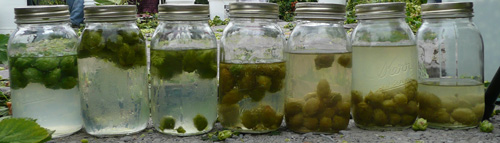
Intrigued by all of this and quite curious, Brian brought out seven examples of his hop tea made with water of different temperatures: 60°, 120°, 130°, 140°, 160°, 180° and 185°. They’re shown above from lower to higher temperature, left to right.

As you can see, the lower the temperature, the more green the hops are and the water remains less cloudy. At the higher temperatures, the hops are stripped of their green, becoming brown, and the water also becomes more brown. Also, as the temperature increases, the hops lose their buoyancy and begin to sink in the water. Although you can’t see it in the photo, the hotter the water, the more hop bitterness and at the upper range, tannins begin to emerge. Here’s what I found:

  • 60°: Fresh, herbal aromas with some hop flavors, but it’s light.
  • 120°: Bigger aromas, less green more vegetal flavors.
  • 130°: Also big aromas emerging, flavors beginning to become stronger, too, but still refreshingly light.
  • 140°: More pickled, vinegary aroma, no longer subtle with biting hop character and strong flavors.
  • 160°: Very big hop aromas with strong hop flavors, too, with a touch of sweetness. Tannins are becoming evident but are still restrained.
  • 180°: Big hop and vinegary aromas, with flavors becoming too astringent and tannins becoming overpowering.
  • 185°: Vinegary aromas, way too bitter and tannins still overpowering.
hop-tea-2
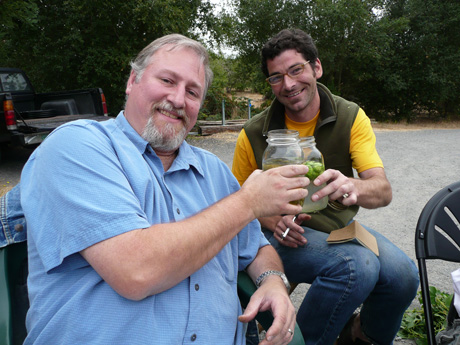
Trying each of the tea samples with Tim Clifford, now owner of Sante Adairius.
hop-tea-3

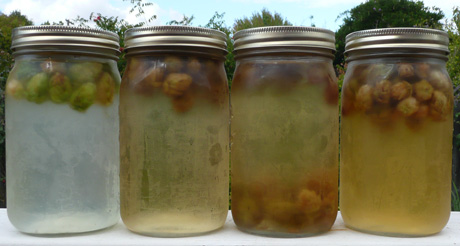
Brian was kind enough to let me take a small bag of fresh hops with me so I could recreate his experiment at home. I had enough for four samples and made tea at 100°, 140° and 160°. Using two dozen hop cones made the jars look light so I used three-dozen in the last jar, also using 160° water. I tasted them with my wife, hoping to get a civilian opinion, too. Here’s what we found:

  • 100°: Hops still green and floating. The nose was very vegetal and reminded my wife of the water leftover in the pot after you’ve steamed vegetables like broccoli or Brussels sprouts. The mouthfeel is somewhat gritty with light, refreshing flavors and only a little bitterness, which dissipates quickly.
  • 140°: Hops turned brown, but still floating. Light hop aromas with some smokey, roasted aromas and even a hint of caramel. Fresh hop flavors with a clean finish. My wife, however, made that puckering bitter face signaling she found it repugnant.
  • 160°: Hops turned brown, but most has sunk to the bottom of the jar. Strong hop aromas and few negatives, at least from my point of view. My wife was still making that face, cursing me for dragging her into this. Hop bitterness had become more pronounced and tannins were now evident, with a lingering finish.
  • 160° Plus: This sample had 50% more hops. The hops had also turned brown but, curiously, they were still floating. The nose was vegetal with string hop aromas. With a gritty mouthfeel, the flavors were even more bitter covering the tannins just slightly, but they were still apparent, and the finish lingered bitterly.

It seems like either 140° or 160° is the right temperature. Lower than that and you don’t get enough hop character (I’m sure that’s why the hops remain green) but above that the tannins become too pronounced. It appears you have to already like big hop flavor or you’ll hate hop tea. I found it pretty enjoyable and even refreshing though it’s still probably best in small amounts. You do seem to catch a little buzz off of it, which doesn’t hurt. I’m sure the amount of hops is important and more research may be needed on that front. Brian tells me that hop pellets can also be used though I doubt the jar of tea looks as attractive using them. They have the advantage of being available year-round, of course. If you use pellets, you need only about a half-ounce for each pint jar.

If you try to make Hunt’s Hop Tea on your own, please let me know your results. And please do raise a toast to Brian Hunt’s ingenuity.

Filed Under: Food & Beer, Just For Fun, Related Pleasures Tagged With: Bay Area, California, Hops

Beer In Ads #2153: C.Z. Guest For Pabst

January 11, 2017 By Jay Brooks


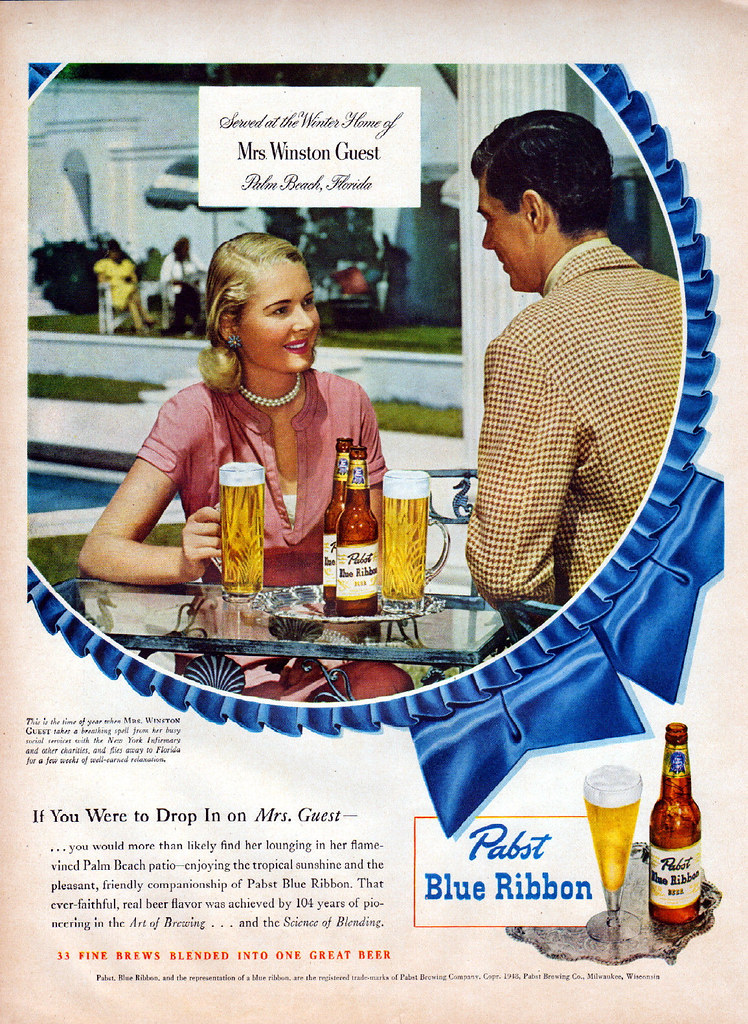
Wednesday’s ad is for Pabst Blue Ribbon, from 1948. In the later 1940s, Pabst embarked on a series of ads with celebrity endorsements, photographing star actors, athletes, musicians and other famous people in their homes, enjoying Pabst Blue Ribbon beer. This one features Mrs. Winston Guest, whose full name was Lucy Douglas “C. Z.” Guest. She “was an American stage actress, author, columnist, horsewoman, fashion designer, and socialite who achieved a degree of fame as a fashion icon. She was frequently seen wearing elegant designs by famous designers like Mainbocher. Her unfussy, clean-cut style was seen as typically American, and she was named to the International Best Dressed List Hall of Fame in 1959.” Her husband was Winston Frederick Churchill Guest, an “Anglo-American polo champion and a member of the Guest family of Britain.” They had married the year before this ad ran, so I’m not sure why he’s not in the ad, too. Perhaps he was busy playing polo?

In the ad, she’s at her “winter hone” in Palm Beach, Florida, on a patio by the pool, having a beer at a table with an unnamed guest.

PBR-1948-mrs-winston-guest-2

Filed Under: Art & Beer, Beers Tagged With: Advertising, Celebrities, History, Pabst

Beer In Ads #2152: Lauritz Melchior For Pabst

January 10, 2017 By Jay Brooks


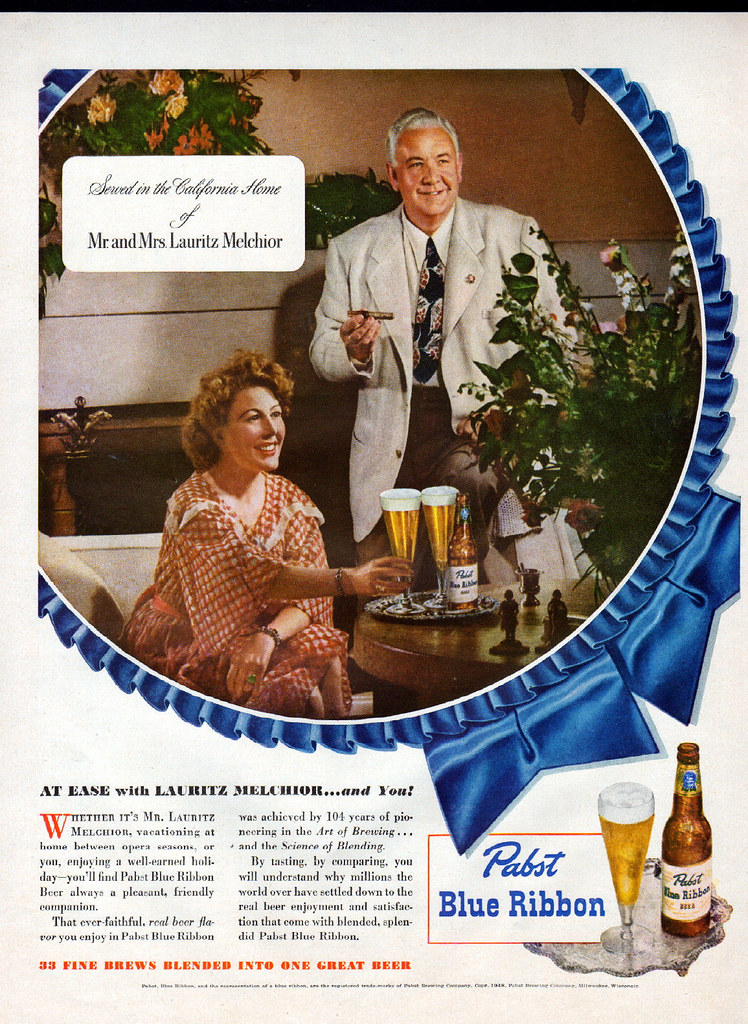
Tuesday’s ad is for Pabst Blue Ribbon, from 1948. In the later 1940s, Pabst embarked on a series of ads with celebrity endorsements, photographing star actors, athletes, musicians and other famous people in their homes, enjoying Pabst Blue Ribbon beer. This one features Mr. and Mrs. Lauritz Melchior. He “was a Danish and later American opera singer. He was the pre-eminent Wagnerian tenor of the 1920s, 1930s, and 1940s and has since come to be considered the quintessence of his voice type. Late in his career, Melchior appeared in movie musicals and on radio and television. He also made numerous recordings.”

In the ad, he’s with his wife in their “California home,” having ginormous glasses of beer from a single bottle. Amazingly, the opera singer is also smoking a cigar. Perhaps they’ll be playing bridge soon. Apparently, “[h]e played contract bridge, and holds the world record for the lowest score (13%) secured in a duplicate bridge tournament.”

PBR-1948-lauritz-melchior

Filed Under: Art & Beer, Beers Tagged With: Advertising, Celebrities, History, Music, Pabst

Liberty IPA

January 10, 2017 By Jay Brooks

anchor-new
When Anchor’s Liberty Ale was first released in 1975, few people knew what to make of it, and in the intervening years, I’ve heard debates on both sides about whether or not it’s a pale ale an IPA or something else altogether. Certainly it was the first beer to be brewed with Cascade hops. But Anchor seems to have an answer at last to that eternal question with the announcement today that they’re releasing a new beer, Liberty IPA, based on the original Liberty Ale. The press release is below, but all you need to know is in this sentence. “Liberty IPA is Anchor’s reimagining of the craft beer classic Liberty Ale, envisioned through the lens of today’s IPAs.”

LibertyIPAFaceLabel102216Update

Today, Anchor Brewing Company announces the release of Liberty IPA™, a bold and modern twist on an original craft classic, Liberty Ale.

Like its predecessor, Liberty IPA (6.3% ABV) is made with two-row pale malt and Cascade hops. It is the combination of Cascade with new hop varieties—Nelson Sauvin and El Dorado—that creates the mouthwateringly complex and robust aromas of pine and citrus in this crisp, American-style IPA.

“Liberty IPA is a revolutionary brew—reimagined,” said Anchor Brewmaster Scott Ungermann. “The beer is a bright straw golden color and boasts aromas of dank and resinous pine up front, with bold citrus and grapefruit notes on the back end. You can really taste the assertive bitterness, with hints of a light biscuit malt base and a smooth, dry finish. Liberty IPA is a celebration of the Cascade hopped IPA’s that Anchor first popularized back in 1975 and remain at the forefront of American craft beer trends.”

Liberty IPA is Anchor’s reimagining of the craft beer classic Liberty Ale, envisioned through the lens of today’s IPAs. Liberty Ale was first brewed in 1975 to celebrate the 200th anniversary of Paul Revere’s midnight ride, and was the first American IPA brewed after prohibition. This revolutionary forerunner of the modern IPA introduced America to the Cascade hop and the nearly lost art of dry-hopping, a steeping process to infuse beer with bold hop aromas.

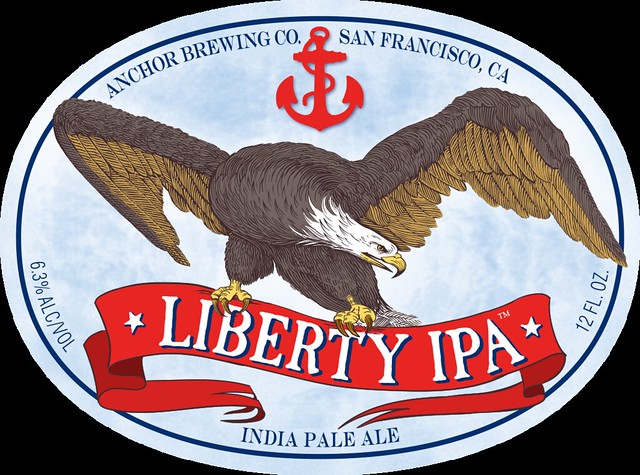
Taking cues from the original Liberty Ale packaging, the newly designed Liberty IPA label features the bald eagle, a symbol of strength and freedom.

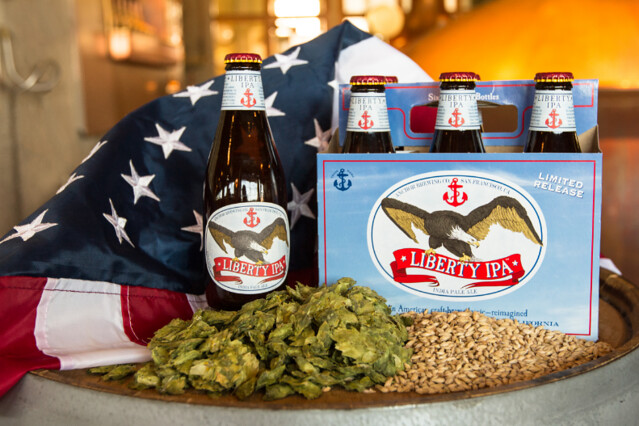
Liberty IPA is available starting January 2017 nationwide for a limited time in 6-pack bottles and on draught at select bars, restaurants, and stores as well as at the Anchor Brewing Taproom in San Francisco.

LIPA-1-low-res-2

Filed Under: Beers, Breweries, News Tagged With: Anchor Brewery, Announcements, new release, Press Release

Session #119: The Discomfort Of Burning Mouth Beer

January 10, 2017 By Jay Brooks

chili-pepper
For our 119th Session, our host is Alec Latham, who writes Mostly About Beer …. For his topic, he’s chosen Discomfort Beer, by which he means a beer which initially tasted funny, or odd, or off, or something, but which later became a favorite. Or maybe it didn’t. I’m not sure if I’m explaining that very well, so I’ll just let Alec take over and describe what he means:

What was your first ever taste of beer like? For me, it was like chilled copper coins mixed with tonic water and was disgusting. This is a process us committed beer drinkers can revisit every time we try something new.

A few years ago, I visited a pub in Pimlico called the Cask and Kitchen. There was a beer called Wild Raven by Thornbridge Brewery. Making assumptions based on the title, I ordered a pint as I love stout. I remember opening the sluices and then seizing up. Something wasn’t right. It had the chocolatey flavour of a stout but there was an intruder – lemon rind hissed in my nostrils and tainted my palate. Citrus grappled with the roast malt. Was it supposed to taste like this? Was it infection? Detergent? I spent some time staring at the floor in a suspended double-take.

That was my first ever Black IPA and at the time I wasn’t sure. Initially, I didn’t like it but whilst deciding whether or not to return it to the bar I kept giving it the benefit of the doubt. The dislike diminished. The acceptance grew. The pint gradually drained.

Black IPA is now one of my favourite styles but it could have gone the other way.

And does a Black IPA still get me blinking at the floor in a state of disquiet? No. Neither does the astringent character of Brett nor the dry bite of Lambic. All styles have been comprehensively “locked in”. Ultimately, familiarity devours discomfort.

For Session 119 I’d like you to write about which/what kind of beers took you out of your comfort zones. Beers you weren’t sure whether you didn’t like, or whether you just needed to adjust to. Also, this can’t include beers that were compromised, defective, flat, off etc because this is about deliberate styles. It would be interesting to see if these experiences are similar in different countries.

I think this could be a good archive for people researching fads, the origins of styles and the dearths of others – but especially how new ones were initially perceived.

Over the past year I’ve had a black barley wine, a braggot, a rye wine, a seaweed and cloudberry Gose, a beer made with Saki yeast and several made with Champagne yeast. I’ve sipped stout with Tonka beans, drank mulled lager and many tea beers – some with the tea complementing the hops – others completely replacing them. This has also been a year where 9 ABV hop-forward beers have become standard (from the UK perspective).

Some of the above I loved, others I liked and some I hated. What remains to be seen is which will catch on and which are just brief social media cameos.

session_logo_all_text_200

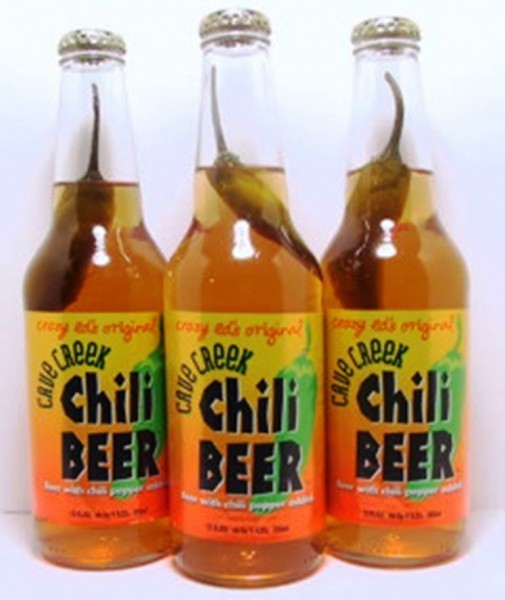
The beer that brings me the most discomfort I first tried in the mid-1990s. It was Ed’s Cave Creek Chili. Every bottle has a whole chili pepper inside of it. Why? Besides being novel, and eye-catching, some people — many people — like hot and spicy food. I am not one of those people, which immediately puts me at a disadvantage. It came across my desk as the chain beer buyer for Beverages & more. And so I tried it, and instantly regretted it. And still do to this day. Besides the pain of the barrage of hot and spicy flavors, these beers completely ruin me for any other beer I might want to drink, or really anything I might to eat too. Basically, it makes me unable to taste anything else for a period of time, and not just a few seconds; more like minutes, sometimes well over an hour.

3-chili-beers

Of course, we brought it in. Just because I don’t like something shouldn’t mean others wouldn’t want to try it. And there was some obvious appeal for people who like that sort of thing, and it sold reasonably well, probably to just the sort of person who loves four-alarm (or is it five-alarm now?) chili or ghost peppers. People who must go to the extremes, who never met a challenge they wouldn’t try.

The beer is still around, though it’s now called Cave Creek Chili Beer, and is brewed in Mexico. As far as I know, it was the first modern chili beer. It was certainly the first one I ever tried. And they appear to even be growing in popularity. Chili Beer was in a subgroup for GABF and World Beer Cup judging, but recently were broken out into their own category. That only happens if they’re getting a growing number of entries each year. I always bow out of judging that category.

To be fair, I don’t like hot or spices in anything, food or liquid. I am unabashedly a spice wuss. I grew up in rural Amish country Pennsylvania, and like to joke that my family only used two spices: salt and lard. But that’s not far off, as most of the dishes I remember eating were fairly bland; corn pie, meatloaf, casseroles, stews, potato soup, stuff with very few spices. Maybe it was just my Mom, but most of her recipes came from other family members, so I don’t think so. Anyway, to this day I don’t even eat mustard or mayonnaise, no pepper, never touch any Indian food, and will eat only the plainest Mexican fare. After over twenty years, my wife will still hand me something, saying it’s not too hot, and I’ll gag from the spiciness. Of course, this usually makes her laugh, so maybe she’s been doing it on purpose all this time.

But that aside, I don’t think that beer should compete with my food, or even my tongue, for attention. It can wash down and compliment or even contrast my food, but if it renders me unable to taste the next bite, then to my way of thinking it’s not doing its job. It should also be pleasant and ultimately enjoyable. And burning the inside of my mouth has never accomplished that, even though I realize that is actually a goal for some people.

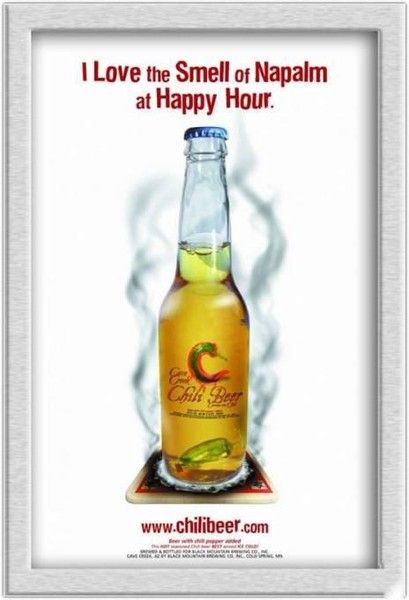
But using any more than the barest amount of chili peppers usually results in it overpowering whatever the base style of beer is, effectively removing its beeriness. I have the same issue with many barrel-aged beers, when they take on so much of the barrel character, or whatever had been in the barrel previously, that its essence is gone, having lost its beeriness in the process. If I want bourbon, I’ll just drink bourbon. In any flavored beer, the adjunct or wood should add to the beer, but not mask, remove or overpower its essential beeriness, otherwise it becomes something else entirely. And for almost every chili pepper beer that’s what happens. I have had one or two examples where it was subtle enough that it did just add to the flavors and not overwhelm your senses, but that’s rare enough that it’s an exception rather than a degree of that type of beer. The majority, I feel, want to hurt me, and wear that goal like a badge of honor, daring me to try it. I don’t think of drinking beer as an endurance test, something to make it through, or a challenge to meet.

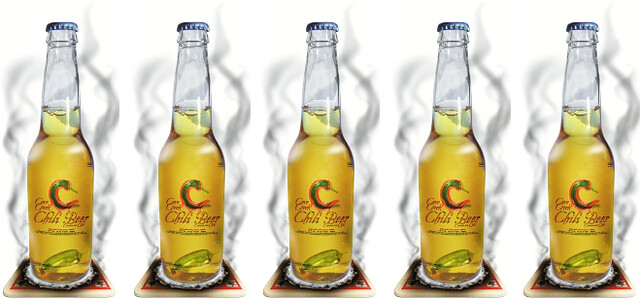
cave-creek-chili-beer-steaming

So unlike Alec’s experience with Black IPAs, or many people, including myself, warming to a new type of beer, chili beer seems like a love it or hate it kind of beer, with little ground in the middle. And you won’t be surprised to learn I hate them. How could there be any middle ground? Maybe your tolerance for spiciness increases over time, but that has not been my personal experience. My wife has been trying for over twenty years, as did many girlfriends before that. And while I do, believe it or not, eat many more foods today than I did when I was a child and in the intervening years, many people are still shocked at how picky I am and usually chuckle at what I consider to be too spicy. C’est la vie.

So maybe I could, through a concerted effort, patent sampling, building up a tolerance over time, learn to better appreciate chili beers. Then what? They’d still be too much for everyday consumption. I can’t imagine a scenario or situation where that’s a beer I’d ever reach for willingly. What occasion would be appropriate to drink something that will burn my mouth and cause me to be unable to taste anything else? Maybe it’s pure hedonism on my part, but I don’t want to have to work at enjoying a beer. A good beer should, at the very least, just be enjoyable on its own, part and parcel of its beeriness. That is, and rightly should be what beeriness means: something delicious that you want to drink, and is enjoyable during and afterwards, or something that does not cause any discomfort.

napalm

Filed Under: Editorial, Just For Fun, Related Pleasures, The Session Tagged With: Beer Styles

Beer In Ads #2151: Jascha Heifetz For Pabst

January 9, 2017 By Jay Brooks


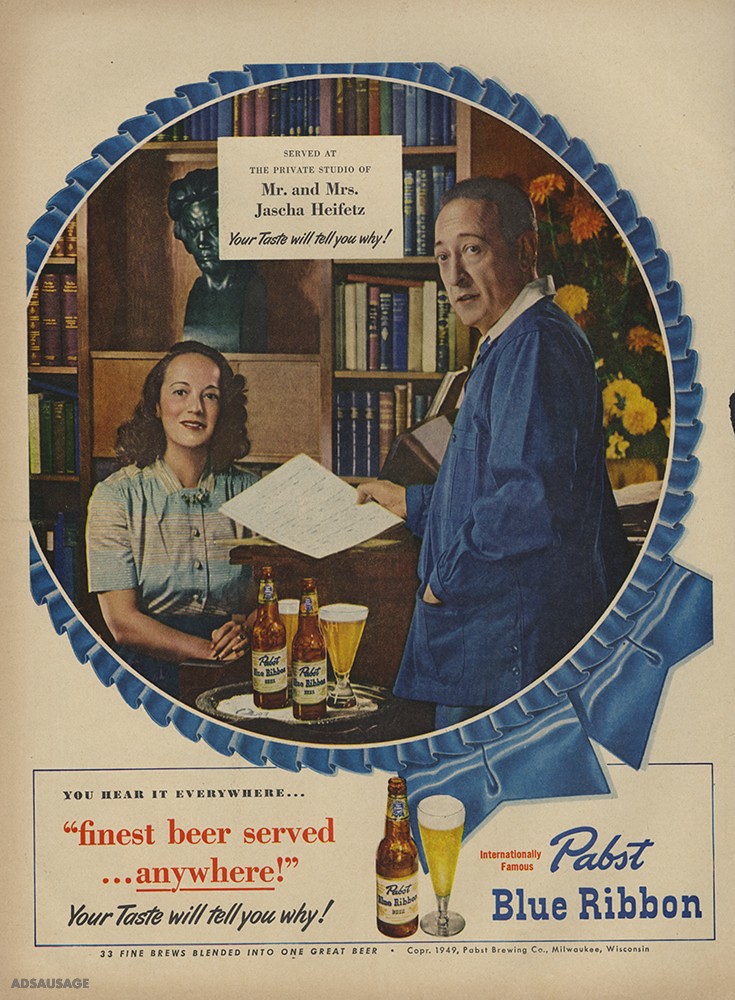
Monday’s ad is for Pabst Blue Ribbon, from 1949. In the later 1940s, Pabst embarked on a series of ads with celebrity endorsements, photographing star actors, athletes, musicians and other famous people in their homes, enjoying Pabst Blue Ribbon beer. This one features Mr. and Mrs. Jascha Heifetz. He “was a Lithuanian born violinist, who is considered by many to be the greatest violinist of all time. Born in Wilno, Russian Empire (present-day Vilnius, Lithuania), he moved as a teenager to the United States, where his Carnegie Hall debut was rapturously received. He was a virtuoso since childhood. Fritz Kreisler, another leading violinist of the twentieth century, said on hearing Heifetz’s debut, “We might as well take our fiddles and break them across our knees.” He had a long and successful performing and recording career; after an injury to his right (bowing) arm, he focused on teaching.”

In the ad, he’s with his second wife, Frances Spielberger Spiegelberg, in their private studio. Along the only wall we can see bookshelves and a large bouquet of flowers. There’s also a stern-looking bust — is that Beethoven? — on one of the shelves. He’s holding a sheet of music and there’s a tray of Pabst bottles and glasses between them.

PBR-1949-jascha-heifetz

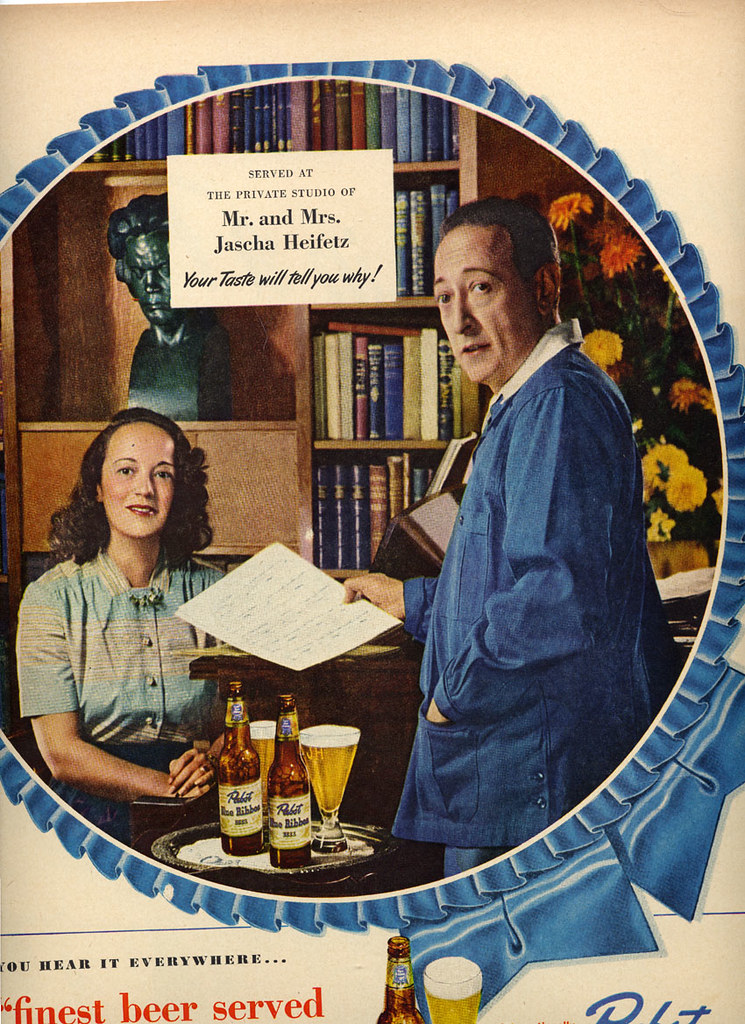
And while the ad below is clipped and not complete, it does show the picture a little more clearly with less aging discoloration.

PBR-1949-jascha-heifetz-2

Filed Under: Art & Beer, Beers Tagged With: Advertising, Celebrities, History, Music, Pabst

Beer In Ads #2150: Rosalind Russell For Pabst

January 8, 2017 By Jay Brooks


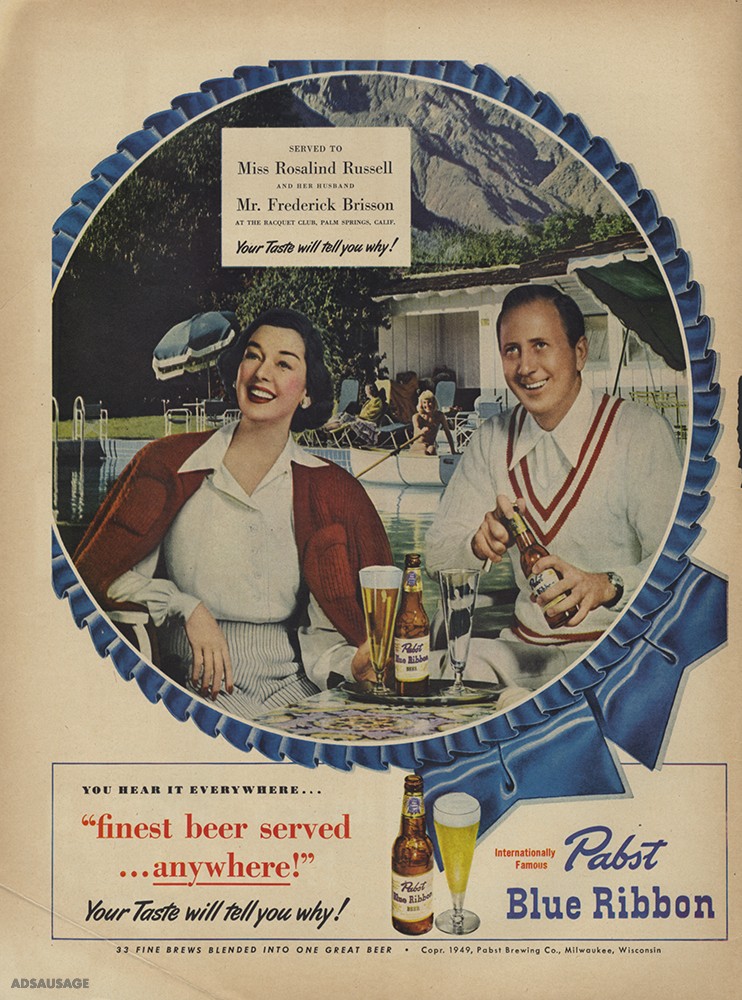
Sunday’s ad is for Pabst Blue Ribbon, from 1949. In the later 1940s, Pabst embarked on a series of ads with celebrity endorsements, photographing star actors, athletes, musicians and other famous people in their homes, enjoying Pabst Blue Ribbon beer. This one features Miss Rosalind Russell and her husband Mr. Frederick Brisson. She “was an American actress of stage and screen, known for her role as fast-talking newspaper reporter Hildy Johnson in the Howard Hawks screwball comedy His Girl Friday (1940), as well as for her portrayals of Mame Dennis in Auntie Mame (1958) and Rose in Gypsy (1962). A noted comedian, she won all five Golden Globes for which she was nominated and was tied with Meryl Streep for most wins until Streep won her sixth award in 2007. Russell won a Tony Award in 1953 for Best Performance by an Actress in a Musical for her portrayal of Ruth in the Broadway show Wonderful Town (a musical based on the film My Sister Eileen, in which she also starred). She was nominated for the Academy Award for Best Actress four times throughout her career.”

In the ad, she’s with her husband, Frederick Brisson, who was a Danish-American producer and the son of actor Carl Brisson. Cary Grant introduced the pair, and was best man at their wedding. They’re not in their home, which is common for this series of ads, but instead are at the Racquet Club in Palm Springs, California. He’s chivalrously poured his wife her beer, and is in the process of opening his beer. But look closely behind the Hollywood couple. There’s a woman rowing a boat in the swimming pool behind them. That seems just a little bit odd, doesn’t it?

PBR-1949-rosalind-russell-2

Filed Under: Art & Beer, Beers Tagged With: Advertising, Celebrities, History, Pabst

Beer In Ads #2149: Sid Luckman For Pabst

January 7, 2017 By Jay Brooks


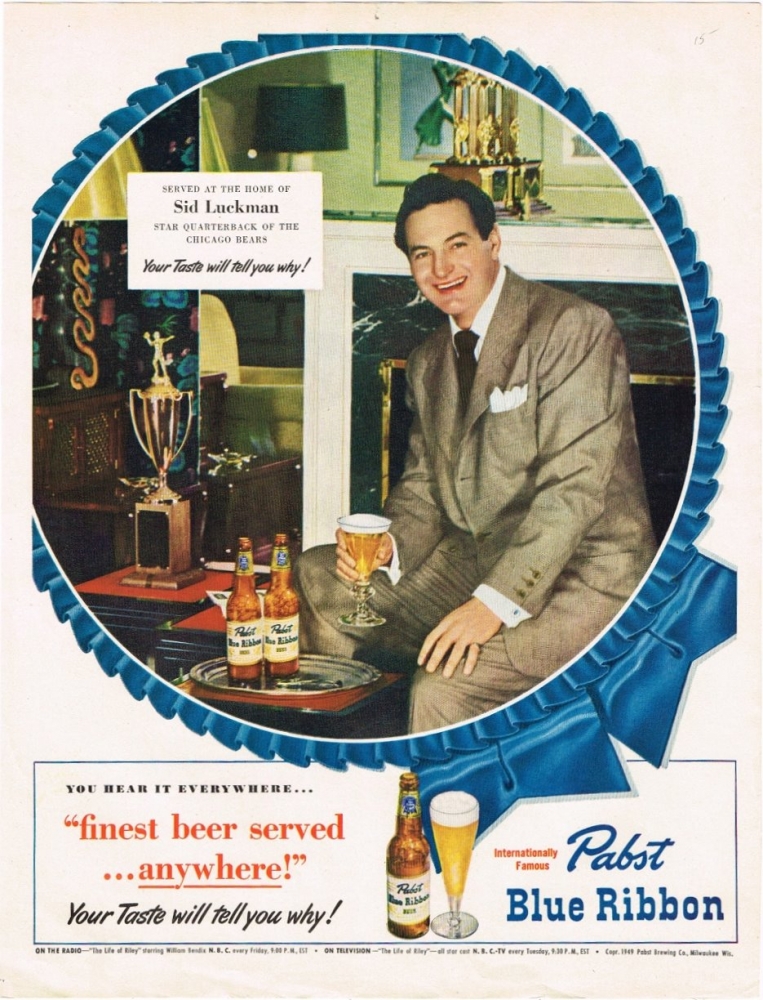
Saturday’s ad is for Pabst Blue Ribbon, from 1949. In the later 1940s, Pabst embarked on a series of ads with celebrity endorsements, photographing star actors, athletes, musicians and other famous people in their homes, enjoying Pabst Blue Ribbon beer. This one features Sid Luckman. He “was an American football quarterback for the Chicago Bears of the National Football League (NFL) from 1939 through 1950. During his twelve seasons with the Bears he led them to four NFL championships. Luckman was the first modern T-formation quarterback and is considered the greatest long range passer of his time.”

In the ad, done when was still an active player, though he would retire the following year, Sid sits in his home, surrounded by a few of his trophies. He holds a glass of beer, but there are two bottles of Pabst in the tray next to him. Either he was a prodigious drinker, or perhaps there’s someone else there in the room with him.

PBR-1949-sid-luckman

Filed Under: Art & Beer, Beers Tagged With: Advertising, Celebrities, Football, History, Pabst, Sports

Beer In Ads #2148: Bob Hope For Pabst

January 6, 2017 By Jay Brooks


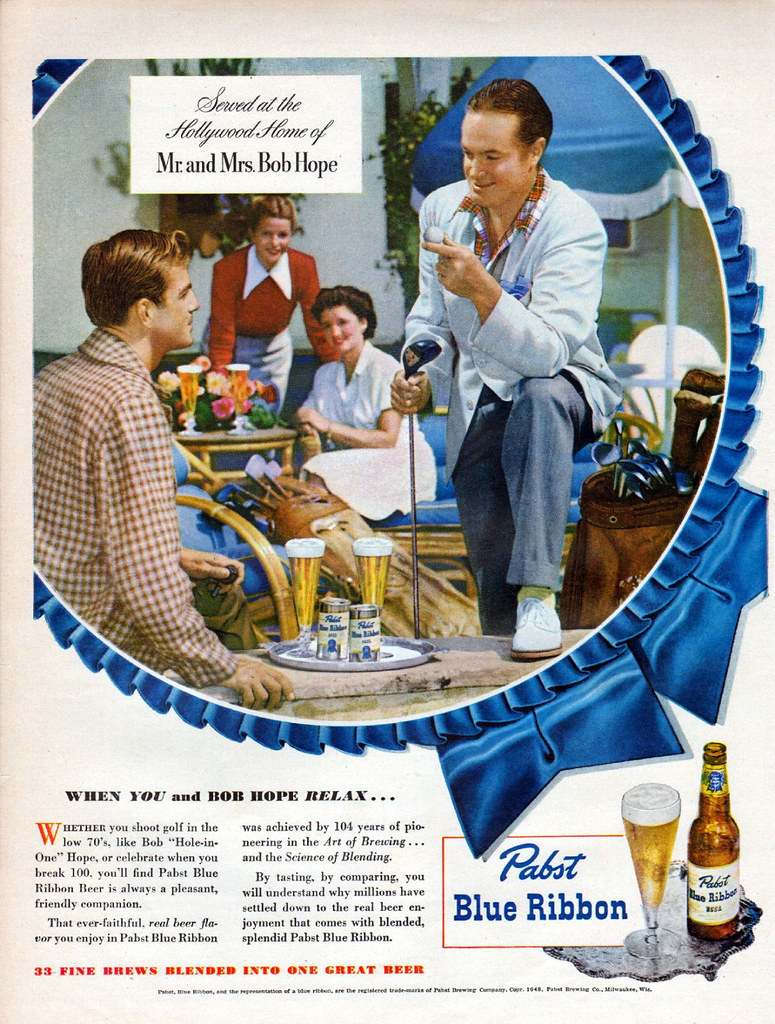
Friday’s ad is for Pabst Blue Ribbon, from 1948. In the later 1940s, Pabst embarked on a series of ads with celebrity endorsements, photographing star actors, athletes, musicians and other famous people in their homes, enjoying Pabst Blue Ribbon beer. This one features Bob Hope. He “was an American comedian, vaudevillian, actor, singer, dancer, athlete, and author. With a career spanning nearly 80 years, Hope appeared in over 70 feature films and short films, including a series of “Road” movies. In addition to hosting the Academy Awards 19 times (more than any other host), he appeared in many stage productions and television roles and was the author of 14 books. The song “Thanks for the Memory” is widely regarded as Hope’s signature tune.

Born in London, Hope arrived in America with his family at the age of four and grew up in Cleveland, Ohio. He began his career in show business in the early 1920s, initially on stage, and began appearing on the radio and in films in 1934. He was praised for his comedy timing, specializing in one-liners and rapid-fire delivery of jokes, which were often self-deprecating, with Hope building himself up and then tearing himself down. Celebrated for his long career performing United Service Organizations (USO) shows to entertain active service American military personnel (he made 57 tours for the USO between 1941 and 1991), Hope was declared an honorary veteran of the United States Armed Forces in 1997 by act of the U.S. Congress. He also appeared in numerous specials for NBC television, starting in 1950, and was one of the first users of cue cards. Hope participated in the sports of golf and boxing, and owned a small stake in his hometown baseball team, the Cleveland Indians. He died at age 100 at his home in Toluca Lake, California.”

In the ad, Hope has foot up on a table, a golf club in one hand and a ball in the other. Probably having just finished another round (he was an avid golfer) he and friend are having cans of Pabst at the clubhouse. Behind them, two women look on, admiringly, with two glasses of beer on their table, as well.

PBR-1948-bob-hope

Filed Under: Art & Beer, Beers Tagged With: Advertising, Celebrities, History, Pabst

Beer In Ads #2147: Gregory Peck For Pabst

January 5, 2017 By Jay Brooks


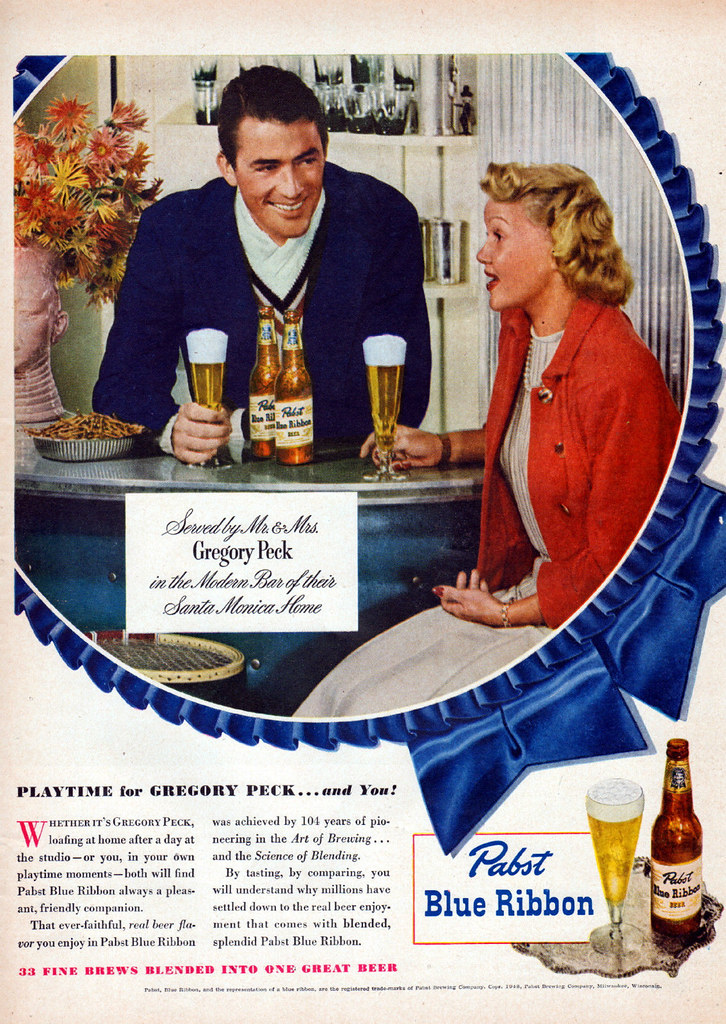
Thursday’s ad is for Pabst Blue Ribbon, from 1949. In the later 1940s, Pabst embarked on a series of ads with celebrity endorsements, photographing star actors, athletes, musicians and other famous people in their homes, enjoying Pabst Blue Ribbon beer. This one features Mr. & Mrs. Gregory Peck. He “was an American actor who was one of the most popular film stars from the 1940s to the 1960s. Peck continued to play major film roles until the late 1980s. His performance as Atticus Finch in the 1962 film To Kill a Mockingbird earned him the Academy Award for Best Actor. He had also been nominated for an Oscar for the same category for The Keys of the Kingdom (1944), The Yearling (1946), Gentleman’s Agreement (1947) and Twelve O’Clock High (1949). Other notable films he appeared in include Spellbound (1945), The Paradine Case (1947), The World in His Arms (1952), Roman Holiday (1953), Moby Dick (1956, and its 1998 miniseries), The Guns of Navarone (1961), Cape Fear (1962, and its 1991 remake), How the West Was Won (1962), The Omen (1976) and The Boys from Brazil (1978).”

President Lyndon Johnson honored Peck with the Presidential Medal of Freedom in 1969 for his lifetime humanitarian efforts. In 1999, the American Film Institute named Peck among Greatest Male Stars of Classic Hollywood cinema, ranking at No. 12. He was named to the International Best Dressed List Hall of Fame in 1983.

In the ad, the Pecks, Gregory and Greta, are in their “modern” bar, with Gregory behind it, smiling at his wife as she appears to be talking to someone we can’t see. Also, there’s a tennis racket on the chair next to her and Mr. Peck does seem to be wearing tennis garb, although Mrs. does not. And how about that flower arrangement next to him, with the flowers sticking out of someone’s head. I guess that’s modern, too.

PBR-1949-gregory-peck-3

Filed Under: Art & Beer, Beers Tagged With: Advertising, Celebrities, History, Pabst

« Previous Page
Next Page »

Find Something

Northern California Breweries

Please consider purchasing my latest book, California Breweries North, available from Amazon, or ask for it at your local bookstore.

Recent Comments

  • Bob Paolino on Beer Birthday: Grant Johnston
  • Gambrinus on Historic Beer Birthday: A.J. Houghton
  • Ernie Dewing on Historic Beer Birthday: Charles William Bergner 
  • Steve 'Pudgy' De Rose on Historic Beer Birthday: Jacob Schmidt
  • Jay Brooks on Beer Birthday: Bill Owens

Recent Posts

  • Beer Birthday: Larry Berlin June 30, 2026
  • Historic Beer Birthday: Louis J. Hauck June 30, 2026
  • Beer In Ads #5279: Nobody* Undersells Weltman’s Bucks Bock! June 29, 2026
  • Historic Beer Birthday: Pablo Díez Fernández June 29, 2026
  • Historic Beer Birthday: Peter Weyand June 29, 2026

BBB Archives

Feedback

Head Quarter
This site is hosted and maintained by H25Q.dev. Any questions or comments for the webmaster can be directed here.