Brookston Beer Bulletin

Jay R. Brooks on Beer

  • Home
  • About
  • Editorial
  • Birthdays
  • Art & Beer

Socialize

  • Dribbble
  • Email
  • Facebook
  • Flickr
  • GitHub
  • Instagram
  • LinkedIn
  • Pinterest
  • RSS
  • Twitter
  • YouTube

Powered by Genesis

Patent No. 385986A: Beer Cooler

July 10, 2016 By Jay Brooks

patent-logo
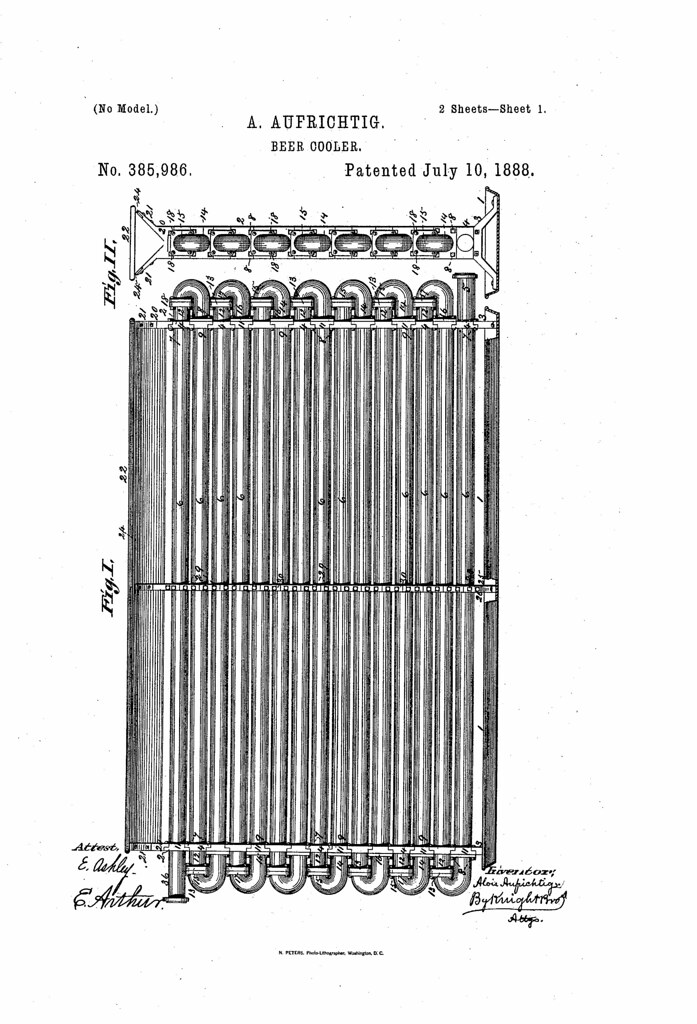
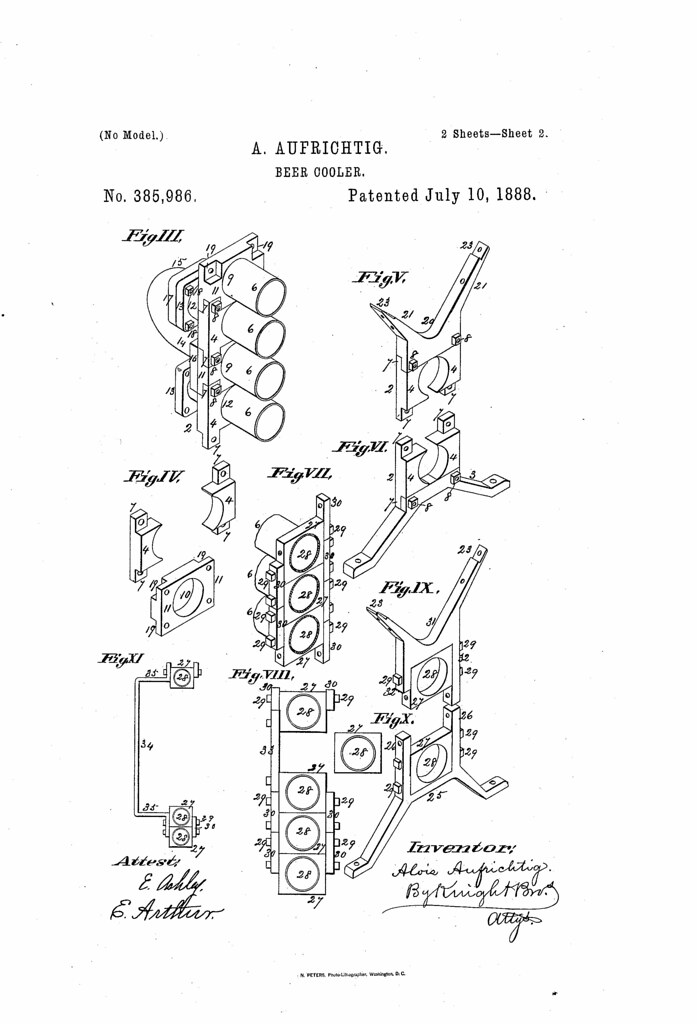
Today in 1888, US Patent 385986 A was issued, an invention of Alois Aufrichtig, for his “Beer Cooler.” There’s no Abstract, although in the description it includes this summary:

I have invented a certain new and useful Improvement in Beer-Coolers. The improvement consists in such construction that either one or more of the pipes or elbows may be removed, and, in combination with such construction, a flanged elbow having parts of different lengths, so that one of the flanges may be in line with the sectional post and the other outside such line.
US385986-0
US385986-1

Filed Under: Beers, Breweries, Just For Fun, Politics & Law, Related Pleasures Tagged With: Brewing Equipment, History, Law, Patent

Beer In Ads #1967: An Evening Of Cards

July 9, 2016 By Jay Brooks


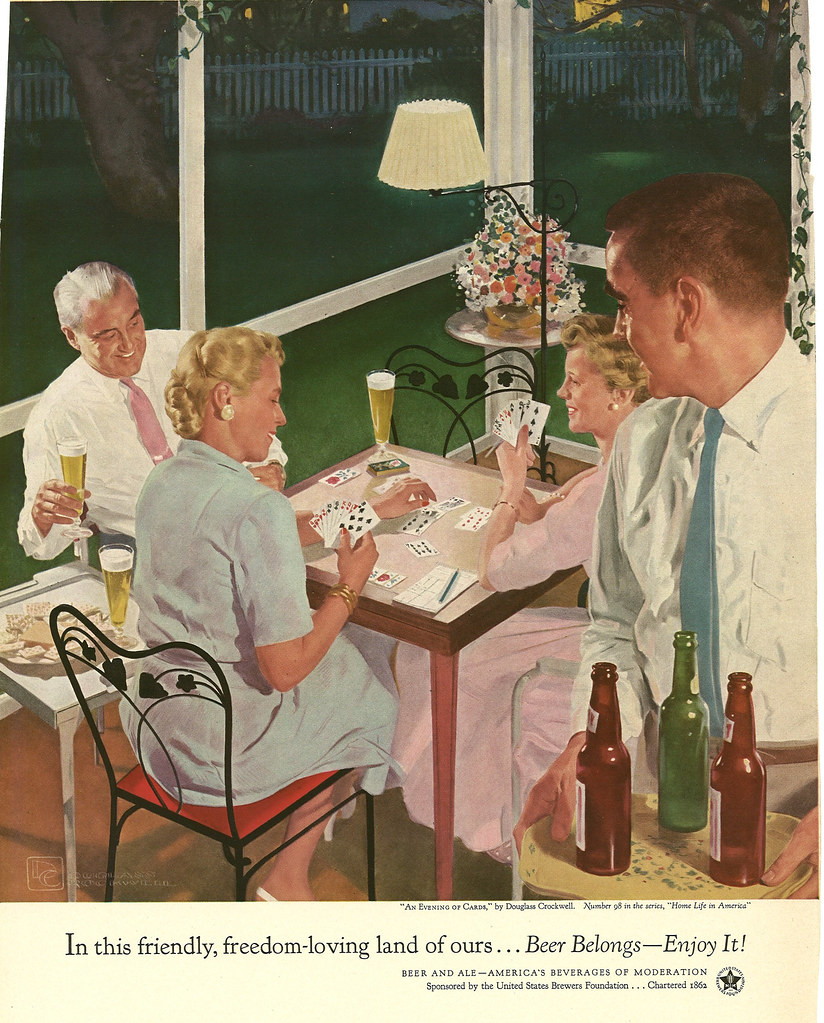
Saturday’s ad is entitled An Evening of Cards, and the illustration was done in 1954 by Douglass Crockwell. It’s #98 in a series entitled “Home Life in America,” also known as the Beer Belongs series of ads that the United States Brewers Foundation ran from 1945 to 1956. In this ad, two couples are spending an evening playing cards, most likely bridge at this time period. At least that’s an activity that fairly cries out for beer. I remember my parents having people over, not to play bridge, but pinochle, which really popular when I was a kid. I also recall being in a pinochle club in junior high, where we’d play during the lunch period. I don’t know if it’s a generational thing, or geographic, but nobody I know plays pinochle in California, which is a shame.

098. An Evening of Cards by Douglass Crockwell, 1954

Filed Under: Art & Beer, Beers, Just For Fun Tagged With: Advertising, Games, History

Patent No. 1031838A: Beer Saving Apparatus

July 9, 2016 By Jay Brooks

patent-logo
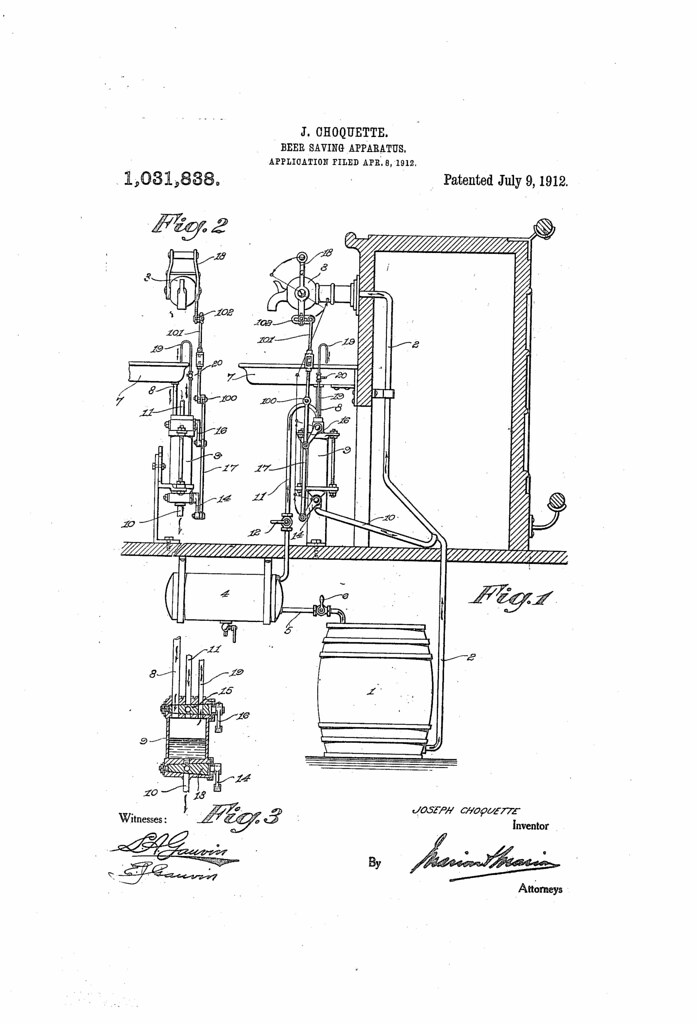
Today in 1912, US Patent 1031838 A was issued, an invention of Beer Saving Apparatus, for his “Beer Saving Apparatus.” There’s no Abstract, although in the description it includes this summary:

Having thus fully described” my invention, what I claim as new and desire to secure by Letters Patent is: in combination, beer tank, a beer faucet provided with a controlling valve, a pipe leading from said tank to said faucet, a pressure tank, connections between said pressure tank and said beer tank, a pan beneath the aforesaid faucet, a trap beneath said pan, a drainpipe leading from said pan to said trap, a pipe leading from said pressure tank to said trap, a branch pipe lead pipe leading from said tank to said faucet, a pressure’ tank, connections between said pressure tank and said beer tank, a pan beneath the aforesaid faucet, a trap beneath said pan a drain pipe leading from said pan to said trap, a pipe leading from said pressure tank to said trap, a drainage .pipe leading from said trap to’ the first named pipe, a valve for controlling the passage through said branch pipe, a valve or controlling the passages through said drain the pipe leading from the. pressure tank to the trap, ‘a link connected pipe and through to said valves, an operating lever for the controlling valve of the aforesaid faucet, and connections between said lever and said link. In combination, a beer tank, a’beer faucet provided with a controlling valve, a pipe leading from said tank to said faucet a pressure tank, connections between said pressure tank and said beer tank, a pan beneath the aforesaid faucet,a trap beneath said pan, a drain pipe leading from said pan to said trap, a pipe leading from said pressure tank to said trap, a branch pipe leading from said trap to the first named r p through said branch pipe, trolling the passages through said drain pipe and through pressure tank to the trap, means for automatically operating said valves as the controlling valve of the faucet is operated, and a jet pipe connected to said trap and adapt a valve for coned to deliver a sweeping jet into the afore said pan

US1031838-0

Filed Under: Beers, Breweries, Just For Fun, Politics & Law, Related Pleasures Tagged With: Brewing Equipment, History, Law, Patent

Patent No. 406486A: Steeping Tub For Steeping Barley

July 9, 2016 By Jay Brooks

patent-logo
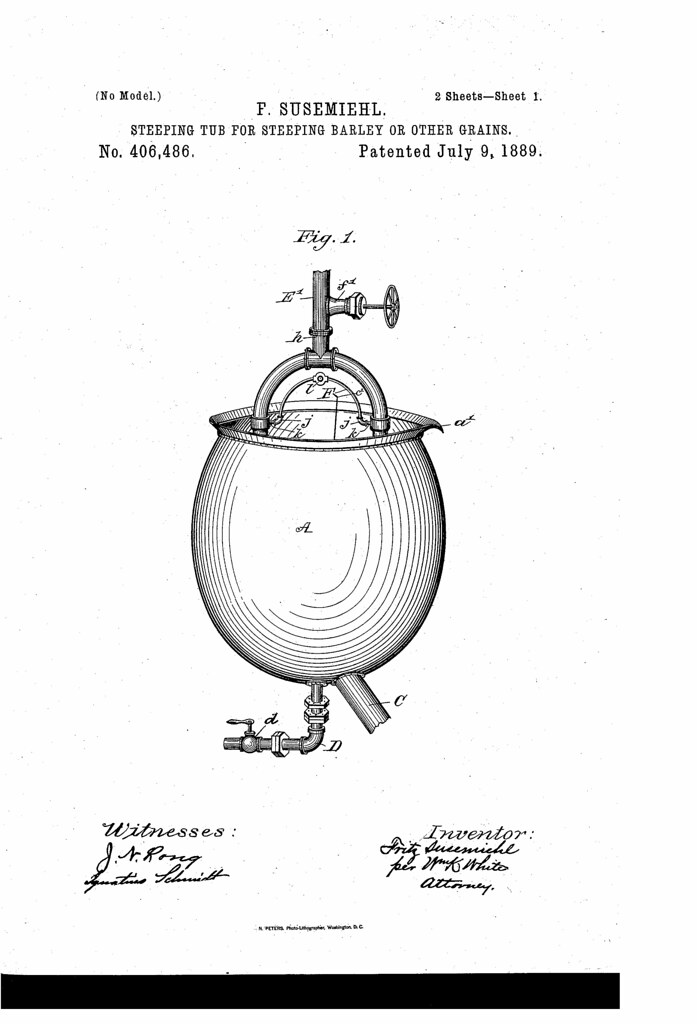
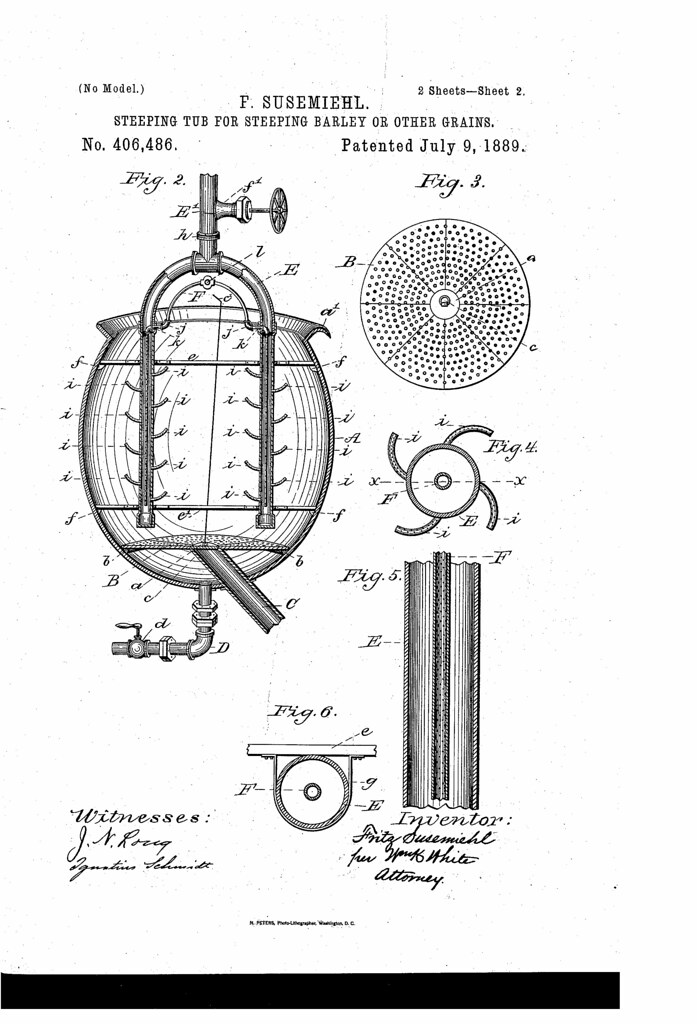
Today in 1889, US Patent 406486 A was issued, an invention of Fritz Susemiehl, for his “Steeping Tub For Steeping Barley or Other Grains.” There’s no Abstract, although in the description it includes this summary:

My invention relates to improvements in steeping-tubs for steeping barley and other grain, in which the form of the tub is preferably globular, except at its top, and having a spout or mouth-piece on its upper edge at one side similar in form to those found in pitchers, the water being conveyed into the tub through perforations in exit-tubes in connection with compressed air passed through same by means of an air force-pump, the tub or vessel laving a false perforated bottom with trap-door connecting with a conveyer-pipe passing out through the bottom of the vessel; and the objects of my improvements are, first, to permit the barley or other grain and refuse foreign matter floating on top of the water to be discharged from the vessel or tub through its spout or mouth-piece; second, to cause the Water to be discharged with great force in the vessel through the perforations in the exit pipes, to stir and agitate the grain in the vessel, and thus cleansing it from dirt and foreign substances adhering to it; third, to permit the dirt and foreign substances wash ed off the grain, which sink, to pass through the perforations of false bottom and lie upon the real bottom of the vessel, thus separating the same from the cleansed grain, and, fourth, to provide means for expeditiously removing the cleansed grain, after its proper treatment, from the vessel by means of a trap-door through the false bottom and a conveyer pipe leading therefrom through the bottom of the vessel. I attain these objects by the mechanism illustrated in the accompanying drawings, in which Figure l is a front view of the steeping-tub. Fig. 2 is a view of a vertical section of the same. Fig. 3 is a top view of the false bottom. Fig. `1i is a top view of one of the arms of the water and air pipes. Fig. 5 is a vertical section of the same on the line :roc ofFig. 4, the exit-pipes being removed; and Fig. 6 is a detail view of the means of attaching one

US406486-0
US406486-1

Filed Under: Beers, Just For Fun, Politics & Law, Related Pleasures Tagged With: barley, Brewing Equipment, History, Law, Malt, Patent

Beer In Ads #1966: Summer Picnic

July 8, 2016 By Jay Brooks


Friday’s ad is entitled Summer Picnic, and the illustration was done in 1954 by Douglass Crockwell. It’s #97 in a series entitled “Home Life in America,” also known as the Beer Belongs series of ads that the United States Brewers Foundation ran from 1945 to 1956. In this ad, two couples go on a summer picnic. The women pack the food, and the men bring beer. They take a boat to a secluded spot, where food and beer is consumed, photos taken, and fun day is had by all. Then back to civilization they go at sunset. Looks like a nice day, although overall I don’t like these multi-panel cartoons nearly as much as the single panel ads. There’s something about conveying a story in a single image, leaving more to the imagination and more reliant on subtle clues that appeals to me.

097. Summer Picnic by Douglass Crockwell, 1954

Filed Under: Art & Beer, Beers, Just For Fun Tagged With: Advertising, History

Patent No. 2248153A: Method For Emulsifying The Essential Principles Of Hops

July 8, 2016 By Jay Brooks

patent-logo
Today in 1941, US Patent 2842293 A was issued, an invention of Lyndon D. Wood, assigned to the Nat Hops Lab Inc., for their “Method for Emulsifying the Essential Principles of Hops.” There’s no Abstract, although in the description it includes this:

In order to make an emulsion, it is generally necessary that the insoluble mat-erialheld in suspension be very finely divided, otherwise the materials will separate in the container. When that occurs, it is necessary .to shake the mixture each time before it is used.

In the making of emulsions it has been found necessary heretofore to employ what is known as an emulsifying agent in the form of a tasteless, odorless gum such as tragacanth or gum acacia. Small amounts of these gums, which are readily soluble in water are mixed with the insoluble material, and the mass is beaten in machines designed for the purpose. The beating or pounding has the effect of finely dividing the material which it is desired to emulsify and hold in suspension.

In medicine many remedies which it is desired to administer are thus emulsified. It is claimed for the use of emulsions that in emulsified form the odor and taste is blanketed, and they are unobjectionable to the patient. Also, because of the fine division, they are much more readily assimilated and more quickly and easily digested. The same claim is made for those which are use-d industrially, that is, that this small division of the essential material makes it possible for it to be more readily mixed and dissolved in whatever it is planned to use it, and that the time of mixing and assimilating is very much shortened.

No emulsion of the essential principles of hops has heretofore been made, so far as I am able to find.

I have made many experiments and attempts to emulsify hops, and was unable to make a satisfactory emulsion until the present process was developed by me. The difficulty in making an emulsion of hops is probably due to the fact that it has been extremely difficult to effect a satisfactory division of the resins chiefly found in the lupulin of the hops. In my experiments, I have tried combining them with purified mineral oils, which are a very common component of emulsions. I have tried many vegetable oils such as cotton seed oil, soy bean oil, corn oil, flax seed oil, sesame oil, etc. I have also tried animal fats and oils such as butter, lard, fish oil, etc.

The process I have designed is entirely new, and seems to work perfectly. Emulsions made by this process have been kept for weeks and months, and I find no separation by precipitation or otherwise into their component parts. The process I have designed for making this emulsion is as follows:

I take one part or :portion of any hops extract or concentrate, made by any suitable process, but preferably by the process herein described, in which my first procedure is to suitably prepare the hops by pulverizing them to a degree of fineness by which they will pass a 20 mesh screen or sieve. This may be done in any one of several types of mills which can be adapted for the Work. The mill should be enclosed in such a way that no air currents are present in which the aroma of the hops can be dispersed From the mill the prepared or pulverized hops should be conveyed to a closed tank or receptacle where a suitable solvent is applied. The solvent which I have found most “efficient is acetone, although it may be not-ed that the essential principles of hops, namely, hop oil, lupulin, tannin, and hop seed oil are partly soluble in either petrolic ether, alcohol, methanol, high grade gasoline, ethyl acetate, etc., and in certain hot fatty oils.

I then mix with the powdered hops a highly efficient solvent, acetone. The amount of acetone applied will depend somewhat on the amount of moisture in the dried hops, and also on their age, which affects the percentage of gamma or hardened resins they contain. In general, however, it will be found that one pound of acetone should be applied to one pound of pulverized hops. This application of solvent should be made in a closed container, as the solvent is volatile and in an open container evaporates rapidly, carrying off by evaporation a small fraction of the desirable hops aroma.

The length of time which the pulverized hops should be submitted to: the action of the acetone in the closed container will depend upon the a e of the hops and the extent to which the resins in the lupulin have hardened. If the hops are fresh and have been dehydrated at low temperatures the percentage of hardened or gamma resins will be less than those in hops which were subjected to a higher degree of heat in dehydrating, and particularly those of older growth and those which have been stored in uncooled warehouses. For fresh hops, dehydrated at low temperatures and kept in cooled storerooms, an hour will be sufficient time for the action of the solvent to soften and make soluble the lupulin. For hops of older growth and those which were subjected to greater heat in drying and storing, the period of time which they would be subjected to the action of the solvent might be extended to twenty-four hours, or even longer.

After the hops have been submitted to the action of the acetone for the required period of time, they should be moved in a closed conveyor to a percolator, also closed, for the extraction of a considerable portion of the solvent and extract. This process of percolation can be expedited by the use of a vacuum pump, if desired.

When old hops are used in which the lupulin has hardened and particularly those in which a rancid odor has occurred from the oxidation of hop oil, I employ activated carbon, which may be made from the vegetable fibrous material of the hops residue after extraction has been made by percolation and pressure. This activated carbon may be used in two ways;

(a) By mixing it in finely powdered form with the pulverized hops while they are in a dry state. When this method is employed one-fourth ounce of activated carbon will be used to each pound of pulverized hops. The prepared hops should be stirred and shaken until the activated carbon has been thoroughly mixed with them, then be permitted to stand in a closed container for a period of time not less than two hours. The activated carbon absorbs the excess oxygen of oxidized material which has produced the rancidity and thus restores the odor of fresh hops.

(1)) Or, the activated carbon may be applied to the liquid extract, in which one-fourth ounce of activated carbon is used to each pound of the extract; permitting it to slowly settle; and after a period of from two to four hours the carbon may be removed from the extract by filtration will not contain as large a percentage or fraction of the resinous lupulin as it will carry. The extract obtained by this percolation may then be reemployed on another similar portion of pulverized hops, and the process repeated until the extract has reached the point of saturation, which will be indicated by its specific gravity as well as by the degree of its liquidity.

After the pulverized hops have been submitted in this way’ to the action of the acetone in the tank and in the percolators, the hops are then conveyed in a closed container to a press, preferably’ of the hydraulic type to avoid heat, in which sufficient pressure is applied to express from the hops residue all of the extract obtainable, after which the residue of hops will be found upon inspection or analysis to contain nothing but vegetable fibrous materials and no tannin, oils, or lupulin. This shows that all of the essential principles of the hops have been entirely extracted.

The liquid extract obtained from these several percolations and from the pressing of the hops is then put into an evaporating pan or preferably a jacketed vacuum still, and a degree of heat (60 C.) is applied sufficient only to evaporate all the acetone.

After finding by analysis the amount of tannin and lupulin which the extract contains, I carefully measure, weigh, observe its degree of liquidity, and by an observation of its specific gravity, etc., and by applying the same tests to subsequent lots manufactured, I secure uniformity by the addition of an amount of alcohol, glyceryl laurate, and tannin sufficient to secure such uniformity. The amount of glyceryl laurate used will vary but in any event would not be more than one ounce to each pound of emulsion produced. The function of the addition of this glyceryl laurate is two fold; first, to continue the resinous material in a soft solvent condition, and to make it soluble in the hop wort; second, it assists in the emulsification of the resinous material.

To the hops extract obtained as above described, or in any other suitable manner, I add an equal amount of malt syrup, preferably made from barley malt. The mixture is put into a hoinogenizer, or into what is known as a colloidal machine, which is commonly employed in making other emulsions, and in which the mixture is beaten until the small particles of resinous lupulin contained in the hops extract are finely divided.- No emulsifying agent such as gum tragacanth or other gums usually employed in the making of emulsions is used in this process. The result is a very perfect emulsion which will retain its form without separation indefinitely.

Due to the fact that by my process of making the hops extract I have made available and retained all of the hop seed oil found in the seeds in the hops blossoms, I assume that this oil has a beneficial effect in the making of this emulsion. To some extent, it produces the same effect as the oils used in the making of other emulsions. Among the advantages in the use of this emulsion in the place of bulk hops in brewing are the following:

First, by effecting a much finer division of the resinous lupulin, the resins which give a bitter flavor to all beer and ale are much more quickly dissolved in and assimilated by the hot water used in brewing.

Second, a better distribution. of the lupulin in the beer is obtained than by the use of boiling bulk hops in the wort.

Third, its use in this finely divided form greatly shortens the time required to hop the beer by the methods now employed.

Fourth, this emulsion has the same advantages as follows the use of hop extract in the creation and maintenance of foam on the beer when it is served. This is produced by the small fraction of hop seed oil found in the extract.

Fifth, another advantage is that due to the finer subdivision of the flavoring principles, the emulsion is more quickly and evenly dispersed in the wort or unfinished beer and the time required for cooking the bulk hops in the beer therefore, the time of making each brew is considerably shortened. To illustrate: Most brewers cook the hops in the wort for from one to two hours after the cooking of the grain has been completed. In brewing tests which we have made, we secure the same result by stopping the brewing or cooking as soon as we have introduced the emulsion.

of brewing is con- In further explanation, We have found that four ounces of emulsion containing only about one ounce of hop extract will flavor as much beer as four ounces of extract or as one pound of bulk hops. This can only be explained by the fact that in emulsifying the resinous lupulin contents of the hops or hops extract, we subdivide each particle of these flavoring constituents into many thousands of finer particles. That is the principal reason for putting it into the form of an emulsion rather than in the form of an extract. It greatly increases the flavoring power or ability as compared with the extract or bulk hops from which it is made.

The method or process above described for the making of hops emulsion is entirely a cold one. The advantage of a cold process over the prior art is that it retains all of the aromatic principles of the hops, which are easily volatilized and driven off by the application of heat.

The only stage of the process in which any heat is used is to vaporize the acetone, and only a slight degree of heat-not over 60 degrees C.- is required for that purpose.

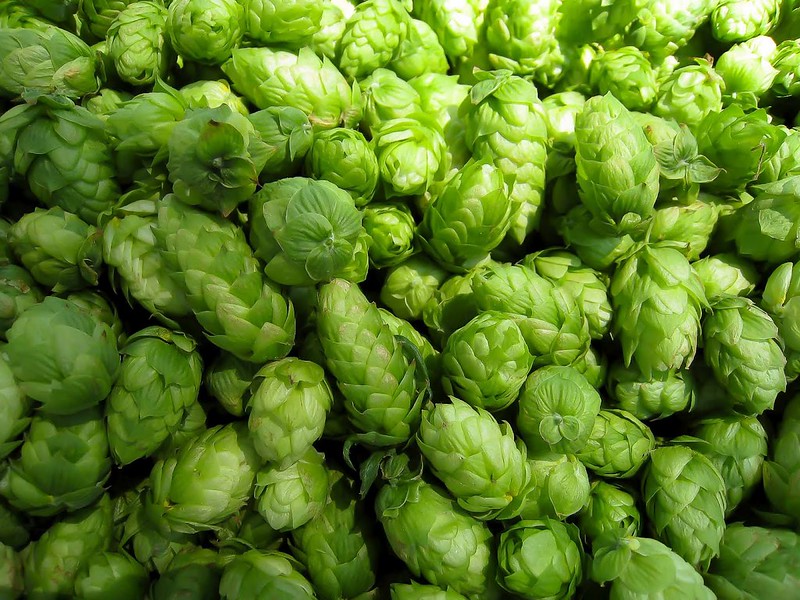
hop-flowers

Filed Under: Beers, Just For Fun, Politics & Law, Related Pleasures Tagged With: History, Hops, Law, Patent, Science of Brewing

Patent No. 2842293A: Dispensing Apparatus

July 8, 2016 By Jay Brooks

patent-logo
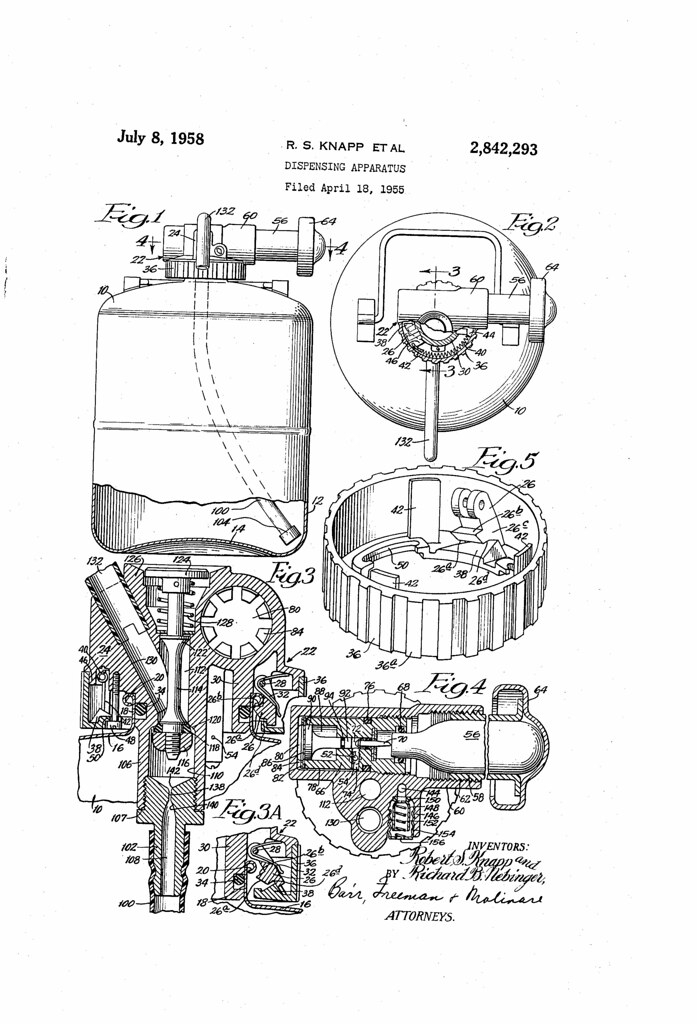
Today in 1958, US Patent 2842293 A was issued, an invention of Robert S. Knapp and Richard B. Nebinger, for their “Dispensing Apparatus.” There’s no Abstract, although in the description it includes this summary:

The present invention relates generally to a dispensing device, and more particularly to an apparatus for pressurizing a liquid container and regulating eduction flow therefrom.

The sale of beer and similar ebullient liquids in relatively large containers, particularly gallon size, for home use necessitates the provision of a simple, efficient and reliable dispensing means for providing a constant pressure on the beer within the container and for regulating eduction flow therefrom. It is desirable to provide dispensing means of this type wherein carbon dioxide pressurization by means of a sparklet bulb may be employed. Several difficult problems arise, however, in attempting to adapt an efficiently operating apparatus to the use of sparklet bulb pressurization. In particular, it is necessary to maintain a constant pressure on the beer throughout the dispensing life of the container, so that the last volume of beer Withdrawn will be received at substantially the same flow rate and pressure as the first volume. It is of further importance to prevent foaming of the beer as a result of agitating and mixing by the pressurizing gas. In addition, the use of carbon dioxide as the pressurizing gas also presents the problem of parts freezing within the bulb mechanism.

it is a primary object of this invention, therefore, to provide a dispensing device of the type described having novel pressure regulator means for providing a constant dispensing pressure.

It is another object to provide a dispensing device of the type described, wherein the pressurizing gas is released above the top. surface of the liquid Within the container in a manner which eliminates the possibility of agitation and consequent foaming of the liquid.

It is a further object to provide a dispensing device of the carbon dioxide type having novel means for preventing freezing within the carbon dioxide release mechanism.

It is still another object to provide a dispensing device of the type described having a self-closing, manually actuated push button type of valve for regulating dispensing flow through a spigot.

It is still a further object to provide a dispensing device of the type described having safety relief valve means to prevent excessive internal container pressure in the event of accidental malfunction of the pressure regulating or dispensing valve means.

US2842293-0

Filed Under: Beers, Just For Fun, Politics & Law, Related Pleasures Tagged With: History, Kegs, Law, Patent

Beer In Ads #1965: Dad Takes On All Comers

July 7, 2016 By Jay Brooks


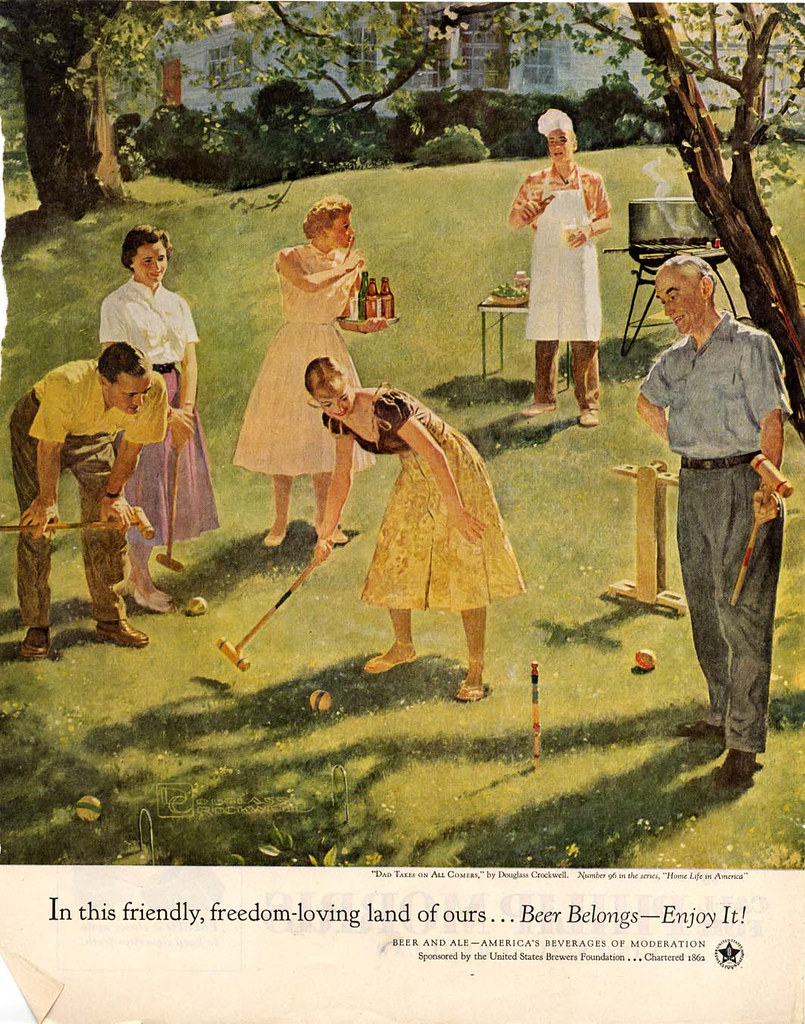
Thursday’s ad is entitled Dad Takes On All Comers, and the illustration was done in 1954 by Douglass Crockwell. It’s #96 in a series entitled “Home Life in America,” also known as the Beer Belongs series of ads that the United States Brewers Foundation ran from 1945 to 1956. In this ad, a backyard croquet match is taking place during a barbecue. And apparently Dad is a ringer. He stands smugly, while a young woman (his daughter?) is about to take her turn, and Mom is telling someone to shut up, perhaps trying to effect a loss for her husband. But she also has a tray of beer, which may help.

096. Dad Takes On All Comers by Douglass Crockwell, 1954-2

Filed Under: Art & Beer, Beers, Just For Fun Tagged With: Advertising, History

Patent No. 4276738A: Hop Picking Machine

July 7, 2016 By Jay Brooks

patent-logo
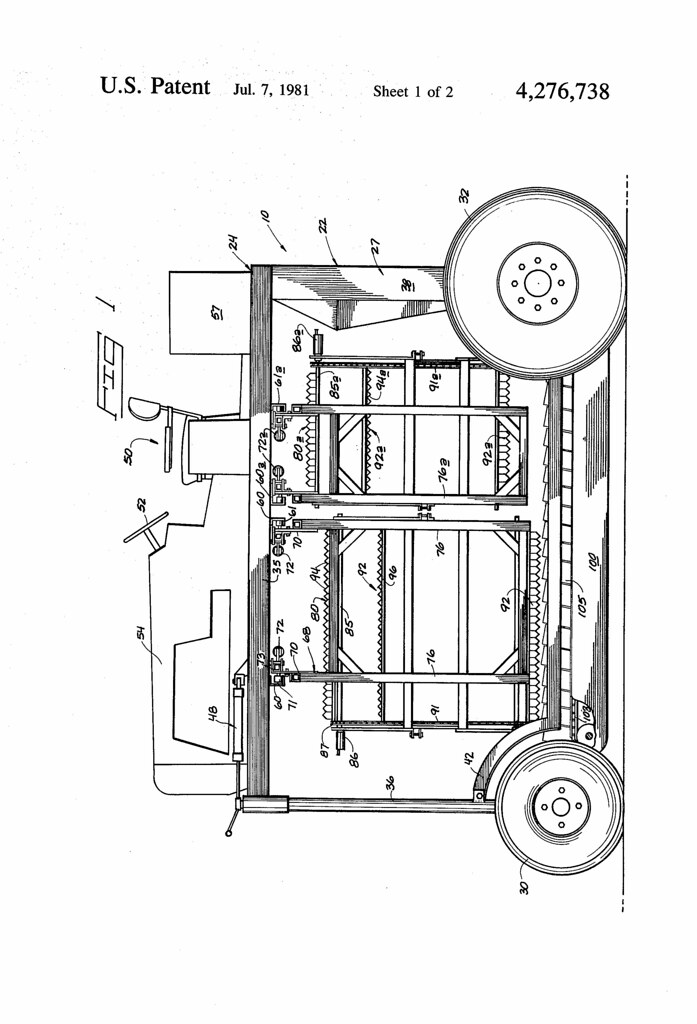
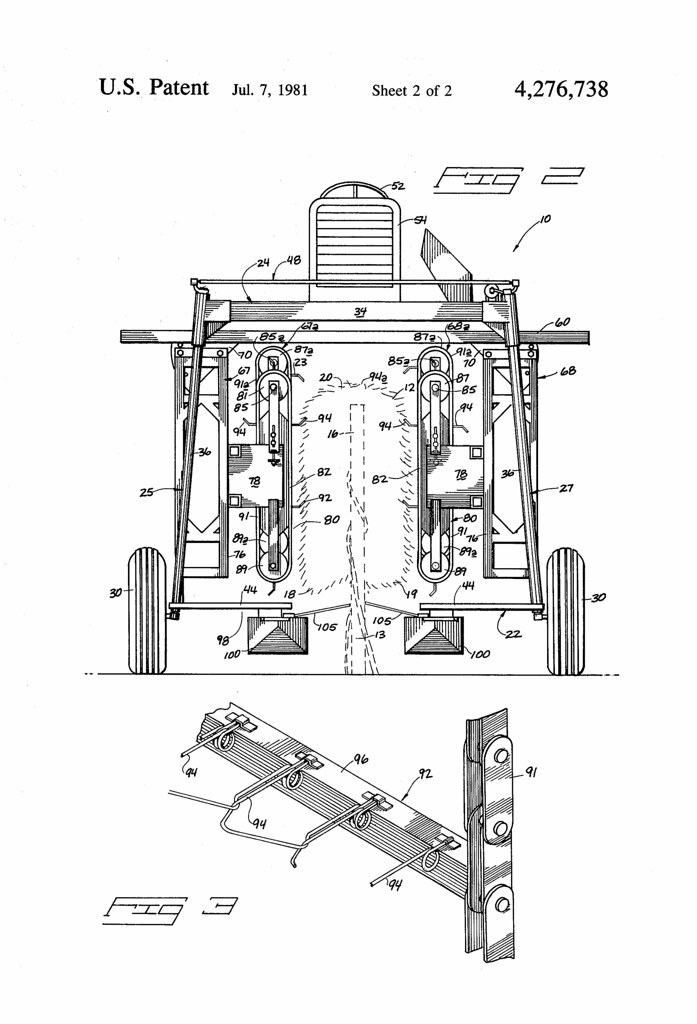
Today in 1981, US Patent 4276738 A was issued, an invention of Dominick Ferraro, for his “Hop Picking Machine.” Here’s the Abstract:

A picking machine is described for harvesting hops from vines that have been trained over a low profile trellis. The machine includes two sets of vertical picking conveyors that straddle the vines. The conveyor sets are transversely adjustable toward or away from the vine. A forward picking conveyor set includes picking fingers that move continuously downwardly, stripping hops down from opposite sides of the vine downwardly onto horizontal receiving conveyors. A rearward set of picking conveyors follow the forward set with picking fingers moving upwardly. The upwardly moving picking fingers lift the vine, “stringing” the vine vertically and stripping the remaining hops so they will fall downwardly onto receiving conveyors below.

US4276738-1 (1)
US4276738-2 (1)

Filed Under: Beers, Just For Fun, Politics & Law, Related Pleasures Tagged With: Brewing Equipment, History, Hops, Law, Patent

Beer In Ads #1964: First Weekend At The Cottage

July 6, 2016 By Jay Brooks


Wednesday’s ad is entitled First Weekend at the Cottage, and the illustration was done in 1954 by John Falter. It’s #95 in a series entitled “Home Life in America,” also known as the Beer Belongs series of ads that the United States Brewers Foundation ran from 1945 to 1956. In this ad, while most of the people at a beachside cottage and half in the bag, having been consuming beer all day long, and watching, bemused, as a new arrival shows off the new gear he’s just purchased, but still hasn’t managed to put on his bathing suit or drink a beer. C’mon, man. Get with the program.

095. First Weekend At the Cottage by John Falter, 1954

Filed Under: Art & Beer, Beers, Just For Fun Tagged With: Advertising, History

« Previous Page
Next Page »

Find Something

Northern California Breweries

Please consider purchasing my latest book, California Breweries North, available from Amazon, or ask for it at your local bookstore.

Recent Comments

  • Bob Paolino on Beer Birthday: Grant Johnston
  • Gambrinus on Historic Beer Birthday: A.J. Houghton
  • Ernie Dewing on Historic Beer Birthday: Charles William Bergner 
  • Steve 'Pudgy' De Rose on Historic Beer Birthday: Jacob Schmidt
  • Jay Brooks on Beer Birthday: Bill Owens

Recent Posts

  • Beer In Ads #5225: Fabled Ambrosia Of The Ancients April 17, 2026
  • Historic Beer Birthday: William O. Poth April 17, 2026
  • Beer In Ads #5224: Harvard Bock Beer April 16, 2026
  • Historic Beer Birthday: William H. Biner April 16, 2026
  • Historic Beer Birthday: Alan Eames April 16, 2026

BBB Archives

Feedback

Head Quarter
This site is hosted and maintained by H25Q.dev. Any questions or comments for the webmaster can be directed here.