
Thursday’s ad is another one for Pabst, from 1897. The Invalid in the title refers to those not drinking Pabst, with its “tonic” qualities where “it lifts, strengthens, builds, is vivifying, life-giving, gives vim and bounce — it braces.”
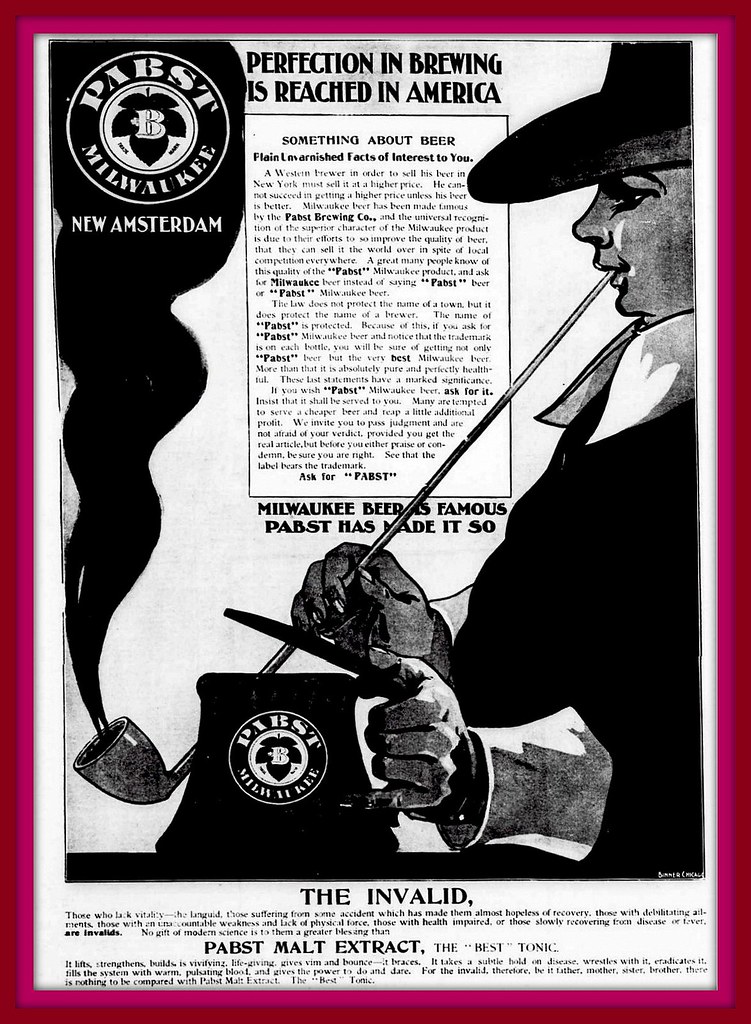

Thursday’s ad is another one for Pabst, from 1897. The Invalid in the title refers to those not drinking Pabst, with its “tonic” qualities where “it lifts, strengthens, builds, is vivifying, life-giving, gives vim and bounce — it braces.”

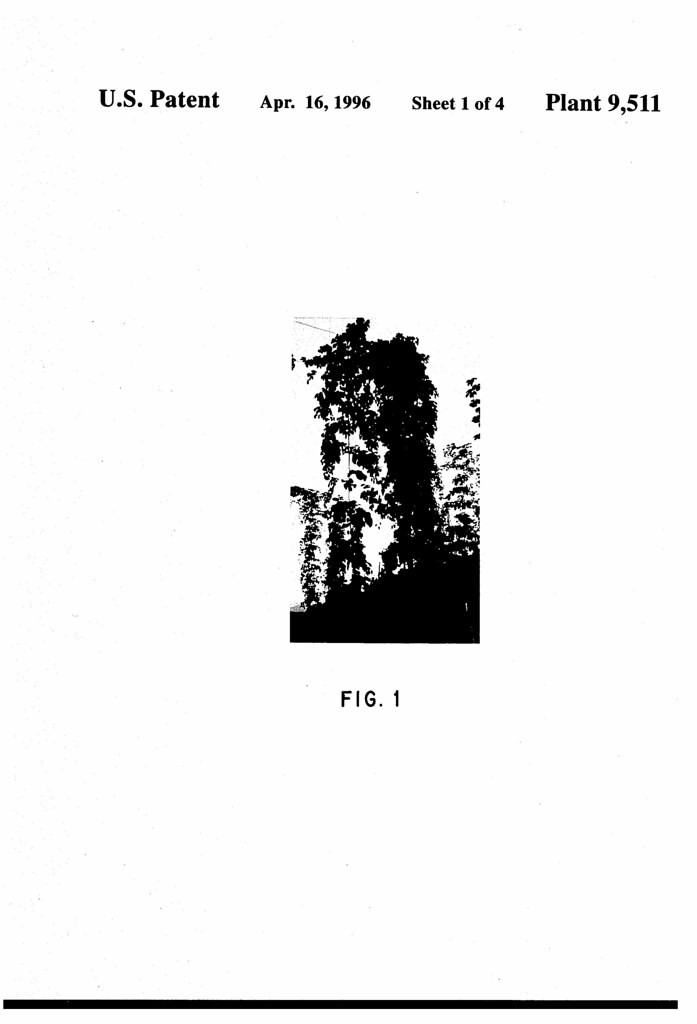
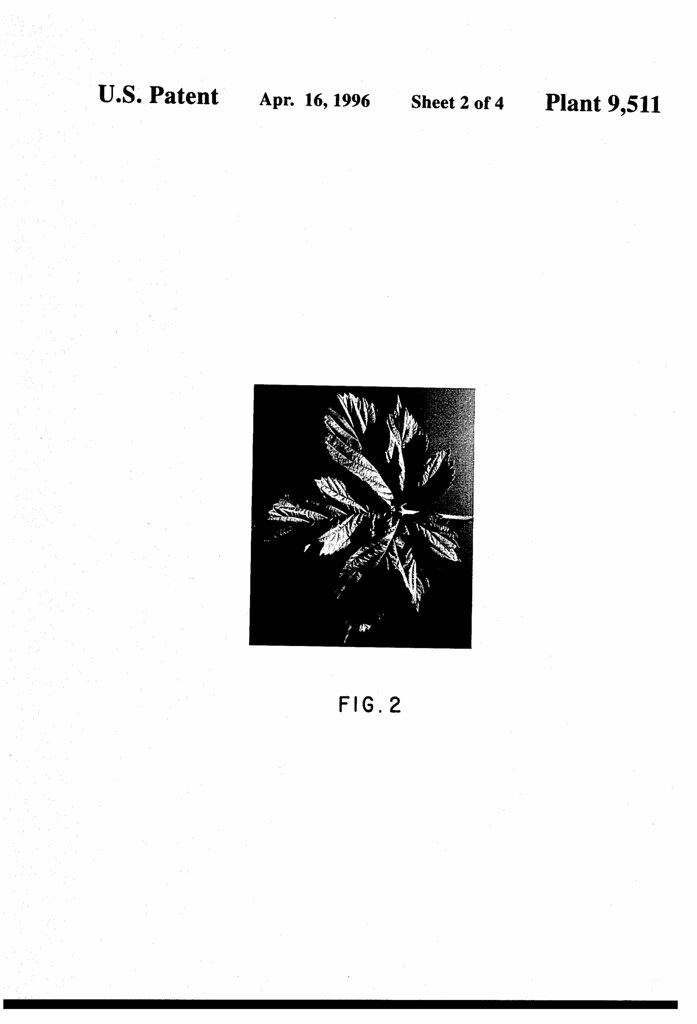
Today in 1996, US Patent PP9511 P was issued, an invention of Tokio Tanikoshi, Yasunori Arai, Yutaka Itoga, Masanobu Goto, and Narushi Suda, assigned to Sapporo Breweries Limited, for their “Hops Named ‘Furano No. 18.'” Here’s the Abstract:
A new and distinct variety of Hops, named Hokuto-Ace, is described, which matures rapidly, has excellent bitterness and aroma, and exhibits increased disease resistance, particularly toward downy mildew and gray mold.
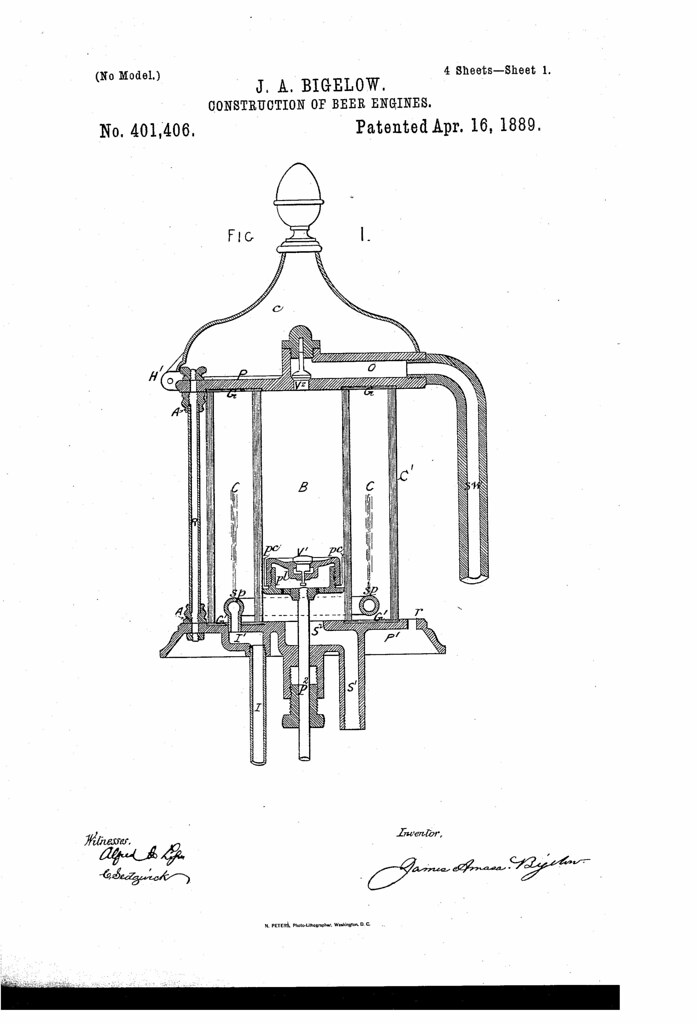
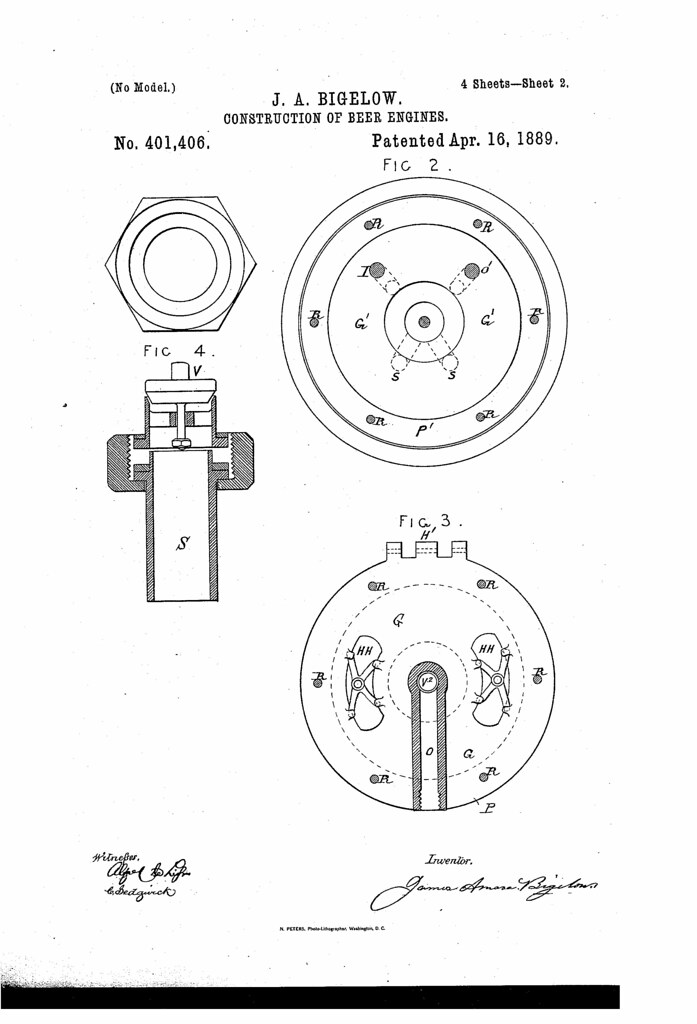
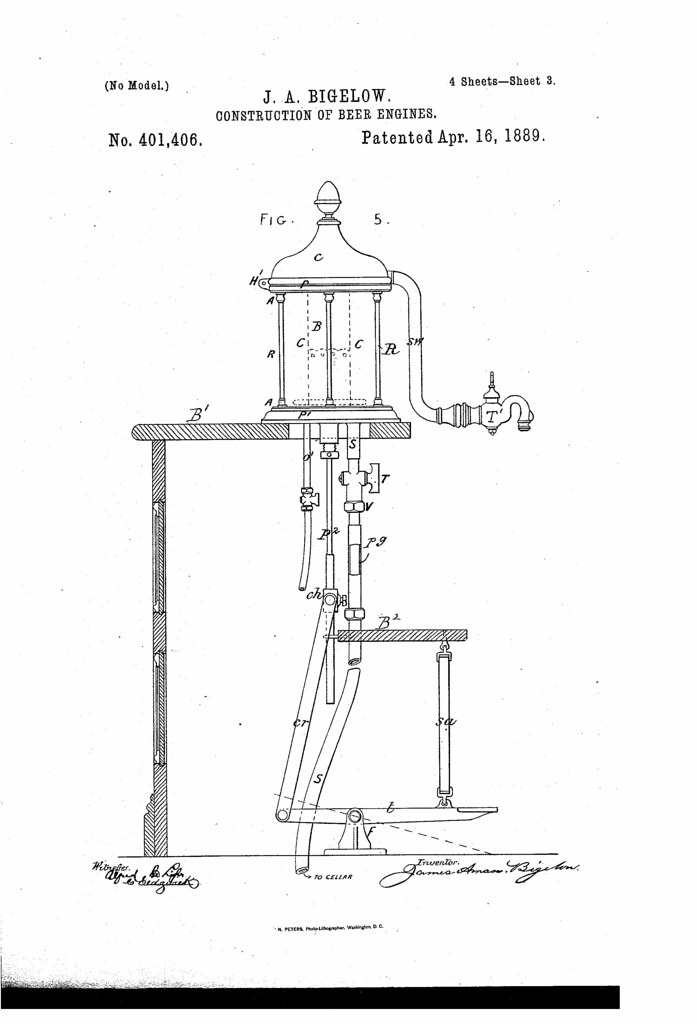
Today in 1889, US Patent 401406 A was issued, an invention of James Amasa Bigelow, for his “Construction Of Beer Engines.” There’s no Abstract, but the description states the following. “My invention relates to apparatus for drawing beer or other liquids from a receptacle in a cellar or adjacent store-room and delivering the same to other receptacles upon a bar counter; and its objects are to provide a simple and efficient apparatus of this character in which the beer or liquids may be cooled or warmed, as desired, and in which also several kinds of beer may be mixed before delivery, and which apparatus may be readily put in order by an unskilled person should any oi` its parts become disarranged during its operation.”

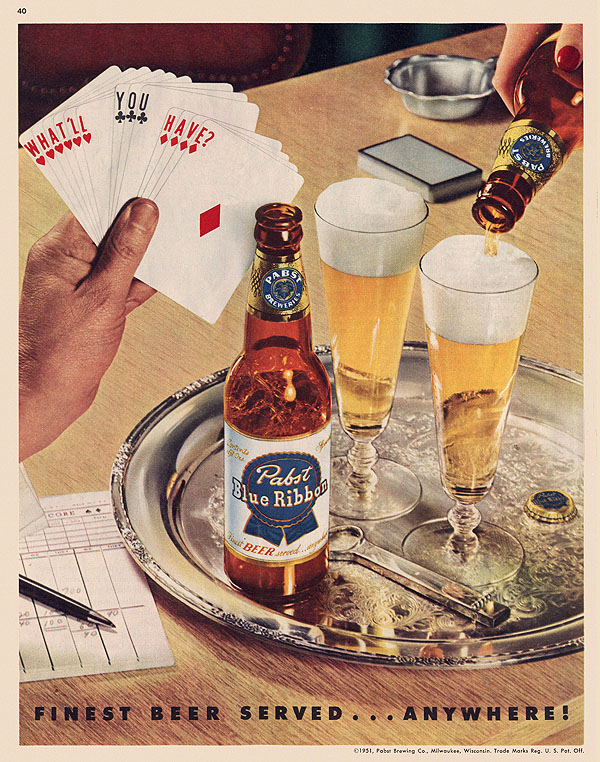
Wednesday’s ad is for Pabst, from 1951. Apparently playing bridge with another couple used to be huge, but it didn’t reach my generation. My parents occasionally had people over to play Pinochle, but never bridge as far as I know. So I don’t even know if that’s a good hand.
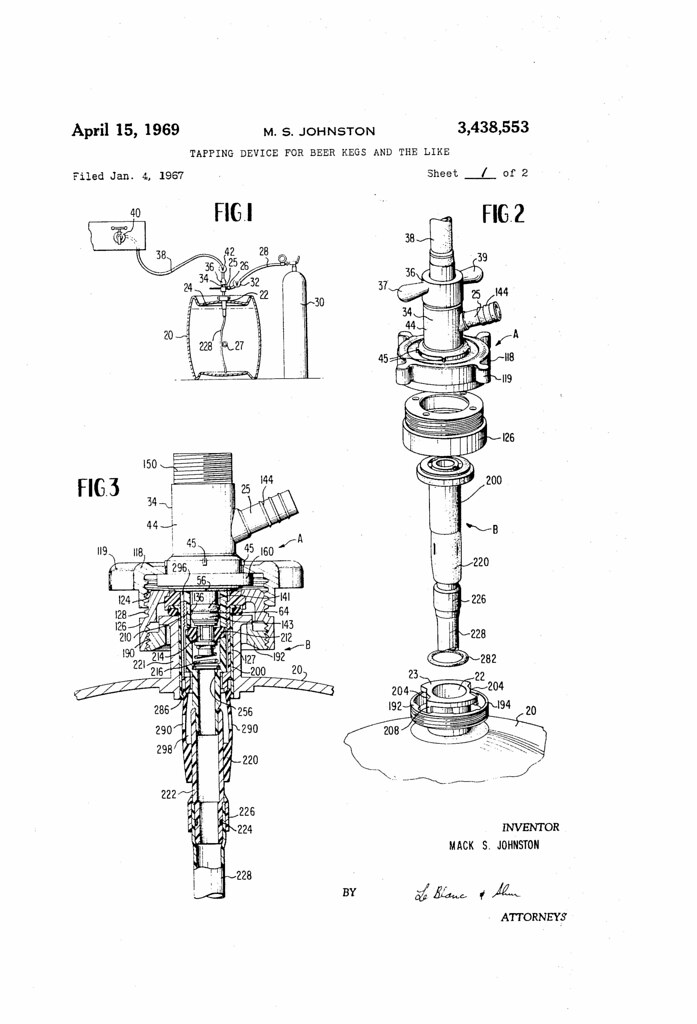
Today in 1969, US Patent 3438553 A was issued, an invention of Mack S. Johnston, for his “Tapping Device for Beer Kegs and the Like.” There’s no Abstract, but the description states the following. “This invention relates to a new and improved tapping device for drawing liquids such as beer from containers such as beer kegs or barrels, using a gas to drive the fluid from the container. In particular, the invention relates to a new improved tapping device usable with conventional beer kegs such as the so-called peerless and golden gate systems, and comprises a sub-unit called a keg adapter which constantly seals the keg, and another sub-unit called a coupler which it attached to the beer dispensing apparatus in a restaurant or tavern and is readily connected to the keg adapter so that the tapping device is automatically in operating condition.”

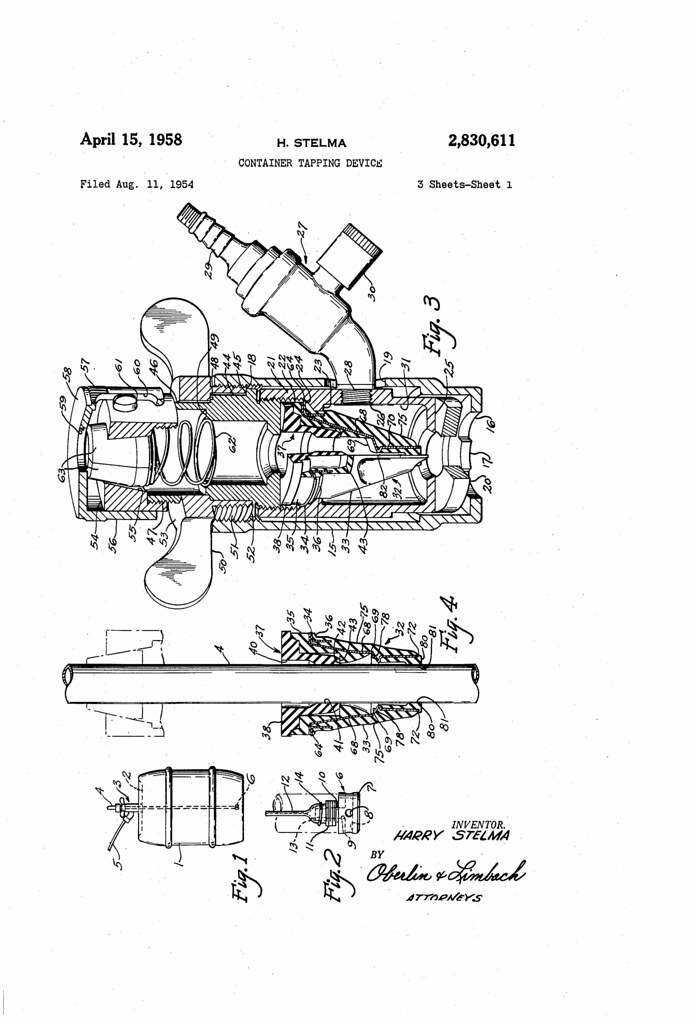
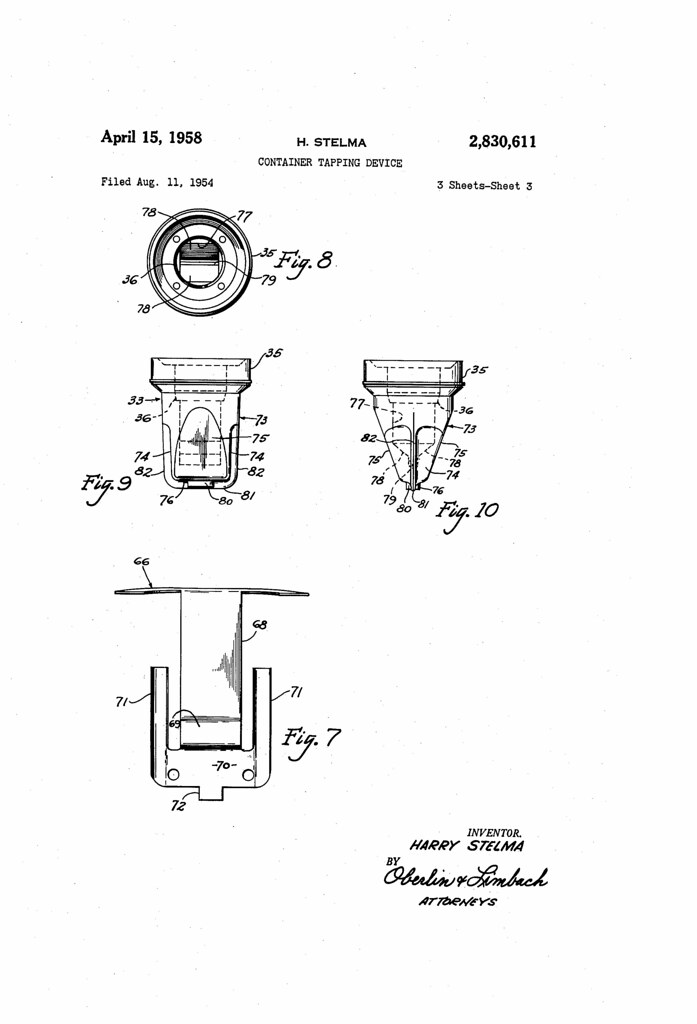
Today in 1958, US Patent 2830611 A was issued, an invention of Harry Stelma, assigned to the Champion Safe Tap Co., for his “Container Tapping Device.” There’s no Abstract, but the description states it’s an “invention [that] relates, as indicated, to container tapping devices and, more particularly, to an improved device of this nature adapted to be used safely and efficiently to tap containers in which fluid is maintained under pressure,” which continues in greater detail:
My improved tap is intended principally for use in withdrawing beer from the usual kegs in which the beverage is transported and stored and will, accordingly, be considered and described in detail in connection with such an application thereof. As is well-known, considerable care must be exercised in the common practice of tapping a beer keg by using the draft tube to force the bung into the keg, since the resultant release of pressure may tear the tube from the users hands and cause body injury. The tapping device of my invention includes means preventative of such blowing of the draft tube.

Tuesday’s ad is for Schlitz, from 1904. The ad is all text, apart from a small logo in the corner. It’s just a notice that drinking beer will keep you healthy, expressed in the headline as “Beer Keeps One Well.” But wait, there’s more. “It is a noticeable fact that those who brew beer, and who drink what they want of it, are usually healthy men.” But I love tis statement. “The malt and the hops are nerve foods.” Nerve foods?

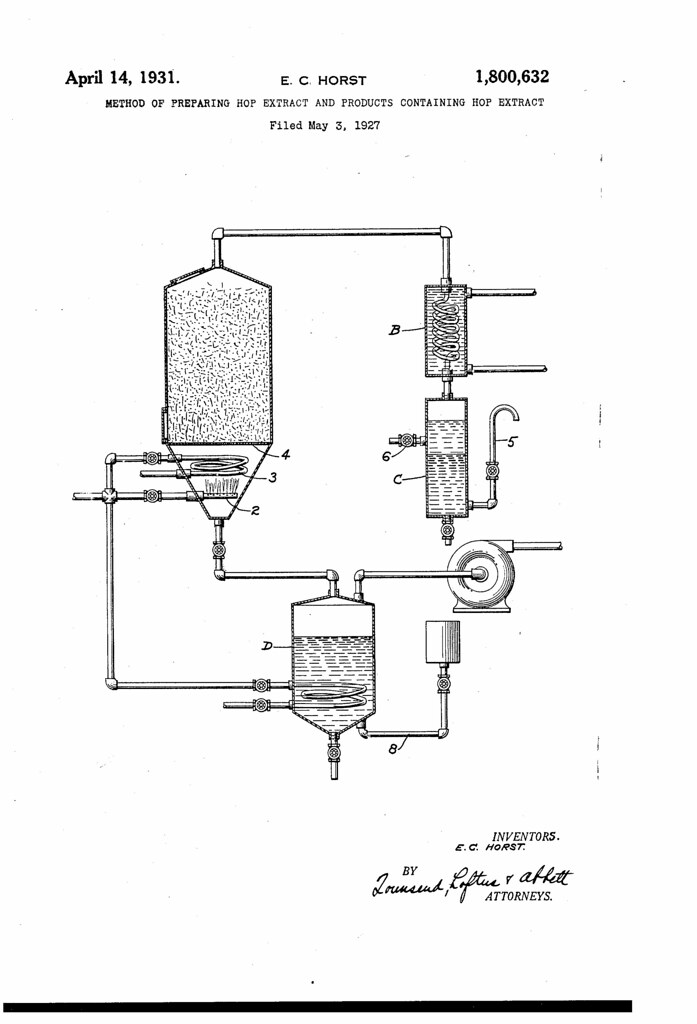
Today in 1931, US Patent 1800632 A was issued, an invention of Emil C. Horst, for his “Method Of Preparing Hop Extract And Products Containing Hop Extract.” There’s no Abstract, but the description says simply it’s an “invention [that] relates to a method of preparing hop extract and the product obtained, the object being to obtain a hop extract containing all the desired constituents of hops of value for the manufacture of non-prohibited cereal beverages and other non-prohibited products.” And here’s how he summarizes it:
The method briefly stated consists first in extracting the volatile matter or oil from the fresh or dried hops. Secondly to extract the bitter constituents consisting of soft resins, the tannins, the coloring matter and the foam producing constituents, and third to combine the volatile oil of the hops and the extract to obtain a product containing all the constituents of hops required for the brewing of cereal beverages.
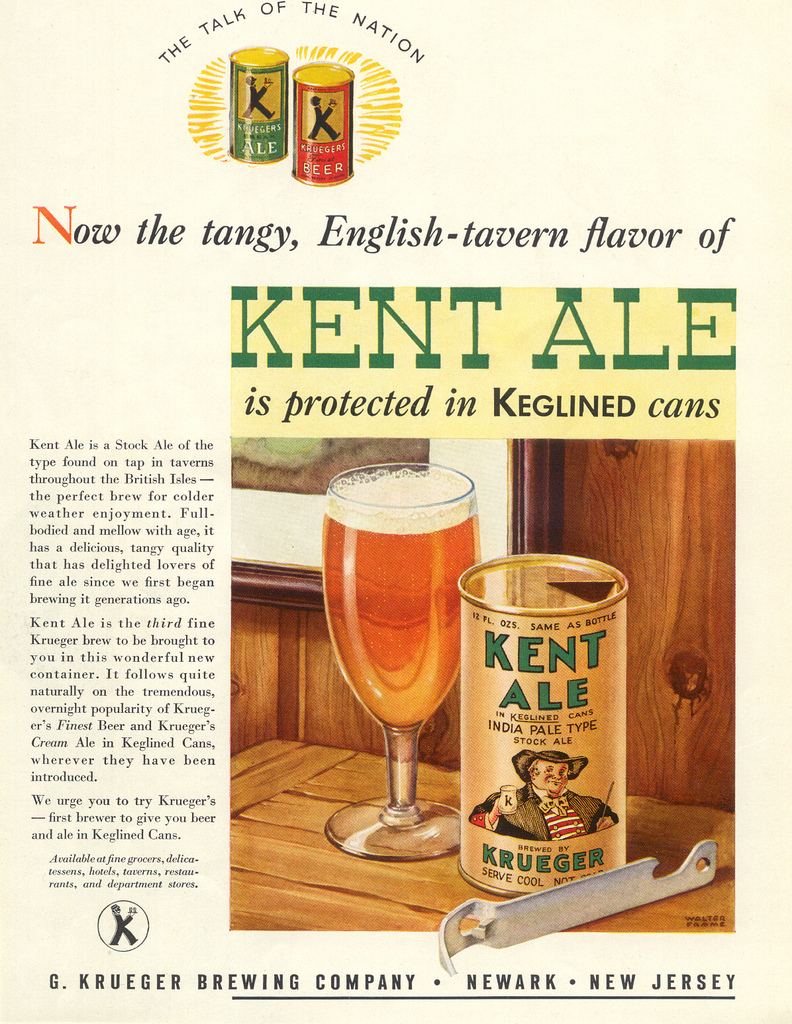
Monday’s ad is for Kent Ale, from 1935. It was made by the G. Krueger Brewing Co., who was the first to debut beer in cans earlier in the same year. Tis was the third of their beers they put in a can, after the first test in their Virginia market was so successful. What’s really interesting is the described the beer as an “India Pale Type Stock Ale,” which apparently has “tangy, English-tavern flavor.” I would have liked to have tasted that one.
Today in 1937, US Patent 2076893 A was issued, an invention of Aron E Johnson, for his “Beer Dispenser.” There’s no Abstract, but the description says simply it’s an “invention relat[ing] to improvements in beer dispensers and aims primarily to provide a beer dispenser especially designed and constructed to avoid the defects previously existent in devices of this type.” Here’s the full story:
The beer dispensers heretofore in use have been defective in that no cushioning means was provided between their outer casings and their fragile beer containers, which in consequence resulted in 1o frequent breakage of the latter. Further, no provision was made heretofore for insulating the covers of such dispensers, hence the contents of the latter became warm and flat in a comparatively short time. Furthermore, no provision was made heretofore for sealing the covers and faucets of these beer dispensers, which fact resulted in the tampering with the contents of the same during the transportation thereof from the producing plants to the consumers.
The present invention, therefore, has for its purpose to obviate the above described defects. This has been primarily attained by providing cushioning means between the lower end of the outer casing and the fragile beer container, thus minimizing breakage of the latter, also by providing the present dispenser with an insulated cover which `protects the beer from becoming warm and at, and also by providing sealing means for the cover and faucet of the instant dispenser which effectively and positively prevents tampering with its contents during transportation, all of which features are to be correlated in the broad aim of enhancing the efficiency of the device for the uses and purposes for which it is primarily designed and intended.
