
Today’s beer video is essentially an animated version of an infographic entitled the American Beer Revival, created by Visual.ly.
The American Beer Revival from visually on Vimeo.

Today’s beer video is essentially an animated version of an infographic entitled the American Beer Revival, created by Visual.ly.
The American Beer Revival from visually on Vimeo.

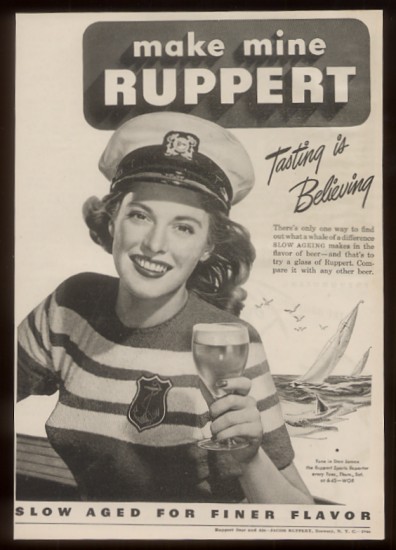
Saturday’s ad is for Jacob Ruppert Beer, from maybe the 1950s. I love the tagline, “Tasting is Believing,” but even better is the line at the bottom of the ad. “Slow Aged for Finer Flavor.” BUt I don’t know about the model, dressed in a nautical blouse with a captain’s hat on her head. She looks like she’s really there beachside as the boats put out. That I’m not believing.

Perhaps it’s why I became a writer, but I’ve always been fascinated by languages, and especially different alphabets. They always seemed like secret codes, and few more so than Egyptian hieroglyphics. Hieroglyphics are, of course, one of the earliest forms of written communication. They were once thought to be the oldest form, but more recent evidence seems to suggest that Sumerian writing most likely predates the Egyptian writing, and that they probably developed independently.
Not surprisingly, since beer was so important at the dawn of civilization, even though the number of individual hieroglyphics was limited (compared to modern vocabularies) there were several beer-specific hieroglyphics. How many there are is uncertain. E.A. Wallis Budge compiled a list of over 1,000 that was published in various forms between the late 1890s and 1920. But the standard reference is generally thought to be Gardiner’s Sign List, created by British Egyptologist Sir Alan Gardiner in the 1950s, containing around 750 common form hieroglyphics from the Middle Egyptian language.
Gardiner’s Sign List is organized into 26 categories that are assigned a letter and then a number to keep them straight. For example, “E” is for “mammals” and E6 is a “horse.”

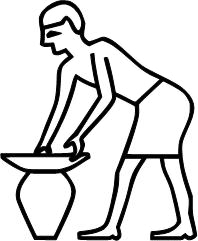
So here are the Egyptian hieroglyphics that have to do with beer and brewing, at least from the Gardiner’s Sign List. I’ve also included different views of the same hieroglyphic, that is different ways that it was written or expressed. The Letter and Number is, of course, how each is classified in the Gardiner’s Sign List.
Alternative Images:




Alternative Images:




Alternative Images:



Alternative Images:



Alternative Images:





Alternative Images:





Alternative Images:






Today’s beer video is a short little animated film by Pedro Conti entitled One More Beer! Shot and sweet, and pretty funny.
One More Beer! from pedro conti on Vimeo.
Friday’s ad is another one for Budweiser, this one from 1969. Showing a stubbie bottle of Budweiser bookended by a pair of actual Clydesdales bookends. My daughter would love those. As to whether “reading” the label makes the beer better and helps you “appreciate” it more, I’m not terribly convinced.

Today’s beer video is a cute little film showing the 10 Biggest Beer Drinking Countries, produced by All Time 10s. I’m not sure where their exact data comes from, but it’s the usual suspects that make the list.

I’m not sure what my fascination with spelunking is, apart from enjoying it as a kid, but the number of brewery caves certainly adds a new dimension of interest. Last year, my post Brewery Caves dipped its toe into the subject, and recently I noticed there’s even more out there about it. For example, the James River Steam Brewery in Richmond, Virginia was built in 1886, right along the bank of the titular James River. The brewery also included a brewery cave and remnants of it can still be seen. The brewery only lasted thirteen years, closing in 1879, falling prey to a post-civil war depression “caused by the railroad credit crisis.” Interestingly, it was “was founded by David G. Yuengling Jr., son of the founder of the D.G. Yuengling and Son Brewery in Pottsville, Pennsylvania.” Earlier this month, the site of the James River Steam Brewery was added to the register of historic places, meaning at some point it may be open to visit or perhaps a museum will be built around it. Drinks Business has more on the story.
Perhaps more interesting is that the British publication Brewery History devoted an entire issue to American brewery architecture. It’s the current issue and you can order a copy from the website. Issue 155 contains five articles spanning lagering caves, preeminent architects and the redevelopment of redundant breweries. To get a flavor for the issue, you can download a pdf of the Introduction by guest editor Susan K. Appel. The other articles include “Stahlmann’s Cellars: a large American lagering cave from the 19th-century,” and “An examination of the Lemp Brewery Cave.” See the Table of Contents for a full list of the articles.
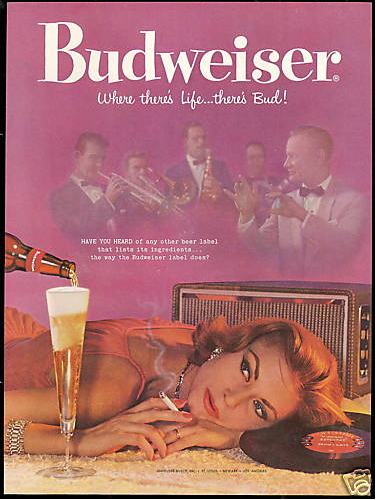
Thursday’s ad is for Budweiser, from 1958. It’s seedy, steamy setting of seduction. A sultry, well-made up, siren lies on a shag carpet, cigarette in hand, its smoke wafting into the air. Using an LP (remember those, kiddies?) for a pillow, she glances up to see a bottle of beer being poured into a glass for her. She’s apparently hallucinating, too, as a jazz band can be seen floating in the air just above the radio/stereo system behind her head. Does that mean she’s had quite enough to drink already, despite being poured another? Frankly, I think she looks a bit too much like Agnes Moorehead from her later years, circa “Endora” from Bewitched.
Today’s beer video is a nice overview of the malting process by which raw barley is turned into brewing malt to make beer. Malting Barley — Malting Process walks you through the malting steps. It was created by the Malt Academy, which is part of the “Canadian Malting Barley Technical Centre, a non-profit, independent organization that was set up to provide technical assistance to the malting barley and brewing industries.” If you want to see more or go father in depth, they have even more videos on YouTube.

Here’s an interesting list from Mental Floss concerning something most of us rarely think about. What did the few American breweries that managed to keep the doors open during prohibition do? Some of the products they continued to make included.
But check out Mental Floss’ How Breweries Kept Busy During Prohibition for a fuller explanation.