Brookston Beer Bulletin

Jay R. Brooks on Beer

  • Home
  • About
  • Editorial
  • Birthdays
  • Art & Beer

Socialize

  • Dribbble
  • Email
  • Facebook
  • Flickr
  • GitHub
  • Instagram
  • LinkedIn
  • Pinterest
  • RSS
  • Twitter
  • YouTube

Powered by Genesis

Craft Beer Grows 11% In Volume

March 21, 2011 By Jay Brooks

ba
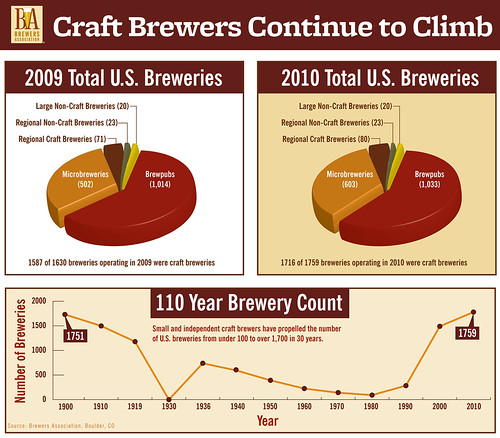
The Brewers Association just announced the statistics of craft beer sales in 2010, and the news is great. Craft beer saw volume growth of 11% over 2009, and in terms of dollars the increase was 12%, equating to roughly an additional one million barrels, or 14 million cases.

From the press release:

“Beer lovers increased their appreciation for American craft brewers and their beers in 2010,” said Paul Gatza, director, Brewers Association. “Craft brewers’ stories resonate with Americans who are choosing small, independent companies making delicious beers in more than 100 different styles.”

The Association also reported a growth in the number of U.S. breweries, with eight percent more breweries than the previous year. In 2010, there were 1,759 operating breweries. Craft brewers produced 9,951,956 barrels, up from an adjusted3 8,934,446 barrels in 2009.

“Prohibition caused a dramatic decline in the number of breweries in the United States, but the number of breweries is now at an all-time high,” added Gatza. “With well over 100 new brewery openings in 2010, plus 618 breweries in planning stages, all signs point to continued growth for the industry.”
Total Breweries

In 2010, craft brewers represented 4.9 percent of volume and 7.6 percent of retail dollars of the total U.S. beer category. The Brewers Association estimates the actual dollar sales figure from craft brewers in 2010 was $7.6 billion, up from $7 billion in 2009.

Overall, the U.S. beer industry represented an estimated retail dollar value of $101 billion. U.S. beer sales were down approximately one percent, or 2 million barrels, in 2010 compared to being down 2.2 percent in 2009. Total beer industry barrels dropped to 203.6 million, down from 205.7 million barrels in 2009. Imports were up five percent in 2010, compared to being down 9.8 percent in 2009. (Note: the Brewers Association does not count flavored malt beverages as beer.)

Gatza added, “We also found that three percent of craft brewer barrels, by volume, are distributed in cans, confirming a growing trend.”

It’s always great to have confirmed what we see in the street, that most, if not all, craft brewers are doing well. Another great year of craft beer growth. Congratulations to everybody.

Filed Under: Breweries, News Tagged With: Brewers Association, Press Release, Statistics

Beerstrology Sign: Aries

March 21, 2011 By Jay Brooks

zodiac
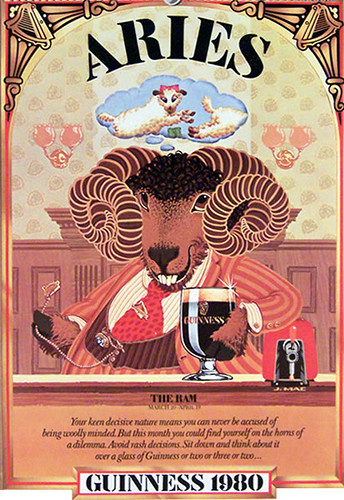
While I don’t put any stock in astrology, in 1980 Guinness put out a calendar with each month representing one of the zodiac signs, and I thought it would be fun to share these throughout the year.

Aries, the water-bearer, is from March 21-April 19. To learn more, see:

  • Astrology Online
  • Universal Psychic Guild
  • Wikipedia
  • Zodiac Signs

Guinness-zodiac-03-aries

Filed Under: Art & Beer, Just For Fun Tagged With: Beerstrology, Guinness

Beer In Art #119: Pablo Picasso’s Glass and Bottle of Bass

March 20, 2011 By Jay Brooks

art-beer
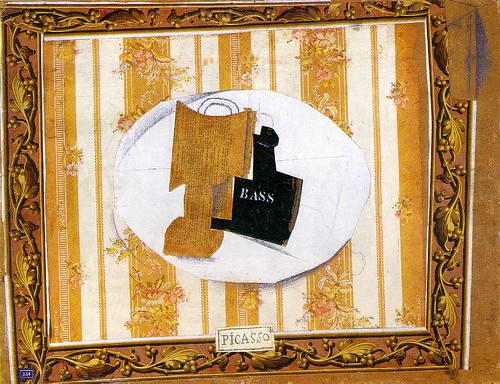
This week’s work of art is by Pablo Picsasso, created using pasted paper and charcoal on cardboard in the Spring of 1914. It’s title is Glass and Bottle of Bass. Though it certainly doesn’t look like any bottle of Bass Ale I’ve ever seen.

Picasso-gls_bass

There’s a biography of Picasso at Wikipedia and also Biography.com. You can also see more of Picasso’s art at Olga’s Gallery, ArtArchive and the ArtCyclopedia. Then there’s Picasso.com and his “official” website.

Filed Under: Art & Beer, Beers Tagged With: Bass, Spain

Beer Making Is Marvel Of Industrial Chemistry

March 20, 2011 By Jay Brooks

copper-kettle
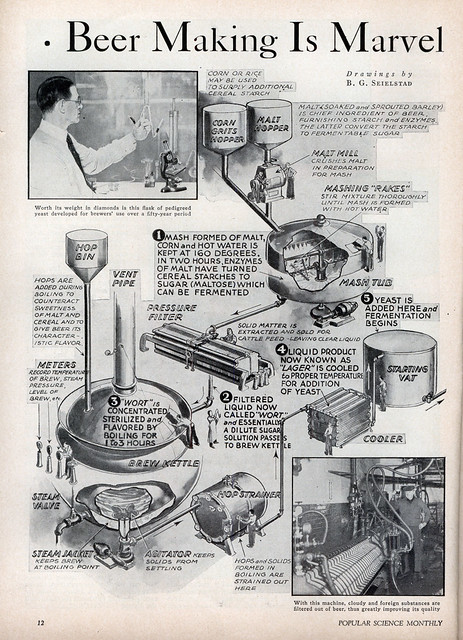
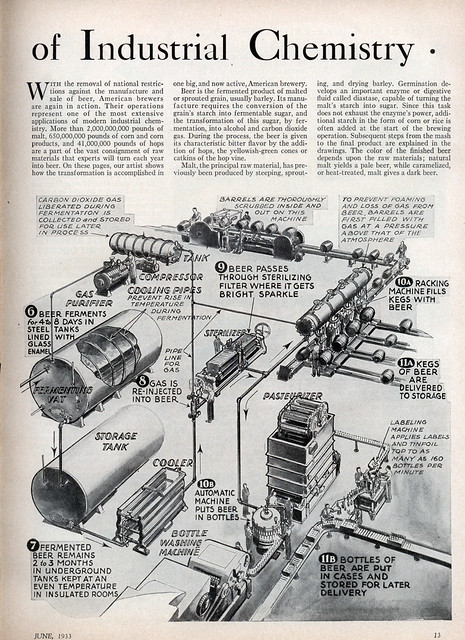
In June of 1933, just as Prohibition was in its death throes, that month’s issue of Popular Science magazine ran a two-page spread entitled Beer Making Is Marvel Of Industrial Chemistry, illustrated by Benjamin Goodwin Seielstad. It’s great fun to see it all laid out the way it’s done here. It seems like they were laying the groundwork for the return of brewing in America.

beer_making_1

There’s not a great deal of text accompanying the chart, but here it is in its entirety, from page two of the beer making chart:

With the removal of national restrictions against the manufacture and sale of beer, American brewers are again in action. Their operations represent one of the most extensive applications of modern industrial chemistry. More than 2,000,000,000 pounds of malt, 650,000,000 pounds of corn and corn products, and 41,000,000 pounds of hops are a part of the vast consignment of raw materials that experts will turn each year into beer. On these pages, our artist shows how the transformation is accomplished in one big, and now active, American brewery.

Beer is the fermented product of malted or sprouted grain, usually barley. Its manufacture requires the conversion of the grain’s starch into fermentable sugar, and the transformation of this sugar, by fermentation, into alcohol and carbon dioxide gas. During the process, the beer is given its characteristic bitter flavor by the addition of hops, the yellowish-green cones or catkins of the hop vine.

Malt, the principal raw material, has previously been produced by steeping, sprouting, and drying barley. Germination develops an important enzyme or digestive fluid called diastase, capable of turning the malt’s starch into sugar. Since this task does not exhaust the enzyme’s power, additional starch in the form of corn or rice is often added at the start of the brewing operation. Subsequent steps from the mash to the final product are explained in the drawings. The color of the finished beer depends upon the raw materials; natural malt yields a pale beer, while caramelized, or heat-treated, malt gives a dark beer.

beer_making_2

Filed Under: Breweries, Just For Fun Tagged With: History, Science of Brewing

Guinness Ad #60: Aim For A Guinness

March 19, 2011 By Jay Brooks

guinness-toucan
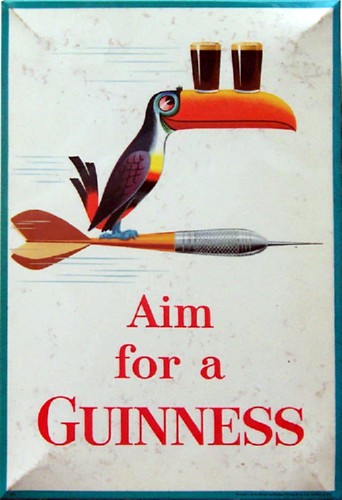
Our 60th Guinness ad shows the iconic toucan riding a dart on its way to the dartboard, all the while holding two pints of Guinness on its beak. The slogan isn’t one of the regular ones, but is specific to the ad itself: “Aim For A Guinness.”

Guinness-aim

Filed Under: Art & Beer, Beers Tagged With: Advertising, Guinness, History

Beer In Ads #334: Ballantine Beer Is Deep-Brewed

March 18, 2011 By Jay Brooks

ad-billboard
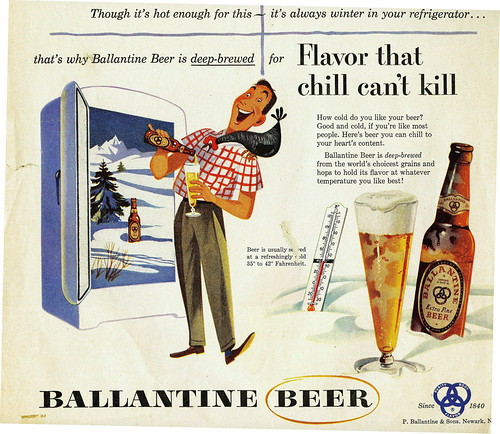
Friday’s ad is another Ballantine ad from, I’m guessing here, the late 50s or early 60s. I love the suggestion that Ballantine is “deep-brewed,” whatever that might mean. And I can’t help but wonder: what the hell is that rooster doing on his shoulder as he pours his beer?

Ballantine-frig-horoz

Filed Under: Art & Beer, Beers Tagged With: Advertising, Ballantine, History

Beer In Ads #333: Ballantine Green

March 17, 2011 By Jay Brooks

ad-billboard
Thursday’s ad is from 1949, a Ballantine ad that’s all green, in honor of St. Patrick’s Day. My initial thought is that it was printed in a magazine that wasn’t full color but instead used spot color, in this case black and green. But it works pretty well. And I love the slogan: “A flavor you will find in no other beverage.”

Ballantine-1949-green

Filed Under: Art & Beer, Beers Tagged With: Advertising, Ballantine, History

Food & Drink’s 50 Most Important Discoveries & Inventions

March 17, 2011 By Jay Brooks

sliced-bread
The Daily Meal, a food-oriented website, has come up with a list of The 50 Most Important Inventions (and Discoveries) in Food and Drink. It’s a pretty interesting list, and at the very least got me thinking about how much we take for granted and how important so many of those simple items are to the enjoyment of our lives.

The process of creating the list began with saying to yourself. “I simply couldn’t cook without my….”

Everybody who prepares food at home (or professionally, for that matter) has an implement or appliance or five or ten of them that they consider essential to their culinary practices. But how many of these things really matter in the larger scheme of things? How many are truly essential, or at least very important, to the preparation — and the ultimate consumption — of food (and let’s throw drink in here as well, just to wash it all down with)?

We were sitting around talking about this one day and came up with the obvious candidates: pots and pans, the knife, the oven, the (hey, we’re up-to-date around here) food processor… Then somebody said, well, what about the things nobody invented but somebody figured out or harnessed — like, er, fire, without which cooking as we understand it would never have been born? And what about methods of collecting food, means of storing or preserving it, ways of taming it? We started making a list, including not just things we have in our own kitchens (salt, four-sided grater) but also natural phenomena (fermentation) and specialized tools (sous-vide equipment — which we don’t have in our own kitchens yet).

We decided to leave out foodstuffs — miraculous innovations that became veritable building blocks of civilization, like bread, wine, cheese, vinegar, bacon-cheeseburgers — though we did include two substances that we ingest, salt and gelling agents. We left out all the vehicles and devices with which food is planted and harvested (with one exception; see below); we omitted broad concepts like the domestication of animals and the development of genetic studies, though both have obviously had enormous effect on what and how we eat (among other things); we decided not to include means of conveying information about food, from the book to the iPad.

What we ended up with is a list of things that we, yes, simply couldn’t cook — or eat and/or drink — without. As usual with such compendiums, we have been both selective and subjective. We’ve probably missed some obvious and vital items, and we have frankly allowed ourselves to have a little fun here and there. Should you decide to assemble such a list yourself, of course, it would almost certainly not be the same as ours.

Here’s the first five:

  1. Salt
  2. Fire
  3. The Knife
  4. The Spoon
  5. The Pot

All pretty important, no doubt. And at number 6? Drum roll, please …

  • 6. Fermentation

Awesome, well-deserved. Seven more alcohol-related items also made the list.

  • 9. The Barrel
  • 10. Wine Press
  • 13. Distillation
  • 18. Cork
  • 25. Pasteurization
  • 26. Refrigeration
  • 50. The Pull-Tab

Some other faves that made the cut included the blender, the restaurant and the fork. Personally, I would have put the Deep-Fryer higher than 32, but then I probably eat fried food every day. But it’s a fun list, despite many commenters taking it way too seriously. Here you can see the full list. But I have to ask, why do we always say something is the best thing since sliced bread. Besides that, what would you add?

Filed Under: Food & Beer, Just For Fun, Related Pleasures

The Birthplace Of Craft Brewing: Colorado?

March 17, 2011 By Jay Brooks

colorado
I should say at the outset that I love Colorado. I go there at least once a year, have many beer friends and colleagues there. There are many, many great breweries there and their beer culture should be celebrated. Of that, I believe there can be no doubt. And in fact, a new documentary film is seeking to do just that, a laudable enterprise. The title is Beer Culture: the Movie, and the idea behind it is the following. “Beer Culture is a documentary film about the growing rich American Culture in Craft Beer by telling the inspirational stories of unwavering motivation by some of Colorado’s top Brewers.” It’s release date is Summer 2011. Frankly, I can’t wait, it looks great. Free Mind Productions should be proud of what they’ve done so far. They’ve also just released a new trailer with tons of great teasers, and lots of great people being interviewed, including Colorado governor John Hickenlooper, Eric Wallace, Marty Jones and Charlie Papazian.

But then at just past the one minute mark, one of the interviewees — I’m not sure who it is — says the following. “Pretty much everybody thinks of Colorado as the birthplace of craft brewing.” Really? Um, did I miss a meeting? That just sticks in my craw. Hyperbole is one thing, but that’s simply a false statement that is just not true. I know the producers didn’t say it, but they’re sure seizing it on it to promote their film. It’s not one of those subjective facts that people can interpret different ways, like who brewed the first Black IPA. We know Fritz Maytag bought the ailing Anchor Brewery in 1965 and turned into what it is today. We know Jack McAuliffe incorporated New Albion Brewery in Sonoma, California in October of 1976 and built the first modern microbrewery from scratch. Colorado’s first microbrewery was the Boulder Beer Company, which was founded in September of 1979. Those are the facts, plain and simple.

Maybe I’m being oversensitive, but I don’t think so. Last week, John Kerry was quoted in a press release about the new BEER Act that’s been introduced in the Senate that the “craft beer revolution started right here in Massachusetts.” Now this. I believe that Colorado has much to celebrate with its beer culture, but it doesn’t really need to take liberties with the truth to do that. It doesn’t need to throw California’s contributions under the bus to raise up its own. I don’t really feel like I should have to protect California’s place in the history of craft brewing. It seems like it should be fairly secure and unassailable, but here we are. I hope enough people will see fit to point this out to the producers of Beer Culture and they’ll remove it from the movie. They don’t need to keep something so blatantly untrue in there and for me, at least, it just mars the film’s credibility. The story of Colorado’s craft beer scene is a great and worthy subject for a movie, but it can only be improved by sticking to the facts … and the beer.

Filed Under: Beers, Breweries, Editorial Tagged With: Bay Area, California, Colorado, Video

Beer In Ads #332: For A Better Day

March 16, 2011 By Jay Brooks

ad-billboard
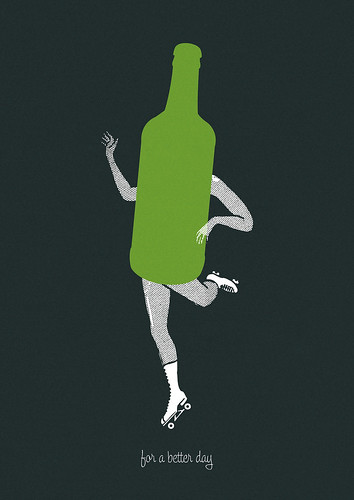
Wednesday’s ad is an odd one, I’m not really sure what the ad was for, or indeed if it’s even an add at all. But still, it’s a great image of the green bottle with legs and arms and the tagline “for a better day.” The artist’s name is apparently Assuma, but that’s about all I know.

assuma-for-a-better-day

Filed Under: Art & Beer, Beers Tagged With: Advertising

« Previous Page
Next Page »

Find Something

Northern California Breweries

Please consider purchasing my latest book, California Breweries North, available from Amazon, or ask for it at your local bookstore.

Recent Comments

  • Bob Paolino on Beer Birthday: Grant Johnston
  • Gambrinus on Historic Beer Birthday: A.J. Houghton
  • Ernie Dewing on Historic Beer Birthday: Charles William Bergner 
  • Steve 'Pudgy' De Rose on Historic Beer Birthday: Jacob Schmidt
  • Jay Brooks on Beer Birthday: Bill Owens

Recent Posts

  • Beer In Ads #5205: Moerlein’s Celebrated Bock Beer, An Easy Winner April 5, 2026
  • Historic Beer Birthday: Fritz Funke April 4, 2026
  • Historic Beer Birthday: Herman Zibold April 4, 2026
  • Beer In Ads #5204: Bock Beer! The First Genuine Bock Of The Season April 4, 2026
  • Historic Beer Birthday: Marcus Rapp April 4, 2026

BBB Archives

Feedback

Head Quarter
This site is hosted and maintained by H25Q.dev. Any questions or comments for the webmaster can be directed here.