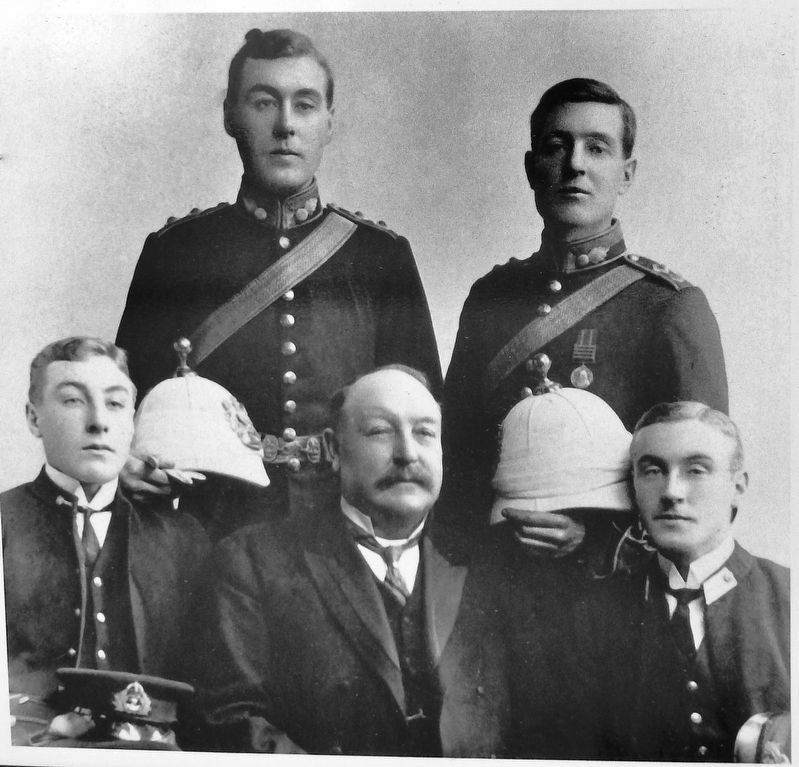
Today is the birthday of Conrad George Oland (March 13, 1851-December 12, 1917). He was born in Trowbridge, Wiltshire, England, and was the son of Susannah Oland, who founded what today is Moosehead Breweries. It was known by several names before 1947, such as S. Oland & Sons Brewery, the Turtle Grove Brewery, and the Army & Navy Brewery. His mother trained both him and his younger brother to brew beer, but after her death it was his younger brother that took over the brewery. In 1917, their brewery was near the famous Halifax Explosion, and windows were shattered and walls collapsed, and Conrad died from shock during the explosion, along with six additional employees.
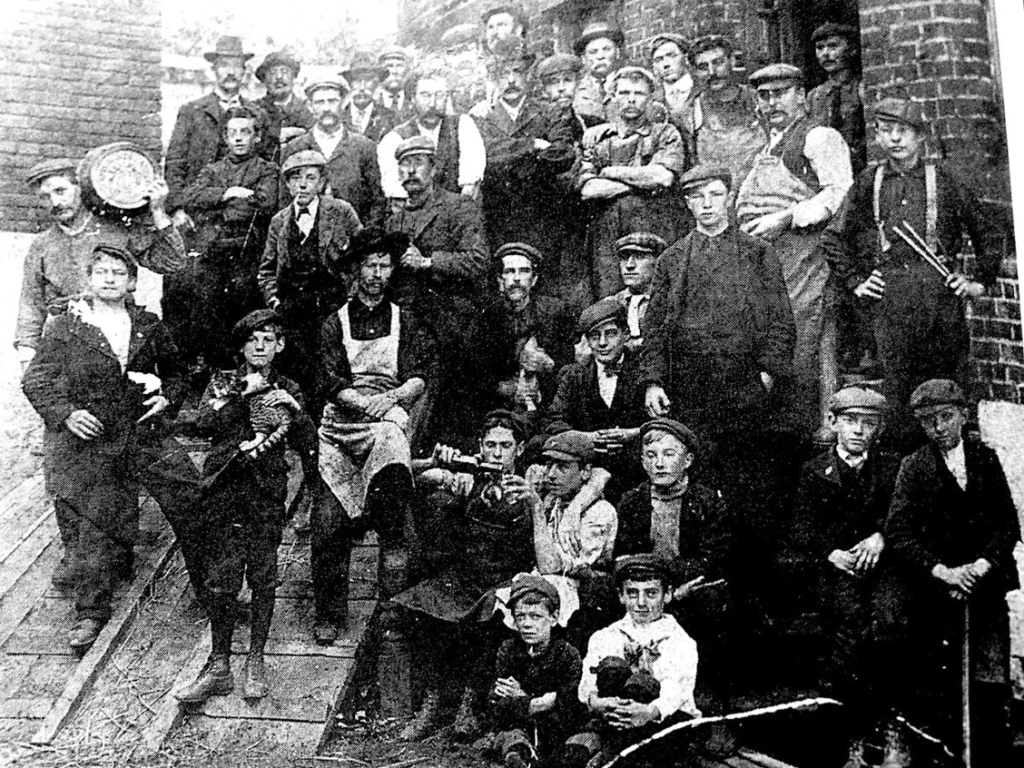
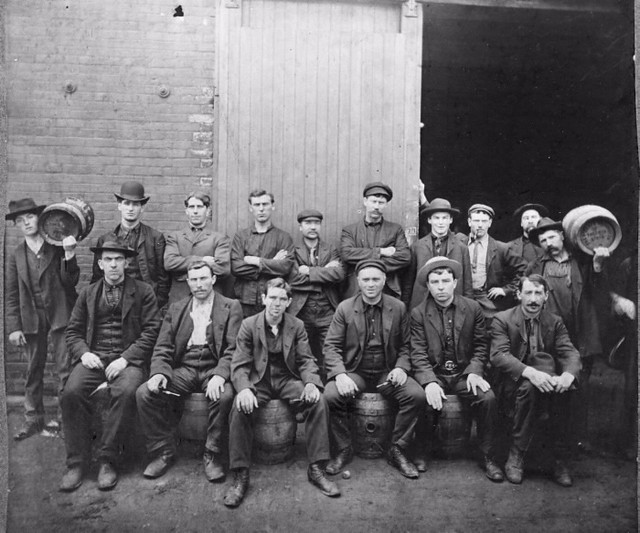
Turtle Grove Brewery workers in 1890.
And this account of his parents Susannah and John is from the Canadian Encyclopedia:
The Turtle Grove Brewery in Halifax after the explosion where Conrad George Oland died.
By 1867, the Oland family had moved to Dartmouth. Struggling financially, Susannah supplemented what little money John earned by making beer in the shed at the back of their Dartmouth property, using an old family recipe. Her October brown ale proved to be so popular with the local inhabitants that a family friend, Captain Francis Walter DeWinton (1835–1901), suggested brewing on a larger scale. DeWinton, along with two other investors, provided the funds to start a commercial brewery. Because they began the business in the Turtle Grove area of Dartmouth — a Mi’kmaq community — the brewery was named Turtle Grove Brewery.The company was incorporated on 1 October 1867. On paper, John Oland was manager of the business, but in reality, Susannah oversaw virtually every aspect of its day-to-day operations. By many accounts, she supervised the brewing process, which was undertaken with the help of her three sons.
The new commercial brewery was situated on a 12.5-acre plot with 300 feet of frontage on Halifax Harbour. Halifax was ideal for a budding brewer because of the pronounced military and naval presence. Beer had long been part of the life in the armed forces. During the War of the Spanish Succession (1701–1714), the Duke of Marlborough, commander of the British forces, proclaimed: “No soldier can fight unless he is properly fed on beef and beer.” British authorities accepted Marlborough’s statement as gospel, and in the years that followed, British soldiers were given enough “beer money” to purchase five pints of beer a day. This, along with the fact that the overwhelming majority of the civilian population in Dartmouth and Halifax could trace its ancestry to the beer-drinking cultures of England, Scotland, and Ireland, gave an immediate incentive to anyone like Susannah Oland looking to capitalize on their knowledge of the art of brewing.
Taking advantage of DeWinton’s connections (he was military secretary to the Marquess of Lorne, the governor general of Canada), the brewery quickly grew to be the third-largest business operating in Dartmouth. Tragedy struck in October 1870, however, when John died in a riding accident. To make matters worse, DeWinton was transferred to Gibraltar and the other two partners sold their interests to a manager, George Fraser, who had formerly been employed at a competing brewery. Undaunted, Susannah Oland and her sons continued working at the brewery, which had been renamed the Army and Navy Brewery in honor of its principal patrons.
In 1877, after receiving an inheritance from a relative in England, Susannah Oland bought out Fraser and dissolved the partnership. She began operating the brewery under the name S. Oland, Sons and Company and trained her sons to be brewmasters. She worked at the brewery for the remainder of her life
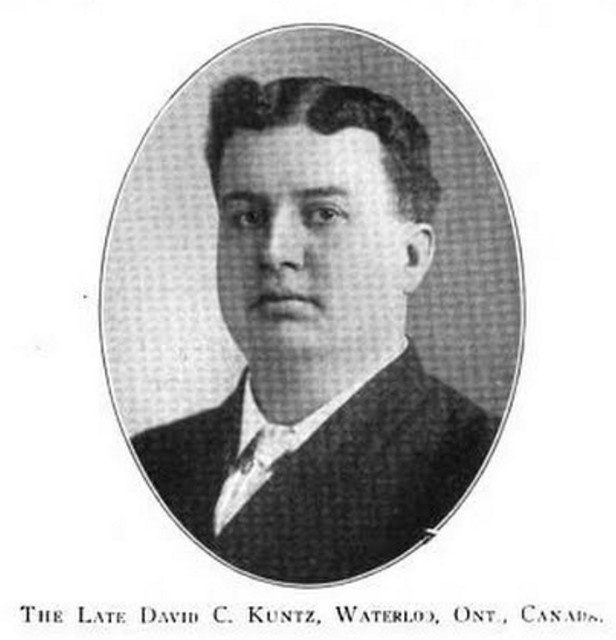
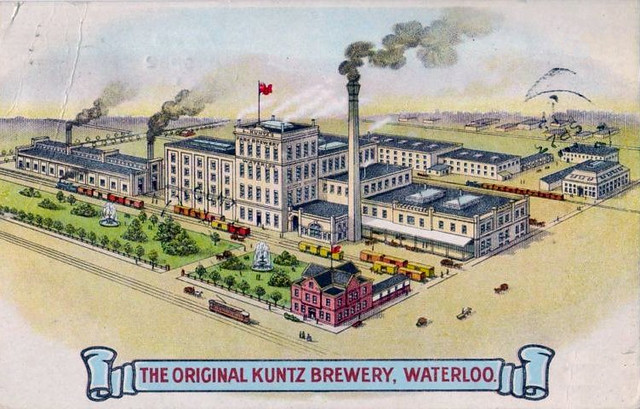
Today is the birthday of David C. Kuntz (February 9, 1877-October 22, 1915). He was born in Waterloo, Ontario, in Canada, and was the grandson of David Kuntz, who established the first brewery in Ontario. He was also the son of Louis Kuntz, David’s son. After the first David Kuntz died, his son Louis Kuntz took over, renaming the the business Louis Kuntz’s Park Brewery, and David C. succeeded his father. Shortly after his passing, in 1930, Canadian Breweries Limited, which had originally been “named Brewing Corporation of Ontario,” was created “by merging The Brading Breweries Limited, an Ottawa company Taylor had inherited from his grandfather, Capital Brewing of Ottawa, and Kuntz Brewery of Waterloo, Ontario.” In 1977 Carling Brewery was purchased by Labatt Breweries of London, but the Waterloo plant was closed by 1993 and all the buildings on the site had been demolished.
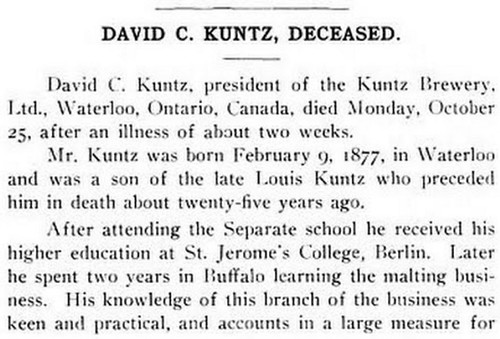
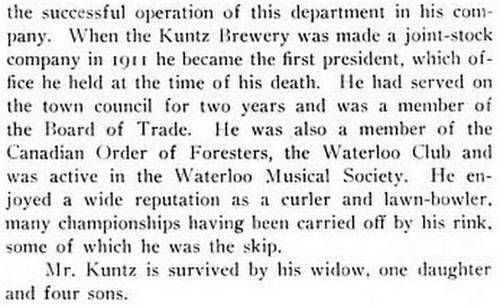
This is his obituary, from the Brewers Journal in 1915:
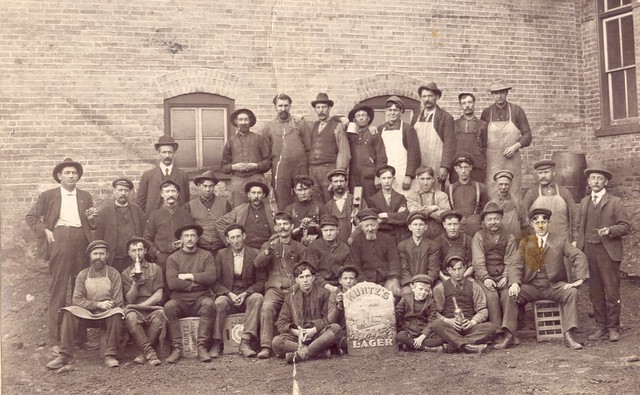
Kuntz brewery works around 1910.
Here’s a brief mention of David C. Kuntz from Flash from the Past: What remains of the Kuntz Brewery legacy?
Louis Kuntz died, aged 39, following an appendectomy in 1891. His children were still young so brother-in-law Frank Bauer, also a brewer, took over. Then David Kuntz died in 1892. Bauer’s own 1895 passing began an almost unbelievable sequence of deaths in the brewery’s management. However, business success continued and in 1910 David Kuntz Jr., Louis’ son, took over. He also died young, 38, in 1915 so his two brothers, Herbert and William stepped in.
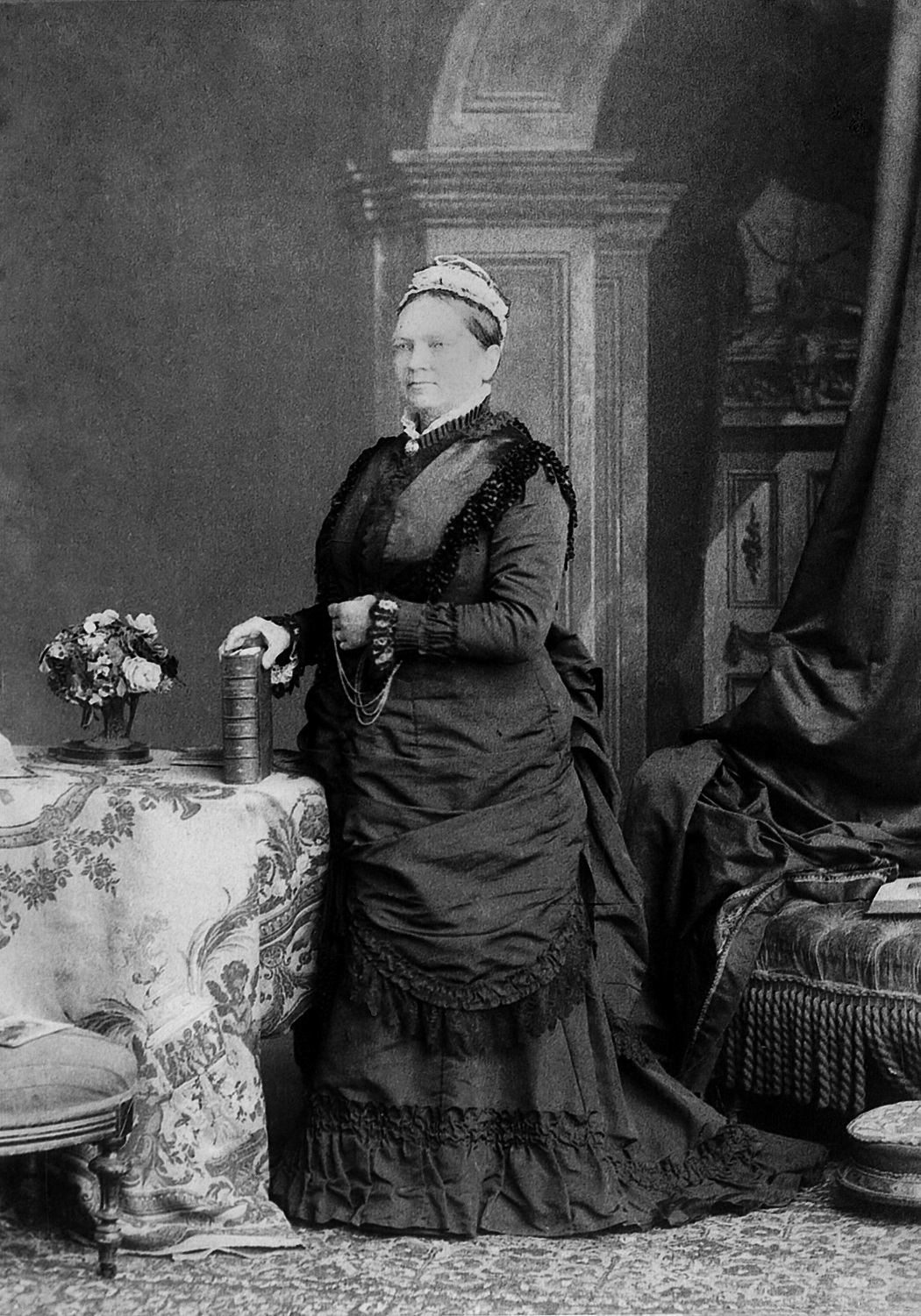
Today is the birthday of Susannah Oland (February 7, 1818-March 24, 1885). “She was the creator of a beer recipe which became the basis for founding Canada’s oldest independent brewery, Moosehead Brewery. Though she was credited with running the operation as well as acting as chief brewer, the business was incorporated in the name of her husband and sons. When her husband died, the partners sold their interests to a manager, whom Oland was able to buy out eight years later. She continued running the business until her death” in 1885. The business remains in the Oland family to this day.
John supposedly studied as an Anglican minister at Cambridge, but worked as a tobacconist and a dealer in tea and beer in Bristol after he and Susannah married. He filed bankruptcy in 1844, and then studied accounting, going to work at the London and South Western Railway. By 1851, the family had reestablished themselves sufficiently to hire a servant girl and a nurse, and were living in Trowbridge, Wiltshire, England. A decade later, the family of nine was farming near Hawley, by Farnborough, Surrey (now in Hampshire), England. In 1862, John immigrated to Nova Scotia, Canada, leaving Susannah to tend the farm and family. He was employed with the Nova Scotia Railway, a part of the intercontinental railway project and she brewed beer. Within three years, the family was reunited and rented a house in Dartmouth, where Susannah set up her brewing operation in the garden shed behind their home.
Captain Francis de Winton, a friend of the family, suggested that they market Susannah’s “Brown October Ale” and John, whose time with the railroad had ended, agreed. On 14 August 1867 the business was incorporated with John designated as manager, places set aside for three of his sons, with funds provided by de Winton, George Harvey and Thomas Mowbray. Though Susannah was the chief brewer and had been the inspiration for the business, her name was not on the agreement. Because they started the business in the Turtle Grove District of Dartmouth, it was called the Turtle Grove Brewery. Within a short time, there were nine employees and the business was the third largest operating in Dartmouth. John’s name may have been on the paperwork, but Susannah ran the business.
When John died in a riding accident on 20 October 1870 Oland was left with no control over the brewery. Compounding matters, de Winton had been transferred to Gibraltar and the other two partners sold their interests to a manager, George Fraser, who had formerly been employed with a competing firm. Undaunted, Oland continued working at the brewery, which had been renamed the “Army and Navy Brewery”, in honor of her biggest patrons. For eight years, the business operated under that name, though it was destroyed and rebuilt twice because of fire. In 1877, after receiving an inheritance from a relative in England, Oland bought out Fraser and published a notice of the partnership’s dissolution in a Halifax newspaper. She began operating the brewery under the gender neutral name, “S. Oland, Sons and Company,” training her sons to be brewmasters. For the remainder of her life, she worked at the brewery; as of 2011 she is the only woman to have run the business.
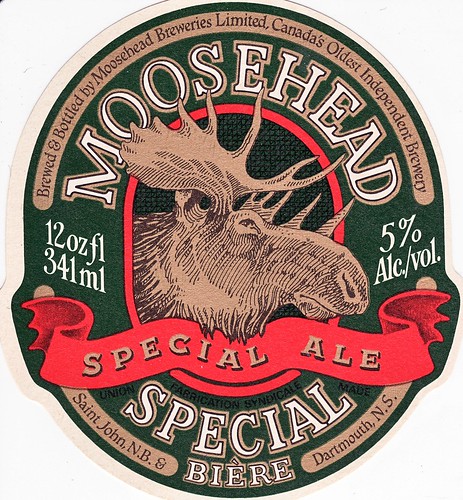
Oland died while spending the winter in Richmond, Virginia, on 24 March 1885. After her death, as her will had stipulated, control did not pass to her eldest sons, but rather to her youngest son, George, with provisions made for her daughter Hulda. The business she drove to be incorporated just 90 days after Canada’s Confederation spawned two brewing dynasties in Canada, as after the 1917 Halifax explosion one branch of the family moved to Saint John, New Brunswick, later selling the Oland Brewery to Labatt Brewing Company, while the original company relocated to Halifax and later to Saint John. After several name changes, it became the Moosehead Brewery in 1947. It is the oldest independently operating and the largest privately-owned brewery in Canada.
The Moosehead Brewery in the 1930s or 40s.
And this account of both Susannah and her husband John is from the Canadian Encyclopedia:
John Oland was born on 14 July 1819 in Bristol, England. His family was of modest means and as a result he worked a variety of jobs before marrying Susannah Culverwell in 1842. Together the couple had nine children. John moved from job to job after he and Susannah married, working as a cigar dealer, draper, shopkeeper, commercial clerk, accountant and more. His restless spirit, however, made it difficult for him to hold a job for an extended period of time and ultimately undermined his financial security; he was forced to file for bankruptcy in 1844. He subsequently studied accounting and began to work for the London and Southwestern Railroad. The family soon thereafter began farming in nearby Surrey. Almost penniless, John decided in 1862 to emigrate to British North America, leaving Susannah to tend to family and farm. In 1865, Susannah and the children joined John in Truro, Nova Scotia, which was witnessing an upswing in economic activity due to the construction of the railroad.
By 1867, the Oland family had moved to Dartmouth. Struggling financially, Susannah supplemented what little money John earned by making beer in the shed at the back of their Dartmouth property, using an old family recipe. Her October brown ale proved to be so popular with the local inhabitants that a family friend, Captain Francis Walter DeWinton (1835–1901), suggested brewing on a larger scale. DeWinton, along with two other investors, provided the funds to start a commercial brewery. Because they began the business in the Turtle Grove area of Dartmouth — a Mi’kmaq community — the brewery was named Turtle Grove Brewery.The company was incorporated on 1 October 1867. On paper, John Oland was manager of the business, but in reality, Susannah oversaw virtually every aspect of its day-to-day operations. By many accounts, she supervised the brewing process, which was undertaken with the help of her three sons.
The new commercial brewery was situated on a 12.5-acre plot with 300 feet of frontage on Halifax Harbour. Halifax was ideal for a budding brewer because of the pronounced military and naval presence. Beer had long been part of the life in the armed forces. During the War of the Spanish Succession (1701–1714), the Duke of Marlborough, commander of the British forces, proclaimed: “No soldier can fight unless he is properly fed on beef and beer.” British authorities accepted Marlborough’s statement as gospel, and in the years that followed, British soldiers were given enough “beer money” to purchase five pints of beer a day. This, along with the fact that the overwhelming majority of the civilian population in Dartmouth and Halifax could trace its ancestry to the beer-drinking cultures of England, Scotland, and Ireland, gave an immediate incentive to anyone like Susannah Oland looking to capitalize on their knowledge of the art of brewing.
Taking advantage of DeWinton’s connections (he was military secretary to the Marquess of Lorne, the governor general of Canada), the brewery quickly grew to be the third-largest business operating in Dartmouth. Tragedy struck in October 1870, however, when John died in a riding accident. To make matters worse, DeWinton was transferred to Gibraltar and the other two partners sold their interests to a manager, George Fraser, who had formerly been employed at a competing brewery. Undaunted, Susannah Oland and her sons continued working at the brewery, which had been renamed the Army and Navy Brewery in honor of its principal patrons.
In 1877, after receiving an inheritance from a relative in England, Susannah Oland bought out Fraser and dissolved the partnership. She began operating the brewery under the name S. Oland, Sons and Company and trained her sons to be brewmasters. She worked at the brewery for the remainder of her life.
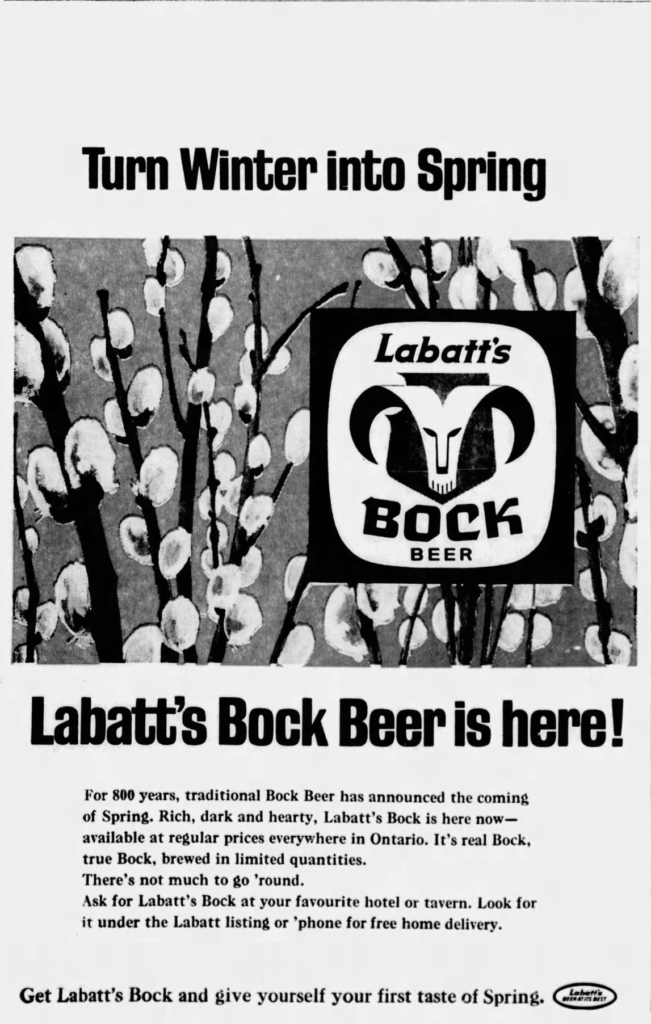
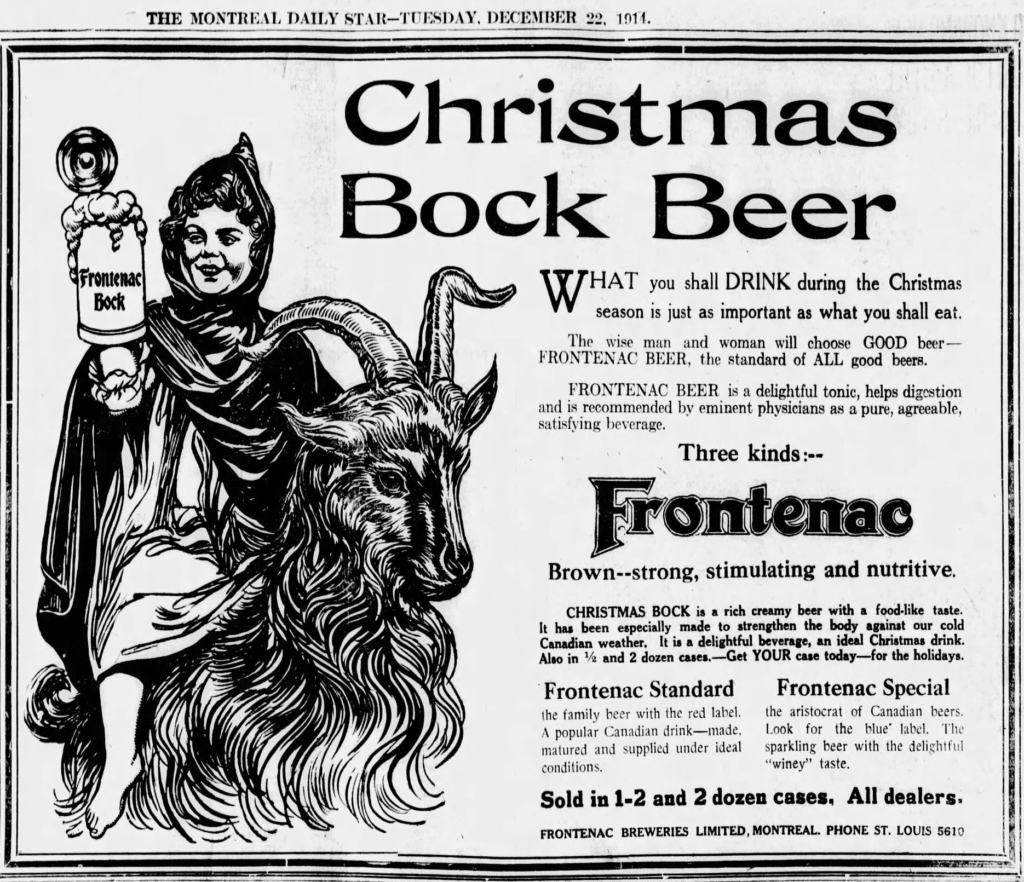
Two years ago I decided to concentrate on Bock ads for awhile. Bock, of course, may have originated in Germany, in the town of Einbeck. Because many 19th century American breweries were founded by German immigrants, they offered a bock at certain times of the year, be it Spring, Easter, Lent, Christmas, or what have you. In a sense they were some of the first seasonal beers. “The style was later adopted in Bavaria by Munich brewers in the 17th century. Due to their Bavarian accent, citizens of Munich pronounced ‘Einbeck’ as ‘ein Bock’ (a billy goat), and thus the beer became known as ‘Bock.’ A goat often appears on bottle labels.” And presumably because they were special releases, many breweries went all out promoting them with beautiful artwork on posters and other advertising.
Saturday’s ad is for Labatt’s Bock Beer, which was published on January 24, 1966. This ad was for the Labatt Brewing Co. of Toronto, Ontario in Canada, which was originally founded in 1847. This ad ran in The North Bay Nugget, also of North Bay, Ontario in Canada.
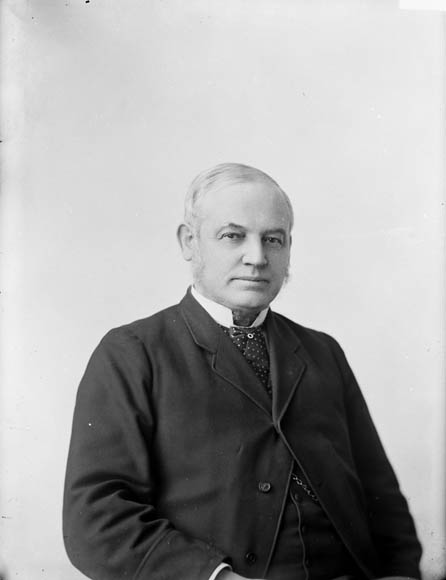
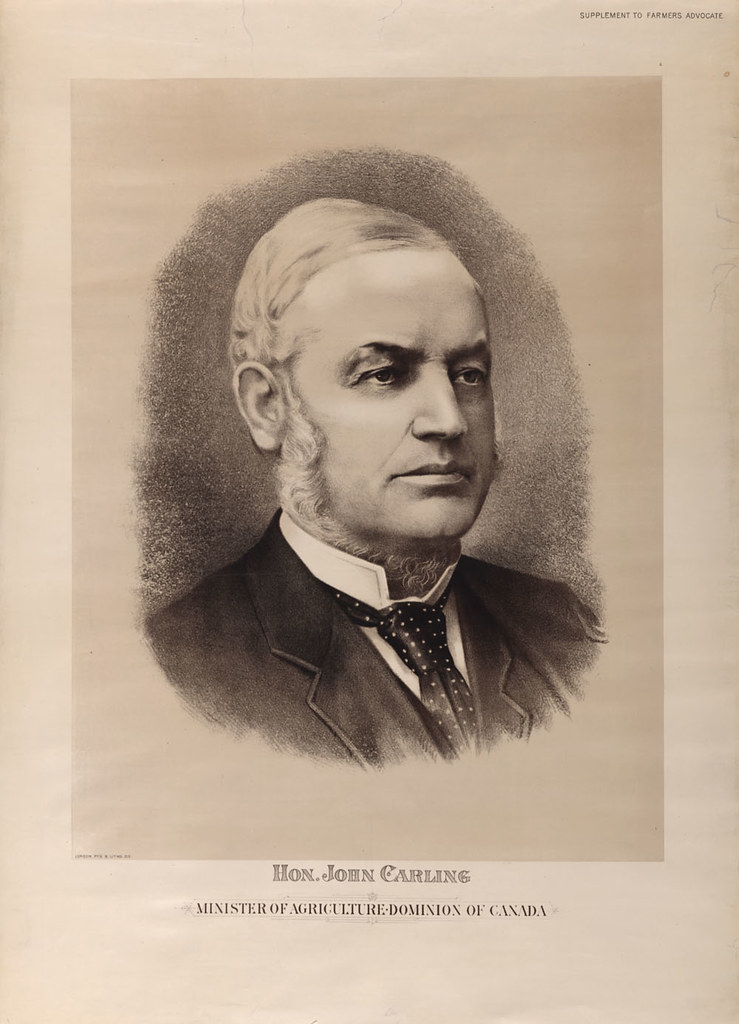
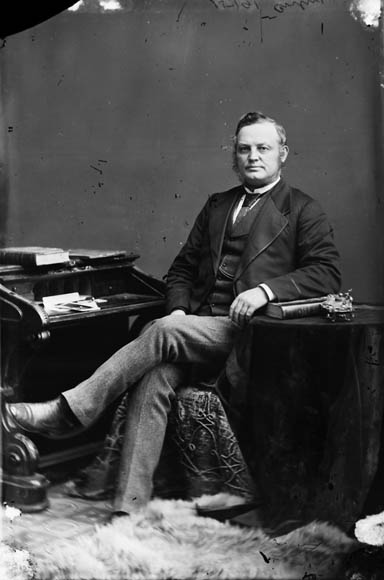
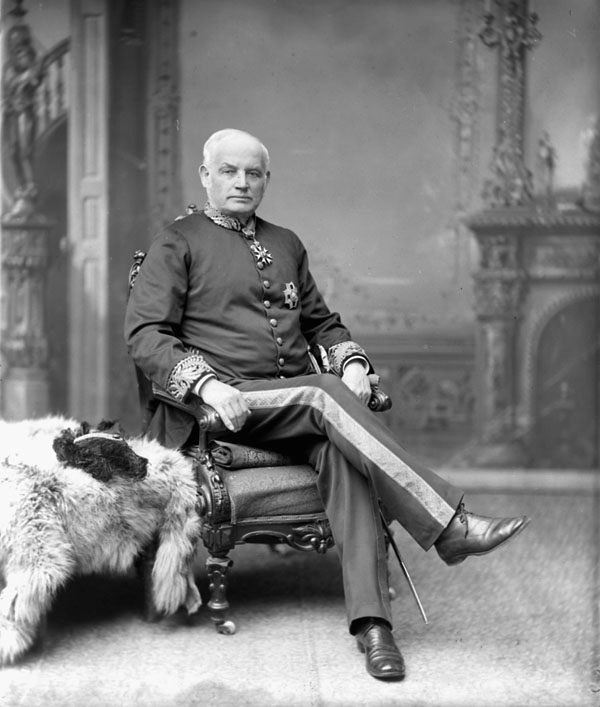
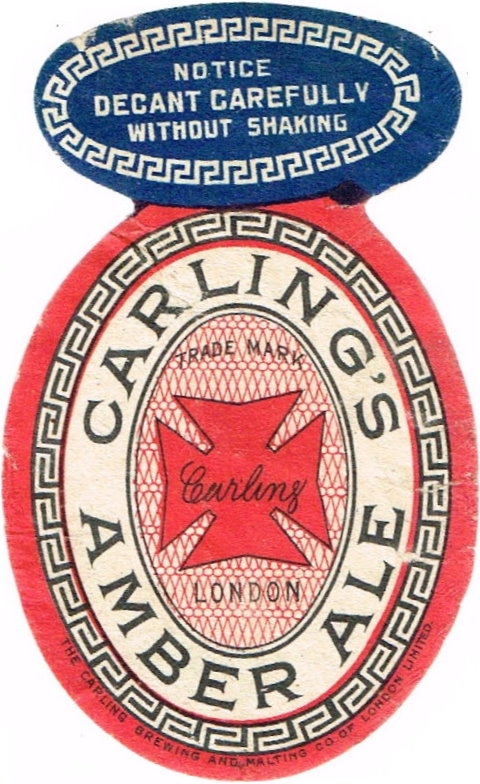
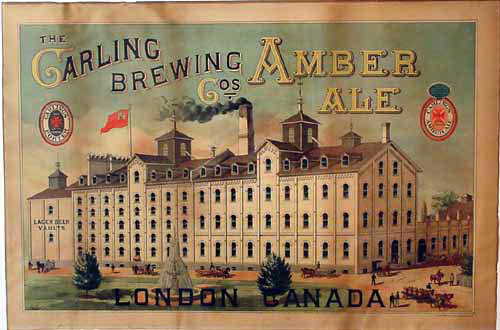
Today is the birthday of John Carling (January 23, 1828–November 6, 1911). He was the son of Thomas Carling, who founded the Carling Brewery in London, Ontario, Canada in 1840.
Sir John Carling of the Carling Brewery was a prominent politician and businessman from London, Ontario, Canada. The Carling family and its descendents later resided in Ottawa, Montreal, Halifax, Brockville, London, Toronto, and Windsor, in Canada, as well as Guernsey in the Channel Islands.
He was the son of farmer Thomas Carling, who emigrated from Etton in Yorkshire, England to Canada in 1818. In 1839, the family moved to London, where Thomas founded the Carling Brewery in 1843, using a recipe from his native Yorkshire. In 1849, the brewery was turned over to John and his brother William.
John’s political career began in municipal government, and in 1858, he was elected to the Legislative Assembly of the Province of Canada. After Confederation in 1867, he represented London in both provincial and federal governments until such a practice was made illegal in 1872. In the 1871 provincial election, he defeated former London mayor Francis Evans Cornish. From 1872 to 1891, he served in the House of Commons as a Conservative Member of Parliament (MP), holding the position as the 7th Postmaster General from 1882 to 1885, and Minister of Agriculture from 1885 to 1891. In this position, he established the Ontario Agricultural College and the Central Experimental Farm near Ottawa. In 1888, he briefly simultaneously held the title of Postmaster General for a second time.
After losing the 1891 election to Charles Hyman, he was appointed to the Senate by Prime Minister John A. Macdonald. However, the election was disputed and declared void, and Carling resigned from the Senate in order to run in a by-election in 1892, which he won. He served in the House of Commons until just before the 1896 election, when he resigned and was re-appointed to the Senate.
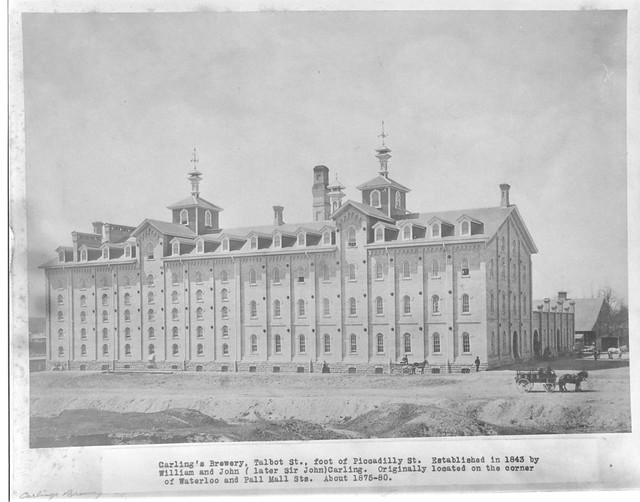
Meanwhile, Carling remained active in London affairs, using his positions in the federal government to influence politics and business. In 1875, John and his brother William built a new Carling Brewery, and an even larger one was built after the first burned down in 1879. The brewery was one of the largest in Canada and rivaled the production of fellow London brewery Labatt.
He also ensured that the Great Western Railway, the London and Port Stanley Railway, and the London, Huron and Bruce Railway passed through the city. Due to his influence, the Grand Trunk Railway began to manufacture their cars in London. In 1878, he established a water commission to provide a water supply to the city. He also established the Ontario Hospital for the Insane in London, and in 1885 he provided the land on which Wolseley Barracks was established, now the Home Station of The Royal Canadian Regiment and the garrison of the Regiment’s 4th Battalion. Carling also facilitated the establishment of Victoria Park.
He was knighted in 1893, and served in the Senate until his death in 1911.
CARLING, Sir JOHN, businessman and politician; b. 23 Jan. 1828 in London Township, Upper Canada, youngest son of Thomas Carling and Margaret Routledge; m. 4 Sept. 1849 Hannah Dalton in London, Upper Canada, and they had four daughters and four sons; d. there 6 Nov. 1911.
John Carling was born and raised on the prosperous farm of his father, where he acquired a reverence for the agrarian way of life. As the three Carling boys approached adolescence, their parents became concerned about the lack of educational opportunity in the township and in 1839 the family relocated in the village of London. John attended the common school there. His parents hoped that he would eventually practise law, but John was not inclined to book learning; he later admitted that he had read only a single book in its entirety.
Carling would be regarded by his daughter Louisa Maria as one of those men “who are natural born contractors . . . at home with large plans and enterprises.” He began his business career by becoming an apprentice at the Hyman and Leonard Tannery in London. Soon he had formed a partnership with his brother Isaac to operate their own tannery in Exeter, some 30 miles away. In 1843 their father opened a brewery in London, producing a beer based on a recipe from his native Yorkshire. The brewery flourished and in 1849 Thomas Carling passed the firm on to his sons William and John. The W. and J. Carling Company was the first of John’s large enterprises and the foundation of his subsequent economic and political success. In addition, he became a large landowner in London and he disposed of various properties for gain. For example, in 1856, for the considerable sum of $8,640, his firm sold the land on which London’s post office would be erected.
A devout capitalist, Carling viewed life in competitive terms: “The game of checkers is like the game of life. Everybody is trying to win and everybody is trying to checkmate him.” He was handsome and affable, and he put these qualities to good use in looking after the public relations of his firm while William handled everyday operations. Carling acquired a reputation for integrity and the epithet Honest John enhanced his business dealings. The brewery fared well and in 1875 Carling’s son Thomas Henry and Joshua D. Dalton entered the business as partners. That same year a new building was opened on the banks of the Thames River. In February 1879 this state-of-the-art structure burned down, and William died of pneumonia contracted while fighting the blaze. John took command of the company’s reconstruction.
The recovery was little short of miraculous. Between 29 April and 29 May 1879 the new plant produced 150,000 gallons of ale, lager, and porter. In 1882 more investors were brought into the enterprise, which became a joint-stock corporation, the Carling Brewing and Malting Company of London Limited. By 1889 it was manufacturing 32,000 barrels of ale, lager, and porter per annum; by 1898 it controlled a “large share” of the Canadian trade. Carling himself never drank beer because it disagreed with his system.
Carling Brewing and Malting was not the only large business enterprise with which Carling was associated. He recognized that its growth depended on an expanding railway network in the London area. Carling’s products were marketed throughout the United States as well as Canada, and massive quantities of barley, malt, and hops had to be brought to the factory. He became a director of the Great Western Railway, a major line in southwest Ontario. His influence with it was evident shortly after confederation when he persuaded the railway to locate its car works in suburban London East, bringing employment to about 300 workmen. Later, when fire destroyed these shops, he used his considerable power within both the federal government and the railway to have them restored, even though there was significant support for their relocation in Brantford. Carling also used his influence to promote the London and Port Stanley Railway and the London and Lake Huron Railway, serving both lines as a director.
There were direct links between Carling’s early entrepreneurial pursuits and his move into politics. He represented Ward 6 on city council in 1855–57 and was a founding member of London’s Board of Trade in 1857. Three years earlier he had impressed two government ministers, in London to work out a land deal with him, with his political and business shrewdness. At a meeting of GWR directors in 1856, the leader of the Liberal-Conservatives, John A. Macdonald*, persuaded Carling to uphold the party standard in London at the next opportunity. In the election of 1857–58 Carling was returned to the Legislative Assembly and he would retain his seat until confederation; in 1862 he served briefly as receiver general in the Macdonald-Cartier ministry.
Thus began Carling’s lengthy parliamentary career and long friendship with Macdonald. Before his initial election, Carling had promised to support the constitutional remedy of representation by population. But when the Grits made a series of “rep by pop” motions in 1861, an embarrassed Carling voted against them. They were, he declared, “mere buscombe motions designed, not to attain the object, but to defeat the Government.” On this occasion loyalty to Macdonald proved stronger than loyalty to principle. Nevertheless, the following year Carling and two other new ministers, John Beverley Robinson* and James Patton, demanded that rep by pop be an open question within the Tory caucus.
Later, Grit leader George Brown* reportedly suggested to Carling on a train ride that he should approach his leader with a proposal for a bipartisan combination dedicated to creating a federal union. The “Great Coalition” eventually resulted from Brown’s initiatives, and in his later years Carling was fond of recollecting their conversation. Though not a Father of Confederation, he might be considered an uncle. His polite manner, coupled with his trustworthy character, often caused him to be cast in an avuncular role. To the extent, however, that he was a political force in the London region, this characterization of him as benign is deceptive. Carling’s brewery, railway investments, and land deals all yielded handsome returns and he undoubtedly used some of the profits to finance his electioneering. Bribes and free drinks were common political tools, and newspaper accounts tell of Tory agents marching prospective voters to the Carling plant just before balloting. It would be naïve to assume that Honest John was not aware of the salient advantage of owning a brewery at election time.
After confederation Carling sat for London in both the dominion and the Ontario legislatures. In John Sandfield Macdonald*’s provincial government of 1867–71 he served as commissioner of agriculture and public works. He had entered the administration at Sir John A. Macdonald’s suggestion and with the government’s defeat in 1871 he was “very glad to get out of office.” Carling was obviously weary of being the peacemaker between the Macdonalds, a function he had assumed mainly out of his regard for the federal leader. When dual representation was abolished in 1872, he stayed in the federal arena. Defeated in 1874, he was re-elected four years later.
In Ottawa London’s mp continued to provide loyal and valuable service to his chieftain. As postmaster general (1882–85) he was responsible for a good deal of the Macdonald government’s patronage. In the House of Commons Carling was quite candid about the political nature of the assignments in his department: “Of course in the appointment of a postmaster the Government’s friends will be consulted as has always been done by hon. gentlemen opposite.”
In carrying out the responsibilities of this office and subsequently as minister of agriculture (1885–92), Carling often deferred to his prime minister. On 22 June 1885, for instance, he eloquently defended the government’s use of subsidies to help the Allan Line of Canadian steamships [see Sir Hugh Allan*] compete with American rivals for transoceanic mail contracts. But once Macdonald intervened in the debate Carling slipped into the background. He emerged at the end to declare: “As the Prime Minister has stated, I think all Canadians are proud of the way the Allan line of steamers is managed.” Carling was, in many respects, an ideal cabinet minister. He was competent and convincing, respected by the opposition, and, above all, generally submissive to the party leader.
It would be wrong, however, to portray Carling as little more than an obsequious follower of Macdonald. He had his own principles and interests to advocate and he consistently did so. Especially prominent on his agenda were the promotion of a progressive brand of conservatism and the advancement of big business, agriculture, and London.
Carling and Macdonald both revered tradition, but they both recognized that it had to accommodate change. As a public school trustee in London (1850–64), Carling had become noteworthy for his support of free public schools. His progressivism was more sharply defined when he entered the Legislative Assembly, where he was committed to the democratic design of rep by pop. By 1866 Carling was arguing further for lower property qualifications for voters and office holders. When, in the first session of the House of Commons in 1867, he pressed for a reduction in the qualifications for Ontario voters in the federal franchise, his liberal stand brought him into brief conflict with his leader. A distressed Macdonald lamely replied that he “did not wish to enter on the discussion of that.”
As Ontario’s first commissioner of agriculture and public works, Carling continued to define his progressive image. The creation of much of the province’s social infrastructure became his responsibility. He directed the construction of the Asylum for the Insane in London (on land he had sold to the government in 1870), the Ontario Institution for the Education and Instruction of the Deaf and Dumb in Belleville, and the Ontario Institution for the Education and Instruction of the Blind in Brantford. Carling appropriated provincial funds for mechanics’ institutes which encouraged working-class Ontarians to develop a variety of self-help plans. Later, as postmaster general, he ensured that an expansion of postal services followed the westward construction of the Canadian Pacific Railway. All of these measures were forward-looking, as were many of the changes that Carling introduced in agriculture on the provincial and national levels.
Carling’s progressivism, however, simply modified his essential conservatism, which was reflected in his political support for capitalism and large enterprises. It was only natural that Carling, an important brewer, should defend the interests of big business. In 1863, in the assembly, he strenuously called for an end to the province’s usury laws. They were, he maintained, outmoded and hindered capital formation.
Following confederation Carling became one of the main spokespersons in the federal sphere for capitalism, including his own interests. In the first session of the commons, in 1867, his suggestion that licence fees for brewers be lowered caused conflict with Macdonald and finance minister John Rose*. In parliament Carling constantly defended the interests of the GWR and the other railways with which he was associated. He believed uncritically that such large corporate entities ought to be encouraged by Ottawa and, if necessary, supported by public funds. So, in 1885, he pushed as postmaster general for federal money for the well-established Allan Line to allow it “to build larger vessels and to dispose of those of smaller tonnage.” The creation of bigger and better capitalist enterprises was, for Carling, a high priority. Like Macdonald, he promoted a close alliance between political and economic élites.
Some of the large private enterprises which Carling sponsored in the commons were truly visionary. In 1870, for example, he brought before the house a corporate charter to build a tunnel underneath the Detroit River and thus connect Canada with the United States. This ambitious design would not be fulfilled until 1910. His last major initiative in parliament was also aimed at encouraging business development in the dominion. In 1898 Carling, then a senator, urged the Liberal government of Sir Wilfrid Laurier to construct a road between Edmonton and the Yukon so that the intervening territory could be opened to mining interests.
Unlike other members of the corporate élite, Carling did not see a conflict between the interests of capital and those of agriculture. For him, they were complementary, as was the case in the brewing industry. From his youth he had come to love the agrarian lifestyle. He delighted in seeing things grow and later in life he purchased a large farm on the outskirts of London. But farming was more than a hobby. Carling saw it as Canada’s most important economic activity, and some of his most significant and progressive achievements occurred in agriculture.
Carling did much as commissioner of public works and agriculture to promote Ontario’s agrarian sector. Public funds were given to the Fruit Growers’ Association of Ontario, which boosted agriculture in the Niagara area. Through an elaborate drainage scheme a considerable amount of land in the province’s southwestern peninsula was redeemed, especially in the Chatham region. A liberal emigration plan, coupled with generous land grants, helped in the rapid development of the Muskoka district [see Alexander Peter Cockburn*]. In 1870 Carling boasted that “greater advantages” were offered there than in the western United States. Port Carling, on Lake Muskoka, was appropriately named after the minister who did so much to foster the area. The following year he secured funds for the founding of an agricultural college and experimental farm, later established at Guelph [see William Fletcher Clarke*]. When he departed from the provincial scene in 1872 he left behind an impressive record as a friend of agriculture.
Carling’s reputation was enhanced when he served as the federal minister of agriculture, from 1885 to 1892. Seeking to raise the profile of agriculture within the dominion and abroad, he placed Canadian produce on display at international gatherings such as the Colonial and Indian Exhibition in London in 1886. Carling is credited with developing, at a time when more and more stock was being imported, the first effective quarantine system to prevent diseased animals from entering the country. He also moved to settle the vast lands in the North-West Territories, just as he had opened up the Muskoka region. Again large land grants were offered and Carling introduced policies to draw settlers. Agents were dispatched overseas, translators were hired to help foreign immigrants, and promotional pamphlets were issued throughout Great Britain and Europe. The depressed economic conditions in Canada were not propitious for a massive influx of homesteaders, but in the late 1890s the Laurier government would use the means initially employed by Carling to populate the prairie region.
Macdonald’s minister of agriculture was more immediately successful in his formation of a network of experimental farms throughout the dominion. What was to become Carling’s single greatest accomplishment was described by him in the commons when the project was launched in 1886: “It is the intention to establish an experimental farm or station in the neighborhood of the capital. . . . Tests, &c., will be made here of all the different seeds, and experiments made as to the raising of cattle, tree planting and fruit culture, and the analysing of different kinds of artificial manures; and the results of such experiments will be made known by monthly bulletins through the press or otherwise.” Later branch farms were established in Nova Scotia, Manitoba, the North-West Territories, and British Columbia to accommodate regional needs. The program was an instant success, and some far-reaching effects flowed from the research at these government stations [see William Saunders]. In 1893, shortly after Carling had relinquished the agriculture portfolio, Liberals as well as Conservatives on the commons committee on agriculture and colonization joined together in an extraordinary bipartisan gesture to pass a resolution thanking him for his services to the farming community. Later that year, on 3 June, Carling received a kcmg, ostensibly for his assistance to Canada’s farmers.
During his parliamentary career Carling also secured important gains for his home city. He had always viewed service to the community as a public duty. Like many wealthy persons, he regarded philanthropy as an appropriate recompense for his good fortune. In 1859, for example, he had subscribed $100 to a recently created soup-kitchen in London and in 1888 he became a trustee of the Protestant Home for Orphans, Aged, and Friendless. A further contribution to London’s progress came with his election in 1878 as a municipal water commissioner; the next year he oversaw the construction of a structure for the city’s first hydraulic pumps.
Dedicated to bringing government contracts to London, Carling took full advantage of his privileged place within provincial and federal ministries. In 1870 he obtained the incorporation of the insane asylum at Amherstburg into the new regional asylum in London. In 1883, at the federal level, the member for London procured his government’s commitment to establish a military school in his riding. It would be built on property acquired from Carling, whose sense of integrity clearly did not prevent him from profiting at government expense. A federal grant was extended to London’s council in 1886 to help it stage a public exhibition, a project that led to Carling’s sale of additional land to the city. Carling certainly saw to it that London received its fair share of patronage, which aided in turn his repeated re-election. By the 1880s Carling was unquestionably the most powerful political figure in the key Conservative constituency of London.
By the early 1890s, however, this situation had begun to change. Defeated in the general election of 1891, Carling was promptly appointed to the Senate, in April, and thus enabled to continue as minister of agriculture. In February 1892 he resigned from the Senate in order to contest London in a by-election, which he won. That spring Carling refused the lieutenant governorship of Ontario because he and the Tory prime minister, John Joseph Caldwell Abbott* (Macdonald had died in 1891), thought the Liberals might well win the by-election that would have ensued. Later in 1892 Abbott’s successor, Sir John Sparrow David Thompson*, moved to drop Carling from his ministry as part of an attempt to rejuvenate the Tories, who were still reeling from Macdonald’s passing. Even though his popularity in parliament and influence in cabinet had lessened, Carling was stunned.
After prolonged negotiations a face-saving formula was worked out. Carling would receive a knighthood and would remain in the cabinet but without a portfolio. In December 1892 he gave up the agriculture ministry, with which he was so closely linked in the public’s mind. It was rather shabby treatment of a veteran who had faithfully served his party for 35 years. Carling stayed in Thompson’s administration until the latter’s death led to the formation of a new government under Mackenzie Bowell in 1894. Although Carling was re-appointed to the Senate two years later, his political career had effectively ended with the shuffle in 1892. He had little to say in either the commons or the Senate after that humiliating experience.
Sir John spent most of his remaining time in London. He resumed control of his brewery, which had been effectively run during his years in Ottawa by his son Thomas, his eventual successor. In the late 19th century temperance legislation and increased duties on malt caused the London brewer political and commercial discomfort. In public presentations before city council in 1876 over the province’s liquor licensing act, he “spoke in the liquor interest.” By 1895 Carling Brewing had applied to council for a tax reduction to compensate for the “injury” suffered from what industry lobbyist Louis P. Kribs* called the “great teetotal craze.” From his position of semiretirement, Carling fondly recalled the good old days and filled a number of largely honorary positions. In 1899 he became colonel of the 7th Battalion of Fusiliers in London, and in 1904 he was made president of the Ontario Brewers’ and Maltsters’ Association. A Methodist, he was also honorary president of both the Yorkshire Society in Ontario and the Sons of England. He died of pneumonia at his Cedar Grove estate in London on 6 Nov. 1911, and was survived by three sons and three daughters.
Sir John Carling was never a major figure in Canada’s history, but he was significant. He had been instrumental in making his brewery one of the largest in the dominion. In a long career in parliament he served as a direct link between the country’s political and economic élites. During that career Carling consistently fought for a progressive type of conservativism as well as for the interests of big business, the agrarian community, and London.
This short brewery history is from the Carling website:
Carling’s British roots trace all the way back to the Yorkshire village of Etton, little known, but forever in the hearts of Carling as the birthplace of our namesakes, William Carling and his son Thomas. Inheriting his father’s passion and skill for brewing, a 21-year-old Thomas emigrated to Canada taking his father’s Yorkshire beer recipe, which on arrival in Canada he used to brew privately for admiring family and friends. The township Thomas settled in soon became an Imperial Army post where the thirsty soldiers became fans of the Carling family’s Yorkshire brew. In 1843 he built his first commercial brewery, only for his sons William and John to take up the baton soon after, and begin producing lager for the first time in 1869, sewing the first seeds of Carling’s refreshingly perfect pint.
The history of Carling dates back to 1818, when Thomas Carling, a farmer from the English county of Yorkshire, and his family settled in Upper Canada, at what is now the city of London, Ontario. He brewed an ale which became popular, and eventually took up brewing full-time. The first Carling brewery had two kettles, a horse to turn the grinding mill and six men to work on the mash tubs, and Carling sold his beer on the streets of London, Ontario from a wheelbarrow.
In 1840 Carling began a small brewing operation in London, selling beer to soldiers at the local camp. In 1878 his sons, John and William, built a six-story brewery in London, which was destroyed by fire a year after opening. Thomas Carling, shortly after helping to fight the fire, died of pneumonia.[citation needed]
William and John took over the company, naming it the W & J Carling Brewing Co. John Carling died in 1911 and the company changed hands numerous times since. It was acquired by Canadian Breweries Limited, which was eventually renamed Carling O’Keefe, which merged with Molson, which then merged with Coors to form Molson Coors Brewing Company.
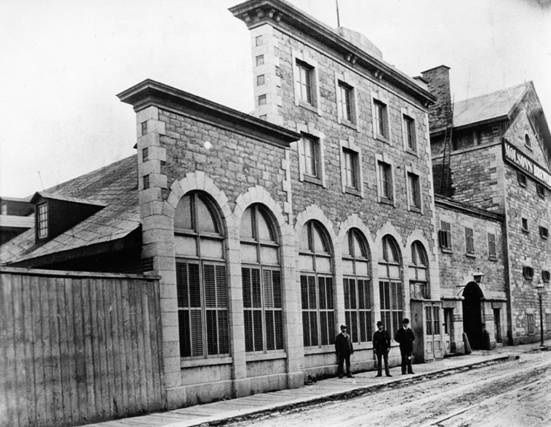
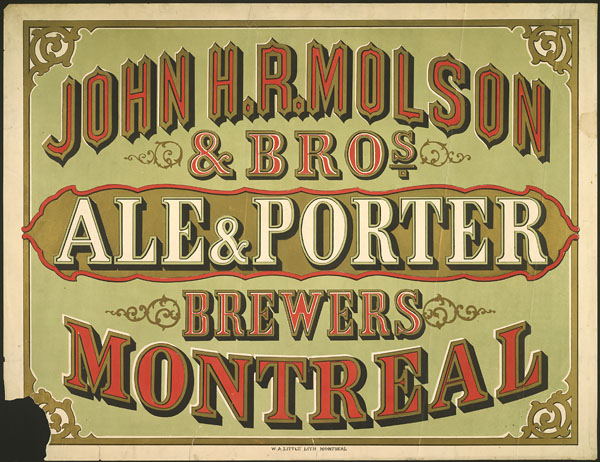
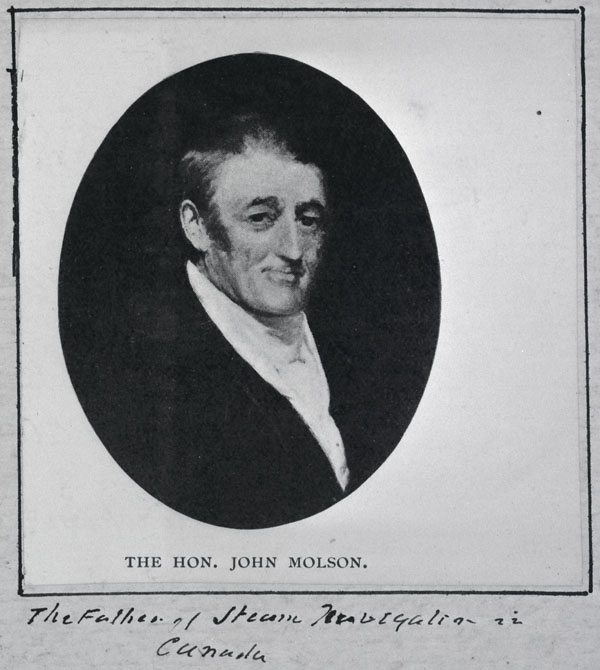
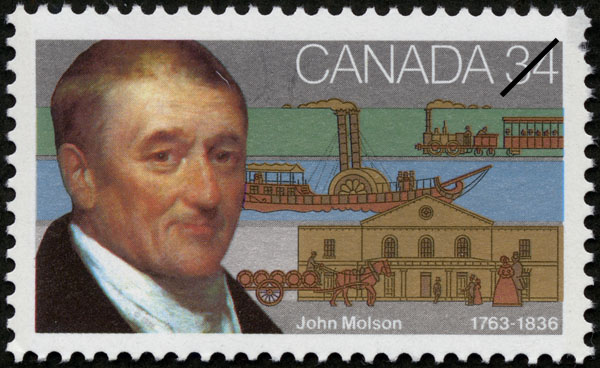
Today is the birthday of John Molson (December 28, 1763–January 11, 1836). He “was an English-born brewer and entrepreneur in colonial Quebec and Lower Canada. He was the founder of Molson Brewery,” the oldest brewery in North America.
MOLSON, JOHN (John Molson Sr), businessman, landowner, militia officer, and politician; b. 28 Dec. 1763 in Moulton, Lincolnshire, England, son of John Molson and Mary Elsdale; m. 7 April 1801 Sarah Insley Vaughan in Montreal, and they had three children; d. 11 Jan. 1836 in Boucherville, Lower Canada.
Having lost his father by the time he was six and his mother when he was eight, John Molson was put under the guardianship of his maternal grandfather, Samuel Elsdale. Early in July 1782, at the age of 18, he emigrated to Montreal, and immediately became involved in various commercial endeavours with family friends who had arrived at the same time as he. He went into the meat business with the two James Pells, father and son, who were both butchers, and then he joined in a brewing enterprise which Thomas Loid (Loyd) set up that year at the foot of the Courant Sainte-Marie in the faubourg Québec.
Coming as he did from the English gentry, Molson naturally wanted to own a farm. During his first year in the colony he bought 160 hectares of land in Caldwell’s Manor, south of Montreal. He parted with it in the spring of 1786, when he began to run the brewery. He had sued Loid for repayment of a debt in the summer of 1784, and as Loid had formally admitted the justice of the case, the buildings had been seized and put up for auction. At an initial sale on 22 October there had been no offers, but at the second, held on 5 Jan. 1785, eight days after Molson had attained his majority, he was the only bidder. He put James Pell Sr in charge of the brewery and on 2 June sailed for England from New York. He could now settle his business affairs himself.
In England, Molson bought some equipment for the brewery. Returning to Montreal on 31 May 1786, he took over management of the operation. He oversaw the enlargement of the plant and began to buy grain for the coming season of malting and brewing. His first purchase, on 28 July, was an exciting event for him, as the entry in the little notebook he kept for his expenditures shows: “28th, Bot 8 bushs of Barley to Malt first this Season, Commencement on the Grand Stage of the World.” Rarely does the spirit of enterprise find such clear expression but, as a letter from Molson to his business agent in England indicated, it also spurred the Lower Canadians: “People here are more of an enterprising spirit than at home, as it is in a great measure owing to that restlessness that induces them to quit their native shore.”
During the next 20 years Molson dedicated himself to his business. He invested in it all the funds at his disposal in order to enlarge his facilities and production. It is estimated that he received about £10,000 sterling from a succession of inherited properties, including the family home, Snake Hall, which was sold on 11 June 1789. Molson had turned away from the import-export business in 1788 because the risks were too great and the profits too slow; he also foresaw that the large-scale fur trade would run into increasing difficulties. He therefore did not seek to diversify his activities during this period. In 1806 he considered opening a brewery in York (Toronto) and was warmly encouraged to do so by his correspondent D’Arcy Boulton*, who also hailed from Moulton, but nothing came of the idea.
Molson preferred to reinvest continually in his Montreal establishment and for that purpose went occasionally to England, as in 1795 and 1797, to buy equipment. The young immigrant had decided to put his money into a sector which was at the forefront of technological innovation in that country during the late 18th century. The influx of loyalists to the colony, and then the first arrivals of British immigrants, opened a market for him and soon there was a demand even from French Canadians, who had not previously been inclined to drink beer. As there was not much barley being produced in the Canadas, Molson induced farmers to grow it by initially supplying them with seed, to be paid back in kind at the rate of two bushels for one.
After his return from England in 1786, Molson had begun living with Sarah Insley Vaughan, who was four years older than he. They remained together and had three children: John*, born in 1787, Thomas*, born in 1791, and William*, born in 1793. They were married on 7 April 1801 at Christ Church in Montreal; according to the declaration they made in the marriage contract drawn up that day by notary Jonathan Abraham Gray, they wanted to acknowledge their mutual affection and legitimize their three children. Sarah signed the contract and the church register with a cross.
Not much is known about how well the young entrepreneur fitted into Montreal business circles, then dominated by the big fur merchants, most of them Scottish. From June to December 1791 and from June 1795 to June 1796 he is known to have held the masonic office of worshipful master of St Paul’s Lodge, which indicates that he had a connection with a social group who recognized him. Molson had been married in the Church of England because at the time it was the only Protestant denomination legally permitted to keep registers of births, marriages, and deaths. But as early as 1792 he had contributed financially to the building of the Scotch Presbyterian Church, later known as St Gabriel Street Church [see Duncan Fisher*], and he remained an active member until at least 1815. In this way, he associated with the community of important Scottish merchants in Montreal.
During the first decade of the 19th century, conditions arising from the Napoleonic Wars were transforming the economy of the St Lawrence valley and giving it new life: the fur trade economy was gradually replaced by the lumber economy, at a time when agriculture was expanding, particularly in Upper Canada. Steam, the new source of energy, led to technological innovations, and after a great deal of experimenting and testing, ships could be propelled with it, for a time at least, on inland water-ways. In 1807 Robert Fulton began to sail the Clermont on the Hudson; in 1808 some businessmen from Burlington, Vt, commissioned brothers John and James Winans of that town to build a steamboat for the run along Lake Champlain and the Rivière Richelieu to Dorchester (Saint-Jean-sur-Richelieu); in June 1809 the Vermont went into service.
By a notarized contract on 5 June, Molson became the third member and financial backer of a partnership founded by John Jackson, “mechanic,” and John Bruce, “shipbuilder,” who were building a steamboat to carry passengers between Montreal and Quebec. The most surprising technical aspect of this undertaking was the construction of the engine at George Platt’s foundry in Montreal. On 1 Nov. 1809 the Accommodation left Montreal at two o’clock in the afternoon; it reached Quebec 66 hours later, on Saturday, 4 November, at eight in the morning, after 30 hours at anchor in the shallows of Lac Saint-Pierre; the return trip to Montreal up the St Lawrence took seven days. The vessel had regular sailings from June to October 1810, the engine having been made more powerful during the winter. The partnership ended with Molson buying the shares of Bruce and Jackson, who said they could no longer take the substantial losses being incurred. In the mean time, on 7 Sept. 1810, Fulton had proposed to Molson the joining of their two enterprises; the terms of the proposal did not seem sufficiently advantageous to Molson, who took no action. Late in October he left Montreal for England to order a steam-engine for the next ship, the Swiftsure, from the firm of Boulton and Watt. The vessel was under construction in Hart Logan’s shipyard on Rue Monarque in Montreal from August 1811 and it was launched on 20 Aug. 1812.
To diversify his interests Molson had again chosen a sector in which the most recent technological advances had occurred. The brewery had been expanding since 1786, bringing him ever increasing profits, and hence he was able to assume the losses experienced with the Accommodation. He did try to obtain a measure of protection by asking the House of Assembly on 6 Feb. 1811 for a monopoly of steam navigation on the St Lawrence between Montreal and Quebec. His request was put forward by Joseph Papineau and Denis-Benjamin Viger* and granted by the assembly, but was rejected by the Legislative Council. With the outbreak of the War of 1812, however, circumstances would prove extraordinarily favourable to shipping on the St Lawrence. Molson offered his ship to the army for the duration of hostilities, but met with a refusal. The military none the less had to use it occasionally on a commercial basis for transporting troops and their supplies. Molson took part in the war as a lieutenant in the 5th Battalion of Select Embodied Militia. Promoted captain on 25 March 1813, he resigned his commission on 25 November.
Early in 1814 another steam-engine was ordered in England. The Malsham (an archaic form of the name Molson), which was built in Logan’s shipyard as well, was launched in September and went into service immediately. The Lady Sherbrooke was added in 1816 and the New Swiftsure in 1817. With the end of the war between France and Britain and the economic depression of 1815, British immigrants began to arrive at Quebec in growing numbers and to seek transportation up the St Lawrence, towards the Great Lakes, and on the Richelieu and the Ottawa. In 1815 Molson purchased a wharf with all its facilities at Près-de-Ville in Quebec from Robert Christie* and Monique-Olivier Doucet; in 1819 he also bought a house at 16 Rue Saint-Pierre. On 16 Feb. 1816 he had obtained from the Executive Council a 50-year lease on a waterfront lot at Montreal with a renewal option, and he proceeded to put up a wharf. It was located in front of a property he had purchased from Sir John Johnson* on 16 Dec. 1815, on which stood a private residence at the corner of Rue Saint-Paul and Rue Bonsecours; in 1816 Molson added two wings to the building and turned it into the Mansion House Hotel. A wharf at William Henry (Sorel) apparently fitted into this network as did the sizeable commercial activity to obtain on contract the wood for steam, which was to be delivered to the various wharfs up and down the St Lawrence where the ships called. By about 1809, Molson had introduced his sons, John, Thomas, and William, to the manufacturing aspects of his enterprises. On 1 Dec. 1816 he formed the first of a long series of partnerships with them under the name John Molson and Sons [see John Molson Jr]. Having transferred greater responsibilities in his enterprises to his sons, Molson could become active in politics. In March 1816 he was elected to the House of Assembly for Montreal East. Politics were closely interwoven with the fundamental interests of the merchants in Lower Canada. Molson did not attend the 1817 session; he was probably not even in the colony. The 1818 session having begun on 7 January, he presented himself on 2 February to be sworn in and take his seat. In the 1819 session, which was prorogued on 24 April, he participated from the opening till about 20 March. He did not run in the 1820 election.
Molson was an active member of the assembly. All the important issues attracted his attention: trade, public finances, banks and currency, inland shipping, education and health, municipal by-laws, fire protection, regulations for public houses and inns, the House of Industry (of which he was a trustee in 1819, according to Thomas Doige’s directory), and the Montreal Library. Two questions concerned him more directly, the Lachine Canal and the Montreal General Hospital. From 1815 to 1821 he took part in the debate over the construction of the canal, speaking out for a private undertaking and a route that favoured his shipping interests. In January 1819, with the support of the merchants, he presented a petition to the assembly for the establishment of a public hospital in Montreal [see William Caldwell*]. The petition was not accepted by the house because of a procedural error that was declared on 18 March; Molson was still in attendance on 19 and 20 March, but did not appear again. The Montreal General Hospital was founded that same year as a private institution, and the four Molsons contributed to the subscription launched in 1820 to buy a lot on Dorchester Street and put up the building.
Even when not in the assembly, Molson continued to follow events closely. In 1822 the presentation to the House of Commons in London of a plan for the union of Upper and Lower Canada caused a political stir in the colony. In Montreal some eminent businessmen, Molson among them, formed a committee in support of the bill which held a public meeting and collected 1,452 signatures.
The description that Hector Berthelot gave of Molson in the Montreal newspaper La Patrie in 1885 has often been repeated; on the basis of old people’s recollections going back as far as 1820, he portrayed Molson in blue tuque, wooden shoes, and homespun. His final paragraph, however, has not always been noted: “After he closed his brewery at night, he took off his rustic garb, donned black evening dress and a white waistcoat, and sported a pince-nez on a long ribbon. When he was dressed grandly, Mr Molson behaved like a steamboat owner.” But probably also not kept in mind is Édouard-Zotique Massicotte’s caution in his introduction to the 1916 edition of Berthelot’s articles that during his lifetime the writer was considered less a historian than a humorist.
At the time Molson was transferring managerial responsibilities in the shipping firm to his eldest son, some financial groups in Montreal (in particular the brothers John and Thomas Torrance and Horatio Gates*) and at Quebec (John Goudie, Noah Freer, and James McDouall, among others) were beginning to compete fiercely on the St Lawrence, launching various steamboats. The competition led to over-investment, and then to consolidation of the firms. On 27 April 1822 the St Lawrence Steamboat Company [see William Molson] was created, with assets including six ships, three belonging to the Molsons; its management was handed over to John Molson and Sons, which held 26 of the 44 shares. Rivalry with the Torrances continued for some time, but it was finally resolved by cartel agreements on services, prices, and even co-ownership of certain ships.
Meanwhile the Mansion House Hotel had burned down on 16 March 1821; rebuilt in 1824, the year in which Molson acceded to the rank of worshipful sword bearer in the Provincial Grand Lodge of Lower Canada, it was renamed the Masonic Hall Hotel. Molson became provincial grand master for the district of Montreal and William Henry in 1826. At the end of December 1833, finding himself in opposition to his council on a matter of principle, he resigned. Upon the death of John Richardson* in 1831, the chairmanship of the Montreal General Hospital fell to Molson. When the cornerstone of the part to be named the Richardson Wing was laid, Molson officiated as provincial grand master in a ceremony at which masonic honours were rendered.
In the early 1820s, as the shipping assets had been removed from John Molson and Sons and placed in the St Lawrence Steamboat Company, the family firm had to be reorganized. In addition, Thomas Molson had decided to settle in Kingston, Upper Canada, and his departure entailed another large withdrawal of assets from the firm. An agreement establishing a new John Molson and Sons was made in 1824, to take effect retroactively from 1 Dec. 1823, the date on which the accounts of the former company had been stopped. William Molson took over management of the brewery from Thomas.
In 1825 Molson Sr gave up his residence in the faubourg Québec of Montreal and moved to Belmont Hall, a magnificent house at the corner of Sherbrooke and Saint-Laurent. For some time he had owned Île Saint-Jean and Île Sainte-Marguerite, which form part of the Îles de Boucherville. It was to these islands that his ships returned in the autumn for their winter berths and on them Molson established an estate to which he could withdraw now and then. There he kept a sheep-breeding establishment large enough that the sales of meat to butchers and wool to wholesale merchants appeared in the company accounts. On 10 March 1825 the Theatre Royal company was formed [see Frederick Brown]. The principal shareholder, Molson received 44 shares worth £25 each in return for a property he transferred to it on Rue Saint-Paul.
Although during his term as an assemblyman Molson had taken an interest in the founding of the Bank of Montreal [see John Richardson], he had made no financial commitments. He had offered to put up the bank building on one of his properties, but the board of directors had unanimously turned down his proposal and had decided on 10 Oct. 1817 that the bank would buy a lot and erect a building itself. John Molson Jr was elected to the board of directors in 1824. In the crisis that split the board in 1826 [see Frederick William Ermatinger*] and put Richardson’s group in the minority, Ermatinger gave up his place so that Molson Sr could become president. A short time later John Jr resigned to enable Ermatinger to regain his seat. During the elder Molson’s term of office, which lasted until 1830, the bank had to deal with the liquidation of major fur-trading houses that declared bankruptcy, in particular Maitland, Garden, and Auldjo and the firms linked with the brothers William* and Simon McGillivray. It was Simon who had recommended that Molson be named to succeed William as provincial grand master for the district of Montreal and William Henry, notifying him by a letter sent from London in 1826.
In 1828 John Molson and Sons had its responsibilities narrowed; as the agent of the St Lawrence Steamboat Company it was concerned only with shipping. A new partnership was formed under the name of John and William Molson, bringing together the two Johns and William. John Jr withdrew in April 1829, however, and the association was dissolved; on 30 June a new John and William Molson was founded, which included only Molson Sr and William. On 1 May John Jr had set up Molson, Davies and Company with the brothers George and George Crew Davies; as for William, he went into partnership on 1 May 1830 with his brother-in-law John Thompson Badgley to create Molson and Badgley. Molson Sr acted as financial backer and stood surety for both undertakings. In the mid 1820s, with a workshop attached to the brewery on Rue Sainte-Marie as a basis, Molson had established St Mary’s Foundry, handing it over to William’s management. In 1831, on the eve of the opening of navigation on the Rideau Canal, Molson Sr joined with Peter McGill*, Horatio Gates, and others in forming the Ottawa and Rideau Forwarding Company.
Once more in the early 1830s an important new field for investment was being opened up by technological innovation: the railway. On 14 Nov. 1831, after an earlier petition had been rejected, a group of 74 Montreal businessmen, including Molson, asked the assembly for incorporation as the Company of Proprietors of the Champlain and St Lawrence Railroad; they planned to build the very first railway in either Upper or Lower Canada, from La Prairie to Dorchester [see John Molson Jr]. Molson Sr bought 180 shares in the company, thus becoming the largest shareholder, but he was not named to its initial board of directors, which was formed on 12 Jan. 1835.
It was clear that by now Molson was interested only in investing: “I have retired from any active part in business for some years past,” he wrote to the London bankers Thomas Wilson and Company in 1830. He had run in the 1827 elections in Montreal East but had been defeated. However, Lord Aylmer [Whitworth-Aylmer] called him to the Legislative Council in January 1832, along with Peter McGill. The previous year, upon the death of the man generally considered the dean of the Montreal business community, John Richardson, George Moffatt* had been appointed. The three men focused to such an extent on the same questions and causes that one can truly speak of the Molson–McGill–Moffatt trio. Together they sat on most of the committees for public investment, taxation, and monetary, banking, and financial matters. Their shared opinions and interests were patent in the dissent they voiced in February 1833 on the question of sharing with Upper Canada the customs duties collected at Quebec. They took the opportunity to ask that the counties of Montreal and Vaudreuil be detached from the lower province and annexed to the upper one. Like McGill and Moffatt, Molson belonged to the Constitutional Association of Montreal, even though he was less active in it than his eldest son. During his four years as a legislative councillor, he was even more assiduous than he had been as an assemblyman 15 years before; on 23 Dec. 1835, less than three weeks before his death, he was still taking part in council.
Towards the end of his life, he became interested in the organization of a Unitarian congregation in Montreal, which among its supporters had a great many merchants of New England origin. In 1832 he was one of a group that purchased a lot for which a chapel was planned, but the initiative was set aside for a while when the pastor died.
In 1833 William Molson added a large distillery to the brewery. The following year Thomas left Kingston to rejoin his brother in Montreal. Through a new partnership contract with their father, signed on 21 Feb. 1835 but retroactive to 30 June 1834, they formed John Molson and Company [see William Molson]; once more John Jr did not join the firm.
Molson had lost his wife on 18 March 1829, and in his seventy-second year he was stricken with an illness that swiftly brought about his own death, on 11 Jan. 1836, at his estate on Île Sainte-Marguerite. The newspapers carried quite detailed eulogies, but La Minerve mentioned one of his qualities in a somewhat veiled fashion: “Mr Molson belonged to that small number of Europeans who, coming to settle in Canada, reject all national distinctions; just as he had started his fortune with those born in this land, so he always had a large number of Canadians in his employ, whose loyalty must have helped to ensure his considerable profits.” The funeral took place at Christ Church in Montreal on 14 January, and he was buried in the old cemetery of the faubourg Saint-Laurent. Later his remains were transported with his wife’s to Mount Royal Cemetery, to rest in the impressive mausoleum that their sons put up in 1860. The day after his funeral the board of the Bank of Montreal decided that the directors would go into mourning for 30 days.
Minutes before his death Molson had dictated his last wishes to notary Henry Griffin, in the presence of Dr Robert Nelson* and Frederick Gundlack. He required his sons to do what they had been incapable of doing during his lifetime: work together in the same enterprises. Each of them, as both residuary legatee and executor of the will, was part owner of the others’ businesses or benefited from the income that these brought in, and each was accountable to his brothers. As the will included some ambiguous parts on which even the notary and the two witnesses could not agree, the brothers instituted legal proceedings against one another, with John on one side and Thomas and William together on the other. At the end of five years they wearied of these disputes and by a strange twist asked the two people whom their father had named in his will to be executors along with them, Peter McGill and George Moffatt (who had both withdrawn), to serve as arbitrators and set the conditions for the division of the assets and income, defining reciprocal rights and obligations. Not until 1843, seven years after their father’s death, did the three brothers truly come to respect his last wishes A portrait of John Molson is in the family’s possession. In a will made on 30 Jan. 1830 he had stipulated: “It is my will that my portrait painted in oil shall be the property of such of my sons and their heirs as shall own the said brewery after my decease.” Perhaps he was seeking to tell posterity which of his numerous enterprises he considered to be the most important; it was the one that had marked his “Commencement on the Grand Stage of the World.”
This is his “Birth and Early Life” from his Wikipedia page:
In 1763, John Molson was born in the village of Moulton near Spalding, Lincolnshire. His father John Molson senior (1730–1770) had, in 1760, married Mary Elsdale (1739–1772), the eldest daughter of Samuel Elsdale (1704–1788), of Surfleet. Her brother, Robinson Elsdale (1744–1783), was a celebrated privateer, whose unpublished exploits formed the basis of the novel by Frederick Marryat, The Privateersman (1846). Before the marriage, John Molson senior inherited a property known as Snake Hall, in Moulton Eaugate[2] which consisted of a home and various outbuildings associated with 38 acres (15 ha) of land.
John Molson senior died on June 4, 1770. His will bequeathed properties to his wife and five surviving children. Under their marriage settlement, Snake Hall went to Mary, and was to then pass on to his eldest son, John, upon her death. She died on September 21, 1772. John senior had named four guardians and trustees for the estate; the young John Molson’s financial affairs were overseen by his paternal uncle, Thomas Molson but in September 1771 Thomas turned over the duties of trustee and guardian to Samuel Elsdale, possibly due to poor health, as he died the following spring. Under Samuel Elsdale’s oversight, Snake Hall was rented out to the benefit of their trusts. John went to live with a man named William Robinson, and at age 12 in 1776 was consigned to the care of a Mr Whitehead, who was paid for his board and education until 1780, when he turned 16. Writers have criticized Samuel Elsdale for his oversight but he seems to have performed his duties prudently, although John Molson plainly chafed under his guardianship.
In 1782, at the age of 18, Molson immigrated to Quebec, in a ship that was leaking so badly he switched ships mid-ocean.[3] In 1786 he returned briefly to England, and it was during that year that Molson picked up the book Theoretic Hints on an Improved Practice in Brewing by John Richardson. Molson returned to Quebec with more money and a new mindset. Many British Loyalists were immigrating to Quebec from the United States. This new influx increased the demand for beer. Molson worked hard, staying up long into the night. He hired an apprentice, Christopher Cook, and a loyalist housemaid, Sarah Insley Vaughan. He married her on 7 April 1801 at Christ Church in Montreal after she had born him three children.
Sarah (1751–1829) was the daughter of Thomas Vaughan of Harnham Hall, Morpeth, Northumberland. She was the niece of Wilmot Vaughan, 1st Earl of Lisburne and through her mother’s family, the Aynsleys, a cousin of the Duke of Atholl. She emigrated to the American colonies with her first husband, David Tetchley, but ten years later left him, and reverting to her maiden name, she made her way to Montreal, penniless, until taken in by Molson.
Soon Molson’s beer was in such demand that according to one of his diary entries “Cannot serve half my customers and they are increasing every day.” One of the major reasons for this was the wide appeal of his beer to different classes of Montreal society. High British officers had been drinking imported London porters and the city merchants preferred Bristol. Yet Molson’s beer was special as it was ‘universally liked’ (a quote from Molson’s diary). Molson soon began attending church. It was here that he met many influential and wealthy businessmen like fur trader James McGill, Joseph Frobisher, founder of the North West Company, and Alexander Mackenzie.
While this covers his “Career Success:”
Between 1788 and 1800, Molson’s business grew quickly into one of the larger ones in Lower Canada. During these years Molson and his wife had four children, John junior, Thomas (who died shortly after birth), another Thomas, and William (aka Billy).
By the start of the 19th Century, Molson’s small brewery had grown tenfold. Molson now had the money to improve his business by buying new technology. He toyed with the idea of buying a steamship after seeing Robert Fulton’s Vermont go down the Hudson. Molson’s steamship would be the first in Canada. Molson teamed up with John Jackson and John Bruce who would build a ship for Molson in return for putting up the money and part ownership. Built in Montreal (with engines produced at Forges du Saint-Maurice in Trois-Rivières) in 1809, Accommodation became the first steamship to ride on the waters of the St Lawrence. This was a great feat for Molson but, from a business viewpoint, it was a net loss, costing ₤4000 by 1810. Molson was determined to make money on his ships so he dismantled Accommodation and purchased two steamship engines from England. He combined the two engines and the remains of Accommodation to create Swiftsure, a magnificent ship that was seen as a vision of elegance. During this time Molson’s business continued to grow and the War of 1812 pushed sales even higher. Swiftsure was leased to the British army and brought in a supplemental income. In 1815, Molson was elected to represent Montreal East in the legislative assembly on the platform of building a wharf.
As Molson became more occupied by his multiple businesses and his seat in the assembly, his three sons began to take a much larger role in the companies. John junior managed the steamships, Thomas was married in England and would frequently travel sending back tips and advice to his father, and William was in charge of the brewery. In 1816, Molson built Mansion House Hotel which coincided with the Assembly’s acceptance of the wharf. Molson’s hotel was only for those who could afford luxury. The hotel offered Montreal’s first library, boat rides on the river, well-furnished rooms and six-course dinners, famous throughout all of Montreal. In 1817, John Richardson, George Moffatt joined together to create the “Montreal Bank.” The three offered Molson partnership in it but Molson refused for the backers of this project had just come off of multiple failed banks in the United States and he felt it was a risky investment. Molson changed his mind not long after and the bank became fully Canadian-owned when the U.S partners sold their shares after the U.S financial crisis in the fall of 1818. By 1822, the Montreal Bank had received a charter from Britain and chose to change their name to the Bank of Montreal.
In 1819, Molson had a short bout of sickness. It was during this time that he noticed the only hospital in the city, Hôtel Dieu, only held 30 beds. Molson proposed to the assembly that a new hospital be established that would contain 200 beds. Although the assembly denied his request there was much private support and soon donations came pouring in. By May the new hospital, the Montreal General Hospital, was opened on Craig Street (now Saint Antoine Street).
A crisis almost struck the Molsons in 1821 when the Mansion House Hotel caught fire; the books from the library were saved but not much more was salvageable. Molson was undaunted by this and had ideas to build an even grander hotel, a true testament to his character. While John junior and William took care of the businesses within Canada, Thomas was busy working in England. Thomas brought over 237 gallons of beer to London, England. The response was encouraging and Thomas brought another 1385 gallons on his next trip. Molson’s had its first international market.
By 1825, Molson’s hotel was completely rebuilt and renamed the British American Hotel. After the hotel was completed Molson built a theatre adjacent to it. By November, Molson’s Theatre Royal was completed, the first theatre in Montreal. It seated 1,000 guests, presenting Shakespeare and Restoration authors and was also used for circuses and concerts. Edmund Kean and Charles Dickens both performed there before it was demolished in 1844 to make way for the Bonsecours Market.
Never resting, Molson continued to build his empire by purchasing multiple steamships and creating the St Lawrence Steamboat Company. This fleet of ships was so big that it outnumbered all of those operating in the United States. In 1826 Molson decided to run against a young Louis-Joseph Papineau but resigned quickly after discovering the amount of support Papineau had from the French and the Irish.
On March 18, 1829 Molson’s wife Sarah Vaughan, died after treating her rheumatism with laudanum. Sarah became addicted to this opium-based painkiller and died from the effects. Molson sold the house they lived in together and moved on with his life. His four-year term as President of the Bank of Montreal ended and Molson did not run for a second. Even at the age of 67 Molson did not contemplate retirement; one of his biggest projects still lay ahead.
Since 1825, Molson had followed reports of the first railways being built in England. Molson had told the head of this project, Jason Pierce, that he was interested. Pierce did not forget about Molson’s interest and in 1832 Molson’s request for a railroad was accepted by the Assembly. The Champlain and St Lawrence Railroad connected the St Lawrence to the Hudson River, making the trip from Montreal to New York much quicker. This was the first railway ever constructed in Canada.
After his multiple successful proposals, John Molson was appointed to the Legislative Council of Lower Canada. He was considered part of the “Chateau Clique” as he was a rich English businessman. The people were losing their faith in English businessmen like Molson and were turning to men like Papineau and Robert Nelson, both members of the Patriote movement. A cholera epidemic struck Canada in 1832 and 1834 causing the railroad project to lose much of its momentum. Many businesses closed in Montreal but the Molsons continued work as usual. In 1833 Molson’s hotel burned down again. This time though, Molson decided not to rebuild it.
After the second cholera epidemic, when things returned to normal, Molson’s railroad project began to gain speed. Unfortunately, he did not live long enough to see his last dream realized. Molson caught a high fever in December 1835. He wrote his will on January 10, 1836 and died that day. In his will, Molson named John Molson junior, Thomas Molson, William Molson, George Moffatt and Peter McGill executors. His body rests at Mount Royal Cemetery.
And this is a short history of the brewery:
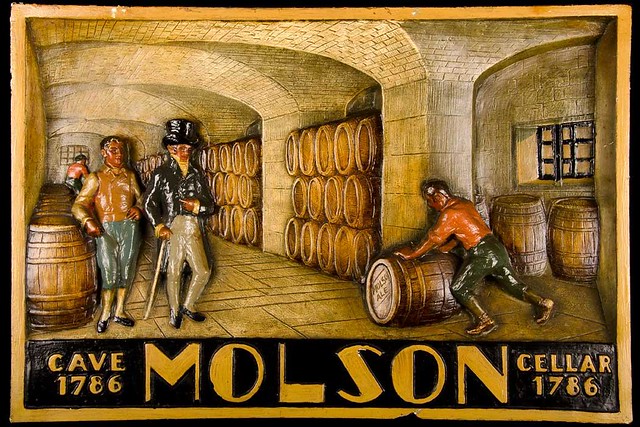
Founded in Montreal in 1786, the Molson Brewery is the oldest brewery in North America and continues to produce beer on the site of the original brewery. The company brews and markets a number of the most popular brands of beer in Canada. Domestic labels include Molson Canadian, Molson M, Molson Export, Molson Dry, Molson Exel De-Alcoholized beer, Old Style Pilsner, Rickard’s, Creemore Springs and Granville Island Brewing. Through partnerships with other major brewers, Molson Coors Canada also offers a diverse portfolio of beer brands, including Coors Light, Corona, Miller Genuine Draft (ending in 2015), Heineken, Foster’s Lager and Tiger. Molson employs 3,000 people in Canada and operates five breweries in locations across the country (Vancouver, Toronto, Montreal, Moncton and St. John’s), as well as the Creemore micro-brewery in Ontario and Granville Island Brewing in British Columbia. Molson Coors Canada is part of the Molson Coors Brewing Company.
On May 2, 1782, at the age of 18, John Molson left England for Canada, landing in Montreal on June 26. Shortly after his arrival, he began working at the Thomas Loyd brewery. He went on to purchase it in an auction in 1784. Not long after his arrival in Montreal in 1782, Molson sensed the market potential for beer in the then British colony. Prices for wine, rum and port were rising and an influx of English and Irish immigrants were particularly partial to beer. When he came of legal age, Molson used the money inherited from his parents to acquire a small brewery housed in a wooden building on the shores of the St Lawrence, just outside the fortifications of the burgeoning City of Montreal.
In 1785 he temporarily closed his business to cross the Atlantic in search of the modern equipment and ingredients. Upon his return, he offered the seeds free of charge to neighbouring Montreal farmers who agreed to grow them to satisfy the brewery’s need for malt. Molson delivered his first brew, an ale in 1786, only six weeks after taking the helm. Priced at five cents a bottle, his brew sold well.
Molson took advantage of the many business opportunities of the time. He quickly diversified his investments, opened a lumber yard and began issuing loans to local Montreal merchants. In 1816, the family enterprise began to take shape when founder John Molson entered into an association with his three sons, John junior, Thomas and William.
Although brewing proved to be Molson’s most sustainable field of endeavour, other activities were added down through the company’s lengthy history. Molson was the first company to own and operate a fleet of steamboats which were used to transport people and goods between Quebec and Ontario. John Molson and his sons also founded the Molson Bank which later merged with Bank of Montreal.
In 1816 John Molson formed a partnership with his three sons – John, Thomas and William. It was Thomas who would eventually follow in his father’s footsteps by continuing the Molson brewing tradition and upholding the high standards of quality. In 1903, inspired by the popularity of imported beers, Herbert Molson, Thomas’ grandson, and brew master John Hyde created Molson Export, an authentic Ale brewed in the classic style developed by John Molson.
Molson Brewery considerably expanded the breadth of corporate activities throughout the 20th century. In 1945 the family decided to transform the company into a public, limited liability enterprise. It then became possible to acquire an ownership in the company without being a member of the Molson family. This made it possible for the company to expand and inaugurate a new brewery in Toronto (near the Canadian National Exhibition) in 1955. Two years later in 1957, the family acquired the Montreal Forum and the Montreal Canadiens. The company continued to develop and, in 1958, acquired six breweries which included five establishments in Western Canada, lending Molson nationwide presence. In 1989, the company consolidated market share in Quebec through a merger with Carling O’Keefe (acquiring Carling’s Toronto brewery in Etobicoke). As a result, Molson became the largest brewery in Canada and the fifth largest in the world.
In 2005 Molson merged with US-based Coors to form Molson Coors Brewing Company. This was followed in 2007 by the opening of a new brewery in Moncton, New Brunswick. Sixth generation family member Eric Molson retired in 2009; however, his sons Andrew and Geoff continue to be active in company affairs as members of the corporate Board of Directors.
Last year I decided to concentrate on Bock ads for awhile. Bock, of course, may have originated in Germany, in the town of Einbeck. Because many 19th century American breweries were founded by German immigrants, they offered a bock at certain times of the year, be it Spring, Easter, Lent, Christmas, or what have you. In a sense they were some of the first seasonal beers. “The style was later adopted in Bavaria by Munich brewers in the 17th century. Due to their Bavarian accent, citizens of Munich pronounced ‘Einbeck’ as ‘ein Bock’ (a billy goat), and thus the beer became known as ‘Bock.’ A goat often appears on bottle labels.” And presumably because they were special releases, many breweries went all out promoting them with beautiful artwork on posters and other advertising.
Saturday’s ad is for Frontenac Christmas Bock Beer, which was published on December 22, 1914. The brewery was the Frontenac Breweries Limited of Montreal, Canada, which was originally founded in 1911. This ad ran in The Montreal Star also of Montreal, Canada.
Last year I decided to concentrate on Bock ads for awhile. Bock, of course, may have originated in Germany, in the town of Einbeck. Because many 19th century American breweries were founded by German immigrants, they offered a bock at certain times of the year, be it Spring, Easter, Lent, Christmas, or what have you. In a sense they were some of the first seasonal beers. “The style was later adopted in Bavaria by Munich brewers in the 17th century. Due to their Bavarian accent, citizens of Munich pronounced ‘Einbeck’ as ‘ein Bock’ (a billy goat), and thus the beer became known as ‘Bock.’ A goat often appears on bottle labels.” And presumably because they were special releases, many breweries went all out promoting them with beautiful artwork on posters and other advertising.
Saturday’s ad is for Frontenac Bock Beer, which was published on December 20, 1914. The brewery was the Frontenac Breweries Limited of Montreal, Canada, which was originally founded in 1911. This ad ran in The Montreal Star also of Montreal, Canada.
Today is the birthday of Eugene O’Keefe (December 10, 1827-October 1, 1913). He “was a Canadian businessman and philanthropist, well-known in the brewing industry for his signature brews. He founded the O’Keefe Brewery Company of Toronto Limited in 1891.”
Born in Bandon, County Cork, he moved with his family to Canada when he was five eventually settling in Toronto. He married Helen Charlotte Bailey in 1862. They had a son and two daughters.
From 1856 to 1861, he worked at the Toronto Savings Bank. He later was president of the Home Bank of Canada. In 1861, he was one of the purchasers of Toronto’s Victoria Brewery (founded by George Hart and Charles Hannath c.1840s as Hannath & Hart Brewery[1]), at the corner of Victoria and Gould Streets, with had an annual production of 1,000 barrels. In 1891, he incorporated it as O’Keefe Brewery Company of Toronto Limited. The brewery would expand to a capacity of 500,000 barrels. He sold the business after his son died in 1911. The company would later be part of Carling O’Keefe Breweries.
In 1909, Pope Pius X made him the first Canadian layman to be made a private Papal chamberlain. He died at his home on Bond Street in 1913, aged 85.
The O’Keefe name is well established in Toronto due to the many charitable donations Eugene O’Keefe made throughout his life. He donated millions of dollars to the Catholic Church in Toronto; built five churches in Toronto; built the St. Augustine’s Seminary in Scarborough; and built Toronto’s first low-income housing development. The O’Keefe name was used as a tribute on the new O’Keefe Centre when it was built in 1960 by E. P. Taylor, then the head of O’Keefe Brewing Company. In 1996, the name was changed to the Hummingbird Centre. In 2007 the name was changed to the Sony Centre for the Performing Arts. His former mansion (O’Keefe House), located across from the former O’Keefe Brewery serves as a residence for students at Ryerson University and the brewery itself is now the Image Arts faculty building.
Since then, a handful of individuals have been actively trying to reestablish the O’Keefe name due to the vital role the man played in shaping the city during the Victorian period. It was not until 2006, when the official biography was written on O’Keefe; the delay due in large part to scant information and lack of personal and company records.
And this biography of O’Keefe is from the Canadian Encyclopedia:
Eugene O’Keefe, brewer, banker, philanthropist (born 10 December 1827 in Bandon, Ireland; died 1 October 1913 in Toronto, ON). O’Keefe is best known for founding the O’Keefe Brewery Company of Toronto Limited. A successful Catholic businessman and philanthropist, he was the first Canadian layman to be made a private chamberlain to the pope.
Early Life and Banking Career
Eugene O’Keefe (born Keeffe) came to Canada in 1832, when he was five years old. The family appears to have changed its name to O’Keefe after immigrating to Canada. O’Keefe was educated in Toronto schools. In 1856, he began working at the Toronto Savings Bank, which had been established two years earlier by Bishop Charbonnel and members of the Society of Saint Vincent de Paul. O’Keefe worked at the bank until 1861, but maintained ties with the institution, serving as board member, director, vice-president and eventually president (1901) of what would become the Home Bank of Canada.
Brewer
In 1861, O’Keefe partnered with two other men to buy Toronto’s Victoria Brewery (owned by Charles Hannath and George Hart). At the time, the brewery produced about 1,000 barrels of ale and stout per year. By the 1890s, O’Keefe was one of the largest brewers of lager beer in Canada, and had implemented new technologies including refrigeration, plant electrification, crown-cap bottles and motorized delivery vehicles. The company was incorporated as the O’Keefe Brewery Company of Toronto Limited in 1891. Devastated by the death of his son in 1911, O’Keefe sold his brewery shares to his partner, Widmer Hawke, and to Sir Henry Pellatt. By that time, the brewery could produce 500,000 barrels a year. After Hawke’s death, the brewery was sold to a holding company, O’Keefe Limited, under Pellat, Sir William Mulock and Charles Vance Millar. This company was bought by E. P. Taylor in 1934 and incorporated into his Brewing Corporation of Canada Limited (later Canadian Breweries Limited).
Philanthropy
O’Keefe donated much of his wealth to charity, particularly the Catholic Church. He financed several new churches in Toronto, including St. Monica’s Church and St. Stanislaus Kostka Church, and donated $400,000 to build St. Augustine’s Seminary in Scarborough. In 1909, he was recognized for his benefactions to the Roman Catholic Church when he became the first Canadian layman to be appointed private chamberlain to the pope.
O’KEEFE, EUGENE (baptized Owen Keeffe), businessman and philanthropist; b. 10 Dec. 1827 in Bandon (Republic of Ireland), son of John Keeffe (O’Keefe) and Mary Russell; m. 23 Jan. 1862 Helen Charlotte Bailey (d. 1899) in Toronto, and they had a son and two daughters; d. there 1 Oct. 1913.
Little is known of Eugene O’Keefe’s early life. His family came to the Canadas when he was five; two years later they settled in Toronto. It seems the family adopted the O’Keefe spelling when they immigrated. John O’Keefe was possibly the tavern proprietor and, later, the sailor listed in Toronto directories. Eugene was educated at the private school run by Denis Heffernan and at “the regular church schools.” In his youth he acquired a reputation as an expert bowler, oarsman, and horseman. Apparently he was an ensign in the local volunteer rifle company. Its captain, Denis K. Feehan, was a close friend, and the two men had much in common. They were Irish Catholics in a distinctly Protestant city and members of the Society of St Vincent de Paul, the principal conduit for Catholic charity in Toronto.
O’Keefe’s brother-in-law, John Murphy, operated a hotel and when he died O’Keefe helped his sister run it. He reputedly spent some time too in the grocery business. In 1856 he became a clerk at the Toronto Savings Bank, established two years before by Bishop Armand-François-Marie de Charbonnel* and members of the Society of St Vincent de Paul. Perhaps Feehan, who had promoted the bank, played a role in O’Keefe’s appointment. O’Keefe worked for the bank until 1861, acquiring in the process a thorough knowledge of business practices, particularly accounting. His association with it did not end then, however. A director before and after its reorganization in 1872, he stayed on the board after the assets of the bank were taken over in 1879 by the Home Savings and Loan Company Limited. Later the same year Archbishop John Joseph Lynch* sold this company to Frank Smith*, a wealthy Catholic politician who made himself president and O’Keefe vice-president. O’ Keefe succeeded Smith in 1901 and oversaw another name change, to the Home Bank of Canada, which enjoyed its most prosperous years under his leadership.
In 1861 O’Keefe had made a business decision that was to have a profound effect not only on his own fortunes, which were far from secure at the time, but also on the welfare of the archdiocese. When the Victoria Brewery, at the corner of Victoria and Gould streets, came up for sale, he formed a partnership with George Macaulay Hawke and a brewer, Patrick Cosgrave, to purchase this small but reputable operation. Its annual production was 1,000 barrels of traditional English ales and stout. Within a year Cosgrave left, but O’Keefe and Hawke continued in association as O’Keefe and Company. When their partnership ended in 1882, O’ Keefe joined with Hawke’s son, Widmer, and Joseph Hooper Mead; the following year the firm was narrowed down to O’Keefe and Widmer Hawke. In 1891 they had it incorporated as O’Keefe Brewery Company of Toronto Limited.
On entering the business O’Keefe had known nothing about brewing, but, according to one biographer, “his business training had shown him that here was an industry with unlimited capacity for expansion.” Before long he had increased productivity to 7,000 barrels a year. Ambitious and forward-looking, O’Keefe supervised additions to the plant in 1872, 1882, and 1889. Shortly after incorporation the entire brewery was replaced by a modern facility equipped with a 60,000-bushel malt-house. This plant lasted until 1911, when a brewery with a capacity of 500,000 barrels was built.
Brewing in 19th-century Ontario was a highly conservative and tradition-bound business. The source of O’Keefe’s rapid success was his willingness to be innovative and aggressive at every level of production and distribution. In 1879 he had introduced the large-scale production of lager; in 1898 he was the first brewer in Canada to install a mechanically refrigerated storehouse; and later he began using motorized vehicles. As early as the 1880s he was outselling his competition everywhere in Ontario. Recognized within the industry, he served as a president of the Ontario Brewers’ and Maltsters’ Association.
The premature death in 1911 of his only son, Eugene Bailey, effectively ended O’Keefe’s interest in his brewery’s long-term future. He sold his shares to Hawke and Sir Henry Mill Pellatt*. The sizeable proceeds were applied to O’Keefe’s favourite charities, such as Peter’s pence, St Michael’s Hospital, and the repair of the rectory of St Michael’s Cathedral, of which he was a member. O’Keefe, who rarely did anything on a small scale, had already set out to erect new Catholic churches. For example, in 1907 he built St Monica’s Church on Broadway Avenue as a memorial to his wife. Four years later he purchased West Presbyterian Church on Denison Avenue and turned it over to immigrant Poles, who renamed it St Stanislaus Kostka Church. In each case he spent $30,000. His most impressive and lasting legacy is St Augustine’s Seminary on the Scarborough Bluffs, which opened in August 1913. O’Keefe gave the colossal sum of $400,000 towards its construction. Even in death he was generous. His will, which confirmed his status as the Catholic Church’s greatest benefactor in Toronto, directed the distribution of additional sums to church and civic charities, out of an estate worth $968,300; eventually $184,776 was given out.
Eugene O’Keefe was a Conservative in politics and a moderate nationalist in Irish affairs. He went to Ottawa in 1887 in an unsuccessful bid to stop William O’Brien, a fiery Home Ruler, from appearing in Toronto at the same time as Governor General Lord Lansdowne [Petty-Fitzmaurice*]. One of Toronto’s richest men, O’Keefe carried more weight in the field of philanthropy. He exercised considerable influence over the work of the Society of St Vincent de Paul, the Catholic League, and the local branch of the United Irish League, and he was a trustee from 1906 of the Toronto General Hospital. As well, he was an original director of the Catholic Church Extension Society, and he sat on numerous parish committees at the cathedral. For his munificence and dedication to the church, he was the first Canadian layman to be made a private chamberlain to the pope, on 9 Jan. 1909.
O’Keefe died on 1 Oct. 1913 at his home, which he had built in the 1880s on Bond Street, across from his brewery. He was survived by one daughter, Helena Charlotte French. Three thousand people, including hundreds of brewery workers, attended his Requiem.