

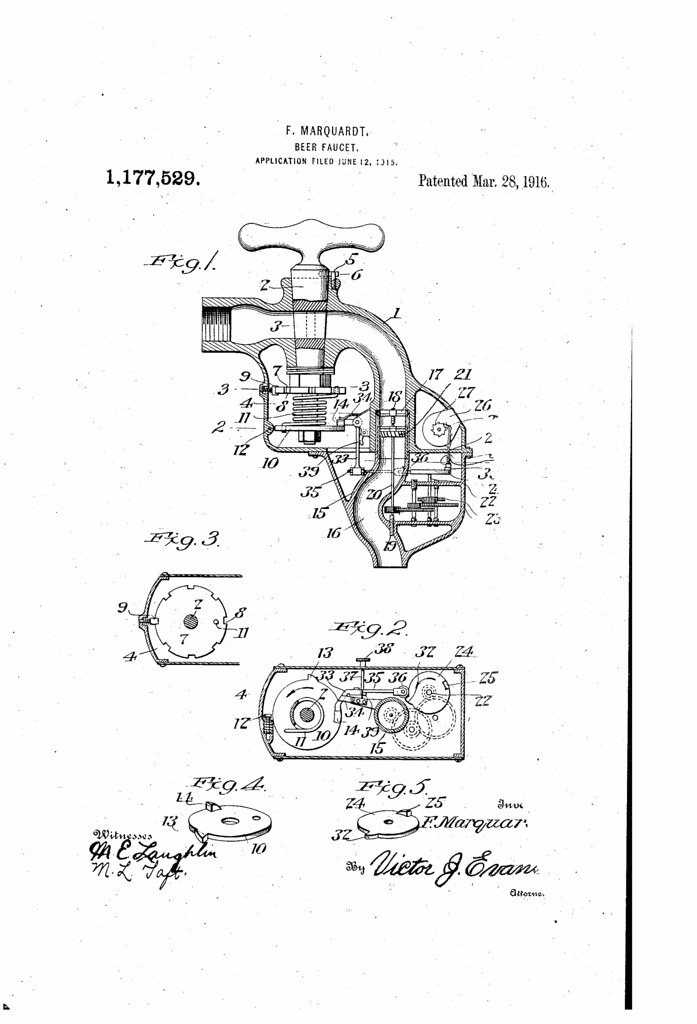
Today in 1916, US Patent 1177529 A was issued, an invention of Frederick Marquardt, for his “Beer-Faucet.” There’s no Abstract, but the description states that the “invention is to provide a faucet especially adapted to be used for dispensing beer, ale orthe like, and the faucet is provided with a meter which is operated by the passage of the liquid through the same to register the quantities of liquid drawn through the faucet.”
Patent No. 3311267A: Measuring Attachment For Beer Keg Or The Like
Today in 1967, US Patent 3311267 A was issued, an invention of James E. Houston, Ryals E. Lee,and George M. Norman, for their “Measuring Attachment for Beer Keg or the Like.” There’s no Abstract, but the description states that the “invention relates to the dispensing of liquids including beer from closed opaque kegs or containers subjected to pressure to discharge the contents and with regard to which it is desirable to be able to determine the amount of liquid contained at any particular time between the initial dispensing and exhausting of the contents of such keg or container.” There’s not much more, but they explain its object:
It is an object of the invention to provide a simple, practical, readily usable, measuring attachment for a beer keg or the like, which can be quickly applied and removed, and by means of which an immediate reading of the contents can be made at any time.

Beer In Ads #1507: Next Time

Friday’s ad is still another one for Budweiser, this one from 1959. It’s another ad from their “Where there’s life” series, this one is called “Next Time.” It’s hard to see what’s going on in this ad. A couple in a darkened room, their faces shiny from the dark red light. They’re dressed up, but he’s taken off his jacket and has his sleeves rolled up. On the counter, bar, table or whatever they’re leaning on, there’s a newspaper, a bag of potato chips and an ashtray, while the woman is pouring a can of beer into a pilsner glass. By the looks of it, if she doesn’t stop right this second, that glass is going to overflow, and with a pretty solid stream still coming out of the can, it may happen anyway.

Patent Nos. 2546250A & 2546251A: Process Of Concentrating Yeast Slurries & For Drying Yeast
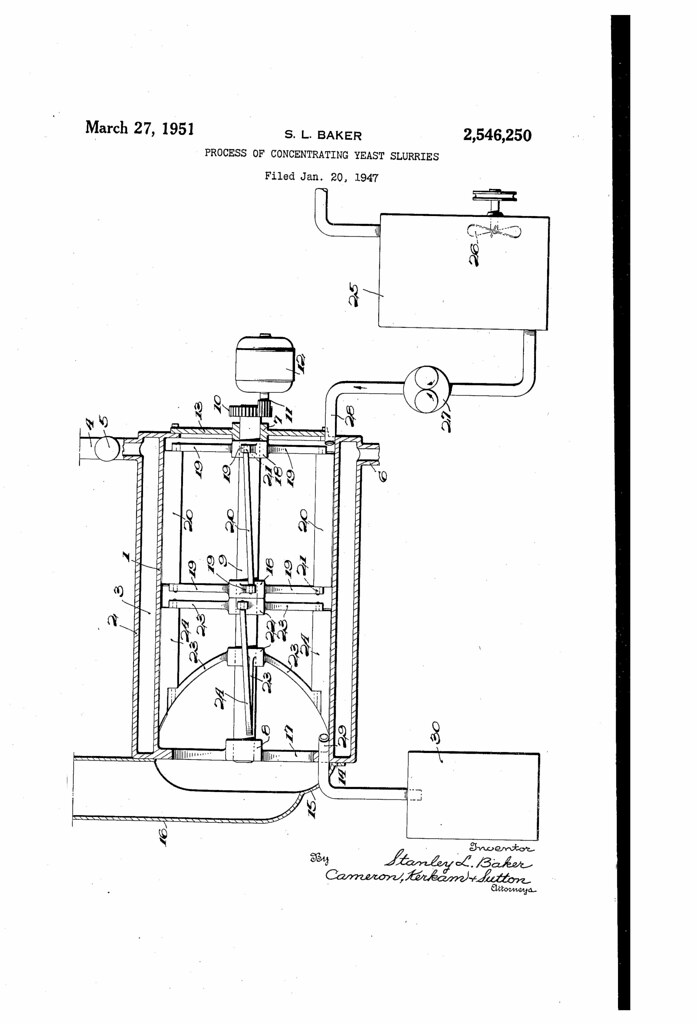
Today in 1951, US Patents 2546250 A and 2546251 A were issued, both inventions of Stanley L. Baker, for his “Process of Concentrating Yeast Slurries” and “Process for Drying Yeast.” There’s no Abstract for either, but the description for the first is an “invention relat[ing] to the concentration of dilute suspensions or slurries of yeast and especially of brewers yeast slurry which will be referred to hereinafter as an example although it will be understood that the invention is not restricted thereto.”
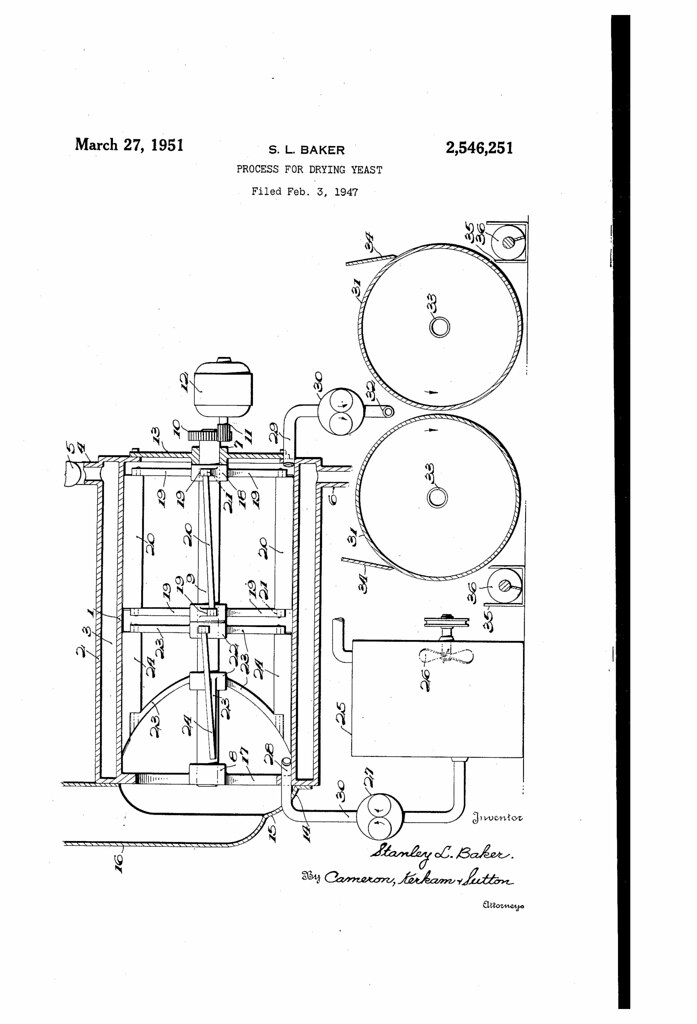
His second patent is described as an “invention relat[ing] to drying dilute suspensions or slurries of yeast and especially brewers yeast slurry which will be referred to hereinafter as an example, although it is to be understood that the invention is not restricted thereto.” You may have noticed that this description is exactly the same as the first. What’s clear is while these are two different patents, they are vey similar and are both about roughly the same yeast process. Even the drawings are only slightly different from one another.
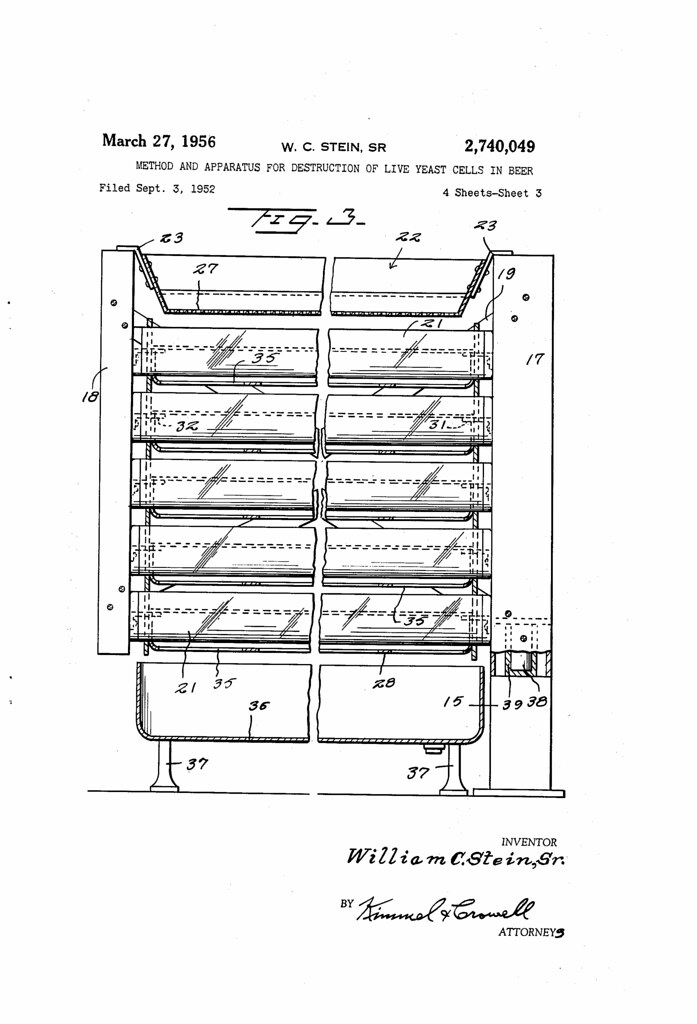
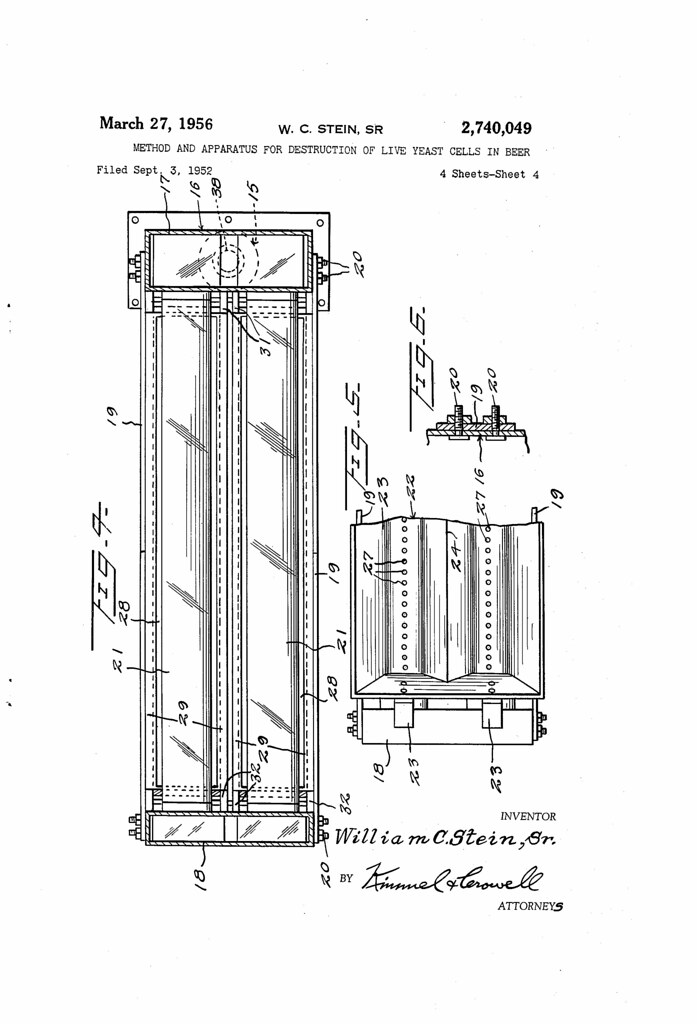
Patent No. 2740049A: Method And Apparatus For Destruction Of Live Yeast Cells In Beer
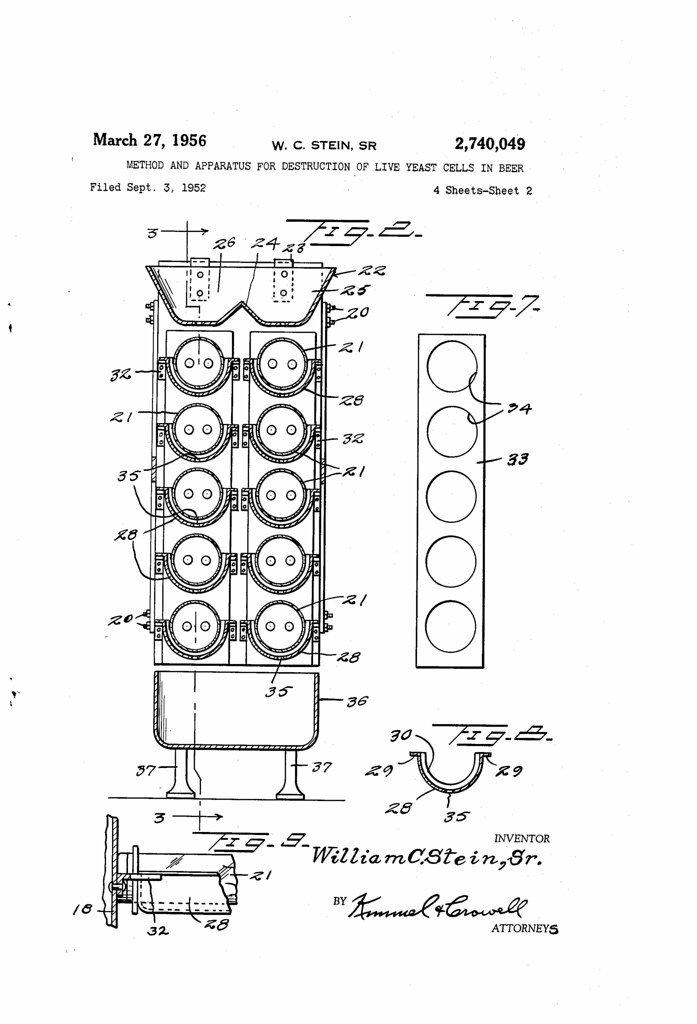
Today in 1956, US Patent 2740049 A was issued, an invention of William C. Stein Sr., for his “Method and Apparatus for Destruction of Live Yeast Cells in Beer.” There’s no Abstract, but the description states that the “invention relates to a method and apparatus for destroying live yeast cells in beer.” When he lays out the various objects for the invention, it’s clear that the yeast is destroyed when “the beer is cascaded over violet ray tubes,” allowing for the “continuous treatment of the beer.” It apparently differs from how this was accomplished beforehand, as using this method “the beer will be subjected to a pre-carbonation pasteurization whereas under prior process the beer was pasteurized after carbonization.”

Beer In Ads #1506: Nothing Like It
Thursday’s ad is yet another one for Budweiser, this one from 1961. It’s another ad from their “Where there’s life” series, this one is called “Nothing Like It.” A man eating a pizza by himself is having a beer poured for him by a uniformed waitress. I love how everyone dressed up to eat pizza. We do that at home, too. I find it best to wear a suit whenever we order a pizza for delivery. But I usually choose a different beer.

Patent No. 1995626A: Manufacture Of Minim Alcohol Beverage
Today in 1935, US Patent 1995626 A was issued, an invention of Karl Schreder, for his “Manufacture of Minim Alcohol Beverage.” There’s no Abstract, as far as I can tell, Minim means low-alcohol. I wonder if that was a common term back then? It’s not one I hear these days. Curiously, although the invention relates to what they call “low alcohol beverages,” the percentage of alcohol is never discussed, which strikes me as odd. Here’s what is revealed:
It has been found that Termobacterium mobile (Lindner) (Pseudomonas Lindneri-Kluyver) discovered by Professor Dr. Lindner is particularly suitable for the manufacture of beverages containing a low proportion of alcohol.
A process for the manufacture of beverages of this kind forms the subject-matter of the present application.
For obtaining a high grade end product it is essential that the preparation of the malt and of the wort be carried out carefully.
Okay, but what is the “high grade end product?” Is it non-alcoholic or near beer below 0.5% a.b.v.? Or something that might be considered a session beer with an alcohol percentage lower than a beer of typical strength?

Patent No. 1021669A: Beer-Tapper
Today in 1912, US Patent 1021669 A was issued, an invention of William W. Frisholm, for his “Beer-Tapper.” There’s no Abstract, but the description states that his “invention is an improvement in beer tappers, and consists in certain novel constructions, and combinations of parts, hereinafter described and claimed. Sometimes the language in these is just wonderful, case in point:
The object of the invention is to provide an improved device for tapping beer and other effervescing liquids which will permit the entering of the device into the keg or other receptacle without waste, and which, while permitting the free egress of the liquid, will also permit the entrance of air under pressure to force out the liquid.

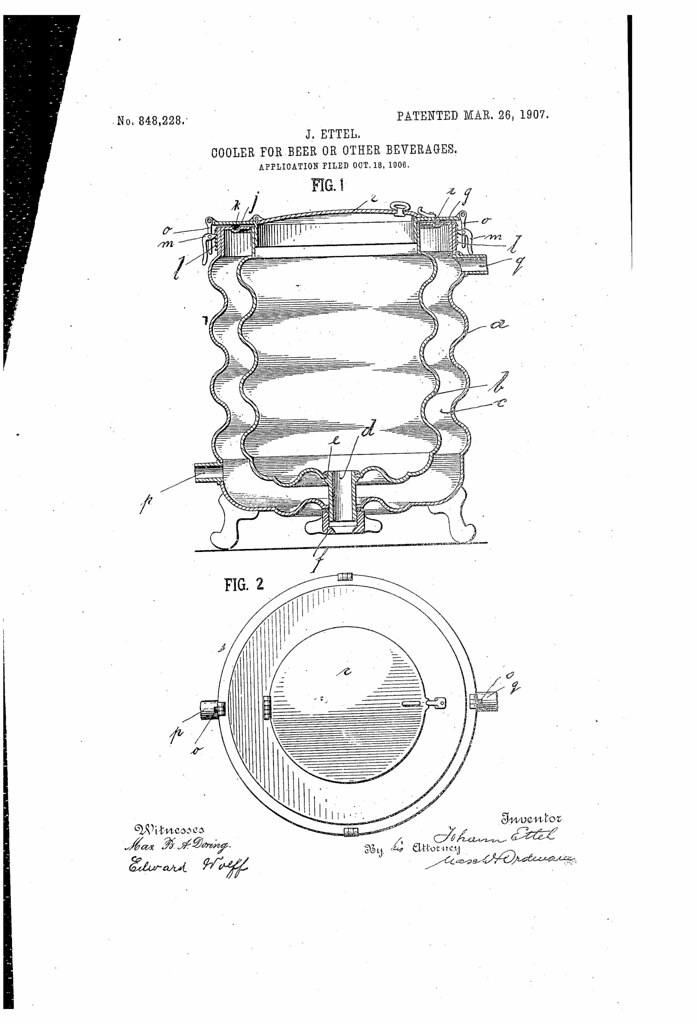
Patent No. 848228A: Cooler For Beer
Today in 1907, US Patent 848228 A was issued, an invention of Johann Ettel, for his “Cooler for Beer or Other Beverages.” There’s no Abstract, and the description is without a doubt one of the worst OCR conversions I’ve ever seen. For example, here’s what should be the introduction, verbatim:
To afl’ whom` if my Concern.- l Be it’known that I, JOHANN ETTEL, a enbject of the Em eror of AustriaHungalj, Brooklyn, county of Kings,
new and useful Improvements in (loolers for Beer or other Beverages, of Whiel’ithe following is eepeei’lieet-ion- L The`presentinvention ‘has for its object to provide n. meier for heer or other beverages principally in hors;restaurant-s, mul the like.- v
Which I think we can infer that Johan Ettel, who was from Austria-Hungary, but living in Brooklyn, invented a new beer cooler.
Beer In Ads #1505: Count ‘Em
Wednesday’s ad is another one for Budweiser, from 1960. It’s another ad from their “Where there’s life” series, this one features puppies and is called “Count ‘Em!” Bud wants you to look at 7 — count ’em, 7 — words on their label. They don’t say which ones, but I assume it’s “Choicest Hops, Rice and Best Barley Malt.” Or you could go with “Brewed by our original all natural process,” though it’s hard to see what is so original. At any rate it doesn’t seem wide to let the consumer pick which seven words to pick off the label to tell them “why Bud is so good.”
