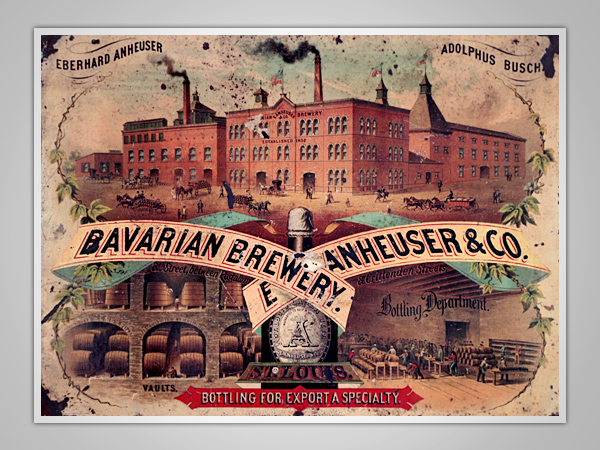
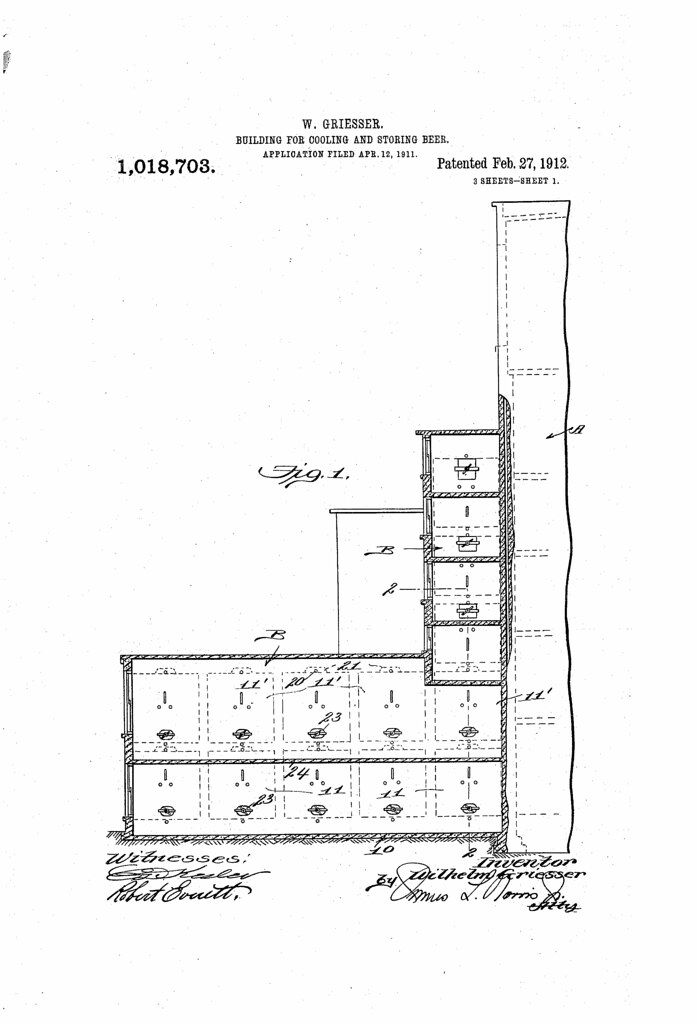
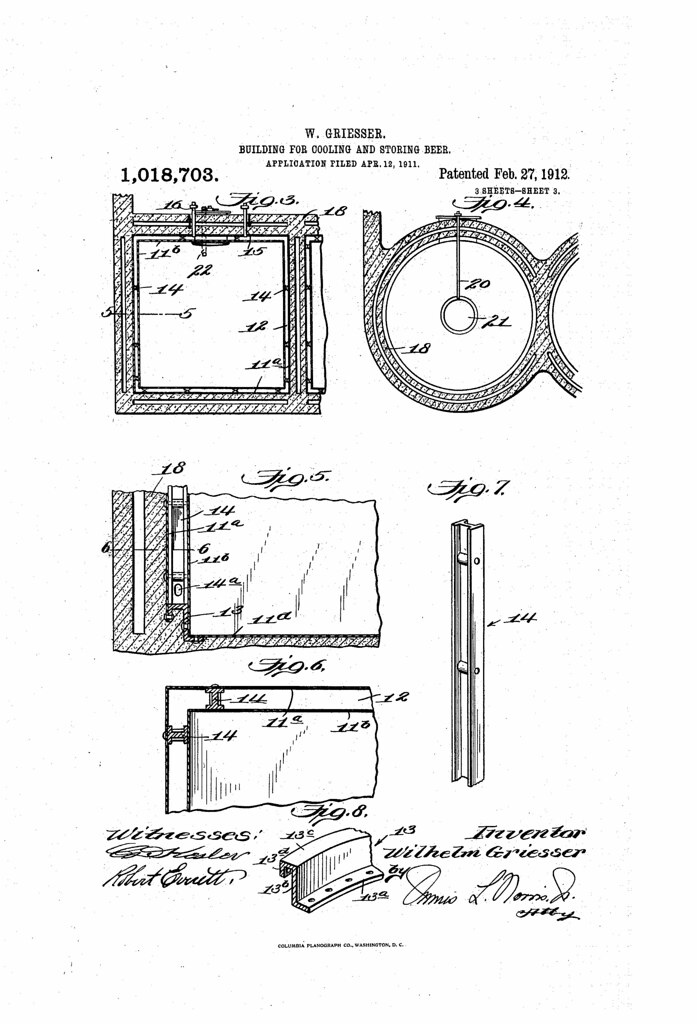
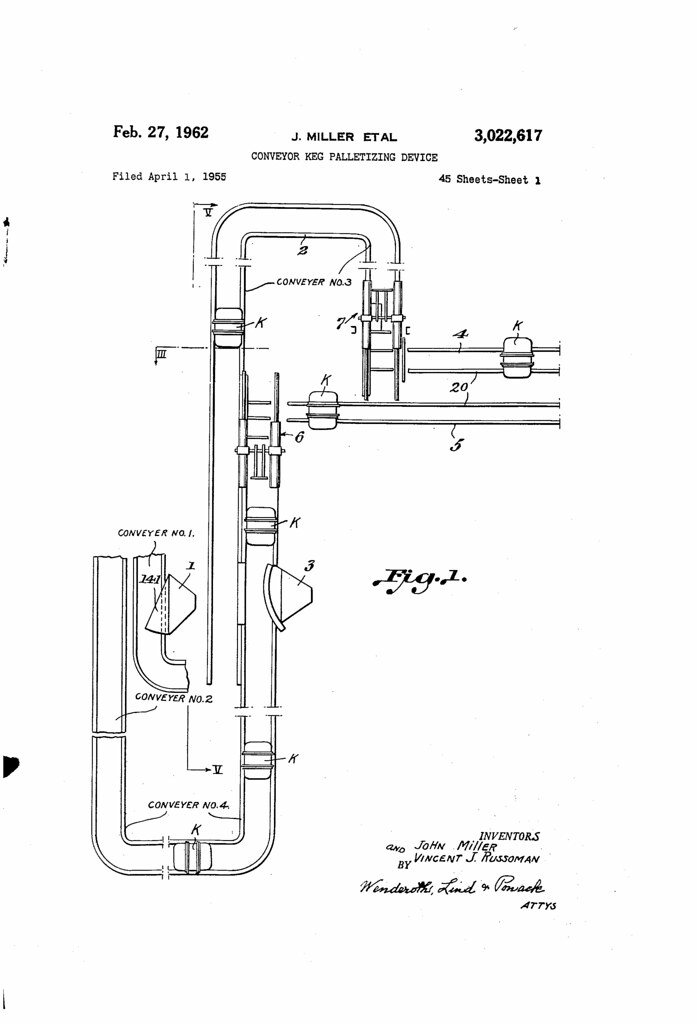
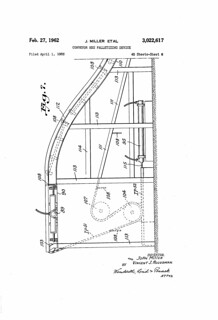
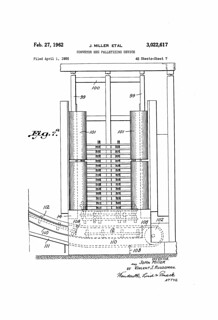
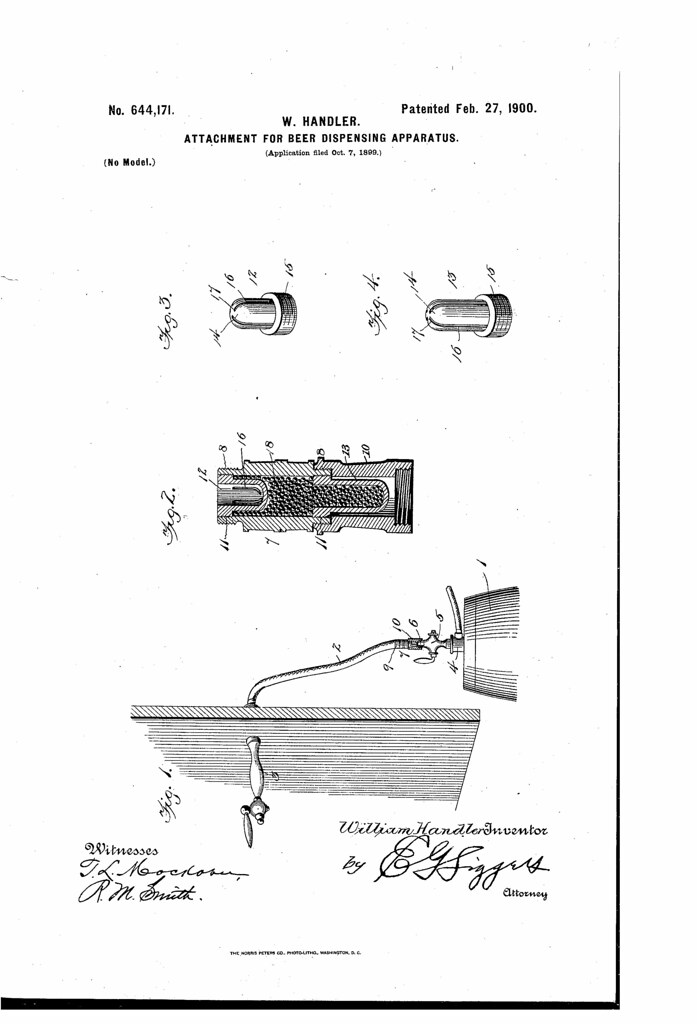
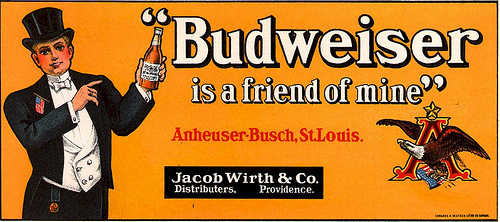
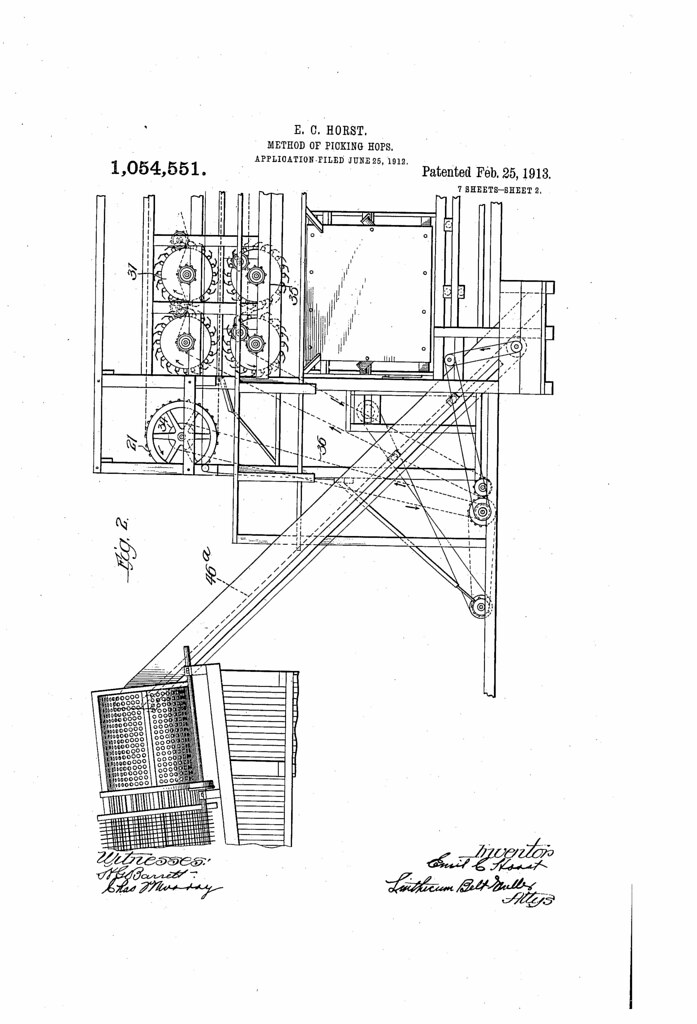
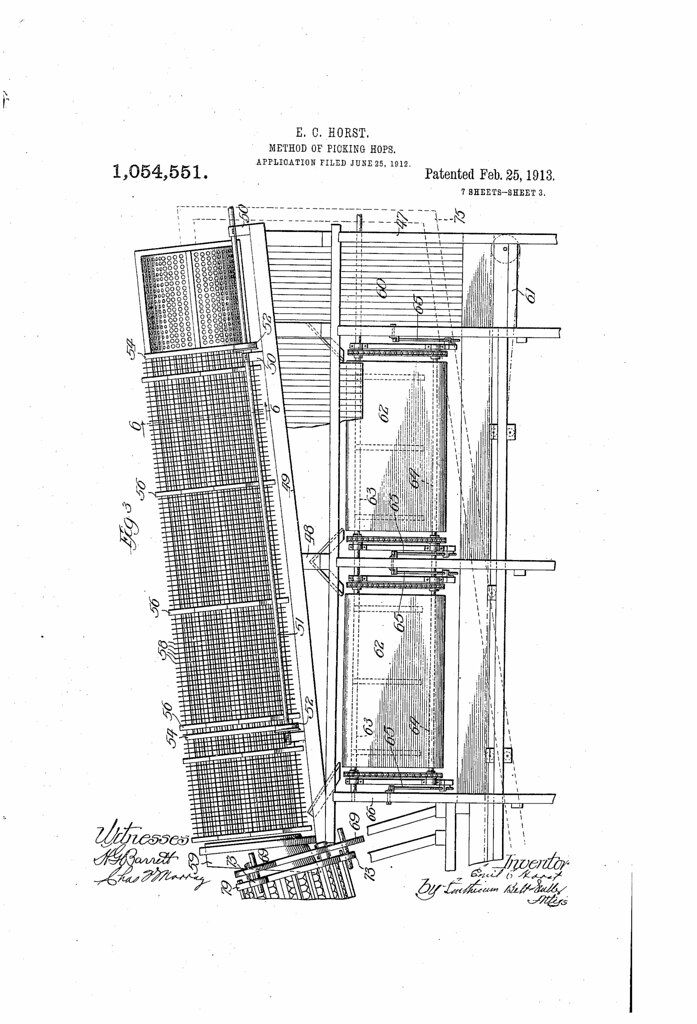
Today in 1881, US Patent 237884 A was issued, an invention of William Mainzer and John Singer, for their “Cask for Beer and Other Liquids.” There’s no Abstract, but the application states that “the object of this invention is to furnish casks for holding beer and other liquids, so constructed that they can be safely handled and transported without detaching the faucets, and can thus be furnished to the consumer with faucets applied ready for use, and can be returned to be refilled without detaching the faucets.”

Beer In Ads #1466: To My Ballantine

Saturday’s ad is for Ballantine, from 1948. A simple Valentine’s Day ad with a great play on words with the title: “To My Ballantine” and showing a woman cutting out a red heart and leaving the three-ring Ballantine logo as the scraps. Those have got to be the longest scissors I’ve ever seen. They look more like garden shears. But nice and simple, with a great illustration in the center. Happy Valentine’s Day.

Patent No. 253683A: Apparatus For Raising Beer

Today in 1882, US Patent 253683 A was issued, an invention of Peter J. Catterall and Edward Birch, from Manchester, England, for their “Apparatus for Raising Beer.” There’s no Abstract, but the application states their “invention relates to apparatus for raising valves, through one of which the liquid is admitted to the chamber, and through the other the liquid is forced to the bar or delivery-tap” and there “is a section of the three-way tap that admits and discharges the water used to raise the beer or other liquid.”

Beer In Ads #1465: If You Can’t Come To Holland …

Friday’s ad is for Heineken, from 1977. In the year I graduated from high school, Heineken was considered “the good stuff” by my step-father’s friends and relatives, which in retrospect is rather sad and indicative of the state of beer at that time. This is also at a time when Holland seemed mysterious, and people really didn’t know much about the European nation. So using such cliched images in their ads like tulips and windmills probably made sense, but looks really dated now. Even the beer glass has a windmill on it.

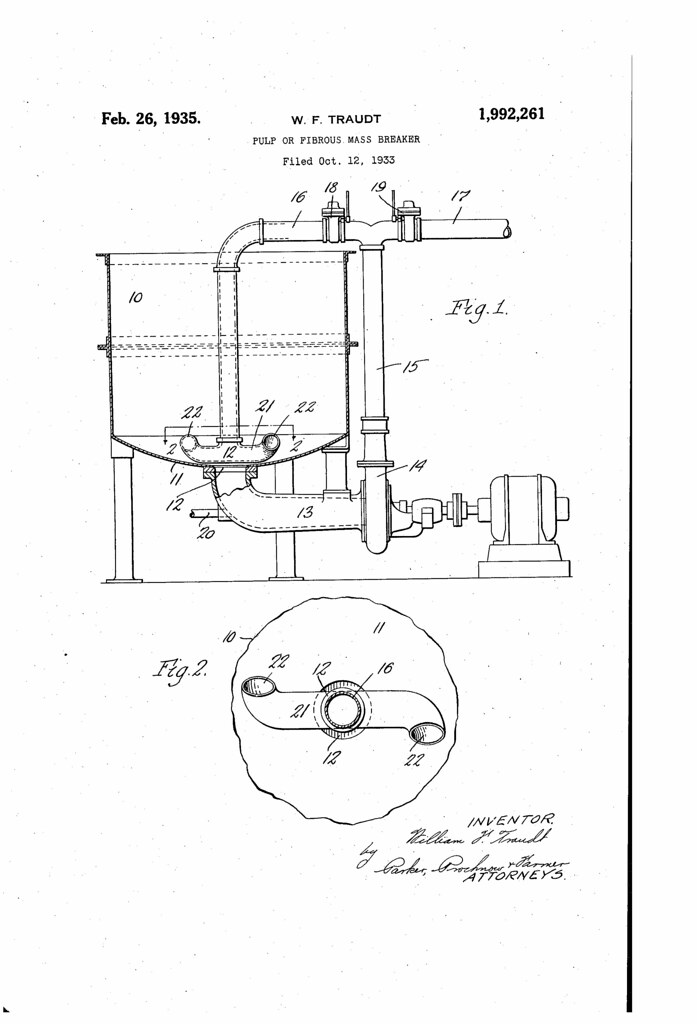
Patent No. 812243A: Circulating System For Beer-Filters

Today in 1906, US Patent 812243 A was issued, an invention of Max Stahl, for his “Circulating System for Beer-Filters.” There’s no Abstract, but Stahl describes his invention as an improvement over then-current systems, saying his “invention aims to and does overcome the losses and disadvantages [mentioned earlier in the description], and in brief it consists of providing means whereby the column of beer can be switched off the racking-bench and continuously returned to the filter until stable relations are secured and the beer no longer runs cloudy or contains fibers of filter mass.”

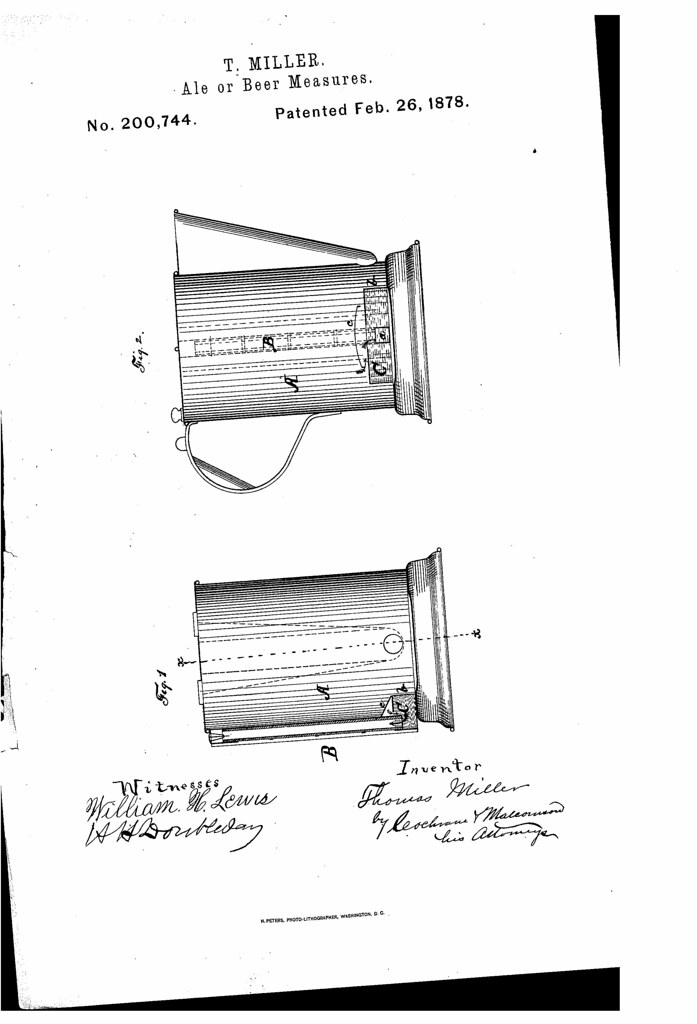
Patent No. 272261A: Beer-Mug

Today in 1883, US Patent 272261 A was issued, an invention of John E. Jeffords, for his “Beer-Mug.” There’s no Abstract, but Jeffords describes his invention as and its purpose “to provide a neat and a cheap form of mug, which is readily cleansed and not easily broken,” adding that it “consists of a beer-mug made of suitable porous material, glazed.”

Beer In Ads #1464: Pronounce It Mick-A-Lobe

Thursday’s ad is for Michelob, from 1967. Apparently, in the late Sixties people still had trouble pronouncing Michelob. It reminds me of the packaging on Lagunitas, which includes “Say ‘lah-goo-knee-tuss'” on their carriers because when the brewery first opened, founder Tony Magee worried that most people wouldn’t know how to pronounce the name of the small west Marin town. So okay, it’s “Mick-A-Lobe,” “Now that’s an order.” Also, “In beer, going first class is Michelob. Period.” Sadly, that is how the brand was positioned. It even seemed to work for a while.

Beer In Ads #1463: Croquet & Beer

Wednesday’s ad is for Budweiser, from 1950. Here’s a great rule of thumb for living. “Some sort of recreation belongs in every one of your busy days.” If it’s croquet and drinking beer, I’m in. Especially if I get to dress up in the backyard. But I love croquet, used to play it at my grandmother’s place all the time growing up. Curiously, though, she never offered me a beer. I do like that their croquet set appears to have a place on it where you set down your beer. Ours didn’t have that.

Beer In Ads #1462: Enjoy Life
The Orchid Of Beer: Women’s Beer Circa 1953
![]()
I believe we tend to think of marketing efforts to create a beer specifically aimed at women as a more recent development, but apparently that’s not the case. I recently discovered that in 1953 the Storz Brewing Co. of Omaha, Nebraska was trying to sell beer to women using the same tired tricks that are often still being used today.
Apparently, in 1953, Storz created the “Storzette,” a smaller package designed for the ladies to be “calorie controlled” and less bitter, and which also had a pink and lavender package with orchids on them, and whose slogan was — believe it or not — “The Orchid of Beer.” Rusty Cans has the full story, from 2004, of the brewery and this dalliance into women’s marketing.
In 1953 Storz tried to market a new product for women, “Storzette.” Designed to be a beer for the ladies it was supposedly not too bitter and was calorie controlled. It also came in a smaller can, 8 ounces, which Storz called “Queen sized” and it came in four can packs called “Princess Packs.” The brewery noted that market studies showed that many women felt that the standard 12 oz can provided too large a serving. The beer inside was also different, made to be less bitter than standard beers. The can even had a pink orchid pictured on it to help it appeal to women. It’s initial test market results in San Diego seemed positive, but in the end the effort was not successful and Storzette did not last long on the market. As a result, the little can with the orchid is very scarce. Storz also used a slogan on its regular cans for awhile in the 1950s, “the Orchid of Beer” which has to be one of the more unusual beer advertising slogans.
Absent any additional information, I can only assume “Calorie Controlled” is done through offering a smaller size can. Smaller portions equals less calories. Of course, you could just drink less, couldn’t you? The control aspect of their claim seems entirely up to the drinker rather than anything designed by the packaging or the beer itself.

According to orchid websites, the particular type of orchid on the label is a cattleya. Not only do they use a flower, but the color palate is soft pastels, pinks and purple.

I presume this is a vintage grocery display using a cart filled with six-packs and surrounded by banners. Notice on the side there’s a gal wearing glasses saying the beer is “Strictly for the Girls.”

And finally, here’s an ad for the beer using an orchid in the advertisement.

Interestingly, a group of local folks from Omaha revived the Storz brand and opened a newer version of the brewery in 2013.