Our 33rd Guinness poster features a Guinness-drinking lobster and was at least promoting a nice beer pairing with the tagline “There’s nothing like a Guinness with Lobster.” But it’s the bad title pun that really make it.
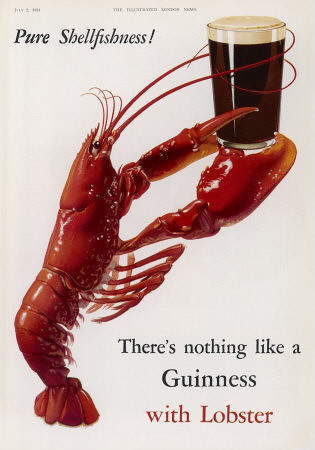

Our 33rd Guinness poster features a Guinness-drinking lobster and was at least promoting a nice beer pairing with the tagline “There’s nothing like a Guinness with Lobster.” But it’s the bad title pun that really make it.

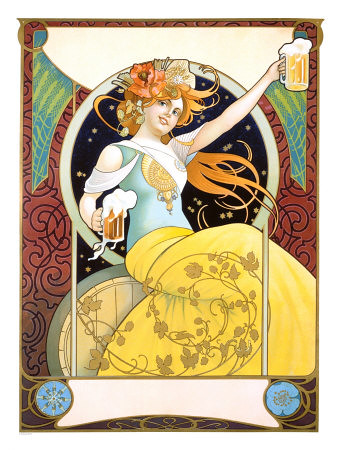
Friday’s ad is one of my favorite beer posters of all time, though I’ve never seen it with any text so I don’t know if it was ever actually used as an advertisement at all and, if so, for what brewery. I’ve never seen any information about the artist or even where it’s from precisely, though I suspect it’s French. Still, it’s beautiful.
Thursday’s ad is for the Swiss brewery, Brauerei Hurlimann. It was founded in 1836, and moved to Zurich thirty years later, in 1866. They’re still brewing beer today, though I don’t know when this ad was done, though I suspect it was shortly after World War 2 ended, as “Kriegs Zeit Friedens Zeit” translates roughly as “postwar peace time period.”

Wednesday’s ad is for another Italian brewery, Birra Dicitura. It seems like it has to be later than the 1920s, because the art is less well-defined, more abstract. It almost seems unfinished, a rough sketch. And I can’t help but wonder; why the five of hearts? Dicitura, by the way, is Italian for “wording.”

Tuesday’s ad is for an Italian brewery, Birra Metzger, in Torino, our second ad from this brewery. They were founded in 1848 but closed in 1975. The artist’s name is Filberto Mateldi (1882-1942), a well-known Italian illustrator, who made his name in the fashion world.

Monday’s ad is for a French brewery, Bieres de Montmorillon, most likely from the 1920s. This ad is quite odd, with the weird little man in the red coast actually licking at the beer and giving a strange sidewards glance. I’m not sure that would make me want to try their brand.

Our 32nd Guinness poster by John Gilroy was a one-off for a specific event, the 1953 coronation of Queen Elizabeth II.
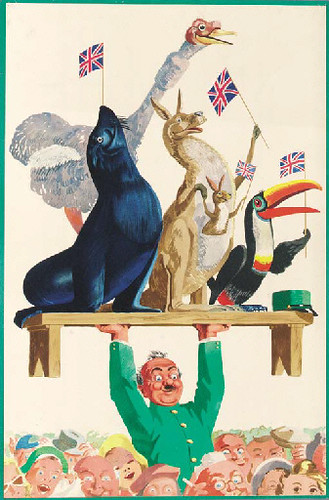
The zookeeper is shown holding up a bench — presumably made possible from drinking a Guinness — with four of the animals used in various Guinness ads over the years, all waving British flags. There’s no text at all, but I assume everyone would have understood it at the time.
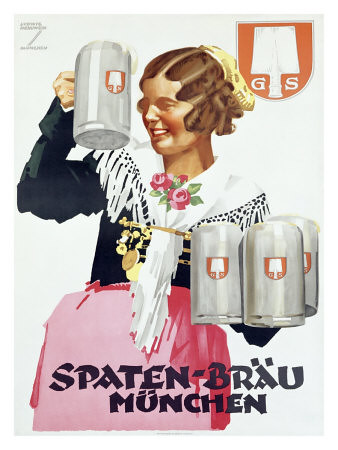
Friday’s ad is for the German brewery Spaten from either 1924 of 1933 (accounts differ). It’s by the famous German poster artist Ludwig Hohlwein. I love the stylized server and just the timeless quality of the art.
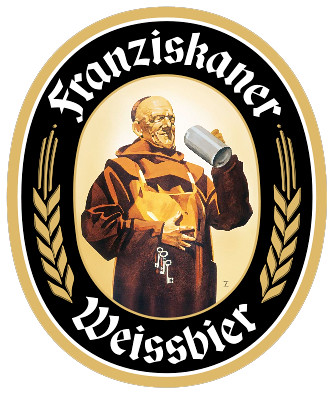
As far as beer is concerned, Hohlwein is probably best know for creating the artwork of the monk used in the label for Franziskaner Weissbier.
Thursday’s ad continues our week of ads from France, this one done in 1930. It’s for Biere Phenix, which was founded in 1886. The artist’s name is Leon Dupin. Either the sailor’s drinking in the fog, or he has a disembodied hand.


Gizmodo has an intriguing post up right now, combining ideas from two books about early man and the dawn of civilization, Sex at Dawn: The Prehistoric Origins of Modern Sexuality and Uncorking the Past: The Quest for Wine, Beer, and Other Alcoholic Beverages. In Orgies or Beer? You Only Get One, author Joel Johnson speculates that early man eschewed group sex with multiple partners to settle down and make beer, setting us on the path to modern civilization, monogamy and the happy hour. As long as you don’t take it too seriously, it’s a pretty funny idea. (In other words, you can safely ignore the many outraged commenters who seem to have confused Gizmodo with an academic journal, they’re an entirely different kind of funny.)
As Patrick McGovern makes the case in Uncorking the Past, a growing body of evidence is pointing to alcohol — and most likely beer, or a rudimentary form of it, at least — as the reason early nomadic man settled down, in order to grow the crops to insure a steady supply of it. In other words, beer, rather than bread, may have been responsible for civilization as we know it today, with all its good and bad developments and legacies. In the newer book, Sex at Dawn, authors Christopher Ryan and Cacilda Jethá argue that what we gave up for civilization, agriculture and beer was free love, group sex and orgies. Gizmodo summarizes the book’s claims in chart form.

One thing that’s funny about the chart is that everything leads to war, and the most hate-filled comment that I ever received was from someone calling himself “The Savagist” who took that same view to ridiculous heights. He vehemently believed that beer and alcohol were directly responsible for every bad thing that ever happened in the history of mankind, ignoring anything good that civilization also brought. Given his epithet, one might have reasonably presumed he had or wanted to return to that savage “pre-civilized” time, but he was obviously still living in a building, with electricity, and typing on a computer connected to the internet, with no sense of irony. Apparently, when he looked in Pandora’s Box, there was no hope at all after beer released all the evil into the world. Me, I found hope … and hops.
But back to Sex at Dawn, and the key points, as laid down in the Gizmodo article:
But accidental alcohol was around for probably millions of years and the “drunken monkey hypothesis” proposed by biologist Robert Dudley “attempts to explain why our bodies have evolved such a happy capacity for metabolizing ethanol.” McGovern extends that idea in Uncorking the Past.
On average, both abstainers and bingers have shorter, harsher lives. The human liver is specially equipped to metabolize alcohol, with about 10 percent of its enzyme machinery, including alcohol dehydrogenase, devoted to generating energy from alcohol. Our organs of smell can pick up wafting alcoholic aromas, and our other senses detect the myriad compounds that permeate ripe fruit.
A couple of years ago, this came up in a different context, in a post I wrote entitled Beer and Civilization which discussed a book by Steven Johnson entitled The Ghost Map: The Story of London’s Most Terrifying Epidemic — and How It Changed Science, Cities, and the Modern World. In Johnson’s book, he discusses how at the dawn of civilization, survival often depended on how a person’s body reacted to and could tolerate the beer that was generally safer to drink than water. Over time, only people who were genetically predisposed with the ability to drink large quantities of beer survived, passing that trait down to their children so that perhaps today most of us have such an ancestor as evidenced simply by the fact that we’re here. As [George] Will (and Johnson) explains.
The gene pools of human settlements became progressively dominated by the survivors — by those genetically disposed to, well, drink beer. “Most of the world’s population today,” Johnson writes, “is made up of descendants of those early beer drinkers, and we have largely inherited their genetic tolerance for alcohol.”
But sitting here in my pajamas, typing on my laptop, beer in hand, surrounded by the trappings of modern society, I can’t help but think we made the right choice. I know the world has many, many challenges and problems but would any of us be happier crawling around the Savannah in a loincloth hunting (and gathering) for our next meal — and without a beer to pair with it? Beer may have been responsible for the single greatest butterfly effect in our civilization’s history because it’s nearly impossible to say what life might be like had we not taken the path we’re on. Did we give up orgies for our beer and civilization? Who knows, but I still think we chose wisely.
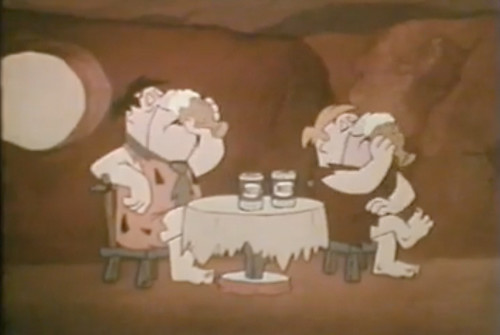
Another funny and very interesting excerpt from Sex at Dawn is The Flintstonization of Prehistory in which modern morals and values are super-imposed on to the past.