Brookston Beer Bulletin

Jay R. Brooks on Beer

  • Home
  • About
  • Editorial
  • Birthdays
  • Art & Beer

Socialize

  • Dribbble
  • Email
  • Facebook
  • Flickr
  • GitHub
  • Instagram
  • LinkedIn
  • Pinterest
  • RSS
  • Twitter
  • YouTube

Powered by Genesis

Around The World In 80 Beers

May 29, 2010 By Jay Brooks

earthday
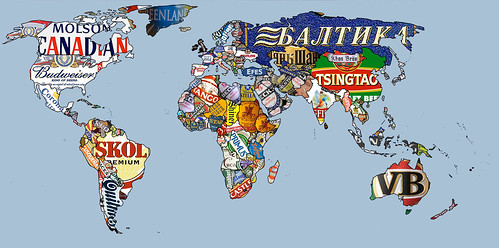
A couple of years ago, someone did a map of the U.S. using a beer label from each state, which I posted in Labeling the States. A world travel website, Pure Travel, has done their own version but with a world map and labels for each country. Apparently there are 80 different labels represented. You can see inset maps at Pure Travel and there’s also a much larger map where you can see greater detail. As before, how many can you identify?
world-beer-map

Filed Under: Beers, Just For Fun Tagged With: Geography, International

International Brewers Buying Breweries In China

May 28, 2010 By Jay Brooks

china
The English version of the Chinese newspaper, The People’s Daily, had an interesting article about international breweries investing heavily in the world’s biggest beer market: China. Entitled, Big Brewers Fermenting Deals in Southwest, it details, for example, how MolsonCoors has “recently spent $40 million to buy a 51 percent stake in a new joint venture with the Hebei Si’hai Beer Company.” Coors Light “now accounts for 10 percent of China’s premium beer market.” Carlsberg is making similar investments, and Anheuser-Busch InBev “started work on a new brewery in Ziyang, Sichuan province, this year.” And that’s just in the southern part of China. It’s a big market.

Filed Under: Breweries Tagged With: Asia, Big Brewers, China, International

Session #39: Collaboration Beers

May 7, 2010 By Jay Brooks

collaboration
Our 39th Session is hosted by Mario Rubio who writes at both Brewed For Thought and, collaboratively at Rate Beer’s Hop Press. It’s appropriate then that he’s chosen Collaboration Beers as this month’ session topic, which he described in his announcement.

Feel free to have fun with the topic. Drink a collaborative beer. Who’s brewed some of your favorite collaborations? Who have been some of your favorite collaborators? Who would you like to see in a future collaboration?

As the topic is collaborations, working with each other is encouraged.

session_logo_all_text_200

As time is short for me, what with being overwhelmed with work of late and leaving later this afternoon for the Boonville Beer Festival, I’ll turn to an article I wrote for the January 2009 issue of All About Beer magazine. Entitled Brewing Togetherness, it was essentially on this very topic, with the subtitle “Collaboration Beers: The Natural Evolution of Craft Beer.” Here are the opening paragraphs:

Aristotle observed, in his classic work Metaphysics, that “the whole is more than the sum of its parts.” He may not have been talking about beer when he said that, but then again, he was on to something. Over the past decade or so, there’s a trend that’s been slowly building as craft brewers are increasingly making metaphysically delicious beers, in pairs or in groups, with the results often tastier than the sum of their part-iers’ efforts alone.

This recent trend of collaboration beers represents the next logical step in building relationships that brewers began thirty years ago at the dawn of modern craft brewing. Since then, an unprecedented sharing of knowledge and resources has led to an industry mature beyond its years. This is arguably the reason that American craft beer has built its excellent reputation in such a short time, and also why collaboration beers feel like such a natural extension of that success.

Of course, since trade guilds began in the United States, shortly after the start of the Civil War, brewers have been sharing technical information and basic advancements in brewing techniques. But today’s craft brewers have gone further. The kind of assistance they gave one another—early on and continuing through the present day—was unequivocal and without reservation.

When all the small breweries combined brewed such a tiny fraction of the total beer sold, nobody worried about market share, competition or trade secrets. Brewers in the craft industry were simply very open with one another, freely offering each other help, and freely asking for it, too, in a way that earlier generations and larger businesses wouldn’t dream of doing.

As several brewers noted, many early brewers came from a homebrewing background, and took their hobby and “went pro” at a time when there were few books available and hardly any readily available body of knowledge. Most brewers learned their craft in the kitchen, not in a formal school setting. As a result, brewers were already used to turning to other homebrew club members or on forums to fill in gaps in their knowledge.

But a curious thing happened once the size and number of small brewers increased and their market share grew bigger, too. Those close relationships endured as did their willingness to share, as brewers eschewed conventional business thinking and continued to help each other as often as needed. You’d be hard-pressed to find another business where people don’t protect their most valuable trade secrets and operational knowledge. Most industries employ corporate espionage to find out their competitors’ secrets and the threat of lawsuits to keep their own employees from defecting and taking their institutional knowledge with them to a competing firm.

You might be tempted to think that so cavalier an attitude could doom such businesses to failure or, at the very least, to not staying ahead of their competition. By any measure, however, you’d be deeply wrong. It may be counter-intuitive, to say the least, but by and large the breweries that have been the most open and helpful have also been the most successful.

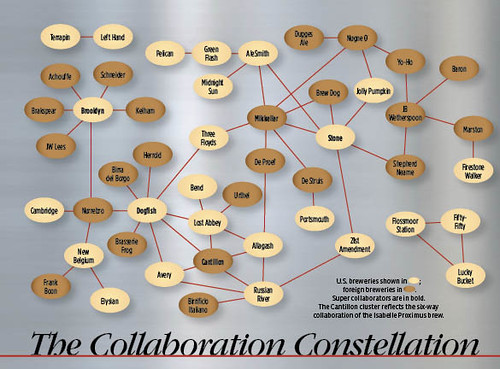
After that, I attempted to detail as many collaborations as I could, with eye toward documenting some early collaborations, both domestic and internationally, and describing the many different kinds of collaborations that brewers were doing. There were so many that a graphic was created for the article showing all the connections that I mentioned.

Collabrographic

And here’s how I concluded, with how the many brewers participating in collaborations feel about them.

The Future of Brewing Together

While there is no doubt that collaboration beers are a growing trend, not everyone is convinced they’re here to stay. Everyone seems to have a different reason for doing them and perceives their value differently.

Some people fear that collaborative brews may simply be a way to generate publicity. Before doing his own jointly-brewed beer, Ron Jeffries admitted to feeling “a little cynical about them.” But after being involved in one, he’s had to rethink that assumption. For him, “the collaboration experience was spiritual,” as well as educational. “It was great to spend time with people I respected, but didn’t really know that well. It was great to see a little bit more of how and why they do what they do.”

Many people echo the sentiment that a collaboration must be more than just a marketing exercise. Collaborations are, by necessity, compromises. Jeffries feels that if it goes too far it becomes more marketing-driven instead of being all about creating a great beer. “That’s the danger,” he says.

Tomme Arthur makes a musical analogy: “There must be a point. You can put Mötley Crüe and Guns N’ Roses on the same stage, but there’s no guarantee the results will be beautiful music.” Continuing the musical metaphors, Cilurzo adds, “Collaborations are like musician’s side projects, where you can gain inspiration. But it doesn’t mean the band breaks up.”

Arthur believes “there will continue to be a need for ambassadors overseas” providing an “opportunity to reach out. We all use the same ingredients, but there’s a world of difference.” Cilurzo adds, “In collaborations, you see things you might never have thought of on your own, and that’s the ultimate reward.” Calagione sees the trend as “a microcosmic symbol of how promiscuous the beer industry is, where we all share secrets with one another, where the consumer is generally catholic with their drinking habits, celebrating the breadth of styles available in the world.”

Todd Ashman sees collaborations as “a natural evolution” of the brewer’s networking experience and offers a way “to stay in touch with people you might not otherwise deal with regularly.” He adds, “It’s also a way to get your customers into the fold and keeps it interesting” for both them and the brewers. And that may be the truest test of all, that the consumers ultimately like and are willing to buy the collaboration beers.

While there is certainly competition among American craft brewers, it is a healthy competition, borne of trying to outdo one another, to show off, to push the envelope just a little bit farther. As Stone’s Mitch Steele says, “Craft brewers feed on what each other is doing.” Or as Calagione puts it, collaborations “remind everybody how creative and exciting the craft beer world is. Not only do we let our freak flag fly, but we also let it mingle.”

Undoubtedly, consumers can count on seeing and tasting more collaboration beers in the coming years. As long as brewers keep approaching the collaborations with their fellow brewers, whether at home or abroad, in the right spirit, then they’ll continue to create unique beers, often in limited quantities, that will keep the beer world continually excited about each new beer. As Dustin Watts, co-creator of the Midnight Project, sees the ultimate point of collaborations, they just scream, “Welcome to the world of craft beer, this is what it’s all about.”

The entire article is online, so you can read it at All About Beer’s online archive. Since then, one of my favorite collaborations has been the Life & Limb project between Sierra Nevada and Dogfish head.

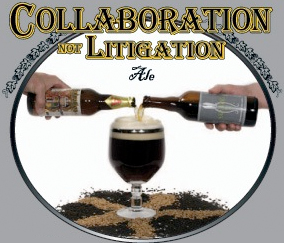
But the story behind the Collaboration Not Litigation between Russian River and Avery expresses the spirit of craft brewers best.
collab-not-lit

Filed Under: Beers, Breweries, The Session Tagged With: Collaborations, International

Mergermania & The Global Beer Picture

March 18, 2010 By Jay Brooks

piechart
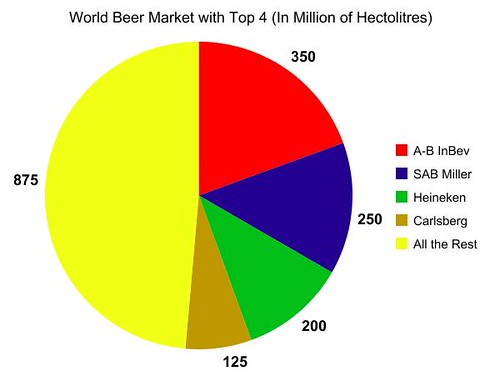
Yesterday Charlie Papazian had an interesting post about recent production numbers of brewers worldwide and how the top Four brewing companies control 50% of the world’s beer. That’s due to the increasing mergermania in the brewing industry, with the recent purchase of Mexico’s FEMSA by Heineken but not including the announced acquisition of Grupo Modelo by Anheuser-Busch InBev. According to a UK Reuters report, the Top four brewers make up half [the] global beer market. The supporting data comes from a researcher for Plato Logic, a beer industry analyst company in Great Britain that produces their world beer report each October. Presumably his statistics are preliminary, taking into account changes in ownership that have taken place since the last report.

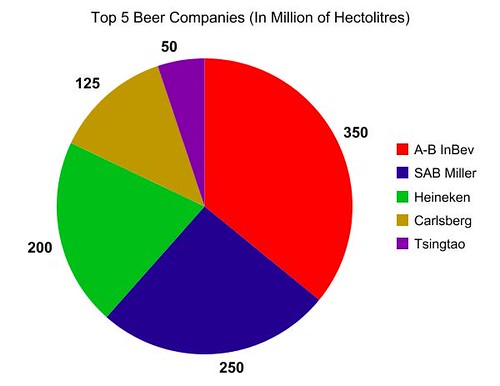
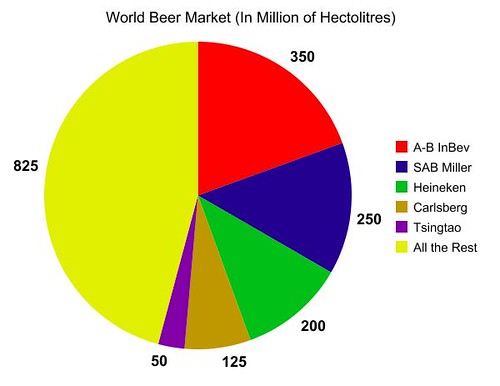
But roughly, here’s what his data shows in a chart I made, using the estimates given for millions of hectoliters produced by the top five beer companies. It shows the relatives sizes of them, and how the top four are so far out in front that it’s almost ridiculous and frankly, you can make that same argument for the top four or the top three. There’s a lot of separation, but one big merger and the deck gets shuffled again.

10-graph-1

Though the production numbers aren’t given for the bottom half of the top ten, here they are by rank.

  1. Anheuser-Busch InBev
  2. SAB Miller
  3. Heineken
  4. Carlsberg
  5. Tsingtao
  6. MolsonCoors
  7. Grupo Modelo
  8. Beijing Yanjing Brewery (China)
  9. Kirin
  10. Asahi

Estimating world beer production (it’s not given in the article) from the Beer Institute’s Brewer’s Almanac, I made the chart below to show how the top four do indeed account for just north of half the beer produced in the world.

10-graph-3

And finally, including number five Tsingtao, here’s how the overall picture looks.

10-graph-2

Filed Under: Breweries, News Tagged With: Business, International, Statistics

ABI To Buy Modelo This Year

March 10, 2010 By Jay Brooks

grupo-modelo
Grupo Modelo is the largest beer company in Mexico, and their most popular beer, of course, is Corona. For many years, Anheuser-Busch has owned a non-controlling 50% share of the company, but after the InBev merger they own 50.2% but only 49.3% voting. And I think they’ve been coveting control for a long, long time and now they may finally get it.

Yesterday, Reuters had an item, AB InBev to Buy Modelo This Year, suggesting it’s likely a deal will go through, and will be completed later this year. The price tag looks to be about $10.8 billion. Earlier this year, Heineken bought FEMSA, Mexico’s second largest beer company. So if ABI buys Modelo, the majority of the country’s beer market will be owned by foreign companies, just like in the U.S.

Filed Under: Breweries, Editorial, News Tagged With: Anheuser-Busch, Anheuser-Busch InBev, Business, International

Olympics & Beer

February 26, 2010 By Jay Brooks

olympics
I may have some of the facts here wrong or may simply be missing something, but over the last week of paying some passing attention to the 2010 Winter Olympics in Vancouver — especially Curling — an odd picture has emerged concerning beer and America at the Olympics. A few nights on the Stephen Colbert Report, Colbert visited several nation’s International Houses, places for the athletes, visitors and sponsors from individual countries to go and relax with their fellow citizens and watch the competitions they don’t have tickets to, as well. Usually, they show off part of their culture — or the sponsor’s products — and they’re also places to celebrate. For example, at the Swiss House they had fondue, the Irish House featured folk music and the Russian House had foosball hockey. After visiting several houses, Colbert ends the segment back at the Irish House, saying it was because USA House didn’t have a bar.

That’s right, even after doubling the size of USA’s hospitality and having two separate houses (one in Vancouver and one in Whistler) there was no bar for American athletes or sponsors. Now, I don’t know for certain that we’re the only international house without a bar, but it certainly wouldn’t surprise me. We’ve done our level best to separate alcohol and move it into this otherworld that’s separate from the regular world that everyone lives in. So besides the fact that every other country can handle having alcohol be a part of their celebrations, at USA Central it’s believed that sports and alcohol can’t mix. You see it in college sports. You see it in the drive to eliminate drinking at professional sporting events. It’s always motivated by the fact that because some people can’t handle themselves, so then the logic is everyone should be prohibited from enjoying themselves. I’m sure other countries have their share of people trying to ruin it for everyone else — but somehow they’ve managed to make it the problem of those individual people and not the majority who can just get on with it. I, too, cringe whenever I see a bad drunk but not because I fear for that person, but because I know that neo-prohibitionists will look at that person and extrapolate his problem to include everyone who drinks. And so one result is the American Olympic Committee concludes it’s too risky for there to be a bar in our international house, despite the fact that craft beer is something America should be justly proud of.

Filed Under: Beers, Editorial, Politics & Law Tagged With: International, National, Prohibitionists, Sports

Drinking All Over The Map

January 27, 2010 By Jay Brooks

world-map
If you’re a regular Bulletin reader, you know I believe that the drinking age in the U.S. is too high, that the age a person can vote and fight and/or die for one’s country should also be the age he or she can drink, as well. I lived through this ridiculous hypocritical double-standard when I was in the military thirty years ago, and I still hold a grudge. It was absurd then, and it’s absurd now.

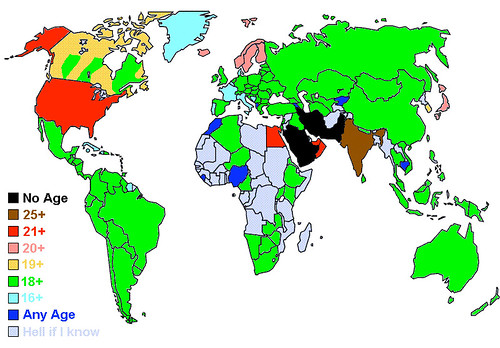
I think most of us believe that America is a progressive country where freedom is something we take for granted, that it’s the lynchpin of our society with free speech, free assembly, freedom of religion, and on and on. But not when it comes to our puritanical view of alcohol, there we are nearly the most backward country in the world. When you take out the handful of countries that allow no alcohol consumption — which are all in the Middle East — only India has a drinking age higher than ours, and even that’s not nationwide, but on a state by state basis. I could talk about this ’till I’m blue in the face, but nothing shows this inequity better than a visual representation of drinking ages by country. Happily, Drinking Map went to the trouble of creating a world map showing the drinking age by country, where known. To see it larger, click through the image, then click on “all sizes.”

drinking-age-map

As you can see, the vast majority of the world is at a sensible 18, with only a few other nations (all in the Middle East, too) that are 21 like us. Japan and most of Scandinavia set the age at 20 and South Korea along with parts of Canada are at 19.

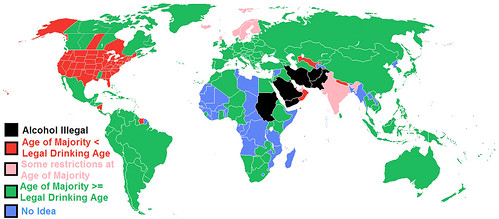
But perhaps more interesting is the map below, also by the folks at Drinking Map, called Where “Adults” Can’t Drink. This map shows the relationship between a country’s age of majority (when a person is considered an “adult”) and the age at which they are permitted to drink alcohol. Notice that for a majority of nations (in green) that age is the same, as I believe it should be. A few more (in pink), like India and most of Scandinavia, allow some drinking but with certain restrictions. Then we, along with parts of Canada and a handful of other nations (in red), stand out as having a drinking age that’s higher than the age of majority. To see it larger, click through the image, then click on “all sizes.”

age-of-majority-map

Would it not be perhaps a reasonable compromise to allow 18-year olds to drink beer, or wine and beer, but not spirits until they’re 21? Anyway, just some food for thought.

Filed Under: Editorial, Just For Fun, Politics & Law Tagged With: International, Prohibitionists, Statistics

Agreement Reached For InBev Takeover Of Anheuser-Busch

July 13, 2008 By Jay Brooks

Well, folks, it’s all over. The deed is done, indeed. The deal for InBev to acquire Anheuser-Busch has been agreed upon in principle, for nearly $50 billion. It’s not really over, of course, because it still has to wind its way through the federal approval process. But for all intents and purposes, it’s probably just a matter of time now that the two parties have reached an accord.

The Wall Street Journal, Reuters, and the Financial Times are all now reporting that the parties have agreed to a deal. The new entity’s board will contain two A-B people, most likely including August A. Busch IV. Sadly, they decided to ignore my suggestion of calling the new company InBusch and went instead with the relatively boring and far too long name, Anheuser-Busch InBev.


Filed Under: Editorial, Politics & Law Tagged With: Business, Ingredients, International, Malt, National

Random Beer Names

January 27, 2008 By Jay Brooks

I’m not entirely sure why this exists, but I did have fun with it — so perhaps that’s enough of a reason — but Strange Brew, a Canadian software company that makes programs for homebrewers, also has an online Random Beer Name Generator. My first beer name:

Flying Squirrel-Mash Oud Bruin

Being a huge fan of Rocky & Bullwinkle, I thought this one was a great name for a beer. But some others were equally intriguing, such as Craptacular Loch Ness Monster Tripel, Barney and Spiderman’s Transgendered Bière de Garde and even The Squid Formerly Known As Winston Churchill’s Unbefreakinglievable Pilsner. I don’t know how many names are in there. I tried quite a few and never got a duplicate. Give it a try. Let me know your best ones.


Filed Under: Just For Fun Tagged With: Business, Europe, History, International, Strange But True

Carlsberg and Heineken Buy Scottish & Newcastle

January 25, 2008 By Jay Brooks

It looks like the brewing brouhaha involving several large multi-national beer companies that I wrote about last week is going to be resolved more quickly then anybody had anticipated. The Carlsberg Group and Heineken today agreed to a $15.3 billion buyout of Scottish & Newcastle. The deal is structured such that Carlsberg will get sole ownership of BBH (Baltic Beverages Holding), giving them access to the lucrative Russian beer market, and will also receive S&N’s markets in China, France and Greece. Heineken will gain control of S&N’s markets in Great Britain, India, the United States and a few others. Business experts don’t seem to think there will a problem in getting the deal approved or with any counter-offers.

 
Note: Portfolio’s online website has a good overview of this story, too.


Filed Under: News Tagged With: Business, Europe, Great Britain, International

« Previous Page
Next Page »

Find Something

Northern California Breweries

Please consider purchasing my latest book, California Breweries North, available from Amazon, or ask for it at your local bookstore.

Recent Comments

  • Ernie Dewing on Historic Beer Birthday: Charles William Bergner 
  • Steve 'Pudgy' De Rose on Historic Beer Birthday: Jacob Schmidt
  • Jay Brooks on Beer Birthday: Bill Owens
  • Steve 'Pudgy' De Rose on Beer Birthday: Charles Finkel
  • Steve 'Pudgy' De Rose on Beer Birthday: Bill Owens

Recent Posts

  • Historic Beer Birthday: Lüder Rutenberg February 8, 2026
  • Beer In Ads #5195: It’s The Time Of Year For Pearl Bock Beer February 7, 2026
  • Beer Birthday: Tom Acitelli February 7, 2026
  • Historic Beer Birthday: George Wiedemann February 7, 2026
  • Historic Beer Birthday: Morton Coutts February 7, 2026

BBB Archives

Feedback

Head Quarter
This site is hosted and maintained by H25Q.dev. Any questions or comments for the webmaster can be directed here.