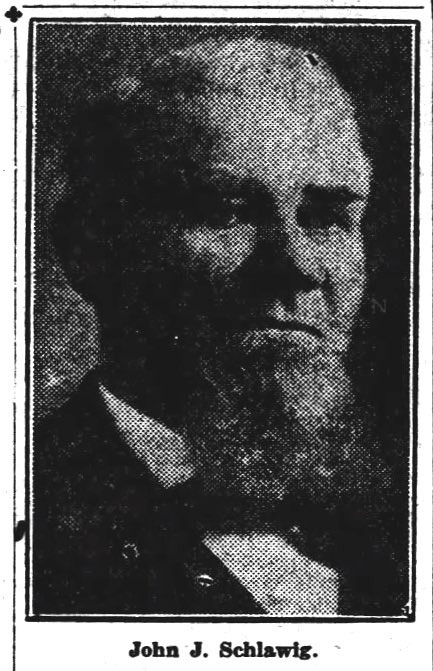
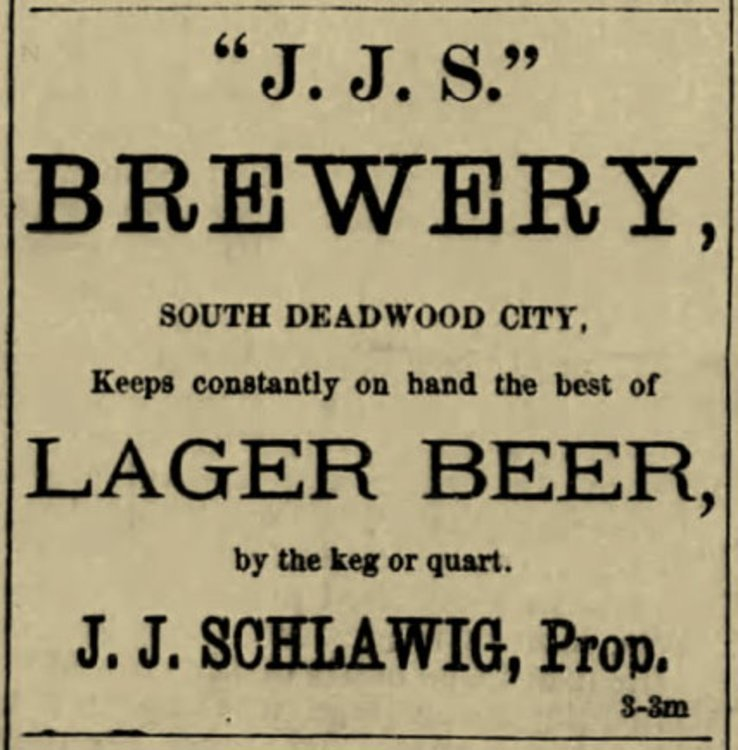
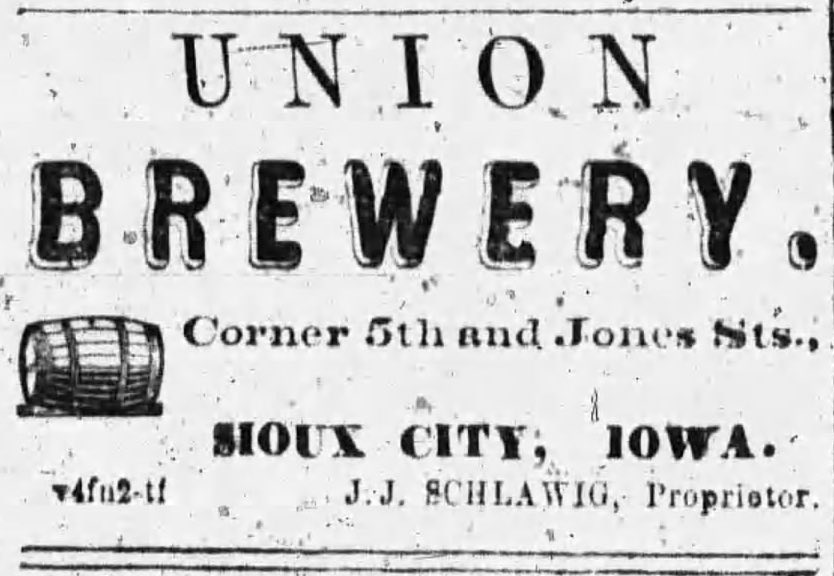
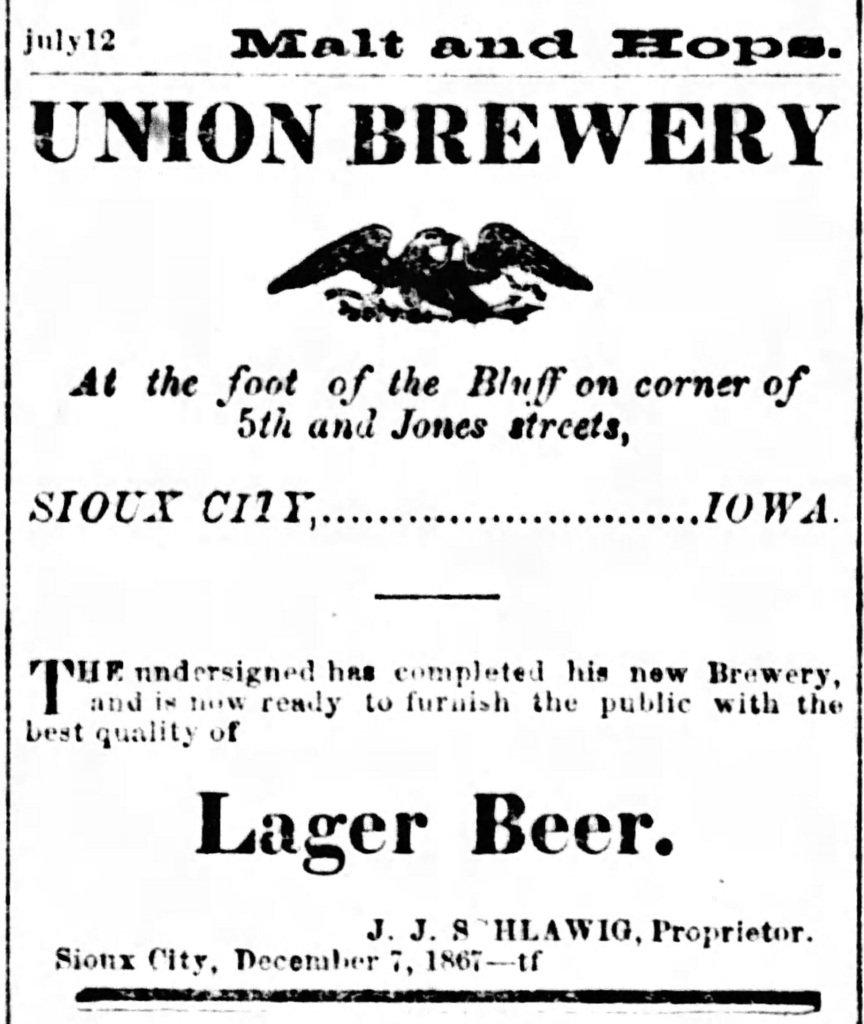
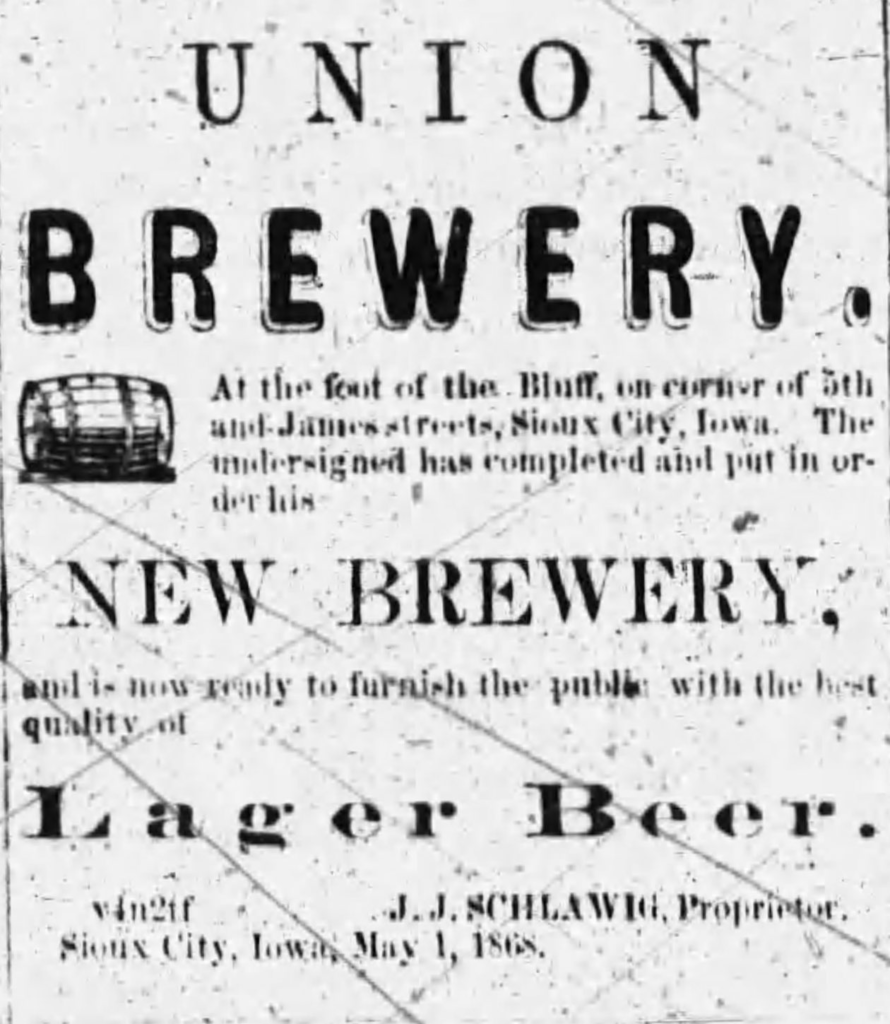
Today is the birthday of John Jacob Schlawig (February 27, 1831-October 11, 1919). He was born in Thusis, Graubünden, Switzerland but was a pioneer of Sioux City, Iowa, believed to be its longest resident at the time of his death in 1919. He married Ursula Haag on 20 September 1853, in Thusis, Graubünden, Switzerland and the couple moved to Iowa in 1857, settling in Sioux City. In 1867, he opened a brewery, the John Schlawig Union Brewery, which was only open until 1876. That same year, gold an silver were discovered in the Dakota Territories, and leaving his family in Iowa, became a miner off and on there for a number years. He also took his brewing equipment and established the J.J. Schlawig Brewery (a.k.a. as J.J.S. Brewery) in Deadwood, South Dakota, though it only lasted one year, closing in 1877.
Here’s a biography of Schlawig from The Sioux City Tribune from October 11, 1919:
J. J. Schlawig Dies, Aged 88 Years; Had Lived in Sioux City Since 1857. Pioneer Believed to Hold Record For Longest Residence Here. Taken By Death Before New Home Was Completed. Family Homestead Recently Sold.
John J. Schlawig, who is believed to have lived longer in Sioux City and to have witnessed more of its growth than any other man, died at 9 a.m. today at the home of his daughter, Mrs. C. A. Patch, 2324 Douglas street, from the infirmities of old age. Mr. Schlawig was born in Thusis, Switzerland. There he married Miss Ursula Haag, 67 years ago. His wife died here one month before the celebration of their golden wedding. He is survived by three daughters, one son, two grandsons and one granddaughter. Dr. J. J. Schlawig, a son, died here 17 years ago. The other son is Dr. William M. Schlawig, of Monument, Col., who has been in the city for the last week. The daughters are Miss Anna Schlawig, who has made the home for her father since the death of the mother; Mrs. R. E. Conniff, and Mrs. Patch at whose home he died. John B. and Arthur C. Patch and Miss Anna Marie Conniff are the grandchildren. He came to Sioux City 62 years ago. He was a wagon and carriage maker and manufactured the first wagon and the first carriage ever made in the city. In 1861 Mr. Schlawig enlisted in Company I of the Seventh Iowa cavalry, a civil war unit of which only two or three men survive. He served as bugler of the regiment and as bodyguard of General Sully. He participated in the White Stone battle.
This is from a “History of Woodbury and Plymouth Counties,” published in 1890:
John Jacob Schlawig, Sioux City. In the picturesque city of Thuses, Canton of Graubunden, Switzerland, February 27, 1831, there was born to one of the oldest families in that historic country an only son, the subject of this sketch, John Jacob Schlawig. His ancestry was prominently identified with the political history of Switzerland, and took an active part in the defense of their land against the invasion of other powers; and a grandfather fell in the gallant defense made against the French army in the battle of Richenan. His early education was acquired among his native hills, where he learned to love the freedom of his Fatherland, and despise the serfdom and oppression of neighboring monarchies. At the age of eighteen he removed to Chur, where he learned the trade of a carriage-maker. There he met and wedded, September 20, 1853, Miss Ursula Haag, the daughter of an old citizen of that city. For some years thereafter he followed his trade, but all the while longing for the greater possibilities offered in America to industry and integrity. In 1857 the dream of his youth was realized when he embarked for this country, taking with him his young wife and two children. On reaching America he pushed westward, believing that that region promised better opportunities to willing hearts and ready hands. He first stopped in Dubuque for a few months, then crossed the state overland by team to Sioux City. On this trip the second daughter, a child of two years, sickened and died, which well nigh discouraged him and his young wife, but they journeyed on, reaching Sioux City, then a frontier village, September 19, 1857. He immediately set to work to procure for himself and family a home. He erected a crude shop and worked at his trade, making and repairing wagons, and built the first wagon made in Sioux City. At the outbreak of the Civil war he offered himself as a volunteer in the defense of his adopted country, and served from 1861 to 1864 in the Seventh Iowa cavalry, Company I. He was with Gen. Sully in his famous expedition against the hostile Sioux, and took part in the battle of White Stone Hill and other engagements. At the close of hostilities he received his honorable discharge, and re-engaged in the wagonmaker’s trade in this city.
In 1875 he was one of the pioneers of the Black Hills, S. D., country, where he prospected extensively, and located several silver mines at Galena, which he afterward consolidated into the Washington Gold and Silver Mining company, of which company he is the principal owner and president. He also owns the Sula mine, at Lead City, S. D. His mining property is well located, and among the best and richest mines in that wonderfully productive mineral region. In the summer of 1890 he platted what is known as Sunny Side addition to Lead City, and a large part of which he still owns. His family consists of two sons and three daughters. The oldest son, John J., is a rising young physician, while the younger, William, is now in college, preparing himself for the practice of dentistry. Two daughters, Anna and Marie, are still at home, the other, Christina, is the wife of Dr. R. E. Conniff, of this city. Mr. Schlawig has always had abundant faith in the future of Sioux City, and has seen it grow from a frontier village to a city of nearly 40,000. He, with other old settlers, endured many of the privations of the early history of Sioux City. His industry and abiding faith in the future of the city have been rewarded by material prosperity, and we find him in his old age surrounded by the comforts of life, and with a competence that jjlaces him above want and secures for him that ease that his industry deserves. Mr. Schlawig is still a man in robust health, of a jovial, kindly disposition that makes and keeps friends, and is respected and esteemed by all that know him.
And this account is from Tavern Trove’s page for Schlawig:
John Jacob Schlawig was born in Thusis, Graubünden, Switzerland where he was trained as a wagon maker. In 1855 he emigrated to America with his wife Ursula (née Haag) and their two daughters. They reached their intended destination of Dubuque, Iowa that summer, but after only a few months they relocated to Sioux City.
In 1855 Sioux City was a hamlet situated on the banks of Perry Creek, far from the noise and nuisance of the lawless frontier town of Dubuque. The Schlawigs made Sioux City their home and John opened a wagon shop on Water Street. He participated in the local guard that defended the area from Sioux warriors who considered the land the property of the Sioux.
In 1861 John Jacob answered the patriotic call of his adopted country and enlisted in the Union Army. The U.S. generals sent him not south but west, to continue the battle with the Native Americans. After his service he returned to Sioux City and opened a brewery next to his home on 6th and Nebraska Street.
For a nearly a decade Schlawig was content in his brewery on the creek. He had three daughters and two sons at home. He took on Joseph Rechner as a foreman and they opened up The William Tell Beer Hall. By all accounts business was good.
Then in 1875 Iowa’s ever-changing Temperance laws caused business strife. The city sued Schlawig for breaking liquor and gambling ordinances. Then his former foreman and another employee sued him for back wages. All three verdicts came down against the brewer and like that, the tidy brewing empire Schlawig built was finished. Schlawig mortgaged the brewery property in February and offered it for sale in November.
In 1876 news came from the west that gold and silver was there for the taking in the Dakota Territory. Schlawig decided to check it out. At age 45 Schlawig filed a miners claim on Bear Butte and rushed back to Iowa in order to pack up his brewery equipment and relocate to the town of Deadwood. He arrived in April of 1876, and, while he retained his residence in Sioux City, over the next decade he spent less and less time there, and more time in the boom town nearly 500 miles away.
By July of 1876 Schlawig was mining by day and brewing at night and both enterprises were earning money. But within the year he will have abandoned the brewery in favor of his silver mine. In February of 1877, when he returned to Iowa he talked only of silver. In June of that year the Sioux City Journal reportedthat Schlawig’s brewery in Deadwood was sitting idle.
Up in the hills Schlawig had hit a vein of silver so rich that soon his brewery debts would soon be a small matter. The Washington Lode, as it was called, was one of the most valuable veins of silver in the Black Hills, and Schlawig had claim to a good bit of it. It ended up making him a very wealthy man.
With the help of Schlawig’s money Sioux City prospered and his old house on 6th and Nebraska Street grew old with him. By 1919 it was considered an eyesore in the business district, and also very valuable property. In April of 1919, 88 year old Schlawig was finally persuaded to move out of the home he built in the 1860s. By that October, he was dead.
John Jacob Schlawig died on October 11th 1919 at age 88 years.
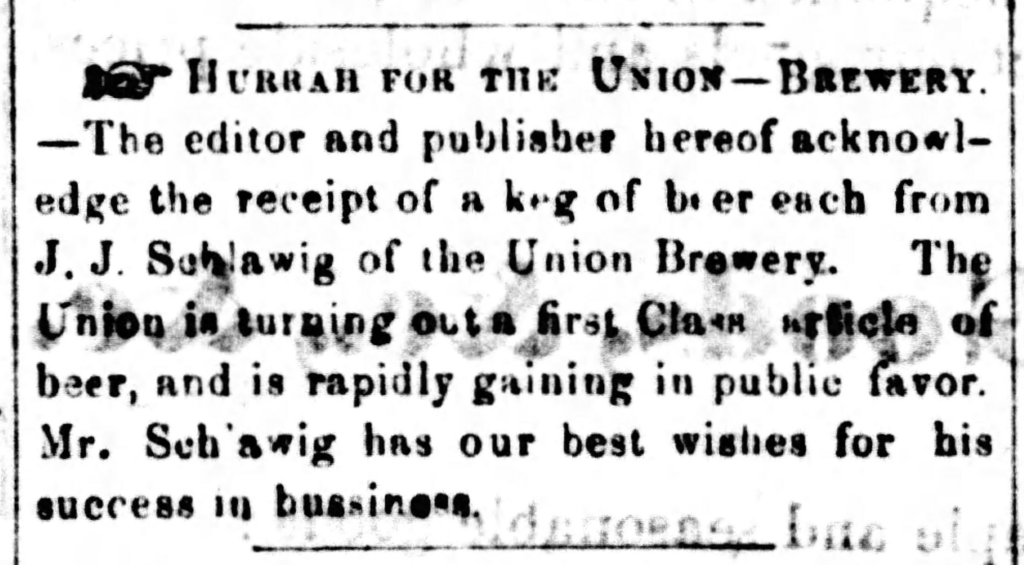
And this was published shortly after the brewery opened:
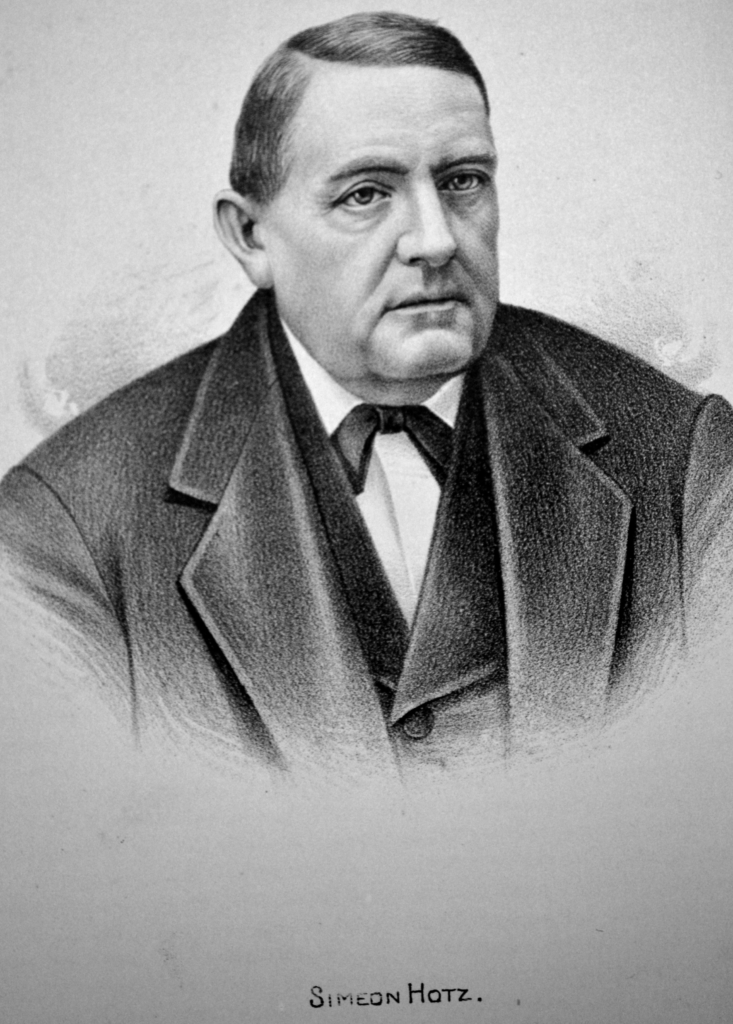
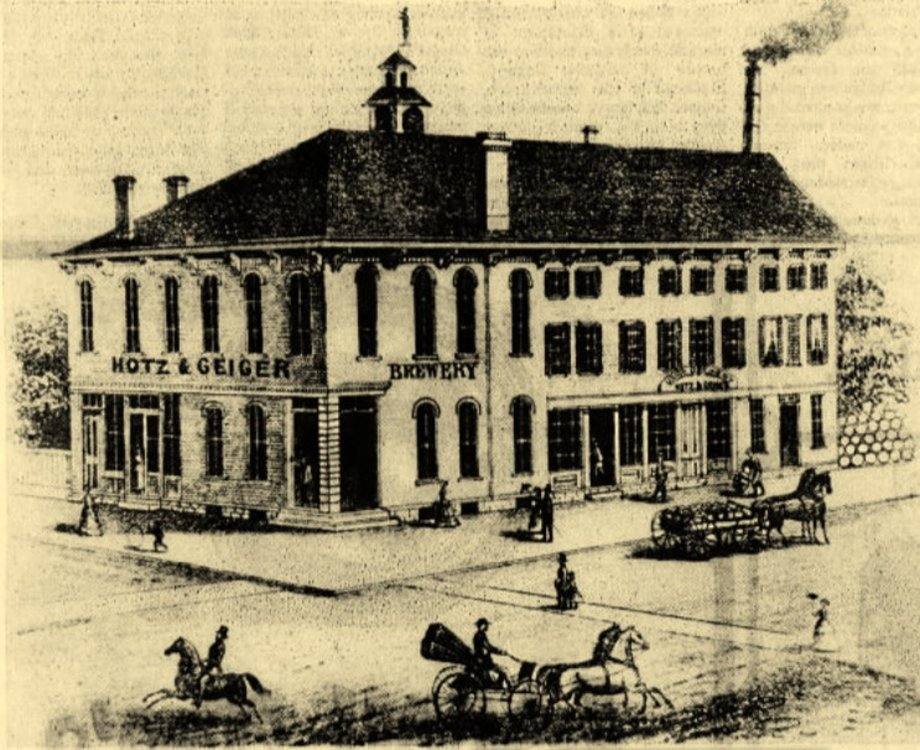
Today is the birthday of Simeon ‘Simon’ Hotz (February 18, 1819-November 6, 1881). He was born in Fützen, Germany, near the Swiss border in the southern part of the country. He was originally trained as a cobbler, or shoemaker, and when he emigrated the U.S. in the late 1840s, that was the work he continued to do. After marrying a widower, Barbara Williams, in Iowa City, he bought into a grocery store, where he continued to work as a cobbler, but eventually the grocery added a brewery, which Hotz launched with Louis Englert, but later involved his his son-in-law, Anton Geiger, which then became known as the Hotz & Geiger Brewery,” but traded under the name Union Brewery.
This biography of Hotz is fronm the University of Iowa:
Simeon Hotz was born on February 18, 1819, in Fützen, Germany which is in the southern region of Germany close to the Swiss border. He was part of the 48er’s in Germany which where a group who supported the revolution in Europe and wanted a more democratic government and unification of the German peoples. Simeon Hotz was a part of Brentano’s Army and was given a high rank when one of the officials had left to do something else. Simeon Hotz came to the United States in 1850 because of the revolution in Germany, and he also had the opportunity to gain American citizenship as well as like the democracy system in the United States. Like many Germans at the time Simeon Hotz came to New York City, but he ended up going to Rochester, New York then moved to just south of Memphis, Tennessee. He then moved to Holly Springs, Mississippi, which isn’t far from Memphis, and then he finally settled in Iowa City in 1857 for the rest of his life. During these years of travelling, he worked as a shoemaker since that is what he was trained as and worked as in Germany.
In 1852 Simeon Hotz married Barbara (Becker) William who was from Bavaria, but they met each other in the United States. Barbara was a widow as she was married to George Williams before he died. She had four children with him and then she and Simeon Hotz had 7 children together. Their names were Caroline, Anna, Ella, Julia, Elizabetha, and George, the seventh kid didn’t live very long, so their name is unknown to us.
Simeon Hotz and his family were members at St. Mary’s Church, and Simeon was even a founding member of the church. He was heavily involved in the church community and was even apart of the St. Joseph’s society. Simeon Hotz was also a prominent man in the Iowa City
community as he was also heavily involved in politics and was a very present and generous man. He aligned himself with the Democratic party. He was described as someone who would always give money to those in need, especially since he had acquired a lot of wealth from owning a brewery.
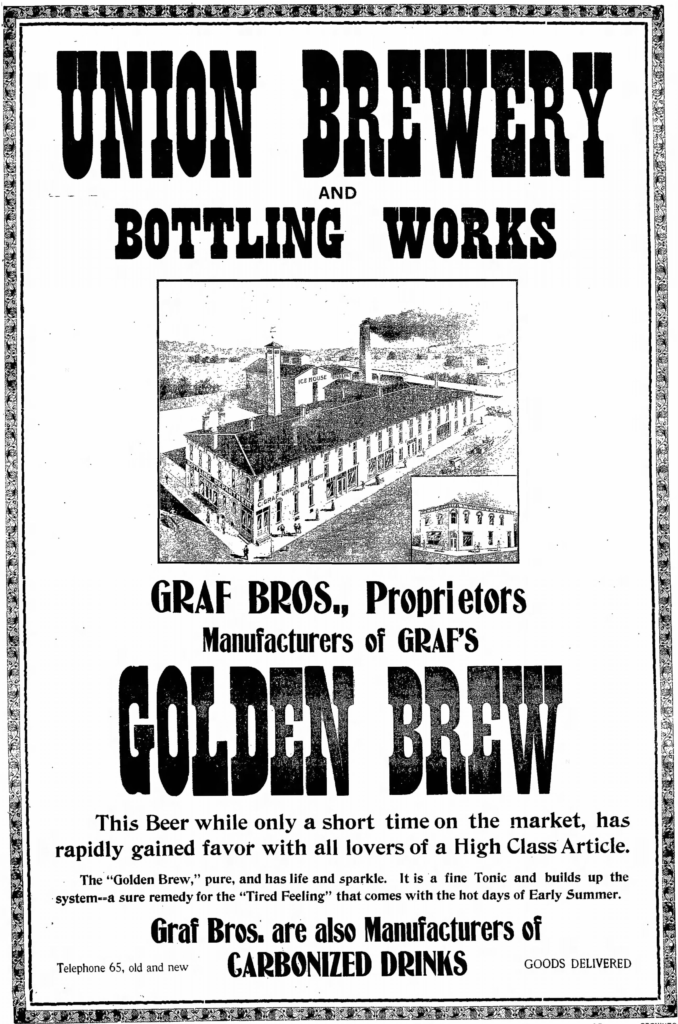
In 1857 Simeon Hotz joined in a partnership with Louis Englert in his brewery and ended up making his own beer. In 1868 Hotz and his son in law Anton Geiger built the Union Brewery on the corner of Linn and Market St, and they opened for business in 1869. The Brew Master of the brewery was Conrad Graf who ended up marrying Simeon Hotz’s daughter Anna. Although the brewery was called Union Brewery it was commonly known as Hotz & Geiger. Hotz & Geiger was an important place for the Iowa City community and was the biggest brewery. Hotz and Geiger expanded the brewery several times to the point that Hotz almost owned the entire street.
Simeon Hotz died in 1881 from injuries due to a house fire. Simeon Hotz is buried in St. Joseph’s Cemetery. After his death Barbara Hotz continued to manage the brewery for 2 years and the Conrad Graf bought the brewery and ran it until his death in 1893. His sons then ran the brewery and once prohibition was on the horizon, they started to switch to a soft drink company, but this didn’t work out financially, so the brewery officially closed in 1917.
Here, Tavern Trove picks up the story:
In 1864 Hotz took on his son-in-law, Antone Geiger, in the brewery. The brewery was renamed the Union, and the two continued in partnership until Geiger died in 1876. At this point Hotz leased his brewery to brewers Joseph Schultze and Conrad Graff, another son-in-law to Hotz. Eventually Simeon Hotz was drawn back into brewing business and he took over management of his old firm in 1878. By this time he had grown the brewery into one of the largest in Iowa.
About this time Hotz was involved in a railroad accident in which he received severe burns. This was compounded by further burns caused by a mishap while making salve for his previous injuries. Holz’s health declined from this point and he died at age 62 on November 6th of 1881.
From that day the brewery Simeon Hotz founded was run by his wife Barbara, who was administatrix of the estate. In 1885 Conrad Graf purchased the Union and ran the brewery until Iowa state Prohibition finally got around to closing it down in 1888.
On May 3rd 1893 Iowa’s Mulct Law went into effect and Conrd Graf reopened the brewery on a small scale. When Graf died in 1894 the brewery became managed by his widow who soon brought in Chris Senner to do the oversee the brew house. Senner eventually married the widow Graf and at this point her sons took over brewery operations. The family switched over to the manufacturing of soft drinks during the Prohibition years, but the firm closed upon repeal in 1933 and never reopened.
Today is the 72nd birthday of historian Maureen Ogle, who wrote Ambitious Brew, which was published in 2006. Her next book was In Meat We Trust, but apparently she’s returning to beer for her next as of yet untitled book. So that’s something to look forward to. I first met Maureen shortly after Ambitious Brew was published when she asked me for some help putting together an invitation list for event at Anchor Brewing, and we’ve been good friends ever since. Please join me in wishing Maureen a very happy birthday.
Me and Maureen at GABF in 2006.
With Jack McAuliffe and Julie Johnson in San Francisco in 2011.
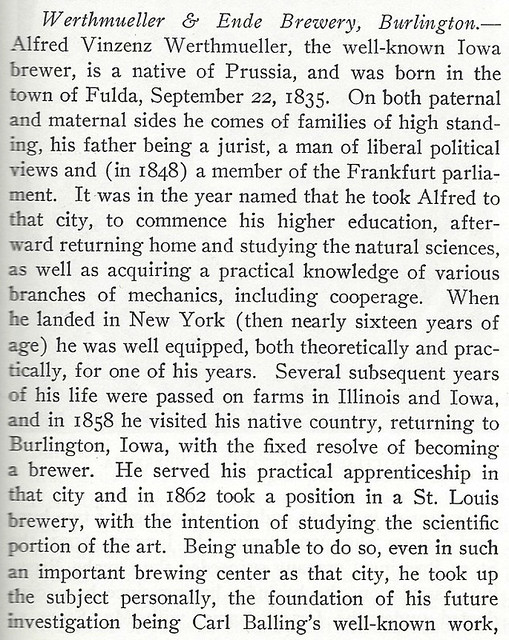
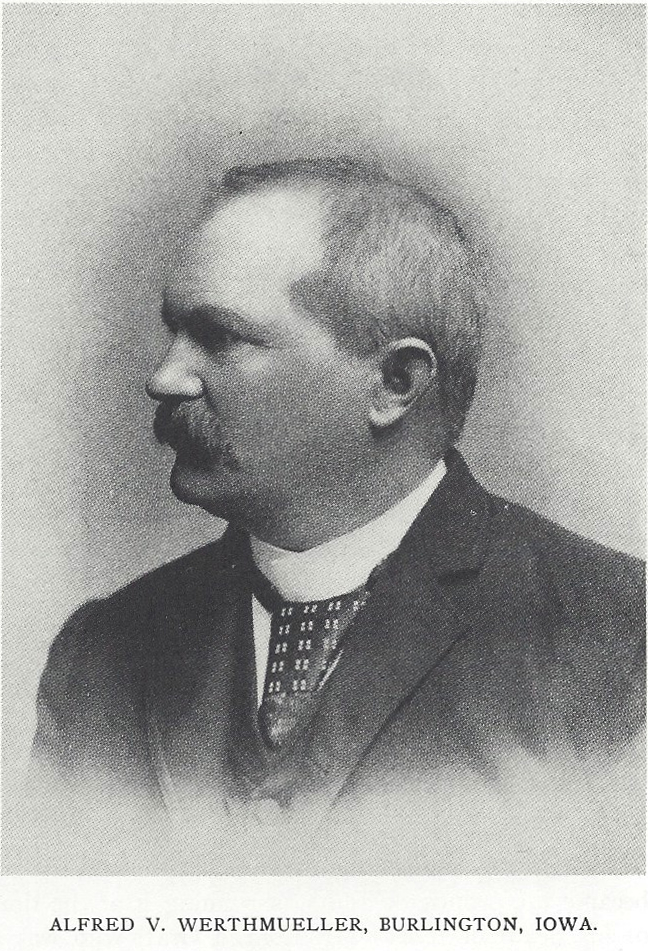
Today is the birthday of Alfred Vinzenz Werthmueller (September 22, 1835-?). Werthmueller was born in Germany, and with a partner, brewed the first lager in the state of Iowa. He became part of the Wertmueller & Ende Co. Brewery in 1892 and appears to have been bought out by his partner, Charles Ende, when in 1902 the name changed to the Ende Brewing Co. It started out in Burlington, Iowa as the Union Brewery in 1856, and closed in 1915.
I can find almost no information about Werthmueller or even the brewery he was a partner in for ten years. He’s referred to as a brewer in USBA convention minutes, and for the Ninth Convention was still in Iowa, but during the Tenth Convention he’s listed as a representative of G. Bosch & Co. I can’t find any information about G. Bosch & Co., although there was a Bosch Brewery in Michigan from 1874 to 1973. But it was founded by a Joseph Bosch, so it may have been a different company. But that’s all I could find, and nothing about his later life or where he ended up.
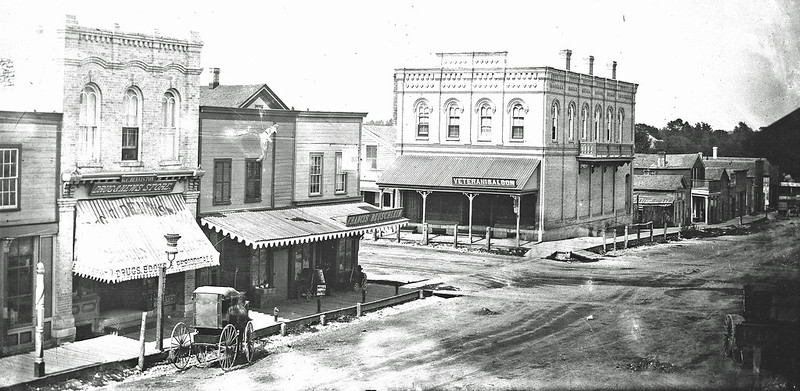
Burlington, Iowa in 1889.
Here’s an account of the brewery from “100 Years of Brewing:”
Today is the birthday of Isaac Leisy (June 26, 1838-July 11, 1892). He was born in Friedelsheim, Landkreis Bad Dürkheim, Rheinland-Pfalz, Germany. He emigrated to the U.S. with his family when he was 17, in 1855. They settled in Iowa initially, and began farming. Like several of his relatives, Isaac pursued brewing and briefly worked for a brewery in Illinois before spending several years working at the William J. Lemp Brewery in St. Louis. He then moved back to Germany for a few years, got married, and returned to the States in 1862 to start a family brewery with two of his brothers called the Leisy & Brothers Union Brewery. But Iassac wanted something bigger and in 1873, he and his brothers August and Henry Leisy bought Frederick Haltnorth’s brewery in Cleveland, Ohio, renaming it Isaac Leisy & Company.
This is the only photo I could find of Leisy, and it appears to be later in his life with his wife and family.
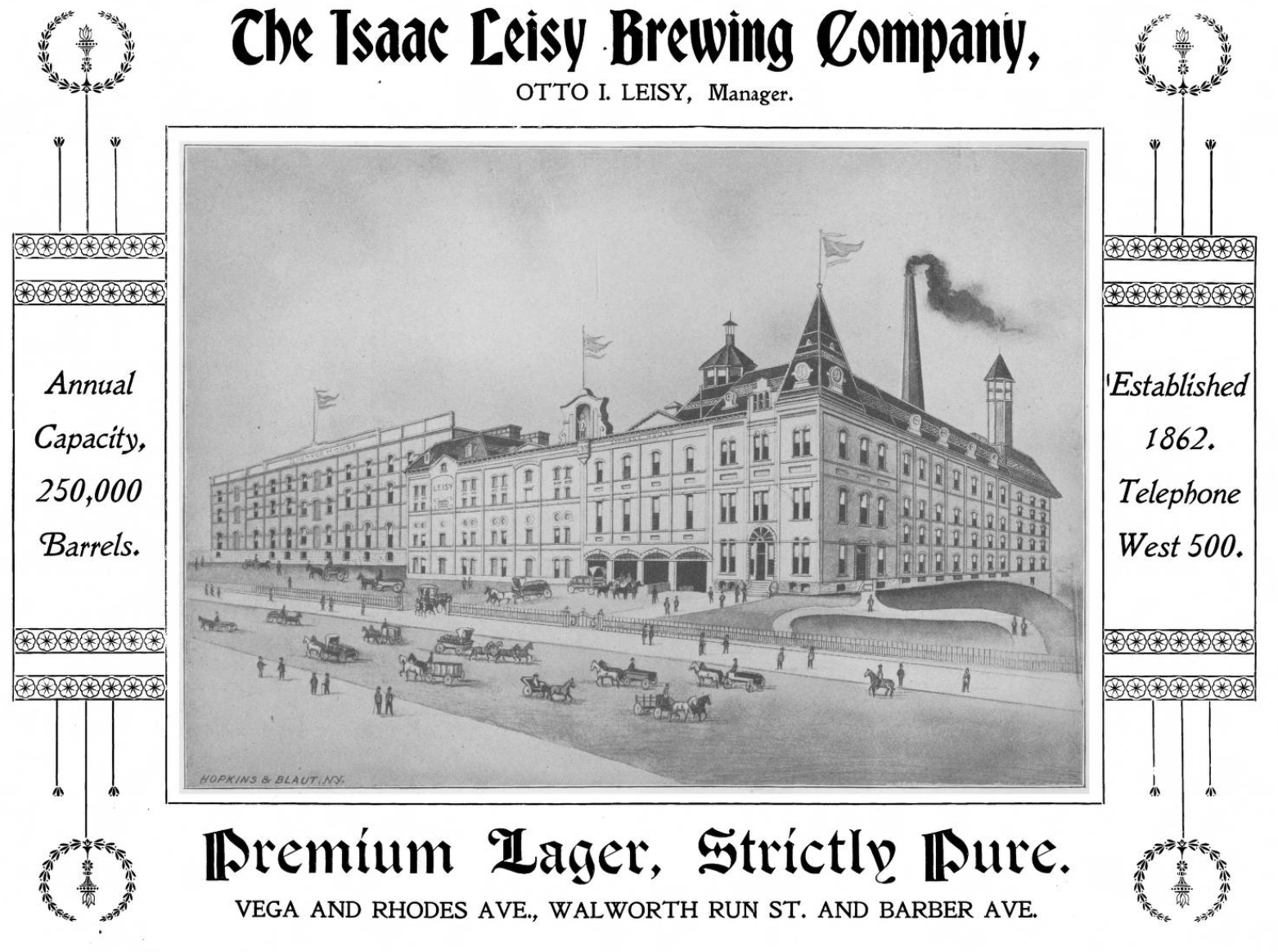
Lesiy’s brewery around 1890.
Here’s a short history of the Leisy Brewery by Michael Rotman in Cleveland Historical:
In 1873, Isaac Leisy and his two brothers (all originally from Bavaria in Germany) left their small brewery in rural Iowa and came to Cleveland after purchasing Frederick Haltnorth’s brewery on Vega Avenue for $120,000. Haltnorth (who was also the proprietor of Haltnorth’s Gardens — a beer garden at East 55th Street and Woodland Avenue) had purchased the brewery in 1864 from Jacob Mueller, who originally opened it in 1858. Only weeks before purchasing Haltnorth’s brewery, Isaac Leissy had been in Cleveland to attend the annual Brewer’s Congress. Leisy must have been impressed with the opportunities for growth and prosperity in Cleveland, which was quickly becoming an industrial metropolis, as compared to those that existed in rural Iowa.
In the mid-1880s, Isaac Leisy (having bought out his brothers) renovated the old brewery and expanded its operations, constructing a multi-building, 8-acre campus along Vega Avenue and increasing beer production eightfold. The Leisy Brewery aimed to be as self-sufficient as possible, and to this end the brewery’s grounds contained, for example, a bottling plant, stables for its fleet of horse-drawn delivery carriages, a cooperage, a blacksmith shop, and two 80-foot silos that held barley prior to its on-site malting. Self-sufficiency was important since competition among breweries in Cleveland at the time was fierce, with nearly twenty breweries operating in the city in 1890. To make matters more difficult for Leisy, in 1898 10 small Cleveland brewers joined the new Cleveland & Sandusky Brewing Co., a massive combination that signaled the brewing industry’s turn towards consolidation. Isaac’s son Otto took control of the company after his father’s death in 1892 and promptly vowed to remain independent of the new combination. He wrote to the Plain Dealer in 1898, emphatically stating that “My firm has existed in Cleveland for over a quarter of a century; has prospered by honorable methods of trade, thereby obtaining, possessing and enjoying the confidence of the same. By its former methods my company proposes to preserve and maintain its trade, and in a fair way compete with its opponent, the huge beer trust.”
Indeed, Leisy Brewing remained an independent, family-owned brewery throughout its entire history. It thrived in the decades before Prohibition, steadily increasing its sales and production. When Prohibition took effect in 1920 and brewing beer became illegal, the company made a short-lived attempt to produce non-alcoholic beverages. This proved to be unprofitable, and Leisy Brewing closed in 1923. Unlike some of Cleveland’s other breweries which had also been forced to shut down during Prohibition, Leisy returned after the repeal of Prohibition in 1933. That year, Otto’s son Herbert Leisy reopened the brewery, reequipping it with new machinery to replace the equipment that had been sold off during Prohibition. Industry consolidation, however, continued to chip away at Cleveland’s small, independent breweries in the decades after Prohibition. Leisy Brewing finally closed in 1958, and its plant on Vega Avenue was demolished in the mid-1970s.
The LEISY BREWING CO., at 3400 Vega Ave. on the near west side, was once Cleveland’s largest independent brewery. It was established by Isaac Leisy (1838-92), an Iowa brewer who purchased Cleveland’s Frederick Haltnorth Brewery in association with 2 brothers; together they established Isaac Leisy & Co. in 1873. Leisy soon gained a reputation for its Premium Lager and Budweiser beers (Budweiser was not then a brand name). Leisy Brewing Co.With the departure of his brothers in 1882, Isaac Leisy as sole owner and manager substantially enlarged the brewery, replacing the old buildings with modern ones occupying 8 acres of land. Production rose from 12,000 barrels in 1873 to over 90,000 in 1890. Leisy employed 75 workers, mostly German-Americans. He died in 1892, shortly after completing a baronial brownstone mansion next to the brewery, and his son, Otto I. (1864-1914), assumed control. During Prohibition, the brewery was closed and its equipment sold, but with repeal Herbert F. Leisy (Otto’s son) reestablished the Leisy brewing dynasty. He reequipped and modernized the brewery with assistance from Carl Faller, the oldest active brewmaster in the U.S. when he died in 1939. In the 1950s, Leisy Black Dallas malt liquor and Leisy Light, Dortmunder, and Mello-Gold beer were distributed in Ohio and 5 neighboring states. To increase capacity, in early 1958 Leisy purchased the Geo. F. Stein brewery in Buffalo. Geo. S. Carter, former Leisy sales manager who had propelled PILSENER’s P.O.C. to a leading position in Ohio, returned to Leisy in June 1958 as president and a substantial owner, but all operations ceased the following year. Pointing to Ohio’s $.36-a-case tax as a major factor in its demise, Leisy was the oldest brewery in Cleveland and one of the longest surviving family-operated breweries in America when it closed.
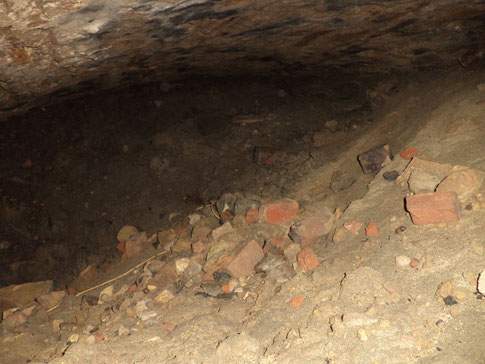
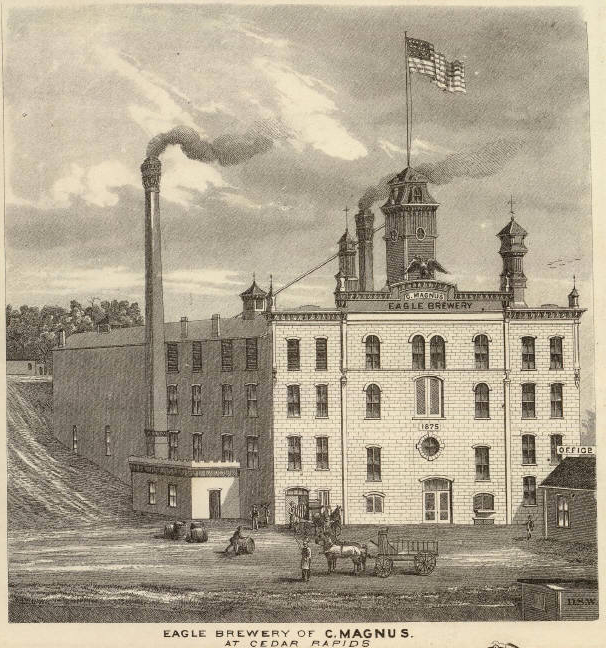
Last month during a routine inspection, a Cedar Rapids, Iowa bridge inspector found a suspicious looking hole in the ground. At first, he thought it might be a “potentially hazardous sinkhole near an Interstate 380 access ramp,” but as he, and others looked closer, it may actually be a 150-year old beer cave, part of the Christian Magnus Eagle Brewery and Bottling Works. According to a local newspaper report in 1977, “excavators had unexpectedly pierced a beer cave during construction of this stretch of I-380 when they were digging to lay a culvert north of Eighth Street” so it’s seems that’s the likeliest explanation.
Apparently, a archaeologist and an architectural historian,among others, are investigating, and are keeping an open mind that it could be any number of things. A local historian, on the hand, appears quite certain it’s the beer caves, and in the local newspaper, The Gazette, appears ready to go record with his belief that they’re beer caves:
Cedar Rapids historian Mark Stoffer Hunter is a bit more certain of the findings.
“They are the Magnus beer caves. That’s exactly what they are,” Hunter said after hearing of the discovery. “This is very exciting as an historian.”
The brewery was constructed by Jacob Wetzel in 1859.
Wetzel hired an old world brewer from Germany named Christian Magnus as his brewmaster and foreman, according to The Gazette’s Time Machine. Beer caves were essential to Magnus’ vision for the beer cooling and aging process. The brewery was a five-story complex overlooking Cedar Lake, but the back ran into a hill where the caves were located.
The brewery had five cellars that could hold 2,000 barrels, two ice houses that held up to 2,300 tons of ice, and a capacity to produce 60 barrels of beer in 12 hours.
Magnus bought out Wetzel in 1868, and at the height of production, the Christian Magnus Eagle Brewery and Bottling Works put out 25,000 barrels of 4.5 percent beer in the late 1800s and early 1900s.
Hunter said the brewery was possibly best known for Eagle Brewing, a popular beer with a logo of an eagle perched on a beer keg with its wings stretched wide and a man tapping the keg.
The brewery closed because of prohibition in 1915, although it operated for several more years producing soft drinks, among other items, before entirely shutting down in the 1920 and being demolished in 1937, Hunter said.
Hunter said in later years homeless people would use the caves, and they were later boarded up. However, children would break through the boards with “skull and cross bone — do not enter warning” to explore.
A neighborhood then was built on top of the beer caves, before being torn down for I-380, he said.
The brewery from a lithograph done around 1875.
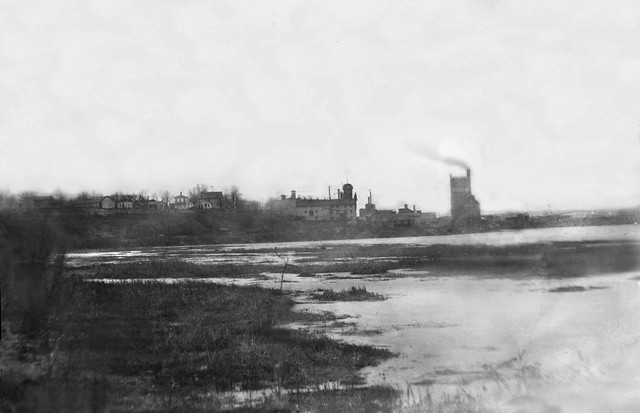
And here’s a photograph of the brewery, believed to be from 1870, from another piece in the Gazette about the Original Breweries.
Cedar Rapids, city of. Historical Views. Little caption information available. Photo appears to show a view of the Magnus Brewery (center), looking southwest over Cedar Lake. The brewery was located near present day Quaker Oats plant. The original Eagle Brewery was established in 1859 by Christian Magnus at the corner of Ely and Van Buren, modern D Avenue (D Ave.) and Eighth Street (Eighth St) NE in Cedar Rapids. The brewery produced beer and ale in a structure made from Anamosa stone and was considered one of the best breweries in Iowa. An immigrant from Germany, Magnus originally started a brewery for Jacob Wetzel in Cedar Rapids in 1859. In 1868, Magnus bought out his former employer and continued the European tradition of aging his beer in cold cellars beneath the brewery. When prohibition threatened his local brewing empire, Magnus invested his earning in such ventures as the Magnus Hotel, a longtime downtown landmark which fell to urban renewal during the 1970s.
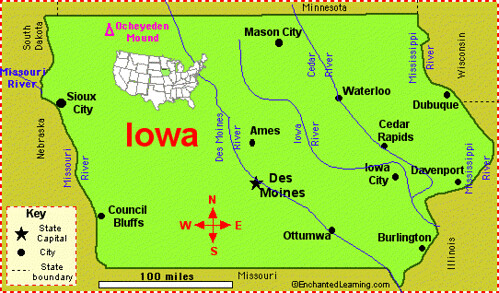
Largest Cities: Des Moines, Cedar Rapids, Davenport, Sioux City, Waterloo
Population: 2,926,324; 30th
Area: 56276 sq.mi., 26th
Nickname: Hawkeye State
Statehood: 29th, December 28, 1846
Alcohol Legalized: April 15, 1933
Number of Breweries: 21
Rank: 24th
Beer Production: 2,462,310
Production Rank: 29th
Beer Per Capita: 25.4 Gallons
Package Mix:
Bottles: 26.5%
Cans: 61.9%
Kegs: 11.1%
Beer Taxes:
Per Gallon: $0.19
Per Case: $0.43
Tax Per Barrel (24/12 Case): $5.89
Draught Tax Per Barrel (in Kegs): $5.89
Economic Impact (2010):
From Brewing: $10,089,237
Direct Impact: $655,803,630
Supplier Impact: $220,436,254
Induced Economic Impact: $378,926,548
Total Impact: $1,255,166,432
Legal Restrictions:
Control State: No
Sale Hours: 6 a.m.–2 a.m. Mon–Sat
8 a.m.–2 a.m. Sun
Grocery Store Sales: Yes
Notes: ABV > 5% beer shipped through state warehouse
Data complied, in part, from the Beer Institute’s Brewer’s Almanac 2010, Beer Serves America, the Brewers Association, Wikipedia and my World Factbook. If you see I’m missing a brewery link, please be so kind as to drop me a note or simply comment on this post. Thanks.
Continuing my unintentional theme of dead animals and beer, here’s an odd one from the archives of Minnesota news, as highlighted in Yesterday’s News, 140 Years of Minnesota News by Ben Welter. Although reported in the Minneapolis Tribune in 1900, July 19 to be exact, the incident actually occurred in Iowa. The report assures us, however, that it was near the Minnesota border. Since it’s archival, here’s the original news report in its entirety:
DEATH LURKS IN THE BEER
Three Men Die in Agony After Drinking Lager.
By Wire From Fort Dodge, Ia., July 19.
Four young men living in Cerro Gordo county, near the Minnesota line, purchased and drank a keg of Eastern-brewed beer some days ago, and as a result three of them have died and the fourth is now in terrible agony, and is reported to be on the point of death.
The day was warm and the beer was consumed hurriedly by the friends, who little realized that they were sipping a death-dealing draught. They were all taken sick immediately, and although a physician was soon summoned, the taking off of three of the young bibbers could not be prevented.
To ascertain, if possible, the strange cause of the sickness, the keg was broken into and the decomposed remains of a genuine rattlesnake was found. Improbable as the story sounds, it is true; and is rendered plausible by the fact that empty kegs are often left lying around for weeks before being shipped back to the breweries. It is thus easy for reptiles and insects to crawl into the kegs as cool resorts.
The scalding out of the kegs upon their return to the brewery would naturally kill any living organism, which would remain right in the keg. It was only a few years ago that a man here became sick from drinking keg beer and an investigation showed that a dead toad occupied the keg with the beer.
I’m certainly glad sanitation standards in breweries have improved markedly over the last 110 years.
This mug, believe it or not, is available for purchase at What on Earth.