Brookston Beer Bulletin

Jay R. Brooks on Beer

  • Home
  • About
  • Editorial
  • Birthdays
  • Art & Beer

Socialize

  • Dribbble
  • Email
  • Facebook
  • Flickr
  • GitHub
  • Instagram
  • LinkedIn
  • Pinterest
  • RSS
  • Twitter
  • YouTube

Powered by Genesis

Patent No. 506120A: Beer Tray

October 3, 2016 By Jay Brooks

patent-logo
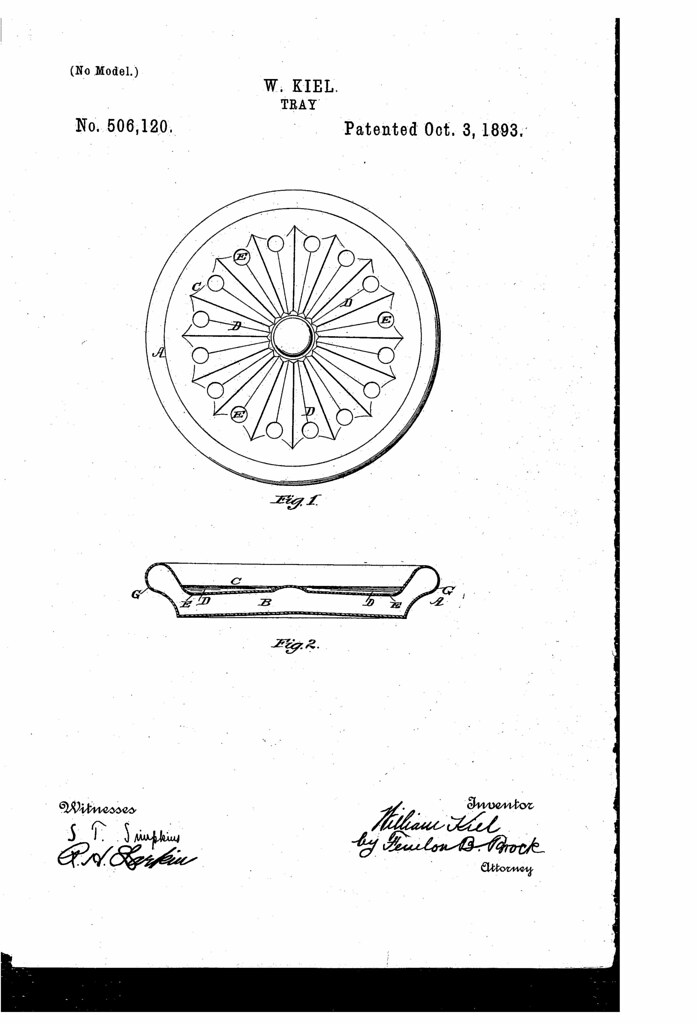
Today in 1893, US Patent 506120 A was issued, an invention of William Kiel, for his “Beer Tray.” There’s no Abstract, although in the description it includes these claims:

The object of my invention is to provide a rapid draining tray for holding wet articles, or vessels subject to overflow. It is designed more especially for holding beer glasses;

The invention consists in the herein described construction of the tray, the details of which will first be set forth, and the novel features then pointed out and claimed.
US506120-0

Filed Under: Beers, Just For Fun, Politics & Law, Related Pleasures Tagged With: Glassware, History, Law, Patent

Patent No. 4474255A: Beer Keg Scale

October 2, 2016 By Jay Brooks

patent-logo
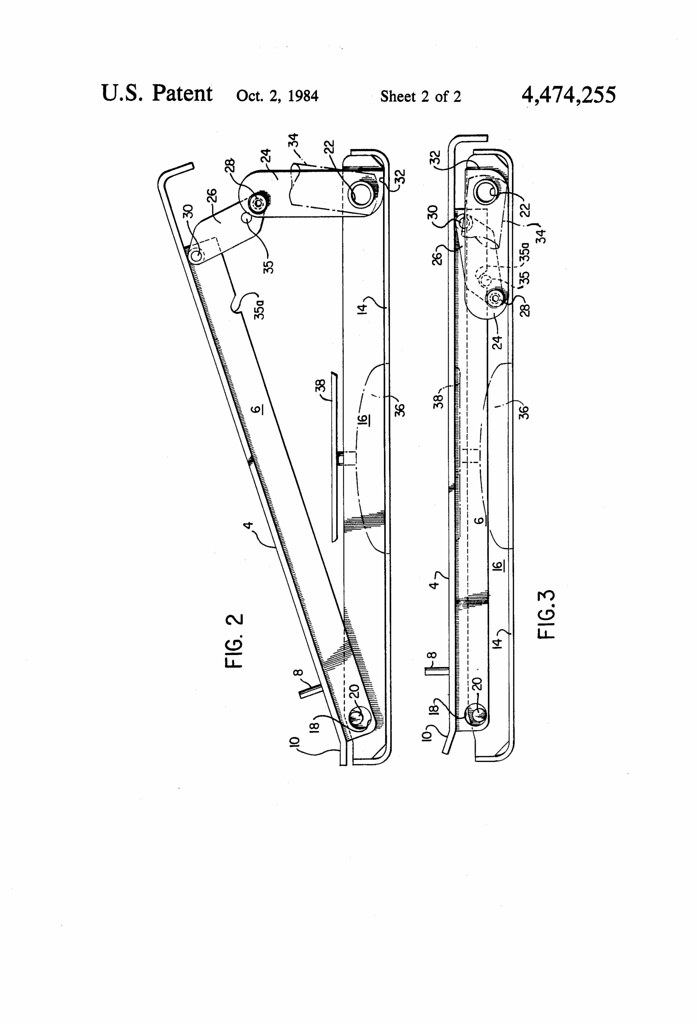
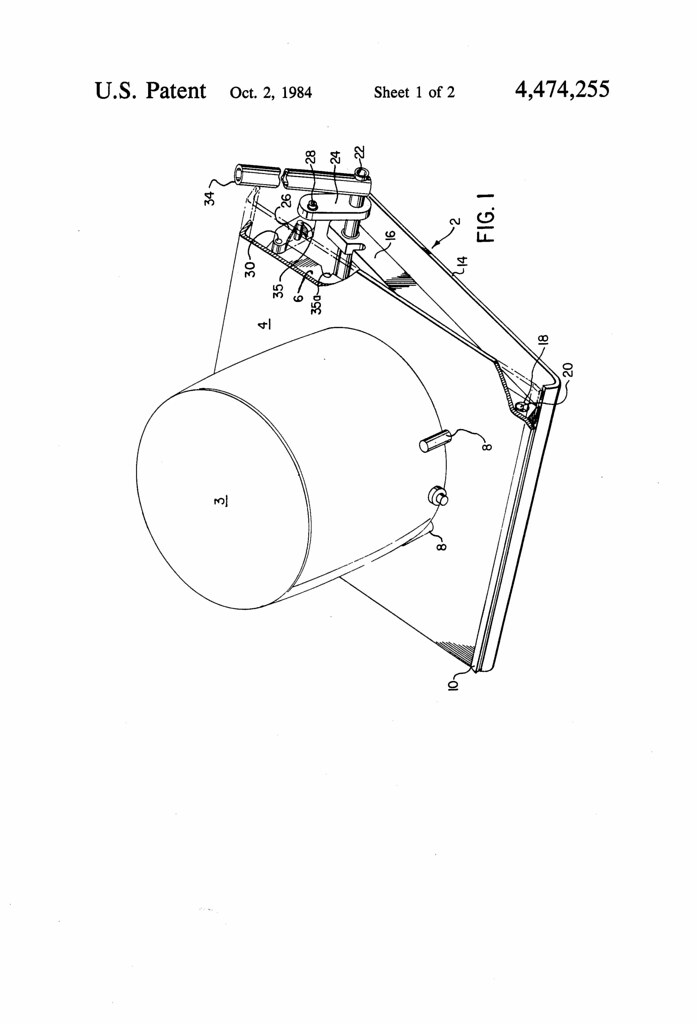
Today in 1984, US Patent 4474255 A was issued, an invention of Stephen A. Blok and Frank A. Kapounek, for their “Beer Keg Scale.” Here’s the Abstract:

A weighing and supporting device for liquid container kegs, such as those for beer. The device comprises a flat, keg-receiving platform beneath which is located a weigh scale, the platform being pivotable between an inclined, dispensing position and a horizontal, weighing position. In the latter, the platform rests upon the scale and is free to move up and down on that scale to enable the platform and a keg supported thereon to be weighed. By taking periodic measurements of the weight of the keg supported on such a device, the need for a liquid metering device in the line of liquid flow from the keg is avoided.

US4474255-1
US4474255-2

Filed Under: Beers, Just For Fun, Politics & Law, Related Pleasures Tagged With: Brewing Equipment, History, Kegs, Law, Patent

Patent No. 20100247276A1: Keg Lifting Device

September 30, 2016 By Jay Brooks

patent-logo
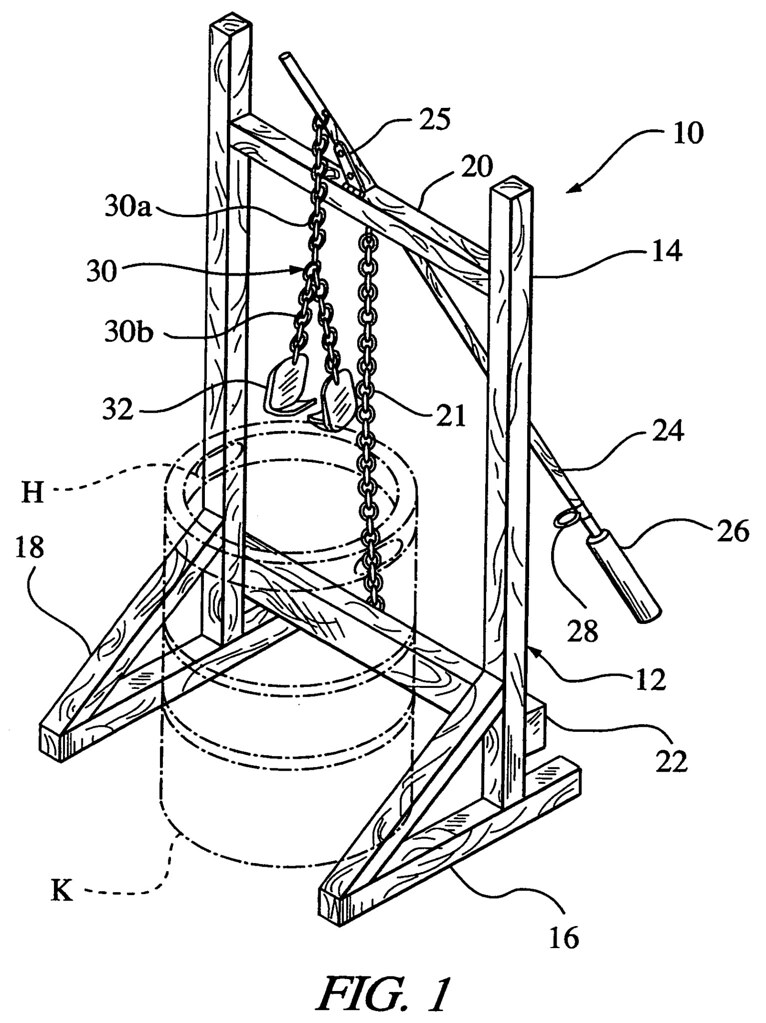
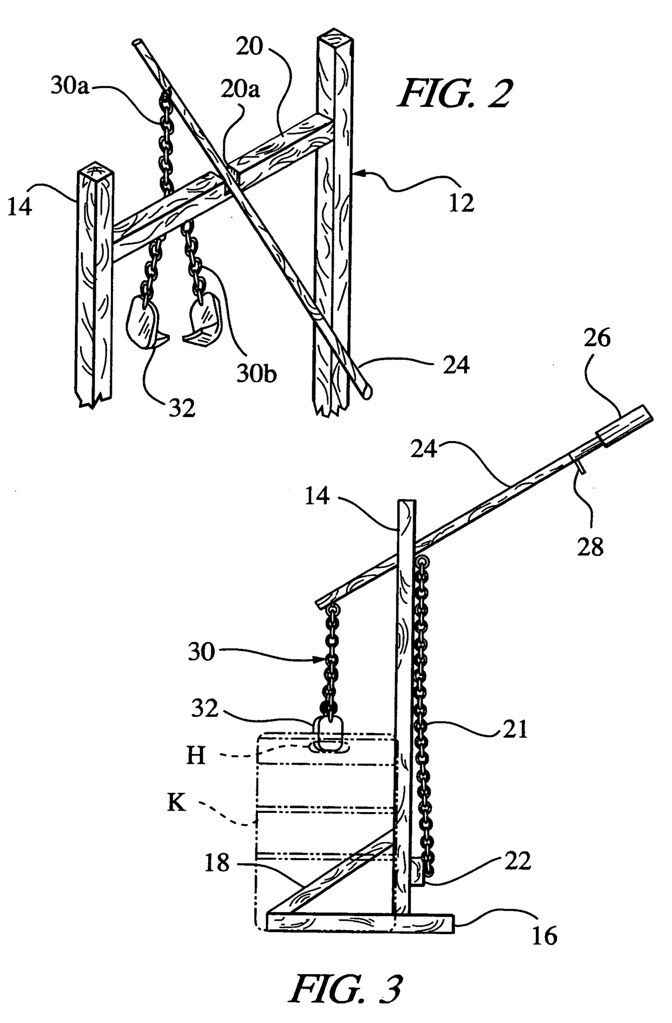
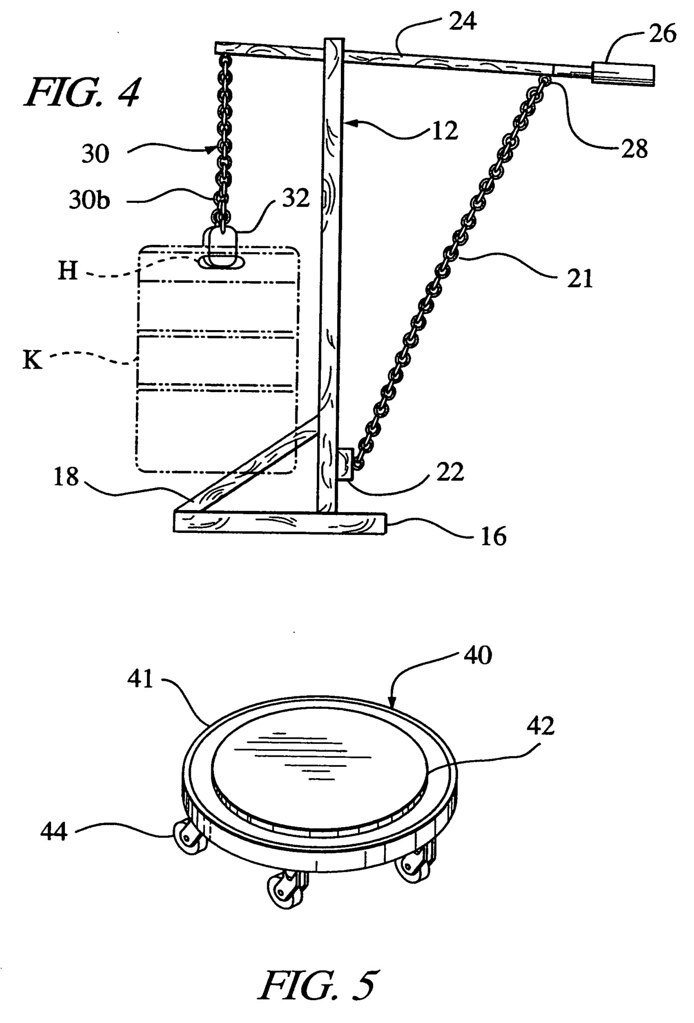
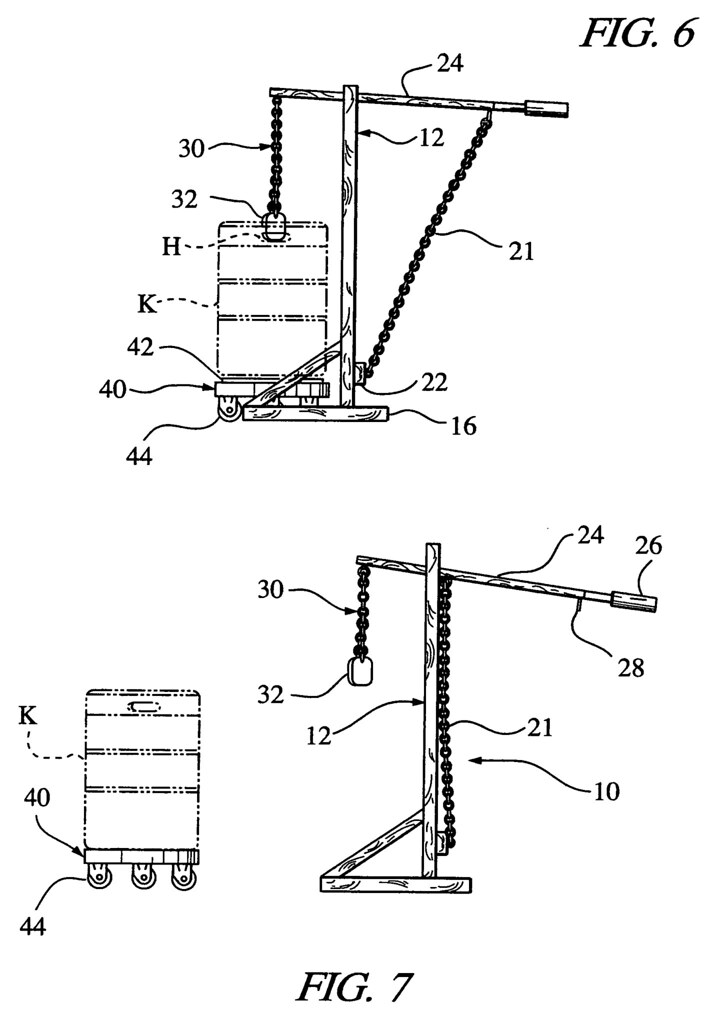
Today in 2010, US Patent 20100247276 A1 was issued, an invention of Giuseppe Loria, for his “Keg Lifting Device.” Here’s the Abstract:

An improved lifting device and associated system for handling a standard beverage keg comprises a rigid support frame formed to partially surround a standing keg and including a pair of vertical posts spaced apart and interconnected by separate upper and lower transverse beams, the posts being erected and supported upon respective lateral base beams that extend forward and rearward of the posts with a support brace angularly disposed and secured over each forward beam extension. A lever rod is pivotally connected to the upper transverse beam having a lower handle end and an upper working end carrying a bifurcated chain link attached thereto, the bifurcated chain link holding a pair of hook fasteners sized and shaped to fit the hand holds provided on the upper rim of the standard keg. With the support frame placed alongside the standing keg and the working end of the lever rod directly over the keg, the hook fasteners are made to engage the hand holds on opposite sides of the keg and apply a clamping pressure to the keg upon lifting. A deployable extension chain further provided on the support frame is adapted to fasten to the handle end of the lever rod to hold the lifted position of the keg, allowing a dolly with a circularly formed raised surface layer to engage the bottom of the keg for its immediate transport.

US20100247276A1-20100930-D00001
US20100247276A1-20100930-D00002
US20100247276A1-20100930-D00003
US20100247276A1-20100930-D00004

Filed Under: Beers, Just For Fun, Politics & Law, Related Pleasures Tagged With: History, Kegs, Law, Patent

Patent No. 3469992A: Chill Stability And Foam Adherence Of Beer

September 30, 2016 By Jay Brooks

patent-logo
Today in 1902, US Patent 3469992 A was issued, an invention of Frede B. Strandskov and Henry L. Ziliotto, assigned to the F&M Schaefer Brewing Co., for their “Chill Stability and Foam Adherence of Beer.” There’s no Abstract, although in the description it includes these claims:

The present invention relates to improvements in the chemical preservation of beer and more particularly it relates to the improvement of the chill stability and the foam adherence properties of beer which has been preserved against microbial growth by the addition thereto of a chemical preservative.

It is a desideratum in the beer making art to eliminate the necessity for pasteurization or refrigeration of finished beer. This is desirable (1) to avoid possible deleterious effects on the taste of the commercial product; (2) to avoid having to keep the beer refrigerated in storage before consumption; and/or (3) to obtain saving in cost per unit produced. It is known that beer may be preserved against microbial growth and the above objects thus accomplished, by treating the finished beer with heptyl parahydroxybenzoate, i.e., the heptyl ester of para-hydroxybenzoic acid as well as alkali metal or alkaline earth metal salts thereof. The discovery of the use of this compound to preserve finished beer represents a great advance in the art of beer making and provides the means by which the disadvantages of the necessity of pasteurization and/or refrigeration may be avoided. It has been discovered that the preservation in the abovemanner, however, tends to introduce complications which it is desirable to overcome if the most acceptable beer product is to be obtained.

In order to be commercially acceptable, a beer must possess certain properties; for example, it must be sparkling clear. Two additional properties which are most significant to beer connoisseurs are referred to as chill stability and foam adherence. The first of these relates to the property noted above as sparkling clear. As the name implies, on occasion a haze forms in some beer when it is chilled. As the temperature of the beer is returned to room temperature, the haze disappears, only to reappear upon subsequent rechilling. This haze is referred to as chill haze. The second of these significant properties, foam adherence, is of special importance to the connoisseurs. This property relates to the adherence of the beer foam to the sides of the drinking glass as the foam collapses or as the glass is being emptied. Beer, which in all other respects has excellent potential, may be excluded from the market solely because of the lack of an acceptable level of foam adherence. One of the marks of a beer connoisseur is his appreciation of the significance of beer foam adherence to the sides of the drinking glass.

3,469,992 Patented Sept. 30, 1969 In the instant invention it is important to note that foam adherence is notably distinct from the property of foam retention. Foam retention, or foam life, is a quality denoting the ability of the head, or layer of foam on a beer, to resist collapse with passage of time. Foam adherence as noted above refers to the ability of foam, as it collapses or as the beer is drained away, to leave a film of foam curtains or lace clinging to the walls of the container. It is from this curtain that the measurement of foam adherence is obtained. A significant foam curtain may be formed from beer, the head of which has completely collapsed and disappeared.

When finished beer is preserved against microbial growth by the addition thereto of heptyl para-hydroxybenzoate or a salt thereof, it has been found that adverse effects are sometimes produced on the acceptable values for chill stability and foam adherence. It is the object of the instant invention to overcome these adverse effects in order that the most commercially acceptable product possible may be obtained.

131683850

Filed Under: Beers, Breweries, Just For Fun, Politics & Law, Related Pleasures Tagged With: History, Law, Patent, Science of Brewing

Patent No. 710145A: Beer Cooler

September 30, 2016 By Jay Brooks

patent-logo
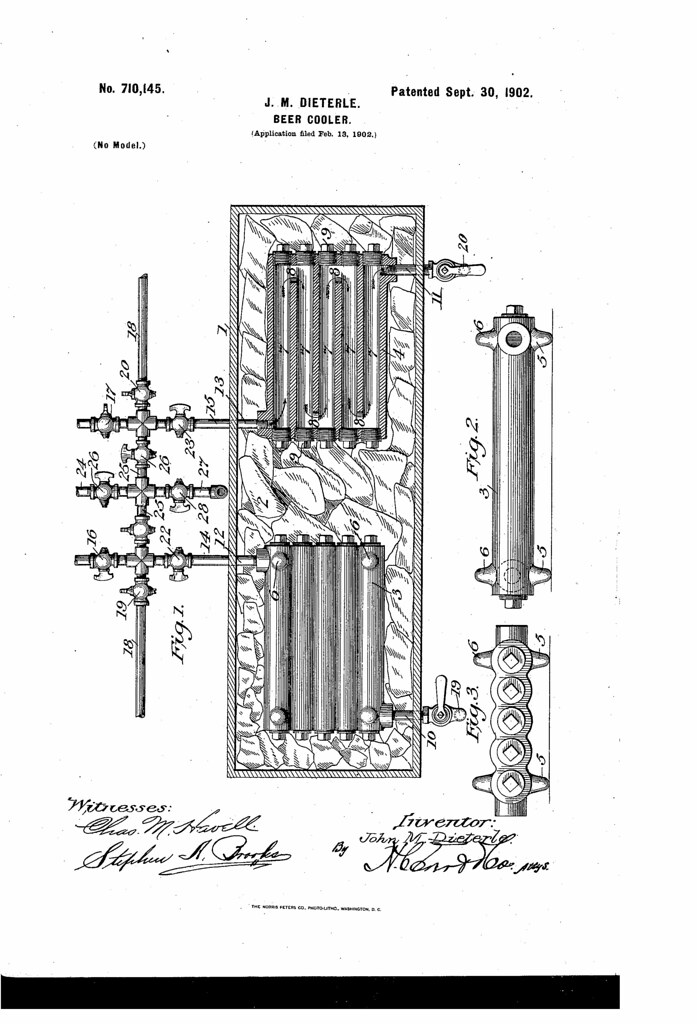
Today in 1902, US Patent 710145 A was issued, an invention of John M. Dieterle, for his “Beer Cooler.” There’s no Abstract, although in the description it includes these claims:

This invention relates to new and useful improvements in beer-coolers, the object of my invention being to provide a self-cleaning beer-cooler and one which will be more sanitary in its operation.

As at present constructed beer-coolersI consist of a number of parallel communicating tubes having pipes for the ingress and egress of the beer extending from the same side of the beer-cooler. The beer is admitted to the cooler and ows therethrough to the pipe leading to the faucet. The pipes through which the beer runs, composing the cooler, necessarily gather a sediment deposited by the beer and become lined with organic matter, which is deleterious and unwholesome in the beer. Heretofore beer-coolers have been constructed with. end caps covering the ends of the several tubes, and an elongated brush has been separately inserted into each of these tubes for the purpose of removing foreign matter which accumulates therein. This means of cleaning the tubes is inconvenient because it is necessary to remove the end caps from the row of tubes, and, being inconvenient, this cleaning is likely to be neglected. Moreover, it is not as effectual as the means hereinafter described, for the use of which my improved beer-cooler is adapted.

In beer coolers as heretofore constructed there has always been a comparatively long line of pipe intervening between the cooler and the faucet, and the beer while passing through this pipe, after having been cooled, again rises somewhat in temperature, due to the fact that while the beer-cooler is surrounded by ice or other suitable cold-producing mediaA the conducting-pipe just referred 5o to has not been similarly cooled.

The objects of my invention, therefore, are threefold-first, to increase the frequency of cleaning beer-coolers by making it easy to do so, thus increasing the sanitariness of the process; second, to construct a beer-cooler which is self-cleaning, and thereby more effectually to cleanse the same, and thus conduce to a more sanitary method of cooling beer, and, third, to provide a beer-cooler so constructed as to be located adjacent to the faucet or beer-tap without the intervention of a pump ‘or long line of conducting-pipe.

US710145-0

Filed Under: Beers, Just For Fun, Politics & Law, Related Pleasures Tagged With: History, Kegs, Law, Patent

Patent No. 2906624A: Apparatus And Method For Extracting Air From Beverages

September 29, 2016 By Jay Brooks

patent-logo
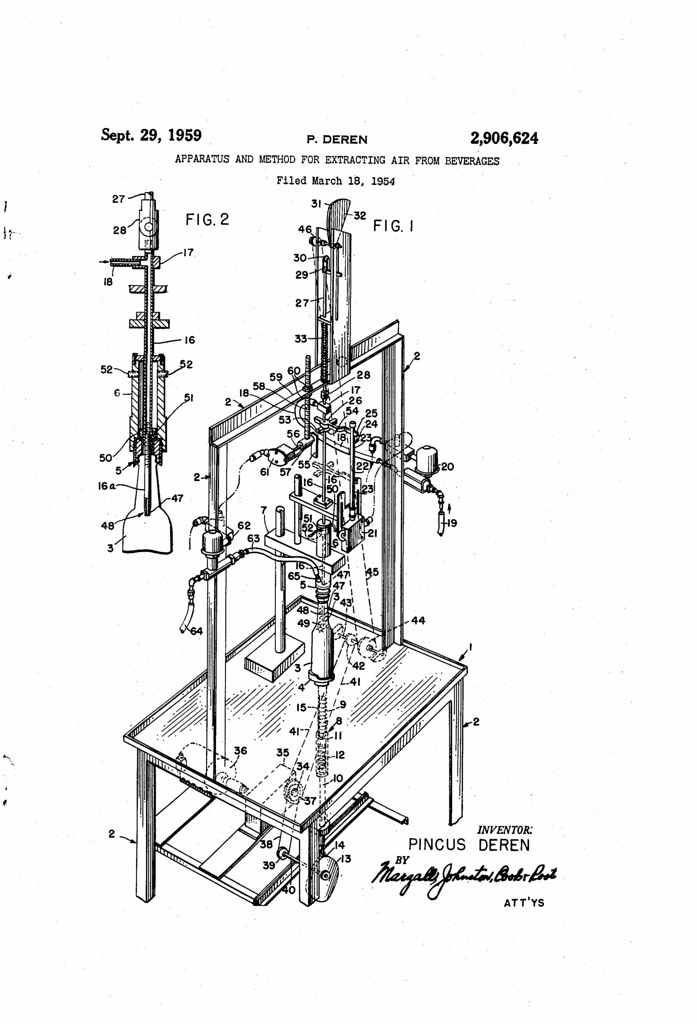
Today in 1959, US Patent 2906624 A was issued, an invention of Pincus Deren, assigned to Pabst Brewing Co., for his “Apparatus and Method for Extracting Air from Beverages.” There’s no Abstract, although in the description it includes these claims:

The present invention consists in the method or process of controlling the air content of carbonated beverages, especially bottled beer, and to the apparatus for carrying out the process.

It is well known that conventional practices in bottling carbonated beverages, particularly beer, causes a certain amount of oxidation of some of the constituents of the product, resulting in an undesirable change in flavor and in accelerated instability which greatly reduces the shelf life of the beverage.

Numerous attempts were made to eliminate’the excess air, and it was found that to remove the excess air successfully it was necessary to cause the beverage to foam and permit the latter to rise in the neck of the bottle to expel the air above the liquid level. Also, it was found that, to achieve good results, enough of the foam must be formed to fill the neck with fine bubbles to the top of the rim of the bottleneck.

One means for producing foam is by knocking the bottle sufliciently to cause the release of the gas in the beer; another means is by jetting or squirting a stream of beer into the beer in the bottle after it has been filled. A third method is by the injection of a stream of CO gas into the liquid.

Control of the degree of foaming by the methods just described is very difficult. When the knocking procedure is used, the condition of the surface of the bottle influences the degree of foaming. When jetting, either with beer or with CO gas, the liquid content is disturbed, and small variations in the temperature of the product and on the inside surface of the container will result in different degrees of foaming. The uncontrolled foaming results in either great variations in the final air content, or in the loss of large quantities of beer.

The primary object of the present invention is to overcome the disadvantages inherent in the conventional 7 Another object of the invention resides in the provision of novel means for removing most of the air before the foam is formed.

A further object is to reduce the losses of beverage due to excessive foaming and thereby practically eliminate socalled short fills.

A still further object resides in the provision of novel means for creating instantaneous suction on the liquid just as the foam starts to form to facilitate the removal of air.

Still another object of the invention consists in the provision of a new and novel apparatus to permit the process and the steps thereof to be accomplished and carried out successfully.

Numerous other objects and advantages will be apparent throughout the progress of the specification.

US2906624-0

Filed Under: Beers, Breweries, Just For Fun, Politics & Law, Related Pleasures Tagged With: Bottles, Brewing Equipment, History, Law, Patent

Patent No. 460291A: Apparatus For Heating And Pitching Barrels

September 29, 2016 By Jay Brooks

patent-logo
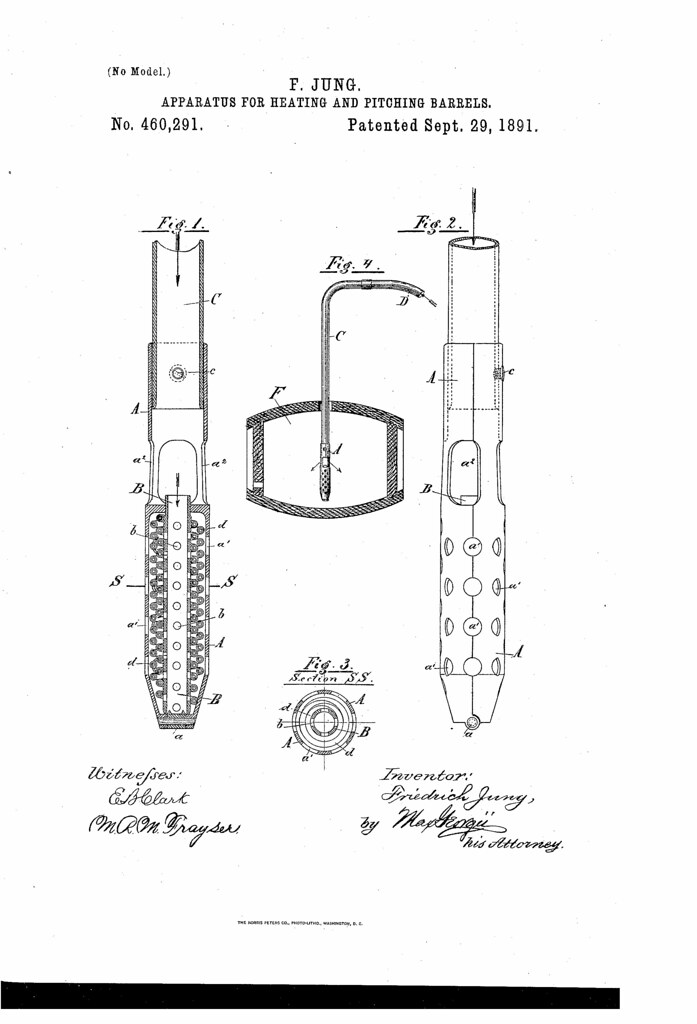
Today in 1891, US Patent 460291 A was issued, an invention of Friedeich Jung, for his “Apparatus for Heating and Pitching Barrels.” There’s no Abstract, although in the description it includes these claims:

The object of my invention, as described below, is to burn out beer-barrels with a direct flame and to remove the danger of explosions, which are still of frequent occurrence in pitching barrels. It is a notorious fact that the latter far more frequently occurs especially when barrels are pitched by the application of hot air or steam than when an open flame or direct fire is employed. The explosive gases are generated and the explosion is produced generally on account of a want of atmospheric air in the barrel.

US460291-0

Filed Under: Beers, Just For Fun, Politics & Law, Related Pleasures Tagged With: Barrels, History, Law, Patent

Patent No. 5248062A: Beer Keg Tap Apparatus

September 28, 2016 By Jay Brooks

patent-logo
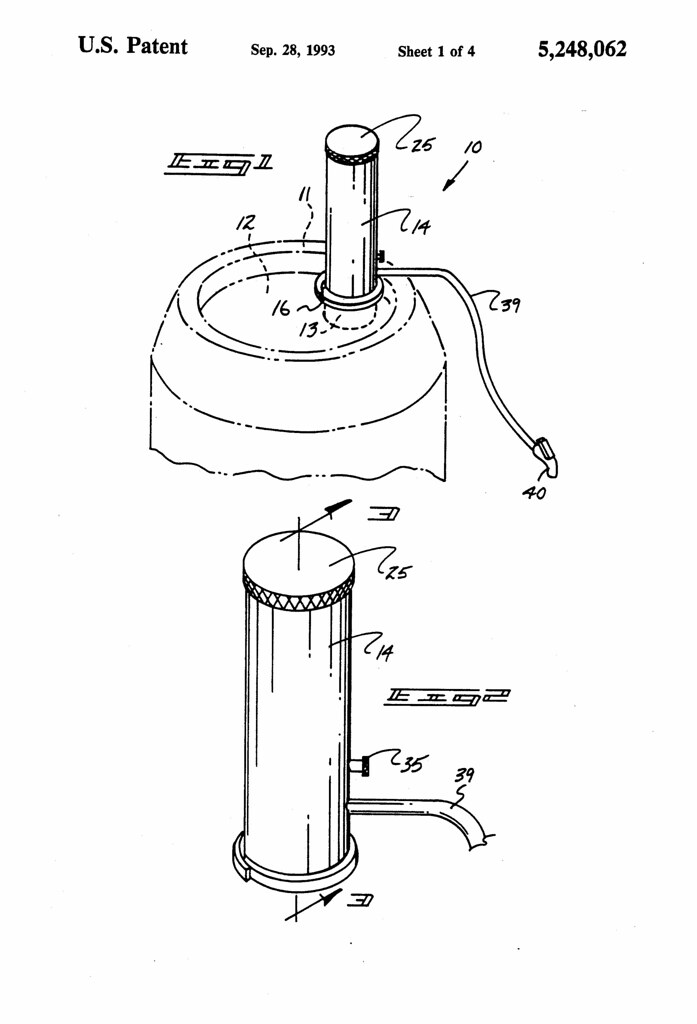
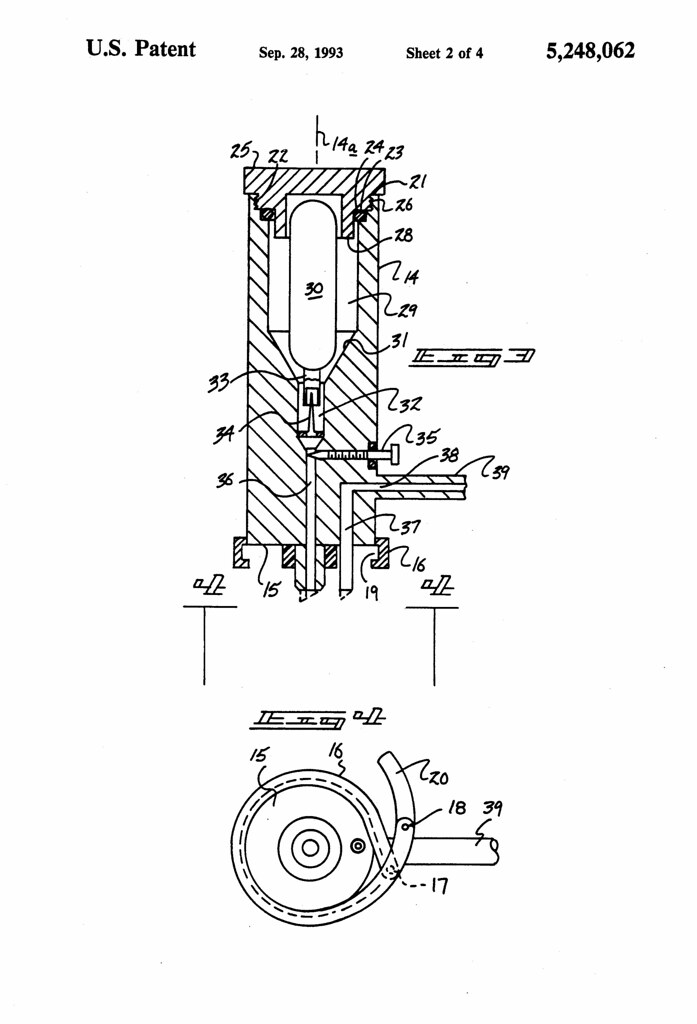
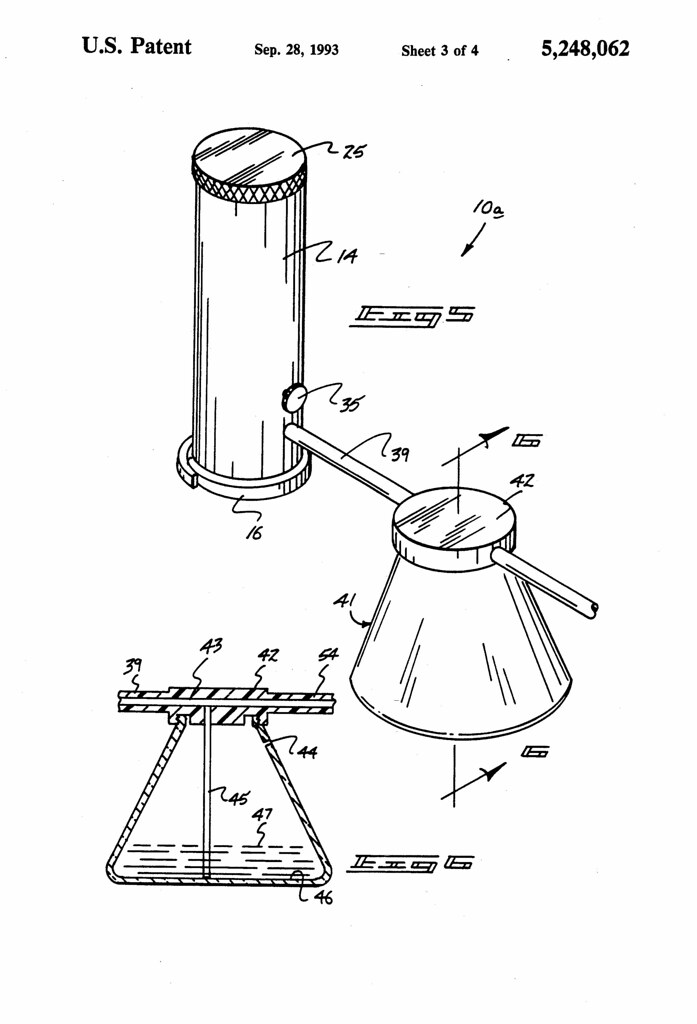
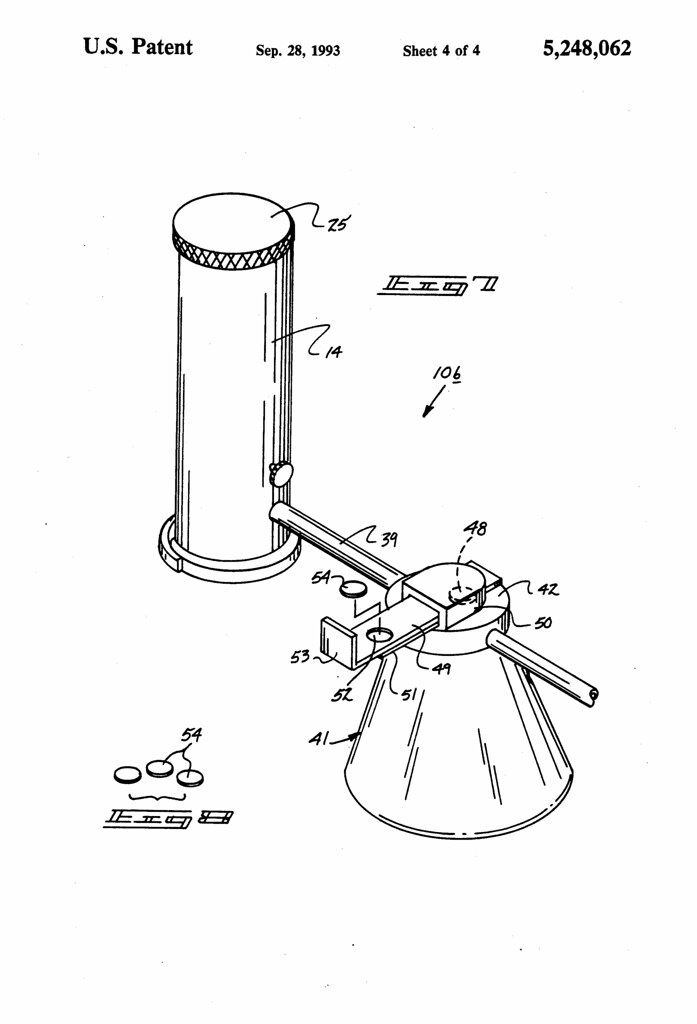
Today in 1993, US Patent 5248062 A was issued, an invention of Vincent G. Hillard, for his “Beer Keg Tap Apparatus.” Here’s the Abstract:

A tap member is arranged with a threaded lid directed into engagement with an upper end of the tap structure configured as a cylindrical housing, including a cavity receiving a compressed gas canister there within. Upon projection of the lid into the housing, the canister is pierced directing compressed gas from the canister into an underlying beer keg, whereupon beer is dispensed through a dispensing conduit.

US5248062-1
US5248062-2
US5248062-3
US5248062-4

Filed Under: Beers, Just For Fun, Politics & Law, Related Pleasures Tagged With: History, Kegs, Law, Patent

Patent No. 4406301A: Keg-Tapping Structure

September 27, 2016 By Jay Brooks

patent-logo
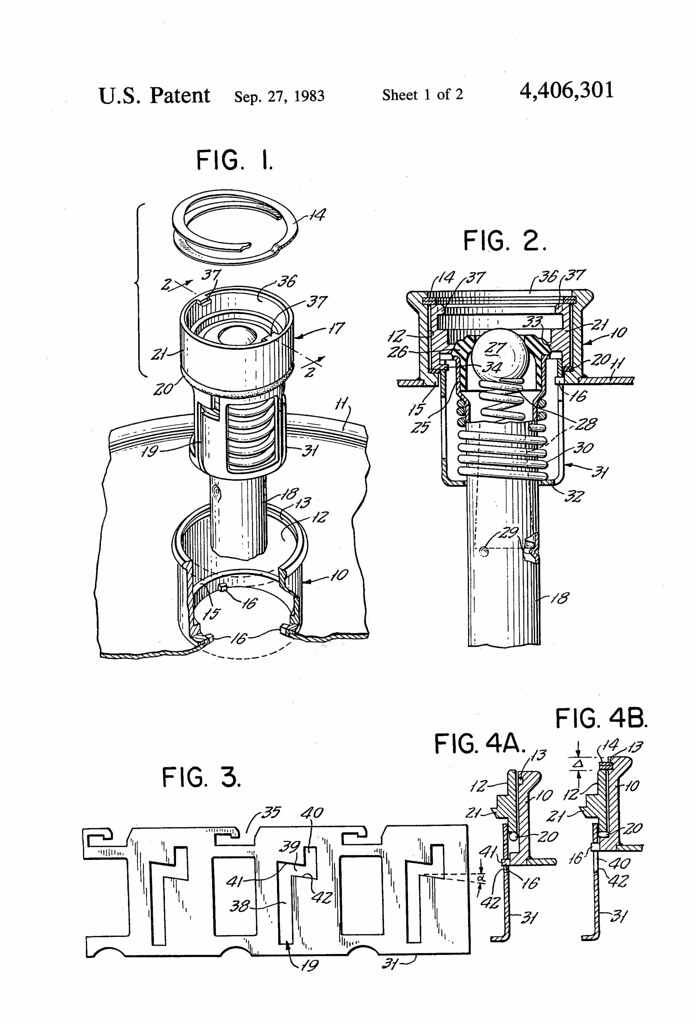
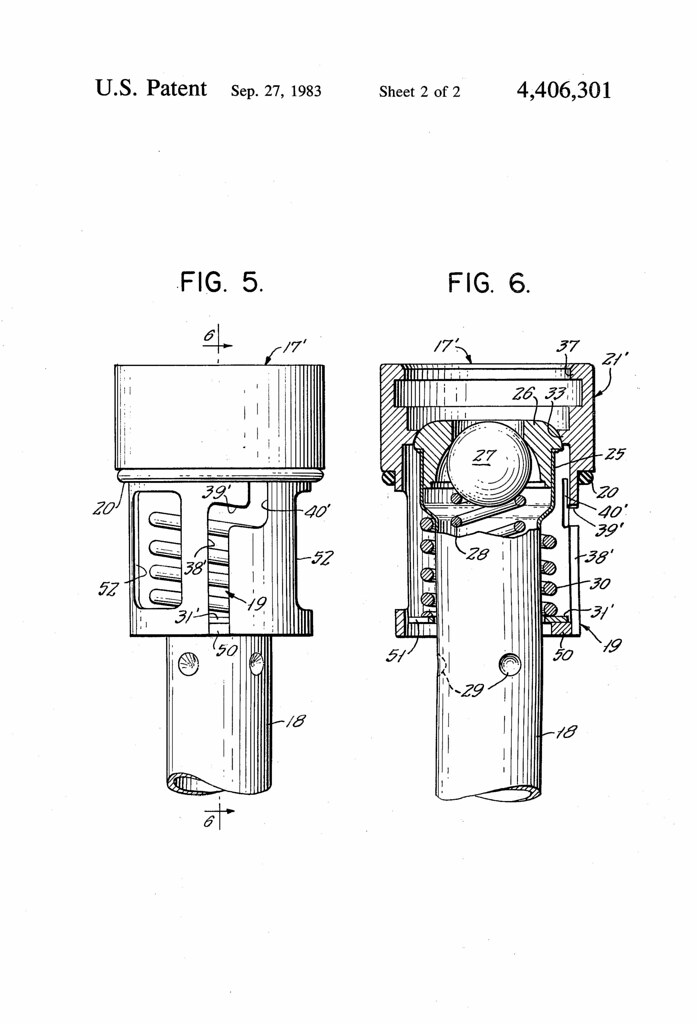
Today in 1983, US Patent 4406301 A was issued, an invention of Vincent J. Cerrato, for his “Keg-Tapping Structure.” Here’s the Abstract:

The invention contemplates removable structure to facilitate keg-tapping, and pressurized dispensing of liquid contents of the keg. A so-called Barnes neck forms part of the keg and has a bore with an elastomeric ring seal and flange at its lower end, and a valve-and-tube subassembly is inserted through the neck, to the point of valve-body compression of the seal, when secured by a removable retaining ring. In the course of such insertion, one or more radially inward lugs on the neck flange track corresponding slot formations in the subassembly. Each such slot formation has a first upward longitudinal course, leading to an angular bayonet-like offset course, and then to a second upward longitudinal course. The location of the angular offset is such that the valve body cannot compressionally load the seal ring in the absence of the partial rotation needed to develop lug alignment with the second upward longitudinal course.

US4406301-1
US4406301-2

Filed Under: Beers, Just For Fun, Politics & Law, Related Pleasures Tagged With: History, Kegs, Law, Patent

Patent No. D510083S1: Beer Bottle-Like Musical Speaker

September 27, 2016 By Jay Brooks

patent-logo
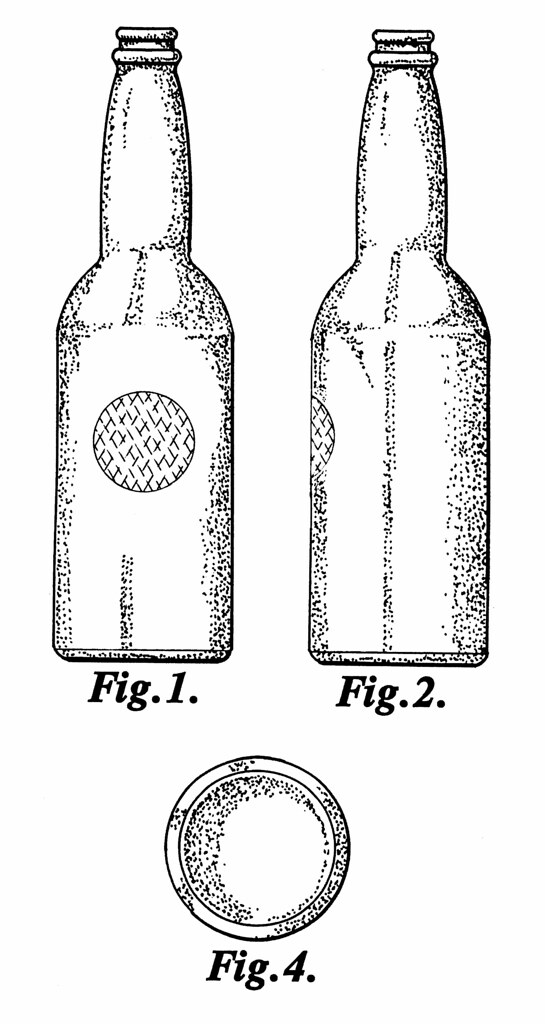
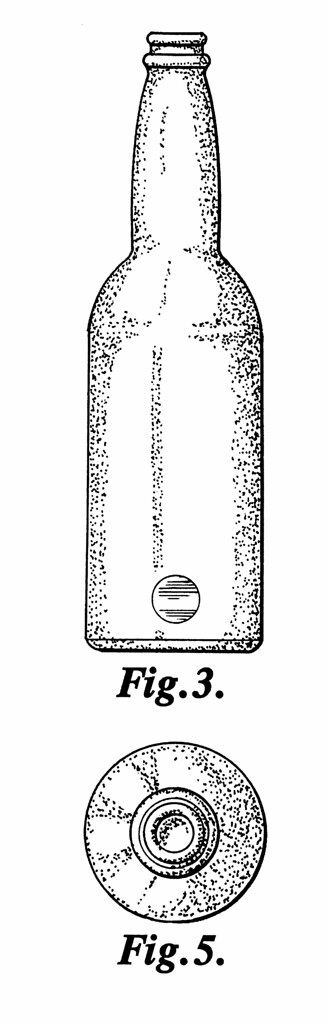
Today in 2005, US Patent D510083 S1 was issued, an invention of Kenneth L. Kasden, for his “Beer Bottle-Like Musical Speaker.” There’s no Abstract, although in the description it includes these claims:

The ornamental design for a beer bottle-like musical speaker, as shown and described.

USD0510083-20050927-D00001
USD0510083-20050927-D00002

Filed Under: Beers, Just For Fun, Politics & Law, Related Pleasures Tagged With: History, Law, Music, novelties, Patent

« Previous Page
Next Page »

Find Something

Northern California Breweries

Please consider purchasing my latest book, California Breweries North, available from Amazon, or ask for it at your local bookstore.

Recent Comments

  • Steve 'Pudgy' De Rose on Historic Beer Birthday: Jacob Schmidt
  • Jay Brooks on Beer Birthday: Bill Owens
  • Steve 'Pudgy' De Rose on Beer Birthday: Charles Finkel
  • Steve 'Pudgy' De Rose on Beer Birthday: Bill Owens
  • Steve "Pudgy" De Rose on Beer Birthday: Pete Slosberg

Recent Posts

  • Beer In Ads #5130: Bishop And Smitty Says Bock Beer December 2, 2025
  • Beer Birthday: Bob Pease December 2, 2025
  • Beer In Ads #5129: Call For Gem Bock Beer December 1, 2025
  • Beer Birthday: Susan Boyle December 1, 2025
  • Historic Beer Birthday: William Krug December 1, 2025

BBB Archives

Feedback

Head Quarter
This site is hosted and maintained by H25Q.dev. Any questions or comments for the webmaster can be directed here.