Brookston Beer Bulletin

Jay R. Brooks on Beer

  • Home
  • About
  • Editorial
  • Birthdays
  • Art & Beer

Socialize

  • Dribbble
  • Email
  • Facebook
  • Flickr
  • GitHub
  • Instagram
  • LinkedIn
  • Pinterest
  • RSS
  • Twitter
  • YouTube

Powered by Genesis

Historic Beer Birthday: Jacob Gimlich

October 4, 2025 By Jay Brooks

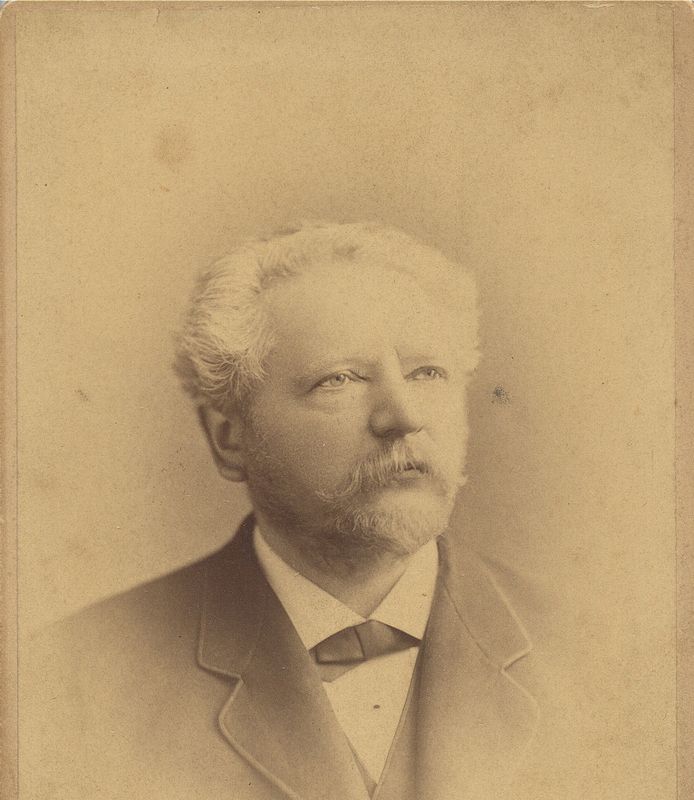
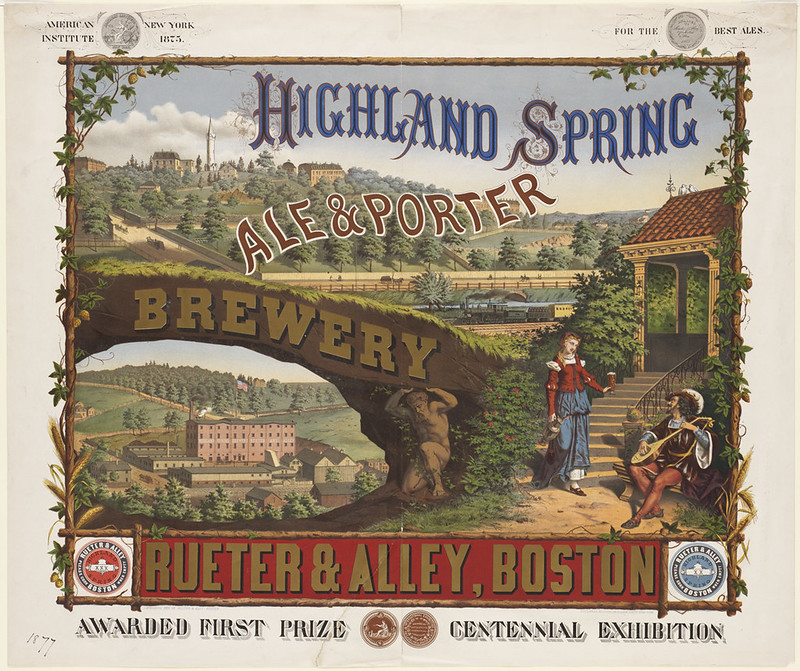
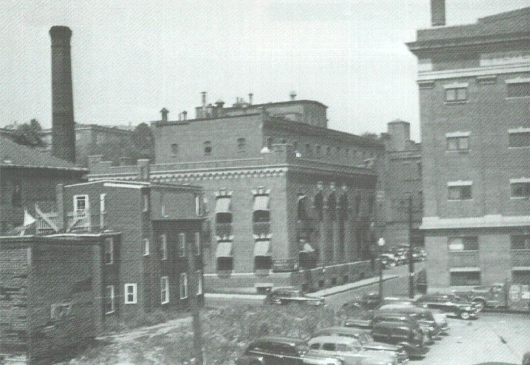
Today is the birthday of Jacob Gimlich (October 4, 1845-January 21, 1912). He was born in Weisenheim, Bavaria, but came to Massachusetts and bought the M. Benson Brewery of Pittsfield, with business partner John White, in 1868, only one year after it opened. They renamed it the unimaginative Jacob Gimlich & John White Brewery. In 1891, they changed its name to the Berkshire Brewing Association, and that remained its name until it closed due to prohibition in 1918 or 1919. “The brewery produced beers such as Greylock Ale, Mannheimer Lager, Lenox Half Stock Ale, Berkshire Lager, Berkshire Ale, and Superior Old Porter. In addition to beer, Mineral Water, Soda, and Malt Extracts were also produced. The brewery was a great success producing 75,000 barrels a year and distributed all over the northeast and as far south as the Carolinas.”

Here’s a history of Gimlich, from “Historic homes and institutions and genealogical and personal memoirs of Berkshire County, Massachusetts,” published in 1906:

Here’s a story of the brewery iBerkshires.com:

One can only wonder what John White and Jacob Gimlich would have thought as federal officers poured 15,000 gallons of locally crafted beer into the sewer on an early May morning in 1922.

Gimlich and his brother-in-law White had first purchased a small brewery on Columbus Street in 1868 from Michael Benson. First called simply “Jacob Gimlich & John White,” the business began at an output of just six barrels a day, but would grow to be a major manufacturer in the West Side Pittsfield neighborhood.

Both men had immigrated to the country from Germany in their youth, and both served tours in the Civil War. Gimlich worked briefly for the Taconic Woolen Mills before going into the beer business with his sister Rachel’s husband.

By 1880, operating as Gimlich, White & Co., the brewers erected a much larger facility in a five-story brick building measuring 40 by 80 feet. The expanded plant employed from 15 to 20 men and was shipping about 16,000 barrels a year.

Gimlich and White built houses directly across the road from their plant on John Street, and as their fortunes grew became increasingly prominent members of the community. Gimlich in particular became enmeshed in a variety of financial and civic affairs. From 1884-1885, he served as the city’s representative in the Legislature, and was one of the organizers and directors of City Savings Bank. Gimlich likewise served on the board of the Berkshire Loan and Trust Co. and of the Co-Operative Bank, was a past chancellor of the local lodge, Knights of Pythias, and member of the Grand Lodge of Massachusetts and of the local Sons of Veterans.

“Pittsfield has been pleased with the success of Gimlich & White and they are counted among the town’s leading, liberal, and most public spirited citizens,” states one Pittsfield Sun editorial of the time.

By the early 1890s the torch was being passed to the next generation, with sons David Gimlich along with Fred and George White taking on more leadership of the company when it reincorporated as Berkshire Brewing Association in 1892. An additional four-story building was added, with the brewing complex now taking up the full block along Columbus Avenue between Onota and John Street to Gilbert Avenue.

Among Berkshire Brewing’s most popular products were Mannheimer Lager Beer, Berkshire Pure Malt Extract, Lenox Half Stock Ale, and Berkshire Pale Ale, considered to be one of the finest India pale ales then on the market. The plant also churned out bottled mineral waters, ginger ale and other soft drinks.

The elder Gimlich and White passed away in 1912 and 1916, respectively, but the enterprise they founded continued to see steady growth. The only brewery of the kind within 50 miles of Pittsfield, Berkshire Brewing Association had something of a monopoly in the region, along with a thriving distribution throughout the east coast as far south as the Carolinas. At its peak, it employed 150 workers and put out 75,000 to 100,000 barrels worth of beer annually. Records indicate between 1910 and 1920, Berkshire Brewing Association paid $1 million in federal taxes, in addition to state and local taxes and fees, including $1,200 a year for a brewer’s license and $800 for an annual bottling license.

The company was not without its occasional hiccups, such as a lengthy strike in the fall of 1911 by the Pittsfield Brewers Union, culminating in the reinstatement of a dismissed employee.

Real crisis came at the end of the decade, as increasing restrictions on alcohol grew into total national prohibition. They first ceased brewing beer temporarily in December 1918, after a directive from the National Food Administration following the passage of the the Wartime Prohibition Act. Even after the passage of the Volstead Act the following fall, BBA voted to remain in business, focusing on bottled soft drinks while hoping the ban to be a brief legislative phase.

They also continued to brew beer, as did several major brewers throughout the country at first, seeing the government’s lack of resources tasked to enforce the rule. Finally in spring 1922, federal officers arrived to turn off the taps, disposing of 15,000 gallons worth and estimated $15,000 to $20,000 at the time.

Ironically, the company waited it out until nearly the end of the failed domestic policy, the board of directors voting to close down in January 1929.

The brewery building was dismantled soon after; for a time, the Siegel Furniture Co. operated out of the former bottling building, which later became the Warehouse Furniture Co. In 1975, this, too, was cleared as the land passed to the Pittsfield Housing Authority, which developed the Christopher Arms housing project that occupies the former site of the brewery today.

berkshire-beer-truck


A brewery delivery truck around 1905.

And here’s Gimlich’s obituary:

berkshire-brewing-sign

Filed Under: Birthdays, Just For Fun Tagged With: Germany, History, Massachusetts

Historic Beer Birthday: Samuel Adams

September 27, 2025 By Jay Brooks

samuel-adams-logo-new
Today is the birthday of Samuel Adams (September 27, 1722-October 2, 1803). He “was an American statesman, political philosopher, and one of the Founding Fathers of the United States. As a politician in colonial Massachusetts, Adams was a leader of the movement that became the American Revolution, and was one of the architects of the principles of American republicanism that shaped the political culture of the United States. He was a second cousin to President John Adams.” He was also at least a maltster, and possibly a brewer.

Copley-sam_adams-lg
A portrait of Samuel Adams by John Singleton Copley.

Copely was one of the most famous early American painters, especially of portraits. He also did paintings of John Hancock, John Adams and Paul Revere, as well. The painting hangs in Boston’s Museum of Fine Art, and I had a change to see the original in 2009, when the CBC was in Boston. It was smaller than I expected at 49 1/2 x 39 1/2 in. and is believed to have been painted around 1772. Its first owner, after the artist, was none other than John Hancock. His wife later gave it to Adams’ grandson and in 1876 it was given to the City of Boston. In the painting, he’s pointing at the Massachusetts Charter, which Adams believed was a constitution that protected peoples’ rights.

engraving-samuel-adams
An engraving of Samuel Adams, by Alonzo Chappel, from 1858.

Whether or not Adams was in fact a brewer is open to some debate. Stanley Baron’s Brewing in America suggests that he may have been involved in his father’s malting business, making him a Malster. In the footnote in the Wikipedia entry on Samuel Adams, it tells the following story.

Baron, Brewed in America, 74–75; Alexander, Revolutionary Politician, 231. However, Stoll (Samuel Adams, 275n16) notes that James Koch, founder of Boston Beer Company, reports having seen a receipt for hops signed by Adams, which indicates that Adams may have done some brewing.

It seems to me we might rarely hear of Sam Adams’ connection to the world of beer were it not for the Boston Beer Co. Historically, it doesn’t seem like that was a driving force in his life. What does seem clear, is that his father, Samuel Adams Sr., was most certainly a maltster, and also probably a brewer.

Here’s Michael Burgan, author of Samuel Adams: Patriot and Statesman, discussing Samuel Adams Sr., Samuel Adams’ father.

adams-sr-bio

samuel-adams-1722-1803-granger

On the New England Historical Society’s website, on a page about Samuel Adams, entitled Sam Adams Walked Into a Tavern and Started a Revolution. Part of that has the heading “Sam the Maltster.”

Sam the Maltster

Sam’s Adams’ father, Deacon Samuel Adams, was a man of wealth and respect. He made his living selling malt to beer makers from a malt house in his backyard. Deacon Adams was a leader of the populist political party known as the Boston Caucus, whose members met in taverns.

Young Sam Adams entered Harvard in 1736 at 14, graduated in 1740 and received a master’s degree in 1743. He didn’t want to be a lawyer or a minister, so he tried working in Thomas Cushing’s counting house. He hated it. He ended up living at home on the income from his father’s malt house.

sam-adams-green-dragonHe haunted the taverns of Boston, honing his political skills and making his political connections. His cousin John Adams noted taverns were where ‘bastards, and legislators, are frequently begotten.’

Sam didn’t become a legislator. First he was elected clerk of the market, then town scavenger, then tax collector, a position he held for nearly a decade. Later he became clerk of the Massachusetts House of Representatives, delegate to the Continental Congress, president of the Massachusetts Senate, lieutenant governor and governor.

When Sam was 24, his father died. The next year, British naval officers kidnapped 50 men on the Boston waterfront to impress them into service. A riot ensued, the prisoners were released and Sam Adams became a journalist. He started a newspaper, The Independent Advertiser, in which he portrayed the rioters as an assembly of people defending their natural right to life and liberty.

He also organized the Sons of Liberty, which flourished in Boston’s tavern-based political culture.

In 1769, Sam Adams, James Otis, Paul Revere, John Hancock, Benjamin Edes and 350 Sons of Liberty celebrated the fourth anniversary of resistance to the Stamp Act at the Liberty Tree Tavern in Dorchester. They dined in a tent set up for the occasion and drank 45 toasts. John Adams, who was there, noted that no one got drunk (beer could be pretty weak) and grudgingly approved of the affair. “Otis and Adams are politick, in promoting these Festivals, for they tinge the Minds of the People, they impregnate them with the sentiments of Liberty.”

BE040567
Samuel Adams in 1795 when he was Governor of Massachusetts.

Most accounts of Samuel Adams focus on his political activities and rarely mention his association with brewing at all. Here, for example, is a short biography from U.S. History.org, one of the 56 on the website done for each of the 56 Signers of the Declaration of Independence.

Samuel and John Adams’ names are almost synonymous in all accounts of the Revolution that grew, largely, out of Boston. Though they were cousins and not brothers, they were often referred to as the Adams’ brothers, or simply as the Adams’. Samuel Adams was born in Boston, son of a merchant and brewer. He was an excellent politician, an unsuccessful brewer, and a poor businessman. His early public office as a tax collector might have made him suspect as an agent of British authority, however he made good use of his understanding of the tax codes and wide acquaintance with the merchants of Boston. Samuel was a very visible popular leader who, along with John, spent a great deal of time in the public eye agitating for resistance. In 1765 he was elected to the Massachusetts Assembly where he served as clerk for many years. It was there that he was the first to propose a continental congress. He was a leading advocate of republicanism and a good friend of Tom Paine. In 1774, he was chosen to be a member of the provincial council during the crisis in Boston. He was then appointed as a representative to the Continental Congress, where he was most noted for his oratory skills, and as a passionate advocate of independence from Britain. In 1776, as a delegate to the Continental Congress, he signed the Declaration of Independence. Adams retired from the Congress in 1781 and returned to Massachusetts to become a leading member of that state’s convention to form a constitution. In 1789 he was appointed lieutenant governor of the state. In 1794 he was elected Governor, and was re-elected annually until 1797 when he retired for health reasons. He died in the morning of October 2, 1803, in his home town of Boston.

Finally, an article on the History Channel’s website, The Sudsy History of Samuel Adams, comes to pretty much the same conclusion, that Samuel Adams did inherit his father’s malting business, but if he was involved at all, his heart wasn’t in it. While it’s possible he also did brew, most likely for his household as was common in his day, there’s little, if any, compelling evidence for it. But thanks to Jim Koch, for the foreseeable future at least, his name will be inextricably linked to beer.

adams_s

Filed Under: Art & Beer, Birthdays, Just For Fun Tagged With: History, Massachusetts, Politics

Beer In Ads #4989: You’ll Like Pickwick Bock Beer

June 5, 2025 By Jay Brooks

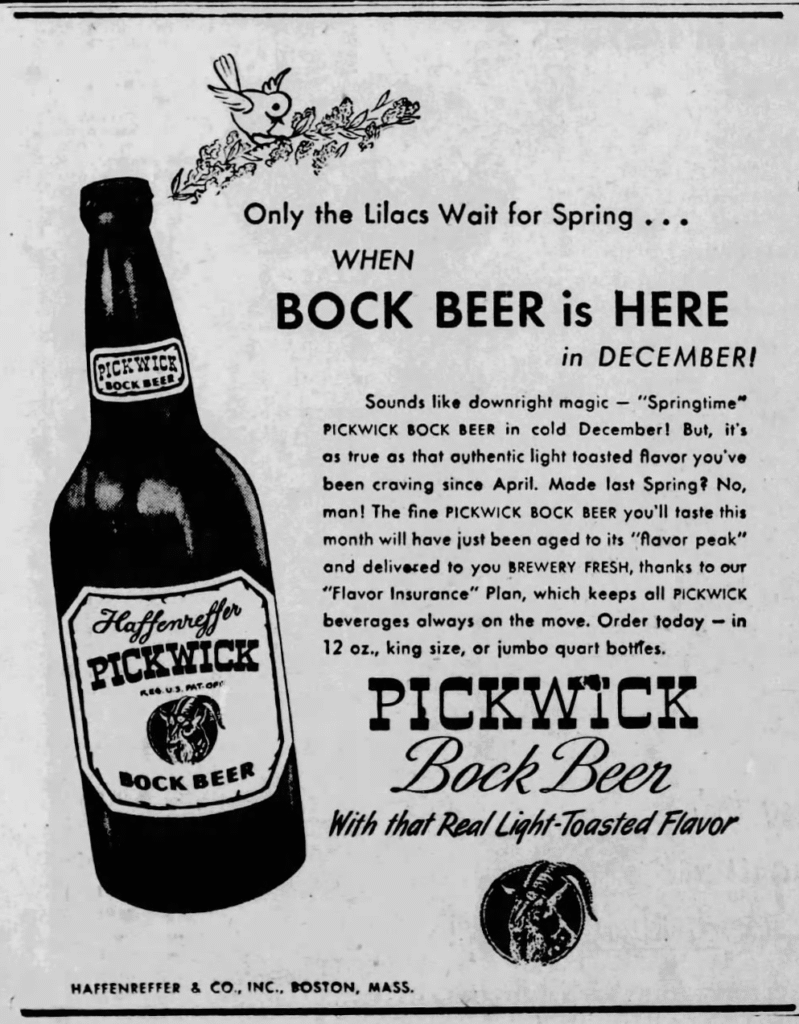
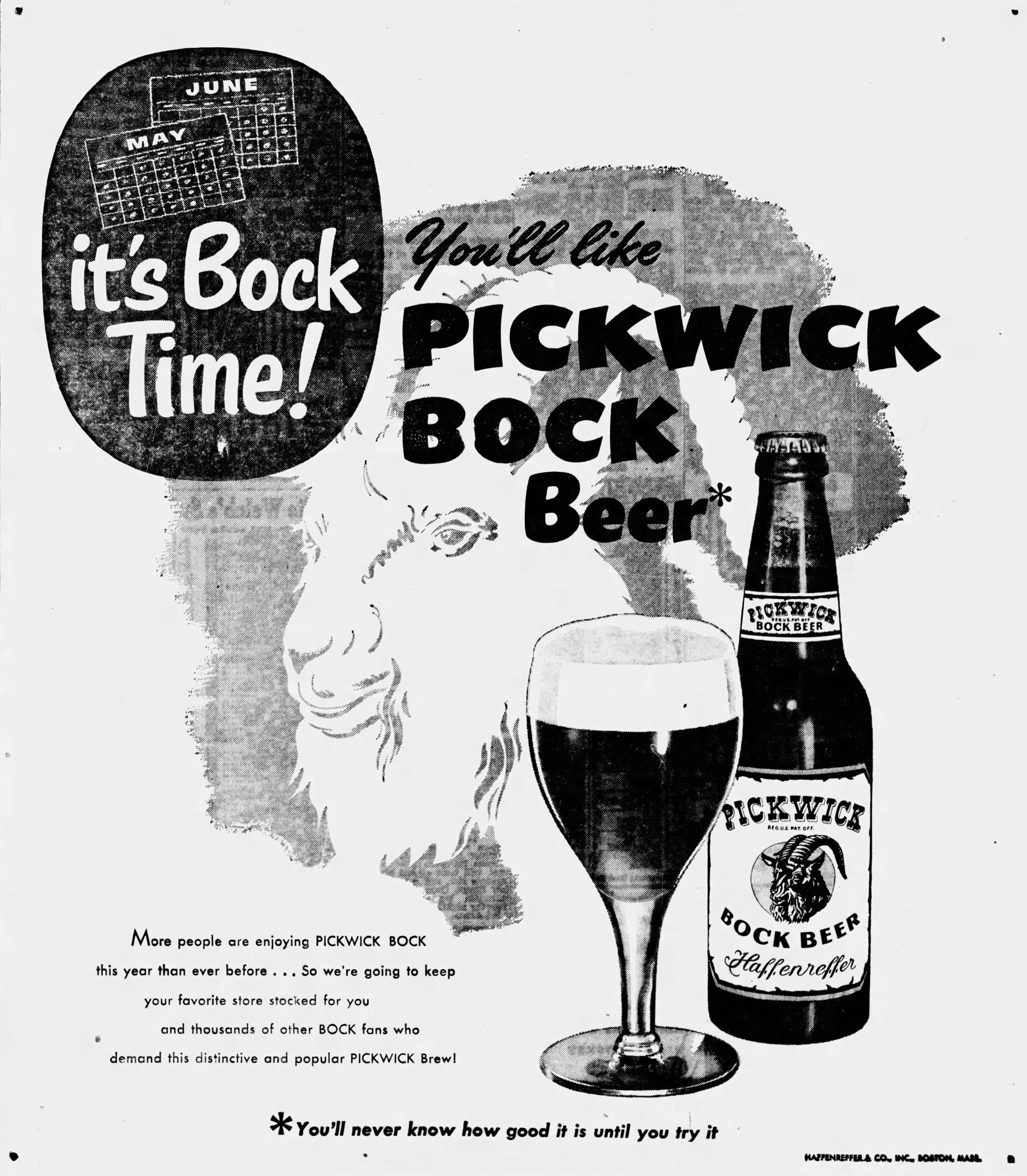
Last year I decided to concentrate on Bock ads. Bock, of course, may have originated in Germany, in the town of Einbeck. Because many 19th century American breweries were founded by German immigrants, they offered a bock at certain times of the year, be it Spring, Easter, Lent, Christmas, or what have you. In a sense they were some of the first seasonal beers. “The style was later adopted in Bavaria by Munich brewers in the 17th century. Due to their Bavarian accent, citizens of Munich pronounced ‘Einbeck’ as ‘ein Bock’ (a billy goat), and thus the beer became known as ‘Bock.’ A goat often appears on bottle labels.” And presumably because they were special releases, many breweries went all out promoting them with beautiful artwork on posters and other advertising.

Thursday’s ad is for Pickwick Bock Beer. The ad was published on June 5, 1951. The brewery was the Haffenreffer Brewery of Boston, Massachusetts, which was originally founded in 1870. It was located in the Jamaica Plain area of Boston, and today the site of the brewery is where the Boston Beer Co. operates one of its breweries. This ad ran in The Boston Globe, of Boston, Massachusetts.

Filed Under: Art & Beer, Beers, Breweries, Just For Fun Tagged With: Advertising, Bock, Boston, History, Massachusetts

Beer In Ads #4960: Pickwick Bock Beer

May 5, 2025 By Jay Brooks

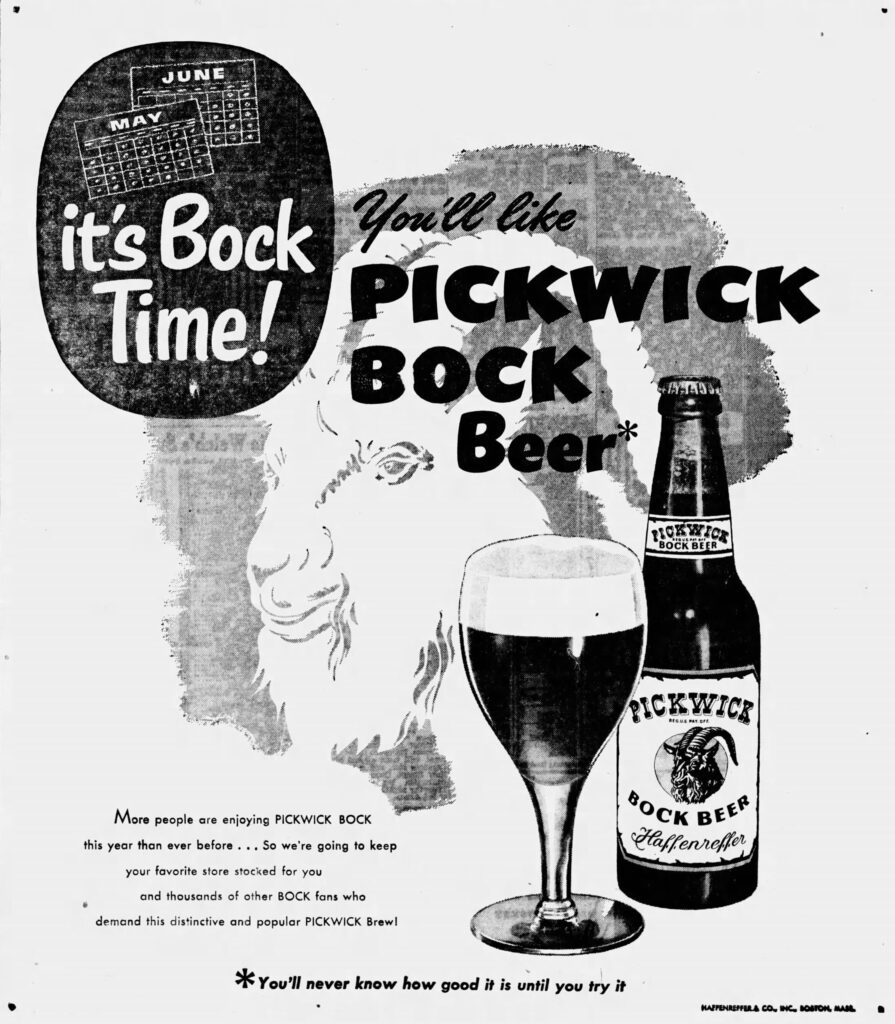
Last year I decided to concentrate on Bock ads. Bock, of course, may have originated in Germany, in the town of Einbeck. Because many 19th century American breweries were founded by German immigrants, they offered a bock at certain times of the year, be it Spring, Easter, Lent, Christmas, or what have you. In a sense they were some of the first seasonal beers. “The style was later adopted in Bavaria by Munich brewers in the 17th century. Due to their Bavarian accent, citizens of Munich pronounced ‘Einbeck’ as ‘ein Bock’ (a billy goat), and thus the beer became known as ‘Bock.’ A goat often appears on bottle labels.” And presumably because they were special releases, many breweries went all out promoting them with beautiful artwork on posters and other advertising.

Monday’s ad is for Pickwick Bock Beer and was published May 5, 1951. The brewery was the Haffenreffer Brewery of Boston, Massachusetts, which was originally founded in 1870. It was located in the Jamaica Plain area of Boston, and today the site of the brewery is where the Boston Beer Co. has operates one of its breweries. This ad ran in The Morning Union, of Springfield, Massachusetts.

Filed Under: Art & Beer, Beers, Breweries, Just For Fun Tagged With: Advertising, Bock, History, Massachusetts

Beer In Ads #4889: Boylston Bock In Color

February 22, 2025 By Jay Brooks

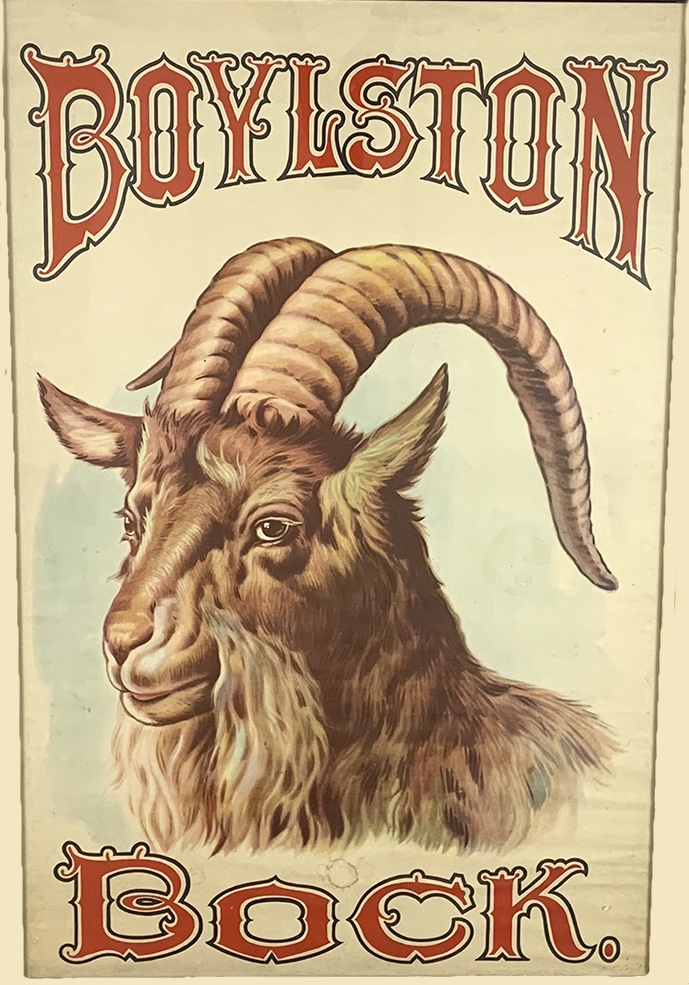
Last year I decided to concentrate on Bock ads. Bock, of course, originated in Germany, in the town of Einbeck. Because many 19th century American breweries were founded by German immigrants, they offered a bock at certain times of the year, be it Spring, Easter, Lent, Christmas, or what have you. In a sense they were some of the first seasonal beers. “The style was later adopted in Bavaria by Munich brewers in the 17th century. Due to their Bavarian accent, citizens of Munich pronounced ‘Einbeck’ as ‘ein Bock’ (a billy goat), and thus the beer became known as ‘Bock.’ A goat often appears on bottle labels.” And presumably because they were special releases, many breweries went all out promoting them with beautiful artwork on posters and other advertising.

Saturday’s ad for “Boylston Bock,” was created in the 1930s, and is a colorized reproduction of yesterday’s poster. which was originally from around 1890. The Boylston Brewery was located in Boston, Massachusetts. The originaly lithographer was Donaldson Litho. of Newport, Kentucky, but this reproduction was done by Erie Lithograph & Printing of Pennsylvania, who are best known for their circus posters. One of its most prominent artists was “John Seyschab [who] studied art in his native Nuremberg, Germany, before coming to Erie and Erie Lithograph in 1917.”

Filed Under: Art & Beer, Beers, Breweries, Just For Fun Tagged With: Advertising, Bock, Boston, History, Massachusetts

Beer In Ads #4888: Boylston Bock

February 21, 2025 By Jay Brooks

Last year I decided to concentrate on Bock ads. Bock, of course, originated in Germany, in the town of Einbeck. Because many 19th century American breweries were founded by German immigrants, they offered a bock at certain times of the year, be it Spring, Easter, Lent, Christmas, or what have you. In a sense they were some of the first seasonal beers. “The style was later adopted in Bavaria by Munich brewers in the 17th century. Due to their Bavarian accent, citizens of Munich pronounced ‘Einbeck’ as ‘ein Bock’ (a billy goat), and thus the beer became known as ‘Bock.’ A goat often appears on bottle labels.” And presumably because they were special releases, many breweries went all out promoting them with beautiful artwork on posters and other advertising.

Friday’s ad for “Boylston Bock,” was created sometime before 1918, and most likely around 1890, plus or minus, known as both the Boylston Brewery and Haffenreffer & Co., which were their trade names from their founding in 1870 until Prohibition. The brewery was located in Boston, Massachusetts. The lithographer was Donaldson Litho. of Newport, Kentucky.

Filed Under: Art & Beer, Beers, Breweries, Just For Fun Tagged With: Advertising, Bock, History, Massachusetts

Beer In Ads #4886: The Boss Lager

February 19, 2025 By Jay Brooks

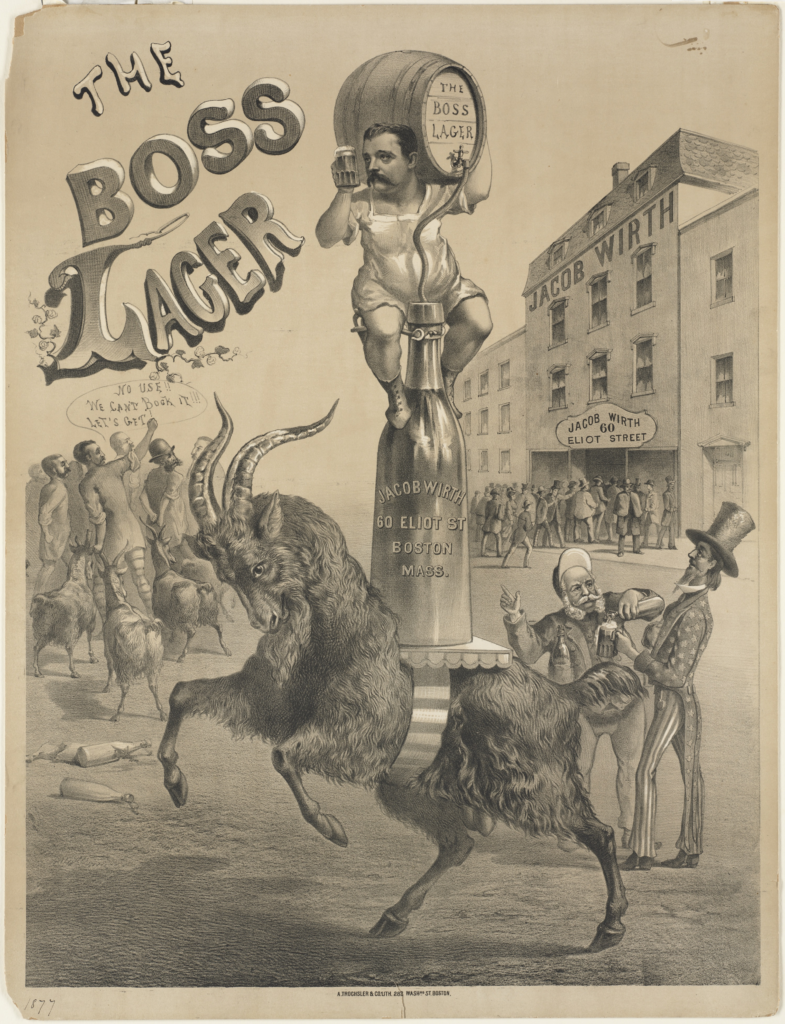
Last year I decided to concentrate on Bock ads. Bock, of course, originated in Germany, in the town of Einbeck. Because many 19th century American breweries were founded by German immigrants, they offered a bock at certain times of the year, be it Spring, Easter, Lent, Christmas, or what have you. In a sense they were some of the first seasonal beers. “The style was later adopted in Bavaria by Munich brewers in the 17th century. Due to their Bavarian accent, citizens of Munich pronounced ‘Einbeck’ as ‘ein Bock’ (a billy goat), and thus the beer became known as ‘Bock.’ A goat often appears on bottle labels.” And presumably because they were special releases, many breweries went all out promoting them with beautiful artwork on posters and other advertising.

Wednesday’s ad for “Bock” was created for the Jacob Wirth, a restaurant at 60 Elliot Street in Boston, Massachusetts. While it’s titled “The Boss Lager,” there are several references and mentions of bock. The poster depicts a strongman astride a giant beer bottle, holding a wood cask on his shoulder, all while the bottle is affixed to a large goat. The restaurant is shown on the right, and in the street next to the goat, a man with muttonchops is pouring a beer for Uncle Sam. There’s also a crowd of people on the left, including several more goats, and at least one of them is shouting: “No use!! We can’t Bock it!!! Let’s get!” The lithograph was created in 1877, and was published by A. Trochsler & Co. Lithographers, who were located at 292 Washington Street in Boston.

Filed Under: Art & Beer, Beers, Just For Fun Tagged With: Advertising, Bock, Boston, History, Massachusetts

Beer In Ads #4884: Pfaff’s Bock

February 17, 2025 By Jay Brooks

Last year I decided to concentrate on Bock ads. Bock, of course, originated in Germany, in the town of Einbeck. Because many 19th century American breweries were founded by German immigrants, they offered a bock at certain times of the year, be it Spring, Easter, Lent, Christmas, or what have you. In a sense they were some of the first seasonal beers. “The style was later adopted in Bavaria by Munich brewers in the 17th century. Due to their Bavarian accent, citizens of Munich pronounced ‘Einbeck’ as ‘ein Bock’ (a billy goat), and thus the beer became known as ‘Bock.’ A goat often appears on bottle labels.” And presumably because they were special releases, many breweries went all out promoting them with beautiful artwork on posters and other advertising.

Monday’s ad for “Bock” was created for the H. & J. Pfaff Brewing Co., which was located in Boston Massachusetts. They were in business from 1857 until 1918. The lithograph was created in 1877, and was published by A. Trochsler & Co. Lithographers, also of Boston. The artist who created it was Charles Wellington Reed, who in addition to his work as an illustrator and artist, he was also at the Battle of Gettysburg, where he received the Medal of Honor for bravery.

Filed Under: Art & Beer, Beers, Breweries, Just For Fun Tagged With: Advertising, Bock, Boston, History, Massachusetts

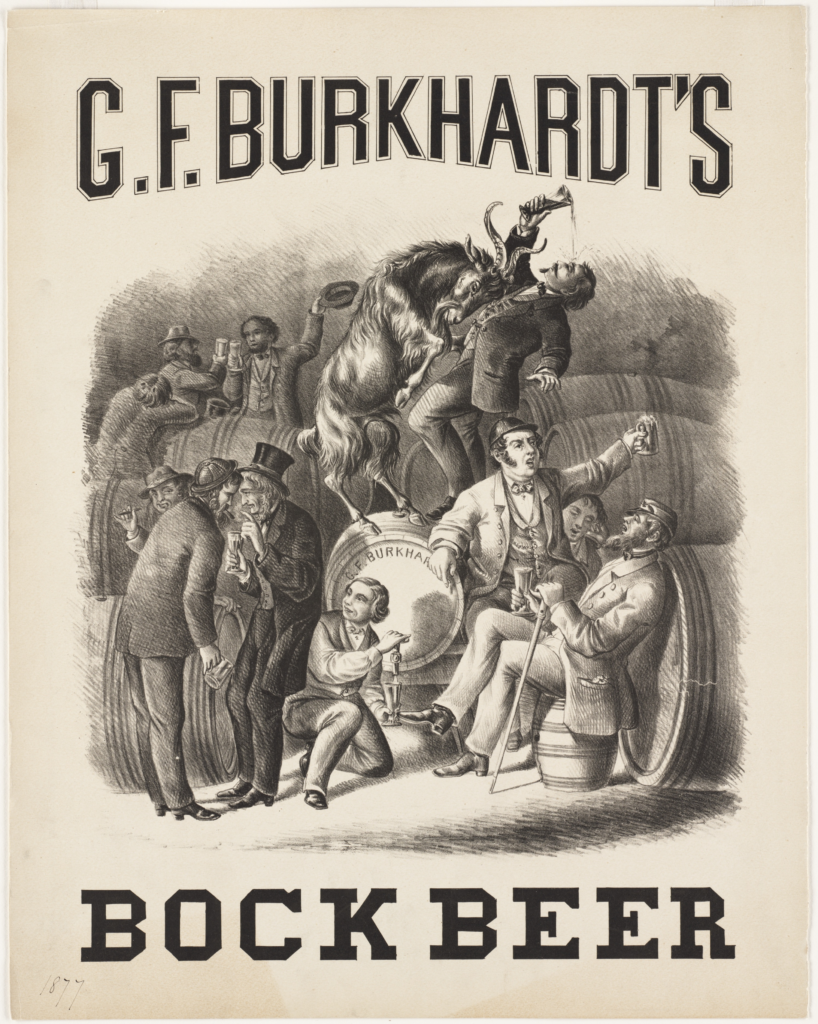
Beer In Ads #4882: G.F. Burkhardt’s Bock Beer

February 15, 2025 By Jay Brooks

Last year I decided to concentrate on Bock ads. Bock, of course, originated in Germany, in the town of Einbeck. Because many 19th century American breweries were founded by German immigrants, they offered a bock at certain times of the year, be it Spring, Easter, Lent, Christmas, or what have you. In a sense they were some of the first seasonal beers. “The style was later adopted in Bavaria by Munich brewers in the 17th century. Due to their Bavarian accent, citizens of Munich pronounced ‘Einbeck’ as ‘ein Bock’ (a billy goat), and thus the beer became known as ‘Bock.’ A goat often appears on bottle labels.” And presumably because they were special releases, many breweries went all out promoting them with beautiful artwork on posters and other advertising.

Saturday’s ad for “Bock” was created for the G.F. Burkhardt Brewing Co., which was located in Boston Massachusetts. They were in business from 1850 until 1918. The lithograph was created in 1877. The artist who created it was Charles Wellington Reed, who in addition to his work as an illustrator and artist, he was also at the Battle of Gettysburg, where he received the Medal of Honor for bravery.

Filed Under: Art & Beer, Beers, Breweries, Just For Fun Tagged With: Advertising, Bock, Boston, History, Massachusetts

Beer In Ads #4849: Roessle Bock

January 12, 2025 By Jay Brooks

Last year I decided to concentrate on Bock ads. Bock, of course, originated in Germany, in the town of Einbeck. Because many 19th century American breweries were founded by German immigrants, they offered a bock at certain times of the year, be it Spring, Easter, Lent, Christmas, or what have you. In a sense they were some of the first seasonal beers. “The style was later adopted in Bavaria by Munich brewers in the 17th century. Due to their Bavarian accent, citizens of Munich pronounced ‘Einbeck’ as ‘ein Bock’ (a billy goat), and thus the beer became known as ‘Bock.’ A goat often appears on bottle labels.” And presumably because they were special releases, many breweries went all out promoting them with beautiful artwork on posters and other advertising.

Sunday’s ad for “Bock” is for the Roessle Brewery of Boston, Massachusetts. The chromolithograph was created in 1894. The lithographer was H. Schile & Co. of 295 Bowery in New York City. Henry Jerome Schile was born in Germany, and emigrated to the U.S. in 1851, settling in Manhattan, which is where he opened his own print company. 

Filed Under: Art & Beer, Beers, Just For Fun Tagged With: Advertising, Bock, Boston, History, Massachusetts, New York

« Previous Page
Next Page »

Find Something

Northern California Breweries

Please consider purchasing my latest book, California Breweries North, available from Amazon, or ask for it at your local bookstore.

Recent Comments

  • Bob Paolino on Beer Birthday: Grant Johnston
  • Gambrinus on Historic Beer Birthday: A.J. Houghton
  • Ernie Dewing on Historic Beer Birthday: Charles William Bergner 
  • Steve 'Pudgy' De Rose on Historic Beer Birthday: Jacob Schmidt
  • Jay Brooks on Beer Birthday: Bill Owens

Recent Posts

  • Beer In Ads #5339: Bären-Bock September 4, 2026
  • Historic Beer Birthday: Samuel Simon Loeb September 4, 2026
  • Beer Birthday: Kei Weaver September 4, 2026
  • Historic Beer Birthday: William Hamm, Jr. September 4, 2026
  • Beer In Ads #5338: Leiner Bock September 3, 2026

BBB Archives

Feedback

Head Quarter
This site is hosted and maintained by H25Q.dev. Any questions or comments for the webmaster can be directed here.