Brookston Beer Bulletin

Jay R. Brooks on Beer

  • Home
  • About
  • Editorial
  • Birthdays
  • Art & Beer

Socialize

  • Dribbble
  • Email
  • Facebook
  • Flickr
  • GitHub
  • Instagram
  • LinkedIn
  • Pinterest
  • RSS
  • Twitter
  • YouTube

Powered by Genesis

Beer In Ads #4826: Bock Beer Toast

December 19, 2024 By Jay Brooks

This year I decided to concentrate on Bock ads. Bock, of course, originated in Germany, in the town of Einbeck. Because many 19th century American breweries were founded by German immigrants, they offered a bock at certain times of the year, be it Spring, Easter, Lent, Christmas, or what have you. In a sense they were some of the first seasonal beers. “The style was later adopted in Bavaria by Munich brewers in the 17th century. Due to their Bavarian accent, citizens of Munich pronounced ‘Einbeck’ as ‘ein Bock’ (a billy goat), and thus the beer became known as ‘Bock.’ A goat often appears on bottle labels.” And presumably because they were special releases, many breweries went all out promoting them with beautiful artwork on posters and other advertising.

Thursday’s ad depicts a young woman and a goat looking each other in the eye over a barrel of Bock Beer and drinking a toast. Behind them on the left is another goat rolling a barrel and to the right is a goat bartender smoking a pipe. The chromolithograph was created in 1882 by the Calvert Lithographing and Engraving Co. of Detroit, Michigan.

Filed Under: Art & Beer, Beers, Just For Fun Tagged With: Advertising, Bock, History, Michigan

Historic Beer Birthday: Peter Stroh

December 18, 2024 By Jay Brooks

strohs
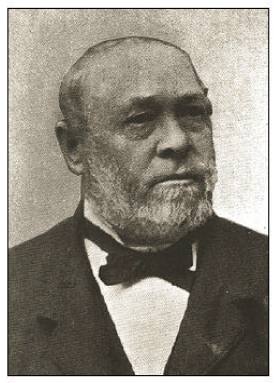
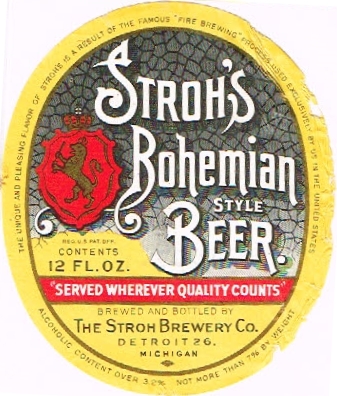
Today is the birthday of Peter Stroh (December 18, 1927-September 17, 2002). He was the great-grandson of Bernhard Stroh, who founded Stroh’s Brewing Co. in 1850. When he became president of Stroh’s in 1968, he was the sixth family member to run the business.

peter-stroh-good-luck

Here’s Stroh’s obituary from Find-a-Grave:

Peter Stroh, former chief executive of the Stroh Brewery Co., died of brain cancer on September 17th at his home in Grosse Pointe Farms, MI.

Mr. Stroh is remembered as a gracious elder statesman in the brewing industry. “Peter Stroh was truly a gentlemen’s gentleman,” said Mac Brighton, chairman and COO of Business Journals, Inc., publisher of Modern Brewery Age. “He was admired and respected by everyone in the brewing industry, friends and competitors alike.”

Stroh also made his mark as a tireless civic booster for the city of Detroit. “He never gave up on the city,” former Detroit mayor Dennis Archer told the Detroit Free Press after learning that Stroh had died. “He was a ‘laboring oar.'”

Stroh was the sixth family member to head the Stroh Brewery Co., which his great-grandfather, Bernhard Stroh, founded in 1850 on Detroit’s east side. Before coming to the United States, the Strohs had been brewers in Rhineland Palatinate since 1755.

Under Peter Stroh’s leadership in the 1980s, the company made a play to become a national brewer, but found itself outmatched by deep-pocketed competitors. Peter Stroh stepped down as chairman in 1997, and the Stroh Brewery Co. was out of the beer business by 1999.

Peter Stroh talked very little to the press, but friends said that the decline of the company’s position in the brewing industry was very painful to him.

Despite the Stroh Brewery Co.’s misfortunes, Stroh is remembered with respect in Detroit due to his remarkable civic commitment. Family members have reported that the 1967 Detroit riots forever changed his out- look on personal and corporate responsibility. Mr. Stroh had stood on the roof of the brewery and watched fires consume the city. “As a result of that sad experience, I began to wonder about the company’s and the family’s historic role in our community,” Stroh wrote in a family newsletter in 1997. “And quickly discovered that there really hadn’t been one for either.”

Stroh became active in the Urban League and the Detroit branch of the National Association for the Advancement of Colored People. He also worked with former Mayor Coleman Young on a variety of projects. “He and the mayor had a very strong, personal friendship,” said Bob Berg, Young’s longtime aide.

The Stroh clan used personal and corporate money to develop Stroh River Place, the renovation of the old Parke-Davis pharmaceutical complex at the foot of Jos. Campau.

The UAW-GM International Training Center is located on former Stroh land nearby. Stroh also was active with the Detroit Medical Center, the Detroit Symphony, the Detroit Zoo and the Detroit Institute of Arts? He served on the boards of more than half a dozen local organizations, including Detroit Renaissance, Detroit Economic GrowthCorp., and New Detroit Incorporated.

Stroh also helped finance projects in genetic engineering and molecular biology, including helping a British company produce recombinant human serum albumin from brewer’s yeast.

Son of Gari and Suzanne Stroh. He graduated from Princeton in 1951 with a degree in international affairs, and planned a career with the Central Intelligence Agency. But in 1952 a runaway truck in Washington, D.C., crushed him against a building and put an end to his nascent career in espionage. He was hospitalized for a year.

As a college student, Stroh had worked in the brewery as a janitor. After recovering from his accident, he spent time in the brewing and laboratory departments and quickly became skilled at the technical side of brewing.

He was elected to the Stroh board in 1955 and became director of operations in 1966. Named president of Stroh’s in 1968, Stroh teamed with his uncle, John Stroh, who was chairman and chief executive officer.

Stroh guided the family company from its regional roots to become a quasi-national brewery. Stroh’s shipped 3 million barrels in 1970 and 24 million in 1985.

Stroh bought F. & M Schaefer in 1980, and in 1982 purchased the Jos. Schlitz Brewing Co. At that time, Stroh was the number three brewer behind Anheuser-Busch and Miller.

But the acquisitions bred over-capacity, and Stroh chose to close its flagship brewery in downtown Detroit in 1985. “This was one of the most difficult decisions we ever made,” Stroh told the Detroit Free Press at the time.

The battle for market share against the top two brewers gradually drained the company’s coffers, although Stroh tried various imaginative strategies to survive. In 1989, Stroh and Coors came close to a deal in which the Golden, CO-based Coors would purchase Stroh. Unfortunately, the deal came unwound, and Stroh was forced to go it alone. In the mid-1990s, Stroh bought the troubled G. Heileman Brewing Co. The deal brought the company a handful of strong brands, but also more capacity than it could ever use.

Over the years, the Stroh brands were consistently rated tops among the major brands, but the brewery could never muster the marketing muscle to compete with A-B and Miller. In 1999, the company announced it would exit the brewing business, and it sold its breweries and brands to the Miller and Pabst Brewing Companies.

Outside his work in the beer business and the city of Detroit, Stroh made his mark as an outdoorsman and conservationist. He served as a member of the National Audubon Society board, did fund-raising for Ducks Unlimited, was a trustee for Conservation International, which specializes in Latin American issues, and sat on the board of actor Robert Redford’s Institute for Resource Management, which tries to settle environmental disputes without lawyers. He traveled the world, hunting birds and fishing.

“To have a sense of our outdoor past–our biological past–is as important as a sense of our historical and cultural past, and sometimes a lot more fun. I say that even as a former board member of the Detroit Institute of Arts and a current board member for the Guggenheim,” he once told the Detroit Free Press. “Wading through a cypress swamp is every bit as much fun as treading through the galleries.”

Stroh is survived by his wife, Nicole; two sons, Pierre and Frederic; one grandchild, and a brother, Eric.

strohs-family-1974
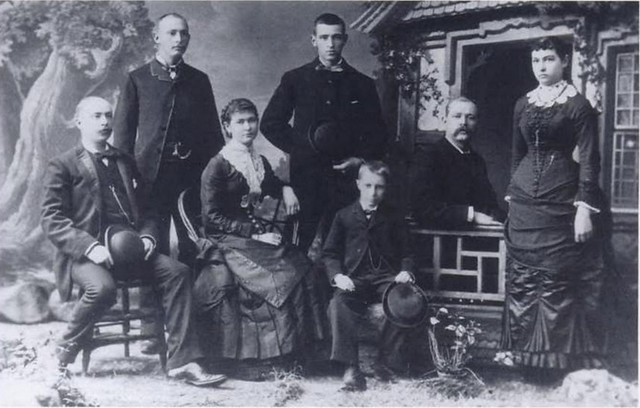
“Members of Detroit’s onetime leading beer family at the Stroh brewhaus, 1974: (from left) Chairman John Sr., President Peter, Eric, Gari Jr., John Jr.”

This is an “In Memoriam” from Crain’s Detroit Business:

Stroh shunned the limelight, but he took seriously his commitment to the family company and his community.

When Stroh became chairman and CEO of the brewery in 1968, it was still trying to recover market share lost in a 1958 strike, and it was clear national brands were squeezing out local ones.

Stroh began introducing products and acquiring other brands until by 1982 it was the third-largest U.S. brewer. But with acquisitions came crippling debt. In 1985, Stroh closed the Detroit brewery on Gratiot Avenue near Eastern Market where the Brewery Park development now sits; it is the headquarters of Crain Communications Inc., parent of Crain’s Detroit Business. Stroh attempted unsuccessfully to sell the company to Coors in 1989. He stepped down in 1995, and in 1999 the Stroh brands were sold to Pabst and Miller.

Despite his unsuccessful efforts to save the company, Stroh and other family members have made lasting contributions to the city of Detroit.

He led a $150 million redevelopment that became Stroh River Place at the site of the former Parke-Davis pharmaceutical company. An ardent hunter, fly fisherman and conservationist, he long advocated for opening the Detroit riverfront to the public and also was a driving force behind the federal designation of the Detroit River as one of 14 American Heritage Rivers.
He died in 2002 at age 74 from brain cancer.

Strohs-brewery-postcard
A postcard of Stroh’s Brewery in Detroit.

And this is the portion of Wikipedia‘s page for Stroh’s that includes Peter’s employment with the family brewery:

Upon Julius Stroh’s death in 1939, his son Gari Stroh assumed the presidency. Gari’s brother John succeeded him in 1950 and became Stroh’s chairman in 1967. Gari’s son Peter, who had joined the company following his graduation from Princeton University in 1951, became president in 1968.

In 1964, the company made its first move toward expansion when it bought the Goebel Brewing Company, a rival across the street. The company had decided it could no longer compete as a local brewer and was about to move into the national scene. One reason was a costly statewide strike in 1958 that halted Michigan beer production and allowed national brands to gain a foothold. When Peter Stroh took over the company in 1968, it still had not regained the market share lost in the strike ten years earlier.

Stroh ended a 40-year relationship with a local advertising agency for a large national agency and began targeting the larger national market. Led by creative director Murray Page, Stroh’s came up with the slogan “The One Beer…”, and by 1971, Stroh Brewery had moved from 15th to 13th place nationally. In 1972, it entered the top 10 for the first time. A year later it hit eighth place. Peter Stroh’s willingness to depart from years of tradition enabled Stroh’s to survive, but the changes were hard to swallow for many Stroh’s employees. Stroh broke the company’s tradition of family management and recruited managers from companies such as Procter & Gamble and Pepsico. He also introduced a light beer, Stroh’s Light.

By 1978, Stroh’s served 17 states when it produced 6.4 million barrels of beer. By this time, the original Detroit facility was 128 years old and had a capacity of seven million barrels annually. As it became difficult to make efficient shipments to new markets in the East, the company recognized that it required a new brewery. The F. & M. Schaefer Brewing Company had fallen victim to the Miller beer wars and Stroh’s purchased all of Schaefer’s stock. In 1981, the combined breweries ranked seventh in beer sales. In addition, Stroh was able to take advantage of Schaefer’s distributors in the northeastern part of the country. The acquisition also brought Stroh three new brands: Schaefer and Piels beers, and Schaefer’s Cream Ale. The company now had a volume of over 40,000,000 barrels (6,400,000 m3) and 400 distributors in 28 states, Washington D.C., Puerto Rico, and other Caribbean islands.

Stroh’s head office used to be located at Grand Park Centre near Grand Circus Park and Woodward Avenue.
In 1982, Stroh bid for 67 percent of the Schlitz Brewing Company. By spring of that year, Stroh had purchased the entire company, making Stroh’s the third largest brewing enterprise in America: it owned seven brewing plants and reached the market value of $700 million in 1988 (according to Forbes). During the takeover, Schlitz fought a fierce battle in the courts trying to remain independent. Schlitz finally accepted the takeover when Stroh raised its offer from an initial $16 per share to $17, and the U.S. Justice Department approved the acquisition once Stroh agreed to sell either Schlitz’s Memphis or Winston-Salem breweries.

Forbes has an interesting article about the Stroh’s family business’ fall from grace, entitled How To Blow $9 Billion: The Fallen Stroh Family.

Strohs-brewery

Filed Under: Birthdays, Just For Fun Tagged With: History, Michigan

Beer In Ads #4817: Bock Couple

December 9, 2024 By Jay Brooks

This year I decided to concentrate on Bock ads. Bock, of course, originated in Germany, in the town of Einbeck. Because many 19th century American breweries were founded by German immigrants, they offered a bock at certain times of the year, be it Spring, Easter, Lent, Christmas, or what have you. In a sense they were some of the first seasonal beers. “The style was later adopted in Bavaria by Munich brewers in the 17th century. Due to their Bavarian accent, citizens of Munich pronounced ‘Einbeck’ as ‘ein Bock’ (a billy goat), and thus the beer became known as ‘Bock.’ A goat often appears on bottle labels.” And presumably because they were special releases, many breweries went all out promoting them with beautiful artwork on posters and other advertising.

Monday’s ad is for Bock Beer, created in 1883. The chromolithograph was done by the Calvert Lithographing Engraving and Map Publishing Co., which appears to have been located in Detroit, Michigan.

Filed Under: Art & Beer, Beers, Just For Fun Tagged With: Advertising, Bock, History, Michigan

Beer In Ads #4812: Detroit Bock Beer

December 4, 2024 By Jay Brooks

This year I decided to concentrate on Bock ads. Bock, of course, originated in Germany, in the town of Einbeck. Because many 19th century American breweries were founded by German immigrants, they offered a bock at certain times of the year, be it Spring, Easter, Lent, Christmas, or what have you. In a sense they were some of the first seasonal beers. “The style was later adopted in Bavaria by Munich brewers in the 17th century. Due to their Bavarian accent, citizens of Munich pronounced ‘Einbeck’ as ‘ein Bock’ (a billy goat), and thus the beer became known as ‘Bock.’ A goat often appears on bottle labels.” And presumably because they were special releases, many breweries went all out promoting them with beautiful artwork on posters and other advertising.

Wednesday’s ad is for Bock Beer, and was created in 1882. It’s a chromolithograph but the lithographer is not known, except that its origin is Detroit, Michigan.

Filed Under: Art & Beer, Beers, Just For Fun Tagged With: Advertising, Bock, History, Michigan

Beer In Ads #1730: Zynda’s Bock

November 5, 2015 By Jay Brooks


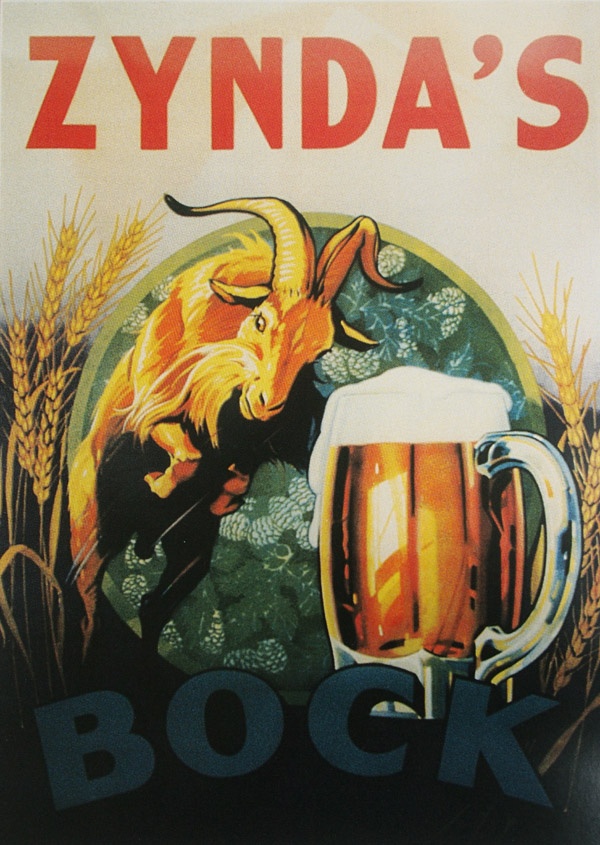
Thursday’s ad is for Zynda’s Bock, from who knows when. John Zynda operated a brewery in Detroit, Michigan, at least until he closed in 1947. Before prohibition, his brewery was known as the White Eagle Brewery, but during prohibition he went underground, literally, and kept brewing beer under the name, John Zynda & Sons Brewery. Here’s a story about they kept making bee through prohibition, from Found Michigan:

Trouble was brewing for Michigan beer companies—big and small—in the spring of 1917, when Michigan jump-started the Prohibition era with its own statewide ban on alcohol nearly three years before the 18th Amendment made drinking a national taboo. Just a handful of Michigan brewers would survive through to the end of Prohibition in 1933, and those that did had to get creative. Several of the bigger companies began making and promoting the still-legal canned hopped malt syrup (the key ingredient needed for homebrewing); Stroh’s turned to making ice cream; and Detroit beer tycoon John Zynda even took his operation underground—literally. In order to avoid the cops, he dug a tunnel from his bottling shop to a garage across the street, rolling the beer to safety a half barrel at a time. When a shipment was ready, he’d then send an empty delivery van away as a decoy, while the real thing made its way off to customers in a car waiting the next block over. Detroit brewers like Zynda, however, had an even harder time making a go of it as of 1927. That year, Canada ended its partial Prohibition, and many Detroit beer makers found it hard to compete once a legal draft at a Windsor saloon was just a boat ride away.

After prohibition ended, and they were legal once again, their name changed to the Zynda Brewing Co. When they brewed Zynda’s Bock, is something I wasn’t able to answer, and although it looks like it’s from the late 1800s, I can’t say for sure.

Zyndas

Filed Under: Art & Beer, Beers Tagged With: Advertising, History, Michigan

Oskar Blues Buys Perrin Brewing

March 27, 2015 By Jay Brooks

oskar-blues-blue Perrin
Oskar Blues, makers of Dale’s Pale Ale and other canned beers, has announced acquisition of the Perrin Brewing Co. of Comstock Park, Michigan (near Grand Rapids). MLive is reporting the deal, and that as part of it, Keith Klopcic, who formerly worked with nearby West Side Beer Distributing, becomes the new president at Perrin Brewing Co., replacing founder and former brewery head Randy Perrin. According to the article, “financial terms of the deal were not disclosed.” I love this quote: “Other than that, it’s the same company,” said Klopcic. “Nothing changes.” Not to second guess the deal, especially since I don’t personally know the parties involved (apart from Dale Katechis from Oskar Blues), but saying nothing changes when a brewery head and (I presume) a founder leaves a company when it’s sold doesn’t strike me as a particularly honest assessment.

Dan Perrin and Jarred Sper will continue running the brewery alongside production manager and head brewer John Stewart and his team. Sper, who will be vice president of sales and marketing at Oskar Blues-owned Perrin, said the brewery is very excited by the acquisition deal.

According to MLive, here’s what Dale had to say:

In a statement, Oskar Blues founder Dale Katechis called the deal “a radical thing.”

“We at Oskar Blues love the Michigan craft beer scene and what the guys at Perrin are doing,” Katechis said. “We feel that Perrin and Oskar Blues have the same mindset toward the craft industry and this partnership will allow us to share information and innovative ideas with one another.”

In December, the breweries teamed up on a lager called “Cornlaboration” that was sold only in Michigan, a state in which Oskar Blues began distributing in 2013.

Until Oskar Blues’ canned beer sales outstripped their original brewpub, they were considered one of the country’s largest brewpubs, so it’s interesting to see them reach a point where they’re acquiring additional brands and another brewery.

perrin-brewing

Filed Under: Breweries, News Tagged With: Announcements, Business, Colorado, Michigan

Drinking Non-Alcoholic Beer Can Be A Crime?

March 20, 2014 By Jay Brooks

near-beer
There was a news item a few days ago that recently a fifth grade teacher in Michigan offered students non-alcoholic beer — O’Douls — as part of “a lesson on colonial times,” with the intention to “represent ale common in the 1700s and consumed because of the scarcity of clean water.” Sounds harmless enough. No students were forced to try it, but they had the opportunity to sample it if they wished to. What could go wrong?

What the teacher didn’t know is that apparently it’s actually illegal to give a minor in Michigan a non-alcoholic beer. The law was passed back in the 1950s, when people were even nuttier about alcohol than they are today, if that’s possible, but Michigan did pass a law making it illegal for minors to drink non-alcoholic beer. Here’s the entirety of the law:

THE MICHIGAN PENAL CODE (EXCERPT)
Act 328 of 1931

750.28 Cereal beverage with alcoholic content; furnishing to minors, penalty.

Sec. 28.

Any person who shall sell, give or furnish to a minor, except upon authority of and pursuant to a prescription of a duly licensed physician, any cereal beverage of any alcoholic content under the name of “near beer”, or “brew”, or “bru”, or any other name which is capable of conveying the impression to the purchaser that the beverage has an alcoholic content, shall be guilty of a misdemeanor.

History: Add. 1957, Act 283, Eff. Sept. 27, 1957

How Kafkaesque. The state defines what non-alcoholic means then still makes it illegal even if it’s within their own definition, and if it’s 0.5% or below, Michigan state’s Liquor Control Commission doesn’t even regulate it. So alcohol in cough syrup. No problem. Non-alcoholic wine? Go for it. A cereal beverage? Heavens no. That’s going too far.

And perhaps more curious, the law can be read to suggest that what’s at issue is giving the “impression” that the drink has alcohol in it, not that it really does. Because it seems like you could create a non-alcoholic beer within the legal definition but call it something random, like “Barley Pop” or “Brown Cow” and not be in violation of this law if you gave some to your children. The name seems more important than the alcoholic content. Why would that be the case?

When I was a kid, the only reason near beer existed was for kids. No sane adult would drink it. My first taste of beer was from a can of near beer that my parents bought for me when I expressed interest in trying beer, which was the case for some of my friends, too. It was horrible. I think that may have been the point, I don’t know.

The Flint Journal reports that the school sent letters home to parents after they discovered the “incident” but according to school district Superintendent Ed Koledo. “Nobody complained to the teacher, principal or me,” or to the police, and no disciplinary measures were taken against the teacher. Despite nobody being upset in the least, you’d think a nuclear blast had gone off, the way they talk about it.

“We talked to the teacher and said this was an inappropriate choice,” Koledo said. “There were a lot better choices to represent a colonial-era drink than what was chosen here.”

Really, what would have been a better choice to represent what the vast majority of people drank during the colonial era? And he says “a lot of better choices.” A lot? Really? I can’t wait to see the list.

“I know there was no intent to expose anyone to harm, just poor thought in this situation.”

Seriously, “poor thought?” It’s non-alcoholic beer for chrissakes, and a few kids had a sip of it in a controlled environment, not a back alley clutching a paper bag. And it was a sip. What is a sip? A teaspoon? Half an ounce? Oh, the horror.

Linden schools are drug and alcohol-free zones and Koledo said he did not know if O’Doul’s beer would constitute a violation.

Again, are we really going to split hairs because it has 0.5% alcohol (or less) in it? So is cough medicine allowed on campus? I’m pretty sure caffeine can be considered a drug, so I hope they’re going to remove the coffee maker from the teacher’s lounge. Up until the 1970s, schools in Belgium served students table beer every day.

So how exactly did this end up being a news story?

berliner-kindl

Filed Under: Beers, Editorial, News, Politics & Law Tagged With: Law, Michigan, Prohibitionists

Craft Beer In Michigan

December 3, 2013 By Jay Brooks

michigan
Today’s infographic is entitled Craft Beer in Michigan, and was created by the Frankenmuth Brewery. Believe it or not, today in 1997, Michigan legalized homebrewing.

Print
Click here to see the infographic full size.

Filed Under: Beers, Breweries, Just For Fun Tagged With: Infographics, Michigan

Michigan, The Great Beer State

June 30, 2013 By Jay Brooks

michigan
Today’s infographic is entitled The Great Beer State. It was created by Shana Preuett of Team Detroit, Inc. to promote Michigan’s craft beer industry, and today is Log Cabin Day in the state of Michigan.

InfoGraphics
Click here to see the infographic full size.

Filed Under: Beers, Just For Fun Tagged With: Infographics, Michigan

The Moon-Faced Man

December 10, 2012 By Jay Brooks

man-in-the-moon
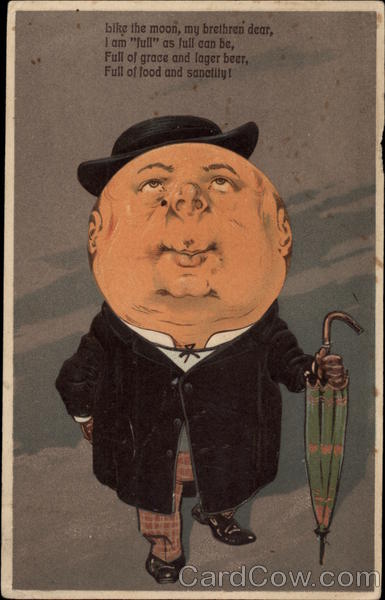
Here’s an odd artifact, a postcard from 1910, with a Holland, Michigan postmark, featuring an illustration of a moon-faced man and the following poem:

Bike the moon, my brethren dear,
I am “full” as full can be,
Full of grace and lager beer,
Full of food and sanctity!

moon-card

Filed Under: Art & Beer, Beers, Just For Fun Tagged With: History, Michigan

« Previous Page
Next Page »

Find Something

Northern California Breweries

Please consider purchasing my latest book, California Breweries North, available from Amazon, or ask for it at your local bookstore.

Recent Comments

  • Steve 'Pudgy' De Rose on Historic Beer Birthday: Jacob Schmidt
  • Jay Brooks on Beer Birthday: Bill Owens
  • Steve 'Pudgy' De Rose on Beer Birthday: Charles Finkel
  • Steve 'Pudgy' De Rose on Beer Birthday: Bill Owens
  • Steve "Pudgy" De Rose on Beer Birthday: Pete Slosberg

Recent Posts

  • Historic Beer Birthday: John Fritsch December 15, 2025
  • Beer In Ads #5141: Eichler’s Holiday Bock Beer December 14, 2025
  • Historic Beer Birthday: Simon Fishel December 14, 2025
  • Beer Birthday: Vic Kralj December 14, 2025
  • Historic Beer Birthday: John Frederick Wiessner Sr.  December 14, 2025

BBB Archives

Feedback

Head Quarter
This site is hosted and maintained by H25Q.dev. Any questions or comments for the webmaster can be directed here.