Brookston Beer Bulletin

Jay R. Brooks on Beer

  • Home
  • About
  • Editorial
  • Birthdays
  • Art & Beer

Socialize

  • Dribbble
  • Email
  • Facebook
  • Flickr
  • GitHub
  • Instagram
  • LinkedIn
  • Pinterest
  • RSS
  • Twitter
  • YouTube

Powered by Genesis

Historic Beer Birthday: Leonhard Eppig
March 4, 2025 By Jay Brooks

eppig
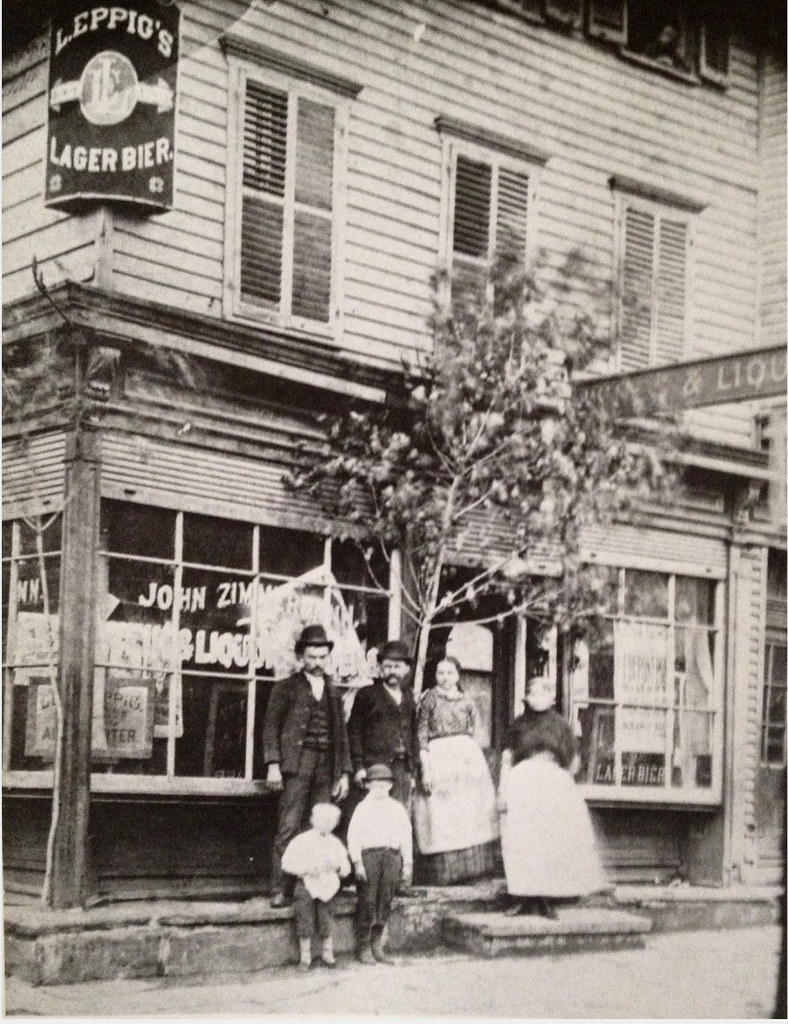
Today is the birthday of Leonhard Eppig (March 4, 1839-April 9, 1893). He was born in Großwallstadt, Bavaria, and at age fifteen, in 1854, he came to New York on the S.S. Rotterdam and settled in Brooklyn. He learned to brew working for a Brooklyn brewer, Michael Seitz. In 1866, he and a partner formed the Hubert Fischer & Leonhard Eppig Brewery. Ten years later, he bought out his partner and it became simply the Leonard Eppig Brewing Co., but traded under the name Germania Brewery. From what I can tell Eppig’s name was spelled Leonhard, but it was often anglicized to Leonard, even on advertising. When Eppig died, his sons continued running the brewery until it was closed down by prohibition in 1920. They reopened the brewery after repeal, but in 1935 sold it to George Ehret Brewery.

leonard-eppig-photo
Here’s a short biography from Find-a-Grave:
Leonhard was born in Bavaria, Germany. He married Margarehta about 1854 and had at least 10 children, Anna, Euginia, John, Henry, Franz, Barbara, Theresa, Mary, Margaret and Regina, some of which are entombed in his mausoleum. Leonhard owned the Eppig Germania Brewery Company, which was located in Brooklyn.

leonard-eppig-1885
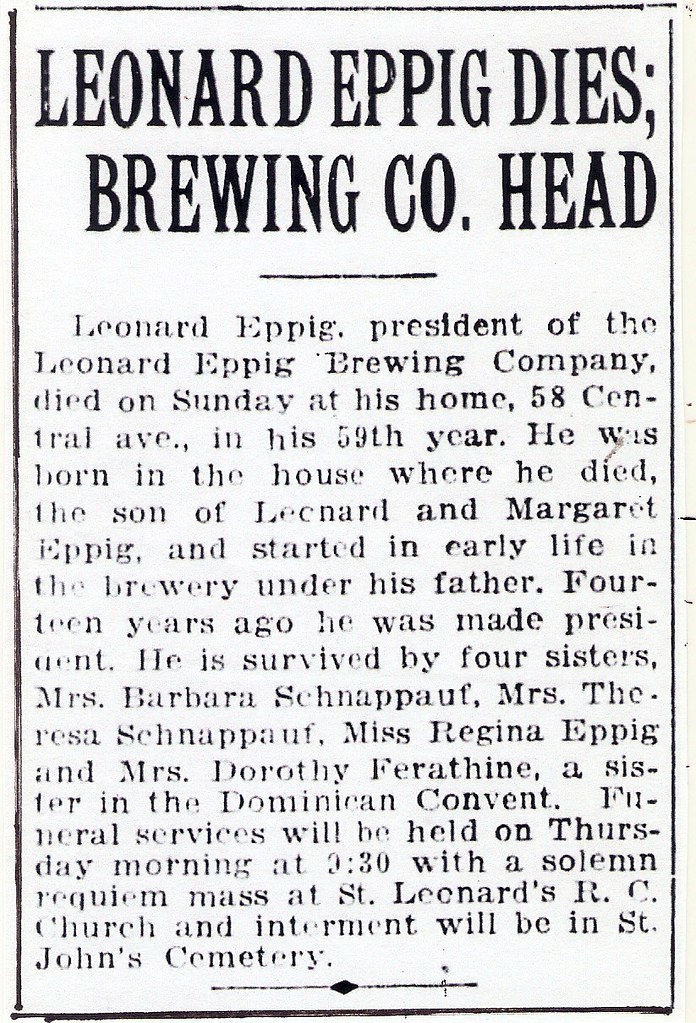
And here’s his obituary from the Brooklyn Daily Eagle:

Leonard-Eppig-obit

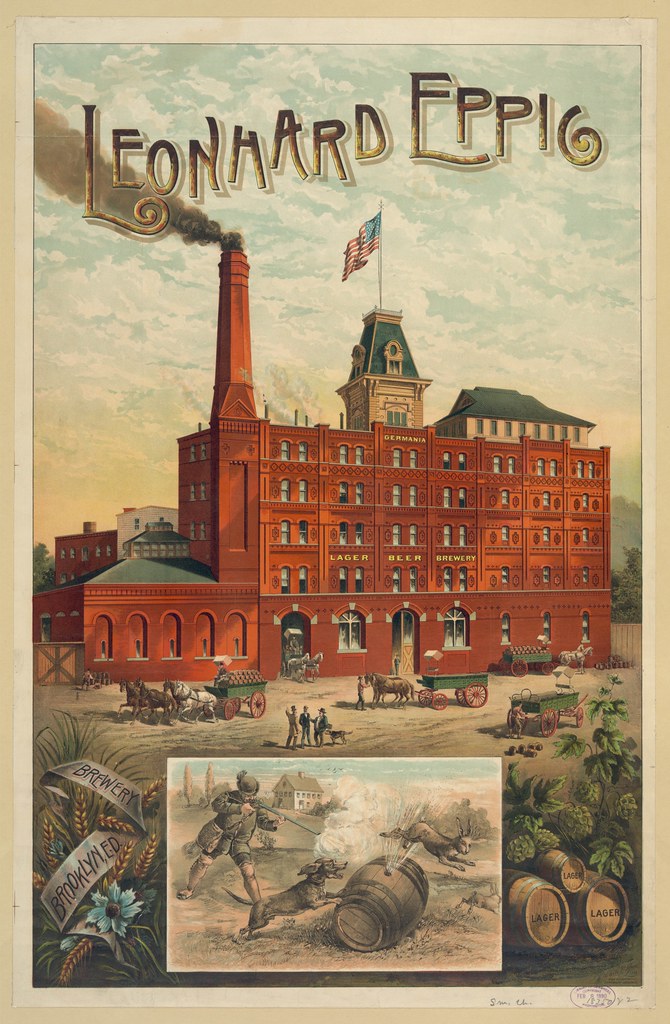
Leonhard_Eppig_Brewery_Poster_Historic

This lengthy story is from “A History of Long Island: From Its Earliest Settlement to the Present Time, Volume 3,” by Peter Ross and William Smith Pelletreau, published in 1905:

leonhard-eppig-bio-1
leonhard-eppig-bio-2
leonhard-eppig-bio-3
leonhard-eppig-bio-4
leonhard-eppig-bio-5
Eppig-mausoleum

Busts of Eppig and his wife on the family mausoleum.

eppig-bottle
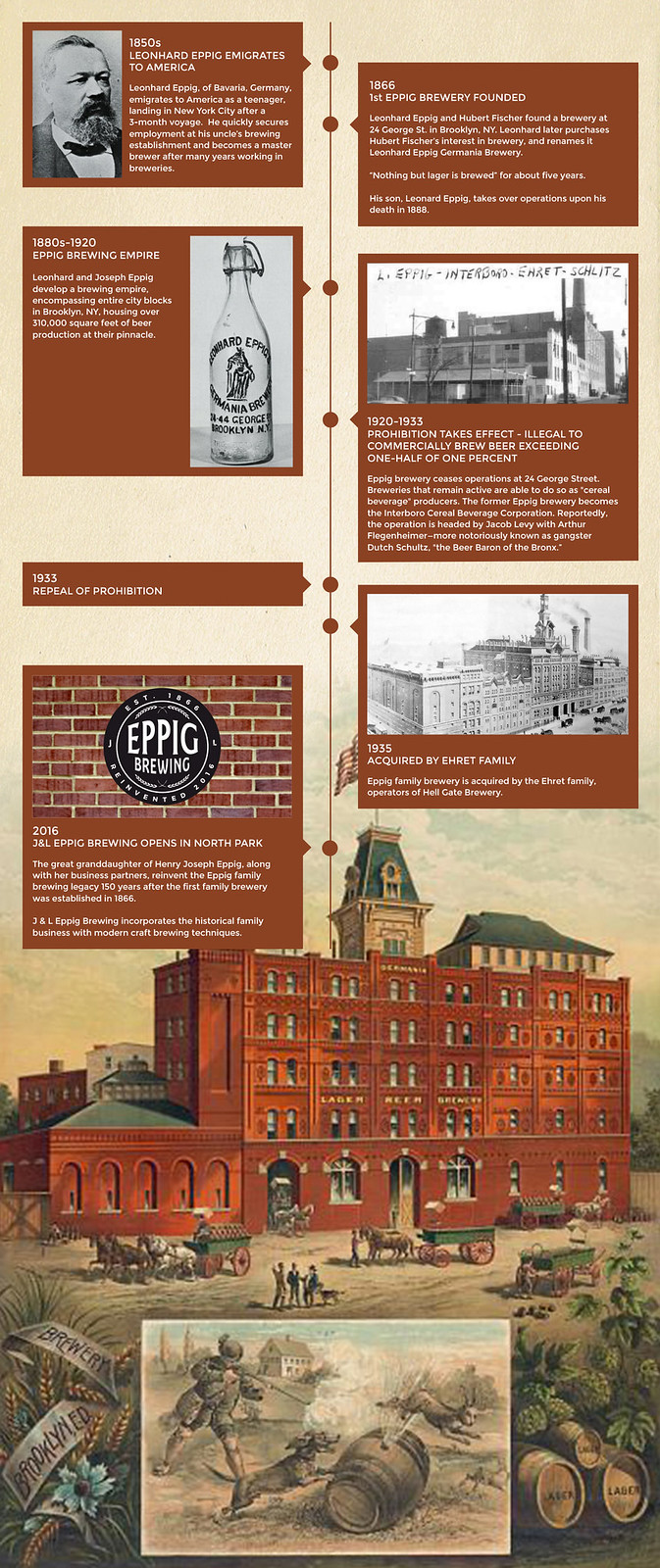
Last year, a descendant of the Eppig family opened a craft brewery in San Diego, which they named Eppig Brewing, and included this infographic in their website:

eppig-history-infographic

Filed Under: Birthdays, Breweries, Just For Fun Tagged With: Brooklyn, Germany, History, New York

Historic Beer Birthday: Jacob Ruppert Sr.

March 4, 2025 By Jay Brooks

Jacob-Ruppert
Today is the birthday of Jacob Ruppert, Sr. (March 4, 1842-May 25, 1915). Although his son Jacob Ruppert, Jr. was more well-known, in politics and in baseball, his father made that possible when he founded the Jacob Ruppert Brewing Company in 1867.

Jacob_Ruppert_Sr._1842-1915

Here’s a biography from Find a Grave:

Founder of the Jacob Ruppert Brewing Company. Jacob Ruppert, Sr. was one of the first and most noted brewers in the US. He was born in NYC and was a son of Franz and Wilhelmina Zindel-Ruppert of Bavaria. Under he expert guidance of his father, Jacob learned the brewing trade thoroughly. At ten he began working for his father’s Turtle Bay Brewery in Midtown Manhattan which was then only two years old. Work was hard for him and his father, as machinery was scarce during the Civil War. In 1867 he opened the Jacob Ruppert Brewing Co. on Manhattan’s then-forested Upper East Side. With a 50 foot square brick building, he opened what was to be the first of many breweries. The Jacob Ruppert Brewery steadily became one of the largest and best-equipped breweries in the world. He eventually broadened his entrepreneurial interests to include real estate which became the biggest money maker for the Rupperts helping them to survive (along with Jacob Jr’s interest in baseball) the coming war, Prohibition and Great Depression. Jacob Jr. eventually took over the brewing business and brought it and the Ruppert name to greater fame and glory. Jacob Ruppert, Sr. was a forceful, single-purposed man with a great capacity for work. His charities were numerous but unostentatious.He married Anna Gillig, daughter of brewer George Gillig, and had six children: Cornelia, Jacob, Frank, Anna, George and Amanda, all interred with their father in our family’s mausoleum. Jacob died of cirrhosis at the age of 74, an illness brought on by the years of testing the very brew he sold.

U206217ACME
The Jacob Ruppert Brewery around 1932.
Special-Knickerbocker-Export-Brew-Labels-Jacob-Ruppert--pre-Prohibition-

Filed Under: Birthdays, Just For Fun Tagged With: History, New York

Beer In Ads #4898: Schaefer Beyond Bock Beer

March 3, 2025 By Jay Brooks

Last year I decided to concentrate on Bock ads. Bock, of course, originated in Germany, in the town of Einbeck. Because many 19th century American breweries were founded by German immigrants, they offered a bock at certain times of the year, be it Spring, Easter, Lent, Christmas, or what have you. In a sense they were some of the first seasonal beers. “The style was later adopted in Bavaria by Munich brewers in the 17th century. Due to their Bavarian accent, citizens of Munich pronounced ‘Einbeck’ as ‘ein Bock’ (a billy goat), and thus the beer became known as ‘Bock.’ A goat often appears on bottle labels.” And presumably because they were special releases, many breweries went all out promoting them with beautiful artwork on posters and other advertising.

Monday’s ad is is for Schaefer Bock Beer, and is not from 1940, but is undoubtedly is a fake someone made over the last few decades based on the Dr. Seuss’ book, “On Beyond Zebra!,” which was published in 1955. But keeping in the spirit of Theodor Geisel‘s birthday yesterday, I thought why not. It’s pretty well done.vThe brewery was the F. & M. Schaefer Brewing Co. originally of New York, New York, which was founded in 1842. Today is the birthday of Theodore Geisel, better known as Dr. Seuss. Before he started writing popular children’s books, he worked for a number of years doing illustrations and art for various company advertising campaigns, including for a couple of beer companies, like the one I shared yesterday for Schaefer.

Filed Under: Art & Beer, Beers, Breweries, Just For Fun Tagged With: Advertising, Bock, History, New York

Beer In Ads #4897: Schaefer Bock Beer

March 2, 2025 By Jay Brooks

Last year I decided to concentrate on Bock ads. Bock, of course, originated in Germany, in the town of Einbeck. Because many 19th century American breweries were founded by German immigrants, they offered a bock at certain times of the year, be it Spring, Easter, Lent, Christmas, or what have you. In a sense they were some of the first seasonal beers. “The style was later adopted in Bavaria by Munich brewers in the 17th century. Due to their Bavarian accent, citizens of Munich pronounced ‘Einbeck’ as ‘ein Bock’ (a billy goat), and thus the beer became known as ‘Bock.’ A goat often appears on bottle labels.” And presumably because they were special releases, many breweries went all out promoting them with beautiful artwork on posters and other advertising.

Sunday’s ad is is for Schaefer Bock Beer, and is from 1940. The brewery was the F. & M. Schaefer Brewing Co. originally of New York, New York, which was founded in 1842. Today is the birthday of Theodore Geisel, better known as Dr. Seuss. Before he started writing popular children’s books, he worked for a number of years doing illustrations and art for various company advertising campaigns, including for a couple of beer companies, like this one for Schaefer.

Filed Under: Art & Beer, Beers, Breweries, Just For Fun Tagged With: Advertising, Bock, History, New York

Beer In Ads #4894: Piel’s Light Bock

February 27, 2025 By Jay Brooks

Last year I decided to concentrate on Bock ads. Bock, of course, originated in Germany, in the town of Einbeck. Because many 19th century American breweries were founded by German immigrants, they offered a bock at certain times of the year, be it Spring, Easter, Lent, Christmas, or what have you. In a sense they were some of the first seasonal beers. “The style was later adopted in Bavaria by Munich brewers in the 17th century. Due to their Bavarian accent, citizens of Munich pronounced ‘Einbeck’ as ‘ein Bock’ (a billy goat), and thus the beer became known as ‘Bock.’ A goat often appears on bottle labels.” And presumably because they were special releases, many breweries went all out promoting them with beautiful artwork on posters and other advertising.

Thursday’s ad is is for Piel’s Light Bock Beer, and is from March of 1949. While I’m aware of lighter colored bocks not being uncommon, this is the first time I’ve seen one advertised as a “light bock.” Piel’s Brewing was founded in 1883 in Brooklyn, but by the 1960s they started closing breweries and by 1973 they were all shut down, and the brand sold to another conglomerate. The brand tried to restart in 2018, but it must not have lasted long because of their new social channels ar dormant. I do quite love the gnomes with the goats.

Filed Under: Art & Beer, Beers, Just For Fun Tagged With: Advertising, Bock, History, New York

Historic Beer Birthday: William Henry Beadleston

February 27, 2025 By Jay Brooks

Today is the birthday of William Henry Beadleston (February 27, 1840-October 24, 1895). He was born in New York, and according to his very short biography was a “director and trustee in various corporations; in brewing business.” He was president of the Beadleston & Woerz Empire Brewery in New York City. “Under William’s leadership the brewery his father founded grew to be a large player supplying beer to many locations east of the Mississippi.” Known by a few different names before 1877, Beadleston was always one of the names list in the brewery name from it’s founding in 1846 until its final name, Beadleston & Woerz Empire Brewery, which it traded under until 1920, when it closed for good.

Here is his obituary from the New Your Tribune on October 25, 1895.

Filed Under: Birthdays, Breweries, Just For Fun Tagged With: New York

Historic Beer Birthday: Rudolph J. Schaefer

February 21, 2025 By Jay Brooks

schaefer
Today is the birthday of Rudolph J. Schaefer (February 21, 1863-November 9, 1923). He was the son of Maximilian Schaefer, who along with his brother Frederick, founded the F&M Schaefer Brewing Company in 1848. Rudolph became the president of F&M Schaefer Brewing in 1912, and continued in that position until his death. He also bought out his uncles and their heirs, and controlled the entire company.

rudolph-j-schaefer

This is what the brewery in Brooklyn looked like in 1916, shortly after Rudolph J. Schaefer took control of the company.

Schaefer-brewery-1916

Below is a chapter on the history of F&M Schaefer Brewing Co., from Will Anderson’s hard-to-find Breweries in Brooklyn.

Longest operating brewery in New York City, last operating brewery in New York City [as of 1976], and America’s oldest lager beer brewing company — these honors, plus many others, all belong to The F. & M. Schaefer Brewing Co.

“F. & M.”, as most breweriana buffs know, stands for Frederick and Maximilian, the brothers who founded Schaefer. Frederick Schaefer, a native of Wetzlar, Prussia, Germany, emigrated to the U.S. in 1838. When he arrived in New York City on October 23rd he was 21 years old and had exactly $1.00 to his name. There is some doubt as to whether or not he had been a practicing brewer in Germany, but there is no doubt that he was soon a practicing brewer in his adopted city. Within two weeks of his landing, Frederick took a job with Sebastian Sommers, who operated a small brewhouse on Broadway, between 18th and 19th Streets. Frederick obviously enjoyed both his job and life in America, and the next year his younger brother, Maximilian, decided to make the arduous trip across the Atlantic also. He arrived in June of 1839 and brought with him a formula for lager, a type of beer popular in Germany but unheard of in the United States. The brothers dreamed, and planned, and saved – and in the late summer of 1842 they were able to buy the small brewery from Sommers. The official, and historic, starting date was September, 1842.

schaefer1842
Sommers’ former facility was a start, but that’s all it was, as it was much too small. New York beer drinkers immediately took a liking to “the different beer” the brothers brewed, and in 1845 Frederick and Maximilian developed a new plant several blocks away, on 7th Avenue, between 16th and 17th Streets (7th Avenue and 17th Street is today, of course, well known as the home of Barney’s, the giant men’s clothing store). This, too, proved to be just a temporary move; the plant was almost immediately inadequate to meet demands and the brothers wisely decided to build yet another new plant, and to locate it in an area where they could expand as needed. Their search took them to what were then the “wilds” of uptown Manhattan. In 1849 the brewery, lock, stock and many barrels, was moved to Fourth Ave. (now Park Avenue) and 51st Street. Here, just north of Grand Central Station, the Schaefers brewed for the next 67 years, ever-expanding their plant. The only problem was that the brothers were not the only ones to locate “uptown.” The area in the 40’s, 50’s and 60’s grew rapidly all during the last half of the 19th century, and especially after the opening of the original Grand Central Terminal in 1871. Frederick and Maximilian had wisely purchased numerous lots between 50th and 52nd Streets, and by the time they passed away (Frederick in 1897 and Maximilian in 1904) the brewery was, literally, sitting atop a small fortune. Maximilian’s son, Rudolph J. Schaefer, fully realized this when he assumed the Presidency of the brewery in 1912. In that same year Rudolph purchased the 50% of the company owned by his uncle Frederick’s heirs. He thus had complete control of the brewery, and one of the first matters he turned to was the suitable location for a new, and presumably everlasting, plant. In 1914, in anticipation of its move, Schaefer sold part of the Park Ave. site to St. Bartholomew’s Church. This sale, for a reputed $1,500,000, forced Rudolph to intensify his search for a new location. Finally, in June of 1915, it was announced that the brewery had decided on a large tract in Brooklyn, directly on the East River and bounded by Kent Avenue and South 9th and 10th Streets. Here, starting in 1915, Rudolph constructed the very best in pre-Prohibition breweries. The move across the river to their ultra-new and modern plant was made in 1916, just four years before the Volstead Act crimped the sails (and sales!) of all United States breweries, new or old alike.

While it must have seemed a real shame to brew “near beer” in his spanking new plant, Rudolph Schaefer obviously felt that near beer was better than no beer at all; consequently, the brewery remained in operation all during Prohibition, producing mostly near beer but also manufacturing dyes and artificial ice.

In 1923 Rudolph J. Schaefer passed away at the relatively young age of 60. Control of the company thus passed to his two sons, Frederick M.E. Schaefer and Rudolph J. Schaefer, Jr. Frederick guided the brewery for several years but was troubled by poor health, therefore, in 1927, only a few years after his graduation from Princeton University, Rudolph Jr. was elected President. Although he was by far the youngest brewery President in the United States, Rudy, Jr. provided excellent leadership. Several months before that magic Repeal date of April 7, 1933, when 3.2% beer became legalized, he beat most of his New York City competitors to the punch by launching an extensive advertising campaign, centered around the theme that “Our hand has never lost its skill.” Rudy, Jr. also personally outlined and designed many of the new buildings added to the brewery in expansion programs in the 1930’s and early 1940’s.

In 1938 Schaefer joined that exclusive group of brewers that sold 1,000,000 barrels in a year, and the 2,000,000 mark was passed in 1944, two years after the company celebrated its 100th birthday in 1842. Sales continued strong throughout the 1940’s and, to increase capacity, Schaefer purchased the former Beverwyck Brewery Co. in Albany, New York in 1950. They remained a two-plant company until 1961 when, with an eye toward expanding into large areas of the mid-west, Rudy Schaefer purchased the Standard Brewing Company, of Cleveland, Ohio. This, however, did not turn out to be a wise move; Schaefer beer just didn’t seem to catch on in Ohio, and within two years Schaefer sold the plant to C. Schmidt and Sons, which used it as their midwestern brewing arm. In what almost seems like musical breweries, however, Schaefer added a plant in Baltimore in the same year, 1963, that it disposed of its Cleveland facility. Ironically, Schaefer purchased the Baltimore plant from Theo. Hamm, a large St. Paul, Minn. brewer that had been attemping, with little success, to move into the east coast. The grass may always seem greener in the other brewer’s territory, but it certainly wasn’t so for both Schaefer and Hamm’s in the early 1960’s!

Schaefer’s most dramatic move with respect to plants was the decision, in 1971, to build a brand new, ultra-modern brewery just outside of Allentown, Pa. Realizing that all three of its plants at the time, Brooklyn, Albany, and Baltimore, were old and inefficient, Schaefer management decided it had to go the route being taken by Pabst, Schlitz, Anheuser-Busch and Miller – build a brand new and thoroughly modernized brewery rather than continue to try to upgrade old facilities. To construct a new brewery is extremely expensive, of course, but when it was opened in 1972 Schaefer could be justifiably proud – their Lehigh Valley plant was one of the most modern and efficient breweries in the world!

What does a company do, however, when it has one ultra-modern plant and three that appear very dated by comparison? The question is really rhetorical, of course; strive to add to the modern plant while phasing out the less efficient facilities. And that’s exactly what Schaefer did. The Albany plant was shut down almost immediately, on December 31st of 1972. In 1974 the Lehigh Valley plant was expanded from its original 1,100,000 barrels-per-year capacity to 2,500,000 and then, in 1975, it was decided to expand again – to 5,000,000 barrels plus. By 1975, therefore, it was obvious that one of the two less efficient plants should and would be closed, the only questions remaining was which plant, Brooklyn or Baltimore, and when. Both questions were answered on January 22, 1976 when Robert W. Lear, Chairman and Chief Executive Officer of The F. & M. Schaefer Corp., announced the closing of the Brooklyn plant. This announcement, only one week after Rheingold disclosed its plans to also shut down in Brooklyn, left Brooklyn and New York City without a single producing brewery. While both Frederick and Maximilian Schaefer, if they were alive today, would undoubtedly be proud of Schaefer’s history and many years of brewing, and would certainly be impressed with the modern brewing techniques reflected in the Lehigh Valley plant, I suspect they’d feel very badly about the closing of the company’s brewery in New York City, the city that’s had a love affair with Schaefer lager for over 134 years.

Rudolph-J-Schaefer-1863
A painting of Rudolph J. Schaefer.

rudolph-and-family

The Schaefers around 1895, with Rudolph Schaefer standing, with his father Maximilian Schaefer sitting down, holding F.M. Emile Schaefer, his grandson and Rudolph’s son on his lap.

Schaefer--Beer-Labels-F--M-Schaefer-Brewing-Company_19149-1

Schaefer-family
Three generations of Schaefers.

Filed Under: Beers, Birthdays, Breweries, Just For Fun Tagged With: History, New York

Beer In Ads #4883: Bock Bier In Color

February 16, 2025 By Jay Brooks

Last year I decided to concentrate on Bock ads. Bock, of course, originated in Germany, in the town of Einbeck. Because many 19th century American breweries were founded by German immigrants, they offered a bock at certain times of the year, be it Spring, Easter, Lent, Christmas, or what have you. In a sense they were some of the first seasonal beers. “The style was later adopted in Bavaria by Munich brewers in the 17th century. Due to their Bavarian accent, citizens of Munich pronounced ‘Einbeck’ as ‘ein Bock’ (a billy goat), and thus the beer became known as ‘Bock.’ A goat often appears on bottle labels.” And presumably because they were special releases, many breweries went all out promoting them with beautiful artwork on posters and other advertising.

Sunday’s ad for “Bock” depicts what looks like a blind goat holding a large mug of beer while leaning over a wooden cask with “Bock Bier” carved into it. The hand-colored lithograph was created in 1880.  The lithographer was H. Schile & Co. of 18 Division St. in New York City. Henry Jerome Schile was born in Germany, and emigrated to the U.S. in 1851, settling in Manhattan, which is where he opened his own print company.

Filed Under: Art & Beer, Just For Fun Tagged With: Advertising, Bock, History, New York

Historic Beer Birthday: Benedict Frank Haberle

February 14, 2025 By Jay Brooks

haberle-color

Today is the birthday of Benedict Frank Haberle (February 14, 1888-January 9, 1938). He was the grandson of Benedict Haberle, who founded the Benedict Haberle Brewing Co. in 1857. When he died in 1881, it was incorporated as the Haberle Brewing Co. and eventually Benedict Frank Haberle became president of the brewery. After merging with the Crystal Spring Brewing Co. in 1892, the name was again changed to the Haberle-Crystal Spring Brewing Co. (and also the Haberle Brewery) until 1920, when it was closed by prohibition. It reopened in 1933 as the Haberle Congress Brewing Co., and it remained in business until 1961, when it closed for good.

bf3portrait

This is his obituary, from the The Syracuse Journal on January 10, 1938:

Benedict Haberle Dies on Auto Ride

President of Brewing Company Succumbs To Heart Attack; Funeral to Take Place Tuesday Afternoon. 

Victim of a fatal heart attack early Sunday morning, Benedict F. Haberle, 49, president of Haberle Congress Brewing Company, Inc., will be interred in Woodlawn cemetery tomorrow afternoon. The funeral will be at the home at 2 p.m. He died while riding in an automobile with his wife toward their home in Maple dr. They had gone out for “some fresh air” after he had complained of feeling ill. According to Mrs. Haberle, the couple left in their automobile from their home about 45 minutes before her husband succumbed. She said he was driving at first, but when they reached downtown Syracuse he was feeling worse, and asked her to drive home. 

SLUMPS IN SEAT.

When the car reached Erie blvd. and Thompson rd. Mrs. Haberle noticed her husband had slumped in his seat and was quiet. She then drove to a nearby inn and summoned a St. Joseph Hospital ambulance and deputy sheriffs. The interne who responded to the call pronounced him dead. Coroner Winne later said that death was due to a heart attack, and permitted the body to be removed to the Haberle home by deputy sheriffs. According to Coroner Winne’s report, Mrs. Haberle told him that her husband had been trap shooting Saturday afternoon, and on Saturday night had complained of indigestion.

ACTIVE IN BUSINESS.

Mr. Haberle was long associated with the local brewing company, which are the Turnverein, the father, Benedict F. Haberle in 1857. It was then known as the Benedict-Haberle & Son Brewery. He was also vice president of the Arctic Ice Company and a member of many organizations, among which are the Turn Verein, the Liederkranz, the Syracuse Lodge of Elks and the DeWitt Fish and Game Club. Members of the DeWitt Fish and Game Club today announced that in respect to Mr. Haberle their banquet scheduled for Jan. 11, at the Yates hotel, will be postponed until Jan. 18. Surviving are his widow, Mrs. Edith Smith Haberle; a son, Benedict Jr.; three daughters, Mrs. Peter Caragol, Mrs. Richard Wegener and Miss Elizabeth L. Haberle; his mother, Mrs. Charles Haberle, and a brother, Warren J. Haberle. The funeral, at the home at 2 p.m. Tuesday, will be conducted by Rev. W. J. Woesner of Fayetteville Trinity Church.

haberle-brewing-postcard

And this account is about the brewery, from 100 Years of Brewing:

haberle-100yrs-1
haberle-letterhead-1905-2
haberle-100yrs-2
Haberle-syracuse
haberle-brewhouse
Haberles-Light-Ale-Labels-Haberle-Congress-Brewing-Company

Filed Under: Birthdays, Breweries, Just For Fun Tagged With: New York

Beer In Ads #4880: Centennial Bock Bier

February 13, 2025 By Jay Brooks

Last year I decided to concentrate on Bock ads. Bock, of course, originated in Germany, in the town of Einbeck. Because many 19th century American breweries were founded by German immigrants, they offered a bock at certain times of the year, be it Spring, Easter, Lent, Christmas, or what have you. In a sense they were some of the first seasonal beers. “The style was later adopted in Bavaria by Munich brewers in the 17th century. Due to their Bavarian accent, citizens of Munich pronounced ‘Einbeck’ as ‘ein Bock’ (a billy goat), and thus the beer became known as ‘Bock.’ A goat often appears on bottle labels.” And presumably because they were special releases, many breweries went all out promoting them with beautiful artwork on posters and other advertising.

Thursday’s ad for “Bock” depicts a well-dressed goat raising a toast to America’s centennial, with the title: “Centennial Bock Bier. The Best, Can Be Had Here.” The lithograph was created in 1876. The lithographer was the famous Currier & Ives, located at 125 Nassau St., New York. They were a “printmaking business operating from 1835 to 1907. Founded by Nathaniel Currier, the company designed and sold inexpensive hand-painted lithographic works based on news events, views of popular culture and Americana. Advertising itself as “the Grand Central Depot for Cheap and Popular Prints,” the corporate name was changed in 1857 to “Currier and Ives” with the addition of James Merritt Ives.”

Filed Under: Art & Beer, Beers, Just For Fun Tagged With: Advertising, Bock, History, New York

« Previous Page
Next Page »

Find Something

Northern California Breweries

Please consider purchasing my latest book, California Breweries North, available from Amazon, or ask for it at your local bookstore.

Recent Comments

  • Ernie Dewing on Historic Beer Birthday: Charles William Bergner 
  • Steve 'Pudgy' De Rose on Historic Beer Birthday: Jacob Schmidt
  • Jay Brooks on Beer Birthday: Bill Owens
  • Steve 'Pudgy' De Rose on Beer Birthday: Charles Finkel
  • Steve 'Pudgy' De Rose on Beer Birthday: Bill Owens

Recent Posts

  • Beer In Ads #5182: Full ‘O Pep … And Rarin’ To Go! January 25, 2026
  • Historic Beer Birthday: Robert Burns January 25, 2026
  • Historic Beer Birthday: Christian Heuser January 25, 2026
  • Historic Beer Birthday: Jacob Knecht January 25, 2026
  • Beer In Ads #5181: Turn Winter Into Spring January 24, 2026

BBB Archives

Feedback

Head Quarter
This site is hosted and maintained by H25Q.dev. Any questions or comments for the webmaster can be directed here.