Brookston Beer Bulletin

Jay R. Brooks on Beer

  • Home
  • About
  • Editorial
  • Birthdays
  • Art & Beer

Socialize

  • Dribbble
  • Email
  • Facebook
  • Flickr
  • GitHub
  • Instagram
  • LinkedIn
  • Pinterest
  • RSS
  • Twitter
  • YouTube

Powered by Genesis

Patent No. 3117005A: Process For The Manufacture Of Beer

January 7, 2016 By Jay Brooks

patent-logo
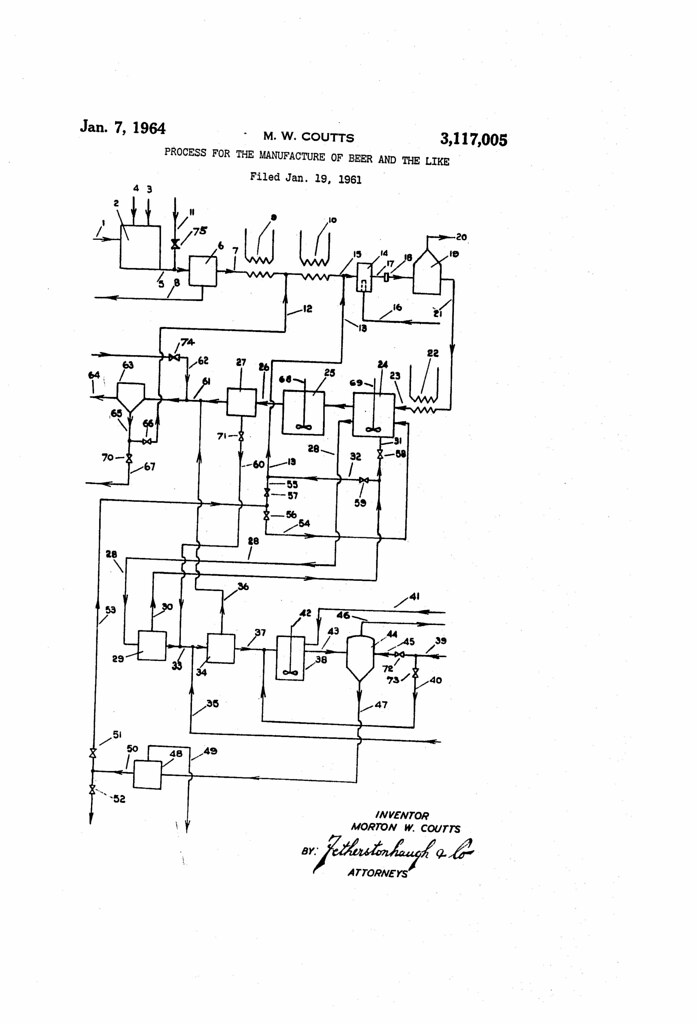
Today in 1964, US Patent 3117005 A was issued, an invention of Morton William Coutts, for his “Process For the Manufacture of Beer and the Like.” There’s no Abstract, although in the description it includes this summary:

This invention relates to a process for the manufacture of beer and the like and has for its objects the provision of an improved continuous process for such manufacture which makes use of certain phenomena which occur during the preparation of brewers Wort and the fermentation thereof and which individually cause problems in production but which when combined bring about beneficial results.

For example, when brewers wort is boiled certain heat sensitive material precipitates and coagulate-s. It has been found that these precipitated particles while in a boiling state have adsorptive properties and take up from the wort many objectionable and unwanted flavours. It is normal practice to hold the hot wort before cooling, and during this time these particles coagulate and as they coagulate gradually lose their adsorptive powers, the adsorbed flavours again becoming soluble and so producing objectionable flavours in the finished beer.
US3117005-0

Filed Under: Beers, Breweries, Just For Fun, Politics & Law, Related Pleasures Tagged With: Brewing Equipment, History, Law, Patent, Science of Brewing, Wort

Patent No. 4633678A: Keg Cooler

January 6, 2016 By Jay Brooks

patent-logo
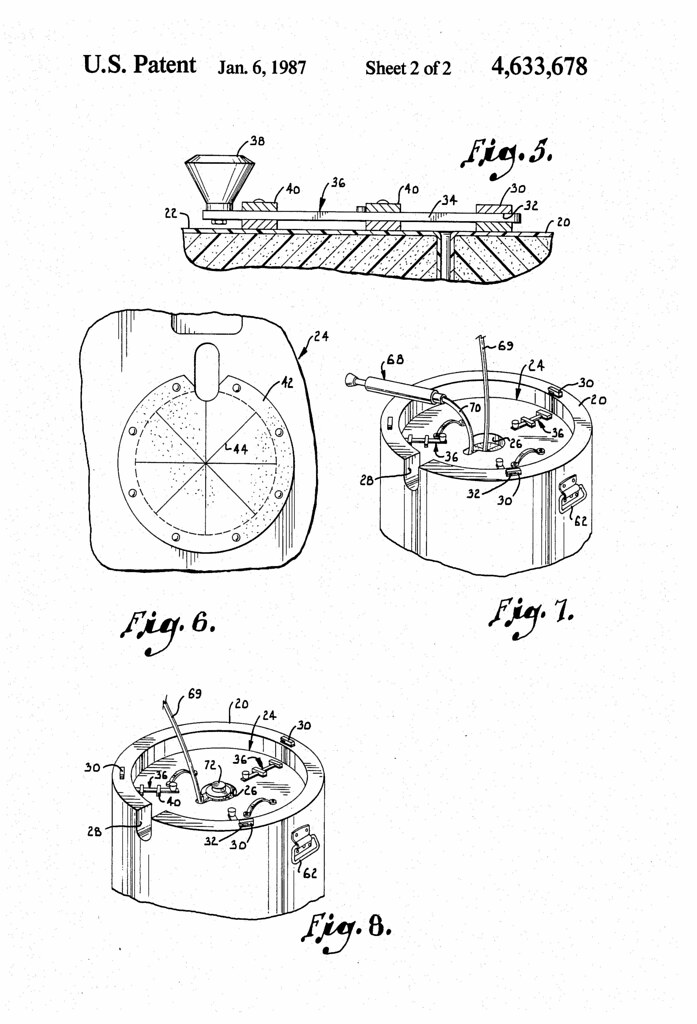
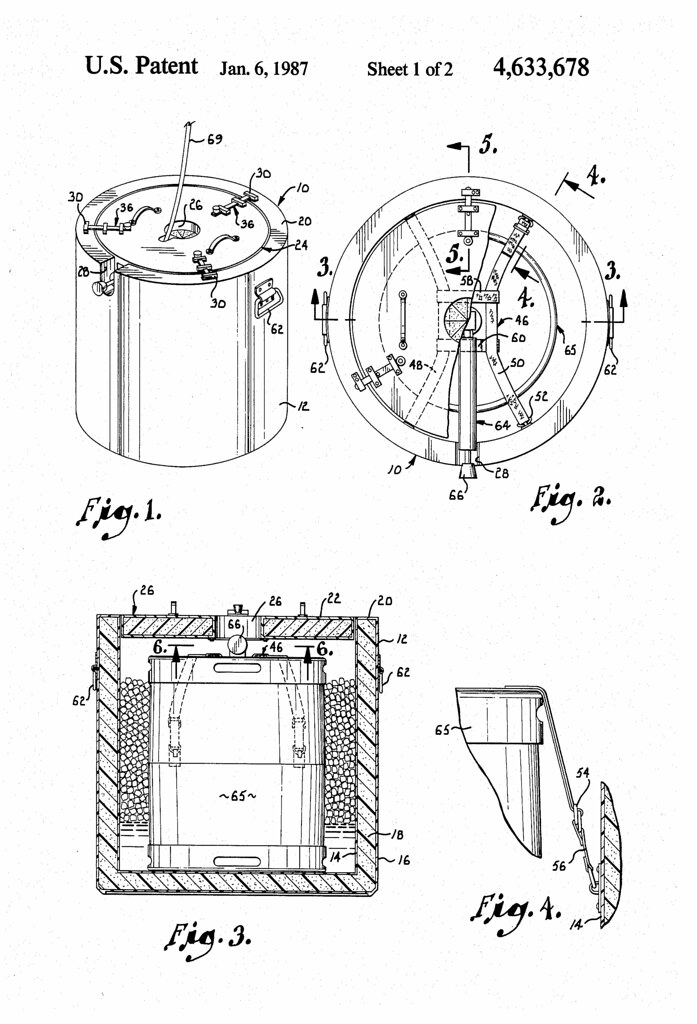
Today in 1987, US Patent 4633678 A was issued, an invention of Richard P. Lea and Randy J. Lea, for their “Keg Cooler.” Here’s the Abstract:

A beer keg cooler has a container and a removable lid of relatively thick wall insulated construction larger than a keg to be accommodated by the cooler so that ice may be packed around the keg. A flexible, web shaped harness is secured to the inner wall of the container and straps of the harness are secured by buckles so that the harness can be adjusted to bridge across the container in tight engagement against the keg to secure the keg in position and to prevent the keg from floating as the ice melts. The container has a notch formed in its upper rim to accommodate beverage dispensing equipment and the lid has a central opening for the same purpose. A flexible flap over the lid opening seals any portion of the opening not required for this purpose.

US4633678-1
US4633678-2

Filed Under: Beers, Just For Fun, Politics & Law, Related Pleasures Tagged With: History, Kegs, Law, Patent

Patent No. 3488213A: Method And Apparatus For Applying A Coating To The Interior Surface Of A Hollow Article

January 6, 2016 By Jay Brooks

patent-logo
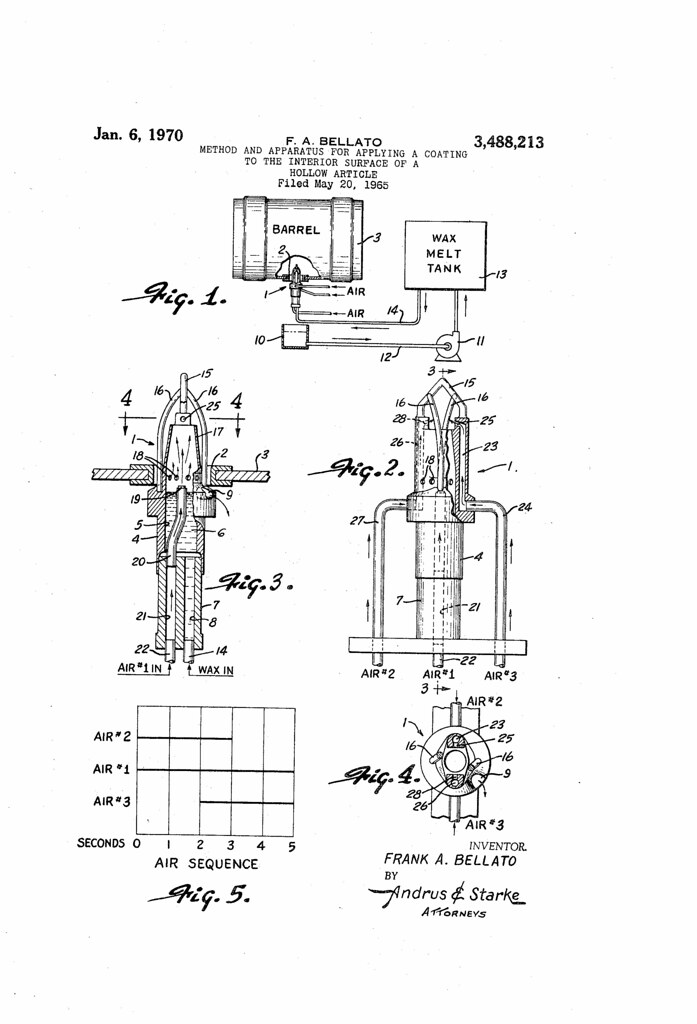
Today in 1970, US Patent 3488213 A was issued, an invention of Frank A. Bellato, assigned to Schlitz Brewing Co., for his “Method and Apparatus For Applying a Coating to the Interior Surface of a Hollow Article.” Here’s the Abstract:

A method and nozzle assembly for coating the interior surface of a barrel with wax or other coating material The nozzle assembly is adapted to be inserted within the bunghole of the barrel and includes a central reservoir which contains melted wax. The Wax is continuously pumped to the reservoir and overflows from the reservoir so that a continual flow of melted wax is achieved. The melted wax is atomized by a pressurized stream of air which is ejected through an orifice into a discharge nozzle located above the level of the wax. In addition to the primary air stream, a pair of auxiliary air jets are employed which are directed laterally towards the ends of the barrel and the auxiliary jets aid in atomizing the wax and directing the atomized wax towards the ends of the barrel.

This invention relates to a method and apparatus for applying a coating to the interior surface of a hollow article and more particularly to a method and apparatus for applying wax or similar coatings to the interior of beer barrels.

US3488213-0

Filed Under: Beers, Just For Fun, Politics & Law, Related Pleasures Tagged With: Barrels, History, Kegs, Law, Patent

Patent No. 3552975A: Hop Flavors For Malt Beverages

January 5, 2016 By Jay Brooks

patent-logo
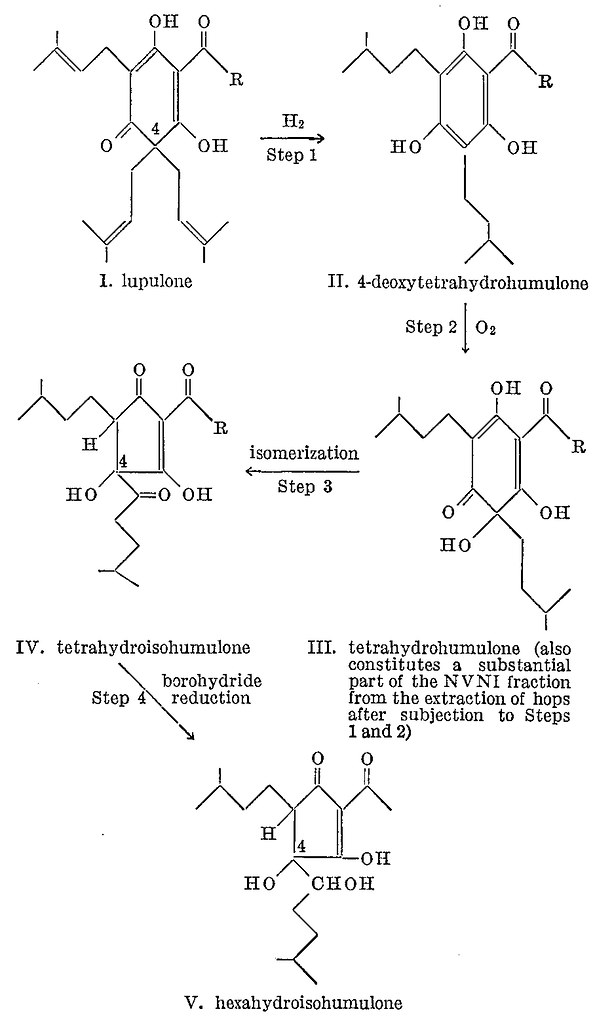
Today in 1971, US Patent 3552975 A was issued, an invention of Paul H. Todd Jr. and Leonard R. Worden, assigned to Matt Brynildson’s first company; the Kalamazoo Spice Extract Co., for their “Hop Flavors for Malt Beverages and the Like.” There’s no Abstract, although in the description it includes this summary:

Process for producing 4-deoxytetrahydrohumulone from lupulone by hydrogenolysis thereof after downward adjustment of pH into the acid range, optional subsequent oxygenation to tetrahydrohumulone, and optional isomerization and reduction to produce hexahydroisohumulone; hexahydroisohumulone itself; use of hexahydroisohumulone, in beverage flavoring; beverages flavored therewith; and employment of the portion of the non-volatile nonisomerizable hop extract fraction which dissolves in water at a pH of at least 9 as starting material in the first-mentioned production processes; use of tetrahydroisohumulone in beverage flavoring, especially by isomerizing tetrahydrohumulone in the beverage; beverages and especially malt beverages so flavored.

US3552975-0

US3552975-1

Filed Under: Beers, Just For Fun, Politics & Law, Related Pleasures Tagged With: History, Hops, Law, Patent, Science

Patent No. 2919806A: Hop Strainer

January 5, 2016 By Jay Brooks

patent-logo
Today in 1960, US Patent 2919806 A was issued, an invention of Alvin Hock and Clarence Rechtin, assigned to the Brighton Corp., for their “Hop Strainer.” There’s no Abstract, although in the description it includes this summary:

Our invention resides in the provision of a novel hop strainer especially designed for obtaining instant separation of wort from hops.

Our invention relates in general to that type of mechanism shown in Patent No. 2,412,400 which issued to Alvin Hock on December 10, 1946. Novel features, however, have been incorporated in the machinery of the instant invention as will be emphasized in the passages which follow.

It is an object of our invention to provide a hop strainer which will remove a maximum amount of Wort from the hops without bruising or crushing the hops sufficient to impart an undesirable bitterness to the Wort. Accordingly, an important feature embodied in the construction of a hop strainer according to the teachings of our invention is that of cascading the wort and hops in a sheet or sheets against a perforated plate or screen in such a manner that the combined wort and hops contact the plate or screen in such a way that the great majority of the wort will strike through the plate or screen instantly while the hops are washed along the plate or screen without driving the hops lint and seed through the plate or screen and without undue splashing.

Another very important object of our invention is to provide means for moving the hops and wort along another’ perforated plate or plates in such a Way as to accomplish further separation of the wort from the hops again without subjecting the hops to extreme pressures or harsh treatment.

A further object of our invention is to provide a final pressing action by means of which the last usable wort lis separated from the hops at the final stage in the separation process, this also being accomplished without damage to the hops and wort.

Another important object of our invention is to provide a hop strainer which may be .cleaned easily and quickly so as to protect the purity of the brew and make it economical to use.

US2919806-0

Filed Under: Beers, Just For Fun, Politics & Law, Related Pleasures Tagged With: Brewing Equipment, History, Hops, Law, Patent

Patent No. 19063A: Can Opener

January 5, 2016 By Jay Brooks

patent-logo
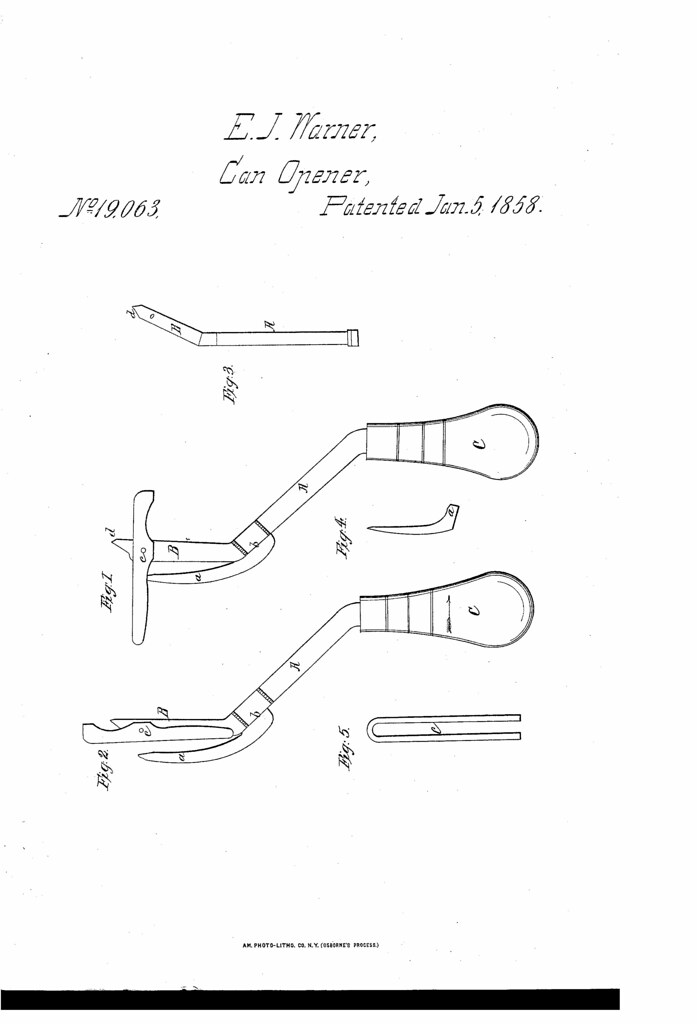
Today in 1858, US Patent 19063 A was issued, an invention of Ezra J. Warner, for his “Can Opener.” There’s no Abstract, although in the description it includes this summary:

I have invented a new and useful Improvement` in Instruments for Cutting Open Sealed Tin Cans and Boxes; and I do hereby declare that the following is a full, clear, and exact description of the construction, character, and operation of the same, reference being had to the accompanying drawings, which make a part of this specification, in which- Figure l, is a view of the whole instrument, showing the looped bar, (as Fig. 5,) swung across the piercer bar. Fig. 2, is a view of the same, showing another position of the looped bar. Fig. 3, is a view of the shaft, with the piercer bar. Fig. 4, is a view of the curved cutter, (as in Figs. l and 2). Fig. 5, is a view of the looped bar, (as in Figs. 1 and 2.)

I make the shank, A, (including t-he piercer-bar, B,) of steel, substantially, as represented in Figs. l, 2, and 3, with a suitable handle, as C, Figs. l and 2, and I make the point of the piercer bar, B, substantially, in the form represented at d, Figs. l, 2, &c., I make the curved cutter, a, of cast steel, substantially in the form shown in Figs. l, 2, and 4, and attach it to the shank, A, (as at 5,) by passing the end, a, Fig. 4, into a dovetail slot, so that it may be readily removed, in case of its being injured, or when I desire to change the position of the cutting edge from one side of the looped or swinging bar c, to the other or to have it cut in the center, between the two sides, and I bevel the edge on either side, or on both sides, according to the position in which it is to be placed for cutting. I make the looped bar, c, of steel, or any other suitable material, substantially in the form shown in Fig. 5, (and indicated in Figs. 1 and 2,) and attach it to the piercer bar, B, (near its end,) by a fulcrum or joint pin, as shown at c, Figs. l and 2, (and indicated in Fig. 3,) so that it may readily swing, or rock, from the position shown in Fig. 1 to that shown in Fig. 2.

To use this instrument, I swing the loop bar substantially to the position shown at c, in Fig. l, take hold of the handle, C, and press the point, a, of the piercer-bar, B, through the tin in the desired place, turn the instrument, and insert the point of the curved cutter, a, through the perforation already made, (when the looped or swinging bar, c, will be substantially in the position shown in Fig. 2,) and work the handle, C, (in the manner of a brake.) Then the handle, C, is moved in the direction indicated by the dart in Fig. 2, the loop bar, c, will be held against the surface of the tin, while the curved cutter, a, will be forced between its parts and cut the tin smoothly through, and when the handle is moved in the opposite direction the instrument may be pushed forward for another cut, and so on, thus allowing the operator to cut as fast as he can move his hand.

The advantages of my improvement over all other instruments for this purpose consist in the smoothness and rapidity of the cut, as well as the ease with which it is worked, as a child may use it without difficulty, or risk, and in making the curved cutter susceptible of being removed, so that if one should be injured it may be replaced by another, thus saving all the other portions of the instrument, and consequently much expense, and in that the piercer will perforate the tin without causing the liquid to fly out, as it does in all those which make the perforation by percussion of any kind.

US19063-0

Filed Under: Beers, Just For Fun, Politics & Law, Related Pleasures Tagged With: Cans, History, Law, Packaging, Patent

Patent No. 3227557A: Continuous Fermentation Process With Sedimentable Microorganisms

January 4, 2016 By Jay Brooks

patent-logo
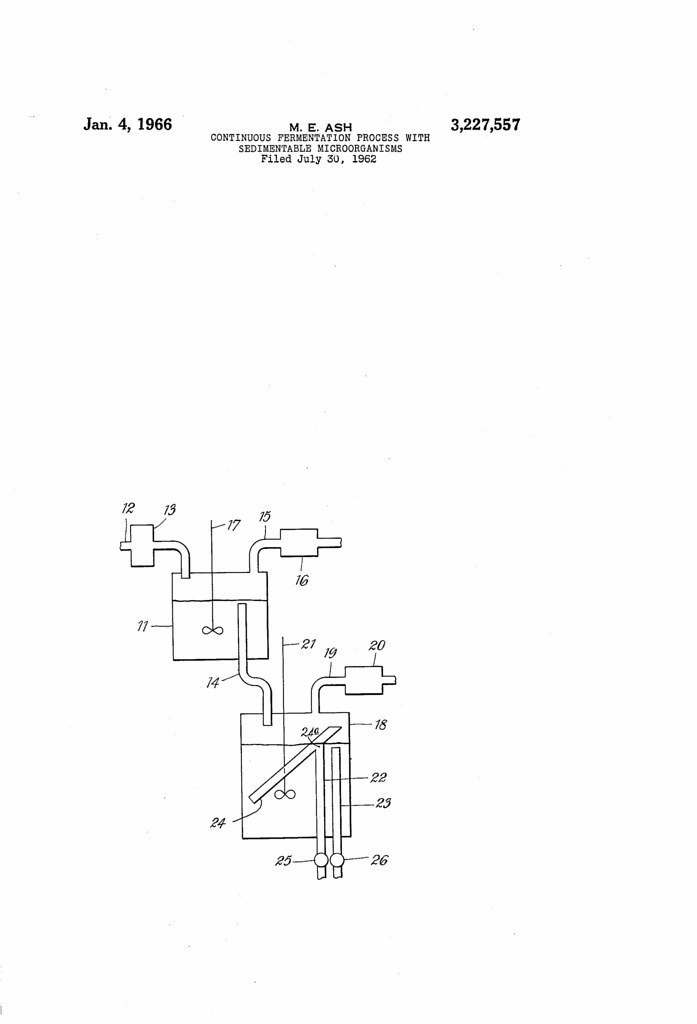
Today in 1966, US Patent 3227557 A was issued, an invention of Michael Edward Ash, assigned to Guinness Son & Co. Ltd., for his “Continuous Fermentation Process with Sedimentable Microorganisms.” There’s no Abstract, although in the description it includes this summary:

This invention relates in general to continuous fermentation systems of the kind in which liquid suspensions comprising a dispersion of said fermentable micro-organisms in a liquid substrate of relatively lower specific gravity, are caused to flow through a fermenting vessel or series of vessels.

More specifically, the invention is concerned with a method and apparatus for controlling the relative degree of concentration of micro-organism in substrate as between any two or all of the stages: inflow, vessel and outflow.

In particular, the invention has been developed for use in connection with the continuous fermentation of Erewers wort in a chemostat system.

The invention is however believed to be applicable to any microbiological process in which a sedimentable micro-organism is operated in a nutrient liquid, and is in the form of a mechanical dispersion in liquid nutrient of relatively lower specific gravity, so that in the absence of turbulence, the micro-organism tends to settle at the bottom of the vessel.

It has already been proposed continuously to ferment Brewers wort or other ferment-able substrate in a plurality of sequentially arranged stirred or unstirred vessels, and to separate the fermenting micro-organism (yeast) from the fermented product (beer) by settlement in a separate vessel or in a part of the final fermentation vessel separated from a stirred region by a baffle.

US3227557-0

Filed Under: Beers, Breweries, Just For Fun, Politics & Law, Related Pleasures Tagged With: Brewing Equipment, Guinness, History, Law, Patent, Science of Brewing

Patent No. 489388A: Attachment For Bar-Room Counters

January 3, 2016 By Jay Brooks

patent-logo
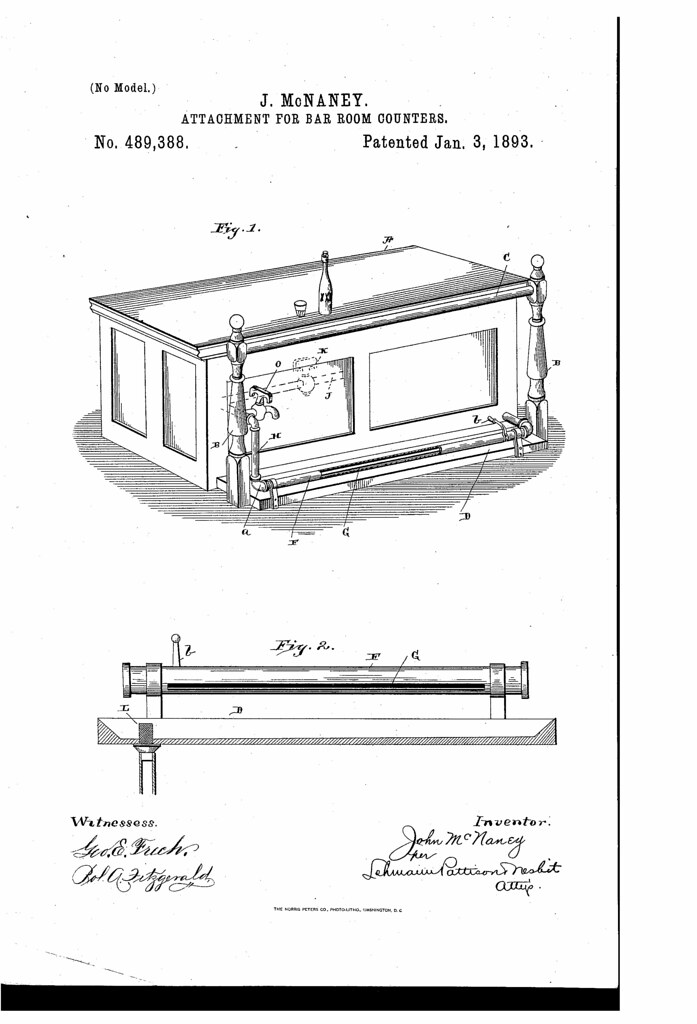
Today in 1893, US Patent 489388 A was issued, an invention of John McNaney, for his “Attachment for Bar-Room Counters.” There’s no Abstract, although in the description it includes this summary:

My invention relates to improvements in attachments for bar room counters; and it consists in the construction and arrangement of parts which will be fully described hereinafter and particularly referred to in the claims.

The object of my invention is to provide an attachment for counters of bar rooms, which comprises a trough or gutter that is placed upon the floor of the room immediately at the lower front edge of the counter to receive tobacco, spit, beer and other slop which occurs in a bar room, and to provide a hollow foot piece which is capable of a partial rotation and provided with a slot through which water can flow into the said trough for cleaning it out, and be turned with the slot down to dislodge all slop accumulated in the said pipe, and to connect this hollow foot piece or rail with a water main or with a tank, whereby the trough and the pipe can be flushed or cleaned by a flow of water under the control of the bar tender.

US489388-0

Filed Under: Beers, Just For Fun, Politics & Law, Related Pleasures Tagged With: Bars, History, Law, Patent

Patent No. 2536927A: Hop-Picking Machine

January 2, 2016 By Jay Brooks

patent-logo
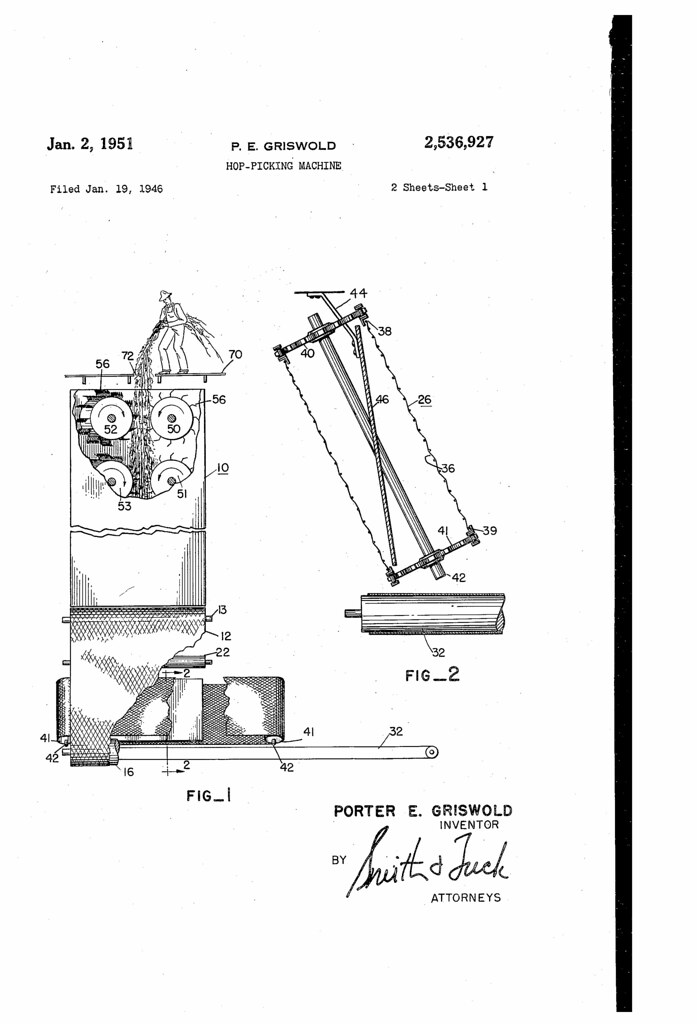
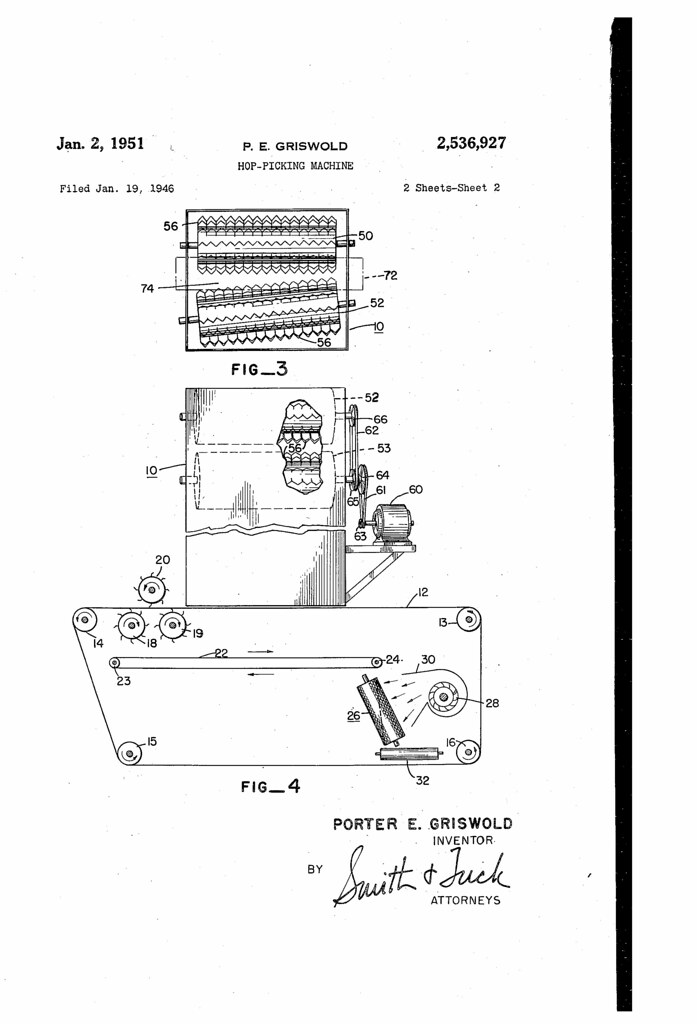
Today in 1951, US Patent 2536927 A was issued, an invention of Porter E. Griswold, for his “Hop-Picking Machine.” There’s no Abstract, although in the description it includes this summary:

My invention relates to a machine especially designed for use in the hop-picking industry for stemming hop clusters.

Hops are generally grown on trellises from sixteen to twenty feet high, the vines being trained over these trellises. In picking by machinery, the vine stalks are out about four feet from the ground and passed through the hop-picking machine, the hops being removed mechanically from the vines during the traverse of the latter through the machine. Some of the hops are removed from the vine -in the form of clusters or bouquets, such clusters having more or less of the stems or small branches, which are undesirable in the finished product, and it is necessary to pull these clusters apart to free the hops from this trash.

The object of the present invention is to design a simple, practical machine of large capacity for this work..

The invention consists of the parts and the construction and combination of parts as hereinafter more fully described and claimed, having reference to the accompanying drawings, in which Figure 1 is a plan view of the invention, one-half of the outer casing being broken away to show the inner stemming centrifugal cone. Fig. 2 is a side elevation in partial section of the invention. Fig. 3 is a detail of the cooperating series of outer and inner, or stationary and movable, pickers.

US2536927-0
US2536927-1

Filed Under: Beers, Just For Fun, Politics & Law, Related Pleasures Tagged With: Brewing Equipment, History, Hops, Law, Patent

Patent No. 1013505A: Hop-Cluster Stemmer

January 2, 2016 By Jay Brooks

patent-logo
Today in 1912, US Patent 1013505 A was issued, an invention of George E Miller, for his “Hop-Cluster Stemmer.” There’s no Abstract, although in the description it includes this summary:

My invention relates to a machine especially designed for use in the hop-picking industry for stemming hop clusters.

Hops are generally grown on trellises from sixteen to twenty feet high, the vines being trained over these trellises. In picking by machinery, the vine stalks are out about four feet from the ground and passed through the hop-picking machine, the hops being removed mechanically from the vines during the traverse of the latter through the machine. Some of the hops are removed from the vine -in the form of clusters or bouquets, such clusters having more or less of the stems or small branches, which are undesirable in the finished product, and it is necessary to pull these clusters apart to free the hops from this trash.

The object of the present invention is to design a simple, practical machine of large capacity for this work..

The invention consists of the parts and the construction and combination of parts as hereinafter more fully described and claimed, having reference to the accompanying drawings, in which Figure 1 is a plan view of the invention, one-half of the outer casing being broken away to show the inner stemming centrifugal cone. Fig. 2 is a side elevation in partial section of the invention. Fig. 3 is a detail of the cooperating series of outer and inner, or stationary and movable, pickers.

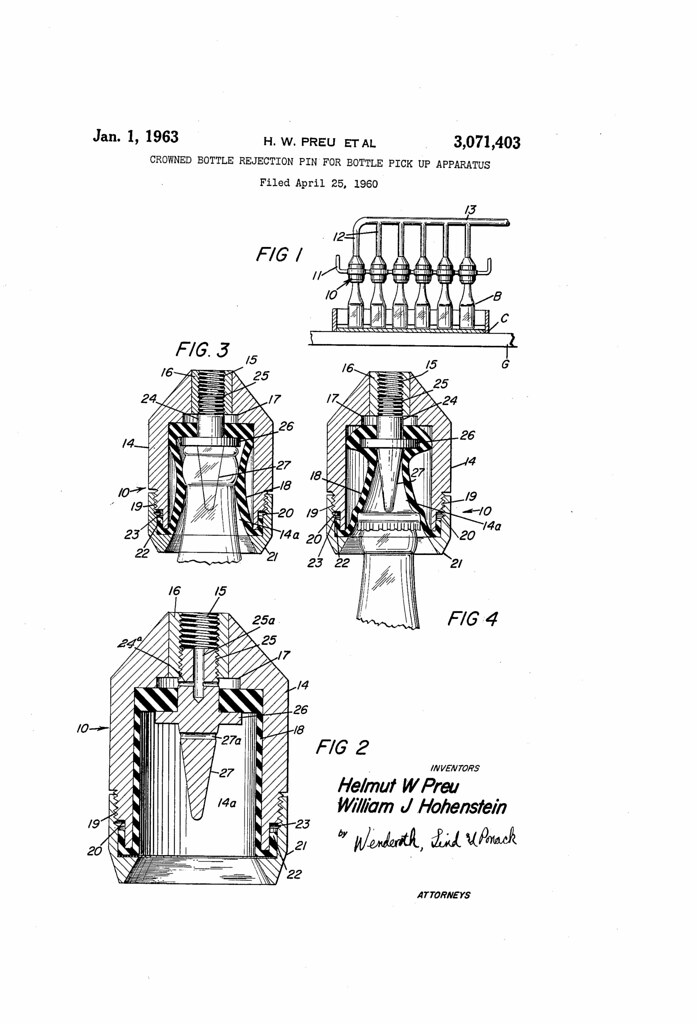
US3071403-0

Filed Under: Beers, Just For Fun, Politics & Law, Related Pleasures Tagged With: Brewing Equipment, History, Hops, Law, Patent

« Previous Page
Next Page »

Find Something

Northern California Breweries

Please consider purchasing my latest book, California Breweries North, available from Amazon, or ask for it at your local bookstore.

Recent Comments

  • Bob Paolino on Beer Birthday: Grant Johnston
  • Gambrinus on Historic Beer Birthday: A.J. Houghton
  • Ernie Dewing on Historic Beer Birthday: Charles William Bergner 
  • Steve 'Pudgy' De Rose on Historic Beer Birthday: Jacob Schmidt
  • Jay Brooks on Beer Birthday: Bill Owens

Recent Posts

  • Historic Beer Birthday: John J. Schlawig February 27, 2026
  • Beer In Ads #5134: Lord Bushkill On Bushkill Bock February 27, 2026
  • Historic Beer Birthday: William Henry Beadleston February 27, 2026
  • Beer In Ads #5133: Going… Going… SB Bock February 26, 2026
  • Beer Birthday: Art Larrance February 26, 2026

BBB Archives

Feedback

Head Quarter
This site is hosted and maintained by H25Q.dev. Any questions or comments for the webmaster can be directed here.