Brookston Beer Bulletin

Jay R. Brooks on Beer

  • Home
  • About
  • Editorial
  • Birthdays
  • Art & Beer

Socialize

  • Dribbble
  • Email
  • Facebook
  • Flickr
  • GitHub
  • Instagram
  • LinkedIn
  • Pinterest
  • RSS
  • Twitter
  • YouTube

Powered by Genesis

Beer Fights Obesity

June 19, 2012 By Jay Brooks

health
Here’s an interesting one, if I’m reading it correctly. A new study published in the journal Cell Metabolism with the inscrutable title The NAD+ Precursor Nicotinamide Riboside Enhances Oxidative Metabolism and Protects against High-Fat Diet-Induced Obesity appears to suggest that beer (and milk) contain a molecule that helps fight against weight-gain, especially in high-fat diets. The wonder molecule is known as nicotinamide riboside, or NR. Here’s the abstract. See if you can get through it without your head spinning:

As NAD+ is a rate-limiting cosubstrate for the sirtuin enzymes, its modulation is emerging as a valuable tool to regulate sirtuin function and, consequently, oxidative metabolism. In line with this premise, decreased activity of PARP-1 or CD38—both NAD+ consumers—increases NAD+ bioavailability, resulting in SIRT1 activation and protection against metabolic disease. Here we evaluated whether similar effects could be achieved by increasing the supply of nicotinamide riboside (NR), a recently described natural NAD+ precursor with the ability to increase NAD+ levels, Sir2-dependent gene silencing, and replicative life span in yeast. We show that NR supplementation in mammalian cells and mouse tissues increases NAD+ levels and activates SIRT1 and SIRT3, culminating in enhanced oxidative metabolism and protection against high-fat diet-induced metabolic abnormalities. Consequently, our results indicate that the natural vitamin NR could be used as a nutritional supplement to ameliorate metabolic and age-related disorders characterized by defective mitochondrial function.

A mouthful, to be sure, but Jenny Hope, at the UK’s Daily Mail, who presumably had access to the full text, valiantly makes more sense of it in The miracle molecule: Hidden vitamin found in BEER and MILK can make you stronger, slimmer and healthier, and the story starts out very promisingly:

If you were planning on having a quick pint tonight, then this will be welcome news.

Beer may contain a vitamin which can fight obesity and improve muscle strength, scientists claim.

The ‘miracle molecule’, which has been found in milk and may also be present in beer and some foods, has no side effects and could even lengthen lifespan, they say.

The bad news — why does there always have to be bad news? — is that NR is found in vanishingly small quantities, so infinitesimal that you couldn’t really drink enough beer (or milk) to take advantage of NR’s positive effects. Oh, you could try, but such immoderate drinking would no doubt land you on MADD’s most wanted and possibly lead you to an early grave, as well, thus defeating the purpose.

Nonetheless, the results were impressive. In addition to fighting weight gain and improving muscle strength, NR also helped combat diabetes and improved endurance. And did I mention no side effects were found, not even in high doses? Apparently, NR “works by becoming trapped in cells where it boosts the metabolism, much like resveratrol, which is found in wine.”

In a statement, one of the study’s authors, Carles Canto said. “It really appears that cells use what they need when they need it, and the rest is set aside without being transformed into any kind of deleterious form.”

The next steps, besides human testing, will be figuring out how to better detect it and, more importantly, discovering if it can be synthesized economically so that sufficiently large quantities can be taken. I sure like the idea of Vitamin Beer. Flintstones chewable beer vitamins, anyone?

Filed Under: Beers, News Tagged With: Health & Beer, Science, Video

Moderate Elderly Beer Drinkers Less Prone To Dementia

June 5, 2012 By Jay Brooks

health
The Foundation for Alcohol Research (ABMRF) recently highlighted a study that appears to show that elderly persons who drink moderately are at a lower or reduced risk of “cognitive decline or dementia and provide cardiovascular benefits.” The study, Alcohol and Cognition in the Elderly: A Review, was published in Psychiatry Investigation. Here’s ABMRF’s report of the study:

Alzheimer’s disease and other types of dementia are most common in the very elderly, and are associated with huge health costs. With a rapidly aging global population, factors influencing the risk of cognitive decline and dementia are important.

A review of the association between alcohol consumption and cognition in the elderly suggests alcohol may have both a neurotoxic and neuroprotective effect, depending on the dose and drinking pattern. Longitudinal and brain imaging studies in the elderly show that excessive alcohol consumption may increase the risk of cognitive dysfunction and dementia, but regular low to moderate alcohol intake may protect against cognitive decline and dementia and provide cardiovascular benefits.

Investigators reviewed studies published from 1971 to 2011 related to alcohol and cognition in the elderly. At present, there are no proven agents to prevent cognitive decline or dementia, although a number of prospective epidemiological studies have shown a lower risk of such conditions among light to moderate drinkers in comparison with non-drinkers.

Other studies suggest that beneficial effects are seen only among certain sub-groups of subjects. A recent meta-analysis by Peters et al of subjects over the age of 65 in longitudinal studies concluded that light-to-moderate alcohol consumption, in comparison with abstinence, was associated with approximately 35-45% lower risk of cognitive decline or dementia.

They also found that heavy drinking has the opposite effect, so that too much alcohol may increase such risks, so it appears that moderation is the key.

And here’s the abstract from the published paper:

Consumption of large amounts of alcohol is known to have negative effects, but consumption in smaller amounts may be protective. The effect of alcohol may be greater in the elderly than in younger adults, particularly with regard to cognition. However, the drinking pattern that will provide optimal protection against dementia and cognitive decline in the elderly has not been systematically investigated. The present paper is a critical review of research on the effect of alcohol on cognitive function and dementia in the elderly. Studies published from 1971 to 2011 related to alcohol and cognition in the elderly were reviewed using a PubMed search. Alcohol may have both a neurotoxic and neuroprotective effect. Longitudinal and brain imaging studies in the elderly show that excessive alcohol consumption may increase the risk of cognitive dysfunction and dementia, but low to moderate alcohol intake may protect against cognitive decline and dementia and provide cardiovascular benefits. Evidence suggesting that low to moderate alcohol consumption in the elderly protects against cognitive decline and dementia exists; however, because of varying methodology and a lack of standardized definitions, these findings should be interpreted with caution. It is important to conduct more, well-designed studies to identify the alcohol drinking pattern that will optimally protect the elderly against cognitive decline and dementia.

And here’s their conclusion, from the full text of the article:

Evidence suggesting that LMD in the elderly protects against cognitive decline and dementia exists. The present review of evidence-based research may help determine the optimal alcohol drinking pattern to prevent cognitive decline and dementia in the elderly and provide an alternative to existing therapeutic interventions, which have limited effectiveness. However, the varying results of several evidence-based studies of the benefits and risks of alcohol on cognition should be interpreted with caution. Furthermore, the cognitive benefit of LMD may vary from person to person; thus, it is difficult to make a clinical recommendation for abstainers to drink alcohol. Nevertheless, it is important to conduct well-designed studies to determine the optimal alcohol drinking pattern for the elderly as the alternative against cognitive decline and dementia.

It sounds like the key is finding the right dosage for each person, the alcohol sweet spot or goldilocks amount. I’m certainly open to experimentation. Because that’s some seriously tasty medicine I can get behind, especially as I age ever closer to my dotage. I think when I have grandkids, I’m going to teach them to call the refrigerator in the garage, stocked with beer, “grandpa’s medicine cabinet.”

Filed Under: News, Politics & Law, Related Pleasures Tagged With: Health & Beer, Science, Statistics

Synthetic Alcohol?

June 4, 2012 By Jay Brooks

science
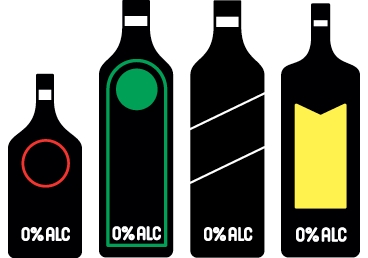
I’m not quite sure what to think about this development, but I can’t imagine how it could be a good thing. On Friday, the New York Times had an interesting list of 32 Innovations That Will Change Your Tomorrow. There are some truly amazing items on the list, which if they come to fruition, would indeed change our everyday lives. But one seems just odd, at least to me. Number 20 envisions “A World Without Hangovers,” with the development of “synthetic alcohol,” by none other than British neo-prohibitionist windbag, professor doctor David Nutt. Here’s how the Times describes it:

Researchers at Imperial College London are closing in on a formula for a new kind of booze — synthetic alcohol, it’s called — that would forever eliminate the next morning’s headache (not to mention other problems associated with drinking). The team, led by David Nutt, a psychiatrist and former British drug czar, has identified six compounds similar to benzodiazepines — a broad class of psychoactive drugs — that won’t get you rip-roaring drunk but will definitely provide a buzz. According to Nutt, the alcohol substitute would be a flavorless additive that you could put in a nonalcoholic drink. And when you want to sober up, all you’d have to do is pop a pill.

Now doesn’t that sound appetizing? An N/A beer with a “flavorless additive” made from “psychoactive drugs.” How on Earth did the Times decide that this one even deserved to be on such a list of innovations. Who would want this? Why would you take a natural product and turn it into a chemical substitute for it. Essentially, this is like taking something natural, like coffee, stripping the caffeine out of it and then adding a chemical compound back into it that simulates the original caffeine, but at lower levels. Wouldn’t it be easier to just advocate drinking less or choosing lower alcohol, session beers? Yes, yes it would, but then people would have to be responsible for their own actions. Nutt and the rest of his neo-prohibitionist crew would much prefer controlling peoples’ behavior. They seem to honestly believe that since some people can’t drink responsibly, then no one can. That’s always their rationalization for the outlandish propaganda they’ve spouted over the last few years, things like “beer is more dangerous than heroin” and “no level of alcohol is safe.”

0-alc

According to the graphic accompanying this item, synthetic alcohol is at least two to four years away, but I’m hoping enough people will recognize this for the abomination that it would be, and no one beyond the lunatic anti-alcohol fringe would be in favor of turning such natural drinks like beer, wine and whisky into chemical-laden soda pop for adults.

Filed Under: Editorial, News, Related Pleasures Tagged With: Science

Creativity & Beer

March 21, 2012 By Jay Brooks

lightbulb
One of the unspoken benefits of beer is that it’s a very useful relaxation tool. After a hard, stressful day of work, a tasty beer is just the thing to calm one’s nerves. It would be nearly impossible to quantify, but I have to wonder how much better off many people are because of the relaxation afforded them through the simple act of drinking a beer. How many didn’t do something that they might later regret had they remained tense, stressed and on edge. It’s worth considering, especially as the neo-prohibitionists increasingly insist that beer has no health benefits. But the mental health benefits that most of us get from a calming glass of beer can’t be ignored.

But there’s apparently one more mental health benefit to a beer, as reported recently in the Wall Street Journal (and thanks to Jeff B. for sending me the link). The essay, by Jonah Lehrer, is How To Be Creative, and the teaser subtitle give a nutshell account of what’s to come. “The image of the ‘creative type’ is a myth. Jonah Lehrer on why anyone can innovate—and why a hot shower, a cold beer or a trip to your colleague’s desk might be the key to your next big idea.” The fascinating story is about where creativity and innovation come from, something science has only very recently even tried to explain. The essay discusses several theories and gives examples of different ways that creativity is sparked and influenced. One of those, of course, is through drinking a glass of beer.

Interestingly, Mr. Beeman and his colleagues have found that certain factors make people much more likely to have an insight, better able to detect the answers generated by the aSTG [superior anterior temporal gyrus]. For instance, exposing subjects to a short, humorous video—the scientists use a clip of Robin Williams doing stand-up—boosts the average success rate by about 20%.

Alcohol also works. Earlier this year, researchers at the University of Illinois at Chicago compared performance on insight puzzles between sober and intoxicated students. The scientists gave the subjects a battery of word problems known as remote associates, in which people have to find one additional word that goes with a triad of words. Here’s a sample problem:

Pine Crab Sauce

In this case, the answer is “apple.” (The compound words are pineapple, crab apple and apple sauce.) Drunk students solved nearly 30% more of these word problems than their sober peers.

What explains the creative benefits of relaxation and booze? The answer involves the surprising advantage of not paying attention. Although we live in an age that worships focus — we are always forcing ourselves to concentrate, chugging caffeine — this approach can inhibit the imagination. We might be focused, but we’re probably focused on the wrong answer.

And this is why relaxation helps: It isn’t until we’re soothed in the shower or distracted by the stand-up comic that we’re able to turn the spotlight of attention inward, eavesdropping on all those random associations unfolding in the far reaches of the brain’s right hemisphere. When we need an insight, those associations are often the source of the answer.

So if you’re having trouble with your latest creative project, stuck somewhere with no solution in sight? Relax, don’t worry, have a beer. That may prove to be just the thing to free your mind and in the process unlock the creativity necessary to solve your problem. Liquid gold indeed.

Filed Under: Beers, Editorial, Politics & Law, Related Pleasures Tagged With: Science

A Biologist’s St. Patrick’s Day Song

March 17, 2012 By Jay Brooks

ethanol
This is one of the coolest, albeit nerdy, songs I’ve heard since Tom Lehrer was doing the Vatican Rag and singing about the Elements. And thanks to Peter H. for sending me the link. It’s a St. Patrick’s Day song by a biologist, known only as Cadamole, who apparently lives in Washington, D.C. He sings about the biology of beer and … well, just listen to it for yourself. Enjoy!

And below are the lyrics so you can sing along:

In the year of our lord eighteen hundred and eleven
On March the seventeenth day
I will raise up a beer and I’ll raise up a cheer
For Saccharomyces cerevisiae
Here’s to brewers yeast, that humblest of all beasts
Producing carbon gas reducing acetaldehyde
But my friends that isn’t all — it makes ethyl alcohol
That is what the yeast excretes and that’s what we imbibe

Anaerobic isolation
Alcoholic fermentation
NADH oxidation
Give me a beer

[CHORUS]

My intestinal wall absorbs that ethanol
And soon it passes through my blood-brain barrier
There’s a girl in the next seat who I didn’t think that sweet
But after a few drinks I want to marry her
I guess it’s not surprising, my dopamine is rising
And my glutamate receptors are all shot
I’d surely be bemoaning all the extra serotonin
But my judgment is impaired and my confidence is not

Allosteric modulation
No Long Term Potentiation
Hastens my inebriation
Give me a beer

[CHORUS]

When ethanol is in me, some shows up in my kidneys
And inhibits vasopressin by degrees
A decrease in aquaporins hinders water re-absorption
And pretty soon I really have to pee
Well my liver breaks it down so my body can rebound
By my store of glycogen is soon depleted
And tomorrow when I’m sober I will also be hungover
Cause I flushed electrolytes that my nerves and muscles needed

Diuretic activation
Urination urination
Urination dehydration
Give me a beer

[CHORUS]

Filed Under: Just For Fun, Related Pleasures Tagged With: Holidays, Music, Science, Science of Brewing, Video

Drowning One’s Sorrows May Be Genetic

March 16, 2012 By Jay Brooks

fruitfly
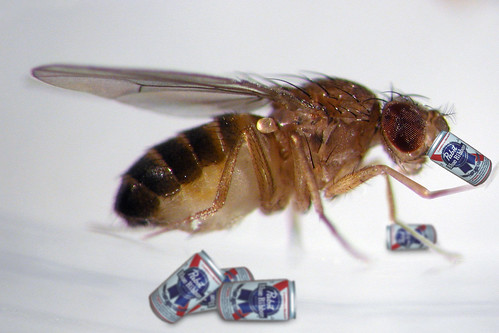
The March issue of Science, touted as “the world’s leading journal of original scientific research, global news and commentary, included an article entitled Sexual Deprivation Increases Ethanol Intake in Drosophila. Which may not mean much, until you realize that in plain English it’s essentially “fruit flies who’ve had their sexual advances rejected drink more alcohol.” Here’s the abstract:

The brain’s reward systems reinforce behaviors required for species survival, including sex, food consumption, and social interaction. Drugs of abuse co-opt these neural pathways, which can lead to addiction. Here, we used Drosophila melanogaster to investigate the relationship between natural and drug rewards. In males, mating increased, whereas sexual deprivation reduced, neuropeptide F (NPF) levels. Activation or inhibition of the NPF system in turn reduced or enhanced ethanol preference. These results thus link sexual experience, NPF system activity, and ethanol consumption. Artificial activation of NPF neurons was in itself rewarding and precluded the ability of ethanol to act as a reward. We propose that activity of the NPF–NPF receptor axis represents the state of the fly reward system and modifies behavior accordingly.

Science Magazine’s News Blog featured the article in more layman’s terms as Sexually Rejected Flies Turn to Booze, and described the results as follows.

Offer a male fruit fly a choice between food soaked in alcohol and its nonalcoholic equivalent, and his decision will depend on whether he’s mated recently or been rejected by a female. Flies that have been given the cold shoulder are more likely to go for the booze, researchers have found. It’s the first discovery, in fruit flies, of a social interaction that influences future behavior.

Apparently that’s not the outcome the scientists expected.

The researchers expected all of the flies to prefer alcohol, but that’s not what they found. “You see that the mated males actually have an aversion to the alcohol-containing food,” Shohat-Ophir says. “And the rejected males have a high preference to that food with alcohol.” On average, the rejected males drank four times more alcohol than the mated ones, her team reports.

In the New York Times’ coverage — Learning From the Spurned and Tipsy Fruit Fly — they make the leap to human addiction, which I find a little troubling. “Fruit flies apparently self-medicate just like many humans do, drowning their sorrows or frustrations for some of the same reasons.” Which is okay, so far, but then they quote an alcohol addiction researcher who was not involved in the study, Dr. Markus Heilig, who believes the study “also supported new approaches to treating alcohol dependence,” including the investigation of “several compounds aimed at blunting alcohol urges.” And earlier in the Times’ reporting, they state that the study “suggests that some elements of the brain’s reward system have changed very little during evolution, and these include some of the mechanisms that support addiction.”

But that presupposes that the urge to drink alcohol is always bad, something that people should never do, and that it necessarily leads to addiction. And that, of course, it not the least bit true. Once upon a time, it meant the difference between living long enough to procreate and dying without issue. When it was safer to drink than the water, those humans with a greater tolerance for alcohol survived while those that couldn’t did not. If you’re reading this right now, it’s likely you can thank your ancient ancestors’ ability to handle their drink.

Even today, people who drink moderately tend to outlive those who never drink alcohol. Even those that drink heavily still tend to outlive those who never drink alcohol. It’s just that small fraction of the population that cannot handle alcohol and can be considered alcoholics, whether genetic or social or simply weak-willed. And for their failings, the world is cursed with neo-prohibitionists hell bent on the idea if even one person can’t handle alcohol, then dagnabbit no one should be able to enjoy it.

But so much of this type of research seems to play into their hands, making the assumption — very, very wrong in my opinion — that alcohol is bad for people, and bad for society, and that drinking alcohol always leads to alcoholism. It’s usually the starting premise. But it’s a false premise, because the majority of people who drink alcohol do so responsibly and in moderation and do not fall prey to alcoholism after their first (or tenth, or 100th or 1000th) sip.

And like the rejected fruit fly, sometimes a beer is just the thing to help get over a bitter rejection, or just a long, tough day at work. The calming effect of a beer after work or with dinner is part of a healthy lifestyle for many, many people. For a majority of people, there’s nothing wrong with that, and it does not signal the onset of addiction or any sort of problem whatsoever. And that’s my takeaway from the fruit fly, too. Sometimes you just need a beer to drown your sorrows.

drunk-fruitfly

Filed Under: Editorial, Just For Fun, News, Related Pleasures Tagged With: Nature, Science

Climate Change In Terms Of Beer Temperature

January 16, 2012 By Jay Brooks

global-warming
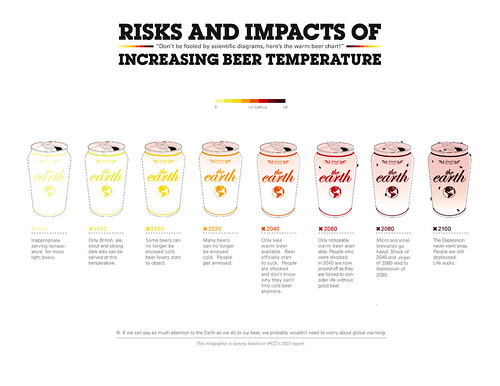
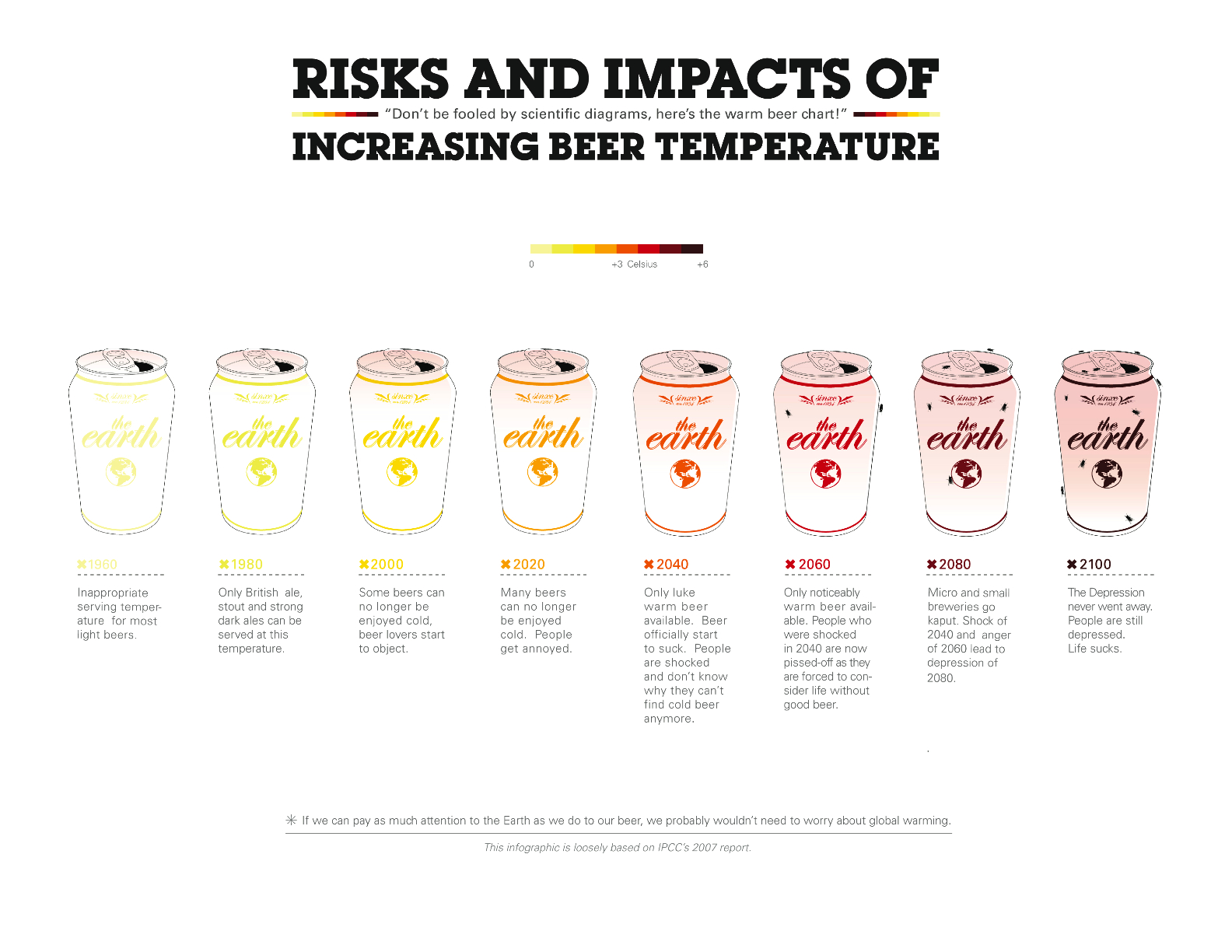
This is fairly clever. A blog dedicated to chronicling the science surrounding climate change, Real Climate, posted a chart comparing the chronology of climate change from 1960 through the year 2100. It was originally created by Artist As Citizen, which is described as “a collaborative, student-driven blend of art and journalism. The infographic is called Risks and Impacts of Increasing Beer Temperature.

beer-climate-change
You can view the full size version of the image here.

I’m not sure about that tagline. “If we can pay as much attention to the Earth as we do to our beer, we probably wouldn’t need to worry about global warming.” I’m pretty sure we can do both fairly easily. And it’s not as if beer drinking is what’s distracting us from addressing global warming.

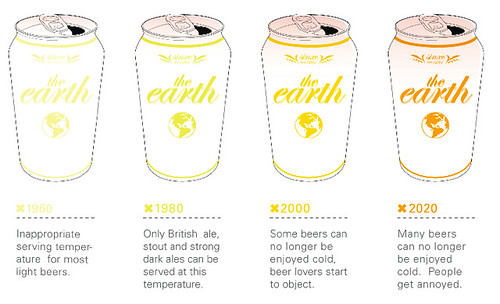
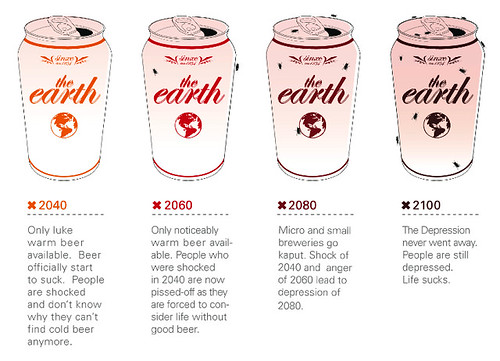
Still it’s interesting to see climate change described in terms of the serving temperature of beer. Below are the 8 stages of global warming split in two so they can bee seen a little larger, and consequently so the text is more readable, too.

1960—2020

beer-climate-change-left

2040—2100

beer-climate-change-right

Filed Under: Beers, Editorial, News, Related Pleasures Tagged With: Science

Hangover Cure News

December 6, 2011 By Jay Brooks

hangover
If you’ve ever looked at the science behind hangovers or endured enough of them, you probably already know that time is really the only cure for one. But when you’re feeling that bad, hope tends to spring eternal; and so hangover cures represent a pretty healthy business, bringing in untold millions of dollars. A hungover fool and his money are soon parted.

We all have our own preferred remedy. Mine is entirely preventative. Before going to bed, I take three Advils and a B-vitamin. More often than not, I wake up feeling fine. I also drink a lot of water, both during a drinking session and before retiring. I don’t think of it as a cure — indeed, I don’t believe there can actually be a cure — but for me it tends to head off the symtoms before they manifest themselves as discomfort or downright pain.

But companies keep taking P.T. Barnum’s prophetic words and proving them true, playing on our desire to do just about anything to speed up the recovery from a bad hangover. And in fact, two new ones are in the news today.
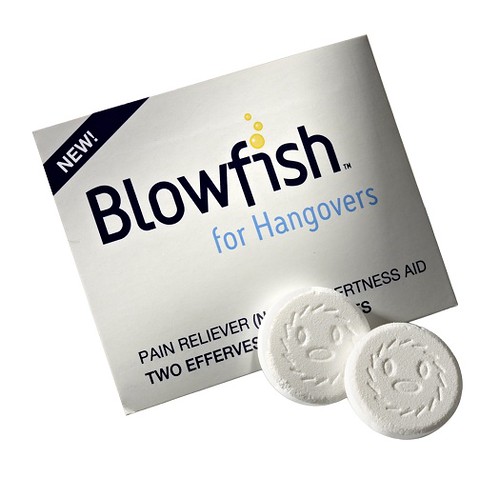
blowfish-tablets

Blowfish

Several news outlets, such as the NY Daily News, have the story that Blowfish tablets, recently approved by the FDA, is on the market, available for sale over-the-counter. The effervescent tablets “combine 1,000 milligrams of aspirin, 120 milligrams of caffeine and a stomach-soothing agent” which you dissolve in water the morning after. “Once dissolved in water, the remedy claims to knock out multiple hangover symptoms in just 15 to 30 minutes.” So far, it’s only for sale in New York City or at ForHangovers.com, and sells for $2.99 for a single dose, or $11.99 for a six-pack. Hmm.
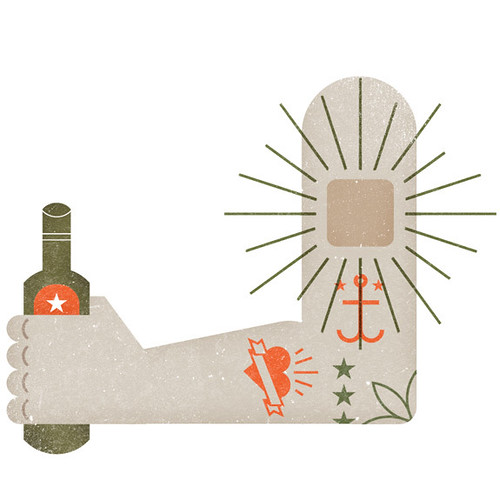
hangover-patch

The Vitamin Patch

The Daily has a story today regarding a patch that you wear on your arm — like a nicotine patch — that time releases B vitamins. “Bytox Inc., has created a hangover patch that slowly releases a complex of B vitamins over eight hours — from the hour before you start drinking to the morning after. The idea, said Dr. Leonard Grossman, is that nutrients are immediately delivered into the bloodstream and stay there instead of being depleted.”

Maybe, but that still seems like a lot of work when taking one pill before bedtime is so simple. Plus, you’d still need to keep drinking a lot of water, too. I continue to think that moderation is the best method, and when that fails, as it inevitably will on occasion, time is your only friend.

Filed Under: Just For Fun, News, Related Pleasures Tagged With: Hangovers, Health & Beer, Science

Real Bar Flies Prefer Pale Ale

November 28, 2011 By Jay Brooks

fly
A new study was reported last week by NPR about research into why insects are drawn to beer. When I was a kid, I remember my Great Aunt placing beer in shallow bowls and laying them on the floor around her house to attract, and drown, pesky insects. I’d always assumed that was because of the sugars in beer and the fact that many, if not most, insects are drawn to sweet flavors.

So scientists in Southern California looked closer at this phenomenon and published their results in Nature Neuroscience. The article, inscrutably titled Evolutionary Differences in Food Preference Rely on Gr64e, a Receptor for Glycerol, finds insights “into the molecular mechanisms of feeding acceptance of yeast products and raise the possibility that Gr64e contributes to specific evolutionary variations in appetitive selectivity across Drosophila species.”

Happily, the NPR article, clears up what that means:

Since flies are well known to like sugar, it could just be that flies like beer because they can detect some residual sugar in beer. But [researcher Anupama] Dahanukar suspected that might not be the case. So she planned an experiment. She would give the flies a choice between beer and sugar water, and see which they preferred.

“We selected a pale ale, and the main reason was because pale ales have very lower sugar contents,” says Dahanukar. “So we were trying to identify other chemicals — chemicals other than sugars that taste good to flies.”

Zev Wisotsky, a graduate student in Dahanukar’s lab, actually performed the experiment. “I remember it was a Saturday,” he says. “I grabbed the beer at the grocery store, came into the lab, and performed the two-choice assay.”

The two-choice assay forces the flies to choose between a sip of beer and a sip of sugar water. The flies went for the beer.

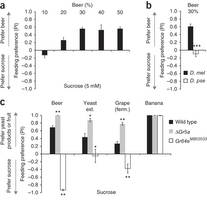
Figure 1: Feeding preference to yeast fermentation products is reduced in Gr64e mutants.
Figure 1 FINAL 9-2
(a) Feeding preference of wild-type flies (w1118) for beer (Bass & Co., Pale Ale) in a binary choice assay. For each concentration, n = 6. PI, preference index. (b) Feeding preference for beer, tested against 5 mM sucrose, in D. melanogaster…

Once they established the fly’s preference for beer, the scientists set about trying to figure out why.

“The answer, as it turns out, was quite simple,” says Dahanukar. “It’s a molecule called glycerol, which is made by yeast during fermentation.” Glycerol is the stuff that’s used in antifreeze. It actually tastes sweet, but it’s not a sugar.

Dahanukar and [researcher Zev] Wisotsky even found the particular gene responsible for flies’ ability to detect glycerol. When they created flies missing that gene, and gave them the sugar water-beer choice, the flies went for the sugar water.

Apparently, the ultimate purpose of the research is to understand how insects perceive chemicals in the hopes of designing better insect repellents. But for my money, I love the fact that they love Pale Ale.

Filed Under: Beers, Just For Fun, News Tagged With: Science

Updates On The Vodka & Tampon Hoax

November 21, 2011 By Jay Brooks

tampon
You may recall my skeptical take on the Vodka and Tampon story two weeks ago. Since then, I got an e-mail from a friend with a link to a Tiny Cat Pants post In Which I Debunk the Vodka-Soaked Tampon Myth. Today, I learned from the Missus that Danielle Crittenden, Managing Editor, Blogs, for the Huffington Post Canada was as skeptical as I was. Crittenden’s also the wife of famed conservative David Frum and an author in her own right. She posted her own efforts at reproducing the vodka tampon on the Huffington Post, in an article entitled Bartender, a Dirty Martini With a Tampon!. Like Tiny Cat Pants, it didn’t go well … at all. And it’s part of mounting evidence that the people spreading this story are, for lack of a better term, full of shit. As I suspected, this sounded more like an urban legend, a hoax, a way for media outlets to scare parents. But read Crittenden’s account, it’s pretty funny, and scary, but in a whole different way.

Filed Under: Editorial, News Tagged With: Rumors, Science

« Previous Page
Next Page »

Find Something

Northern California Breweries

Please consider purchasing my latest book, California Breweries North, available from Amazon, or ask for it at your local bookstore.

Recent Comments

  • Ernie Dewing on Historic Beer Birthday: Charles William Bergner 
  • Steve 'Pudgy' De Rose on Historic Beer Birthday: Jacob Schmidt
  • Jay Brooks on Beer Birthday: Bill Owens
  • Steve 'Pudgy' De Rose on Beer Birthday: Charles Finkel
  • Steve 'Pudgy' De Rose on Beer Birthday: Bill Owens

Recent Posts

  • Beer In Ads #5185: It’s Bock Time January 28, 2026
  • Beer Birthday: Shane McNamara January 28, 2026
  • Historic Beer Birthday: John Goetz January 28, 2026
  • Beer Birthday: Jean-Marie Rock January 28, 2026
  • Beer In Ads #5184: The “B”s Are Here, Bruton Bock Beer January 27, 2026

BBB Archives

Feedback

Head Quarter
This site is hosted and maintained by H25Q.dev. Any questions or comments for the webmaster can be directed here.