Brookston Beer Bulletin

Jay R. Brooks on Beer

  • Home
  • About
  • Editorial
  • Birthdays
  • Art & Beer

Socialize

  • Dribbble
  • Email
  • Facebook
  • Flickr
  • GitHub
  • Instagram
  • LinkedIn
  • Pinterest
  • RSS
  • Twitter
  • YouTube

Powered by Genesis

Blood Alcohol Content Effects At Different Levels

August 17, 2013 By Jay Brooks

bac-chart
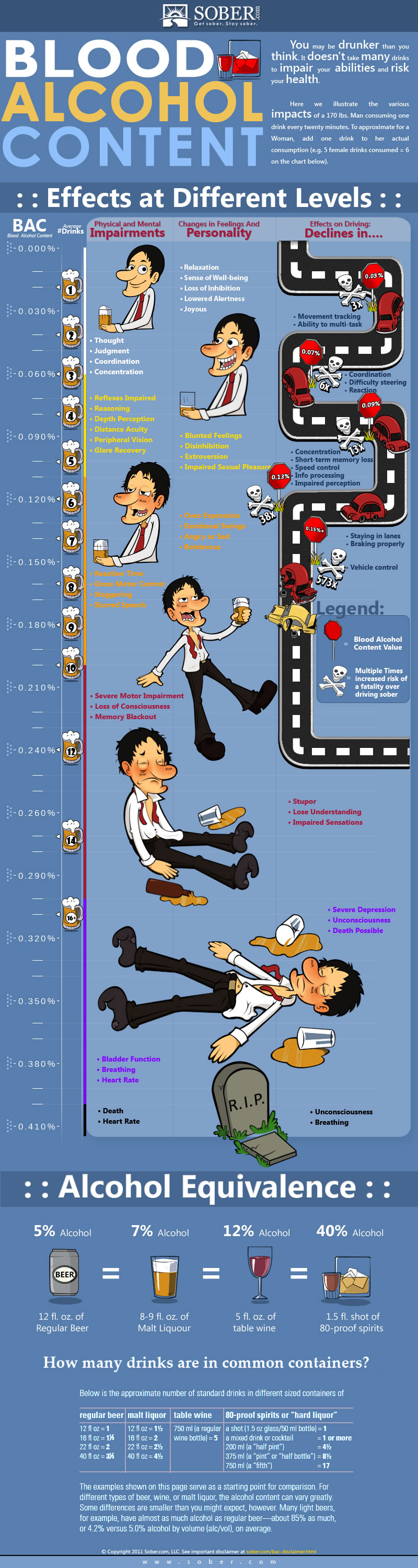
Today’s infographic, Blood Alcohol Content Effects At Different Levels, shows just that, moving from your first pint, at 0.000% BAC and proceeding to an untimely death at 0.410% BAC. It was created by Sober.com, a clearing house for treatment centers.
bac-alcohol-effects
Click here to see the infographic full size.

Filed Under: Beers, Just For Fun Tagged With: Health & Beer, Infographics, Statistics

Bud Blamed In Absurd E.R. Visit Study

August 16, 2013 By Jay Brooks

medicine
That the neo-prohibitionists are rife with propaganda is well documented, but this one may take the cake. A new study at John Hopkins, conducted by David Jernigan, appears to show that Budweiser is the most popular drink “most commonly linked to emergency room visits.” Apparently “Budweiser has 9.1 percent of the national beer market, and represents approximately 15 percent of the E.R. ‘market.'” After Bud, it was “Steel Reserve Malt Liquor, Colt 45 malt liquor, Bud Ice (another malt liquor), Bud Light, and a discount-priced vodka called Barton’s.” Another malt liquor brand, “King Cobra, account[s] for only 2.4 percent of the U.S. beer market, but accounted for 46 percent of the beer consumed by E.R. patients.” The conclusion, as reported by NBC News, was that “[o]verall, malt liquor and lower alcohol beer dominated consumption but vodka, gin, brandy and cognac were overrepresented, too.”

But despite all the attention and scary statistics and headlines — Alcohol Justice gleefully tweeted the headline Budweiser to Blame for Most Alcohol-Related ER Visits — the study itself is absurd. The story Sherrif A.J. retweeted was from Science World Report, and despite the headline, the story doesn’t back up the sensationalist tone of it at all. The “study,” if we can even call it that, consisted of giving a survey to 105 people at one inner city Baltimore E.R., in a predominately African-American neighborhood.

The study was done by David Jernigan, who in addition to being an associate professor in the Department of Health, Behavior and Society at the Johns Hopkins Bloomberg School of Public Health, is more importantly the director of the Center on Alcohol Marketing and Youth (CAMY), a notoriously anti-alcohol organization. That affiliation is not disclosed in any of the reports on this particular “study.”

Curiously, he does admit that both the Federal Trade Commission and the National Institute on Drug Abuse both told him personally that “this kind of research cannot be done.” Did he listen? Nope, he went right ahead and jumped to all sorts of conclusions, even though there’s no clear cut causality here whatsoever. And look how they conducted the study, and persuaded people to participate:

By using a drop down menu on a small notebook computer, the survey takers managed to obtain information from patients, and to include about 400 brands, in less than five minutes. At first, Jernigan, said, many patients refused to talk. But then the survey takers, with the permission of the emergency room staff, donned white coats. After that, patients talked freely.

See what they did? They put on white lab coats, so they looked like they worked there or were E.R. doctors, and tricked people into answering. Nice.

But the news was reported that, in fact, the conclusions were sound, especially in the headlines, which is only what a majority of people will see. The problems with the study, its limitations and lack of causality is buried toward the end, well after most people stop reading. The fact that it was done by essentially a neo-prohibitionist organization is never mentioned at all. And that certainly didn’t stop Johns Hopkins from issuing a press release. The study itself was published in the journal Substance Use & Misuse, under the title Alcohol Brand Use and Injury in the Emergency Department: A Pilot Study. But none of that stopped anybody from spreading the news about how Bud, and the other brands, are directly responsible for people visiting the E.R. It couldn’t be any other reason, right?

Filed Under: Beers, News, Politics & Law Tagged With: Anti-Alcohol, Prohibitionists, Statistics

Relative Prevalence Of The Word For Beer In Europe’s Ten Most Spoken Languages

August 13, 2013 By Jay Brooks

europe
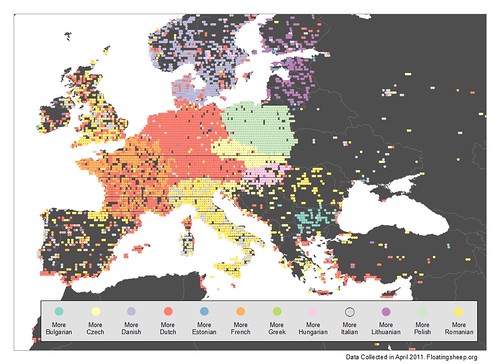
Today’s infographic graphs is similar to yesterday’s one showing “the relative prevalence of the word for beer in the world’s ten most spoken languages (by # of native speakers),” but instead shows the same metric for Europe. The map was also created by http://www.floatingsheep.org/2011/10/wherever-you-are-just-ask-for-beer.html”>Floating Sheep, and was a follow up to yesterdays.

Because simply mapping references to beer in the world’s most spoken languages yielded a relatively homogeneous result due to the significant number of references to “beer” and “ale” in English, we thought a more locally specific analysis would be appropriate. So we instead mapped references to beer in twelve languages spoken primarily in Europe that were not included in our earlier map. And while this map obviously doesn’t include all of the many languages spoken on the continent, these languages were chosen because of their relative prominence within a larger sample of languages.

world_beer_euro_110723
Click here to see the map full size.

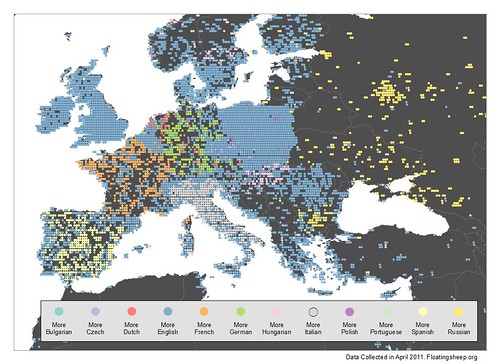
Despite the usefulness of this particular grouping, it remains useful to consider how some of the most spoken languages in the world stack up to these more country-specific languages, so in the map below we reintroduce references in English, as well as references in German, Portuguese, Russian and Spanish, to some of Europe’s more widely spoken tongues.

While this graphic complicates the picture provided by our first map — there continues to be a significant amount of content in the expected, native languages of each country — English remains prominent throughout Europe, especially in reference to beer.

world_beer_euromajor_110724
Click here to see the map full size.

Filed Under: Beers, Just For Fun Tagged With: Europe, Infographics, Language, Statistics

Relative Prevalence Of The Word For Beer In The World’s Ten Most Spoken Languages

August 12, 2013 By Jay Brooks

world-map-3
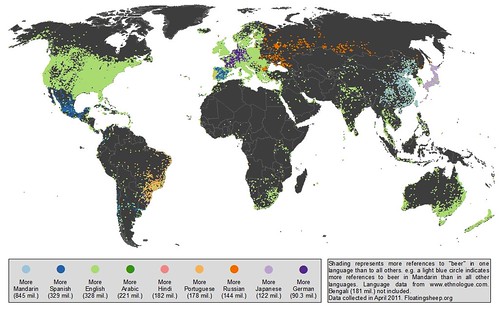
Today’s infographic graphs out the “the relative prevalence of the word for beer in the world’s ten most spoken languages (by # of native speakers). However, because of the fact that there were no points at which the number of references in the world’s sixth most-spoken language, Bengali, were greater than references to each of the other nine languages, we have excluded Bengali in this particular case. So while we’re sad to see Bengali left off the map, the fact that a language with 181 million native speakers has so few references to “beer” is telling of either vast inequalities in the way Bengalis are represented within the geoweb, or perhaps just their general distaste for beer.” The map was created by Floating Sheep, one of my favorite websites.

world_beer_top10_110723
Click here to see the map full size.

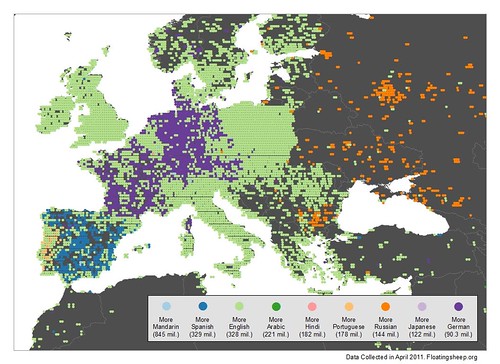
“Zooming in to Europe only further accentuates the relative dominance of English among these languages, with significant portions of Portugal, Spain, and Germany even showing more references to beer than in their native languages. Interesting, however, that much of France is a mixture of English and German references, even in the much more southern portions of the country.”

world_beer_top10_euro_110724
Click here to see the European map full size.

Filed Under: Beers, Just For Fun Tagged With: Infographics, International, Language, Statistics

Mosquitoes Prefer Beer Lovers

August 9, 2013 By Jay Brooks

mosquito
There was an interesting article recently in the Smithsonian’s Surprising Science entitled Why Do Mosquitoes Bite Some People More Than Others? The article provides a good overview about why some people get bitten more frequently than others, and some of the causes believed to account for this very real phenomenon.

An estimated 20 percent of people, it turns out, are especially delicious for mosquitoes, and get bit more often on a consistent basis. And while scientists don’t yet have a cure for the ailment, other than preventing bites with insect repellent (which, we’ve recently discovered, some mosquitoes can become immune to over time), they do have a number of ideas regarding why some of us are more prone to bites than others.

Some of the factors include blood type, carbon dioxide, exercise and metabolism, pregnancy, skin bacteria, the color of your clothing and even genetics. But the interesting one that stood out for me, of course, was beer.

Just a single 12-ounce bottle of beer can make you more attractive to the insects, one study found. But even though researchers had suspected this was because drinking increases the amount of ethanol excreted in sweat, or because it increases body temperature, neither of these factors were found to correlate with mosquito landings, making their affinity for drinkers something of a mystery.

That beer is a mosquito attracter was confirmed by a study with the wonderfully bland title Alcohol ingestion stimulates mosquito attraction (seriously, who comes up with the titles for journal articles, so often they’re just dreadful). Of course, even though they know that it’s true that drinking alcohol attracts more mosquito bites, they still haven’t a clue why.

I’d love to see a study of different kinds of beer to see if any particular kind is more attractive to mosquitos than another. Can you imagine the ad copy following that study? “Drink our beer at your next picnic and mosquitoes will leave you alone!”

Mosquito-Beach

Filed Under: Beers, Just For Fun, News Tagged With: Science, Statistics

Are Americans Turning Away From Beer?

August 6, 2013 By Jay Brooks

gallup-poll
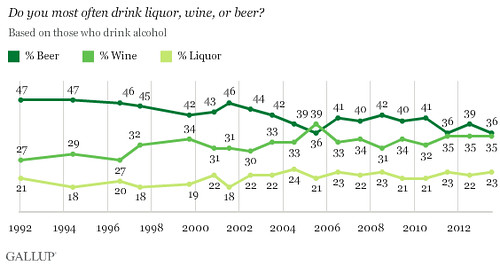
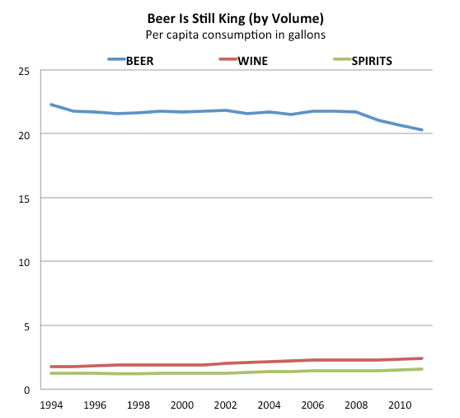
Well I can’t say that seems to be the case from my personal experience, but a new Gallup Poll is being spun that way, especially in an Atlantic article, Why Are American Drinkers Turning Against Beer? This particular Gallop Poll is done each year — since at least 1939 — and what you have to remember is that it’s a popularity poll, not necessarily a scientific one. The poll itself is conducted in a proper manner, but it’s asking people to “say what they drink” or “what they prefer.” And that’s far different from what the actual sales indicate. The last time I wrote about this was in 2010, when that year the Latest Gallup Poll Reveals Drinking At 25-Year High With Beer #1.

Gallop-2013-01

This year, the big story is “per capita consumption of beer down 20 percent,” as is overall production of beer. But as they continue to lump all beer together, when clearly patterns of drinking beer are changing, by keeping the poll simple they miss some of what’s really going on.

As my “beer brother” Lew Bryson commented. “Craft beer has been on a tear since 2002; latest figures have it up 15% annually (volume, 17% on $ sales). Volume sales of the majors are down, and trending downward steadily. Wine and spirits are picking up some of that, but craft is picking up a good share. It’s also worth noting that this IS a ‘what do you like’ poll, not ‘how much do you drink’ sales numbers. Beer still wins that by a sizable margin, both on volume and $ sales.” True indeed, when I wrote about this in 2010, beer outsold beer 4 to 1, showing just how skewed the difference is between what people say they like to drink, and what they actually drink.

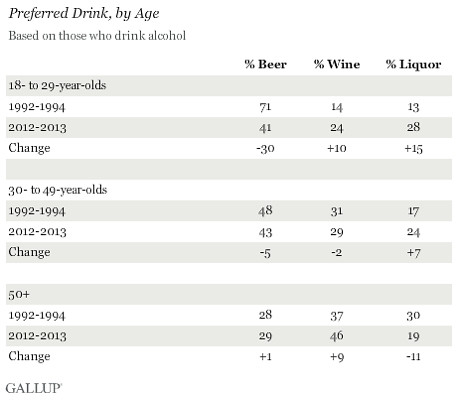
One curious thing I wonder about these polls, and other alcohol data generally, is why alcohol is always divided up into these three tidy boxes? And where in these categories, if anywhere, is captured the sales, preferences or what-have-you for cider, alcopops, sake and other beverages that don’t seem to fit neatly into one of the big three. Are they ignored, or lumped into one of the three? It’s seems a fairly relevant question, since cider’s on a big upswing and alcopops have had their ups and downs, but certainly have to be part of the equation, especially when it comes to the all-important 18-29 demographic. But not even the full report gives any additional clues.

Gallop-2013-02

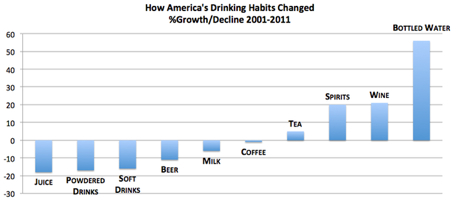
Another item that makes me question Gallup’s polling is the huge gains of bottled water. To me that has more to do with availability than anything else. It’s getting harder and harder to even find a water fountain these days, because business has figured out that people will pay for it when that have no choice.

Gallop-2013-03

Another explanation that didn’t ring true was that “American drinkers are more health-conscious today” and that’s led to people choosing other beverages, but even the author admits that this “does not adequately explain why Americans would turn against light beer,” as if that really is a healthy alternative. As I’ve said endlessly, low-calorie diet beer is hardly any healthier than non-light beers so that argument doesn’t hold any water … or even any watered-down beer.

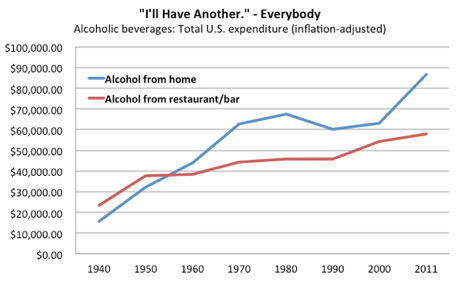
Happily, the day after this story ran on the Atlantic’s website, the same author posted The Death of Beer Has Been Greatly Exaggerated, in which Derek Thompson shows that, despite the Gallop Poll, “total U.S. spending on all alcoholic beverages — both at home and at restaurants and bars — is up 27 percent since 1980 and even more since the mid-century.”

Gallop-2013-04

And as I mentioned earlier, beer currently still outsells wine by a significant margin, and his data also indicates that “beer volume still outsells wine volume by 8.5” times! So it’s pretty hard to swallow once more that beer is on the ropes.

Gallop-2013-05

Thompson sums up his two days worth of articles:

The total amount of beer consumed by Americans is in structural decline, and there are more wine-drinkers than there used to be. But beer is still the most popular boozy beverage in America and overall sales are holding up, thanks in part to the emergence of craft beers.

Did we really need another Gallop Poll or Atlantic business writer to tell us that?

Filed Under: Beers, Editorial, News, Politics & Law Tagged With: Mainstream Coverage, Poll, Statistics, United States

American Beer Sales Continue To Climb: BA Releases Mid-Year Numbers

August 5, 2013 By Jay Brooks

ba
You probably saw this last week, but just in case, the Brewers Association released the preliminary mid-year numbers on how beer sales are going so far in 2013. It’s probably no surprise to most that the news is good, with double-digit growth once more, a common story these days.

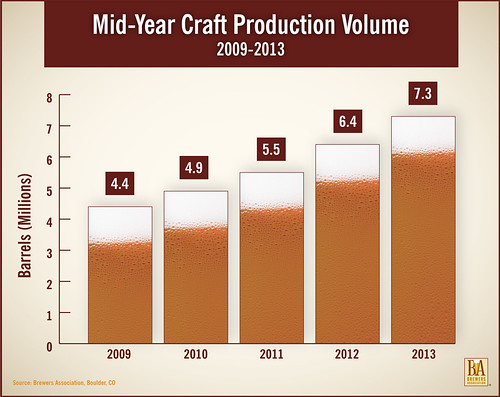
During the first six months of 2013, American craft beer dollar sales and volume were up 15 percent and 13 percent, respectively. Over the same period last year, dollar sales jumped 14 percent and volume increased 12 percent.

During the first half of 2013, approximately 7.3 million barrels of beer were sold by small and independent craft brewers, up from 6.4 million barrels over the first half of 2012. American craft beer continues to grow despite decreased overall beer sales, which were down two percent through the first six months of the year.

It’s nice to see the steady increases over the last five years.

MidYear_HR-2013

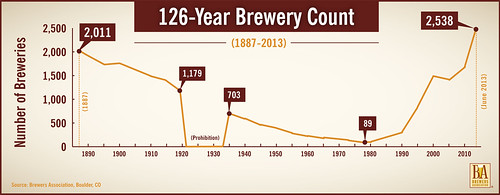
The number of breweries also continues the meteoric rise of late, with latest count standing at an amazing 2, 538.

There are 2,538 breweries operating in the U.S. as of June 30, 2013, an increase of 446 breweries since June 2012. The BA also lists an additional 1,605 breweries in planning at the year’s midpoint, compared to 1,252 a year ago. As of June 30, 2013, the count of craft breweries was at 2,483, showing that 98 percent of U.S. brewers are craft brewers. Craft brewers currently employ an estimated 108,440 full-time and part-time workers, many of which are manufacturing jobs, contributing significantly to the U.S. economy.

Brewery-Count-HR-2013

“More breweries are currently operating in the U.S. than at any time since the 1870s.” [Director of the Brewers Association, Paul] Gatza added. “With each new brewery opening, American craft brewers are reinforcing the U.S.’s position as the world’s most diverse brewing nation. It’s a very good time to be an American beer lover.”

Amen to that.

Filed Under: Beers, Breweries, News Tagged With: Brewers Association, Business, Statistics, United States

10 Surprising Health Benefits Of Drinking Beer

July 23, 2013 By Jay Brooks

health
Today’s infographic is entitled 10 Surprising Health Benefits of Drinking Beer, and was created by the Future of Health Now. None of these are particularly surprising, especially to regular readers, but thanks to anti-alcohol biases they tend to be under-reported and breweries are, in fact, forbidden from making health claims about their beer, another neo-prohibitionist victory. But drink up — in moderation of course — you’ll live longer and it’ll annoy the hell out of them.

10-surprising-health-benefits
Click here to see the chart full size.

Filed Under: Beers, Just For Fun, Related Pleasures Tagged With: Health & Beer, Infographics, Statistics

Facts About Beer

July 21, 2013 By Jay Brooks

beer-graphic
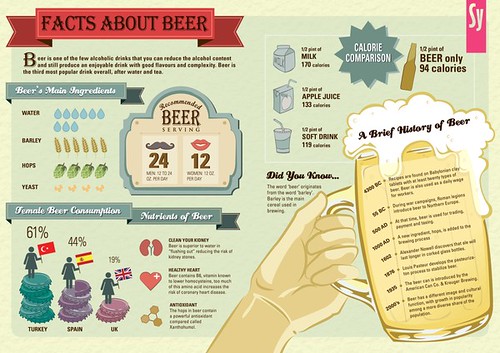
Today’s infographic is entitled “Facts About Beer,” and was created by Wong Sockying of Singapore. It looks like there’s a lot of information there, but I couldn’t find an example of much larger than the one below.

Facts-About-Beer
Click here to see the infographic full size.

Filed Under: Beers, Just For Fun Tagged With: Infographics, Singapore, Statistics

Where People Buy Their Beer

July 20, 2013 By Jay Brooks

pie-chart
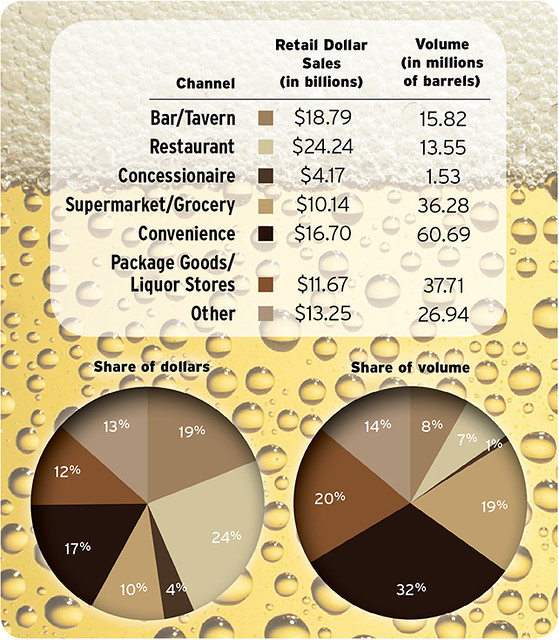
Today’s infographic is a pie chart showing where people buy their beer. The chart was originally used with an AdAge story, Stat of the Day: Where People Buy Their Beer, using statistics from February of last year. By dollars, most people buy their beer at restaurants, but imagine how much more would be sold if more restaurants actually paid better attention to their beer list. Second was bars, followed by convenience stores in third place. By volume, the most beer is sold at convenience stores, followed by supermarkets/grocery stores and “other” in third place. In both measure, concessions comes in last place; I wonder if the often-gouging price has something to do with that?

beer_sales642
Click here to see the chart full size.

Filed Under: Beers, Just For Fun Tagged With: Business, Infographics, Statistics

« Previous Page
Next Page »

Find Something

Northern California Breweries

Please consider purchasing my latest book, California Breweries North, available from Amazon, or ask for it at your local bookstore.

Recent Comments

  • Ernie Dewing on Historic Beer Birthday: Charles William Bergner 
  • Steve 'Pudgy' De Rose on Historic Beer Birthday: Jacob Schmidt
  • Jay Brooks on Beer Birthday: Bill Owens
  • Steve 'Pudgy' De Rose on Beer Birthday: Charles Finkel
  • Steve 'Pudgy' De Rose on Beer Birthday: Bill Owens

Recent Posts

  • Beer In Ads #5203: Robert Portner’s Bock Beer February 15, 2026
  • Historic Beer Birthday: August Schell February 15, 2026
  • Beer Birthday: Daniel Satterthwaite February 15, 2026
  • Beer In Ads #5202: Here’s To You Our Valentine Fidelio Bock Beer February 14, 2026
  • Historic Beer Birthday: Benedict Frank Haberle February 14, 2026

BBB Archives

Feedback

Head Quarter
This site is hosted and maintained by H25Q.dev. Any questions or comments for the webmaster can be directed here.