Brookston Beer Bulletin

Jay R. Brooks on Beer

  • Home
  • About
  • Editorial
  • Birthdays
  • Art & Beer

Socialize

  • Dribbble
  • Email
  • Facebook
  • Flickr
  • GitHub
  • Instagram
  • LinkedIn
  • Pinterest
  • RSS
  • Twitter
  • YouTube

Powered by Genesis

Graduation & Prom Drinking

May 4, 2011 By Jay Brooks

graduation
Apparently prom season and graduation time is coming up, because the scary statistics that always accompany this time of year are also starting to appear. Now before the angry comments start filling my queue, I’m not encouraging drinking at either, and especially not drinking and driving, no matter what the occasion. There are, however, some curious features about this time of the year about how we still try to scare our kids into staying sober for prom and graduation that bear scrutiny.

The first missive of Spring comes from Join Together, with the requisite scary headline School Nurse: It’s Not OK to Give Teens Alcohol for Prom and Graduation. Apparently, we’re more likely to listen up if it’s coming from the school nurse. And while I recognize that in many states it’s actually illegal to give your own underage kids alcohol, I’m pretty sure that these days it’s almost always illegal to give alcohol to kids who are not your own. But that’s all year round, and I have to believe that most adults who engage in purchasing or furnishing alcohol to their kids or their kids’ friends at this time of the year, do so with the full knowledge that what they’re doing is not acceptable in today’s social climate, not to mention its illegality.

But here’s the thing, the news report by the school nurse is based on another study, by an insurance company no less, and that headline is Study Shows 90 Percent of Teens Admit Stronger Likelihood of Drinking and Driving on Prom Night, Yet Less Than One-Third See Dangers. According to Liberty Mutual’s study, in “a national survey of more than 2,500 eleventh and twelfth graders, 90 percent of teens believe their counterparts are more likely to drink and drive on prom night and 79 percent believe the same is true for graduation night. Yet, that belief does not translate to concern, as only 29 percent and 25 percent of teens say that driving on prom night and graduation night, respectively, comes with a high degree of danger.” They claim that’s “new research,” as if we didn’t know teenagers believe themselves immortal and are likelier to take risks than the more mature segment of the population. It’s one of the features of being a teenager. But okay, it’s not bad advice to remind teens about the difference between perceived risks and reality, but it’s just so heavy-handed, so black and white. They’ve been using the same scare tactics since I was going to prom over thirty years ago. Here’s the latest version:

[T]here were 380 teen alcohol-related traffic deaths during prom and graduation season (April, May and June) in 2007, according to the National Highway Traffic Safety Administration. And the Insurance Institute for Highway Safety reports 1,009 total teen fatalities (alcohol and non-alcohol-related) in motor vehicle crashes during those same months in 2008.

Alarmingly, parents may be unwitting enablers of teen drinking and driving: more than one in three teens (36 percent) say their parents have allowed them to attend parties where it is known that alcohol will be served, and 14 percent say their parents have, in fact, hosted such teen gatherings.

But it just strikes me as the razor blade in the apple. Every Halloween, that story gets trotted out to scare kids into being responsible about accepting candy from strangers during the holiday that’s designed for just that. As a kid, I remember being nervous about that the first year, but after hearing it over and over again, and never once seeing any real proof of a razor in an apple, any meaningful fear tended to dissipate. I can’t be the only adult who remembers that as a child there was a great sense that adults were constantly lying to us about the dangers of the world, among many other things less threatening.

But let’s look at those scary statistics. According to the U.S. Census Bureau in 2008, there were 21,469,780 prom-age teenagers in America. So that means 0.0017% died in “alcohol-related traffic” accidents and 0.0046% in “alcohol and non-alcohol-related” traffic accidents. Now as a parent, I agree that even one needless death is too many, and I’d be inconsolable if it happened to one of my children. But the point is that the danger is relatively low compared to other dangers every person in the world faces every day. That seems so obvious to me I’m not even going to go looking for those, because any rational person should recognize that.

Yet here we are again chastising parents for trying to do something about it that’s not just the knee jerk “just say no” total-abstinence policy that we’re so fond of here in the U.S. Our response is simply disproportionate to the true danger, and I can’t help but believe the reason is because it’s — gasp — alcohol and we’ve lost the ability to be rational about it.

The fact that according to the scary news reports, this is still claimed to be a huge problem nearly 30 years after MADD supposedly set everybody straight and awareness of the issue of drunk driving is at an all-time high, should convince anyone that there is nothing we can do to stop people, even underage kids, from drinking. Prohibition didn’t work. More awareness didn’t work. The “just say no” campaign didn’t work. Kids are still drinking now, as they did nearly 35 years ago when I graduated from high school.

Back in those dark ages, it was quite common for parents to be at high school parties where alcohol was being served, at least where I grew up in suburban Pennsylvania. And most of the other parents in the community were not only aware of it but supported it. I have to laugh when the modern reports refer to such situations as making the parents “unwitting enablers” when there was not one driving fatality from the dozens and dozens of such events I attended in my youth. Parents took keys, and wouldn’t let anyone drive home if they were unable to. It made things safer, despite this weird notion today that the opposite is true.
young-frankenstein-movie

I recall one of the several graduation parties I went to as an 18-year old, the parents had a few kegs and even entertainment for us. The girl’s father was a movie projectionist and had a movie theater set up in their basement, and he was showing Young Frankenstein, which was only a few years old at that time (and this was in the days before videotape). It was great fun. I walked home that evening, retrieving my car the next morning. No harm, no foul. No one at that party got into any trouble. Imagine that?

Just lucky? Maybe, but I don’t think so. It was most certainly a different time, but that doesn’t mean the parents in my youth didn’t care about their children every bit as much as today’s parents. It feels quite insulting to read today’s adults, who were raised no doubt by loving parents, imply otherwise. You read these press releases, studies and propaganda and start to get the impression that any parent who gives their kid a drink is a monster. These same reports seem to see parents giving alcohol to kids in only one way, as completely irresponsible. But as with the other recent study I wrote about last week, there’s no suggestion that education could be part of it, or that parents might be better judges of how to raise their own children. Or that a party with alcohol that’s supervised could be preferable to kids drinking completely unsupervised, underground. Yet how could it not?

Yes, there’s no doubt our job as parents involves keeping our children safe, during prom season, graduation and every other time of the year, throughout their entire lives, really. But when it comes to alcohol, I’m quite tired of how the anti-alcohol abstinence policy seeps its way into every nook and cranny, particularly when it’s so ineffective. It doesn’t work on college campuses, where all it does is drive underage drinking underground, where it’s unsupervised and as a result far more dangerous. There’s no reason to believe it works any better at the high school level, either. High school kids often struggle with where they fit in society. They’re not really children anymore, yet they’re not quite adults, either. They often want to become adults faster than their parents and society will allow. It’s only natural. They see adults celebrate all manner of occasions — holidays, births, deaths, birthdays, achievements, good news, etc. — with alcohol. For them, the prom and graduation are reasons to celebrate. They want to be adults, they want to act like adults. So they want a drink, too. But many, if not most, are not ready to handle the personal responsibility that comes with drinking alcohol. In part, that’s because no one has taught them anything about how to accomplish that, and in fact even teaching them about alcohol is forbidden in many places and jurisdictions.

So when we instead keep creating policies that keep that status quo, in fact make it harder for parents to be in a position to supervise or educate their own kids about alcohol, I can’t help but wonder what’s really going on. It has to be more about control or ideology or something, because it’s not what’s best for the kids, despite being framed that way. It’s that old “it’s for the kids” canard that’s become so popular in anti-alcohol propaganda. But this goes even a bit further, as it tells parents not only to talk to their kids, not buy them alcohol and don’t let them drive after drinking — all good advice — but also that they shouldn’t do what they feel is best if it deviates from the party line (or perhaps “no party line”). It presumes all adult supervision is bad, and then tries to back up that claim with nonsense. It creates a black and white ideological world where only abstinence is approved. But it doesn’t matter how many more flawed studies or well-meaning advice from school nurses is doled out, “just say no” just doesn’t work. Could we please stop pretending it does, ignoring other approaches that might have a better chance at being effective? Why don’t we try “just say know” for a change. After all, school is supposed to be about learning, about preparing kids to become independent adults, productive members of society. Why not let that include a little alcohol education, too. That might go a long way toward keeping our youth safe on prom night and graduation, too.

Filed Under: Beers, Editorial, Events, Politics & Law Tagged With: Prohibitionists, Statistics

The Science Of Manipulation: New Study Comparing Underage Drinking Riddled With Problems

April 28, 2011 By Jay Brooks

scientist-mad
Join Together and the Partnership For a Drugfree America yesterday sent out an item in their e-mail blast entitled Teens Who Drink with Adult Supervision Have More Drinking Problems, Study Finds. Alarming, right? Likewise, the Seattle Post-Intelligencer’s went even farther with this misleading headline: UW study: Teens don’t need parents as ‘drinking buddies’.

But do these headlines accurately convey what the study actually found? Unsurprisingly, no. Not even close. Naturally, most news organizations don’t really care about the news or how accurately they portray it. Many of the reporters do, I should hasten to add, but the companies themselves and people that run them, not so much. It’s one of those open secrets that they’re businesses and what they care about is revenue. Advertising. Making money. They cynically refer to the empty spots in their papers where there is no advertising as “news holes.” That’s not necessarily a criticism. They do, I realize, have to make a profit. But it’s important to remember that they understand that fear, danger and making people uneasy sells far more papers than telling us everything’s hunky dory. “If it bleeds, it leads” is another well-known news axiom. Headlines are designed to pull in readers, to make them want to read the article. As a result, the more salacious or fearful the headline is, the more likely we’ll be persuaded to read the paper (and see all that glorious advertising that surrounds it).

The people who are against alcohol and have their own agenda to advance — those pesky neo-prohibitionists — also know how the world works and create studies that can be used to advance their cause. Lying with statistics is perhaps one of the oldest forms of propaganda. It’s certainly one of the most effective, because people tend to believe “studies” created in academia. They get them published in so-called scientific or academic journals, which while they have the imprimatur of accuracy, are often not as accurate as they first appear to be. Firstly, there’s just the law of large numbers, with an estimated 50 million such papers having been published since anybody started tracking these things, around 1665. Then how many are truly accurate or are based on legitimate premises or science? A 2009 Scottish study (and yes, I see the irony in relying on a study to discuss the inaccuracy of studies) entitled How Many Scientists Fabricate and Falsify Research? A Systematic Review and Meta-Analysis of Survey Data revealed that a weighted average of nearly 2% “of scientists admitted to have fabricated, falsified or modified data or results,” and “up to 33.7% admitted other questionable research practices.” Worse still, when surveying their colleagues’ practices, scientists believed 14.2% of them falsified papers, “and up to 72% [engaged in] other questionable research practices.” At just one university, “81% were ‘willing to select, omit or fabricate data to win a grant or publish a paper.'” The point is that journal articles are hardly as sacrosanct as the media would have us believe. Common sense is still required. Asking about the agenda, where the money or support came from or how the study was conducted often reveals surprising results, yet the supposedly fair and balanced media more often takes them unquestioningly at face value, especially if they advance a particular agenda or can be used to scare people into reading an article.

In this case, the headlines state quite emphatically that if you drink along with your underage kids that more problems will ensue for your children. How did they arrive at that conclusion? According to the articles that conclusion was reached when “[r]esearchers looked at 1,945 adolescents in Washington state and Australia and compared two approaches to underage drinking: Zero-tolerance attitudes and ‘harm minimization.'” Join Together added that “[t]hey chose to include teens from both the U.S. and Australia because the two countries have different attitudes about teens and drinking.” And they further described the differences like this. “While the U.S. Surgeon General recently issued a call to action promoting a zero-tolerance position toward youth alcohol use, in Australia surveys indicate that 30 percent to 50 percent of teen drinkers get alcohol from their parents.”

So from that, the two articles conclude the following:

The study found that by ninth grade, 71 percent of Australian teens and 45 percent of U.S. teens used alcohol. More than a third (36 percent) of Australian students reported having experienced harmful consequences resulting from alcohol use, compared with 21 percent of U.S. teens.

“Providing opportunities for drinking in supervised contexts did not inhibit alcohol use or harmful use in either state,” the researchers wrote. They recommend that policies should not encourage parents to drink with their children and parents should not allow their children to drink under their supervision.

“Findings challenge the harm-minimization position that supervised alcohol use or early-age alcohol use will reduce the development of adolescent alcohol problems,” the researchers wrote.

But let’s look at the study itself, Influence of Family Factors and Supervised Alcohol Use on Adolescent Alcohol Use and Harms: Similarities Between Youth in Different Alcohol Policy Contexts. According to the Abstract, their objective was the following:

Harm-minimization policies suggest that alcohol use is a part of normal adolescent development and that parents should supervise their children’s use to encourage responsible drinking. Zero-tolerance policies suggest that all underage alcohol use should be discouraged. This article compared hypotheses derived from harm-minimization and zero-tolerance policies regarding the influence of family context and supervised drinking on adolescent alcohol use and related harms among adolescents in Washington State, USA, and Victoria, Australia, two states that have respectively adopted zero-tolerance and harm-minimization policies

And while I’ll agree that that sounds reasonable, comparing just two makes it an us vs. them scenario. And why Australia? The claim is that it’s because of the two policy differences, but there are, of course, other ones. For example, Australian youths become adults at 18 and that includes the ability to legally buy and consume alcohol, unlike here in the U.S., where we have essentially two levels of adulthood and our youth must wait until they’re 21 to legally imbibe. Then there’s the drinking culture. Here in the U.S., we’re ranked 13th in per capita alcohol consumption, drinking about 81.6 litres (21.5 gallons per year, or roughly 230 12 oz. bottles or 9.5 cases per year). Australia, by contrast, is ranked 5th and consumes 104.7 litres (27.6 gallons, or roughly 295 12 oz. bottles or 12.3 cases per year). By percentage, the difference is that Americans, on average, drink about three-quarters of what Australians do.

I can’t help but believe that choosing just two so disparate drinking cultures, with no control, essentially created a false dichotomy, an either or situation. It seems to me, a survey or multiple nations would be far more revealing.

The so-called “harmful consequences” were self-reported and included “loss of control (“not able to stop drinking once you had started”) and social conflict (“trouble at school the next day,” “arguments with your family,” and “become violent and get into a fight”). Other alcohol-related consequences were “got injured or had an accident,” “had sex with someone, which you later regretted,” “got so drunk you were sick or passed out,” and “were unable to remember the night before because you had been drinking (blackouts).” Just under 3% of the kids had their answers discounted because they were considered to be dishonest, which given the subject matter seems quite low, to me at least. But that aside, many of the behaviors listed, except of course the ones directly related to drinking (“loss of control” and “blackouts”) don’t require alcohol to be fairly common in adolescence. As a result, it seems to me that causality doesn’t necessarily have to be in the alcohol. Any of those experiences could have happened with or without alcohol. Young teenagers could even experience something similar to a “loss of control” without alcohol — I know my friends and I sometimes did at that age. Alcohol could cause such behaviors, or exacerbate them, but it seems to me it shouldn’t be a given that the two are conclusively linked to one another.

Predictably, the prevalence of alcohol use behavior in both states increased over time between seventh and ninth grades. Lifetime alcohol use by seventh grade among Victoria students was significantly higher than among Washington students (59% vs. 39%). By eighth grade, drinking in adult supervised settings was reported by two thirds of students in Victoria and 35% of Washington youth. By ninth grade, rates of alcohol use had increased to 71% in Victoria and 45% in Washington. More than a third of Victoria students (36%) also reported having experienced any harmful consequences resulting from their alcohol use, compared

What’s also not in the reports of the study is that the kids studied were 7th graders — 12 and 13-years olds — who were then followed over the subsequent three years. So another problem with that data is that an 8th grader in the U.S. is seven years from the minimum drinking age whereas an Australian is only three years from being allowed to legally drink. That, I think, would change any parents’ decision to educate their child about alcohol, and especially when and how they’d educate them regardless of the ages being the same. It would also go a long way in explaining the results.

Another issue I see is that the general terms “favorable parental attitudes toward alcohol use” and “adult-supervised alcohol use” is never really defined, suggesting it has only a general meaning that avoids any nuanced difference. For example, I think there’s a big difference between an alcoholic who lets their kids drink because they don’t care or don’t see any possible harm and a parent who carefully tries to educate their kids about responsible drinking. One might just allow drinking in the household without limit while the other’s goal would be to sample their kids and model behavior to show that moderation and enjoyment is the key. Those are two very different approaches that would both fall under the umbrella of “favorable parental attitudes toward alcohol use” and “adult-supervised alcohol use” as far as the study is concerned.

In the summary discussion, the researchers concluded that “although harm-minimization perspectives contend that youth drinking in adult-supervised settings is protective against future harmful use, we found that adult supervised drinking in both states resulted in higher levels of harmful alcohol use.” But even in their own discussion of the study’s limitations, they admit that the lack of specificity of which adult was doing the supervising and the problems inherent in adolescents self-reporting and further contend that “a more concrete
measure asking about parents or guardians overseeing youth alcohol use may have yielded different results.”

Though not mentioned specifically, they never even bring up or account for the nature and type of the adult supervision, and for me that’s the most important factor. Because it’s not just that adults should allow their children to drink in their presence. They should use such opportunities to educate and teach them about alcohol. Merely allowing such behavior I would contend, is reckless and even counter-productive and on that point, I agree with the premise of the study. But their methods do nothing to make that all-important distinction, which is the crux of the issue, at least to my way of thinking.

And while I do doubt the sincerity of the researchers and the study itself, the media and especially the anti-alcohol groups will use the study to their own ends and gloss over the study’s own admitted limitations. As the headlines make clear, they’re not interested in accurately portraying the study’s results. Few people will go to the trouble of actually reading it, and will take it at face value, never questioning the results. Especially egregious is lead researcher Barbara McMorris’ quote that “[k]ids need parents to be parents and not drinking buddies.” Did anyone suggest otherwise? Ever? No, but characterizing any adult supervised drinking as being a “drinking buddy” makes her intentions somewhat suspect. Because raising a child to be an independent and productive adult member of society is not merely saying no. We saw how well that worked when Nancy Reagen tried it in the 80s. Sometimes we have to show them the way, teach them the difference between good and bad in a way that’s not just black and white. Things are rarely all-good or all-bad, and alcohol is a prime example. Saying adults shouldn’t be allowed to educate their children about alcohol robs them of the ability of doing their job. And pushing a zero-tolerance policy with this faulty “study” does nothing to further the goal of parents’ raising responsible adults.

So when the study concludes that their “[f]indings challenge the harm-minimization position that supervised alcohol use or early-age alcohol use will reduce the development of adolescent alcohol problems” and in the final sentence they claim that the “[r]esults from the current study provide consistent support for parents adopting a ‘no-use’ standard if they want to reduce harmful alcohol use among their adolescents,” I have to question their motives. Because those statements are essentially false. That conclusion is sound only if you ignore the manner in which the parents supervise their children, and seems to assume there is no positive way to educate your children about alcohol under supervision. I, myself, wouldn’t want to start that process in the 7th grade, but by high school, I think every child should be taught about a great many things that our schools don’t tackle. And that leaves it to every parent to prepare their children for adulthood, including teaching them about the use of alcohol. Saying the only way to prepare them for becoming an adult is to make sure they never drink the stuff all but insures they’ll binge drink the first chance they get, whether as a freshman in college or whenever they’re unsupervised. There’s nothing like a taboo to create demand. And that strikes me as irresponsible. That strikes me as the science of manipulation.

mad_scientist

Filed Under: Editorial, News, Politics & Law Tagged With: Prohibitionists, Science, Statistics

UK Gov’t Statistics On Women Drinking Found To Be Wrong

April 19, 2011 By Jay Brooks

ofc-nat-stats
For the second time in a few years, a UK Government agency has admitted to making a mistake regarding statistics used in the creation and furtherance of alcohol policy. The first, in 2007, was when the UK’s Department of Health revealed that the definition of a hazardous drinker, that is what the safe limits of alcohol intake were said to be, was completely made up, quite literally “plucked out of the air.”

On Monday, the UK’s Office for National Statistics (ONS) “admitted that it misrepresented the trends in alcohol consumption and has issued a sincere apology to the Portman Group, the drinks industry organisation that champions responsible drinking.”

According to Straight Statistics:

In a report about the productivity of the NHS published at the end of last month, the claim was made that the proportion of women drinking more than 14 units a week had increased by a fifth since 1998, leading to a greater demand for healthcare. As Straight Statistics reported here, there was no justification for such a claim.

A change in methodology for measuring alcohol consumption in 2006 creates a break in the time series. If not allowed for, this gives the impression that the number of women who exceed 14 units a week has indeed increased. Plenty of anti-drink campaigners are happy to spread this false message but it came as a shock when the ONS did so.

David Poley, chief executive of the Portman Group wrote to Stephen Penneck, Director General of the ONS, who has now replied admitting that Mr Poley’s concerns are “entirely justified”. He blames a “lapse in the quality assurance process by which we check carefully the accuracy and reliability of any information that is for publication … unfortunately in this rare instance a key issue went unnoticed.”

The article and press release have been amended. The article, accessible here, is now proceeded by a correction notice. The press release now reads: “The percentage of males and females consuming over the weekly recommended alcohol limits declined from 2006 to 2009.”

Mr Penneck’s response is prompt, straightforward, and makes no attempt to fudge the issue. If only it were equally easy to persuade the media to look more critically at its assumptions about drinking being out of control.

At least they admitted their error. I doubt the same would be true on this side of the pond, where statistical errors tend to live in perpetuity if they serve the anti-alcohol agenda. But the original stories that parroted the incorrect statistics that drinking for women has increased in The Daily Telegraph, the Daily Mail and the Daily Star are still out there and, as far as I know, have not been corrected. They can’t be, really, because the stories focused on the false problem at the heart of the mistake. And that’s the same here, too, as propaganda — even after it’s been disproved — is still used by numerous anti-alcohol groups. Repeat a lie often enough and … well, you know the rest.

Filed Under: Editorial, News, Politics & Law Tagged With: Prohibitionists, Statistics, UK, Women

When Science Becomes Propaganda: The Caffeine & Alcohol Conundrum

April 18, 2011 By Jay Brooks

science
Ugh. To me there’s nothing worse than junk science, especially when it’s in the service of an agenda. And that’s how this latest “study” in the journal Alcoholism: Clinical and Experimental Research comes across. The title of the “study” is Effects of Energy Drinks Mixed with Alcohol on Behavioral Control: Risks for College Students Consuming Trendy Cocktails and was conducted at the Universities of Northern Kentucky and the Maryland School of Public Health. Here’s how the press release for the study explains it:

  • A new laboratory study compares the effects of alcohol alone versus alcohol mixed with an energy drink on a cognitive task, as well as participants’ reports of feelings of intoxication.
  • Results show that energy drinks can enhance the feeling of stimulation that occurs when drinking alcohol.
  • However, energy drinks did not alter the level of behavioral impairment when drinking alcohol, particularly for impaired impulse control.
  • The combination of impaired impulse control and enhanced stimulation may make energy drinks combined with alcohol riskier than alcohol alone.

Energy drinks mixed with alcohol, such as Red Bull™ and vodka, have become trendy. While this consumption has been implicated in risky drinking practices and associated accidents and injuries, there is little laboratory research on how the effects of this combination differ from those of drinking alcohol alone. A recent laboratory study, comparing measures of intoxication due to alcohol alone versus alcohol/energy drink, has found that the combination of the energy drink enhanced feelings of stimulation in participants. However, the energy drink did not change the level of impairment for impulsive behavior. These findings suggest that energy drinks combined with alcohol may increase the risks associated with drinking.

But take a closer look at what that says. The caffeine stimulates. Well, duh. That’s what caffeine does. Did anybody doubt that? Then the study goes on to say that “energy drinks did not alter the level of behavioral impairment when drinking alcohol,” meaning it didn’t make people more drunk. Then they conclude combining caffeine and alcohol “may increase the risks associated with drinking [my emphasis].”

Here’s how they conducted it:

Marczinski [lead author] and her colleagues randomly assigned 56 college student participants (28 men, 28 women), between the ages of 21 and 33, to one of four groups that received four different doses: 0.65 g/kg alcohol, 3.57 ml/kg energy drink, energy drink/alcohol, or a placebo beverage. The participants’ behavior was measured on a task that measures how quickly one can execute and suppress actions following the dose. Participants also rated how they felt, including feelings of stimulation, sedation, impairment, and levels of intoxication.

“We found that an energy drink alters the reaction to alcohol that a drinker experiences when compared to a drinker that consumed alcohol alone,” said Marczinski. “A consumer of alcohol, with or without the energy drink, acts impulsively compared to when they had not consumed alcohol. However, the consumer of the alcohol/energy drink felt more stimulated compared to an alcohol-alone consumer. Therefore, consumption of an energy drink combined with alcohol sets up a risky scenario for the drinker due to this enhanced feeling of stimulation and high impulsivity levels.”

“To reiterate,” said Arria, “the investigators found that the presence of an energy drink did not change the level of impairment associated with alcohol consumption.” It did, however, change the perception of impairment.

“The findings from this study provide concrete laboratory evidence that the mixture of energy drinks with alcohol is riskier than alcohol alone,” said Marczinski. “College students need to be aware of the risks of these beverages. Moreover, clinicians who are working with risky drinkers will need to try and steer their clients away from these beverages.”

But that’s hardly “concrete” as she characterizes it. In fact, it’s the very opposite of concrete. It didn’t change impairment, just how people felt about it, how they perceived it. From that “insight” they concluded that since being stimulated “sets up a risky scenario for the drinker” that therefore the risk is greater. And they recommend that people should “be aware of the risks.” So far, so good. But if you didn’t realize drinking coffee after alcohol would stimulate you, perhaps you shouldn’t be in college after all. Maybe it’s time to lower your sights if that obvious bit of wisdom eluded you. I hear McDonald’s is hiring.

When Marczinski states that “[y]oung people are now drinking alcohol in different ways than they have in the past” I have to wonder what her evidence is for that nonsense. People have been mixing caffeine and alcohol for as long as the two have been around, I’d wager. This is one of those generational things, where the older one always believes the younger generation is worse than they were. The only difference between when I was a kid and now, at least regarding caffeine and alcohol, is that you don’t have to go to the trouble of mixing it yourself.

And I shouldn’t have to say this, but I’m not a fan of alcopops or alcoholic drinks with caffeine added (that is not naturally occurring like many coffee stouts, for example). But for me, that’s not the issue. The issue is society going out of its mind over a perceived problem for which there is only anecdotal evidence that there even is a problem. And this study seems like more of the same. I don’t like these drinks, don’t drink them myself, but I don’t think they should be banned just because some people don’t like them. There are obviously adults who bought them, and want to continue buying them, and they shouldn’t be removed from shelves just so that kids can’t buy them. Kids are already prohibited from buying them. If kids can still get them, that’s an entirely different problem. Kids can’t own guns either, but I don’t see any movement to ban all guns so that we can keep them out of the hands of children. That’s just not how a society should function. We shouldn’t make the world safe for our children by only allowing kid friendly products to be in it.

In the end, this “study” is hardly the hard evidence that the caffeine and alcohol conundrum has now been solved and they’ve found the data to close the book on this scourge. Even its authors know as much, as they use qualifying words all over the place. Their hesitation is right there in the title of the press release, which is “Drinking energy beverages mixed with alcohol may be riskier than drinking alcohol alone.” [my emphasis.] Up front, it tells you this is not as conclusive as you might otherwise think because they admit that a greater risk is simply possible. Beyond using an almost laughable 56 test subjects, the study simply jumps to anecdotal conclusions that are not supported by what passes for hard data. There really isn’t any hard data beyond people’s feelings after having consumed alcohol and then alcohol with caffeine and the authors then concluding those feelings might turn into actions that were riskier.

But even as honestly as the study states that their “findings suggest that energy drinks combined with alcohol may increase the risks associated with drinking,” naturally that’s not how it’s being reported. Every headline has essentially removed the qualifying “might” and made it sound far scarier and more conclusive than it really is. Here’s just a few examples.

Combining Energy Drinks with Alcohol More Dangerous Than Drinking Alcohol Alone at Partnership for a Drug Free America and as linked to a Join Together e-mail blast. And that report begins by stating that “A new study finds that consuming a caffeine-infused energy drink combined with alcohol is more dangerous than drinking alcohol alone.” But that’s not what the study concluded at all.

Likewise, HealthDay’s headline was Alcohol-Energy Drink Combo Riskier Than Booze Alone, Study Says, MedPage states Alcohol and Energy Drinks, a Risky Combination and News Feed Researcher claims Study: Alcohol, Energy Drinks Are Risky Combo. But again, those headlines are misleading. That’s not what the “study” claims. The “study” never even mentions drunk driving, but sure enough some of the news reports do. All the “study” says is that drinking alcohol and caffeine might make you feel more stimulated which might possibly lead you to act more impulsively, which might make you engage in riskier behaviors. Maybe. Maybe we can agree that’s not exactly science, but propaganda.

Filed Under: Editorial, News, Politics & Law Tagged With: Prohibitionists, Propaganda, Science, Statistics

The Brain and Alcohol Research Project

April 17, 2011 By Jay Brooks

trinity-college
Trinity College, in Hartford, Connecticut, at the end of March released some preliminary results after three years of a five-year study entitled the Brain and Alcohol Research Project. In a press release entitled What Students’ Brains Have Told Us about the Effects of Binge Drinking, they revealed the following:

Young adults who binge drink tend to perform worse in class than normally would have been expected, but only in the first year of college. After that, drinking to excess produces no discernible difference in academic performance.

So the obvious takeaway from that is that during a student’s first year away from home and away from parental rule, young adults tend to go a little wild that first year but then settle down into academic life for the remaining three years of their four-year college experience. They may not stop drinking, but they figure out how to hit the books, too. It seems rather predictable when you think about, especially when there’s virtually no alcohol education prior to college and in some states even parents are forbidden from educating their own children about drinking.

But it also seems to fly in the face of the neo-prohibitionist hue and cry about underage drinking being as bad for student performance as believed. And undoubtedly the worst of it is because it’s underground as a result of the minimum age being 21 instead of a more reasonable 18.

Also known as BARCS (for Brain and Alcohol Research with College Students), the project is “a large-scale longitudinal study that includes more than 2,000 college students from diverse backgrounds, set out to definitively address previously unanswered questions such as: Can heavy drinking in college affect brain structure and grades? If so, is it related to the overall amount of alcohol consumed or more to consumption patterns, such as binging and blackouts? Why is it that many students drink heavily in college but only a minority goes on to have alcohol problems after college? Are all adolescents affected equally by alcohol in terms of possible effects on brain and risk for later alcohol abuse? Is there a way to identify the people who will be longer-term problem drinkers?”

Unfortunately, I believe they begin with a failed premise. The study defines binge drinking “as a pattern of drinking that raises a person’s blood alcohol content to 0.08 percent or above.” That means drinking enough to be considered drunk at the lowest BAC allowed in most jurisdictions is the same as binge drinking. It’s amazing how what it means to binge drink keeps getting lower and lower, presumably in an effort to make the perceived problem seem increasingly worse. But this greater incidence of binge drinking is due entirely to continually redefining its meaning. Equating binge drinking with merely being drunk (under the legal definition) removes any distinction between the two and renders it meaningless.

Filed Under: Editorial, News, Politics & Law Tagged With: Prohibitionists, Statistics

Thirty Percent Of Americans Drink Once A Week

April 16, 2011 By Jay Brooks

harris-poll
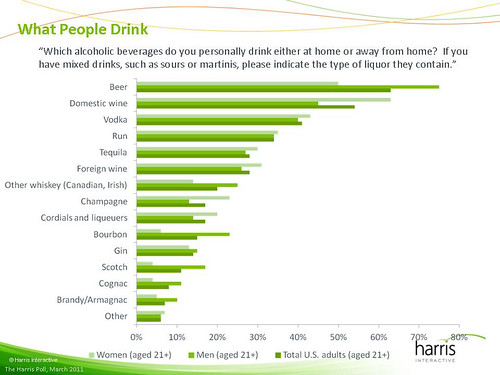
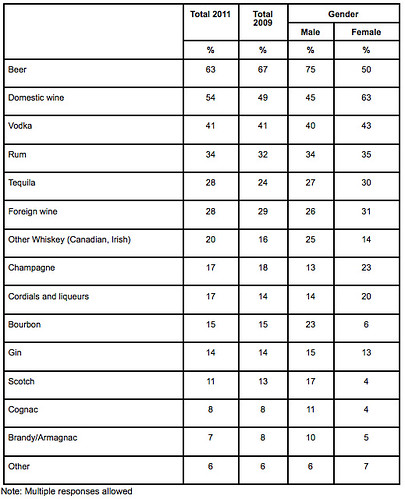
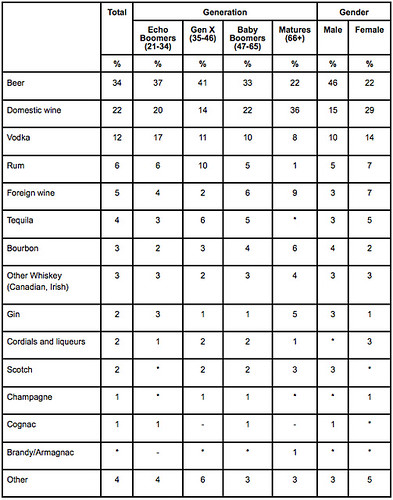
A Harris Poll conducted in March of this year concluded that Three in Ten Americans Drink Alcohol at Least Once a Week. The poll, conducted by Harris Interactive, surveyed 2,379 adults between March 7 and 14, 2011. Not surprisingly, beer continues to be the most popular alcoholic beverage, followed by American wine and vodka. And men still drink beer more than women “75% vs. 50%.”

Harris-What_People_Drink-2011

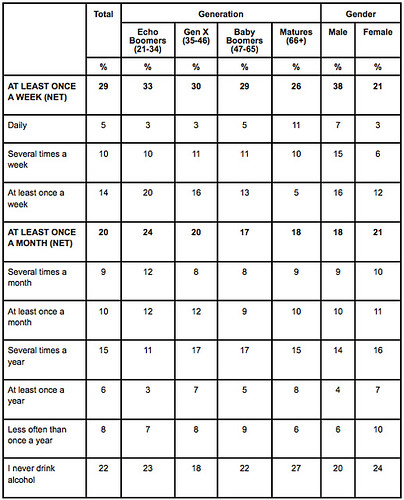
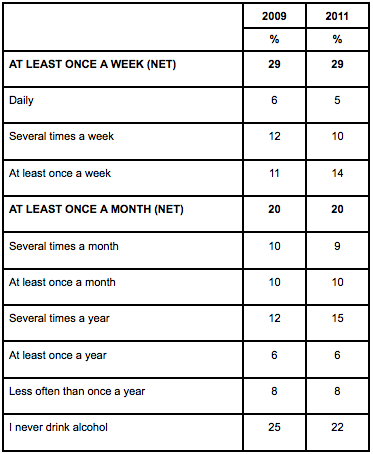
Here are some other findings from the poll:

Question 1: “How often do you drink alcohol, including beer or wine?”

Harris-2001-1

Question 2: “How often do you drink alcohol, including beer or wine?”

Harris-2001-2

Question 3: “Which alcoholic beverages do you personally drink either at home or away from home? If you have mixed drinks, such as sours or martinis, please indicate the type of liquor they contain.”

Harris-2001-3

Question 4: “Although you may drink several types of alcoholic beverages, which one type would you say you drink most often?”

Harris-2001-4

Naturally, I have a couple of quibbles:

  1. Why did they separate out domestic and foreign wine, but not domestic and foreign beer?
  2. “It’s probably not surprising that men and women have different drinking preferences.” Maybe, but isn’t this something of a self-perpetuating prophecy? I know plenty of women who love beer and find wine too sweet. I also know women who claim to find beer too bitter but drink their weight in coffee. I can’t help but wonder if we keep reinforcing this by asking the question, and people respond with the answer they think is the case, which ends up making it real when maybe it’s not.
  3. “According to many doctors and medical studies, a glass of wine is good for one’s health. And even beyond wine, a drink, as long as it’s in moderation, is something that people shouldn’t be afraid of having.” Goddammit, why does this one persist, that “wine” is good for you but the rest are not? By omission, the statement implies that beer and other alcohol is not “good for one’s health” or at a minimum not “as” good which infuriates me. And adding the qualifying statement that “beyond wine” it’s okay to drink the other alcoholic drinks “as long as it’s in moderation” likewise implies that it’s healthful to drink as much wine as you like. How can they be so detail-oriented about the statistics involved in polling, and so ignorant in their statements of analysis? Sheesh.

Filed Under: Beers, Editorial, News Tagged With: Poll, Statistics, United States

Your Brain On Beer

April 14, 2011 By Jay Brooks

brain-2
A new study conducted at the Waggoner Center for Alcohol and Addiction Research at The University of Texas at Austin appears to indicate that alcohol actually helps your memory, at least at the synapse level; that “alcohol primes certain areas of our brain to learn and remember better.” The new study, published in the April 6 edition of the Journal of Neuroscience, is a mouthful, entitled Previous Ethanol Experience Enhances Synaptic Plasticity of NMDA Receptors in the Ventral Tegmental Area. And the Abstract isn’t much clearer:

Alcohol addiction (alcoholism) is one of the most prevalent substance abuse disorders worldwide. Addiction is thought to arise, in part, from a maladaptive learning process in which enduring memories of drug experiences are formed. However, alcohol (ethanol) generally interferes with synaptic plasticity mechanisms in the CNS and thus impairs various types of learning and memory. Therefore, it is unclear how powerful memories associated with alcohol experience are formed during the development of alcoholism. Here, using brain slice electrophysiology in mice, we show that repeated in vivo ethanol exposure (2 g/kg, i.p., three times daily for 7 d) causes increased susceptibility to the induction of long-term potentiation (LTP) of NMDA receptor (NMDAR)-mediated transmission in mesolimbic dopamine neurons, a form of synaptic plasticity that may drive the learning of stimuli associated with rewards, including drugs of abuse. Enhancement of NMDAR plasticity results from an increase in the potency of inositol 1,4,5-trisphosphate (IP3) in producing facilitation of action potential-evoked Ca2+ signals, which is critical for LTP induction. This increase in IP3 effect, which lasts for a week but not a month after ethanol withdrawal, occurs through a protein kinase A (PKA)-dependent mechanism. Corticotropin-releasing factor, a stress-related neuropeptide implicated in alcoholism and other addictions, further amplifies the PKA-mediated increase in IP3 effect in ethanol-treated mice. Finally, we found that ethanol-treated mice display enhanced place conditioning induced by the psychostimulant cocaine. These data suggest that repeated ethanol experience may promote the formation of drug-associated memories by enhancing synaptic plasticity of NMDARs in dopamine neurons.

Professor Hitoshi Morikawa, who wrote the paper, is slightly less jargon-laden and impenetrable on the University’s website, where he more generally lays out the goals of his research:

This lab specifically focuses on the dopaminergic neurons in the ventral midbrain. They are activated by the perception and expectation of rewards. Therefore, the dopaminergic projections from the midbrain to the limbic structures constitute an endogenous reward circuit. Behaviors that lead to the enhancement of dopamine release in this brain reward circuit tend to be repeated (reinforced). Addictive drugs induce stronger stimulation of dopaminergic transmission than almost any natural reinforcers (food, sex, etc). Thus, drugs are repeatedly used (abused) in vulnerable individuals, which will lead to plastic changes in the reward circuit.

The amount and temporal profile of dopamine release is controlled by the firing pattern of dopamine neurons, which is determined by the interaction of their intrinsic membrane properties and the afferent inputs they receive from other neurons. Accordingly, we make detailed analyses of the influence of addictive drugs on membrane ionic conductances and neurotransmitter inputs of dopamine neurons, and investigate the resulting alteration in the firing pattern. We use brain slices because they retain intact synaptic connections that are necessary for these studies. Brain slices are obtained from drug-naïve animals and animals that are chronically treated with drugs to elucidate the plastic changes induced by repeated exposure to drugs in vivo. Technically, we perform patch clamp electrophysiological recordings combined with confocal fluorescent imaging of intracellular ions. These methods will allow us to delineate the cellular events that determine the excitability of neurons with a preciseness that could not be attained by other conventional techniques. Therefore, this lab offers an ideal system to link the behavior of certain types of central neurons to that of a whole organism.

But a science news website, Physog.com has the most understandable account of the study, and what it means.

Essentially, and somewhat confusingly, the study shows that while common view that too much alcohol can be bad for memory retention and learning, that how your brain reacts to it is more complicated than that.

“Usually, when we talk about learning and memory, we’re talking about conscious memory,” says Morikawa, whose results were published last month in The Journal of Neuroscience. “Alcohol diminishes our ability to hold on to pieces of information like your colleague’s name, or the definition of a word, or where you parked your car this morning. But our subconscious is learning and remembering too, and alcohol may actually increase our capacity to learn, or ‘conditionability,’ at that level.”

So while short terms losses may occur, long term gains in subconscious memory may also be taking place. “Morikawa’s study found that repeated ethanol exposure enhances synaptic plasticity in a key area in the brain, [and] is further evidence toward an emerging consensus in the neuroscience community that drug and alcohol addiction is fundamentally a learning and memory disorder.”

When we drink alcohol (or shoot up heroin, or snort cocaine, or take methamphetamines), our subconscious is learning to consume more. But it doesn’t stop there. We become more receptive to forming subsconscious memories and habits with respect to food, music, even people and social situations.

In an important sense, says Morikawa, alcoholics aren’t addicted to the experience of pleasure or relief they get from drinking alcohol. They’re addicted to the constellation of environmental, behavioral and physiological cues that are reinforced when alcohol triggers the release of dopamine in the brain.

“People commonly think of dopamine as a happy transmitter, or a pleasure transmitter, but more accurately it’s a learning transmitter,” says Morikawa. “It strengthens those synapses that are active when dopamine is released.”

Alcohol, in this model, is the enabler. It hijacks the dopaminergic system, and it tells our brain that what we’re doing at that moment is rewarding (and thus worth repeating).

Among the things we learn is that drinking alcohol is rewarding. We also learn that going to the bar, chatting with friends, eating certain foods and listening to certain kinds of music are rewarding. The more often we do these things while drinking, and the more dopamine that gets released, the more “potentiated” the various synapses become and the more we crave the set of experiences and associations that orbit around the alcohol use.

Between that, and new research from the University of Michigan that may have identified a gene — the GABRA2 — that increases the risk of alcoholism in certain individuals, it seems clear that there are environmental and genetic factors that make some people more susceptible to becoming unable to drink responsibly, along with the obvious psychological factors, too. But what that also suggests is that alcoholism is more like a food allergy insofar as it does not effect everyone in the same way, and in fact the vast majority of people who do consume alcohol are able to do so responsibly and in moderation, which also allows them to take advantage of the many health benefits of drinking in moderation. Contrary to neo-prohibitionist propaganda, not everyone becomes an alcoholic with the first sip they take. Most, in fact, not only don’t, but never do, yet the anti-alcohol contingency tends to treat alcohol as a toxic substance that is dangerous to everyone equally or that everyone has the potential to become an alcoholic. I just don’t think that’s true. And the science seems to bearing that out. And because of all the beer I’ve consumed, I can remember all that, too. Thank you, beer.

Filed Under: Editorial, News, Politics & Law Tagged With: Science, Statistics

The Top 50 Annotated 2010

April 13, 2011 By Jay Brooks

ba
This is my fifth annual annotated list of the Top 50 so you can see who moved up and down, who was new to the list and who dropped off. So here is this year’s list again annotated with how they changed compared to last year.

  1. Anheuser-Busch InBev; #1 last five years, no surprises
  2. MillerCoors; ditto for #2
  3. Pabst Brewing; ditto for #3
  4. D. G. Yuengling and Son; Same as last year
  5. Boston Beer Co.; Same as last year
  6. Sierra Nevada Brewing; Same as last year
  7. New Belgium Brewing; Same as last year
  8. North American Breweries; new entity
  9. Craft Brewers Alliance; Moved down 1 for 2nd straight year
  10. Spoetzl Brewery (Gambrinus); Moved down 1
  11. Deschutes Brewery; Up 2
  12. Independent Brewers United (IBU); Same as last year, with a new name
  13. F.X. Matt Brewing; Moved down 1, after moving up 1 last year
  14. Minhas Craft Brewery; Down 2 over last year
  15. Bell’s Brewery; Up 4 from #19 last year
  16. Harpoon Brewery; Up 1 from #17 last year
  17. Boulevard Brewing; Down 1 from #16 last year
  18. Goose Island Beer; Up 2, for 2nd straight year, from #20 last year
  19. Dogfish Head Craft Brewery; Shot up 5 from #24, after being up 9, 5 and 4 the three previous years
  20. Alaskan Brewing; Down 2 from #18 last year
  21. Long Trail Brewing; Leapt up 14 from #35 last year
  22. August Schell Brewing; Up 4 from last year
  23. Stone Brewing; Same as last year, though they were up 5 each of last two years
  24. Abita Brewing; Up 4 from #28 last year
  25. Brooklyn Brewery; Up 2 from #27 last year
  26. Lagunitas Brewing; Jumped up 10 from #36 last year
  27. Full Sail Brewing; Down 5 for the 2nd straight year
  28. Shipyard Brewing; Down 3 from #31 last year
  29. Summit Brewing; Same as last year
  30. New Glarus Brewing; Up 2 from #32 last year
  31. Great Lakes Brewing; Up 2 from #31 last year
  32. Anchor Brewing; Down 2 from #30
  33. Iron City Brewing; Down 8, after dropping 12 last year, after a Chapter 11 bankruptcy and moving production out of Pittsburgh
  34. Kona Brewing; Fell 13 after being up 2 last year, and 14 the previous year
  35. Rogue Ales/Oregon Brewing; Down 1, after being up 2 last year, canceling being down 2 the previous year, and up 2 the year before that, essentially hovering
  36. Firestone Walker Brewing; Up 4 from #40 last year
  37. Winery Exchange Inc. / World Brew; Novato CA; new to the list this year
  38. Sweetwater Brewing; Up 1 from #39 last year
  39. Mendocino Brewing; Down 2 from #7 last year, after falling 8 the previous year
  40. Flying Dog Brewery; Up 2 from #42 last year
  41. Victory Brewing; Same as last year
  42. Gordon Biersch Brewing; Down 4 from #38 last year
  43. BJs Restaurant & Brewery; Down 1 from #43 last year
  44. Stevens Point Brewery; Up 6 from #50 last year
  45. Odell Brewing; Down 1 from #44 last year
  46. BridgePort Brewing (Gambrinus); Up 1 from #47 last year
  47. Cold Spring Brewing; Not in Top 50 last year
  48. Rock Bottom Brewery Restaurants; Down 3 from #45 last year
  49. Oskar Blues Brewing; Not in Top 50 last year
  50. Straub Brewery; Down 3 from #46 last year

Some new companies made the list, two from mergers — North American Breweries and Independent Brewers United — along with Winery Exchange Inc. as a result of doing a contract private label beer for the Walgreen’s pharmacy chain, Big Flats.

Two breweries are new to the list this year, Oskar Blues and Cold Spring Brewing again, who fell off last year but had been on the list the year before that under their former name, Gluek Brewing. Two more are off the list, Big Sky Brewing and Lost Coast Brewing, who had just cracked the list last year.

If you want to see the previous annotated lists for comparison, here is 2009, 2008, 2007 and 2006.

Filed Under: Beers, Editorial, News Tagged With: Big Brewers, Business, Statistics, United States

Top 50 Breweries For 2010

April 13, 2011 By Jay Brooks

ba
The Brewers Association has also just announced the top 50 breweries in the U.S. based on sales, by volume, for 2010. This includes all breweries, regardless of size or other parameters. Here is the new list:

  1. Anheuser-Busch InBev; St Louis MO
  2. MillerCoors; Chicago IL
  3. Pabst Brewing; Woodridge IL
  4. D. G. Yuengling and Son; Pottsville PA
  5. Boston Beer Co.; Boston MA
  6. Sierra Nevada Brewing; Chico CA
  7. New Belgium Brewing; Fort Collins CO
  8. North American Breweries; Rochester, NY
  9. Craft Brewers Alliance, Inc.; Portland, OR
  10. Spoetzl Brewery (Gambrinus); Spoetzl TX
  11. Deschutes Brewery; Bend OR
  12. Independent Brewers United (IBU); Burlington, VT
  13. F.X. Matt Brewing; Utica NY
  14. Minhas Craft Brewery; Monroe WI
  15. Bell’s Brewery; Galesburg MI
  16. Harpoon Brewery; Boston, MA
  17. Boulevard Brewing; Kansas City MO
  18. Goose Island Beer; Chicago IL
  19. Dogfish Head Craft Brewery; Lewes DE
  20. Alaskan Brewing; Juneau AK
  21. Long Trail Brewing; Burlington VT
  22. August Schell Brewing; New Ulm MN
  23. Stone Brewing; Escondido CA
  24. Abita Brewing; New Orleans LA
  25. Brooklyn Brewery; Brooklyn NY
  26. Lagunitas Brewing; Petaluma CA
  27. Full Sail Brewing; Hood River OR
  28. Shipyard Brewing; Portland ME
  29. Summit Brewing; Saint Paul MN
  30. New Glarus Brewing; New Glarus WI
  31. Great Lakes Brewing; Cleveland OH
  32. Anchor Brewing; San Francisco CA
  33. Iron City Brewing; Pittsburgh PA
  34. Kona Brewing; Kailua-Kona HI
  35. Rogue Ales/Oregon Brewing; Newport OR
  36. Firestone Walker Brewing; Paso Robles CA
  37. Winery Exchange Inc. / World Brew; Novato CA
  38. SweetWater Brewing; Atlanta GA
  39. Mendocino Brewing; Ukiah CA
  40. Flying Dog Brewery; Frederick MD
  41. Victory Brewing; Downington PA
  42. Gordon Biersch Brewing; San Jose CA
  43. BJs Restaurant & Brewery; Huntington Beach CA
  44. Stevens Point Brewery; Stevens Point WI
  45. Odell Brewing; Fort Collins CO
  46. Bridgeport Brewing (Gambrinus); Portland OR
  47. Cold Spring Brewing; Cold Spring MN
  48. Rock Bottom Brewery Restaurants; Louisville CO
  49. Oskar Blues Brewery; Longmont CO
  50. Straub Brewery; Saint Mary’s PA

Here is this year’s press release.

Filed Under: Breweries, News Tagged With: Big Brewers, Business, Statistics, United States

Top 50 Craft Breweries For 2010

April 13, 2011 By Jay Brooks

ba
The Brewers Association just announced the top 50 breweries in the U.S. based on sales, by volume, for 2010, which is listed below here. For the fourth year, they’ve also released a list of the top 50 craft breweries based on the new definition adopted by the Brewers Association a few years ago, and updated earlier this year. Here is the new craft brewery list:

  1. Boston Beer Co.; Boston MA
  2. Sierra Nevada Brewing; Chico CA
  3. New Belgium Brewing; Fort Collins CO
  4. Spoetzl Brewery (Gambrinus); Spoetzl TX
  5. Deschutes Brewery; Bend OR
  6. Independent Brewers United (IBU); Burlington, VT
  7. Matt Brewing; Utica NY
  8. Bell’s Brewery; Galesburg MI
  9. Harpoon Brewery; Boston, MA
  10. Boulevard Brewing; Kansas City MO
  11. Dogfish Head Craft Brewery; Lewes DE
  12. Alaskan Brewing; Juneau AK
  13. Long Trail Brewing; Bridgewater Corners VT
  14. Stone Brewing; Escondido CA
  15. Abita Brewing; New Orleans LA
  16. Brooklyn Brewery; Brooklyn NY
  17. Lagunitas Brewing; Petaluma CA
  18. Full Sail Brewing; Hood River OR
  19. Shipyard Brewing; Portland ME
  20. Summit Brewing; Saint Paul MN
  21. New Glarus Brewing; New Glarus WI
  22. Great Lakes Brewing; Cleveland OH
  23. Anchor Brewing; San Francisco CA
  24. Kona Brewing; Kailua-Kona HI
  25. Rogue Ales/Oregon Brewing; Newport OR
  26. Firestone Walker Brewing; Paso Robles CA
  27. Sweetwater Brewing; Atlanta GA
  28. Flying Dog Brewery; Frederick MD
  29. Victory Brewing; Downingtown PA
  30. Gordon Biersch Brewing; San Jose CA
  31. BJs Restaurant & Brewery; Huntington Beach CA
  32. Stevens Point Brewing; Stevens Point WI
  33. Odell Brewing; Fort Collins CO
  34. Bridgeport Brewing (Gambrinus); Portland OR
  35. Rock Bottom Brewery Restaurants; Louisville CO
  36. Oskar Blues Brewery; Longmont CO
  37. Blue Point Brewing; Patchogue NY
  38. Lost Coast Brewery; Eureka CA
  39. Big Sky Brewing; Missoula MT
  40. North Coast Brewing; Fort Bragg CA
  41. Mac and Jack’s Brewery; Redmond WA
  42. The Saint Louis Brewery; St Louis MO
  43. Bear Republic Brewing; Cloverdale CA
  44. Karl Strauss Breweries; San Diego CA
  45. Breckenridge Brewery; Denver CO
  46. Utah Brewers Cooperative; Salt Lake City UT
  47. Gordon Biersch Brewery Restaurants; Chattanooga TN
  48. Saint Arnold Brewing; Houston TX
  49. Real Ale Brewing; Blanco, TX
  50. Ninkasi Brewing; Eugene, OR

Two breweries are new to the Top 50 Craft Breweries list; Real Ale Brewing and Ninkasi. Here is this year’s press release.

I’ll have my annual annotated list shortly.

Filed Under: Breweries, News Tagged With: Statistics, United States

« Previous Page
Next Page »

Find Something

Northern California Breweries

Please consider purchasing my latest book, California Breweries North, available from Amazon, or ask for it at your local bookstore.

Recent Comments

  • Ernie Dewing on Historic Beer Birthday: Charles William Bergner 
  • Steve 'Pudgy' De Rose on Historic Beer Birthday: Jacob Schmidt
  • Jay Brooks on Beer Birthday: Bill Owens
  • Steve 'Pudgy' De Rose on Beer Birthday: Charles Finkel
  • Steve 'Pudgy' De Rose on Beer Birthday: Bill Owens

Recent Posts

  • Beer In Ads #5204: Oh Brother! Griesedieck Bros. Genuine Premium Bock Beer Is Here! February 15, 2026
  • Historic Beer Birthday: Emil Resch February 15, 2026
  • Historic Beer Birthday: Philip Zang February 15, 2026
  • Beer In Ads #5203: Robert Portner’s Bock Beer February 15, 2026
  • Historic Beer Birthday: August Schell February 15, 2026

BBB Archives

Feedback

Head Quarter
This site is hosted and maintained by H25Q.dev. Any questions or comments for the webmaster can be directed here.