Brookston Beer Bulletin

Jay R. Brooks on Beer

  • Home
  • About
  • Editorial
  • Birthdays
  • Art & Beer

Socialize

  • Dribbble
  • Email
  • Facebook
  • Flickr
  • GitHub
  • Instagram
  • LinkedIn
  • Pinterest
  • RSS
  • Twitter
  • YouTube

Powered by Genesis

Specialty Foods Trending Up, Paralleling Craft Beer

April 7, 2011 By Jay Brooks

specialty-food
Seems like it’s a food sort of day. There was an interesting press release from the National Association for the Specialty Food Trade (or NASFT) — the folks that put on the various Fancy Food Shows — entitled Specialty Food Industry Shows Renewed Strength. It’s a teaser for the actual report, The State of the Specialty Food Industry 2011, “an annual report from the NASFT prepared in conjunction with market researchers Mintel International and SPINS. The report tracks sales of specialty food through supermarkets, natural food stores and specialty food retailers, and includes research from interviews with food retailers, distributors, brokers and others involved in the supply chain.” The actual report will be presented April 13 in a “webinar” and for a mere $90 clams you can listen in, too. But the press release does reveal some of what to expect:

Consumers are spending on specialty food again after a period of holding back. Sales of specialty food and beverages rose 7.7 percent in 2010, topping $70 billion, according to new research released by the National Association for the Specialty Food Trade.

“The rebound is impressive,” says Ron Tanner, Vice President, Communications and Education for the NASFT. “As consumers feel more confident about the economy, they are coming back to specialty foods.” In 2009, sales rose by a more tepid 4.5 percent.

Cheese continues to dominate spending for this segment of the food industry, with $3.23 billion in sales in 2010. Rounding out the top five categories are meats, chips and snacks, bread and baked goods and condiments. Functional beverages are the fastest growing specialty food category, followed by yogurt and kefir.

Last year specialty food makers focused on their existing items, with new product introductions about even with 2009. Launches of premium private-label products, such as store brand cookies and sauces, declined to 455 in 2010 from 518 in 2009, demonstrating a return to branded products.

It’s interesting to see artisanal cheese continue to hum along, the 500-lb. gorilla of the specialty food world. I attended a cheese conference a few years ago with a panel that discussed the parallels between craft beer and American craft cheese. At that point, the experts on the panel claimed that our artisanal cheese industry was roughly 15 years behind where craft beer was at that point. But based on this, it would appear that cheese is indeed keeping pace and even catching up. Given how good the two are together — is there anything better the perfect beer and food pairing? — that’s very good news indeed.

Here are some more highlights from the report:

  • Total U.S. sales of specialty foods in 2010 were $70.32 billion, with $14.4 billion represented by sales to the food service industry.
  • Specialty foods represent 13.1 percent of all food sales at retail.
  • Natural food stores are the fastest growing retail channel; sales rose 14.7 percent between 2008 and 2010.
  • Mediterranean and Indian are the most influential emerging cuisines, importers say.
  • Seventy-six percent of specialty food manufacturers reported a sales increase in 2010, with 36 percent up more than 20 percent.
  • Gluten-free introductions showed sharp gains, with 119 new products in 2010 versus 67 in 2009.
  • Supermarkets remain the largest seller of specialty foods, with 72.3 percent of sales, but their share is dipping as specialty and natural food stores attract more consumers.
  • The average specialty food manufacturer produces 51 different items and brings in $2.3 million in annual sales.

Filed Under: Food & Beer, News, Related Pleasures Tagged With: Cheese, Food, Statistics

The Calorie Mix From The 1970s To Today

April 7, 2011 By Jay Brooks

cornucopia
This is not a beer post, but we gotta eat, too. Tom Philpott, at Grist, details an interesting interactive chart created by Andrea Jezovit at Civil Eats.

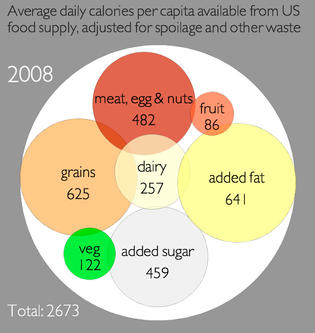
Using USDA data for “average daily calories available per capita, adjusted for spoilage and waste,” it tracks our eating habits since 1970, separating our foodstuffs into basic categories: grains, dairy, vegetables, fruits, proteins (“meat, eggs, and nuts”), added sugars, and added fats.

calorie-mix-2008

Both Philpott’s The American diet in one chart, with lots of fats and sugars and Jezovit’s Where Do Americans Get Their Calories? are worth a read. Be sure to check out the interactive version of the chart which graphically shows how the mix of calories we eat has changed over the last 40 years.

Filed Under: Food & Beer, News, Politics & Law, Related Pleasures Tagged With: Food, Statistics

Top 10 Alcohol Drinking Cities

March 28, 2011 By Jay Brooks

all-america-city
I’m not sure where the source data comes from, but the latest issue of Playboy — in the Raw Data section — had an interesting Top 10 list of what they referred to as the “Tipsiest Towns in the U.S.” The list is “based on the average number of alcoholic drinks consumed per person.”

  1. Milwaukee, WI
  2. Fargo, ND
  3. San Francisco, CA
  4. Austin, TX
  5. Reno, NV
  6. Burlington, VT
  7. Omaha, NE
  8. Boston, MA
  9. Anchorage, AK
  10. San Diego, CA

Filed Under: Beers, Editorial, News, Top 10 Tagged With: Lists, Statistics

Craft Beer Grows 11% In Volume

March 21, 2011 By Jay Brooks

ba
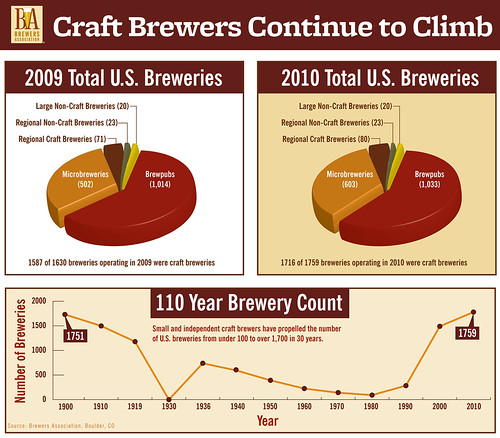
The Brewers Association just announced the statistics of craft beer sales in 2010, and the news is great. Craft beer saw volume growth of 11% over 2009, and in terms of dollars the increase was 12%, equating to roughly an additional one million barrels, or 14 million cases.

From the press release:

“Beer lovers increased their appreciation for American craft brewers and their beers in 2010,” said Paul Gatza, director, Brewers Association. “Craft brewers’ stories resonate with Americans who are choosing small, independent companies making delicious beers in more than 100 different styles.”

The Association also reported a growth in the number of U.S. breweries, with eight percent more breweries than the previous year. In 2010, there were 1,759 operating breweries. Craft brewers produced 9,951,956 barrels, up from an adjusted3 8,934,446 barrels in 2009.

“Prohibition caused a dramatic decline in the number of breweries in the United States, but the number of breweries is now at an all-time high,” added Gatza. “With well over 100 new brewery openings in 2010, plus 618 breweries in planning stages, all signs point to continued growth for the industry.”

Total Breweries

In 2010, craft brewers represented 4.9 percent of volume and 7.6 percent of retail dollars of the total U.S. beer category. The Brewers Association estimates the actual dollar sales figure from craft brewers in 2010 was $7.6 billion, up from $7 billion in 2009.

Overall, the U.S. beer industry represented an estimated retail dollar value of $101 billion. U.S. beer sales were down approximately one percent, or 2 million barrels, in 2010 compared to being down 2.2 percent in 2009. Total beer industry barrels dropped to 203.6 million, down from 205.7 million barrels in 2009. Imports were up five percent in 2010, compared to being down 9.8 percent in 2009. (Note: the Brewers Association does not count flavored malt beverages as beer.)

Gatza added, “We also found that three percent of craft brewer barrels, by volume, are distributed in cans, confirming a growing trend.”

It’s always great to have confirmed what we see in the street, that most, if not all, craft brewers are doing well. Another great year of craft beer growth. Congratulations to everybody.

Filed Under: Breweries, News Tagged With: Brewers Association, Press Release, Statistics

Socialcohol Media Influencers

March 9, 2011 By Jay Brooks

social-media
Here’s some more interesting statistical data on alcohol bloggers — beer, wine and liquor — from a software company in Silicon Valley by the name of eCairn, or eCairn Conversation. Watch this short video to get a feel for what the company is selling, essentially tools to help companies reach their core customers and “influencers.”

This is especially interesting given the recent monthly Wikio rankings, as these represent yet another metric to rate a beer blog’s influence. At eCairn’s blog, they’ve been analyzing different aspects of social media, presumably to give potential customers real world examples of how they might use their software. For example, they looked at an Analysis of 4 Networks of Community of Influencers that included mommy, beauty, fashion, deco, food, daddy, celebrity, baking, craft and fitness blogs. Then a few days ago they examined beer, wine and liquor blogs which they referred to as “Socialcohol Media,” which is a great looking term, if only I could figure out how it should be pronounced (go ahead, try to say it). Here’s their introduction:

Tagging along with previous analysis of social media Tribes and Influencers, we looked this time at the socialcohol ecosystem 😉 .

Even if the wine & alcohol industry is highly restricted and social media has its set of challenges, matters like beer, wine and liquor generate quite a bit of conversations from the virtual streets.

Here, we pulled 200 influencers from our existing communities of English speaking influencers (~1500 for wine, ~1000 for beers and ~500 for liquor) to create our own cocktail of the tops.

From those 4,000 blogs, they whittled them down to 200 and then ranked those. In the Top 20, half unsurprisingly are wine blogs. But what’s more surprising is that five were beer blogs and five were liquor blogs, and all five of the beer blogs were in the top ten, along with two liquor blogs. That means that in the top ten alcohol blogs, the majority are beer blogs. That’s huge, because up until now, as far as I knew, wine blogs were kicking our butt. Certainly there are far more of them, and still are, but what this suggests is that beer online is gaining in popularity. During last fall’s Beer Blogger’s Conference, the number of beer blogs was reckoned to be about 500, and another source I saw said about 700, the difference being the former was independent beer blogs and the latter included company beer blogs, too. So either we’ve added another 300 beer blogs in the intervening months or they arrived at their number using more generous definitions. Either way, 1,000 sure sounds more impressive.

While I don’t see any information specifically about what formula they used to arrive at their rankings, shockingly I’m No. 1, even above Eric Asimov in the New York Times and the Wine Spectator. Honestly, as flattered as I am by that, it doesn’t feel right. Their traffic alone must be exponentially higher than mine, though perhaps traffic isn’t that important to the way they figure things out. Still, the best news would seem to be that beer blogs more generally are catching up to wine in terms of popularity online. That alone is worth cheering.

Top 20 Alcohol Blogs

  1. Brookston Beer Bulletin (Beer)
  2. Good Grape: A Wine Blog Manifesto (Wine)
  3. Alcademics.com (Liquor)
  4. Eric Asimov’s The Pour: NY Times (Wine)
  5. Seen Through a Glass (Beer)
  6. Pencil and Spoon (Beer)
  7. The Beer Nut (Beer)
  8. Catavino (Wine)
  9. Art of Drink (Liquor)
  10. Drink With The Wench (Beer)
  11. Wine Spectator (Wine)
  12. Mutineer Magazine (Wine*) [Listed as a wine blog, but Mutineer also covers beer and spirits.]
  13. Trader Tiki’s Exotic Syrups, Bitters and Spirits (Liquor)
  14. RumDood (Liquor)
  15. AlaWine (Wine)
  16. Good Wine Under $20 (Wine)
  17. Wannabe Wino Wine Blog (Wine)
  18. The Pegu Blog (Liquor)
  19. Through The Walla Walla Grape Vine™ (Wine)
  20. Palate Press (Wine)

They also note that Beer, Wine and Liquor blogging communities are fairly separate but that Whisky blogs tend to act as a bridge between them all.
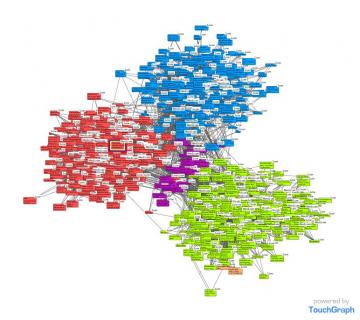
winebeerliquor

The density of the American beer blogs has “higher density in the mid-west/colorado compared to wine and liquor.”
beer-geo

Filed Under: Beers, Editorial, Just For Fun, Related Pleasures Tagged With: Blogging, Social Media, Statistics, Websites

Number Of U.S. Breweries Reach 1,700

February 27, 2011 By Jay Brooks

ba
The Brewers Association just announced that the number of breweries in America has eclipsed 1,700 (and thanks to the other BA, Beer Advocate for the Twitter tip — a Twip?). According to the BA:

The count is at 1,701 operating breweries in the U.S. There are 9 percent more breweries in the U.S. than a year ago. As I blow the dust off the historical records, it appears that there were 1,751 breweries in 1900 and 1,498 in 1910. So we have more breweries than we have since around 1905. My resource for these data points is The Register of United States Breweries 1876-1976 (compilers Friedrich and Bull). There certainly are a lot more diverse brewing styles being offered today, particularly by craft brewers, and I’m betting quality is far greater now than then.

That’s great news. Two months ago when I needed a firm number for an article I was writing, the number was 1,677 so that’s nearly 25 brewery openings in less than sixty days. How cool is that?

Filed Under: Breweries, Just For Fun, News Tagged With: Announcements, Brewers Association, Press Release, Statistics

Liking Beer Equals Liking Sex?

February 11, 2011 By Jay Brooks

humor
I’m not sure what to think about this one. An alert reader (thanks Dave) sent me this curious bit of advice from OK Trends, offering dating advice including the Best Questions to Ask On a First Date, to wit:

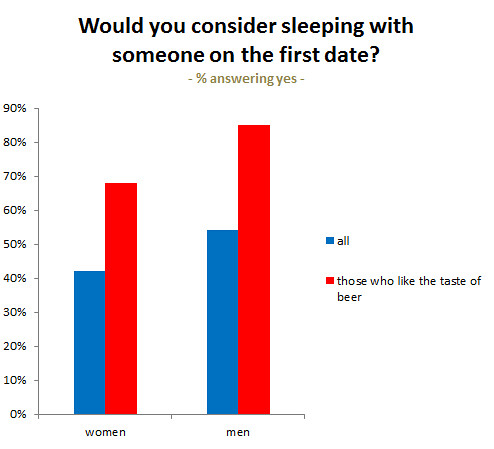
If you want to know if your date will sleep with you on the first date, the question to ask apparently is “do you like the taste of beer?” That’s because, according to their research, “whether someone likes the taste of beer is the single best predictor of if he or she has sex on the first date.”
BeerGoggles

They continue. “No matter their gender or orientation, beer-lovers are 60% more likely to be okay with sleeping with someone they’ve just met.” I wish I’d known that before I was married.

Filed Under: Beers, Just For Fun Tagged With: Humor, Statistics

Full Fact Disputes UK Alcohol Statistics

November 9, 2010 By Jay Brooks

beer-syringe
In response to the highly unscientific study published in The Lancet last week suggesting alcohol is more dangerous than heroin, FullFact.org — “A [British] independent fact-checking organisation” — asked the question “Are alcohol-related problems on the rise?” Their conclusion? “Full Fact finds little support in the evidence.”

Filed Under: Beers, Editorial, News, Politics & Law Tagged With: Science, Statistics, UK

Beer More Dangerous Than Heroin!?!

November 1, 2010 By Jay Brooks

beer-syringe
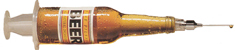
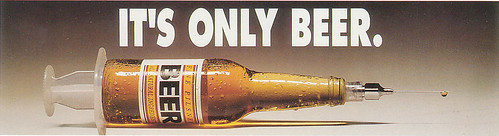
I suppose it was inevitable. Anti-alcohol folks have been saying for years that alcohol is the worst drug on the planet. And comparing it to heroin is not exactly new, either. A popular neo-prohibitionist PSA shows a beer bottle as a syringe to remind people that alcohol is also a drug. You can even buy bookmarks and posters of it at Face, the one-stop shop for neo-prohibitionist propaganda. Of course, aspirin is also a drug, but who would drink beer in either pill or syringe form?

its-only-beer-lg

The characterization of alcohol as a drug is mostly a specious one, because it ultimately depends on how you define what a drug is or how it’s used. You might be tempted to think that it’s fairly easy to explain exactly what is a “drug,” but it’s actually not. Even the most common dictionaries define it rather differently, and how people connote it varies even more widely. Some say it’s only a drug if it’s used as medicine, others any chemical substance that alters something physical, while still other definitions insist a drug is something illicit or illegal. A lot of what definition you choose is dependent on your message or what point you’re trying to make. In other words, context matters. What we can agree on — I hope — is that there are both good and bad drugs. I know there won’t be universal agreement on which is which, but that they’re not all the same I trust can be acknowledged by either side of the alcohol divide.

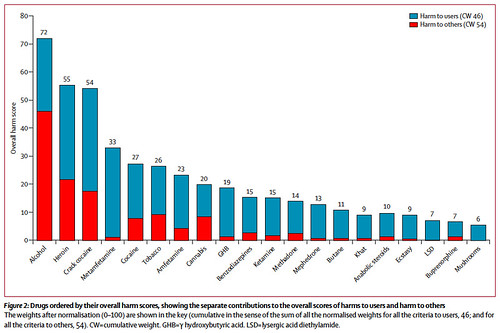
Today the scientific journal The Lancet published a new article entitled Drug Harms in the UK: A Multicriteria Decision Analysis that purports to show that alcohol is more dangerous than heroin. According to their results it is indeed claimed that alcohol is more dangerous to society and individuals than anything else on Earth, including crack, cocaine, tobacco, Ecstasy and LSD. The article — I refuse to call it a study — was authored by David Nutt, the former UK chief drugs adviser who was fired in October of last year by the British government.

Why this so-called study is garnering such media attention has to do with its volatile headline. As they say, if it bleeds it leads, and this definitely has blood on it. But it’s not exactly scientific. I’d always thought of the Lancet as one of the more rigidly scientific journals, but this gives me pause. Essentially, the way the results of this article were collected was by gathering together sixteen “experts,” specifically “members of the Independent Scientific Committee on Drugs (an organization founded by David Nutt after his firing), including two invited specialists” who then sat down for a one-day meeting — called a “workshop” — where each of them was asked to “score 20 drugs on 16 criteria: nine related to the harms that a drug produces in the individual and seven to the harms to others. Drugs were scored out of 100 points, and the criteria were weighted to indicate their relative importance.” Well, how scientific.

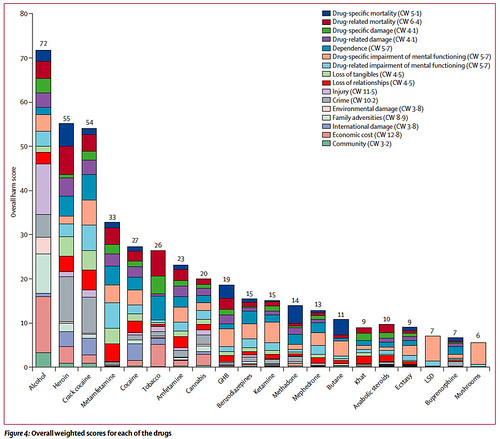
This is the 16 criteria they scored:
Lancet-Nov10-fig-1

So essentially this “study” is simply the scores collected by a few so-called “experts” — almost entirely made up of members of one organization thick with agenda — during a one-day retreat. That’s hardly “proof” of anything. If I were The Lancet, though, I’d be a little embarrassed about having so unscientific a piece being in my previously distinguished pages. Throughout the article, the author infuriatingly keeps referring to the results as “findings,” as if they’re a tally of something more meaningful than mere opinion. Self-fulfilling prophecy is a more reasonable assessment of their “findings.”

Here’s how they explain themselves:

The issue of the weightings is crucial since they affect the overall scores. The weighting process is necessarily based on judgment, so it is best done by a group of experts working to consensus. Although the assessed weights can be made public, they cannot be cross-validated with objective data.

They also admit that their opinionated scores only include the supposed harm of the substances they’re evaluating, and that they did not take into account any benefits, apart from admitting that some do exist.

Limitations of this approach include the fact that we scored only harms. All drugs have some benefits to the user, at least initially, otherwise they would not be used, but this effect might attenuate over time with tolerance and withdrawal. Some drugs such as alcohol and tobacco have commercial benefits to society in terms of providing work and tax, which to some extent offset the harms….

So they admit alcohol’s economic benefits, but still conveniently ignore the many health benefits of responsible, moderate consumption, including the rather important fact that most people who drink moderately will live longer than those who either totally abstain or over-indulge.

No matter, the experts conclude that both heroin and crack-cocaine are nearly a third less dangerous than alcohol. Mushrooms, they’ve declared, are the safest of all.

Lancet-Nov10-fig-2

But essentially they’re taking the minority of people who abuse alcohol and from there go on to imply that essentially everyone who drinks alcohol exacts that same cost to themselves and society, extending the data out to include all drinkers. But that’s clearly untrue and quite ludicrous. All they’ve done is dress up opinions — and biased ones at that — and presented them as facts and findings, based solely on the idea that expert opinions are facts. That The Lancet went along with it shows how mesmerized we are by the lure of so-called, and even self-proclaimed, “expert opinions.”

Finally, the chart below shows the breakdowns of each of the 16 criteria and how much they assigned to each “drug.”
Lancet-Nov10-fig-4

The BBC even collected drinkers’ responses and one woman noted that her grandmother has had a glass of wine every single day since she was 18 and is still going strong, reasonably suggesting that she might not still be here if she’d been taking heroin every day for the same period of time. Professor Nutt won’t even concede that point, saying that it’s not necessarily true, stating that the woman’s grandmother might be better off if she’d taken the heroin instead! He says “all medicines are safe if they’re used appropriately.” Maybe, but why wouldn’t that same logic then extend to alcohol? Why can’t he concede that it’s also safe if used “appropriately?” Can anyone really believe that a prescription of heroin every day is safer than a drink or two of beer per day, just because it didn’t come from a doctor’s advice?

Is it possible there’s another reason for Professor Nutt’s war on alcohol? Well here’s at least one possibility. In December, the London Telegraph reported that Nutt was leading a team at Imperial College London in developing a synthetic alcohol, produced using chemicals related to Valium. According to the report, it “works like alcohol on nerves in the brain that provide a feeling of well-being and relaxation,” but “unlike alcohol its does not affect other parts of the brain that control mood swings and lead to addiction. It is also much easier to flush out of the body.” And because it’s “much more focused in its effects, it can also be switched off with an antidote, leaving the drinker immediately sober.” It’s not too hard to imagine that the scarier and more dangerously alcohol is perceived as a societal evil and health risk, the more customers for synthetic alcohol there would be.

No matter what his true motives, Nutt is … well, I’ve been trying to avoid this but there’s just no way around it, something of a nutter. He claims that his “findings showed that ‘aggressively targeting alcohol harms is a valid and necessary public health strategy.'” Of course, that’s been his position since well before this farce began, so again, it’s much more of an agenda in search of its own validation. Not so much a self-fulfilling prophecy, but a self-created justification for a position he already held. All he needed to do was to create the official-sounding organization “Independent Scientific Committee on Drugs” and then have them say the same thing he’s been saying all along, this time with charts and people with strings of alphabets after their names so it all sounds on the up and up. But this is just another case of the Emperor having no lab coat, and few people in the media even noticing.

UPDATE: As expected, Pete Brown has also tackled Nutt’s Lancet article and its attendant publicity in The MAIN reason Professor Nutt is bad for our health. Check it out.

Filed Under: Beers, Editorial, News, Politics & Law Tagged With: Prohibitionists, Science, Statistics, UK

Customer Satisfaction With Beer Continues To Fall

October 19, 2010 By Jay Brooks

acsi
The American Customer Satisfaction Index (ACSI) today released their latest findings for a variety of products, and beer again continued to drop. I should point out, however, that the ACSI tracks only the big brands. As far as I can tell, they do not track any craft brewers. Since they refer to “Corona, Heineken, and Samuel Adams” all as “smaller brands,” I feel confident that very few, if any, craft breweries are on their radar. As a result, these findings — while interesting — are only relevant for the big picture and don’t reflect the continuing gains and positive growth in the craft sector.

From the press release:

Beverages: Anheuser-Busch Tanks
Beer drinker satisfaction falls from its all-time high in 2009 by 2.4% to 82, driven by a sharp decline for Anheuser-Busch products. Last year, shortly after its acquisition by Belgian InBev, Anheuser-Busch recorded its best ACSI score ever and captured the industry lead. Now that gain evaporates, as the company drops 4% to an ACSI score of 82. Sales of the Budweiser brand fell by nearly 10% over the past year, the largest decline on record, as younger drinkers have increasingly turned to microbrews and low-calorie products. A-B’s weakness is Miller’s gain. Without improving, Miller claims the top ACSI spot among brewers, unchanged at 83. Molson Coors also remains unchanged, stalled at the bottom of the industry at 81.

And here’s additional analysis from a second release:

Beverages
Customer satisfaction with beer fell from its all-time high in 2009 by 2.4% to 82, driven by a sharp decline for Anheuser-Busch products. The rest of the measured brewers—Miller, Molson Coors, and the aggregate of smaller brands such as Corona, Heineken, and Samuel Adams—held to the same scores received one year ago.

In 2009, a year after its acquisition by Belgian InBev, Anheuser-Busch advanced to its best ACSI score ever and captured the industry lead at a record 84. In 2010, the gain has evaporated as the company lost 4% and slid to 82. The number-one seller of beer in the United States also has struggled with sales of its Budweiser brand. Sales of the brand fell by nearly 10% last year, the largest decline on record, as younger drinkers have increasingly turned to microbrews and low-calorie products.

Miller is a beneficiary of A-B’s plunge. Miller assumes the industry lead in customer satisfaction by standing still at an ACSI score of 83, sharing the top spot with the aggregate of smaller brands (also unchanged). A year ago, Molson Coors slumped to the bottom of the industry. The company is stalled there for a second year at an unchanged score of 81. Value for money remains a challenge, as consumers are increasingly price sensitive and Molson Coors brands tend to be higher priced than many of its competitors’ brands.

Filed Under: Breweries, News Tagged With: Big Brewers, Press Release, Statistics

« Previous Page
Next Page »

Find Something

Northern California Breweries

Please consider purchasing my latest book, California Breweries North, available from Amazon, or ask for it at your local bookstore.

Recent Comments

  • Ernie Dewing on Historic Beer Birthday: Charles William Bergner 
  • Steve 'Pudgy' De Rose on Historic Beer Birthday: Jacob Schmidt
  • Jay Brooks on Beer Birthday: Bill Owens
  • Steve 'Pudgy' De Rose on Beer Birthday: Charles Finkel
  • Steve 'Pudgy' De Rose on Beer Birthday: Bill Owens

Recent Posts

  • Beer In Ads #5204: Oh Brother! Griesedieck Bros. Genuine Premium Bock Beer Is Here! February 15, 2026
  • Historic Beer Birthday: Emil Resch February 15, 2026
  • Historic Beer Birthday: Philip Zang February 15, 2026
  • Beer In Ads #5203: Robert Portner’s Bock Beer February 15, 2026
  • Historic Beer Birthday: August Schell February 15, 2026

BBB Archives

Feedback

Head Quarter
This site is hosted and maintained by H25Q.dev. Any questions or comments for the webmaster can be directed here.