Brookston Beer Bulletin

Jay R. Brooks on Beer

  • Home
  • About
  • Editorial
  • Birthdays
  • Art & Beer

Socialize

  • Dribbble
  • Email
  • Facebook
  • Flickr
  • GitHub
  • Instagram
  • LinkedIn
  • Pinterest
  • RSS
  • Twitter
  • YouTube

Powered by Genesis

UK Creates New Ministry For Pubs

March 9, 2010 By Jay Brooks

pub-sign
How cool is this. The UK government has just created a new Ministry — similar to our cabinet positions — The Ministry for Pubs. Wentworth MP John Healey was named the firs Minister, and he had the following to say about his appointment.

“Pubs are often at the heart of community life. And they are important meeting places for many people. While we can’t stop every pub from closing it’s right we do everything possible to back them. But they need help now so I am determined to have a deal on the table with a package of practical help in the next few weeks.”

The Morning Advertiser has the full story, to which Drinks International added.

Mark Hastings. British Beer and Pub Association (BBPA) director of communications said: “This is a clear sign of the strong public desire to see British pubs supported and the success of our campaign over the last year. We hope this means that pubs will now have a strategic place in Government policy making, and we are pleased that the agenda echoes so many of the priorities we have identified.

“We couldn’t wish for a better minister than John Healey as the voice for pubs within Government, and look forward to a positive, frank and constructive relationship with him in order to support this great British institution that is so important to the social and economic life of local communities.”

Can you imagine a cabinet post in the U.S. Secretary of Alcohol? Or Drinks Czar? It would give new meaning to the term, “member of the bar.”

Filed Under: Beers, News, Politics & Law Tagged With: Government, Pubs, UK

Beer In Art #68: Henry Singleton’s Ale-House Door

March 7, 2010 By Jay Brooks

art-beer
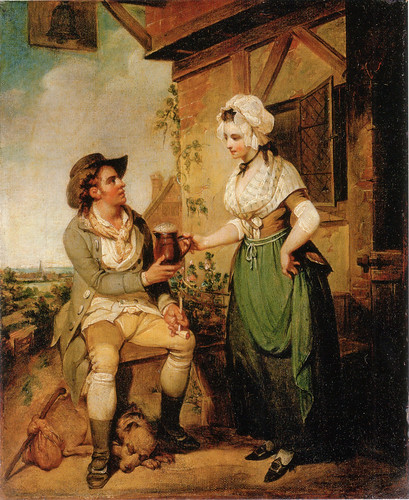
Today’s work of art was originally painted around 1790, when the English pub was a very different animal. It was created by Henry Singleton, a British artist who lived from 1766-1839. This painting, The Ale-House Door, is an oil on canvas painting roughly 10 x 12 inches, and the original can be found at the Victoria & Albert Museum in London. It’s also sometimes known by the title At the Inn Door.

Henry-Singleton_Ale-House-Door

The pub looks like it was probably called The Bell, though I’m just guessing based on the sign. According to my handy Dictionary of Pub Names, the Bell is a fairly common pub name owing to the idea that a “bell speaks all languages.”

You can read more about Singleton at his Wikipedia page and there’s a biography of him from the Grove Dictionary of Art, too. You can see a few more of his works at the Tate and there are more links at ArtCyclopedia.

Filed Under: Art & Beer Tagged With: History, Pubs, UK

Beer In Ads #59: Whitbread’s Here’s Health

March 5, 2010 By Jay Brooks

ad-billboard
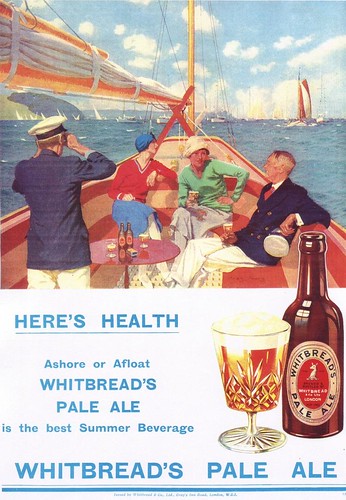
Friday’s ad is for Whitbread beer, since that’s who I was writing about for this month’s Session post today. This one is from 1930 and fittingly features a boat on the water. “Ashore or Afloat WHITBREAD’S PALE ALE is the best Summer beverage.” The art has the same idealized look as the series that U.S. Brewers Foundation started in the late 1940s, Beer Belongs.

Whitbreads-Pale-Ale-1930

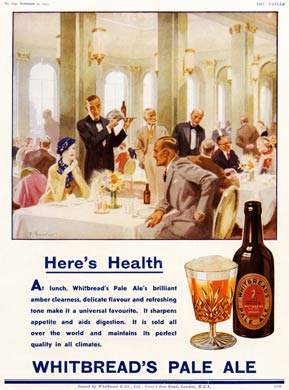
And here’s another from what looks to be the same series, though this one features a lunch setting.

Whitbread-Lunch-med

You can also see a larger, though watermarked, lunch ad and there’s also a third one from the series, this one in a canoe. Lastly, here’s a clearer, but again watermarked, version of the boat ad.

Filed Under: Art & Beer, Beers Tagged With: Advertising, History, UK

Session #37: Drinking The Good Stuff

March 5, 2010 By Jay Brooks

vault
Our 37th Session is hosted by The Ferm and Sir Ron’s theme is The Display Shelf: When to Drink the Good Stuff, a dilemma many of us face. We’ve all accumulated “numerous bottles of beers that [were] subsequently cellared and designated as ‘to be opened on a special occasion.’ [The] dilemma, however, is matching an occasion with opening a particular bottle in [the] collection.”

The Ferm continues to elucidate their topic:

Finding a drinking occasion that lives up to the reputation of the bottle and the story of its acquisition is not a dreadful struggle to have, but it is a struggle nonetheless. When my good friends are over and we have had a few other beverages, will we still be able to enjoy my cave aged Hennepin that I bought after my tour of the brewery and have cellared for ten years? Will I miss it like I miss that four year old Golden Monkey?

The topic is open ended and the rules of The Session are close to nil. You can use your post to be persuasive or therapeutic. You may choose to tell a story of a great bottle you once opened or boast of your own beer collection.

So that got me thinking about my own beer cellar. It’s not as grand as a lot of impressive ones I’ve visited or have heard about. It’s not in a goldmine, for example. It doesn’t have Celtic granite columns. It’s not a converted walk-in, sadly. It’s just part of my network of four refrigerators, three of which are devoted exclusively to beer. One of the refrigerators is used for everyday beers, the ones my wife is allowed to drink. I used to employ a system where I put sticker dots on the beers she wasn’t allowed to open, but she (and my friends and relatives) just ignored them. So now there’s a separate refrigerator in the hallway, just off the kitchen, that I keep stocked with beer for her and guests. It’s worked beautifully, and I suspect the reason is a sort of “out of sight, out of mind” phenomenon where people aren’t tempted by what they can’t see.

session_logo_all_text_200

But nestled coolly inside one of them (the other is partly the queue for beers I need to taste for work) are a number of gems, but nothing I’d consider overly spectacular. I’ve seen spectacular, I’ve been fortunate to taste a lot of spectacular stuff, but I’ve never set out to collect beers in any systematic way so what I’ve got aging is a mishmash of what people were kind enough to gift me and a few things I’ve stumbled across that were just too good to pass up. I’ve got magnums and 12-oz. bottles of Anchor Christmas Ale going back into the 1980s. Some Thomas Hardy from the same time period. A few strong beers, old ales, dubbels and tripels, things like that. Some waxed-top barleywines from several brewers, and the ubiquitous Samuel Adams Triple Bock that it seems everybody has a few bottles of, myself included.

safe

But I suspect many of us have a least a few special beers we’ve been holding on to, and for me the more interesting question is when to open them. When is the right time to open the safe and let them flow freely? As the Ferm put it, the trick is “matching an occasion with opening a particular bottle in [the] collection.” Obvious choices are events like birthdays, anniversaries, weddings, and holidays. As the humorist Dave Barry expressed it, he will “drink beer to celebrate a major event such as the fall of communism or the fact that the refrigerator is still working.” But for some reason that rarely seems to work, and the bottles stack up. Literally.

I have a colleague who has a party to clear out his cellar — I think once a year. I’ve hosted a few “clearing out the garage of beer” events and they’ve been great fun. What it comes down to is that I don’t want to open a special bottle just for me. I want to share it. But I also want to share it with people who can and will appreciate how special it is. And while my wife has developed a great palate over the years, the rest of the family has largely not, so that makes holidays and family gatherings not the ideal occasion. There are some beers so cool, rare or otherwise special that you want to have as many people try them as you can. It’s that social aspect that make beer so worthwhile.

I keep trying to start a tasting club that would get together to taste beer once a month, but am continually stalled in trying to get the ball rolling for no better reason than I feel so busy all the time. The idea is to set aside the last Tuesday of every month and have a good number of brewers, other writers, and just people I know would appreciate trying different beers get together and open a few bottles, a mix of new samples and old gems. My plam is to have roughly 50 people on the list with the idea that if 6 or so show up any given month, we’ve got a good group. In that way, no one will feel any pressure to come every month, only if they’re free and have the desire to come. I think in that way, the garage wouldn’t get so clogged with beer to the point where I feel overwhelmed just trying to decide what to drink some days. And while I realize that’s not a problem for which I’ll be getting any genuine sympathy for having, it is a problem nonetheless.

Whitbread-Pale

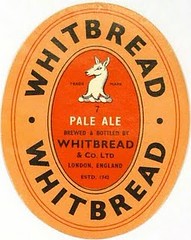
But there is one beer I have that continues to vex me concerning when and where to open it. Actually, I have two bottles of this beer, which were given to me by a Costello Beverage distributor’s rep. in Las Vegas, when I was still the beer buyer at BevMo and we still had two stores in Nevada. The bottles in question are from the Whitbread Brewery, and though I can’t confirm the veracity of everything in their story, here’s what I was told.

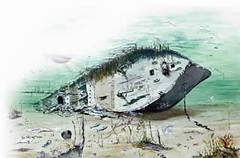
Port-Napier

Back in World War II, a British minelayer, the HMS Port Napier, sank off the coast of Scotland. Here’s what happened, according to Wikipedia:

After being loaded with her cargo, she dragged her anchor during a gale in the Kyle of Loch Alsh on 26 November 1940 and grounded in shallow water. While being unloaded there was a fire in the engine room, whereupon the harbour and towns nearby were evacuated, and she was towed well out into the loch and cast adrift in anticipation of an explosion.

A massive explosion on 27 November, which fortuitously didn’t set off any of the mines, blew her apart and she tipped over on her starboard side and sank in 20 metres of water with her port side visible at low tide.

In 1955 the Royal Navy took off the steel plating on her port side and removed the mines and 4000 anti-aircraft shells.

Today, she’s still a popular site for divers, even though the wreck is silty, “owing to its relative intactness and shallow location.”

hms-port-napier-clr

But in 1993, some divers found something interesting that others had missed.

In 1993 eight divers visited the wreck of HMS Port Napier off the Isle of Skye, Scotland. The ship was a WWII mine layer which sank on its maiden voyage in 1940 when fire broke out in the engine room. The wreck lays in 24m of water. The divers found two crates of beer in the galley. They contained 48 bottles of Whitbread pale ale and the contents had been preserved by rubber-sealed screw-in bottle tops. The divers sampled some of the beer back on dry land and found it to be even better than new beer. “Foamy with a mature flavour” said one of the divers. They didn’t finish off the 48 bottles though. They saved a few of them for the Whitbread company.

www-10-5-93

So that part of the story I can more or less confirm. From here on out, it’s all uncorroborated, unless someone out there has more information. The Whitbread Brewery examined some of the bottles and managed to extract some still-living yeast from them, using it to brew some special beer. The bottles that I received were supposedly that beer, made with the 50+ year old yeast. If the yeast was found in 1993, then I don’t know exactly when Whitbread made the beer. They were still in business at least until 2000, when they sold out to what was then InterBrew (and now is InBev or Anhueser-Busch InBev) for £400 million. A few years later, in 2005, Whitbread (now a hotel chain, though they call it a “hospitality company”) even sold the original brewery building on Chiswick Street on London, where Samuel Whitbread founded his brewing empire in 1732. Today it’s an event center called, fittingly, the brewery.

whitbread-full
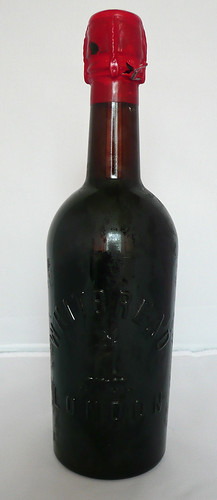
This is one of the bottles. Note: the glass is perfectly smooth, what looks odd is just condensation as I’d just taken it from the refrigerator moments before taking this photo. Some of the bright red wax is starting to chip off just a little bit, but is otherwise in pretty good shape, all things considered.

I was given them around 1998 and was told to wait until the Millennium to open them, but to be honest I forgot about them that New Year’s Eve and then I never quite found another occasion that seemed worthy of opening one of them. So they’re roughly twelve years old now, and I’ve kept them properly chilled virtually the entire time (though I can’t vouch for the time before they were in my possession) brewed with yeast from a beer bottle that was under water since 1940, 70 years ago. I’ve heard of other people who’ve seen them, but I don’t know anyone else that has one, let alone two of them. I’m very curious what the beer tastes like, of course. I’d employ the above rule about “when surrounded by enough people who can and will appreciate trying it,” but somehow that doesn’t seem quite right. So when exactly should I open them? For what occasion? I’m stumped. What do you think?

whitbread-raised
Here’s a close up of the embossed bottle.

Filed Under: Beers, The Session Tagged With: Strange But True, UK, Whitbread

Literature and the English Pub

March 3, 2010 By Jay Brooks

pub-sign
If you’re a fan of great English literature and its relationship to the traditional pub, you may enjoy this program from BBC 4. It was first broadcast March 1 and will be available to listen to on the BBC’s archive until this Saturday, March 6. Here’s the description of it from the website:

From Falstaff at The Boar’s Head to John Self at The Shakespeare in Martin Amis’s Money, English literature and the pub are intertwined. It started in a pub — Chaucer’s pilgrims setting out from The Tabard in Southwark — and has been waiting to be chucked out ever since. Robert Hanks presents an elegy for pubs in literature and an exploration of what the smoking ban, the gastro pub and the five quid pint are going to do to writing.

It’s just under an hour long, but goes by quickly if you love this sort of thing, as I do. So settle in with a beer and give it a listen. Thanks to my friend Glenn Payne for letting me know about this fascinating show.

Filed Under: Just For Fun, Related Pleasures Tagged With: Beer Radio, History, Pubs, UK

Beer In Art #67: Peter Cross’ Beer Drawings

February 28, 2010 By Jay Brooks

art-beer
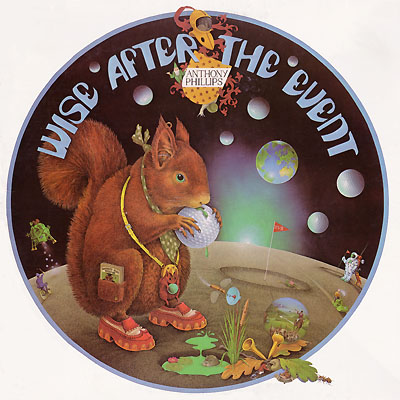
Today work of art is, at least to me, a great example of how varying interests can come together and lead to one thing, in this case the art of Peter Cross, a British illustrator of album covers and children’s books, among others. I first became aware of Peter Cross in the late 1970s. I was a huge fan of the music of early Genesis (up until around Duke) and was enough of a music geek that I also picked up solo works by members of the band. Anthony Phillips was a founding member of Genesis and its original guitarist (along with Mike Rutherford) though the most famous Genesis is alum is undoubtedly Pete Gabriel. Anthony Phillips left after the second album due to crippling stage fright, though he also wrote fan fave Musical Box which appears on Nursery Cryme, the band’s third album. After leaving Genesis in 1970, Phillips studied classical guitar and appeared on other people’s recordings from time to time before releasing his first solo album, The Geese and the Ghost, in 1977. The album cover featured beautiful art by Peter Cross. I was, and remain, a huge fan of art that’s very, very detailed, the sort of art you can look at for days and continue to find new things. So I was almost as excited by the cover art as the music when Phillips second solo effort appeared in 1978. Wise After the Event also featured another Peter Cross cover. A couple of years later I was working as a record buyer for the now-defunct chain Record Bar. A friend who worked at Jem Imports in New Jersey — and who knew I loved Peter Cross and Anthony Phillips — gave me a print of Wise After the Event signed by both Cross and Phillips, and it still hangs in our hallway.

wise-after-the-event

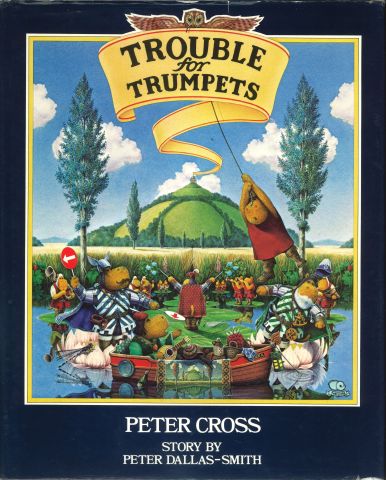
A few years later, a children’s book was published called Trouble For Trumpets and Cross did all the illustrations for it, apparently taking seven years to compete the 30-page book.

trouble_for_trumpets

It’s a fabulous book, a story about war, but it’s the art that really makes it for me. There was also a sequel a few years called Trumpets in Grumpetland and it’s equally wonderful. Unfortunately, both are out of print and quite expensive if you can even find one used.

But that brings us back around to beer. I was recently searching for new art to feature in this weekly series of Beer In Art, when I discovered that Peter Cross is still working and is represented online by Chris Beetles Art Gallery. Better still, he’s done several works recently involving beer. So I’m thrilled to be able to share one of my absolute favorite illustrators, Peter Cross.

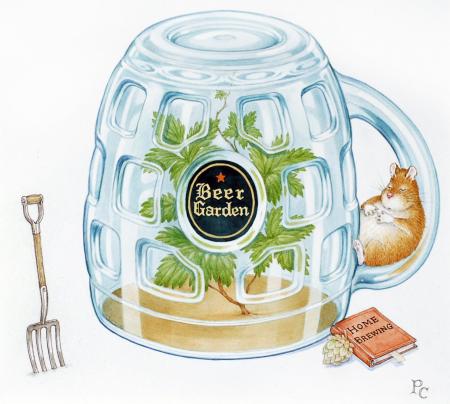
peter-cross_beer-garden
Beer Garden is a watercolor originally done for a greeting card.

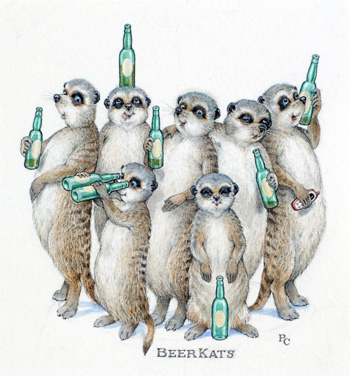
peter-cross_beerkats
Beerkats, a watercolor spoof of Meerkats also for a greeting card.

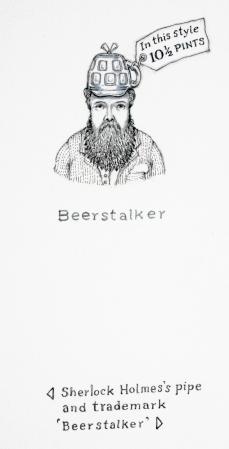
peter-cross_beerstalker
And lastly, Beerstalker, a pen and ink drawing.

In addition to Peter Cross’ Wikipedia page, there’s also a short biography and an interview on Anthony Phillips’ website. And can see more of his artwork at Chris Beetles Art Gallery

Filed Under: Art & Beer, Just For Fun, Related Pleasures Tagged With: Music, UK

UK Craft Paralleling US Craft Market

February 22, 2010 By Jay Brooks

siba
For several years now — maybe a decade? — craft beer has been growing at a faster rate than the older, big breweries. Naturally, they’re so big that even small percentage growth adds up to big dollars while craft beer, for the most part, with a smaller base has far more room to grow. As a result, this has been happening year after year without changing the overall landscape of the American beer market very much. It is changing, but very, very slowly (or at least slower than I’d like).

Perhaps more importantly, this sustained growth in the craft segment while the mainstream market continues to slip suggests a broader trend and what the future might hold, at least eventually. It certainly has worried the big brewers to some extent as they continue to test market micro-like products, niche products, buy into existing craft brewers and other actions calculated to take back some of the market share lost to the craft segment, no matter how small. It’s nothing sinister, just the way corporations operate. Perpetual growth sets the share price, and they must answer to the shareholders when sales goals are not met.

As our economy tanked this trend continued, with growth slowing in both big and small segments of the industry. While beer narrowly upheld its status as “recession-proof,” it did slow somewhat. Big beer went negative while craft continues to grow, but at a slower rate, at least in terms of volume of sales. In dollars, growth remained strong, but mostly because of higher prices. Of course, I also think that craft beer can sustain higher margins than big beer, whose drive to increase volume has seen price wars for decades. That gives craft another advantage, I think, because reaching a sustainable, profitable business model doesn’t have to involve going public, huge growth or answering to shareholders. Anchor Brewery is an excellent example of growing big enough and then sustaining that level while remaining profitable. Anchor has no desire to grow larger, and their future is entirely positive. It’s the opposite of the corporate model, and the one employed by most craft brewers. And I think it bodes well for the future of craft beer.

Today, the Society of Independent Brewers (SIBA) released a report about the state of things in the UK beer market, and there are some interesting parallels between the two markets.

Some key findings:

  • Local brewers achieved a 3.75% increase in volume sales in 2009, while the overall beer market fell 4.2%
  • Three-quarters of all local brewers recorded volume growth in 2009
  • On average, they achieved a 17% increase in sales turnover
  • Pubs continue to close, but local cask ale volumes rise by 1.27%
  • Local bottled beer production up by 16%

The entire report is available as a pdf at the bottom of the article about it in today’s Morning Advertiser. Another interesting stat not mentioned is that 22%, the highest percentage, of independent beer is sold to the consumer directly by the brewery in their shops or via their website. Second was Supermarkets (21%) and third was through independent pubs (19%).

Filed Under: Breweries, Editorial, News Tagged With: Big Brewers, Business, Statistics, UK

Beer In Ads #26: McEwan’s Everyone’s Choice

January 20, 2010 By Jay Brooks

ad-billboard
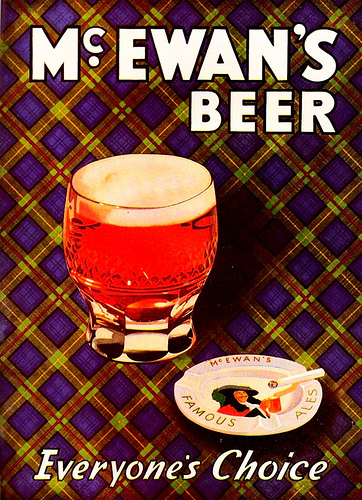
Wednesday’s ad is for the Scottish beer, McEwan’s, which until recently was owned by Scottish & Newcastle, but in 2007 it was split up and bought by both Heineken USA and Carlsberg, who each picked over its bones and took bits of it for themselves. Heineken got the McEwan’s brand.Who knows what its ultimate fate will be, though Heineken’s track record isn’t exactly geared toward preservation.

I don’t know when this ad was produced, but given the burning cigarette dangling above the McEwan’s man — taken from the Laughing Cavalier by Frans Hals — in the ashtray. it certainly must be when smoking still didn’t carry the stigma is does nowadays. I love the tartan background and just the simplicity of the drawing.

McEwans-everyones-choice

Filed Under: Art & Beer, Beers Tagged With: Advertising, Scotland, UK

Stuff & Nonsense, Part 10

January 19, 2010 By Jay Brooks

Last week, you probably recall I was following Pete Brown’s brilliant refutation of his national health service’s attack on alcohol, beginning with, Stuff & Nonsense: The UK Health Select Committee Report On Alcohol. The first nine parts of Pete’s rebuke were posted last week and today part ten, the last one, was also posted.

In part 10, Pete tackles an issue that isn’t entirely relevant in the U.S., because as far as I know there aren’t any states that allow it. The issue is Binge drinking has been made much worse by 24 hour licensing. Despite that, it’s a still a great read an interesting peek into the window of manipulation that’s taking place at the hands of the UK Parliament. This, sadly, is similar to our shores where neo-prohibitionists have worked their way — and their agenda — into politics at all levels. The rest of us, understandably were busy just trying to enjoy our lives, and so missed seeing what was going on until it was nearly too late.

Part of the problem here, at least in comparison to the UK, is we don’t have the same tradition of pub culture. When we separated from mother England, our two drinking cultures diverged dramatically. England’s stayed something that was part of their culture, something to be proud of, that had national associations. Ours fractured into taverns, pubs, dive bars, biker bars, fern bars, niteclubs, pool halls, chain bars, etc. And from the beginning of the temperance movements, all those were demonized and continue to be demonized. It’s a rare bar in the U.S. that can call itself a family place. And that’s at least part of the reason why so many can’t see alcohol as part of society, but something to be feared and separated, especially from — gasp — the little children.

That’s also why it was great seeing Pete’s addendum to his series, Answering the Neo-Prohibitionists — A Series Disclaimer. In it, Pete relates some personal stories of how alcohol abuse has affected him. It sounds like he didn’t want to recall such painful memories, but felt he had to do so, so that people criticizing him understood where he was coming from and that he did understand that alcohol can be destructive. I get that, too; the criticism for talking about neo-prohibitionists too much. But for whatever reason, I don’t mind talking about my own history with alcohol abuse. I grew up with an abusive, alcoholic, violent, clinically psychotic stepfather. He surrounded himself with other alcoholics and I all but grew up in bars around eastern Pennsylvania.

I’ve even written about it before, both here and as a semi-fictional memoir I did for NaNoWriMo a few years ago. The rough draft I wrote extemporaneously is still online, actually. It’s called Under the Table and hasn’t been edited since 2006, so expect lots of typos, run-on sentences and all manner of grammar horrors, assuming you’ve got a lots of spare hours to kill and have any desire to crawl inside my head (don’t say you haven’t been warned).

But the reason for bringing this up now is that even as a child I understood something the average neo-prohibitionist can’t seem to wrap his or her head around. And that’s the fact that my stepfather was — and indeed most alcoholics are — that way for reasons that have nothing to do with the booze itself. Attacking the product and its manufacturers and consumer’s access to them does absolutely nothing to stop people from drinking. If anything, it exacerbates those problems. Witness American Prohibition. Did it stop people from drinking? No. Did it increase crime? Yes. Did it work? Not even a little, yet there are people for whom that lesson counts for nothing and want to give it another go.

Here’s Pete’s take:

Firstly, because having witnessed it close up, I know that when people step up to fight alcohol abuse, they go for the wrong targets. People don’t drink harmfully because alcohol is there, or because it’s cheap, or because it’s advertised. Restricting the availability of alcohol won’t help alcoholics. These people live for alcohol – it’s the only thing they care about. Make it expensive and they’ll go without food, sell their house, Christ, they’d sell their fucking kids for a drink. Prohibit it altogether and they’ll drink meths, or nail varnish remover, or after shave.

Alcoholics drink not because it’s there, or cheap, or tastes nice, but because they have deeper trauma and/or unhappiness in their lives. Even if you were studying this at GCSE level, if you look at it scientifically, if availability/pricing/advertising of booze caused problem drinking, then everyone exposed to it would be more likely to problem drink. But most people in theUK are drinking less. A minority are drinking to harmful levels. And as far as I can tell, no one is studying that minority in detail and asking what it is about them that makes them different from the majority.

It’s easy to blame the availability of booze. And it is shameful that problem drinkers are not being researched in a way that can highlight what it is that’s different about them that makes them more likely to problem drink.

People drink to excess because they are unhappy, because they feel empty inside, because they are lonely, because they are stressed, because they have shit jobs being bullied in call centres and alcoholic oblivion is the only escape they can see. Why is no one helping them? Because it’s a bit more complicated than just blaming drink, that’s why.

Secondly, I’m doing this because for the vast majority of people, drink is an innocent pleasure with minimal health risks beyond a few extra pounds or the odd hangover. My father died of smoking-related lung cancer when he was 58 and I was 27. I’ve read the science, and I know that there is a direct linear relationship between smoking and ill health – every single cigarette you smoke causes you damage. Drink is not the same. There are healthy levels of alcohol consumption.

My close quarters witnessing of the destruction alcoholism can cause makes me more keenly aware of the benefits of moderate consumption, and the stark difference between the two. So it makes me very angry indeed when someone who doesn’t know what they’re talking about tars all habitual drinkers with the same brush. And even angrier when newspapers distort the facts even further for nothing more than a sensationalist story.

Thirdly – quite simply, because it needs doing. A quick review of press stories about alcohol over the last week alone will show you how drinking is being demonised and made socially unacceptable. It’s based on lies and distortions. The figures say the problem is not getting any worse – if anything, the situation is improving. No one in the media seems to want to report this truth. No one questions press releases from avowedly anti-drink organisations. My blog posts might seem excessive if you’ve been staying tuned over the last week or so, but they amount to a fart in the face of a hurricane compared to the anti-drink propaganda that’s out there every single day.

In summary then – I know the ill effects of alcohol abuse as well as anyone, and care about them as much as anyone. I’ll never deny that there’s a problem, and am not seeking to do so on this blog.

But if that problem is going to be dealt with effectively, it has to be understood properly. I think the neopros are acting against the interests of the majority of drinkers. But worse, because they are approaching the problem over-simplistically, wilfully distorting the evidence, and confusing personal beliefs with real health issues, I don’t think their antics will do anything to help the people who really need helping. And that is just shameful.

That’s why I’m doing this.

Amen, brother.

To sum up, if this is new to you, start with Pete Brown’s Health Select Committee Report on Alcohol. Part One (of 10) was published Sunday, Alcohol consumption in the UK is increasing. On Monday, parts two, 25% of the UK population is drinking at hazardous or harmful levels, and three, Binge drinking is increasing, were published. Tuesday saw part four: Alcohol is becoming cheaper/more affordable, and yesterday part five, Alcohol related hospital admissions — and the cost of alcohol to the NHS — are soaring, was published online. Overnight and today, part six, Alcohol abuse costs the country £55bn a year, part seven, The best way to reduce the harmful effects of alcohol is to reduce overall consumption, part eight, Alcohol advertising and promotion must be tightly regulated because it encourages underage drinking, and part nine, Pubs are a problem, went up. And finally, part ten, Binge drinking has been made much worse by 24 hour licensing.

Filed Under: Editorial, Politics & Law Tagged With: Prohibitionists, Statistics, UK

Stuff & Nonsense, Parts 6 Through 9

January 14, 2010 By Jay Brooks

By now, even the casual Bulletin reader has likely noticed that I’ve been following Pete Brown’s brilliant refutation of his national health service’s attack on alcohol, beginning with, Stuff & Nonsense: The UK Health Select Committee Report On Alcohol. The first five parts of Pete’s rebuke have been published over the past few days, and overnight and this morning, west coast time, parts six through nine were posted.

In part 6, Pete tackles the assertion that Alcohol abuse costs the country £55bn a year
Today’s rebuke. In the U.S., this is claim made with alarming regularity, charging alcohol for all manner of sins, and ignoring personal responsibility, common sense and even logic. If there’s a whiff of alcohol anywhere in the vicinity, then by gum the whole thing is alky’s fault. Last year, the Marin Institute did their own study claiming in California alone alcohol costs $38 billion each year. It’s as self-serving a document you’ll ever read. In the UK report, they claim alcohol costs Britain either £20 or £55 billion pounds (which is 32.5 billion dollars or 89.5 billion dollars). This should give you some idea about who whacked our anti-alcohol folks are. The are just over 61 million people in the UK, but almost 37 million in California, yet they assert that, using the UK’s lower figure, alcohol costs more than the entire nation of Great Britain, with roughly half the number of people. It’s just so easy to lie with statistics, and, more profoundly sad, even easier to get the government and the media to swallow those lies without questioning them. But in any event, take a look at Pete’s analysis.

In part 7, the government trots out yet another old favorite, the wolf in sheep’s clothing that is the best way to reduce the harmful effects of alcohol is to reduce overall consumption. All we need to do to get rid of some people doing something we don’t like is make it illegal for everybody. Problem solved. Except that alcohol has been around since before the dawn of civilization and maybe 99.9% (full disclosure, I made that number up but the idea is that the vast majority) of people enjoy the occasional without ruining their lives, their loved ones, their careers, or even their livers. And numerous medical studies confirm a wide range of health benefits, not least of which is the fact that people who drink alcohol in moderation tend to outlive those who never touch the stuff.

In the case of the UK report, they claim to be advising just toward reducing consumption, but to where? To what level? It’s already be shown beyond doubt that the recommended levels that the UK advises were made up wholesale, pulled out of thin air. Just the notion that recommended safe amounts are the same for any two men or women is patently absurd, yet that’s the standard. The other problem I see with arguing for less overall consumption is that it’s a slippery slope. Today’s reduction is tomorrow’s outright ban. If less is more, then none must be best of all, right?

Part eight brings up to the most pernicious argument of all, and the one that always sticks in my craw. “It’s for the children,” they cry. “Doesn’t anybody think of the children.” What the UK says, is Alcohol advertising and promotion must be tightly regulated because it encourages underage drinking. While the report says the opposite, the truth is drinking is declining in the UK, and I suspect that’s true here, too. But it’s Pete’ summary that is most telling, showing the chain of absurdity.

The HSC says drinking among children is increasing. But recent official figures suggest it is falling.

The HSC simply asserts that advertising encourages young people to drink. But there is no evidence of a causal link, despite people looking very hard to try to find one.

So they imply that there is a link between awareness of alcohol brands and propensity to drink underage, because they can prove awareness. But there’s no evidence of this either.

So after having spent a long time discussing the content of alcohol ads, they then say it’s not the content, but the quantity of it that has an effect. There’s no evidence of this either.

So in the end, they disregard testimony from advertising professionals, and simply choose to believe the testimony of people who want alcohol advertising to be banned, say it is damaging to children, but can produce no evidence to back up their assertion.

Which brings us to part 9, Pubs are a problem. If alcohol is a problem, then the places where people drink it must also be dens of inequity, mustn’t they?

To sum up, if this is new to you, start with Pete Brown’s Health Select Committee Report on Alcohol. Part One (of 10) was published Sunday, Alcohol consumption in the UK is increasing. On Monday, parts two, 25% of the UK population is drinking at hazardous or harmful levels, and three, Binge drinking is increasing, were published. Tuesday saw part four: Alcohol is becoming cheaper/more affordable, and yesterday part five, Alcohol related hospital admissions — and the cost of alcohol to the NHS — are soaring, was published online. Overnight and today, part six, Alcohol abuse costs the country £55bn a year, part seven, The best way to reduce the harmful effects of alcohol is to reduce overall consumption, part eight, Alcohol advertising and promotion must be tightly regulated because it encourages underage drinking, and part nine, Pubs are a problem, went up. Once again, stay tuned. There’s one more part to go.

Filed Under: Editorial, Politics & Law Tagged With: Health & Beer, Prohibitionists, Statistics, UK

« Previous Page
Next Page »

Find Something

Northern California Breweries

Please consider purchasing my latest book, California Breweries North, available from Amazon, or ask for it at your local bookstore.

Recent Comments

  • Ernie Dewing on Historic Beer Birthday: Charles William Bergner 
  • Steve 'Pudgy' De Rose on Historic Beer Birthday: Jacob Schmidt
  • Jay Brooks on Beer Birthday: Bill Owens
  • Steve 'Pudgy' De Rose on Beer Birthday: Charles Finkel
  • Steve 'Pudgy' De Rose on Beer Birthday: Bill Owens

Recent Posts

  • Beer In Ads #5200: Now Is The Time To Enjoy … Stroh’s Bock Beer February 12, 2026
  • Historic Beer Birthday: Adolph Schell February 12, 2026
  • Beer Birthday: Jennifer Talley February 12, 2026
  • Beer In Ads #5199: Fresh As A Frosty Morn, Congress Bock Beer February 11, 2026
  • Historic Beer Birthday: John Weidenfeller February 11, 2026

BBB Archives

Feedback

Head Quarter
This site is hosted and maintained by H25Q.dev. Any questions or comments for the webmaster can be directed here.