Brookston Beer Bulletin

Jay R. Brooks on Beer

  • Home
  • About
  • Editorial
  • Birthdays
  • Art & Beer

Socialize

  • Dribbble
  • Email
  • Facebook
  • Flickr
  • GitHub
  • Instagram
  • LinkedIn
  • Pinterest
  • RSS
  • Twitter
  • YouTube

Powered by Genesis

Historic Beer Birthday: Henry F. Hagemeister

November 18, 2025 By Jay Brooks

hagemeister
Today is the birthday of Henry Frank Hagemeister (November 18, 1855-June 27, 1915). He “was a member of the Wisconsin State Assembly and the Wisconsin State Senate.” His father founded the Hagemeister Brewery in 1866, calling it the Union Brewery. Henry joined the brewery at the bottom, and worked his way up, and ran it with his father, and the changed the name to Hagemeister & Son. After his father passed away, Henry took over, and incorporated it as the Hagemeister Brewing Co. in 1890. Hagemeister stayed open through prohibition, and in 1934 changed its name to the Valley Brewing & Refrigerating Co. but closed for good the same year. Here’s his basics, from Wikipedia:

He was born in Green Bay, Wisconsin in 1855, [the son of German immigrants] and educated in the parochial and public schools of Green Bay. He would go on to work in brewing and banking, as the president of the Hagemeister Brewing Company, and president of Kellogg’s National Bank.

Henry_Hagemeister
Here’s a biography of Hagermeister from the “Commemorative Biographical Record of the West Shore of Green Bay, Wisconsin,” published in 1896.

hagermeister-bio-1
hagermeister-bio-2
Hagemeister-brewery-1907
This is his obituary, from the Brewers Journal:

henry-hagemeister-bio-1-bj
henry-hagemeister-bio-2-bj
And here’s a longer biography from “Wisconsin: Its Story and Biography, 1848-1913, Volume VIII,” written by Ellis Baker Usher, and published in 1914:

hagermeister-henry-bio-1
hagermeister-henry-bio-2
Hagemeister-Brewing-Company-Drinkware-Mugs-Steins-Hagemeister-Brewing-Co_21355-1
hagermeister-henry-bio-3
hagermeister-henry-bio-4

Ehren-Brau-Beer-Labels-Hagemeister-Brewing-Co

Filed Under: Birthdays, Just For Fun Tagged With: History, Wisconsin

Beer In Ads #5116: Uff-Da Wisconsin Bock Beer

November 14, 2025 By Jay Brooks

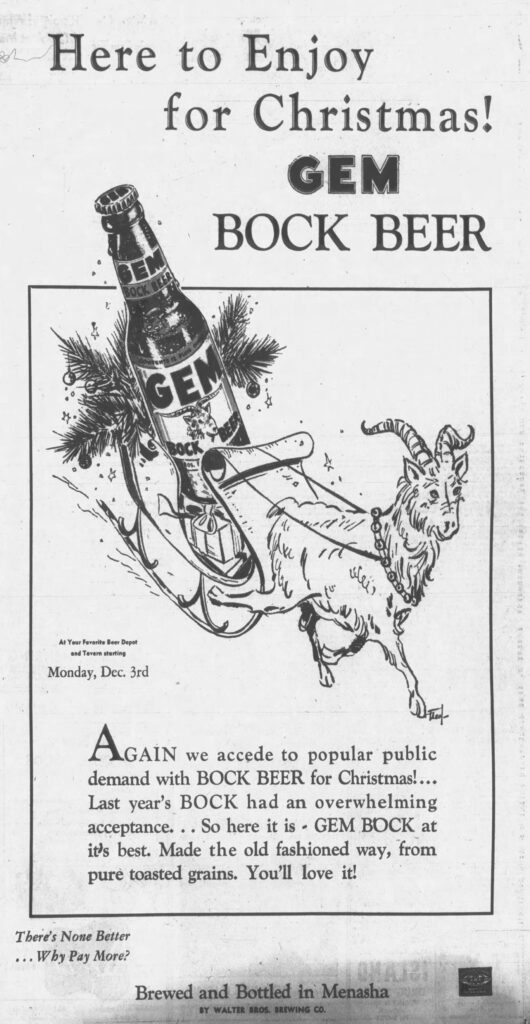
Last year I decided to concentrate on Bock ads for awhile. Bock, of course, may have originated in Germany, in the town of Einbeck. Because many 19th century American breweries were founded by German immigrants, they offered a bock at certain times of the year, be it Spring, Easter, Lent, Christmas, or what have you. In a sense they were some of the first seasonal beers. “The style was later adopted in Bavaria by Munich brewers in the 17th century. Due to their Bavarian accent, citizens of Munich pronounced ‘Einbeck’ as ‘ein Bock’ (a billy goat), and thus the beer became known as ‘Bock.’ A goat often appears on bottle labels.” And presumably because they were special releases, many breweries went all out promoting them with beautiful artwork on posters and other advertising.

Friday’s ad is for Uff-Da Bock Beer, which was published on November 14, 1994. This one was not specifically for the beer, but instead for the Landmark Restaurant Tavern at 1066 Cass St. in Portage, Wisconsin. But in the ad, they’re urging people to “Stop In And Try A New Local Micro-Brewery Beer From New Glarus: Uff-Da Wisconsin Bock Beer.” from the New Glarus Brewing Co. of New Glarus, Wisconsin, which was originally founded in 1993. This ad ran in The Portage Daily Register, also from Portage, Wisconsin.

Filed Under: Art & Beer, Beers, Breweries, Just For Fun Tagged With: Advertising, Bock, History, Wisconsin

Historic Beer Birthday: William G. Jung

November 5, 2025 By Jay Brooks

jung-wis
Today is the birthday of William Gustave Jung (November 5, 1886-September 17, 1947). I couldn’t find very much information about Jung, though I believe he was born in Germany. After seeking his fortune in America, he apparently worked at the Silver Creek Brewery, which also became known as the Chas. Hamm Brewing Co. in 1910. Unfortunately, Charles Hamm died of pneumonia while an American soldier in Europe in 1918. Jung, who was a brewmaster, leased the brewery from the Hamm family after Charles Hamm’s death (including making non-alcoholic drinks and soda during prohibition as the Jung Beverage Co.) until 1932, when he bought it from the family, renaming it the William G. Jung Products Co. Brewery, but a few years later shortening that to the Jung Brewing Co. It remained in business until 1958, when it closed for good.

jungs-old-country-label
jung-beer-bottles

Jung-bock
jung-pilsener-can
Jung-holiday-beer

Filed Under: Birthdays, Breweries, Just For Fun Tagged With: History, Wisconsin

Historic Beer Birthday: Andrew Hemrich

October 31, 2025 By Jay Brooks

hemrich
Today is the birthday of Andrew Henrich (October 31, 1856-May 2, 1910). He was born in Wisconsin, and was the first of his brothers to move to the Seattle, Washington area, but his brothers Alvin, Julius and Louis soon joined him. He bought the Bay View Brewery in Seattle, and later his brother Alvin bought the North Pacific Brewery (also known as the old Slorah brewery), and renamed it the Alvin Hemrich Brewing Co. in 1897. Two of his brothers soon joined him in the enterprise, and it was renamed again, this time to Hemrich Brothers Brewing Company. They did well enough that he began buying out other area breweries. When prohibition closed the brewery, they were ready, having retooled their plants for near-beer and also having divested into some other businesses.

andrew-hemrich
This biography of Andrew is from “An Illustrated History of the State of Washington,” by Rev. H. K. Hines, published in 1893, as found on Gary Flynn’s Brewery Gems‘ page on Andrew Hemrich:

Andrew Hemrich received an elementary education at Alma, which was continued in the practical duties of life, as at the age of ten years, he began work in his father’s brewery, and three years later was sent to La Crosse, as an apprentice to learn the brewing business. This was followed by two years in breweries in Milwaukee, one year at Denver, Colorado, and one year at Eureka, Nevada. In 1876, with two companions, all well mounted, he made a trip of 1,700 miles through the Yankee Fork mining district of Idaho, but the claims being all covered and the country being in constant danger from the attacks of hostile tribes of Indians, the party continued to Butte, Montana, then but a small mining settlement. In 1877 at Glendale, thirty-five miles from Butte, Mr. Hemrich partnered with Frank Gilig in starting a small brewery, selling their product at $21 per barrel. This he continued for eighteen months, then sold out and engaged in mining, in which a short experience exhausted his accumulated savings. He then gave up mining and going to Bozeman resumed his trade as foreman of a small brewery and there remained until February, 1883, when he came to Seattle and forming a co-partnership with John Kopp started a small steam beer brewery with an annual capacity of 2,500 barrels. This was the nucleus of the present Bay View brewery.

In 1884 Mr. Kopp sold out his interest to the father of our subject, John Hemrich, and in 1885, the latter’s brother-in-law; Fred Kirschner, entered the firm, then known as Hemrich & Co. With the growing demand the capacity of the brewery was increased from time to time up to 1887, when the brewery was rebuilt and with improved machinery the firm engaged in the manufacture of lager beer, with a capacity of 80,000 barrels per year. The product was sold throughout the Northwest. In April, 1891, the business was incorporated as the Bay View Brewing Company, with a capital stock of $300,000, and so continued up to the spring of 1893, when the company consolidated with the Albert Braun Brewing Company, and the Claussen-Sweeney Brewing Company, under the incorporate name of Seattle Brewing & Malting Company, with a capital stock of $1,000,000, Mr. Hemrich continuing as president. In 1892 our subject was one of the organizers and incorporators of the Victoria Brewing & Ice Company, of which he is vice-president. He has also extensive mining interests in the Cascade mountains, twenty miles east of Snoqualmie Falls. The claims cover 6,000 x 600 feet on one ledge, and 4,500 x 600 feet on a parallel ledge, gold-bearing, running from $5 to $105 per ton. Mr. Hemrich is also president of the Eureka Coal Company, and owns valuable improved and unimproved property in the city of Seattle.

He was married in Seattle, in 1885, to Miss Amelia Hucke, of Essen, Germany. They have four children: John, Alvin, Ernest and Katherine.

andrew-hemrich-cartoon

And this account of Andrew is from “A Volume of Memoirs and Genealogy of Representative Citizens of the City of Seattle and County of King, Washington,” published in 1903:

With a deep and abiding interest in the city of Seattle, in its progress and improvement, Andrew Hemrich has done much for its advancement, laboring earnestly along lines that have contributed to its material upbuilding. He is therefore known as one of its valued citizens. He is furthermore prominent in business affairs and a recognized leader in the ranks of the Republican party, on whose ticket he was elected to the office of state senator in 1898, so that he is now serving.

Mr. Hemrich was born in Alma, Wisconsin, October 31, 1856, and is a son of John and Catherine (Koeppel) Hemrich, both of whom were natives of Germany, the father having been born in Baden, while the mother’s birth occurred in Bavaria. In youth they came to American and the father traveled across the country in a covered wagon from Rochester, New York, to Iowa, stopping for a while at Mount Vernon, Indiana, thus making his way to Keokuk, Iowa, where he engaged in the brewing business. He followed that pursuit until 1852, when he loaded his brewery appliances and fixtures upon a barge which was towed to Alma, Wisconsin. There he again established a brewery, which he successfully conducted for thirty years. In 1884 he came to Seattle, where his son Andrew had previously located, and joined him in the organization and incorporation of the Bay View Brewing Company, which was conducted under the firm name until 1893, when it became the Bay View branch of the Seattle Brewing and Malting Company. About 1891 John Hemrich retired from active business life, enjoying a well-merited rest until called to his final home in 1897. His wife still survives him and resides at the old home in Bay View. He was a very active and energetic business man, reliable in all his trade transactions and his industry and capable management brought to him splendid success. In politics he was a Democrat and during the war of the rebellion served as sheriff of Buffalo county, Wisconsin. To him and his wife were born ten children: Edwin, who died at the age of six years; George, who passed away at the age of eighteen; Louise, who became the wife of John Lick, and died at the age of twenty-four; Matilda, who married John Lick, and died at the age of twenty-nine years; Andrew, whose name introduces this review; John, who is living retired; Emma, the widow of Frederick Kirschner; William, who is connected with the Bay View Brewery; Alvin and Louis, who are members of the firm of Hemrich Brothers.

During his boyhood days Andrew Hemrich pursued his education in the common schools, which he attended until fourteen years of age. He then left home and went to the wild mining regions of the west, spending about ten or twelve years on the prairies of Colorado, Nevada, Idaho and Montana. He was there engaged in mining and was also connected with brewing interests, establishing a brewery at Glendale, Montana, which he conducted for several years. He then sold his plant there and accepted a position as manager superintendent of the Bozeman Brewing Company of Bozeman, Montana. He occupied that position for two years and upon resigning he came to Seattle in accordance with plans perfected to establish a brewery business in company with John Kopp.

Mr. Hemrich arrived in this city February 18, 1883, and has since been one of its residents, active in its business affairs and a recognized leader in political circles. The same year he established a business at Bay View under the firm name of Kopp & Hemrich, which business was conducted for two years, at the end of which time he was joined by his father, John Hemrich, and his brother-in-law, Frederick Kirschner, in the organization and incorporation of the Bay View Brewing Company, which was conducted under that style until 1893. The business was then merged into the Seattle Brewing and Malting Company, whose trade has grown from a modest beginning to mammoth proportions, and it is now the largest establishment of the kind on the coast. In addition to the plant at Bay View, there has been a colossal new brick structure erected at Georgetown. It required three years in its construction and has just been completed. It now has a capacity of three hundred thousand barrels per year. The brand “Rainier” is as famous on the coast as the Pabst and Schlitz brews are in the middle and eastern section of the country. Mr. Hemrich was chosen president on the organization of the new company and still serves in that capacity. He has excellent business ability and executive force, his plans are readily and substantially formed and he is determined in their execution and carries forth to a successful conclusion whatever he commences, brooking no obstacles that can be overcome by persistent, honorable and earnest effort.

Mr. Hemrich has long been deeply interested in important measures for the improvement and upbuilding of Seattle. He was one of the organizers and is vice-president of the Seattle and Lake Washington Water-way Company, and many other interests of importance owe their successful existence to his wise counsel and active co-operation. No movement or measure calculated to prove of benefit to the city solicits his aid in vain, for he had ever been a generous contributor to every interest for the general good. In political affairs, too, he is well known, and has labored earnestly and effectively for the improvement and growth of the Republican party, of which he has long been a stalwart and earnest supporter. He was elected in 1898 on that ticket to the office of state senator and is still occupying this position. He has given due consideration to all matters which have come up for action and has left the impress of his individuality upon the legislation enacted during his term.

In November, 1884, Mr. Hemrich was united in marriage to Miss Maria Hucke, a native of Germany, and to them have been born five children: John, Alvin, Ernest, Katie G. and Charles. The family have a fine residence at Bay View, which was erected by Mr. Hemrich in 1892. He has been and is distinctively a man of affairs and one who has wielded wide influence. A strong mentality, an invincible courage and a most determined individuality have so entered into his makeup as to render him a natural leader of men and director of things.

Hemrichs-Select-Beer-Labels-Hemrich-Brew

Hemrich-tray

Filed Under: Birthdays, Just For Fun Tagged With: History, Washington, Wisconsin

Historic Beer Birthday: Jean Baptiste Bechaud

October 31, 2025 By Jay Brooks

Today is the birthday of Jean Baptiste Bechaud (October 31, 1848-April 20, 1922). He was born in Franfhein, Lower Bavaria on the Rhine, in Germany, but moved to the U.S. with his parents at the age of six, settling in Fond du Lac, Wisconsin. At some point, he anglicized his name to John Bates, but seems to have used the two interchangeably depending on the setting. In 1871, along with two of his brothers, Adoph and Frank, founded the A.G. Bechaud Brewery, which was also known as the A.G. Bechaud & Bros. Brewery and later, beginning in 1875, traded under the Empire Brewery name, before returning to Bechaud Brewery when it reopened after prohibition ended, before closing for good in 1941.

This is Bechaud’s obituary in the Fond du Lac Daily Reporter, on Thursday April 20, 1922:

JOHN B. BECHAUD DIES, AGED 75. Well Known Businessman of City Succumbs to Long Illness. LEAVES SIX CHILDREN. John Bates Bechaud, aged 75 years, prominent in Fond du Lac business circles for many years, died at 2:50 o’clock this afternoon after an illness of a year, which had been acute for the past two months. He had been a resident of Fond du Lac for 53 years. Funeral arrangements have not yet been made. Mr. Bechaud was born in Germany Oct. 31, 1846, his parents immigrating to America in 1851. The father, John P. Bechaud, conducted a hotel in Fond du Lac for four years after the family arrived in America, later removing to a farm. The son remained with the father until 1871, when he joined with his brothers, Adolph and Frank H. Bechaud, in the organization of the Bechaud Brewing company. Serving as a private in the Sixth Michigan Cavalry from the date of his enlistment in 1864 until the close of the Civil war, Mr. Bechaud served with another Michigan cavalry regiment in the West until his discharge in 1866. He was affiliated with the Elks, Eagles and Masonic order. The surviving relatives are the widow, Mrs. Mary Bechaud, and three sons and three daughters, Mrs. M.H. Nelson, Mrs. M.H. Boudry, Mrs. P.L. Kolb, and Rudolph and Louis Bechaud, Fond du Lac, and Armand Bechaud, Chicago.

Jean Baptiste with his wife, Mary Ann Kraemer Bechaud.

And here’s another obituary from the Fond du Lac Daily Commonwealth, also on Thursday, April 20, 1922:

J.B. BECHAUD IS DEAD, WAS FAILING FOR LONG PERIOD. End Comes at Residence Near 3 O’clock. WAS A CIVIL WAR VETERAN. John B. Bechaud, one of Fond du Lac’s prominent citizens and businessmen, died at 3 o’clock this afternoon at the residence 108 South Union street. He had been in failing health for some time. Mr. Bechaud was born Oct. 31, 1846 in Germany, and came to this country in 1851. Mr. Bechaud on acquiring his majority followed agricultural pursuits until 1871 when he became associated with his brothers, F.H., and Adolph, in the brewing business. He served as vice president of the Bechaud Brewing Co. He was a member of the Masons, Elks, Eagles and National Union. He served as a member of the city common council and the school board.

This history of the Bechaud Brewery is from Oshkosh Beer’s post “An Illustrated History of the Brewing Industry in Fond du Lac.”

In 1871, Fond du Lac’s most successful brewery was opened at 515 Main Street by the brothers Frank, John and Capt. A.G. Bechaud. Formed during the presidency of Ulysses S. Grant, their brewing company also set the standard for longevity among Fond du Lac beer makers, surviving until 1941, when Franklin Delano Roosevelt began his third term in office.

The Bechaud brothers, all born in Bavaria, started brewing at their Main Street location but they also bought lakeshore property on Lake Winnebago just northwest of the city limits, where they envisioned locating their permanent brewing empire. However, the beachfront brew-house was not to be. Instead, in 1873, the Bechauds opened their new large brewery on Eleventh Street, just west of Hickory Street.

The Bechauds also maintained a Main Street address. Their “sample room” gave people a chance to enjoy the freshest beer the company had to offer. The most popular brand produced by Bechaud, “Empire” was bottled and sold in various cities. Their other beers included “Műnchner” and “Pilsener.” In all, the company sold an average of 15,000 barrels of their beers annually.

Filed Under: Birthdays, Breweries, Just For Fun Tagged With: Germany, Wisconsin

Beer In Ads #5111: Pabst Bock Beer

October 27, 2025 By Jay Brooks

Last year I decided to concentrate on Bock ads for awhile. Bock, of course, may have originated in Germany, in the town of Einbeck. Because many 19th century American breweries were founded by German immigrants, they offered a bock at certain times of the year, be it Spring, Easter, Lent, Christmas, or what have you. In a sense they were some of the first seasonal beers. “The style was later adopted in Bavaria by Munich brewers in the 17th century. Due to their Bavarian accent, citizens of Munich pronounced ‘Einbeck’ as ‘ein Bock’ (a billy goat), and thus the beer became known as ‘Bock.’ A goat often appears on bottle labels.” And presumably because they were special releases, many breweries went all out promoting them with beautiful artwork on posters and other advertising.

Monday’s poster is for Pabst Bock Beer, which was published, I think, in the last 19th century. It was made for the Pabst Brewing Co. of Milwaukee, Wisconsin, which was originally founded in 1844. Unfortunately, it’s not known who the artist was who created this.

Filed Under: Art & Beer, Beers, Breweries, Just For Fun Tagged With: Advertising, Bock, History, Pabst, Wisconsin

Beer In Ads #5110: Van Merritt Bock Beer

October 23, 2025 By Jay Brooks

Last year I decided to concentrate on Bock ads for awhile. Bock, of course, may have originated in Germany, in the town of Einbeck. Because many 19th century American breweries were founded by German immigrants, they offered a bock at certain times of the year, be it Spring, Easter, Lent, Christmas, or what have you. In a sense they were some of the first seasonal beers. “The style was later adopted in Bavaria by Munich brewers in the 17th century. Due to their Bavarian accent, citizens of Munich pronounced ‘Einbeck’ as ‘ein Bock’ (a billy goat), and thus the beer became known as ‘Bock.’ A goat often appears on bottle labels.” And presumably because they were special releases, many breweries went all out promoting them with beautiful artwork on posters and other advertising.

Thursday’s ad is for Van Merritt Bock Beer, which was published on October 23, 1962. This one was for the Van Merritt Brewing Co. of Oconto, Wisconsin, which was originally founded in 1858 by Anton Link. Van Merritt was one of several brands marketed by the Oconto Brewing Co. in the early 1960s, though it doesn’t seem to have works, as the brewery closed in 1967. This ad ran in The Arizona Republic, from Phoenix, Arizona.

Filed Under: Beers, Breweries, Just For Fun Tagged With: Advertising, Arizona, Bock, History, Wisconsin

Beer Birthday: Lucy Saunders

October 21, 2025 By Jay Brooks

beercook
because beer is food: in cooking, at the table, and by the glass …

So begins the website of beer cook Lucy Saunders, whose birthday is today. Lucy has done much to promote both cooking with beer and enjoying food with beer through her books and other writings. She’s a treasure, in more ways than one. Join me in wishing Lucy a very happy birthday Lucy.

beerbistro-04
At the beer bistro in Toronto for Stephen Beaumont and Maggie’s wedding reception.

nbwa08-09
Lucy with Stacy Williams, Brand Manager for Gambrinus, at the Hot Brands reception at the NBWA Convention, when it was in San Francisco a few years ago.

cbc07-36
During CBC in Austin, Texas in 2007, at the Moonshine bar for an event with Lucy for her book, Grilling with Beer. Here, Lucy with three contributors to her book, myself included.

gabf06-wed-04
Lucy with Vinnie Cilurzo at the GABF brewers reception in Denver in 2006.

monks-candinner-6
Shaun O’Sullivan from 21st Amendment, Fergie Carey, co-owner of Monk’s, Lucy Saunders, the beer cook, and Tom Peters, also co-owner of Monk’s at the Canned Beer Dinner many Junes ago.

Filed Under: Birthdays, Food & Beer Tagged With: Midwest, Wisconsin

Historic Beer Birthday: Anna Maria Hartig Krug Schlitz

October 9, 2025 By Jay Brooks

schlitz-globe
Today is the birthday of Anna Maria Hartig Krug Schlitz (October 9, 1819-January 20, 1887). She was born in Germany, and married August Krug when she was 21, in 1840, and the couple emigrated to Milwaukee Wisconsin in 1848. The Krugs opened a restaurant and the following year, 1849, added a brewery, which was known then as the August Krug Brewery. When he died young, in 1856, his bookkeeper, Joseph Schlitz took over management on behalf of Anna Maria Krug. In 1858, she married Joseph Schlitz and he renamed the brewery after himself.

Anna-Maria-Hartig-Krug-Schlitz

This biography is from Find-a-Grave:

Anna Maria Hartig was born in Germany. Her first husband was Georg August Krug and her second husband was Joseph Schlitz.

Anna Maria and August were married in 1840 in Miltenberg, Germany. August came to Milwaukee Wisconsin in 1848 and in 1849 opened a restaurant and saloon on Juneau Avenue. He brewed his own beer in the basement of his Kilbourntown home, enough to supply the saloon and restaurant. Because of no refrigeration, beer was only brewed in colder months. He brewed about 150 barrels during the first year. When business was prospering, Anna Maria joined him from Germany.

In 1850, Georg Krug, August’s father, and eight-year old August Uihlein, August’s nephew, came to visit them. On their passage to Milwaukee, they survived the sinking of the S.S. Helene Schlomann. Krug’s father gave August $800, so he sold his restaurant and began construction of a full-time brew house, called the August Krug Brewery. He built Milwaukee’s first underground vaults for the storage of beer. August Uihlein remained in Milwaukee, lived with them and attended school in Milwaukee.

In 1850, August also hired four employees including Joseph Schlitz, a twenty-year-old bookkeeper, who was born in Mainz, Rheinhessen, Germany in 1831. Joseph Schlitz’s father was a wine and beer broker who taught his son the intricacies of both business and brewing. As a bookkeeper, Joseph helped to expand the business by buying horses, wagons, brewing equipment. By 1853 the brewery produced 300 barrels of beer.

Anna Maria’s first husband, August Krug died on December 30, 1856, seven years after his brewery opened. Joseph Schlitz assumed the role of brewery manager. In 1858, two years after August died, Joseph Schlitz married Anna Maria, who was twelve years his senior. By 1859, the Schlitz Brewing Company produced and sold approximately 2,000 barrels of beer.

In 1875, her husband, Joseph Schlitz, traveled to Germany and was lost at sea in a shipwreck off the coast of England on a steamer, The S.S. Schiller on May 7, 1875. A likeness of the steamer can be seen on the front of the Schlitz monument.

Anna Maria then had her five nephews on August Krug’s side of the family, the Uihlein brothers, run the Brewery. August Uihlein helped lead the company to its fame. When Anna Maria died in 1887 at age 68, complete ownership of the company went to the Uihlein brothers.

schlitz-postcard

And this part of longer article on Immigrant Entrepreneurship entitled “Political Revolution, Emigration, and Establishing a Regional Player in Brewing: August Krug and Joseph Schlitz.” This portion discusses Anna Marie and her part of the story:

At the beginning was the German revolution of 1848. Georg August Krug (born April 15, 1815 in Miltenberg, grand duchy of Hesse-Darmstadt; died: December 30, 1856 in Milwaukee, WI) was born the son of Georg Anton Krug (1785–1860) and Anna Marie Ludwig (1784–1864), who owned the brewery “Zum Weißen Löwen,” the predecessor of today’s Faust brewery, in Miltenberg. This was a small and contested town at the River Main, which belonged until 1803 to the Electorate of Mayence (Mainz), became part of the grand duchy of Baden in 1806, was transferred to the grand duchy of Hesse-Darmstadt in 1810, and finally became part of the Kingdom of Bavaria in 1816. Georg August Krug worked in the family business but also became a member of a group of revolutionists surrounding a local doctor and farmer, Jakob Nöthig, who later emigrated to the U.S. after he was accused of being a ringleader (Rädelsführerei) of a local band of political agitators and other offenses against the Bavarian authorities. Krug and his father were among the petitioners in Miltenberg on March 8, 1848 who demanded liberal reforms. On the following day Miltenberg was shaken by protests and turmoil, and Bavarian armed forces reestablished order. Facing official prosecution, the younger Krug became part of the first wave of politically-motivated emigration. He arrived in the United States in May 1848, where he used only his second name and where he was naturalized on December 15, 1854.

In Milwaukee, at that time a preferred destination for the 48ers, August Krug established, probably with his savings, a saloon and restaurant on 4th and Chestnut Streets. Far from Bavaria, he still managed to receive additional support from his family. First, his fiancée Anna Maria Wiesmann Hartig arrived from Miltenberg (Oct. 9, 1819–Jan. 20, 1887) and they eventually married—likely in 1849. She was the daughter of Michael Wiesmann and Christina Schlohr, both from Miltenberg. Her presence allowed an expansion of his business activities. While Anna Maria Krug managed the restaurant, August Krug started a small brewing business at a nearby building at 420 Chestnut Street in 1849. Second, his father Georg Anton Krug arrived in the United States on October 25, 1850, accompanied by his grandson, 8-year-old August Uihlein. Such visits were not without risk: the visitors travelled on the Helena Sloman, the first German steamship on the transatlantic route. It encountered distress at sea on November 28, 1850 and sunk. Nine people were killed, but the vast majority of the crew and the passengers, in total 175 persons, were rescued by the American ship Devonshire. Georg Anton Krug lost a Bavarian beer pump, which went down with the wreckage, but he rescued $800 in gold (or $23,000 in 2010 dollars). This capital was invested into the brewery of his son and used to hire three additional employees, including a bookkeeper named Joseph Schlitz.

August Krug became a respected citizen. In 1850, his real estate property was valued at $1,600 ($46,100 in 2010 dollars). His household consisted of five people: himself and his wife Anna Maria, two brewery workers (both from Bavaria), and a young 18-year-old women, probably a servant. Krug was apparently a respected voice in his neighborhood, as his name was invoked in a newspaper advertisement for a local fireproof tile maker. He could afford to visit Germany in 1855, where he was able to meet with his relatives again.

anna-hertig

By the mid-1850s, Krug already saw himself as a competitor for preeminence with other German immigrant brewers in Milwaukee in particular the Best family and Miltenberg-born Valentin Blatz (1826–1894). However, he was injured in an accident late in 1856, when he tumbled down a hatchway, and passed away several days later. The value of the eleven lots of real estate he owned was estimated at $20,050 ($532,000 in 2010 dollars). There were a total of $15,296.76 in claims and demands against the estate, including $276.50 owed to bookkeeper Joseph Schlitz (in 2010 dollars, equivalent to roughly $406,000 and $7,330, respectively).

Anna Maria Krug became the sole owner of the Krug Brewery after her husband’s death. Two years later, in 1858, she married Joseph Schlitz, who at age 27 was twelve years her junior. While a later biography claimed that August Krug “had left definite instructions for the continuing of the business under the active supervision of his valued friend and employe[e], Mr. Schlitz,” there seems to be no direct evidence of this intention on August Krug’s part. Instead, this seems to have been a pragmatic decision reached by the couple together. Joseph knew the business, and he invested his savings to finance the small but steady expansion of the firm and received a free hand to operate it. The “son-in-law” or “widow/faithful employee” relationship mechanism was and is quite typical for ownership transfer in family businesses, and had already been practiced in Milwaukee’s brewing business: when Johann Braun, the owner of the City Brewery, died in 1851, Braun’s widow Louisa married Valentin Blatz. The widow’s capital and the new husband’s business skills enabled the business to continue operating without disruption. Although women played an important role in small businesses in the middle of the nineteenth century, such social mechanisms guaranteed that active management of mid-sized or larger firms by women was rare. Nevertheless, Anna Maria Schlitz seems to have been independent: for example, in 1863, she visited Germany without her husband escorting her.

Anna Maria Krug’s marriage to Schlitz allowed the brewery to retain a capable manager for the business. By the terms of her first husband’s will, after her death her share in Krug’s estate would pass on to his blood relatives, including his nephew August Uihlein. Anna Maria’s childlessness had been one reason for Uihlein’s migration. Her property rights were to become important for strengthening the Uihlein dominance in the Schlitz Brewing Company. After Schlitz’s death in 1875, she lived a modest and reclusive life at the home they had shared on 11th Street in Milwaukee, attended by only one servant, a young woman from Prussia. Like other Milwaukee elite members, she supported the Milwaukee Töchter Institut, founded by German immigrant social entrepreneur and early feminist Mathilde Franziska Anneke. However, not being active in business did not mean living without means: when Anna Maria Schlitz died in 1887, her estate was valued at $500,000 (or $11.8 million in 2010 dollars). Anna Maria Schlitz was buried at Forest Home Cemetery in Milwaukee.

schlitz-1900-top-of-the-world

Filed Under: Birthdays, Breweries, Just For Fun Tagged With: Germany, History, Schlitz, Wisconsin

Beer In Ads #5096: Pabst October Bock

October 4, 2025 By Jay Brooks

Last year I decided to concentrate on Bock ads. Bock, of course, may have originated in Germany, in the town of Einbeck. Because many 19th century American breweries were founded by German immigrants, they offered a bock at certain times of the year, be it Spring, Easter, Lent, Christmas, or what have you. In a sense they were some of the first seasonal beers. “The style was later adopted in Bavaria by Munich brewers in the 17th century. Due to their Bavarian accent, citizens of Munich pronounced ‘Einbeck’ as ‘ein Bock’ (a billy goat), and thus the beer became known as ‘Bock.’ A goat often appears on bottle labels.” And presumably because they were special releases, many breweries went all out promoting them with beautiful artwork on posters and other advertising.

Saturday’s ad is for Pabst October Bock Beer, which was published on October 4, 1899. This one was for the Pabst Brewing Co. of Milwaukee, Wisconsin, which was originally founded in 1844. This ad ran in The Burlington Free Press, from Burlington, Wisconsin.

Filed Under: Art & Beer, Beers, Birthdays, Just For Fun Tagged With: Advertising, Bock, History, Milwaukee, Vermont, Wisconsin

« Previous Page
Next Page »

Find Something

Northern California Breweries

Please consider purchasing my latest book, California Breweries North, available from Amazon, or ask for it at your local bookstore.

Recent Comments

  • Ernie Dewing on Historic Beer Birthday: Charles William Bergner 
  • Steve 'Pudgy' De Rose on Historic Beer Birthday: Jacob Schmidt
  • Jay Brooks on Beer Birthday: Bill Owens
  • Steve 'Pudgy' De Rose on Beer Birthday: Charles Finkel
  • Steve 'Pudgy' De Rose on Beer Birthday: Bill Owens

Recent Posts

  • Beer In Ads #5207: Good News! Good Cheer! Dawson’s Bock Beer Is Here! February 17, 2026
  • Historic Beer Birthday: George Younger February 17, 2026
  • Historic Beer Birthday: Anton Geiger February 17, 2026
  • Beer Birthday: Marty Jones February 17, 2026
  • Historic Beer Birthday: Joseph Ibach February 17, 2026

BBB Archives

Feedback

Head Quarter
This site is hosted and maintained by H25Q.dev. Any questions or comments for the webmaster can be directed here.