Why Is This News? Beer Beats Wine!

beer-vs-wine
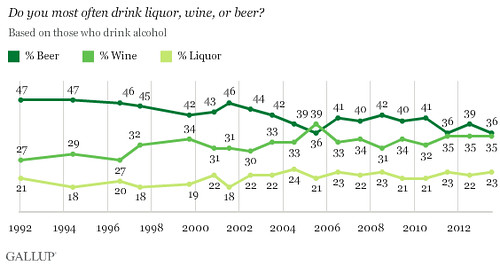
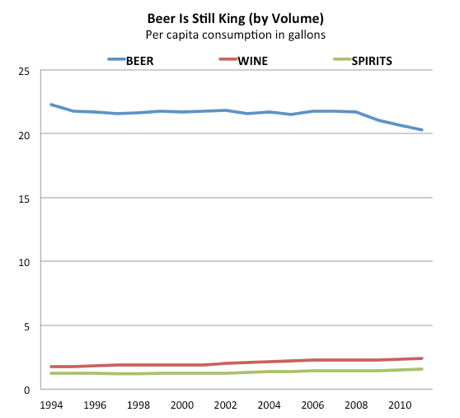
I never quite understand why this is even considered news at all? The L.A. Times is reporting that “Beer beats out wine as Americans’ booze of choice.” Their source for this so-called news is a new Gallup Poll entitled Majority in U.S. Drink Alcohol, Averaging Four Drinks a Week. But that’s not exactly news insofar as it’s been that way since the dawn of time, or thereabouts. The gallup poll is just a survey, of course, and prone to people’s prejudices and perceptions. So when they report that “Beer edges out wine by 39% to 35% as drinkers’ beverage of choice,” it’s hard not to laugh, and even harder to take it seriously. This is what people tell pollsters, and it’s pretty divorced from reality.

If you want a truer, more accurate picture of peoples’ tastes, look at what they buy. The World Health Organization, at their website, gives the following data, collected in 2005 (though it rarely changes by much):

Alcohol Consumption By Type:

  • Beer: 53%
  • Wine: 16%
  • Spirits: 31%

And the Ginley USDC 2010 reports that for 2009, the volume of alcohol sold in the U.S. — 3.3 billion cases — is divided as follows, giving beer an 85 share:

Alcohol Sales By Volume:

  • Beer: 85%
  • Wine: 6%
  • Spirits: 9%

And by retail dollars — a total $1.89 billion — beer still has a commanding lead:

Alcohol Sales By Dollars:

  • Beer: 52%
  • Wine: 14%
  • Spirits: 34%

It doesn’t really matter what people tell the voice on the other end of the phone when Gallup calls asking for peoples’ preferences, this is what they really drink. And while it does fluctuate over time, it’s been roughly like this as long as anybody can remember. Trying to turn it into something newsworthy takes a certain amount of opportunistic forgetfulness, ignorance and a willingness to ignore history.

And while somewhat petty, this also struck me in a way I couldn’t ignore, like someone slapped me. The author of the L.A. Times piece, Tiffany Hsu, refers to men as floozies, when she reports. “Men tend to be the biggest floozies, downing 6.2 drinks a week on average compared with 2.2 drinks for women.” Now I assume she owns a dictionary, and I was pretty sure what the definition of a floozy was. So after checking at least six dictionaries to confirm my suspicions — like it or not — a floozy is always described as a woman. It’s an old, archaic word you rarely hear these days, but it doesn’t mean someone who drinks too much, as she appears to believe.

There’s also other findings in the Gallup Poll results, part of their annual Consumption Habits poll, and some are interesting, if not altogether showing anything particularly novel or new. But toward the end of Gallup’s press release, they make this obnoxious statement in the conclusion, which they title “The Bottom Line.”

With drinking comes overdrinking, and despite possible reluctance by some respondents to admit problems, one in five drinkers — representing 14% of all U.S. adults — say they sometimes drink too much.

Okay, first of all, WTF! “With drinking comes overdrinking?” No it doesn’t. It’s hardly a fait accompli. Even by their own numbers, that’s twisted logic. 86% of the people polled say they don’t drink too much so one clearly does not follow from the other, now does it? And how about this for twisting; “one in five” is 20%, not even close to 14%. You can’t even say that’s rounding, it’s simply inflating the numbers. So much for even the illusion of accuracy.

And just the idea that one alcoholic beverage has “beat” the other is annoying, too. I may prefer beer, but as a cross-drinker — like most people, frankly — I don’t feel that they’re competing in an us vs. them kind of way. It seems only news outlets hungry for headlines pit the two against one another. The first sentence of the article is “Score one for beer.” What was the contest?

There are plenty of positive stories from the world of beer that mainstream media could be covering. As Garrett Oliver recently wrote in Food & Wine magazine, one of the Crimes Against Beer is its continuing lack of media coverage. Oliver writes. “The public is yearning for more knowledge about beer, and nobody’s giving it to them. Even though craft beer is more popular than wine in the US, every major newspaper has a wine column, and almost nobody has a beer column. What’s wrong with this picture?”

What’s wrong, indeed.

UPDATE: An interesting side discussion came out of my linking Garrett Oliver’s piece, Crimes Against Beer, in which he casually mentions that “craft beer is more popular than wine in the US.” I confess that when I first read that, I thought it couldn’t be correct, but since it wasn’t relevant to the broader point I was trying to make in this post, I didn’t dwell on it. Alan, from A Good Beer Blog, however, did, and used it as a launching point for his own post, Is All That Made Up Stuff A Problem With The Dialogue?. He also did a little digging this morning to get at the actual numbers, and between the two of us, here’s what we found. Alan looked at statistics gathered by the Brewers Association and the Wine Institute. He found that in 2011, there were 347 million cases of wine and 11,468,152 barrels of craft beer sold in the U.S. From that he concluded that craft beer volume is roughly one-third of wine. Being lazier than Alan, I looked at retail dollars from the same sources and saw that there was an “estimated $8.7 billion” in craft beer sales and $32.5 billion in U.S. wine sales. That works out to craft beer selling about 26.8% — just over one-quarter — of wine sales. So no matter how you slice it, craft beer sales are nowhere near that of wine sold in America. That number could be slightly higher, as my one quibble with this is that the Brewers Association definition of what it means to be a craft beer is fine for their purposes (which is membership-based) but is not practical in the real world where what makes a beer crafty is, to my mind at least, how it’s made and how it tastes. I do, for example, consider Blue Moon a craft beer. And that would change the numbers to some degree, but I suspect not enough to alter the fact that wine still outsells craft beer, at least for now.

Travel Channel Picks The “Top 7 Beer Destinations”

top-7
Okay, these things are pretty easy to pick apart because no one will ever agree on where the “best” or “top” destinations are for anything, beer or otherwise. I understand that top x lists are very popular. Hell, I enjoy making them myself. They can be fun. But take a look at what the Travel Channel, written by NYC-based travel writer Jimmy Im, has chosen as the Top 7 Beer Destinations.

  1. Asheville, North Carolina
  2. Los Angeles’ Popular Breweries
  3. Virginia’s Lagers and Ales
  4. Toronto’s Craft Breweries
  5. Finger Lakes, New York’s Beer Hub
  6. Atlanta’s New Brews
  7. Traverse City, Emerging Beer Town

So while I’m sure none of the places he’s listed are bad beer destinations, and certainly a few of them deserve to be on this list, I have a hard time accepting these as the very top destinations. The list strikes me as being from someone who’s not really connected to the beer community in any meaningful way. If they had only resisted calling them the top beer destinations and called them instead something like “seven beer destinations worth visiting” that might have worked, but they didn’t. Im specifically states that “these destinations that are fast becoming beer scene kings that offer some of the best suds in town.”

So while I have no problem with Asheville being here, ignoring Philly, Portland (both Oregon and Maine), San Francisco, San Diego, Seattle, Denver, Boston, Chicago and several others makes this list more infamous for what it’s left out than what was chosen. Certainly L.A. is an up and coming beer city, and has made great strides over the last few years, but I’m not sure I’d put it as the second-best beer destination, especially over so many others left out. And he singles out the Strand Brewing Co. and El Segundo Brewing Company as “two of the more popular breweries.” No disrespect to those two breweries — I haven’t been to either of them but I’m sure they’re fine places — but those are not the L.A breweries that are making a splash lately.

Third is the entire state of Virginia, and Im seems to have chosen the Old Dominion State because it’s “so obsessed with its beer culture, it is officially naming the month of August ‘Virginia Craft Brew Month’” and now has 40 breweries. Well July is Oregon Beer Month and February is California Beer Month. Oregon has over 160 breweries and California around 325. So while Virginia is a terrific state and undoubtedly has some fine breweries, if obsession, state beer months and the number of breweries is his criteria, then I’m just not sure Virginia is the right one to choose.

The remaning four, Toronto, the New York Finger Lakes, Atlanta and Traverse City, Michigan, again I’m sure are all fine beer places, but do they deserve to be among the “top 7?” By choosing Toronto, he’s also opened the door to other international beer destinations, of which there are numerous examples, many of which most people would choose over some of the destinations on the Travel Channel’s list. With the last one, Traverse City, Im seems even to have forgotten his own mandate, when he refers to the Michigan town as an “emerging beer town.” It may well be, but shouldn’t we wait until it’s emerged before putting it on the list of the top spots?

So while these things are, as I alluded to, very subjective and depend greatly on how you define the criteria used to rank them, these choices wouldn’t pass muster for even a casual beer lover. It could have been a fun list if they’d only resisted the temptation to declare them the “Top 7 Beer Destinations.” They’re just not.

What We Spend On Alcohol

npr
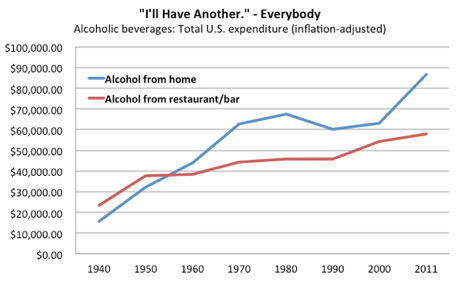
NPR’s Planet Money blog had an interesting report today entitled What America Spends On Booze, breaking it down with some recent data from the U.S. Bureau of Labor Statistics and some great infographics by Lam Thuy Vo of NPR.

npr-booze-spending-1
As you can see, we drink outside our homes almost twice as much as we did three decades ago, though as Lam Thuy Vo notes, that’s a little deceptive at least partly because the price of alcohol in bars and restaurants has skyrocketed while real prices have fallen, when adjusted for inflation.

npr-booze-spending-2
Also, what we spend our alcohol dollars on has likewise shifted over the last thirty years. While beer is still on top, it has slipped a little. Wine is way up, while spirits have significantly dropped.

npr-booze-spending-3

The one thing I’m a bit surprised about is the drop in beer. Since the price of craft beer is generally higher than mainstream adjunct lagers, I would think that the higher dollar rings would cause the figures for beer to rise as the percentage of craft beer has increased. Perhaps the price wars among the big players that have kept the price of beer artificially low for so long have contributed, or at least partially account, for the extended dip.

Betty Crocker Beer?

betty-crocker
Who knew that Betty Crocker even knew about beer? Today, I saw that they posted 35 Beer Terms Every Beer Lover Needs To Know, and it’s not a bad list. Of course, it helps that it was compiled by a Cicerone — Michael Agnew. But beyond that, there’s a whole section on Betty Crocker’s website dedicated to beer entitled Betty’s BrewHouse. Way to stay hip and with it, Betty. I guess she’s not just about cakes and brownies anymore.

Anatomy Of A Propaganda Piece

anatomy-of-murder
With Alcohol Justice promoting it, I just knew there had to be more to the CNN story Movies May Increase Binge Drinking in Teens. The article is based on a study published in the journal Pediatrics with the more benign title Alcohol Consumption in Movies and Adolescent Binge Drinking in 6 European Countries. But either way, Hollywood is, of course, the bogeyman. The study “surveyed 16,500 students ages 10 to 19 from Germany, Iceland, Italy, the Netherlands, Poland and Scotland.”

The students were asked how often they drank five alcoholic beverages during one sitting [interesting a European study has adopted the ridiculous U.S. definition of "binge drinking"], and about the types of movies they watched. Participants were given a list of 50 movies to choose from, which included many top box-office hits from the U.S. The number of drinking scenes was tallied for each movie.

I don’t have the resources to pay to see the whole study, so I don’t know what films are on the list, but the first thing I have to wonder is how many of those films are age-appropriate for 10-year olds? Many Hollywood blockbusters would be at least “PG-13″ (so no 10-12 year olds allowed) or “R” (no 10-17 year olds allowed). Are there many movies with “drinking scenes” that are “G” or that every parent would find appropriate for their 10 through 19 year old child? There’s also no breakdown of how many kids were 10, 15, 19, etc., but I have to believe there’s a vast difference between the effect of watching a film on a ten-year old and a young adult, age 18 or 19. The researchers apparently also considered other so-called “risk factors,” and somehow accounted for each “teen’s levels of rebelliousness or sensation-seeking, peer drinking levels, family drinking patterns, affluence and gender.” That’s a lot of data on 16,500 kids, and almost none of it could be considered the “hard facts” type.

The overall results were that “27% of the sample had consumed >5 drinks on at least 1 occasion in their life.” So roughly 1 out of 4 of the “kids” had consumed 5 drinks at least once, and possibly ONLY once, in their life. And of those 16,500, some of the “kids” were legally allowed to drink 5 beers if they wanted to. In Germany, Italy and the Netherlands, the minimum age for drinking is 16. In Poland and Scotland it’s 18 (though once source I have says it’s 16 in Poland). In Iceland it’s 20. So for at least half the countries where the kids were surveyed, they were permitted to drink at least beer 4 out of the 10 ages of “kids” in the study.

For five-sixths of the countries, at least some of the ages of children surveyed were likewise legally allowed to drink alcohol. Like the age breakdowns, there’s no information available (at least to me) about how many of those surveyed were from which country. Given all the supposed control factors they accounted for, the legal age at which people in the surveyed countries are permitted to drink alcohol seems nakedly absent and, at least to my way of thinking, a rather important omission.

And one last comment about their methodology, such as it was. To determine each film’s — I don’t know, “quotient,” “unworthiness” or whatever — “the number of drinking scenes was tallied for each movie” by the researchers. But is the sheer number of times there’s a scene of people drinking in any way relevant? Is there no context to each scene? Are there not positive and negative ways to portray drinking alcohol? I already know the answer to that one, as obviously the researchers are convinced that ANY depiction of people drinking alcohol they consider wrong, but of course a second’s thought will reveal that to be patently nonsense. Just counting how often people are seen drinking alcohol in a film really tells you nothing about how influential it will be, or indeed, if it registers anything at all. Shown being consumed responsibly, it could just as easily be a positive influence.

Personally, I’m much more concerned about my kids seeing casual violence in films than drinking. But there, as well as in America, research continues to claim that there’s a direct “link between drinking in movies and adolescent alcohol consumption habits.” This latest study’s conclusion likewise claims that the “link between alcohol use in movies and adolescent binge drinking was robust and seems relatively unaffected by cultural contexts.”

But in the last paragraphs — well after most people probably stopped reading — was what I’d been thinking as I read this, that “even though the European study shows a strong association between what is seen on the movie screen and binge drinking, it cannot show cause and effect.” Like Otto Preminger’s Anatomy of a Murder, not everything is as it seems.

And despite the tone of the story up until that point having been confidently certain, as expressed in the headline’s more movies, more binging (or better mo movies, mo binging), it may not be as certain as they would have you believe. Here’s the smoking gun.

It may be that binge drinking teens seek out movies that have alcohol scenes, or it could be that seeing scenes of alcohol use in movies makes them more likely to binge drink. More research is needed to confirm these findings.

I continue to be troubled by the wide range of ages surveyed, because in my experience those are the ages when people change more in a shorter period of time than at any other time in their entire life. The conclusion suggests that to combat this scourge, parents should “go to the movies with [their kids] and discuss what you’re seeing. What you say matters more than what one TV show or one movie says.” In other words, be a parent. So is this a problem of parenting or the movies? Should movies be stripped of adult content because kids might watch them? That does seem to be a common strategy by neo-prohibitionist groups, especially with regard to advertising.

In the end, this seems like yet another study riddled with more questions than answers. But, as is typical, those questions — if the media raises them at all — are buried at the end of the article, well after the average person has given up reading and has moved on to something else. What we’re left with is a “survey” (and we all now how teenagers always tell the truth about what they’re doing) of kids in six varied nations (with different minimum drinking ages) who are of widely different ages (from a childlike ten to a young adult 19) who appear to binge drink more (or at least once) if they see Hollywood blockbuster movies (or it may be teens who drink prefer those movies). Tell me again how exactly that’s news?

Martha Stewart Declares Beer “The New Thing”

martha-stewart
I should confess right up front that I’ve never been a big fan of Martha Stewart. I’m not really sure why, but her advice and how she presents it has always bugged me for some reason. I guess for me, it always comes across as trying to be for everyone, the common people, but can really only be followed by people with a lot of free time and money. Even my wife disagrees with me on this one, so I have to conclude it’s just a weird personal prejudice I have about her.

So Stewart was on the Today show this morning in a segment entitled “Bottoms Up! Martha throws a beer party.” And yes, I know it’s great whenever craft beer gets attention from the mainstream media, but the curmudgeon in me just can’t let it pass uncritically. Here’s how it went down.

Matt Lauer begins the segment by saying that “forget the college keg, beer has grown up. Now it’s all about pairing some cold brew with great snacks.” So those are the two choices of what beer can be, “college keg” or “grown-up?” I know it was just an off-hand remark, but sheesh. And being “grown-up” means pairing it with snacks? It just seems like they could do so much better if they really cared about it.

So in comes Martha Stewart, beer savvy housekeeping diva, and declares “a beer tasting party is like the new thing.” That statement reminds me of the actor or musician who finally has a big hit after toiling in his or her craft for thirty years and is suddenly hailed as an overnight success. For millions of people, beer tasting has been a pretty big deal for quite some time now, but now that it’s reached Martha’s notice it’s “the new thing.”

But before she goes too crazy, Lauer reigns her in, suggesting that she “keep it casual, it doesn’t have to be fancy.” Naturally, you should keep it casual, because it would be absurd to suggest otherwise. Stewart, who usually seems at ease in front of the camera, looked unsure of herself talking about the beer, and even appeared to skirt any questions about it.

After showing off the chalkboard oilcloth table cloth where people can use chalk so they “can write their impressions of the beer” right on the table, Lauer asks her what beers are on the table, and guesses, “light, dark and amber.” Stewart replies “yes,” explaining that it’s because “each have a very specific kind of quality.”

When they moved over to the food, she perked up and appeared much more comfortable and at ease. Her demeanor seemed far more confident, since she was now in her element. But the weird thing is, the food seemed much more fancy, with onion jam made with balsamic vinegar and maple syrup and cocktail meatballs with three kinds of meat. That’s not “keeping it casual” to me. So in keeping things “casual” because it’s beer, the food doesn’t stay casual? That seems weird to me. Beer can’t be fancy, but food almost has to be.

In the four and a half minute piece, no more than a minute was about the beer, and in the end, they never got any more specific about the beers than “light, dark and amber,” and that much only because Matt Lauer asked. No mention of what styles. No mention of what brands, though Greg Koch tweeted that he’d been told the dark beer was Stone Smoked Porter. Maybe they didn’t need to talk about specific brands, but to not even discuss what kinds of beers they were tasting seemed odd, especially since the whole point was supposedly to tell people how to throw “a beer party.” They never adressed how or why any of the food paired with the beer, apart from an offhand remark Martha made that the parsnip chips paired with the dark beer’s “smokey flavors.” In the end, it was really all about the food, and really very little, if anything, was communicated about the beer. Which, if you think about it, is pretty pathetic if, as they’re claiming, “a beer tasting party is like the new thing.” Like, for sure. And I guess it must be; after all I saw Martha Stewart say so on national TV.

Visit msnbc.com for breaking news, world news, and news about the economy

Consumer Reports Rates Mainstream Beers

consumer-reports
At the end of December, Consumer Reports sent out a press release regarding a beer tasting they’d conducted by an unnamed panel of “experts.” Curious as I was, especially as similar tastings have gone somewhat badly in the past, I held off any judgment until the full report became available, which happened January 3 (though it will be in the February print edition). Here’s the salient parts of the press release, Coors Outscores Bud in Consumer Reports’ Taste Tests of Beer:

Looking to enjoy the last weeks of football season with the perfect brew? Coors regular topped Consumer Reports’ recent taste test of beers, blowing away nine brews including Budweiser and Bud Light. Name Tag and Big Flats — store brands from Trader Joe’s and Walgreens respectively — beat out top-sellers Corona Extra and Budweiser. The full report and Ratings of beer is featured in the February issue of Consumer Reports and online at www.ConsumerReports.org.

To determine the best brews, the experts at Consumer Reports conducted blind taste tests of ten lagers — eight top-selling regular and light beers plus two store brands. Although none of the beers were scored a touchdown, Coors, which scored Very Good but not quite high enough to be rated excellent, came close, standing out for balanced flavors with citrus notes and no off-tastes. In addition to earning the highest marks in Consumer Reports’ tests, Coors, available for $6.45 for a six-pack, was deemed a CR Best Buy along with runners-up Name Tag (Trader Joe’s), Big Flats (Walgreens), and Miller High Life.

When it comes to choosing a beer, taste may be the most important factor to consider, but Consumer Reports tests found that consumers should also keep the following in mind:

  • Regular vs. light. Light beer has 20 to 50 less calories per serving due to lower carbs and slightly less alcohol, but no tested light scored high enough to be very good. Miller Lite, which had more flavor and is a little fruiter than most, was best of the bunch; Corona Light, a bitter brew with traces of tinny and sulfury off-notes was the worst.
  • Price vs. taste. Corona Light costs far more than the higher-rated Miller Lite; and Corona Extra costs about twice as much as three better beers – Name Tag, Big Flats and Miller High Life.
  • Cans vs. bottles. Consumer Reports tasted beer from cans which do a better job than bottles in keeping light, beer’s nemesis, from getting inside. Light can react with beer within weeks or even days to create compounds similar to those a skunk uses to defend itself.

The complete beer Ratings are available in the February issue of Consumer Reports and online at www.ConsumerReports.org starting January 3.

So now they’re out, let’s look a little closer.

On the Plus Side:

  • They used cans for their tasting because they “do a better job than bottles in keeping light, beer’s nemesis, from getting inside.”
  • They included private label, contract beers.

To be fair, I had to stretch to find something positive. While there are advantages to cans, a fresh beer in a bottle or can that’s been well-maintained and cared for should be indistinguishable, and since (one hopes) they poured the beer into a glass first it should really make no difference. And then, of course, limiting the tasting to beer in cans arbitrarily leaves out a lot of good beer, though they left out more than enough on their own.

CR-beer-ratings-feb-2012

On the Minus Side:

  • Only 10 Beers (6 regular, 4 low-calorie)? Really, that’s not very representative of the market. Just sticking to the big guys, there’s no MGD or PBR. There’s no Yuengling. And at this point, to ignore the national craft brewers like Sam Adams, Sierra Nevada and New Belgium seems like a big disservice to their readers. Yes, BMC represent the majority of beer sold, but they’re no longer the only game in town. By ignoring other beers, Consumer Reports is in a sense helping to maintain the status quo. In their world, it’s as if the decline of big brands and the rise of craft beer is not even happening.
  • As I said before, this kind of tasting does not help their readers. I don’t know the exact demographics of Consumer Reports subscribers, but it seems fair to say they’re not the sort of people who buy whatever’s cheapest or whatever’s on sale. They care about what they’re buying. They want the best value or the best quality products. Otherwise, why bother reading a publication that’s supposedly dedicated to those principles. So by ignoring quality and choosing beers to rate based purely on popularity, they’re not telling their readers about quality beers that may be more expensive, but given how much more flavorful they are might be the better value. Of anyone, Consumer Reports should know that price is not the primary factor in determining value.
  • Sorry to keep beating a dead horse, but also by not going beyond the three most popular domestic brands and one import, Consumer Reports missed an opportunity to tell their audience looking for guidance why cheaper isn’t always better. That buying full-flavored beers means drinking less, but enjoying it more. Instead, they fell back on what they’ve always done; dumbed it down and went for numbers over intangibles, price over value, the big over the smaller. Pathetic.
  • I don’t know who their so-called “experts” included, but calling Big Flats “very good” in my mind calls into question their credentials or experience. Because Big Flats, when we tried it at one of my Philopotes Society meetings, was all but undrinkable. And not just by me, but by the entire assembled group, who included experienced judges and brewers that I’ve conducted tastings with for years. Swill, to be kind. And my experience with the others makes me wonder by what standards they were judging the beers. At what temperature were they served? Did they discuss the beers and come to a consensus or merely assign them scores and let the numbers speak for themselves. In order to have your results taken seriously, I think at the very least the methodology used has to be disclosed so the rankings can be placed in that context. There’s no key that explains the difference between a “very good” beer and merely a “good” one, or what the others ratings might be, such as below “good” or above “very good.” I could never in good conscience call Corona a “good” beer. And Budweiser may be a well-made beer, but it lacks that key ingredient I look for in my beer: flavor.
  • Indeed, all of the beers on the list are very lightly flavored beers. Most judges, even experienced ones, would have a hard time distinguishing them blind. I realize that sometimes you have to judge such beers, but I think it would be difficult to rate Coors, Name Tag, Big Flats and Miller High Life as being essentially the same, all “very good.” That seems like a stretch. And at any rate, why bother rating beers that are so much alike and whose sales have more to do with advertising and brand loyalty than taste? Is any loyal Bud fan going to be swayed by this tasting and suddenly switch to Coors? Beer just isn’t like a new refrigerator or toaster.
  • I concur that there are no “very good” or above light beers, but I’d have a hard time calling any of these “good,” either. But that’s perhaps a personal preference. I find all low-calorie light beers an abomination, a slap in the face to good beer everywhere. They have no business even existing, let alone being best-sellers. They’re a triumph of advertising and marketing over good sense and taste.

So it seems to me that Consumer Reports, a well-respected publication, really booted this one and did very little, if anything, to educate their readers and give them some truly useful information about what beers to try. From their choices of which beers to rate and the way in which they rated them, there’s very little here to change anyone’s mind about which beer to choose, or indeed how to choose a good beer in the first place.

Brewing Up: WSJ Beer Sales Infographic

wall-street-journal
The Wall Street Journal, through their WSJ News Graphics twitter feed, posted the following graphic on TwitPic, showing yearly beer sales through November 2011.

wsj-brewing-up-2011

This data is from Nielsen and the Brewers Association. A couple of weeks ago I posted similar numbers, but with data from Symphony IRI, in Beer Sales By Style Through Thanksgiving. According to Nielsen’s data, total beer volume was down 2%, while craft beer was up 16.4%. By dollars, total beer was up just 0.3%, while craft beer was up 17.5%. Nice.

New Belgium & The Battle Of The Microbrews

new-belgium-new
Business Week had an interesting article in the beginning of the month on New Belgium Brewing entitled New Belgium and the Battle of the Microbrews. It’s lengthy — at four online pages — and features an in depth interview with Kim Jordan and the future of her brewery and the craft beer industry as a whole. [And thanks to Michael O. for sending me the link.]